
Jerome R. Corsi's Blog, page 39
September 28, 2025
Iran’s revolutionary war on America’s homeland
 Ayatollah Khamenei
Have we arrived at a turning point in America, where our foreign and domestic threats have converged?
It appears that Tehran has spun an intricate strategy to threaten the homeland, Americans as well as values that shape the fabric of our culture.
In 1979 when Ayatollah Khomeini was leading the Islamic revolution in Iran, he vowed to export his revolution abroad. He famously declared the United States and Israel satans and dreamt to conquer Qods (Jerusalem). When Iraq attacked Iran, Khomeini insisted that “The road to Qods passes through Karbala (present day Iraq)” and persisted to stay in the devastating war.
His thirst for vengeance remained unquenchable, to bring so-called American imperialism to its knees. “Even if they build mosques all over America, don’t forget the mantra of ‘death to America,’” he warned as he masterfully commingled propaganda with policy.
Over the past four decades, the Islamic Republic has proven that these fiery words were not spoken in vain, and that there is a strategy behind the slogans. The regime established a network of proxies across the Middle East, established the Quds forces to monitor and target Jews and Israelis around the world, erected hundreds of mosques and Shia institutions globally to promote their ideologies, and fomented a global narrative that holds America responsible for much of the suffering around the world. “Death to America” remains as the most repeated chant in Iran.
Many Americans are uninformed or in denial about such a phenomenon, perceiving the Iranian influence as something limited to the Middle East. But the Islamic Republic’s presence has made its way in the US and is posing an escalated threat, especially after the 2020 killing of Qasem Soleimani. One should remember the Supreme Leader Ali Khamenei’s call to avenge Soleimani’s blood.
The call has been repeated by the regime’s spokespersons around the world. Recently, English-language-Ijtihad Network published the words of senior Iranian Grand Ayatollah Makarem Shirazi as a fatwa on their website: “Any person or regime that threatens the Leader or Shīʻa Marjaʻ is considered as Muḥārib Allāh… It is necessary for all Muslims around the world to make these enemies regret their words and mistakes… a Muslim who abides by his Muslim duty…will be rewarded a fighter in the way of God, God willing.” Like the fatwa against Salman Rushdie, the call for blood of a “Mohareb” lingers as an open call until one day a lone wolf makes it actionable.
It appears that for the Iranian regime’s foot soldiers the “enemies of God” are not only high level politicians like President Trump, Ambassador John Bolton, and former Secretary of State Mike Pompeo who have been facing ongoing threats. The regime is working to control the narrative in the media to favor their agenda by threatening journalists and citizens. The kidnapping and murder plots against Iranian-American journalist Masih Alinejad thankfully were foiled by the FBI and the culprits are awaiting trial in New York City. But France-based journalist Rouhollah Zam and US green card holder Jamshid Sharmahd were kidnapped, tried, tortured and executed in Iran in an attempt to intimidate and silence activists and journalists. Indeed, the problem is much more widespread than most people realize. According to Reporters Without Borders, at least 200 activists and journalists in the US and Europe have reported harassment and threats by elements of the Islamic Republic.
The Regime’s expanding frontier of transnational repression affects more than American journalists and politicians; they are increasingly eroding pillars of American democracy. On one hand they silence reporters, on another hand they abuse the first amendment to spread disinformation on social media platforms, promoting their propaganda and political agenda. There are countless reports of Iranian trolls attacking public figures and silencing online dialogue.
They also have sought to weaken the American electoral process, the hallmark of American democracy, by compromising political candidates in the digital space. Various reports of compromised candidates’ accounts have created confusion and eroded the confidence of the American voters, regardless of whether Iran’s favorite candidate obtained a victory.
On college campuses, the Islamic Republic wields its influence in lectures and libraries, injecting future generations of Americans with ideas that promote Iranian soft power. Until just recently Iranian professors with dubious pasts like Mohammad Jafar Mahallati at Oberlin or Seyed Hossein Mousavian at Princeton remained secure in their positions. Robert Mally, the former US Special Envoy to Iran in the Biden Administration who remains under investigation for mishandling classified material, currently holds a teaching position at Yale where he reportedly invited former Iranian Foreign Minister Javad Zarif as a guest speaker. The former minister of a regime that calls for death to America is given a platform at an elite university by a former US diplomat who is under investigation. Let that sink in.
Iran’s influence on college campuses also appears in more subtle ways. Since October 7, it’s been impossible to miss the student protests on US campuses as young people defending the actions of Hamas or the sinking of civilian ships by Houthi rebels in Yemen. Many might not realize it, but the students celebrating such violative behaviors frequently use materials from Iran-supported sources. Although the ayatollahs in Iran don’t take credit for the students’ violence and protests, they praise them from their platforms.
The presence of such anti-American attitudes and behavior among college-educated is alarming. These future leaders will shape domestic and international policies that will be founded on the principles of American culpability — the fundamental tenet of the Islamic revolution in Iran. Regardless of Iran’s direct interference, their influence is already shaping the future minds.
In 2022, hundreds of children in Houston Texas as a Shia mosque chanted “Hello Commander,” an ode to Iran’s Supreme Leader Khamenei in a gender-segregated procession of girls in hijabs and boys with names of Shia Imams on their headbands. This was not a religious event, it was a political exercise, hailing Khamenei as a leader on American soil. It was largely ignored by the American media.
Perhaps the most striking example of symbolic infiltration came in summer of 2022, when Arbaeen commemorations at the White House featured flags honoring the Shia Imam Hussein. Images went viral across Iranian media, hailed the demonstration as a “triumph” and evidence that the regime’s “dream of turning the White House into a Husseinieh”—a Shia shrine—was one step closer. Once again, American media outlets largely ignored it. Whether the lack of coverage was an oversight or the media’s ignorance of what the scene represented, the ambition of the Islamic Republic could not be more clear.
From assassinations and kidnapping plots to disinformation campaigns, campus influence, and symbolic victories, Iran’s strategy reveals a single truth: America can no longer afford to undermine the multilayered threat of Iran’s revolutionary war on America.
Marjan Keypour is an Iran analyst and an activist for the rights of women and minorities in Iran. She is the founder of StopFemicideIran.
This article was originally published by RealClearDefense and made available via RealClearWire.

How taxes and rules are tarnishing the Golden State
 San Francisco
As it emerges from bankruptcy, Bed, Bath & Beyond has announced plans to open 300 new stores in the next two years – though not a single one will be in California, the state that used to be a center of its operations.
The home goods retailer, which once operated 90 stores in California – the highest number in any state – is seeking a fresh start in business-friendly Southern states. opened in Nashville, Tennessee, in August 2024 under the new name “Bed Bath & Beyond Home.”
“California has created one of the most overregulated, expensive, and risky environments for businesses,” the company’s executive chairman, Marcus Lemonis, said in a statement on X. “It’s a system that makes it harder to employ people, harder to keep doors open, and harder to deliver value to customers.”
In response, California Gov. Gavin Newsom, who seems poised for a presidential run in 2028, mocked Lemonis’ complaints. “After their bankruptcy and closure of every store, like most Americans, we thought Bed, Bath & Beyond no longer existed,” Newsom stated in an X post. “We wish them well in their efforts to become relevant again as they try to open a 2nd store.”
Bed, Bath & Beyond, however, is not an outlier. It’s another sign of the slow withering of one of the most diversified and robust economies in the world, backed by a relatively well-educated workforce drawn to the many cultural and recreational charms of the mountainous, coastal state. But that’s no longer enough for the hundreds of companies that have relocated their headquarters from the Golden State in response to the rising costs of doing business there. Unaffordable housing for employees, the nation’s most generous minimum wage, sky-high taxes and fees, and some of the most stringent regulations in the country are among the reasons Tesla, Charles Schwab, and Chevron – the oil giant that was founded in Los Angeles in 1879 – and hundreds of other companies have moved their operations to other states.
One result: California posted the highest unemployment rate of any state in July. This, in turn, is creating a doom loop crisis for the state’s indebted and fraud-ridden unemployment insurance fund. As employers are expected to shoulder the growing tax burden necessary to cover the fund’s obligations, more businesses are leaving the state altogether and taking jobs with them, compounding the problem.
In January 2024, the state’s nonpartisan Legislative Analyst’s Office (LAO) warned that the unemployment fund’s “benefit payments exceeded state payroll tax contributions by $1.3 billion in 2023,” and the imbalance would balloon “to $1.6 billion annually in 2024 and 2025.”
California is also indebted to the federal government to the tune of $22 billion as a result of a loan Sacramento took out at the start of the COVID-19 pandemic to help the state cover unemployment payments. This problem is exacerbated by mismanagement. Sacramento doled out $55 billion in fraudulent payments and overpayments during the pandemic due to poor oversight, leading the LAO to declare the unemployment insurance fund “structurally insolvent.”
Bleak Reality for Workers
Newsom regularly touts California as the fourth-largest economy in the world due to its gross domestic product (GDP) of $4.1 trillion. But that metric conceals the increasingly bleak reality for the state’s workers. California has seen a 45% increase in unemployment since August 2022, according to the nonpartisan Public Policy Institute of California.
The institute’s economists argue that California’s official 5.5% unemployment rate is likely higher because the Bureau of Labor Statistics (BLS) counts anyone who works one hour per week as employed. The official unemployment rate also “does not capture those Californians who have stopped looking for work because the prospects are slim or those working part time when they’d rather be working full time,” the institute reports.
A far more detailed measure, known as U-6 according to the BLS website, which combines “total unemployed, plus all marginally attached workers,” suggests more than 10% of California’s workers may be unemployed, the highest of any state. The number jumps to 11.5% in Los Angeles County.
Taking the U-6 metric into account, more than 2 million working-age California residents are either unemployed, underemployed, or have simply given up on finding a job. More positions are drying up, too. California lost a total of 54,800 private sector positions in the first three months of 2025, accounting for the largest decline in the nation. An increase in public sector jobs by many debt-burdened local governments and the state helped offset some of the decline. RIGHT?
Experts attribute some job losses to larger economic forces that California has little control over. The state has historically had higher unemployment relative to the national rate due to its younger workforce, which translates to greater job turnover. And the rise of artificial intelligence is hitting Silicon Valley’s workforce particularly hard. An estimated 36,000 Californians who work in the information industry lost their jobs in 2024 alone, partly due to the rise of AI.
Several California-based tech companies, including Google, Meta, and X, cut tens of thousands of positions as the industry increasingly pivoted its focus toward AI to save on labor costs. AI replaced 30% to 50% of the workers at San Francisco-based Salesforce, according to CEO Marc Benioff, and the company cut 1,000 jobs in software engineering and customer support this year alone. Microsoft, which has campuses in the Bay Area, is reporting similar trends, with AI now writing 30% of the company’s code. Nationally, an estimated 10,000 jobs were lost to AI within the first seven months of 2025, according to a recent report from Challenger, Gray & Christmas.
President Trump’s trade war with China is adding to California’s employment woes. The state is the biggest U.S. importer of Chinese goods, forcing its companies and consumers to absorb a 30% tariff on most goods. As a big agricultural and technology exporter to China, California businesses also face a reduction in revenue from the tariffs imposed by the world’s second-largest economy.
As the global trade war also poses risks to the broader U.S. economy, the outlook for California only darkens, with economists expecting the state’s job market to worsen in the coming months.
Policies Lead to Job Cuts
Economists and business executives such as Lemonis, however, often cite state and local policies and the high cost of doing business as the catalysts for job cuts, business closures, or relocations to other parts of the country. At 8.84%, California has one of the highest corporate tax rates in the nation, and it’s applied uniformly and without graduated brackets. Every dollar of a company’s taxable income is subject to the same tax rate.
The individual income tax rate for S corporations is at an even higher 13.3%. California also requires corporations to pay an annual franchise tax of $800, in addition to a sales and use tax of 7.25%.
California’s lawmakers are now offering special tax incentives to entice production companies to bring film and television jobs back to Hollywood. The BLS reported that the state lost around 40,000 jobs in motion picture and video production in 2024, and entertainment unions report that 40% to 50% of their members are jobless. The jury is still out on whether expanded tax credits are having any impact yet.
Some economists also argue that employers are leaving the state as a result of California’s wage requirements. Employment at limited-service restaurants fell by 3.1% one year after California raised hourly wages for fast food workers from $16.50 to $20 per hour in April 2024, according to the St. Louis Federal Reserve.
Underscoring the doom loop narrative, not all of the 22,600 lost jobs were strictly due to the new policy. Michael Reich, chair of the Center on Wage and Employment Dynamics at the University of California, Berkeley, told CNN that his own analysis pointed to California’s population loss, slower economic growth, and rising fast food prices.
Minimum Wage Woes
Selvin Martinez, who works at a Wienerschnitzel in San Jose, told CNN that while he appreciates the pay bump to $20 an hour, the restaurant is now scheduling him to work fewer hours per week. The same goes for Edgar Recinos, who works at a Los Angeles Wingstop and lobbies his employer for more scheduled hours.
Despite this track record, the state is making it more expensive to hire people in the massive tourism and hospitality industry, which has never fully recovered from COVID-era shutdowns. A new ordinance in Los Angeles increases wages for hotel and airport workers in steps from $25 an hour in July 2026 to $30 in July 2028, two weeks before the Olympic Games begin in L.A.
The Los Angeles Alliance for Tourism, Jobs and Progress attempted to repeal the ordinance through a ballot initiative. “It’s clear that the ordinance will jeopardize jobs, push hotels to the brink of closure, severely cut tax revenue the city desperately needs,” the group said, adding that it will “leave the city grossly unprepared for the 2028 Olympic Games.”
Business owners say crime is yet another factor leading to closures, particularly in Los Angeles, Oakland, and downtown San Francisco. American Eagle closed its flagship store in San Francisco’s Westfield Mall, citing more than 100 “significant security incidents” involving firearms and threatening behavior between 2020 and 2023 that impacted customers and employees. Whole Foods and Nordstrom have also exited the city center, partly because of theft and safety issues.
In Oakland, fast-food franchisees have locked dining rooms, keeping only drive-thru windows open after staff were threatened or assaulted. In-N-Out Burger announced it was leaving Oakland entirely and closed its store permanently in March 2024, marking the first such closure in the chain’s 75-year history. The company blamed persistent car break-ins, robberies, and theft.
Many critics blame these problems on what they consider soft-on-crime policies implemented by progressive district attorneys and state leaders.
Unemployment Insurance Strained
Even before COVID-related layoffs took a financial toll on California’s unemployment insurance program, its fund was already operating at a deficit after being underfunded for years.
The state’s LOA had warned about the problem in a report dating back to 2016. Last December, the office projected that the state unemployment program would operate at a $2 billion deficit each year from 2025 to 2030.
Although “the state has, in the past, failed to build robust reserves during periods of economic growth, it has never before run persistent deficits during one of these periods,” the LAO report stated. It proposes either raising payroll taxes, cutting unemployment benefits, or a combination of both.
The unemployment program is funded by employers paying an average of 3.5% in payroll taxes on the first $7,000 of each employee’s annual wages. While most states have updated their taxable wage base to keep their unemployment programs solvent, California hasn’t updated its since 1983. The LAO recommends increasing the taxable base from $7,000 to $46,800.
“The state has had multiple opportunities to fix this system, and each time, it’s chosen to kick the can down the road,” said Rob Lapsley, president of the California Business Roundtable.
The state’s need for $18.5 billion in federal loans to cover the program’s obligations during the pandemic turned out to be a costly move. Higher interest rates over the last several years mean that California now owes the federal government more than $22.7 billion, representing the largest unemployment loan balance in the country.
Now the burden of that loan shifts to employers since the state failed to repay the debt within two years. This year, all businesses began paying a fee of $21 per employee, regardless of whether they work full- or part-time, and the fee will significantly increase until the state pays off its federal debt.
“The state has never paid any money towards the principal, nor has it created any sort of credit or benefit for smaller businesses facing this significant federal tax hike,” said McGeorge School of Law Professor Chris Micheli.
Michael Bernick, former director of the Employment Development Department, warned that California’s leaders are repeating the same mistakes. “We have a system that is guaranteed to collapse in every downturn,” he said. “Without serious reforms, California will continue to borrow billions, pass the costs to employers, and weaken confidence in state governance.”
With business taxes likely to keep rising, prompting more jobs to leave the state, California is facing one of its toughest economic challenges in many years. Newsom terms out in 2027, and a new business-friendly governor in a state that has elected many of them could be part of its rebound. But in the short term, with liberal majorities in control of state politics, it’s hard to see any viable route to restoring the California Dream.
This article was originally published by RealClearInvestigations and made available via RealClearWire.Next National Security Strategy risks misreading history again
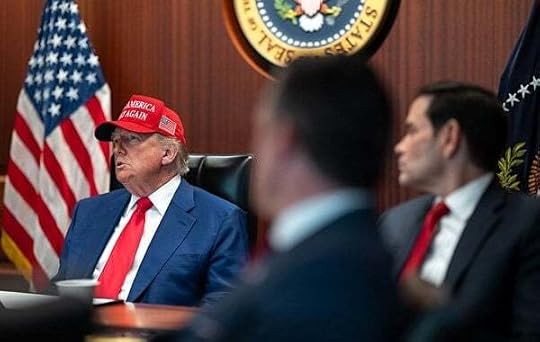 President Donald Trump and his national security team meet in the Situation Room of the White House, Saturday, June 21, 2025. (Official White House photo by Daniel Torok)
At the twilight of globalization, as the next U.S. National Security Strategy is about to be finalized, America’s current and future strategic choices are being impacted by a misreading of the drivers of state behavior, as well as the degree to which Washington can shape the global systemic transformation lurking over the horizon. The second Trump administration’s policy decisions that are reshaping the international security environment are not simply, as POTUS’s critics imply, the product of a mercurial presidency. Rather, they are a consistent manifestation of the US policy community’s shared world view, steeped in a historically derived though ultimately flawed diagnosis of what drives great power competition. We seem to have consensus that the prospect of the United States’ relative decline as a great power stems from changes in global power distribution, but what’s missing is a clear recognition that we are locked into an ideological framing of our own making that constrains how we approach the increasingly unstable world. Simply put, we are continuing to misread history.
Three decades of unprecedented U.S. power in the wake of our victory in the Cold War have conditioned America’s policy elites to assume that the international system will ultimately always bend to our will. Drawing on abundant military stocks accumulated during the Cold War, after 1991 successive presidents saw their wins generously rewarded while their policy missteps routinely carried but a marginal penalty. This state of affairs quickly gave rise to a sense of ideological certitude bordering geostrategic arrogance, one that still infuses the nation’s policy debates. The Washington policy community continues to operate on the assumption that the U.S. retains the ability to impose its priorities on other principal players without first incurring additional costs, even though Russia and China have demonstrated repeatedly that the enemy gets a voice when it comes to shaping regional balances close to home and beyond. We believe that we have agency in world affairs, while we remain unwilling to pay for properly resourcing our military and our defense industry, as though we were still living in the post-Cold War world.
The Trump administration’s policy choices, especially in its relations with European NATO allies and of late with India, have accelerated the process of a systemic transformation toward what Beijing and Moscow like to call the “multipolarization” of the world. We have yet to acknowledge that this transformation will inevitably impact America’s ability to protect its national interests. A case in point: Repeated efforts to reset the United States’ relations with Russia to woo it away from China’s embrace have failed, and yet the administration keeps returning to this formula, seemingly convinced that this time the result will be different. And so, instead of communicating to the nation that to retain its competitive edge the United States will need to commit significant additional resources to rebuild its military and its defense industry, our defense planners stipulate that this can be achieved through a strategic sleight of hand, whether through a pivot from Europe to Asia, or perhaps even away from both theaters.
We seem to believe that through this reprioritization and selective focus – with its Kissingerian echoes of a latter-day Concert of Europe – the U.S. will preserve the latitude to shape regional power balances at an acceptable cost. This is a misreading of history, for if the calculated diplomacy of the 19th century offers any lessons in this regard, such balancing can take place not before but after a major system transforming war. Absent a great power conflict, it has never served as a negotiated substitution that preserves the equities of a status quo power or reigns in the geostrategic assertiveness of a country surging to the top of the power pyramid.
For three decades, the U.S. policy community has misread the evolution of the international system, prioritizing normative concepts over hard power indices. The initial hubris that accompanied the “end of history” and alleged “unipolar moment” drove the country to expend its national power in a most profligate fashion in secondary theaters, while China and Russia armed at speed and scale. Today the Trump administration is trying to affect a sweeping policy realignment away from the normative institutionally based policy framework toward one grounded in geopolitics. However, it is doing so at a time when, absent a generational reinvestment in defense, America’s military power position vis-à-vis China and Russia has already declined. And so, in the lead up to the publication of the administration’s new National Security Strategy, the policy debate continues to oscillate between, on the one hand, the “Asia first” school and, on the other, growing talk of a more wide-ranging withdrawal, one which would return the United States to a defensive position in the Western Hemisphere and prioritize continental territorial defense. Both courses of action in effect imply the country’s declining ability to project power, to secure access to the world’s resources, and to deter threats away from the homeland. This is the wrong lesson to learn from history, for the United States is a quintessentially maritime power, and the preconditions for our security and prosperity are antithetical to those that shape the strategic thought of a land-locked state.
Before the next National Security Strategy is adopted, our policy community owes Congress and the public a frank appraisal of the consequences of continuing along this trajectory. We need a national conversation about what these proposed paths would yield in terms of the United States’ power position relative to our adversaries. Only then can the American people decide if we are willing to undertake the costly effort to rearm at scale and bring to bear our abundant latent resources to shore up our sovereign ability to guard vital national security interests. Or determine that at this moment in our history a strategic retreat is the preferred path forward.
Andrew A. Michta is Professor of Strategic Studies at the Hamilton School for Classical and Civic Education at the University of Florida. Views expressed here are his own.
This article was originally published by RealClearDefense and made available via RealClearWire.Communist China’s 80th anniversary victory parade: Nuclear intimidation

In September 2025, Communist China celebrated the Chinese victory in World II, a war that Mao’s Communist forces largely did not fight by avoiding combat against the Japanese. In honor of this “heroic victory,” China staged the largest ever and well-choreographed military parade that featured Chinese strategic nuclear weapons as well as advanced technology weapons of other types (e.g., laser weapons, unmanned combat aircraft, electronic warfare systems and hypersonic missiles.) The parade demonstrated that China is “building a full-spectrum arsenal.” China’s President Xi Jinping, flanked by Russia’s Vladimir Putin and North Korea’s Kim Jong-Un (perhaps the three most dangerous men in the world), declared that China was “never intimidated by any bullies” and stands between “good and evil, light and darkness, progress and reaction.” Not exactly an accurate description of one of the world’s worst dictatorships.
President Trump characterized Xi, Putin and Kim as “conspiring against” the United States. He was correct. Xi’s remarks and the parade were an exercise in intimidation with great emphasis on China’s nuclear capability, a significant shift away from the historical Chinese nuclear secrecy. Four Chinese strategic nuclear missiles, the DF-61 ICBM, the DF-31BJ ICBM, the JL-3 SLBM and the JL-1 air-launched ballistic missile were officially displayed to the public for the first time. Also displayed for the first time was the nuclear-capable DF-26 IRBM, the “Guam Killer.”
China’s English language propaganda mouthpiece Global Times stated that the massive Chinese DF-5C ICBM, displayed during the parade, had a range of 20,000-km and that it carried nuclear and conventional multiple independently targetable warheads. The DF-5C can reportedly carry 12 nuclear warheads (the Pentagon’s China military power report says the DF-5 can carry five.) In effect, it was advertising a nuclear threat to the entire world. The message was “do not resist Chinese aggression” or “aid its victims.” Xi Jinping has ordered that the Chinese military be prepared to invade Taiwan by 2027. The unprecedented post-Cold War Chinese nuclear buildup appears directly connected to this objective.
The full Chinese nuclear Triad was displayed for the first time during the parade. It showcased the large new DF-61 ICBM. This missile came as a surprise. According to noted China expert Rick Fisher, the new DF-61 ICBM uses the same mobile launcher as the powerful DF-41 ICBM, underscoring that “…this new missile has new capabilities, perhaps more than 10 multiple warheads, or new multiple hypersonic glide vehicle warheads, again perhaps intended to overcome future U.S. Golden Dome defenses.” Janes’s credits the DF-61 with up to 12 nuclear warheads.
Fisher also noted that the newly displayed version of the DF-31 ICBM “…is interesting” because the “… DF-31BJ comes in a self-contained cold-launch tube, meaning the tubes can be stored, to be available for rapid reloading, and the silos do not have to be stressed for hot launches, making them cheaper and easier to replicate if required.” An analysis by the Federation of American Scientists also concluded that the DF-31BJ was a silo-based ICBM. According to the FAS analysis:
Based on new information from the parade footage, it seems China now has nine different versions of land-based ICBMs: DF-5A, DF-5B, DF-5C, DF-27 (not yet displayed in public), DF-31A, DF-31AG, DF-31BJ, DF-41, and DF-61. Interestingly, rather than necessarily representing incremental upgrades, many of the missiles are quite distinct from one another: five are road-mobile, and four are silo-based; three are liquid-fueled, four are solid-fueled, and two are unconfirmed; at least one carries MIRVs, at least one carries an HGV, at least one carries a multi-megaton warhead, and one may even carry a conventional warhead .
Actually, in addition to the DF-61, according to U.S. government publications, China has three other MIRVed ICBMs and SLBMs (the DF-41, the DF-31, and the JL-3). According to Joseph Trevithick, Deputy Editor of The War Zone, “The newly emerged DF-61 could still be just one of several all-new ICBM designs China has been working on.” STRATCOM Commander General Anthony Cotton reportedly stated in a closed Congressional hearing that China was developing a “new generation of mobile intercontinental ballistic missiles.”
In addition to the DF-61, China is reported to have under development one or two other large ICBMs, the DF-45 and the DF-51, which Fisher reports are “clearly intended to outperform the DF-41.” It is unclear whether the DF-45 and DF-51 are one or two systems. The DF-41 is widely reported to be a ten warhead missile. (The Pentagon says it carries no more than three.) In 2017, the People’s Liberation Army Rocket Force indicated that the DF-41 ICBM had a 14,000-km range and could carry: 1) one 1,600-kg warhead of 5.5 megatons; 2) six 250-kg warheads of 650 kilotons; or 3) 10 165-kg warheads of 150 kilotons. This presentation has been almost completely ignored in the West. By comparison, the U.S. has one ICBM, the small 1970 vintage three warhead Minuteman III, reduced to one warhead by the New START Treaty, and which will be replaced by a single ICBM type, the Sentinel. which has not yet been flight tested and is experiencing major delays.
It has been suggested that the DF-61 is related to the previous reports concerning the DF-45 and DF-51. The DF-61 is a road-mobile ICBM. If the reported launch-weights of the DF-45 and the DF-51 are accurate, there is clearly no connection to the DF-61 because they are too heavy to be road-mobile ICBMs.
A Center for Strategic and International Studies (CSIS) publication by Joseph Rodgers and Heather Williams noted that, “The U.S. Is Losing the Arms Race.” (Emphasis in the original.) The reason is simple. U.S. strategic nuclear modernization programs are not remotely comparable in scope to those of China and Russia. Both have multiple modernization programs for every leg of their nuclear Triads. Rogers and Williams also note that, “China’s parade is particularly notable as it suggests an intent to continue expanding [its nuclear force]- it showcased a lot of nuclear platforms for only a 600-warhead arsenal.” The reason for this is that the 600+ number, the Pentagon estimate for Chinese operational nuclear weapons in mid-2024, is unreasonably low.
Unlike the United States whose strategic nuclear missiles are frozen with Cold War-level accuracy with two of the three best U.S. Cold War-era missiles, the Peacekeeper ICBM and the Advanced Cruise Missile, eliminated without replacement, China has introduced precision accuracy and low-yield nuclear warheads. The implications of these developments and the high throw-weight of Chinese theater range missiles for the possible size of the Chinese nuclear arsenal have been completely ignored by the Pentagon.The annual Department of Defense (DoD) (now the Department of War) reports on Chinese military power are the most authoritative publicly available publications, but they have a poor track record on Chinese nuclear weapons. Concerning the DoD’s estimate of 1,500 Chinese nuclear weapons in 2035, Senator Tom Cotton has written that “…given the Pentagon’s consistent underestimates in the past, it’s fair to assume that China will move even faster.” Prior to 2020, the DoD’s China military reports provided little indication that China was planning a major nuclear weapons buildup. When the first Trump Administration did its Nuclear Posture Review in 2018, China was assessed (probably inaccurately) to have only 200 nuclear weapons. Yet, there was significant open source evidence of Chinese plans to expand greatly its nuclear capability even 15-20 years ago.
For the December 2024 DoD estimate of Chinese nuclear weapons to be correct all of the following assumptions would have to be true:
All MIRVed Chinese missiles are deployed with one warhead.China is building ICBM launchers faster than it is building missiles and building missiles faster than warheads.Less capable DF-31 ICBMs are being deployed in China’s new silos.China has only a handful of air-delivered nuclear warheads, no nuclear-capable cruise missiles and no nuclear-capable H-6K bombers.China lacks nuclear-capable short-range ballistic missiles.China has only a small number of non-strategic nuclear warheads.The probability that all of these necessary assumptions are true is essentially zero. It would be idiotic for the Chinese to pay for the development of powerful MIRVed strategic missiles and then deploy them with only a single nuclear warhead. Before undertaking the very expensive programs for nuclear delivery systems force expansion, China would certainly have initiated programs to increase its nuclear weapons production capability if this was a problem. China has enough fissile material to have deployed far more than 600+ warheads by mid-2024. It is currently producing more fissile material. The DoD’s estimate of 1,000 plus Chinese nuclear warheads for 2030 (first made in 2022) mathematically must assume a decline in Chinese nuclear warhead production rates to 70 warheads per year. This has not happened.
There is substantial evidence of Chinese possession of nuclear cruise missiles. A declassified 1995 CIA intelligence report stated that a 1995 Chinese nuclear test may have been aimed at developing “…a cruise missile warhead and may involve safety upgrades to existing systems.” In 2009, the Air Force’s National Air and Intelligence Center said the DH-10 (the ground- and sea-launched CJ-20 air-launched cruise missile) was nuclear-capable. Since 2012, three and four star generals while on active duty stated that China has nuclear cruise missiles. The 2019 DoD China military power report noted that, “Since at least 2016, Chinese media have been referring to the H-6K as a dual nuclear-conventional bomber.” A 2018 DoD Fact Sheet indicated that China had nuclear-capable cruise missiles. The 2019 DoD report pointed out that, “A number of press sources have also reported China [has] nuclear cruise missiles.” In 2021, then-Vice Chairman of the Joint Chiefs of Staff General John Hyten said they were rapidly building them. A 2023 Japanese White Paper indicated China had nuclear-capable cruise missiles. A 2024 report of the International Institute for Strategy Studies stated that China had nuclear-capable long-range cruise missiles. The assumption of no Chinese nuclear-capable cruise missiles results in zero nuclear warheads being counted on China’s numerous H-6K bombers.
The Pentagon is likely to be considerably underestimating the number of Chinese non-strategic or tactical nuclear weapons. Captain (ret.) James E. Fanell, former Chief of United States Pacific Command Intelligence, has stated that China has more non-strategic nuclear weapons than the United States. In 2023, General Cotton stated that China had 1,000 dual-capable medium- and intermediate-range ballistic missiles. Other sources credit China with nuclear-capable cruise missiles, short-range ballistic missiles, and gravity bombs. Many of the missiles frequently described in the Western press as conventional are likely dual-capable (nuclear and conventional).
The Pentagon projection of a buildup of China’s nuclear warheads to 1,000+ operational warheads in 2030 and 1,500 in 2035 (in the 2022 DoD China military report) is likely to be only a fraction of actual Chinese capabilities. An estimate of the number of Chinese nuclear warheads in 2035 has not been included in the last two DoD China military power reports. These omissions were not explained. The Biden Administration apparently did not want to admit that even with their low estimates of the growth in Chinese nuclear warheads, China would achieve numerical nuclear superiority by 2035. In reality, this is likely to be accomplished well before then. China already has a nuclear-capable force with sufficient potential to carry thousands of warheads. It will grow. The Defense Intelligence Agency (DIA) projects a growth in Chinese ICBMs from 480 to 700 and Chinese SLBMs from 72 to “at least 132” by 2035. There will also be massive increases in the number of Chinese hypersonic missiles and land-attack cruises missiles, some percentage of which will be nuclear-armed. (For some unexplained reason, the report does not project the growth in the large Chinese theater ballistic missile force.) China will also expand its nuclear-capable bomber force. China is also projected to deploy 60 Fractional Orbital Bombs by 2035.
The dramatic projected growth in the number of Chinese nuclear delivery vehicles provides additional evidence that the Pentagon’s projected growth in the number of Chinese nuclear warheads is unreasonably low. With the number of Chinese strategic nuclear delivery vehicles assessed by DIA for 2035 (which does not even count Chinese bombers), the 1,500 nuclear warheads estimated by DoD for 2035 must assume both many single warhead missiles and only a small numbers of warheads on the MIRVed missiles. Even the DIA’s projected number of Russian ICBMs and SLBMs in 2035 will have dramatically more nuclear warhead delivery potential than the DoD’s estimate for the number of Chinese nuclear weapons in 2035. Moreover, this does not even count Chinese non-strategic nuclear weapons. These ominous developments must be addressed sooner rather than later.
Mark B. Schneider is a Senior Analyst with the National Institute for Public Policy. Dr. Schneider previously served in DoD as Principal Director for Forces Policy, Principal Director for Strategic Defense, Space and Verification Policy, Director for Strategic Arms Control Policy and Representative of the Secretary of Defense to the Nuclear Arms Control Implementation Commission. He also served in the senior Foreign Service as a Member of the State Department Policy Planning Staff.
Notes:
Senator Tom Cotton, Seven Things You Can’t Say About China, (New York: HarberCollins Publishers, 2025), p. 52.
This article was originally published by RealClearDefense and made available via RealClearWire.Priscilla Presley: Elvis asked if I wanted to abort Lisa Marie

 Elvis Presley of Memphis, Tennessee, joined the U.S. Army on March 24, 1958. During his active military career, Presley served as a member of two different armor battalions. Between March 28 and Sept. 17, 1958, he belonged to Company A, 2d Medium Tank Battalion, 37th Armor, stationed at Fort Hood, Texas. Sgt. Presley’s overseas service took place in Germany from Oct. 1, 1958, until March 2, 1960, as a member of the 1st Medium Tank Battalion, 32d Armor. (U.S. Army photo)
In her new book, Elvis Presley’s ex-wife, Priscilla Presley, revealed that when she became pregnant with their daughter Lisa Marie on their honeymoon, they felt unprepared for parenthood — and Elvis said he would “support” any choice she wanted to make.
Key Takeaways:
Priscilla Presley learned she was pregnant a few weeks after marrying Elvis in 1967.In her new memoir, Presley explains that neither she nor Elvis felt ready to have a baby so soon, and that Elvis told her he would support her if she wanted an abortion.The thought of having an abortion was so upsetting to Priscilla that she cried, and exclaimed, “This is our baby!”Abortion had not been widely legalized, but Presley’s account makes it clear that people knew they could obtain clandestine illegal abortions.The Details:
In her new memoir, “Softly As I Leave You: Life After Elvis,” Priscilla discussed her relationship with Elvis, whom she married when she was 21 years old. Soon after their wedding, she found out she was pregnant with the couple’s only child, Lisa Marie.
Presley, now 80, said the pregnancy came too soon into their marriage, and the revelation of their relationship, which had been kept secret until then.
“Our wedding had meant I could finally come out in the open,” she wrote. “I was so excited. But when I got pregnant on my wedding night, those dreams fell apart.”
She explained that neither she nor Elvis felt ready to be a parent.
“For weeks, Elvis and I worried in silence about what was to come,” she said. “At my lowest point, I even wondered how I’d feel if I had an accident and miscarried. I felt so guilty that I was even having these thoughts.”
She said Elvis saw her emotional turmoil, which can be very common during pregnancy, especially in the first few weeks.
“[Elvis] looked at me one day and asked if I wanted to have an abortion,” wrote Priscilla. “He told me he’d support whatever I wanted.”
Priscilla said this question sparked something inside of her. “The enormity of it hit me head-on, and I began to cry. I told him, ‘No! We can’t do that. This is our baby!”
They happily welcomed their daughter in 1968, exactly nine months to the day of their wedding. They ultimately divorced in 1973. Lisa Marie, who died in 2023 at age 54, was the couple’s only child. Lisa Marie had four children of her own — Riley and Benjamin Keough, and twins Harper and Finley Lockwood (three daughters and a son). Lisa Marie’s oldest daughter, Riley, now has two children of her own — making Priscilla Presley a great grandmother.
These generations would not exist if Presley had chosen to end Lisa Marie’s life by abortion.
Even decades later, Presley has not forgotten the moment of shock when her husband was willing to support the death of their daughter in a misguided attempt to relieve the temporary panic and uncertainty that they felt.
Why It Matters:
The couple would most likely have sought an illegal abortion had they decided to consider it, as abortion was not widely legalized at the time — yet it’s clear that people knew where to get clandestine abortions if they were willing to break the law. As previously reported by Live Action News (emphasis added):
A Washington Post fact check cited… former Planned Parenthood medical director Mary Steichen Calderone, who said the maternal mortality rate related to abortion had been declining due to antibiotics, and that 90% of illegal abortions were already being committed by trained physicians.
Abortion has been heavily marketed as a women’s issue. And yet, many abusive men who have wanted their children aborted against the mothers’ wishes have resorted to violence and homicide. Others have chosen to adopt positions of indifference or powerlessness, believing the idea that they had no right to any opinion in the matter.
Both of these attitudes harm women and babies.
When men say they will support whatever “choice” the woman makes, it gives the appearance that the men — the fathers of these children and partners of these women — simply don’t care. It puts the full weight of the abortion decision solely on the women, leaving them in even deeper emotional turmoil.
A Lifeway Research survey found that 75% of men whose babies were aborted were asked by their partners what their feelings were about the abortion. Forty two percent (42%) of men whose partners had an abortion said they encouraged their partners to do so, with 12% saying they strongly urged them to have the abortion. More than a quarter (27%) said they advised their partners not to have an abortion, including eight percent (8%) who strongly urged them not to. The same survey found that 31% of men gave no advice, thinking it was a choice that should be left only to the woman.
The Bottom Line:
Men and women conceive children together; both are impacted by a choice of death for their child. A man’s abandonment of a woman and her child is an injustice.
[Editor’s note: This story originally was published by Live Action News.]
Nonprofit asks feds to investigate schools’ ‘gender-affirming care’ practices

A conservative nonprofit asked the Federal Trade Commission Friday to look into schools’ use of federal funding to encourage “gender-affirming care” for kids.
Advancing American Freedom asked the FTC to investigate what it calls schools’ fraudulent practices around gender-affirming care, including their alleged use of misinformation and deception to encourage treatments that cause “life-long harm.”
“Children should not be pawns in the culture war,” the nonprofit wrote in a comment obtained by The Daily Signal. “We hope the FTC will protect them from fraudulent GAC [gender-affirming care] practices.”
Advancing American Freedom’s comment comes in response to a 60-day public inquiry the FTC launched in July to “better understand how consumers may have been exposed to false or unsupported claims about ‘gender-affirming care,’ especially as it relates to minors.”
In its comment, the organization pointed to at least 12 instances of “secret social transition” cases in which schools actively deceived parents while facilitating children’s “transition” to act and/or appear as a different sex.
The group also encouraged the FTC to investigate school clubs that encourage gender-affirming care to discover where they receive their information on gender dysphoria and what resources they recommend to students.
Advancing American Freedom pointed to the World Professional Association for Transgender Health, a “leading voice for gender health” that admitted its members “perform procedures without informed consent and blatantly misinform their audience of the long-term effects of transitioning.”
“If schools are directing children into WPATH programs or to WPATH-aligned therapists, the schools are stained with the same fraudulent behavior,” the group wrote.
Advancing American Freedom specifically highlighted nine school districts currently facing lawsuits from parents for their actions around gender-affirming care.
“We hope … [this list of school districts] will provide a rich starting point for an investigation,” the group wrote. “We know these districts have acted illegally, and these cases readily provide facts, contacts, and leads.”
The FTC’s public comment portal closes Friday.
[Editor’s note: This story originally was published by The Daily Signal.]
2 European nations give military escort to Greta Thunberg’s Gaza-bound boats


Greta Thunberg statueItaly and Spain have deployed naval assets to escort a Gaza-bound flotilla hauling international activists including Greta Thunberg, the Wall Street Journal reported Friday.
The Global Sumud Flotilla, which contains a few dozen boats with a few hundred total passengers, will now receive protection from both the Spanish Navy and Italian Navy while attempting to make their way to Gazan shores, according to the WSJ. The move comes after unidentified drones allegedly blew up near the boats on Wednesday, which reportedly damaged some of the fleet.
Israel has issued multiple warnings to the flotilla to turn back, but so far the group has not complied, the WSJ reported.
“We are sailing peacefully in international waters, we are not carrying weapons, we are carrying food, baby formula, medical supplies and water, and we are sailing to break Israel’s illegal and inhumane siege,” Thunberg said during a livestream aboard the flotilla.
Spain and Italy have both said they would dispatch rescue vessels should they be necessary, according to the WSJ. The ships are projected to reach Gaza next week, where they would likely face Israeli interdiction.
The fleet is aiming to break Israel’s blockade of the Gaza Strip, but has so far been unsuccessful. Greta’s trip to the Gaza Strip in June resulted in the Israel Defense Forces (IDF) interdicting her boat and detaining her in Israel, and deporting her.
The Global Sumud Flotilla, the Italian Foreign Ministry and the Spanish External Affairs Ministry did not immediately respond to the Daily Caller News Foundation’s request for comment.
Content created by The Daily Caller News Foundation is available without charge to any eligible news publisher that can provide a large audience. For licensing opportunities of our original content, please contact licensing@dailycallernewsfoundation.org.
Dems reportedly planning luxury getaway to 5-star resort despite looming gov’t shutdown

The Senate Democrats’ campaign arm is planning a two-day getaway at a five-star resort in the heart of California’s wine country in early October — at the same time the country may be in the midst of a government shutdown — according to an invitation obtained by Politico’s “Playbook.”
The Democratic Senatorial Campaign Committee (DSCC) is hosting its Napa Retreat from Oct. 13-14 at Hotel Yountville in Napa County, Politico reported Saturday. Democratic New York Sen. Kirsten Gillibrand, who has chaired the DSCC since January, circulated an invitation to the event which lists her, Democratic Maryland Sen. Angela Alsobrooks and other unidentified “[m]embers of the Democratic Caucus” as attendees, according to the outlet.
Democratic Michigan Rep. Haley Stevens — who is running in a hotly-contested 2026 primary for Michigan’s open Senate seat — is also expected to make an appearance at the Napa retreat, Politico reported, citing an anonymous Democrat who was briefed on the gathering. The DSCC has yet to publicly endorse a candidate in the highly competitive race between Stevens, Democratic Michigan Sen. Mallory McMorrow, and former public health official Abdul El-Sayed.
The event will potentially coincide with a government shutdown, which multiple Democratic senators in recent months have threatened to back in opposition to President Donald Trump. A shutdown will occur if Congress does not pass an agreement to fund the government by the end of Sept. 30.
Sen. Kirsten Gillibrand (D-N.Y.) has circulated an invitation obtained by Playbook for a “Napa Retreat” for the DSCC on Oct. 13 and 14. Should the government shut down next week, the retreat could fall on what might be day 12 of a shutdown. @playbookdc
— Senator John Cornyn (@JohnCornyn) September 27, 2025
The majority of the retreat is slated to take place at the hotel, with the noted exceptions of an Oct. 13 wine tour and dinner at the certified organic Staglin Family Vineyards, according to the circulated invitation.
Hotel Yountville’s website describes the luxury resort and spa as a “vineyard estate-inspired retreat” which “extends a Tuscan-European vibe.”
“Sleep deeply always, in our luxurious accommodations. Soak in one of our oversized sunken tubs and find warmth by your private fieldstone fireplace,” the hotel’s website states. “Savor a meal at Heritage Oak Café, immerse yourself in our pool, or find repose at our distinguished spa. Hotel Yountville offers more than a Wine Country trip—it’s the luxury escape you didn’t know you needed…until now.”
The Daily Caller News Foundation asked the DSCC to name the retreat’s objective, cost, and other requirements for attendance. The DCNF also asked the Senate Democrats’ campaign arm if the gathering would still proceed as planned in the event of a shutdown and whether the retreat was created with foreknowledge it may coincide with it. Furthermore, the DCNF asked the DSCC if either of Stevens’s primary opponents or any other 2026 Senate candidates were invited to attend the retreat.
The DSCC did not respond to any of the DCNF’s questions.
“Not only is Haley Stevens threatening to freeze paychecks for tens of thousands of Michiganders in order to give illegal aliens taxpayer-funded healthcare — she’s running off to wine and dine in California while they pay the price,” Alyssa Brouillet, campaign spokesperson for Trump-endorsed Republican Michigan Senate candidate Mike Rogers, said in a statement to the DCNF. “This is a complete slap in the face to working Michigan families.”
Stevens on Sept. 2 falsely claimed on X her campaign was endorsed by Berrien County Commissioner Chokwe Pitchford. Pitchford ended up endorsing Stevens’s primary opponent, Sen. McMorrow, less than a week later.
McMorrow is a prominent critic of Senate Minority Leader Chuck Schumer and was one of the first 2026 Democratic Senate candidates to publicly call for him to step down as leader of the upper chamber’s Democratic Caucus. El-Sayed, meanwhile, is a left-wing candidate endorsed by Independent Vermont Sen. Bernie Sanders.
Spokespersons for Gillibrand, Alsobrooks, and Stevens did not respond to requests for comment from the DCNF.
Content created by The Daily Caller News Foundation is available without charge to any eligible news publisher that can provide a large audience. For licensing opportunities of our original content, please contact licensing@dailycallernewsfoundation.org.
Big Tech’s ‘misleading’ green energy claims may plunge nation into blackouts, AGs warn

Several big tech companies touting a 100% renewable energy label could exacerbate America’s risk of blackouts, according to a letter led by Republican Montana Attorney General Austin Knudsen and signed by several other state attorneys general.
Knudsen wrote to several major tech companies on Wednesday — including Google, Amazon, Microsoft and Meta — stating that their claims regarding “100% renewable energy” ignore the reality that they likely still rely on a grid that is 60% powered by fossil fuels. Knudsen argues in the letter that not only are these claims misleading but also signal that intermittent sources like wind and solar are sufficient to power America’s grid, despite warnings from energy experts, grid operators and watchdogs, including the Department of Energy (DOE), that phasing out reliable energy sources could exponentially increase blackout risks.
“As a result of big tech’s misleading energy use claims, coal and natural gas plants are being shut down, putting communities across the country at an increased risk of blackouts over the next few years. In Montana, reliable energy – like fossil fuels – are a vital part of our economy and keep us warm during harsh winters,” Knudsen told the Daily Caller News Foundation. “Not only is our electric grid being threatened, but the companies could be in violation of Montana law. As attorney general, I am committed to getting answers.”
After years of stagnation, energy demand is rising in the U.S. along with costs as the anticipation of power-hungry data centers looms large. Aging energy infrastructure and aggressive green energy mandates set by former President Joe Biden and several Democrats at the state level have tightened the supply of reliable, baseload power sources like coal.
Biden sought to phase out coal across America and signed off on stringent emissions goals that were set to severely strain the power grid, according to energy sector experts. In contrast, the Trump administration has moved to bolster reliable energy sources like coal and nuclear.
One July DOE report warns that America’s risk for blackouts will increase 100-fold by 2030 if the U.S. continues to shutter reliable power plants without adequate replacements. Knudsen argues in the letter that tech companies touting a 100% renewable label risk adding to blackout concerns, since it signals that the growing demand from data centers can be met solely by intermittent sources like wind and solar.
Fourteen additional Republican attorneys general signed onto the letter, including those from Alabama, Alaska, Arkansas, Indiana, Iowa, Florida, Kansas, Nebraska, North Dakota, Oklahoma, Pennsylvania, West Virginia, South Carolina and Wyoming.
“We are also concerned that the unrealistic claim of 100% renewable energy contributes to the present grid-reliability crisis,” the letter states. “Tech companies have not only created skyrocketing demand for electricity but also locked up relatively rare baseload sources like nuclear power for themselves, while pushing utilities towards harmful net-zero goals that require greater reliance on intermittent renewable power sources for everyone else.”
Knudsen wrote that these companies aim to, or claim to, match all of their energy use with renewable sources through the potential purchase of unbundled “renewable energy certificates” (RECs). The Montana attorney general argues that big tech’s “100% renewable” energy language stemming from these potential purchases is misleading as the companies are still relying on the fossil fuel-laden grid.
Knudsen continues to argue that these “100% renewable” claims from tech companies may have accelerated the phase-out of reliable power plants as utilities move to incentivize the proliferation of data centers through aggressive green energy goals.
Meta, Google and Microsoft did not respond to the DCNF’s requests for comment and Amazon referred the DCNF to its “Renewable Energy Methodology,” which confirms the company’s use of RECs.
“These utility commitments have helped contribute to the phenomenon of early retirement of coal and natural gas plants, which is raising state concerns and threatening the integrity of the electric grid,” the letter states, citing Constellation’s commitment to phasing out fossil fuels as one example. The DOE recently ordered Constellation to keep one of its oil and gas plants running to prevent blackouts, the letter notes.
Knudsen states in the letter that tech companies still rely on grid electricity, much of which comes from fossil fuels, and that many are reportedly turning to nuclear power to address their electricity supply crunch. Notably, several big tech companies like Microsoft and Google have reportedly abandoned their carbon neutrality goals after struggling to meet them, according to multiple reports.
“Big tech’s efforts to lock up nuclear power are necessary for tech companies to actually meet their net-zero commitments — commitments which are currently propped up by misleading climate marketing based on unbundled REC use,” Knudsen writes, noting that tech companies’ net-zero commitments and 100% renewable energy labels “pressure utilities to move away from fossil-fuel-generated baseload power to attract or retain big tech data center development.”
“Major tech companies use unbundled RECs to claim that they have achieved 100% renewable energy ‘use’ or ‘consumption,’ and also have reduced their emissions. Both types of claims appear to be false or deceptive. Purchasing unbundled RECs does not mean that the companies are using renewable energy, or that they are reducing emissions,” the letter states. “Because it is currently impossible to sustain the amount of energy required by data centers with renewables like wind and solar power due to their intermittent qualities, many tech companies claiming 100% renewable energy usage and hoping to move away from their reliance on unbundled RECs are looking to ‘lock up’ a more reliable form of clean energy — nuclear power.”
The Obama Federal Trade Commission (FTC) rewrote a guidance document called the “Green Guides,” updating “renewable” energy claims in 2012. Author and energy expert Alex Epstein wrote that the Obama-era guidance update allows “companies [to] falsely claim to be ‘100% renewable.’”
“It’s time to stop hundreds of companies including Apple, Google, and Meta from lying about being ‘100% renewable’ and deceiving American voters into thinking that solar and wind can power a modern economy,” Epstein wrote. “When a company says they are ‘100% renewable,’ it suggests that the company has figured out a way of just powering itself via solar and wind. People would not be impressed if they knew that the company was simply using its money to blame-shift its massive non-renewable energy use.”
Knudsen concludes the letter with 21 questions for tech companies, inquiring if they are using unbundled RECs and why several of their sustainability reports seem to contradict reality.
Content created by The Daily Caller News Foundation is available without charge to any eligible news publisher that can provide a large audience. For licensing opportunities of our original content, please contact licensing@dailycallernewsfoundation.org.
/p>
More than 8,000 public employees get paid MORE than the president
 (Photo by Joe Kovacs)
Topline: The President of the United States has the most important government job in the country, but even with a $400,000 salary, he is far from the highest paid. There were 8,752 public employees at the federal, state and local levels that earned $400,000 or more in base salary in 2024, according to thousands of open records requests filed by Open the Books.
Key facts: The list of employees includes researchers, doctors, university professors and many more. In total, the 8,752 employees earned just over $4.76 billion in base salary. There were 290 people with salaries of at least $1 million.
The top 10 highest-paid employees are all football coaches at public universities. Kirby Smart at the University of Georgia earned the most with a $12.2 million base salary, far more than Thomas Allen in second place at Indiana University.
Every state except Delaware and Montana had at least one person making more than $400,000. California had the most such employees with 890 people earning $465.8 million in total, but Texas spent the most on its high earners with $538.4 million paid to 806 people.
Florida (533 people), Utah (525) and Ohio (488) were the other states with the most $400,000 earners.
The federal government has 995 people on the list — all doctors, most of whom work for the Department of Veterans Affairs.
Alexander Nyerges, director of the Virginia Museum of Fine Arts, was the top-paid public employee not affiliated with a university. He made $1.2 million.
Search all federal, state and local salaries and vendor spending with the world’s largest government spending database at OpenTheBooks.com .
Background: Open the Books’ auditors file over 60,000 open records requests each year to capture every salary paid to public employees across the nation.
Our list of top earners does not include employees whose base salaries are below $400,000 but boosted their earnings in other ways.
For example, one of had a base salary of $232,603 but collected $644,456 of overtime last year. Ferry workers in New York City earned overtime payments of up to $500,000. Several major cities have reported only their base salaries in response to Open the Books’ open records requests, and not their other sources of compensation, making a comprehensive list of other top earners impossible.
Summary: As taxpayer-funded salaries across the country continue to rise every year, how long will it be until a $400,000 payout is commonplace?
The #WasteOfTheDay is brought to you by the forensic auditors at OpenTheBooks.com
This article was originally published by RealClearInvestigations and made available via RealClearWire.
Jerome R. Corsi's Blog

- Jerome R. Corsi's profile
- 74 followers

