
Jerome R. Corsi's Blog, page 347
October 7, 2013
New worries over confiscating bank accounts
Greece announced it intends to take drastic measures to obtain the social security contributions owed by commercial enterprises in the country, without having to slash pensions and benefits.
The announcement by the Labor and Social Insurance Ministry has raised the question for Americans: Are your bank deposits in a Federal Deposit Insurance Corporation-protected financial institution safe from confiscation?
Though little noticed at the time it was issued, a 15-page paper jointly issued Dec. 10, 2012, by the FDIC in the United States and by the Bank of England, titled “Resolving Globally Active, Systematically Important, Financial Institutions,” makes clear bank deposits can be confiscated by a bank defined as a “globally active, systematically important, financial institution,” or G-SIFI. The deposits can be seized if the depositors receive equity in the form of bank stock in one or more of the newly reformed operating entities after a bank failing economically is resolved or restructured.
That means the type of assets confiscations witnessed today in the Eurozone can happen in the United States. Bank deposits, even in a FDIC-protected bank, are subject to confiscation provided the crisis involves a G-SIFI and the depositor is given bank stock of one form or another once the financial institution under consideration has been restructured.
In Greece, the labor ministry is planning to force corporations operating in the country to pay up to a total of 14 billion euros of pension contributions due or face having their assets held in banks confiscated by the government. The amount is equal to 8 percent of Greece’s Gross Domestic Product, or GDP.
Greece’s fiscal gap expected at the end of 2013 from social security is expected to equal at best 1.06 billion euros, with next year’s government budget requiring a 1.8 billion euro reduction in state subsidies to social security funds.
Reporting on the possibility of a confiscation of corporate assets in a Cyprus-style “bail-in” in Greece, ZeroHedge.com commented: “Aside from the obvious, namely that this ‘plan’ will be merely the latest disaster to hit the long-suffering Greek economy, now caught in the worst depression in its history, and where greedy and corrupt politicians will promptly ‘confiscate’ whatever benefits there are to have been made from this confiscation plan … the greater problem is that any entrepreneurial confidence that Greece may be a sound place to do business, has just gone out of the window as nobody will know if they are safe from arbitrary prosecution, and subject to a wholesale asset confiscation at any moment of time.”
“Bail-in” confiscations of assets are becoming more widespread in the Eurozone.
WND reported Sept. 9 that Polish Prime Minister Donald Tusk announced a government decision in September to transfer to ZUS, the government pension system, all bond investments in privately held pension funds within the state-guaranteed system.
Polish Finance Minister Jacek Rostowski said the change was projected to reduce the Polish national debt about 8 percent of Polish GDP, a move that allows the Polish government to resume another round of aggressive debt creation by borrowing in international markets.
By confiscating or otherwise “nationalizing” the bonds held in the private retirement accounts of Polish citizens, the government – with public debt standing at that time at approximately 52.7 percent of GDP – was able to circumvent two threshold restrictions that were deterring the government from allowing debt to rise to over 50 percent of GDP, followed by a second deterrence that kicks in when national debt hits 55 percent of GDP.
In March, the government of the Mediterranean island nation of Cyprus followed Ireland, Greece, Portugal and Spain in obtaining an emergency Eurozone bail-out of 10 billion euros, but only after Cyprus agreed to confiscate 10 percent of all deposits in Cypriot banks, calculated to result in a 10 billion euro “bail-in.”
“Bail-in” is the current term used in counterpoint to the more commonly known term “bail-out.”
A “bail-out” typically is a government injecting taxpayer funds into a failing financial institution or business to make up for insufficient reserves, or otherwise prevent or forestall a bankruptcy.
A “bail-in” is a relatively new term being used increasingly in international finance to refer to a situation in which private assets, including private bank deposits, are confiscated by government institutions to compensate for shortfalls. The bail-ins are used to address problems ranging from inadequacies in financial institution reserves to situations in which a government needs to reduce debt ratios to resume borrowing.


September 15, 2013
No joke this time: Is the pope Catholic?
NEW YORK – “Is the pope Catholic?” goes the quip most Catholic faithful thought they would never ask … at least not seriously.
But with a series of recent pronouncements and decisions bucking papal tradition, Pope Francis has many Catholics wondering if the Catholic Church will survive his papacy.
In recent days, the Pope has declared that non-believers – not just non-Catholics, but even atheists – can gain salvation and be admitted into heaven, while his new appointment to be secretary of State, the second most important position in the Vatican, has suggested the Vatican is ready to rethink celibacy and the clergy, suggesting priests and nuns might be allowed to get married.
Now, Catholic faithful are asking, “Will the Catholic Church survive Pope Francis’ papacy?”
Discover the prophecy that suggests the answer is no. Get “The Last Pope?” on DVD now!
Is homosexuality a sin?
The shock to traditional Catholic thinking began when Pope Francis decided to go to the back of the airplane and give an interview to news reporters on the return home from Brazil on his first international trip as pope.
Instead of saying that homosexuality is “an intrinsic moral evil,” as did his predecessor Benedict XVI, Francis responded to a reporter’s question, “If someone is gay and he searches for the Lord and has good will, who am I to judge?”
Can atheists be saved?
Then, on Sept. 11, in a letter published on the front page of the Rome-based newspaper La Repubblica, Pope Francis answered a question posed by the paper’s founder and long-time editor, the 89 year-old Eugenio Scalfari, who asked whether God would forgive someone who lacked faith for having committed a sin.
The pope’s answer suggested that not only does God not require belief in Jesus for salvation, but God does not even require belief in God.
Specifically, the pope wrote: “So, I come to the three questions you put to me in your article of Aug. 7. It seems to me that, in the first two, what is in your heart is to understand the attitude of the Church to those who don’t share faith in Jesus. First of all, you ask me if the God of Christians forgives one who doesn’t believe and doesn’t seek the faith. Premise that – and it’s the fundamental thing – the mercy of God has no limits if one turns to him with a sincere and contrite heart; the question for one who doesn’t believe in God lies in obeying one’s conscience. Sin, also for those who don’t have faith, exists when one goes against one’s conscience. To listen to and obey it means, in fact, to decide in face of what is perceived as good or evil. And on this decision pivots the goodness or malice of our action.”
Must Jews accept Jesus?
In the same letter, Pope Francis reached out to Jews, continuing a theme he has made famous in Argentina since the 1994 bombing of a Jewish center in Buenos Aires killed 85 people and wounded hundreds more.
Pope Francis stressed that the Jewish people are the “root” from which Jesus germinated.
“In the friendship I cultivated in the course of all these years with Jewish brothers in Argentina, often in prayer I also questioned God when my mind went to the memory of the terrible experience of the Holocaust,” Pope Francis wrote. “What I can say to you, with the Apostle Paul, is that God’s fidelity to the close covenant with Israel never failed and that, through the terrible trials of these centuries, the Jews have kept their faith in God.”
Pope Francis on the occasion of Rash Hashanah wished Jews a Happy New Year and encouraged an open dialogue on questions of faith.
Still, Giulio Meotti, an Italian journalist writing an op-ed piece in the Israeli National News was not satisfied.
“But as this new letter shows, one of the grave dangers in the Vatican’s dialogue with Judaism is the Church’s attempt to drive a wedge between the ‘good’ and docile Jews of the Diaspora and the ‘bad’ and arrogant Jews of Israel,” Meotti wrote. “Pope Francis has never addressed the Israelis in his messages, nor has he openly defended the Jewish State since he was elected by the College of Cardinals. It seems that there is no room for stubborn, faithful Zionists in the pope’s lenient smile. In his speeches, Jewish national aspirations are ignored, if not denigrated.”
Meotti referenced a letter the U.S. Conference of Catholic Bishops distributed recently in conjunction with the Catholic University of America that condemned the expansion of Israeli settlements, arguing that settlement expansion “is a primary source of human rights violations for Palestinians,” suggesting that Palestinians living in Israel are living under “a prolonged military occupation” by Israeli Jews.
Can priests and nuns marry?
While Pope Benedict XVI forbade any open dialogue on whether or not priests and nuns should be allowed to marry, Pope Francis, who famously said priestly celibacy could change, may be about to put the subject on the table for serious debate and discussion.
So says Clelia Luro, an 87-year-old woman whose romance and eventual marriage with a bishop became a major scandal in the 1960s, but did not deter Pope Francis from being her strong friend, who telephoned her every Sunday when he was Argentina’s leading cardinal, as reported by Fox News.
That prediction appears to be coming true after Italian Archbishop Pietro Parolin, the apostolic nuncio from Venezuela who was recently appointed to be papal secretary of State, the Vatican’s second-in-command, told Venezuela’s El Universal newspaper that celibacy for the clergy is not dogma.
Translated out of formal Catholic Church terminology, with this pronouncement Archbishop Parolin was signaling that celibacy for the clergy was not a required article of faith in which all practicing Catholics must believe, but a practice or tradition that should be open to debate.
Get “The Last Pope?” on DVD now! And watch the trailer below:
September 9, 2013
Government confiscates half of citizens' pensions
NEW YORK – Quietly, as the looming possibility of a U.S. military attack on Syria dominated news internationally, the government of Poland announced a decision to confiscate half of the nation’s pension funds in an attempt to delay an impending government debt crisis.
While details remain hazy, Reuters reported Sept. 4 that Polish Prime Minister Donald Tusk announced a government decision to transfer to ZUS, the government pension system, all bond investments in privately owned pension funds within the state-guaranteed system.
For now, private pensions in Poland will be allowed to keep equity investments that in the Polish state-guaranteed pension system tend to be approximately half of all private pension investments.
Polish Finance Minister Jacek Rostowski said the change will reduce Polish national debt about 8 percent of Polish Gross Domestic Product, or GDP, a move that allows the Polish government to resume another round of aggressive debt creation by borrowing in international markets, as reported by ZeroHedge.com.
By confiscating, or otherwise “nationalizing” the bonds held private retirement accounts of Polish citizens, the government – with public debt currently standing at approximately 52.7 percent of GDP – circumvents two threshold restrictions that deter the government from allowing debt to rise to over 50 percent of GDP, followed by a second deterrence that kicks in when national debt hits 55 percent of GDP.
Reuters reported that by shifting bonds held in private retirement accounts into ZUS, the government can book those assets on the state balance sheet to offset public debt, giving the government more scope to borrow and spend.
As is the case with other nations in the European Union, Poland, faced with slowing economic growth, a grim job situation and declining tax revenues, has been forced to borrow to maintain the nation’s large social welfare system without imposing austerity measures.
International private investment advisers reacted with shock and dismay.
The reform is “a decimation of the [private pension fund] system to open up fiscal space for an easier life now for the government,” Peter Attard Montalto of Nomura Securities told Reuters. “The government has an odd definition of private property given its claims this is not nationalization.”
Private retirement accounts in Poland hold assets worth about 20 percent of Polish economic output and are among the biggest investors on the Warsaw bourse.
How the move will affect many international investment firms remains uncertain, but the Polish private pension market includes many well known firms such as ING, Aviva, Axa, Generali and Allianz.
Reuters further reported Polish government officials have tried to reinsure private retirement investors, saying the overhaul avoids the more radical options of taking both bond and equity assets away from the private retirement founds outright, in a more comprehensive government confiscation.
Poland’s private pension until now has been a hybrid system in which mandatory contributions that are made into both the state pension vehicle, ZUS, and the private funds that are collectively known by the Polish acronym OFE.
Although Poland is in the EU, it continues to utilize the zloty as the national currency, not the Euro.
Poland’s move follows a similar move by the Mediterranean island-nation of Cyprus in March when the government confiscated 10 percent of all bank accounts. Cyprus sought to raise 6 billion euros to meet a condition set by international bankers, including the International Monetary Fund, or IMF, as a condition of finalizing a proposed Eurozone bail-out.
In November 2012, WND reported the Obama administration was exploring a creative way to finance continuing trillion-dollar annual federal budget deficits by forcing private citizens holding IRA and 401(k) accounts to buy Treasury bonds.
WND report two years earlier that the U.S. Department of Labor and the Treasury Department held joint hearings on whether government lifetime annuity options funded by U.S. Treasury debt should be required for private retirement accounts, including IRAs and 401(k) plans.
September 8, 2013
Look who turns against Obama on Syria
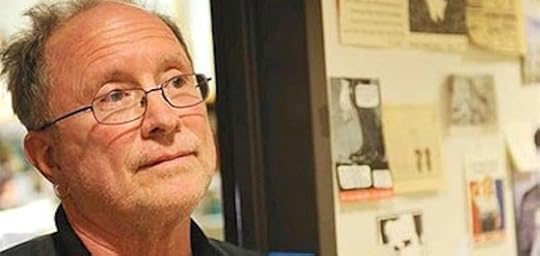
Bill Ayers
NEW YORK – Leftist political activist and University of Chicago professor Bill Ayers has turned on Barack Obama, characterizing the president’s determination to launch a military attack on the regime of Bashar al-Assad in Syria as a “dumb war.”
In a series of posts on his Internet website over the past few days, Ayers has come out swinging, attacking the presidential candidate he backed in 2004 for trying to justify a U.S. strike on Syria.
In what appears to be satire aimed at mocking President Obama, Ayers posted Sunday, Sept. 8, a diatribe suggesting Assad has already authorized launch missile strikes against the United States.
Ayers wrote: “President Assad of Syria announced yesterday that he had authorized limited missile strikes against the United States of America. ‘The United States has consistently violated international law and civilized standards of behavior,’ he said. ‘It has gathered the greatest arsenal of weapons of mass destruction ever assembled, and it is in fact the only country that has ever used nuclear weapons. It has unleashed drone strikes against at least seven other nations, murdering thousands – it has even used drones to kill its own people. And the U.S. has routinely employed torture, a practice that has been condemned and outlawed for decades – it has even tortured its own citizens” [italics in original].
The giveaway that the piece is intended at biting humor is Ayers’ next paragraph, in which he mocks the language Obama has used to explain the planned military strike is limited in nature, language Secretary of State John Kerry seconded in his testimony before Congress last week.
Ayers wrote: “[Assad] explained that Syria had no territorial ambitions, that there would be no Syrian boots on the ground, and that his goals did not include regime change.”
In a post on Aug. 31, Ayers harkened back to speech Obama gave in Chicago opposing the Iraq war in 2002.
Ayers wrote: “‘I don’t oppose all wars,’ said State Senator Barack Obama from the speaker’s platform at an antiwar rally in downtown Chicago in October 2002. ‘What I am opposed to is a dumb war. What I am opposed to is a rash war.’
“Dumb and rash,” Ayers continued, “that pretty much sums up the threatened U.S. bombing of Syria.”
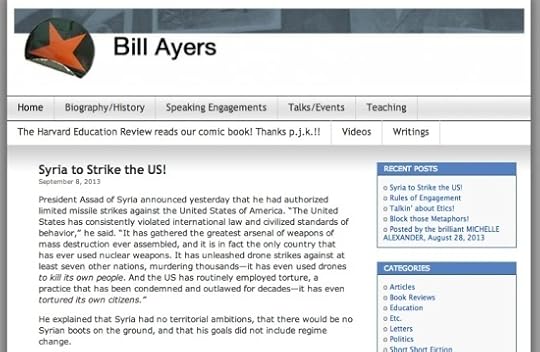
Screen shot of Ayers' blog
Sen. John McCain, R-Ariz., also suffers the sting of Ayers’ wit.
As his “Rules of Engagement” No. 2, Ayers specified that McCain should be appointed the “official barometer regarding the use of U.S. military force” because “McCain has been wrong on every major U.S. foreign policy initiative for half a century.”
Anti-Israel Ayers supported “Gaza Flotilla” in 2010
One of the “foreign policy initiatives” Ayers has repeatedly criticized is U.S. support for Israel.
In 2010, WND reported the group behind the six-ship Gaza flotilla that had engaged at that time in deadly clashes with Israeli commandos counted among its top supporters the friends and associates of President Barack Obama, namely the founders of the Weather Underground terrorist organization, William Ayers and Bernardine Dohrn, as well as Jodie Evans, the leader of the radical activist organization Code Pink.
On May 31, 2010, Israeli navy commandos raided the six-ship flotilla, encountering heavy resistance and live fire from the activists. Several activists were killed and dozens of others were reportedly injured, as were several of the Israeli commandos.
The flotilla was organized by the Free Gaza Movement, a coalition of leftist human rights activists and pro-Palestinian groups engaged in various attempts to run a blockade that had been imposed at that time by Israel on the Hamas-controlled Gaza Strip.
Ayers, Dohrn and Evans’ Code Pink led several Free Gaza Movement initiatives, including attempted marches into the Gaza Strip. Dohrn was reported in the Middle East in April 2010 on behalf of the Free Gaza Movement.
Note: There is a poll embedded within this post, please visit the site to participate in this post's poll.
September 7, 2013
Pope leads 100,000 in prayer vigil for Syria peace
NEW YORK – Pope Francis led a 5-hour prayer vigil for peace in Syria from St. Peter’s Square tonight, joined by a crowd of worshipers estimated at 100,000.
In series of news feeds posted on Twitter, the Catholic News Service reported the pope urged people around the world to leave behind self-interest, opening up to dialogue and reconciliation.
“How I wish all men and women of good will would accept God’s admonition that violence is not answered with violence,’ he reminded the faithful in St. Peter’s Square and around the world.
Pope Francis recalled the year 2000, when various religious groups participated together to plant an olive tree for peace in Plaza de Mayo in Buenos Ares.
“We have sharpened our ideas to justify ourselves,” he said, in what appeared to be a veiled criticism of President Barack Obama, “but our conscience has fallen asleep.”
The pope reminded the faithful that when the world is filled with violence, division, disagreement and war, people withdraw into selfishness.
“When human beings take the place of God, the world opens the door to conflict,” he said.
As WND reported yesterday, Pope Francis and the head of the Catholic Church in Syria had decided to take on President Obama, with both issuing direct appeals for the United States not to launch a military strike on Syria.
Pope Francis sent a Twitter message to his nearly 3 million followers declaring: “With utmost firmness I condemn the use of chemical weapons.” But he also wrote a letter to Russian President Vladimir Putin, the host of the G-20 Summit attended by Obama, appealing to the leaders to “lay aside the futile pursuit of a military solution.”

Pope Francis wrote Wednesday:
The leaders of the G20 cannot remain indifferent to the dramatic situation of the beloved Syrian people which has lasted far too long, and even risks bringing greater suffering to a region bitterly tested by strife and needful of peace. To the leaders present, to each and every one, I make a heartfelt appeal for them to help find ways to overcome the conflicting positions and to lay aside the futile pursuit of a military solution.Rather, let there be a renewed commitment to seek, with courage and determination, a peaceful solution through dialogue and negotiation of the parties, unanimously supported by the international community. Moreover, all governments have the moral duty to do everything possible to ensure humanitarian assistance to those suffering because of the conflict, both within and beyond the country’s borders.
On Sunday, Pope Francis abandoned the traditional religious theme in his Angelus prayer appearance from the window in the papal residence above St. Peter’s Square, calling instead for the worldwide day of fasting and prayer for peace held this evening..
To thousands of the faithful assembled below, he said: “My heart is deeply wounded by what is happening in Syria and anguished by the dramatic developments” on the horizon, an apparent reference to the reports that the U.S. and France were considering a military strike to punish the Syrian regime for a chemical weapons attack.
He urged all sides in the Syrian civil war to lay down arms and “listen to the voice of their conscience and with courage take up the way of negotiations.”
Francis was joined by Gregory III, the head of the Greek Catholic Church, who said the U.S. launching a military strike on Syria would constitute “a criminal act” that would “reap more victims” as Islamic jihadists continue to flow into Syria.
Gregory III, the patriarch of Antioch, who oversees the Melkite Greek Catholic Church in Syria and Lebanon, said:
We must listen to the pope’s appeal for peace in Syria. If Western countries want to create true democracy then they must build it on reconciliation, through dialogue between Christians and Muslims, not with weapons. This attack being planned by the United States is a criminal act, which will only reap more victims, in addition to the tens of thousands of these two years of war. This will destroy the Arab world’s trust in the West.What or who have led Syria to this thin red line, this point of no return? Who created this hell in which our people have been living for months? Every day, Islamic extremists from all over the world are pouring into Syria with the sole intent to kill and not one country has done anything to stop them; even the U.S. has decided to send in more weapons. We renew our rejection of any foreign military intervention in the Syrian crisis.
On Friday, Pope Francis tweeted: “All men and women of good will are bound by the task of pursuing peace. #prayforpeace.”
Following Francis’ lead, Cardinal Dolan of New York and leaders of the United States Conference of Catholic Bishops, or USCCB, wrote to every member of Congress on Thursday, urging them to vote against military intervention in Syria, Time magazine reported.
On Wednesday, the USCCB wrote a letter to President Obama condemning the use of chemical weapons in Syria while insisting Obama should not resort to military intervention, urging him instead to work for a political solution.
“Our focus is on the humanitarian catastrophe unfolding in Syria and on saying lives by ending the conflict, not fueling it,” the Catholic bishops told Obama.
“We have heard the urgent calls of the Successor of Saint Peter, Pope Francis, and our suffering brother bishops of the venerable and ancient Christian communities of the Middle East. As one, they beg the international community not to resort to military intervention in Syria. They have made it clear that a military attack will be counterproductive, will exacerbate an already deadly situation, and will have unintended negative consequences. Their concerns find a strong resonance in American public opinion that questions the wisdom of intervention and in the lack of international consensus.”
The Catholic bishops stressed their longstanding position that the Syrian people need a political solution.
“We ask the United States to work urgently and tirelessly with other governments to obtain a cease-fire, initiate serious negotiations, provide impartial humanitarian assistance, and encourage efforts to build an inclusive society in Syria that protects the rights of all its citizens, including Christians and other minorities,” the bishops wrote.
Note: There is a poll embedded within this post, please visit the site to participate in this post's poll.
September 6, 2013
Pope Francis takes on Obama
NEW YORK – Pope Francis and the head of the Catholic Church in Syria have decided to take on President Obama, with both issuing direct appeals for the United States not to launch a military strike on Syria.
Pope Francis has sent a Twitter message to his nearly 3 million followers declaring: “With utmost firmness I condemn the use of chemical weapons. But he also wrote a letter to Russian President Vladimir Putin, the host of the G-20 Summit attended by Obama, appealing to the leaders to “lay aside the futile pursuit of a military solution.”
Pope Francis wrote Wednesday:
The leaders of the G20 cannot remain indifferent to the dramatic situation of the beloved Syrian people which has lasted far too long, and even risks bringing greater suffering to a region bitterly tested by strife and needful of peace. To the leaders present, to each and every one, I make a heartfelt appeal for them to help find ways to overcome the conflicting positions and to lay aside the futile pursuit of a military solution.
Rather, let there be a renewed commitment to seek, with courage and determination, a peaceful solution through dialogue and negotiation of the parties, unanimously supported by the international community. Moreover, all governments have the moral duty to do everything possible to ensure humanitarian assistance to those suffering because of the conflict, both within and beyond the country’s borders.
On Sunday, Pope Francis abandoned the traditional religious theme in his Angelus prayer appearance from the window in the papal residence above St. Peter’s Square, calling instead for a worldwide day of fasting and prayer for peace on Sept. 7.
To thousands of the faithful assembled below, he said: “My heart is deeply wounded by what is happening in Syria and anguished by the dramatic developments” on the horizon, an apparent reference to the reports that the U.S. and France were considering a military strike to punish the Syrian regime for a chemical weapons attack.
He urged all sides in the Syrian civil war to lay down arms and “listen to the voice of their conscience and with courage take up the way of negotiations.”
Francis was joined by Gregory III, the head of the Greek Catholic Church, who said the U.S. launching a military strike on Syria would constitute “a criminal act” that would “reap more victims” as Islamic jihadists continue to flow into Syria.
Gregory III, the patriarch of Antioch, who oversees the Melkite Greek Catholic Church in Syria and Lebanon, said:
We must listen to the pope’s appeal for peace in Syria. If Western countries want to create true democracy then they must build it on reconciliation, through dialogue between Christians and Muslims, not with weapons. This attack being planned by the United States is a criminal act, which will only reap more victims, in addition to the tens of thousands of these two years of war. This will destroy the Arab world’s trust in the West.
What or who have led Syria to this thin red line, this point of no return? Who created this hell in which our people have been living for months? Every day, Islamic extremists from all over the world are pouring into Syria with the sole intent to kill and not one country has done anything to stop them; even the U.S. has decided to send in more weapons. We renew our rejection of any foreign military intervention in the Syrian crisis.
On Friday, Pope Francis tweeted: “All men and women of good will are bound by the task of pursuing peace. #prayforpeace.”
Following Francis’ lead, Cardinal Dolan of New York and leaders of the United States Conference of Catholic Bishops, or USCCB, wrote to every member of Congress on Thursday, urging them to vote against military intervention in Syria, Time magazine reported.
On Wednesday, the USCCB wrote a letter to President Obama condemning the use of chemical weapons in Syria while insisting Obama should not resort to military intervention, urging him instead to work for a political solution.
“Our focus is on the humanitarian catastrophe unfolding in Syria and on saying lives by ending the conflict, not fueling it,” the Catholic bishops told Obama.
“We have heard the urgent calls of the Successor of Saint Peter, Pope Francis, and our suffering brother bishops of the venerable and ancient Christian communities of the Middle East. As one, they beg the international community not to resort to military intervention in Syria. They have made it clear that a military attack will be counterproductive, will exacerbate an already deadly situation, and will have unintended negative consequences. Their concerns find a strong resonance in American public opinion that questions the wisdom of intervention and in the lack of international consensus.”
The Catholic bishops stressed their longstanding position that the Syrian people need a political solution.
“We ask the United States to work urgently and tirelessly with other governments to obtain a cease-fire, initiate serious negotiations, provide impartial humanitarian assistance, and encourage efforts to build an inclusive society in Syria that protects the rights of all its citizens, including Christians and other minorities,” the bishops wrote.
Obama employing think-tank plan to oust Assad?
NEW YORK – The Obama administration’s proposal to attack Syria appears to have been outlined in a Brookings Institution report published in March 2012 that contemplated a range of options to destabilize Syria and depose the government of Bashar al-Assad.
The plan included launching limited military attacks and supporting the Free Syria Army as the group of choice among the various “rebel” forces dominated by al-Qaida, the Muslim Brotherhood and radical Islamic mercenaries from around the region.
Produced by the think tank’s Sabin Center in March 2012, “Middle East Memo #21,” titled “Saving Syria: Assessing Options for Regime Change,” proposed the United States should implement a policy aimed at destabilizing Syria with the explicitly stated goal of ousting the Assad regime.
Authored by four Brookings Institution-affiliated authors, the report said the “brutal regime of Bashar al-Asad (sic) is employing its loyal military forces and sectarian thugs to crush the opposition and reassert its tyranny.”
The authors’ underlying justification for removing the Assad regime was that it was engaging in acts of violence against civilians that violated international standards of human rights.
The memo, however, made clear that the real gain to be achieved in toppling Assad was not the humanitarian protection of the Syrian population but the removal from the Middle East of “Iran’s oldest and most important ally in the Arab world.” The report characterized the Assad regime as “a longtime supporter” of terrorist groups like Hezbollah and Hamas that has “at times aided al-Qa’ida terrorists and former regime elements in Iraq.”
The memo’s characterization of U.S. foreign policy goals has prompted critics to charge it presented humanitarian concerns couched in the doctrine of “responsibility to protect,” a U.N. initiative asserting sovereignty is a responsibility, not a right, and the international community, therefore, has a right to ensure nations protect their populations from genocide, war crime, crimes against humanity and ethnic cleansing.
The critics see the plan as a pretext designed to cover the real goal of destabilizing Syria to depose the Assad regime. The plan would provide weapons to rebel groups, combined with U.S. air attacks and the possibility of a U.S.-backed, internationally configured military invasion with ground troops.
The memo cautioned, however, that actually ousting Assad “will not be easy.”
“Although the Obama administration has for months called for Asad to go, every policy option to remove him is flawed, and some could even make the situation worse – seemingly a recipe for inaction. Doing nothing, however, means standing by while Asad murders his own people and Syria plunges into civil war and risks becoming a failed state.”
Even after acknowledging the Free Syrian Army, or FSA, “is more a brand than a meaningful, united force,” the Brookings Institution memo proceeded on the premise the FSA is the rebel force the Obama administration should champion.
The memo proposed six strategies the U.S. “should consider to achieve Asad’s overthrow”:
Removing the Assad regime via diplomacy;
Coercing the regime via sanctions and diplomatic isolation;
Arming the Syrian opposition to overthrow the regime;
Engaging in a Libya-like air campaign to help an opposition army gain victory;
Invading Syria with U.S.-led forces and toppling the regime directly; and
Participating in a multilateral, NATO-led effort to oust Assad and rebuild Syria.
The memo stressed that no one strategy was going to be endorsed, although the memo clearly indicates preferences, especially when it comes to evaluating the probability each particular strategy has to achieve the stated policy goal of ousting the Assad regime.
The diplomatic option is discounted as having a low probability of success, because Russia’s protection of the Assad regime makes it unlikely the U.S. could pass a U.N. Security Council resolution in any way critical of Assad.
The effort to coerce the Assad regime by sanctions and diplomatic isolation is also regarded as a strategy with a low probability of success, because it would most likely create a stalemate in Syria between government and rebel forces, which would benefit Iran and Russia.
Option 3: U.S. to support FSA in Syria
The third option, arming the Syrian opposition, is considered to have a greater probability of success, provided the U.S. arms the Free Syria Army.
“The United States and its allies could arm the Free Syrian Army (FSA) and other anti-regime forces to try to carry out regime change on their own,” the Brookings Institution memo specified. “Rhetorically, the United States is already moving in this direction, with repeated high-level statements noting that the United States will not rule out arming the opposition should current efforts fail.”
The memo went on to champion arming the FSA with the following language:
A U.S. or allied-armed opposition could gain victory in two ways: the FSA could defeat Syria’s armed forces and conquer the country, or it could continue to gain strength and dishearten regime stalwarts, leading to mass defections or even a coup that causes the regime to collapse. The FSA would then become the new Syrian army, subordinate to an elected Syrian government, with the mission of ensuring the country remains stable and has protected borders.
The Brookings Institution acknowledged that achieving the result will be difficult, noting:
The FSA, for its part, is currently poorly armed, disorganized, and divided from the broader political opposition movement. To make matters more complex, there is also a deep schism between FSA forces in Syria, doing the bulk of the fighting, and the FSA leadership outside it.
The memo cautioned a U.S. strategy of arming the rebels will also require “coalition strengthening” efforts by the U.S. to better organize the rebels:
Thus, if the United States were to embrace the policy of arming the opposition, a key initial step would be to make the opposition more coherent. This would entail first gaining a better understanding of Syria’s tribal, religious, ethnic, and community structures and their affiliations, and then using money, recognition, and arms as an incentive to push the FSA and Syrian opposition political groups like the Syrian National Council (SNC) to work together. The same tools would then have to be used to push for military integration and a unified command.
The Brookings Institution memo noted the cost and risk to the U.S. of the strategy would be low because the U.S. could avoid putting forces on the ground, and the cost of providing weapons could be represented as being in the millions of dollars, not billions.
The Brookings Institution cautioned, however, that in most cases, supporting opposition forces may foster instability in Syria but not topple the Assad regime.
Option 4: Massive air strikes
Massive U.S. air strikes would supplement arming the FSA.
The memo articulated the option as follows:
The theory here is that powerful American air support could tip the balance in favor of the FSA without miring American ground troops in the fight that will have to be waged for Syria’s cities and mountain fastnesses. In crass terms, the hope is that the United States could fight a “clean” war from 10,000 feet and leave the dirty work on the ground to the FSA, perhaps even obviating a massive commitment to Iraq-style nation-building. Because of the much greater cost and lengthy duration of post-war reconstruction, as well as the obvious unpleasant experiences in Iraq and Afghanistan, the potential to relieve the United States from this task appears to be a key selling point for some of this policy’s advocates.
The memo said, however, that the problem was that Assad’s armed forces were already heavily engaged with the population and the opposition across the country, making it difficult to target them from the air.
Option 5: A U.S. invasion
A U.S. invasion was the least popular of the options: “No one currently advocating an invasion of Syria, the four authors of this memo included.”
Yet, the authors suggest the option would work: “Moreover, if the United States is absolutely determined to stop the slaughter of innocent civilians in Syria and/or overthrow the Alawi regime, an invasion may well be the only way to do so – it is certainly the only way that would be guaranteed to do so.”
The authors also expressed concern that if the U.S. were “to kick in the door, to oust the regime,” Washington would then have to commit to long and costly efforts to rebuild Syria after the war.
Option 6: International intervention, the ‘goldilocks’ solution
The international option entails a NATO invasion of Syria, with Arab financial support at a minimum, and the support of the Arab League substituting for an inability to get U.N. Security Council approval.
The Brookings plan may be the origin of Secretary of State John Kerry’s suggestion to the House Foreign Affairs Committee that Arab nations were willing to help bear the cost of military action against Syria.
The memo specified:
The Europeans and the Gulf Arabs have to be willing to pick up much of the tab. As noted above, rebuilding Syria after the events of 2011 and an invasion and occupation will be a major undertaking. Even if the reconstruction of Syria benefits from all the lessons learned in Iraq and suffers from none of its mistakes, it will still be enormously costly and well beyond Turkey’s means. Consequently, even though Turkey would be needed to put up much of the raw military muscle, it would be a mistake to ask them to shoulder the costs of that burden.
The advantage of the international plan, and the reason the Brookings Institution suggested it was “just right,” or “Goldilocks,” was that the U.S. would provide primarily logistics support and a few of the combat components involved in a war against Syria, but not all.
The memo also stressed some of the options “can be considered on an escalation ladder – some should be tried because they are less costly than more aggressive measures, and others should be pursued because they will be a component of a broader effort.”
In conclusion, the Brookings Institution memo cautioned against inaction: “As a final thought, it is always important to keep in mind that failing to act – even failing to decide – is an action and a decision.”
The four authors of the report include three from the Sabin Center for Middle East Policy, Daniel Byman, the director of research, along with Michael Doran and Kenneth M. Pollack, both senior fellows.
Pollack is the author of the 2005 book “The Persian Puzzle: The Conflict Between Iran and America.”
Salman Shaikh is the director of the Brookings Doha Center and a fellow at the Sabin Center. Prior to joining the Brookings Institution, he worked with the U.N. for nearly a decade.
Note: There is a poll embedded within this post, please visit the site to participate in this post's poll.
Obama relying on student's spin on Syria?
NEW YORK – Evidence is mounting that the strategy by Sen. John McCain, R-Ariz., and Secretary of State John F. Kerry to cast members of the Free Syria Army as “moderates” among the rebel forces opposing the government of Bashir al-Assad was the brain-child of Elizabeth O’Bagy, a 26-year-old graduate student pursuing a Ph.D. in Arab studies and political science at Georgetown University, who is working on a dissertation on woman’s militancy.
In his testimony before the Senate Foreign Relations Committee on Tuesday, Kerry cited O’Bagy, arguing that the war in Syria is “not being waged entirely or even predominately by dangerous Islamists and al-Qaida die-hards,” but rather the struggle is being led but “moderate opposition forces – a collection of groups known as the Free Syria Army.”
Kerry was citing an opinion piece O’Bagy wrote for the Wall Street Journal on Aug. 30 titled “On the Front Lines of Syria’s Civil War.” It ran with a tag-line “The conventional wisdom – that jihadists are running the rebellion [in Syria] – is not what I’ve witnessed on the ground.”
The O’Bagy narrative, however, is contradicted by intelligence estimates and experts specializing in the region.
After Kerry’s testimony to Congress this week, Reuters reported: “Secretary of State John Kerry’s public assertions that moderate Syrian opposition groups are growing in influence appear to be at odds with estimates by U.S. and European intelligence sources and non-governmental experts, who say Islamic extremists remain by far the fiercest and best-organized rebel elements.”
On April 27, the New York Times reported that the Jabhat al-Nursa Front, a group declared a terrorist organization by the U.S. State Department, has pledged allegiance to al Qaida’s top leader, Ayman al-Zawahiri, and remains the group of choice for foreign jihadis pouring into Syria. The Ahrar al-Sham, meanwhile, which shares much of al-Nusra’s extremist ideology, is composed mostly of Syrians.
In her capacity as a senior research analyst and the Syria team leader at the Washington-based Institute for the Study of War think-tank, O’Bagy authored a report in March titled “The Free Syrian Army” in which she argued as follows:
The opposition movement in Syria has been fragmented from its inception, a direct reflection of Syria’s social complexity and the decentralized grassroots of the uprising. This condition has plagued Syria’s armed opposition since peaceful protestors took up arms and began forming rebel groups under the umbrella of the Free Syrian Army (FSA) in the summer of 2001.
The narrative is currently being circulated in Congress in an attempt to counter the recent disclosure of evidence the rebel groups in Syria affiliated with al-Qaida and the Muslim Brotherhood, who have committed atrocities against government soldiers and Syrian civilians, may be the parties responsible for the chemical weapons attacks the Obama administration is blaming on the Assad government.
O’Bagy also works as the political director of the Washington-based Syrian Emergency Task Force, or SETF, chaired by Mohamed Kawam.
Kawam is linked with the Washington-based Syrian Support Group, or SSG, which encourages Americans to send money that arguably could be used to buy weapons for the Free Syria Group.
The “Donate” button on the Syrian Support Group website specifies donations will go toward providing “certain logistical, communications, and other services to the FSA.” The caveat is “the SSG intends to support only those military councils that have adopted the FSA’s Proclamation of Principles,” not the Jabhat al-Nusra or any other group designated a terrorist organization by the U.S. government.

Syrian Support Group donation
The “About the Syrian Support Group” page on the group’s website states the SSG has pursued and received a license from the U.S. Department of Treasury Office of Foreign Assets Control that permits the organization to raise funds and provide certain services to the FSA, further specifying the SSG has to date transported over $10 million in U.S. government aid to the Supreme Military Council of the FSA.
The Facebook page of the Coalition for a Democratic Syria makes clear the Syrian Emergency Task Force organized McCain’s surprise May visit to Syria, where he met with leaders of the FSA Supreme Military Council.

Facebook posting by Coalition for a Democratic Syria
On May 27, the Los Angeles Times reported O’Bagy, in her capacity as political director for the Syrian Emergency Task Force, said in a telephone interview from Turkey that McCain’s office approached the task force two weeks earlier to ask if it could arrange for him to meet with Syrian rebel leaders in Syria.
O’Bagy, who accompanied McCain on the senator’s May trip to the Middle East, told the newspaper McCain met with FSA commanders in two meetings in Gaziantep, Turkey, and in one meeting about a half mile inside the Syrian border at the Bab Salameh border crossing. There, he talked with the Asifat al-Shamal, identified as the Northern Storm Brigade, that controls the border.
O’Bagy further confirmed to the Los Angeles Times that Gen. Salim Idriss, the leader of the Supreme Military Council of the Free Syrian Army, and other rebel commanders asked the U.S. to consider giving heavy weapons to the FSA, set up a no-fly zone in Syria and conduct air attacks on Hezbollah in Lebanon.
McCain asked the FSA commanders how they planned to reduce the presence of Islamic extremists in Syrian rebel ranks, O’Bagy told the newspaper.
In Syria, McCain was photographed with a group of Syrian rebels that included Mouaz Moustafa, a Palestinian Arab (seen to far right of photograph, closest to camera) who was introduced to McCain as the executive director of the Syrian Emergency Task Force, the group that organized the senator’s trip.
McCain in Syria, May 2013, with Mouaz Moustafa (seen at far right, closest to camera)
On Twitter, Moustafa identifies himself as a Palestinian refugee who moved to the U.S. at 12 years old, worked as a staffer in the U.S. House and Senate (Rep. Vic Snyder, D-Ark., and Sen. Blanche Lincoln, D-Ark.) and participated in the Libyan and Syrian revolutions.

Mouaz Moustafa Twitter post
On Instagram, Moustafa calls himself a “Freelance Revolutionary,” adding that he also worked as a field organizer for the Democratic National Committee in 2008.
On Linkedin.com, Moustafa continues to list himself as the executive director at the Libyan Council of North America.
A Daily Caller profile of Moustafa added that he meets with National Security Council staff “every couple of months.”
In recent weeks, O’Bagy and Moustafa have been conducting a media blitz on behalf of the Syrian Emergency Task Force, including interviews with NPR, Fox News, RT, Thom Hartmann’s radio show, Foreign Policy Magazine and MSNBC, arguing that the FSA is the “moderate” rebel group the U.S. should support in Syria.
The Daily Beast has reported that in addition to meeting with Moustafa and FSA leaders in Syria, McCain also met with Mohammad Nour and Ammar Al-Dadikhi (a.k.a. Abu Ibrahim), two men who were part of a group that kidnapped Lebanese religious pilgrims returning from Iran in May 2012. Both were identified as being part of Asifat al Shamal, the Syrian rebel group known as the Northern Storm Brigade controlling the border.
Note: There is a poll embedded within this post, please visit the site to participate in this post's poll.
Record 90 million Americans not in labor force
NEW YORK – Just after Labor Day, the Bureau of Labor statistics reported more than 90 million Americans age 16 and older were not in the labor force in August, the highest level recorded since the Department of Labor began collecting the data during the Truman administration three years after the end of World War II.
On Friday, the BLS reported that the 90,473,000 Americans not currently in the labor force marked the first time the figure exceeded the 90 million threshold.
In January 2009, when President Obama first took office, there were 80.5 million Americans 16 years and older not in the labor force, meaning the number of Americans not in the labor force has increased 10 million during his presidency.
For men, the BLS reported the labor force participation rate, the percentage of the population working or considered looking for work, was 63.2 percent in August, basically unchanged from 63.5 percent in July. It’s also a record low.
The BLS also reported the unemployment rate dropped 0.1 percent to 7.3 percent in August, but the figure was almost completely driven by negative factors.
The total number of people employed fell by 115,000 in August, but the unemployment rate dropped because the overall labor force dropped by a larger 312,000, a phenomenon the Wall Street Journal interpreted as a possible sign of discouraged long-term jobless workers dropping out of the labor force altogether.
Alternative calculations place “true unemployment statistics” at 23.3 percent for August, with nearly 1 of every 4 workers out of work, not the politically adjusted figure of 7.3 percent the BLS reported.
Manipulated unemployment rates
Last month, WND reported that according to John Williams, an economist known for arguing the government reports manipulated “shadow statistics” of economic data for political purposes, the real unemployment rate for July was 23.3 percent, not the 7.4 percent reported by the Bureau of Labor Statistics.
By including in the calculation of the unemployment rate people the BLS classifies as “not currently in the labor force” because of their long-term unemployment, the true unemployment rate could be more than three times the unemployment rate the BLS publicly declares.
Williams, the editor of the Shadow Government Statistics website, has repeatedly insisted that the BLS reports, such as the current showing that unemployment dropped from 7.4 percent in July to 7.3 percent in August, are essentially “meaningless.”
“The broad economic outlook has not changed, despite the heavily distorted numbers that continue to be published by the BLS,” Williams wrote. “The unemployment rates have not dropped from peak levels due to a surge in hiring; instead, they generally have dropped because of discouraged workers being eliminated from headline labor-force accounting.”
Williams has demonstrated that it takes an expert to truly decipher BLS unemployment statistics. For instance, in a table titled “Alternative measures of labor underutilization,” the BLS reports what is known as “U6 unemployment.”
The U6 unemployment rate is the BLS’s broadest measure. It includes those marginally attached to the labor force and the “under-employed,” those who have accepted part-time jobs when they are really looking for full-time employment. Also included are short-term discouraged workers, those who have not looked for work in the last year because they have become convinced there are no jobs to be found.
Since 1994, however, the long-term discouraged workers, those who have been discouraged for more than one year, have been excluded from all government data.
While the BLS was reporting seasonally adjusted headline unemployment in July of only 7.4 percent, it also was reporting the broader U6 seasonally adjusted unemployment was 14percent.
In his subscription newsletter, Williams has urged caution in interpreting BLS statistics: “To the extent that there is any significance in the monthly reporting, it is that the economy is not in recovery, and that unemployment has made a new high, at a level that rivals any other downturn of the post-Great Depression era.”
The only measure BLS reports to the public, as the official monthly unemployment rate, is the seasonally adjusted U3 number.
Williams calculates his “ShadowStats Alternative Unemployment Rate” by adding to the BLS U6 numbers the long-term discouraged workers.
Williams argues that his ShadowStats Alternative Unemployment measure most closely mirrors common experience.
“If you were to survey everyone in the country as to whether they were employed or unemployed, without qualification as to when they last looked for a job, the resulting unemployment rate would be close to the ShadowStats estimate,” Williams explained to WND.
The headline BLS unemployment rate has stayed relatively low because it excludes all discouraged workers, Williams argues.
As the unemployed first become discouraged and then disappear into the long-term discouraged category, they also vanish from inclusion in the headline labor force numbers. Those workers still are there, however, ready to take a job if one becomes available. They are unemployed and consider themselves to be unemployed, but the government’s popularly followed unemployment reporting ignores them completely.
Below is a more complete unemployment table that includes the seasonally adjusted unemployment percentages for U3 unemployment, as well as the same for U6 unemployment, followed by the ShadowStats Alternative Unemployment rate for both July 2012 and July 2013, the most recent month for which Williams has calculated his ShadowStats Alternative Unemployment Rate.

The higher alternative unemployment rate for August relative to the BLS percentages reflects an increasing tendency by the BLS to add to the “not in the labor force” total to depress unemployment percentages reported in the U3 and U6 calculations.
Increasingly, critics like Williams believe the seasonally adjusted U3 numbers reported by the BLS as the official monthly unemployment rate do not give a reliable picture of the true magnitude of unemployment in the United States.
The definitions used by the BLS exclude from the calculation of the monthly U3 unemployment rate anyone who has not looked for work at any time during the past four weeks.
In the U6 calculations, the inclusion of discouraged workers extends only to those who have actively looked for work in the past year.
The BLS definitions exclude from the definition of unemployed those who have grown so discouraged that they have not actively lookedfor work in the past year, without distinguishing those who would look for work if there were a reasonable chance their job search might result in employment.
Under Obama, an economy of part-time jobs
WND also reported last month that under the Obama administration, the U.S. is rapidly transforming from a nation of full-time employment to a nation of part-time employment. Seven out of eight jobs created during Obama’s five years as president have been part-time jobs.
The House Ways and Means Committee noted Aug. 5 that approximately 88 percent of the jobs created under President Obama have been part-time jobs.
“The reality, as you dig into the latest jobs data, reveals that few are finding the full-time work they want and need, and many are forced to accept part-time employment,” the committee said.
The BLS statistics show that under Obama, 1,882,000 part-time jobs have been created, compared to only 270,000 full-time jobs created between January 2009 and July 2013.

On Aug. 21, Reuters reported that three out of four of the nearly 1 million jobs created this year are part-time, with many of the jobs low-paid, a phenomenon Reuters attributed to an unanticipated adverse economic impact of Obamacare.
“Faltering economic growth at home and abroad and concern that President Barack Obama’s signature health care law will drive up business costs are behind the wariness about taking on full-time staff, executives at staffing and payroll firms say,” Reuters reported.
“Employers say part-timers offer them flexibility. If the economy picks up, they can quickly offer full-time work. If orders dry up, they know costs are under control. It also helps them curb costs they might face under the Affordable Care Act, also known as Obamacare.”
Reuters pointed out that the growing tendency to create part-time jobs instead of full-time jobs causes a vicious cycle in which the new employees who tend to be hired in retail businesses and food services do not have the disposable income to drive demand for goods and services in the economy as a whole.
September 5, 2013
Egypt eyes Obama's brother for terror list
NEW YORK – President Obama’s Kenyan half-brother, Malik Obama, appears headed for the Egyptian terror watch list because of his Muslim Brotherhood ties.
Complaints have been filed with Egypt’s prosecutor-general calling for Malik to be put on Egypt’s terror watch list and brought to Egypt to be questioned by state criminal investigators for allegedly financing terrorism, according to former PLO member and native Arabic-speaker Walid Shoebat.
According to Egyptian newspaper and television reports, Malik Obama has become a target in an Egyptian government terrorist investigation because of his role as an owner and investment adviser for the Sudan-based Islamic Dawa Organization, or IDO, and the organization’s umbrella group, the Muslim Brotherhood.
Shoebat has provided the following translation of a report from an Egyptian media source, Youm 7, detailing criminal complaints filed against Malik Obama with the Egyptian attorney general and the Egyptian High Court, petitioning to put him on the terror watch list in Egypt:
Dr. Ahmed Nabil Ganzory, in his capacity as lawyer and agent for Dr. Sadik Rauf Obeid, and resident in the United States of America, filed a complaint with Egyptian Attorney General Hisham Barakat, against Malik Obama, accusing him of supporting terrorism in Egypt and for his involvement in managing the Islamic Dawa Organization (IDO). The complaint also asks to include Chancellor Tahani Al-Jebali to substantiate claims against Obama. …
Complaint No. 1761 for the year 2013 reported to the Attorney General asked the Egyptian High Court to consider the suspicious activity of a group called the Islamic Dawa Organization, which is owned and managed by Malik Obama. This group is now being investigated by international bodies and the attached evidence proves beyond a reasonable doubt that a close link exists between Malik Obama and some of the most notorious characters already wanted for their involvement in terrorism, as is consistent with the pictures and reports attached. …
The complaint also asks the court to bring in Malik Obama – a resident of the United States – to be questioned in regard to the terrorist groups in Egypt, whether by inciting or participating with or in any form of support punishable by law. It seeks permission to declare Obama a defendant in his right outside Egypt diplomatically, through the Ministry of Foreign Affairs. In the case of non-appearance and compliance for the investigation, the complainant requests monitoring [Malik Obama] by including his name on all Egyptian airports and ports, and take the necessary legal steps.”
[Editor’s note: bold text placed in translation by Walid Shoebat for emphasis]
WND has previously reported that Malik Obama is the executive secretary of the Dawa Organization, a group created by the government of Sudan, which is considered by the U.S. State Department to be a terrorist state.
Shoebat has further reported Malik Obama attended an IDO conference in the Sudanese capital, Khartoum, that was attended and supervised by Sudan President Omar Al-Bashir, who is wanted by the International Criminal Court on seven counts related to crimes against humanity.
An objectives of the IDO is to spread radical Wahhabist Islam across the African continent.
WND has reported Malik Obama was the best man at the wedding of Barack Obama to Michelle Robinson on Oct. 3, 1992. He has been photographed visiting President Obama in the White House.

Malik Obama, best man at the wedding of Barack H. Obama, Oct. 3, 1992
Tied to Egyptian Muslim Brotherhood
The criminal complaint referenced in the translation by Shoebat also calls for the inclusion of Tahani al-Gebali, former chancellor and a current advisor to the Constitutional Court of Egypt.
WND reported Aug. 20 that Gebali went public in Cairo with allegations that Malik Obama had links to the Muslim Brotherhood in Egypt. Gebali charged that Malik Obama is “one of the architects” of the investments made by the Muslim Brotherhood in Egypt.
In her allegations against Malik Obama, Gebali also threatened to expose evidence of the Obama administration’s support of the Muslim Brotherhood in Egypt.
“The Obama administration cannot stop us,” Gebali said, as reported by Egyptian television. “We need to open the files and begin court sessions. The Obama administration knows that they supported terrorism. We will open the files and begin court sessions.”
Gebali further charged the Obama administration’s enthusiastic support of the Morsi government brought into power after the “Arab Spring” continued even after the Morsi government welcomed Muslim Brotherhood leaders into the government.
Gebali suggested the Obama administration’s support of the Muslim Brotherhood in Egypt was a main reason President Obama has opposed the current military government ruling Egypt since Morsi was deposed.
Shortly after July 3, when Morsi was removed from office by a military coup that led to the establishment of the current Egyptian government, the Egyptian Independent newspaper reported in English on July 15 that Egypt’s prosecutor general, Hisham Barakat, moved to freeze the financial assets of several Islamic politicians, including Muslim Brotherhood Supreme Guide Mohamad Badie.
Last Sunday, Hisham Barakat moved to bring criminal charges against Morsi and 14 other members of the Muslim Brotherhood in a Cairo criminal court. Morsi was accused of “committing acts of violence and inciting killing and thuggery” in the deadly street clashes outside the presidential palace in December 2012 with opponents of his rule.
WND has reported Egyptian government prosecutors plan to introduce evidence Muslim Brotherhood leaders in Cairo received bribes paid in amounts as large as $850,000 a year each from the Obama administration in Washington via the U.S. Embassy in Cairo.
In September 2011, WND reported the Barack H. Obama Foundation, owned and operated by Malik Obama, apparently received notice of IRS approval in a document signed by Lois Lerner, the former head of the IRS tax-exempt division now on paid executive leave from her supervisory duties after she took the Fifth Amendment before the House Oversight and Government Reform Committee on May 22. She was to be questioned regarding her department’s use of inappropriate criteria to delay or otherwise deny tax-exempt status for tea party and “patriot” groups.
Malik Obama received the determination letter from Lerner one month after an application was submitted in May 2011. The IRS determination letter June 11, 2011, granted highly irregular retroactive tax-exempt approval only after the group came under fire for operating as a 501(c)3 foundation since 2008 without ever having applied to the IRS.

Abongo “Roy” Malik Obama displays a 1980s-era photograph of Barack Obama in Kenya
In May, WND reported that funds contributed in the U.S. to a 501(c)3 foundation run by Malik Obama have been diverted to support Malik’s multiple wives in Kenya, according to Shoebat.
In October 2012, WND reported a separate foundation, the Mama Sarah Obama Foundation, created on behalf of Obama’s step-grandmother in Kenya, has transferred funds, 90 percent of which are raised from U.S. individuals and corporations, to send Kenyan students to the top three most radical Wahhabist madrassas in Saudi Arabia.
In the first parliamentary elections held in Egypt after former Egyptian president Hosni Mubarak was overthrown in February 2011, the Muslim Brotherhood’s newly formed Freedom and Justice Party won nearly half the seats in the People’s Assembly.
Jerome R. Corsi's Blog

- Jerome R. Corsi's profile
- 74 followers

