
Jerome R. Corsi's Blog, page 345
November 25, 2013
Talk about this over Thanksgiving dinner
While the establishment media has reported an upswing in the economy after “bottoming out” in 2010, child poverty has dramatically increased over the past five years under President Obama.
Michael Synder, creator of the website TheEconomicCollapse.com, points out that in the “wealthiest nation” on the planet, approximately one of every four U.S. children is enrolled in the government food stamp program. An estimated 50 percent of all U.S. children will be on food stamps before they reach the age of 18.
Some 17 million children in the U.S. are facing “food insecurity,” meaning “one in four children in the country is living without consistent access to enough nutritious food to live a healthy life,” Snyder said.
He emphasizes that the number of children living on $2 a day or less in the U.S. has now grown to 2.8 million, despite the government having spent an astounding $3.7 trillion on welfare programs over the past five years.
Crisis of poverty in U.S. public schools
According to an October report published by the Southern Education Foundation, 60 percent of public school children in American cities were in low-income households.
Mississippi has the nation’s highest rate for low-income students in cities (83 percent), followed by New Jersey (78 percent), Pennsylvania (75 percent) and New York (73 percent).
While the problem of poverty in the public schools is most intense in the cities, it is by no means limited to the cities. The report said 50 percent of the public school children in America across all classifications – urban, suburban and rural – were in low-income households in 2011.
It’s the first time that nearly half the nation’s public school student population could be considered to be living under or near the poverty line.
The current crisis in public school poverty is also a crisis for the future, as low-income public school students will face major hardships as adults in gaining meaningful employment in an increasingly competitive global economy.
In a report published by the American Psychological Association in May, Russell W. Rumberger, Ph.D. said students in low-income families, estimated at 20 percent of the high-school population, were five times more likely to drop out of high school than students from high-income families, also estimated to be 20 percent of the high-school population.
“Family poverty is associated with a number of adverse conditions – high mobility and homelessness; hunger and food insecurity; parents who are in jail or absent; domestic violence; drug abuse and other problems – known as ‘toxic stressors’ because they are severe, sustained and not buffered by supportive relationships,” Rumberger wrote.
“Child poverty is rampant in the U.S., with more than 20 percent of school-age children living in poor families. And poverty rates for black and Hispanic families are three times the rates for white families,” Rumberger concluded.
Homeless students
Remarkably, the National Center for Homeless Education, a group affiliated with the University of North Carolina at Greensboro funded by the Department of Education, reported in October that there were 1.2 million homeless students in U.S. public schools during the 2011-2012 academic year.
The record figure is up 10 percent from the year before and up 72 percent from the start of the recession.
Homelessness children suffer many psychological consequences. The National Center Family Homelessness reported an estimated 97 percent of homeless children change schools frequently, many up to three times within a single year.
The National Center for Homeless Education lists warning signs for public-school officials to help them determine if a child is homeless, including hording food; poor self-esteem and unwillingness to risk forming relationships with peers and with teachers; a fear of abandonment; a need for immediate gratification; and “school phobia,” an unusual need to be with a parent.
The New York Post reported last month that in New York City the subways are being “overrun with homeless.”
Meanwhile, Obama’s former campaign organization, now called “Organizing for Action,” on Monday handed out suggestions to supporters to lobby their friends and family for the behemoth law at Thanksgiving dinner.
“Take advantage of downtime after meals or between holiday activities to start your talk,” says OFA’s strategy document, called “Health Care for the Holidays.”
“Tell them: There are a variety of plans available in the new health insurance marketplace, so you can pick one that fits your budget. There’s also financial assistance available based on how much you make,” the instructions state. “It might not always seem like it, but your family listens to you. So have the talk.”


Claim: Unearthed JFK film shows 2nd gunman
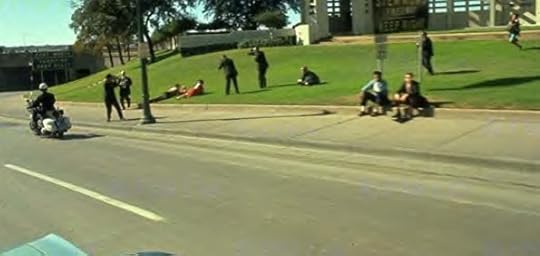
The famous grassy knoll in Dallas, Texas
A JFK assassination video held under wraps for 50 years that purports to show a second gunman on the “grassy knoll” is being shopped to news media by a Texas real estate mogul-turned-Hollywood producer.
TheWrap.com broke the story Friday, reporting that Stephen Bowen, a highly successful real-estate entrepreneur in Texas has acquired the never-before-screened JFK assassination video and is shopping it.
Bowen is now a principal in Hollywood-based Waterstone Entertainment, an independent motion picture financing and production company.
According to TheWrap.com, Bowen acquired the video from a local Houston television news producer who held it secretly for more than 40 years.
While TheWrap.com admitted its staff had not viewed the video, the published report quoted two unnamed individuals who have described portions of it as a challenge to the Warren Commission’s conclusion that Lee Harvey Oswald was the lone assassin.
“You can see a guy in the bushes with a gun,” one of the unnamed sources told TheWrap.com. “It looks like real footage, though I am not an expert.”
TheWrap.com further reported Jay Cohen of the Gersh agency in Los Angeles is in the process of arranging private screenings of the video this week for news media and other parties interested in purchasing the film, including CNN, Fox News and Reuters.
WND is in the process of contacting Cohen to see if it can screen the film and determine its importance and authenticity before making a bid for the rights.
In a separate story, Robert F. Kennedy Jr. is on the record saying his late father, Sen. Robert F. Kennedy, believed the Warren Commission was “a shoddy piece of craftsmanship.”
He said his father had concluded that JFK was assassinated by a conspiracy.
“The evidence at this point I think is very, very convincing that it was not a lone gunman,” Robert F. Kennedy Jr., told CBS News in January.
He explained his father, the U.S. attorney general at the time of JFK’s death, felt “some sense of guilt because he thought there might have been a link between his very aggressive efforts against organized crime.”
RFK Jr. said his father publicly supported the Warren Commission, “but privately he was dismissive of it.”
Note: Media wishing to interview Jerome Corsi, please contact us here.
Ayers 'playing Riddler' on authorship of Obama memoir
Comparing him to the Riddler character on the 1960s “Batman” television series, WND columnist Jack Cashill said former Weather Underground co-founder Bill Ayers is still playing games with his tongue-in-check claims to have authored Barack Obama’s autobiography “Dreams from My Father.”
Cashill, in his 2001 book “Deconstructing Obama: The Life, Loves, and Letters of the First Postmodern President,” presented a content analysis in which he argued Ayers’ authorship of Obama’s autobiography could be determined by comparing thematic constructions and similarity of language between Ayers’ 2001 book “Fugitive Days” and Obama’s “Dreams.”
“Ayers likes the idea people think he is the real author of ‘Dreams,’” Cashill said. “But Ayers knows that if he were to admit seriously he was Obama’s ghost writer, Ayers would alienate his radical friends and neighbors who still support Obama.”
The controversy surfaced once again last week when Red Emma’s Bookstore Coffeehouse in Baltimore announced Ayer’s appearance last week at a book signing event.
The announcement said that in Ayers’ new book, “Public Enemy: Confessions of an American Dissident,” he repeated his “confessions” that he wrote “Dreams.”
A YouTube video, including comments by Donald Trump and Andrew Breitbart, features media reaction to Cashill’s claims that Ayers ghost-wrote Obama’s “Dreams.”
“Ayers has spent his entire career playing games,” Cashill told WND. “Even when he was a Weather Underground bomber, Ayers was more of a ‘pretend revolutionary’ than a real revolutionary. Truly, Ayers did not want to pay the consequences of being a real revolutionary.”
Arguing that Ayers’ radicalism is largely theater, Cashill pointed out he has a pattern of lacing his “admissions” with irony, leaving doubt in the minds of his audiences.
In March 2011, WND reported Ayers, at the conclusion of a speech sponsored by the students for a Democratic Society at Montclair State University in New Jersey, admitted in response to a question that he authored “Dreams” but lamented he did not get paid the millions of dollars in royalties Obama received.
See video of Ayers’ response at Montclair State:
In “Public Enemy,” Ayers devotes some six pages to discussing the idea he had ghostwritten “Dreams.”
Mentioning Cashill by name, Ayers attempts to ridicule his scholarship:
A self-described deep-thinking intellectual named Jack Cashill set out to prove – independent of my denials or affirmations – that I had indeed written “Dreams.” He sought real evidence through a close readings of texts and a brush with the Internet. He was the great brain who discovered, for example, those infamous maritime references and metaphors in both “Dreams” and “Fugitive Days,” a possible testament to my fraught time as a merchant marine. In any case, it was now clear that I had been the seafaring Odysseus to Obama’s father-hungry Telemachus, and “Dreams” the “record of a personal, interior journey – a boy’s search for his father.” I loved the reflection, and loved imagining my few months on the Atlantic as an epic tale of the human journey.
In the end, Ayers leaves it up to the reader to decide if Cashill’s argument is correct or not.
“Empirical proof or crackpot confirmation, you decide,” Ayers wrote, refusing once again to give a definitive answer.
On Friday, Cashill is scheduled to appear in East Hanover, N.J., to sign copies of his most recent book, “If I Had a Son,” published by WND Books, which uncovers the real story behind the headlines of the George Zimmerman trial.
Cashill told WND his speech “Lying for the Truth,” will concentrate on the duplicity of the establishment media’s leftist political slant as it maintains its reporting is non-biased and “factual.”
Cashill’s presentation on Book TV discussing “Deconstructing Obama” can be viewed here.
November 18, 2013
Did JFK seal his fate with plan to dump LBJ?
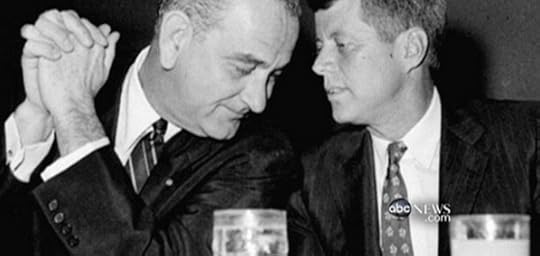
Lyndon B. Johnson and John F. Kennedy
In November 1963, the available evidence indicates President John F. Kennedy was on the verge of deciding to remove Vice President Lyndon B. Johnson from the 1964 Democratic Party presidential ticket.
But the instant JFK was pronounced dead, everything changed, and LBJ was secure as the party’s presumptive presidential nominee for 1964.
The scandal that most threatened LBJ’s place on the 1964 ticket with JFK centered on Bobby Baker, a Senate page who rose to become Johnson’s secretary when LBJ was Senate majority leader. After Johnson became vice president, Baker continued as his personal secretary and close private adviser.
The Baker scandal and the evidence that Kennedy was about to dump Johnson from the ticket have led conspirators to conclude that LBJ at least was aware of assassination plots against Kennedy and did nothing to intervene or expose them. Books such as “The Man Who Killed Kennedy: The Case Against LBJ” by Roger Stone, a senior staffer in the campaigns of Richard Nixon, Ronald Reagan and George H. W. Bush, have gone further, charging Johnson with murder.
The Baker scandal
In the middle of the Baker scandal was a vending machine company, Serve-U Corporation, from which Baker was deriving an annual gross income of $3.5 million. At that time his compensation from the Senate was less than $20,000 a year.
Serve-U Corporation had links to Texas oil millionaire Clint Murchison, as well as ties to mobsters Sam Giancana and Meyer Lansky. The company derived most of its earnings from vending machines placed in aerospace companies dependent on the government for contract work.
Baker also was engulfed in a sex scandal involving the Quorum Club, a private club on Capitol Hill he created. The club was run out of the Carroll Arms Hotel near the Senate office buildings on Capitol Hill. It provided call girls to prominent lobbyists and influential members of Congress. Baker was positioned centrally, advancing his career politically and financially by trading on sex and power.
Life magazine exposes scandal
The Baker scandal broke wide open with a Life magazine cover story published Nov. 8, 1963, hitting the newsstands just three weeks before JFK’s death.
The Life issue featured a front-page photograph of a laughing Baker in a costume at an unspecified Washington masquerade party with his mask lifted to show his face. A yellow banner across the cover of the magazine proclaimed: “Capital Buzzes Over Stories of Misconduct in High Places: The Bobby Baker Bombshell.”
The article featured “German call girl” Elly Rometsch, an East German beauty who was a Communist Party member before fleeing to the United States with her parents.
“Last week, a Senate committee was investigating Bobby Baker,” the featured article read. “He had quietly resigned after a former vending-machine associate sued him, charging use of Baker’s influence in placing machines in defense plants.”
The second page of the article featured a full-page photograph of a smiling LBJ with his arms around Baker’s shoulder.
The caption under the photo noted Baker was “an indispensable confident” of Johnson. Baker was described as “a messenger, a pleader of causes, a fund-raiser and a source of intelligence.”
A two-page spread featured a picture of scantily clad waitresses sitting on bar stools, waiting to greet guests during the opening of the Carousel Hotel in Ocean City, Md., in 1962.
The article pointed out that in addition to his interest in the vending-machine business, Baker was half owner of the Carousel as well as having business interests in a law firm, a travel agency, an insurance agency and a Howard Johnson motel.
Noting that Baker had just resigned from the Senate under fire, Life asked how his $19,612 annual salary had enabled his family to move into the $124,500 Washington home he bought a short walk from LBJ’s residence in Washington. Baker and his wife, Dorothy, had five children at the time, ages 10 to 1, with the youngest named Lyndon Baines Johnson.
Targeting LBJ
The Life probe expanded during the week of Nov. 11, 1963, when reporter William Lambert sought permission from his managing editor, George P. Hunt, to begin raising questions about how LBJ acquired his fortune.
Lambert was the Pulitzer Prize-winning journalist famous for breaking the story on the Teamsters Union penetrating the criminal empire of organized-crime boss J.B. Elkins that led to the McClellan Committee hearings.
Lambert explained to Hunt his concern that LBJ had used his public office to enhance his private wealth.
Lambert wanted to know how LBJ had managed to accumulate millions in personal net worth when he had been on the public payroll ever since he got out of college. Hunt authorized Lambert to put together an expanded investigative reporter “task force,” assigned to research not only Baker in Washington, but also LBJ in Austin and Johnson City, Texas.
The Life magazine issue dated Nov. 22, 1963, that hit the newsstands on Nov. 18, 1963, the Monday of the week JFK was scheduled to leave for Texas, contained a second article on the Baker scandal.
Titled “The Bobby Baker Scandal: It grows and grows as Washington shudders,” the article authored by Keith Wheeler disclosed to readers that Life had assigned a nine-member investigative team to investigate Baker.
This second article went in-depth, exposing Baker’s sleazy use of sex to rack up political favors and make lucrative business deals. Baker, according to the story, employed “hostesses,” who essentially were prostitutes, to escort lobbyists, legislators and businessmen.
“But in the peculiar Washington world here under review, wives were not the only women involved in social activity,” the article read. This may have been because simple congeniality often carried the burdens of business. The lines between having fun and furthering important actions were often hard to draw.”
The article continued: “Girls, a former Baker business associate said, were often around as business adjuncts. As he put it, in describing one planning session which he attended, ‘Again – so help me – even to talk business, they had a bunch of girls who, they say, work in the government and during their lunch hour they make a little extra money.”
Wheeler made clear that everything about Baker led back to Lyndon Johnson. Noting the U.S. Senate was “Baker’s base of operations,” Wheeler pointed out that the Senate was controlled by a small group of Southern senators and conservative Republicans called the “Establishment.”
At the center of the Establishment, Wheeler found LBJ.
“In a very real sense the present Establishment is the personal creation of Lyndon Baines Johnson who, from the day he took over as majority leader until he went to the Vice Presidency, ruled it like an absolute monarch,” Wheeler wrote.
In his 2012 book in his “Years of Lyndon Johnson” series titled “The Passage of Power,” Robert A. Caro, the Pulitzer Prize-winning biographer of LBJ, noted (pages 298-299) that after the publication of the second article, Wheeler and Lambert scheduled a meeting with Hunt.
The Life investigation that started with the Baker scandal had morphed to focus on LBJ as the real target Lambert and his team sought to expose. As Caro explained, it was clear “that the Bobby Baker case was inevitably going to become the Lyndon Johnson case as well.”
The meeting was scheduled for late morning of that Friday, Nov. 22, 1963, in the managing editor’s office, at which all the members of the team who were in New York were invited to attend.
The JFK assassination derailed the Life investigation.
No third article on the Bobby Baker-Lyndon Johnson scandal was ever published by the magazine.
Stopped only by the JFK assassination, Lambert and his team of Life Magazine investigators could have ended LBJ’s political career.
What to do with LBJ
Caro reported in his 2012 book “The Passage of Power” (pages 294-296) that on Wednesday, Nov. 13, 1963, JFK convened the first major planning session for the 1964 campaign in the Cabinet Room at the White House.
The meeting included White House staff advisers Kenneth O’Donnell, Lawrence O’Brien and Ted Sorenson.
The main subject of the meeting, Caro further reported, was JFK’s chances in the South in 1964, along with a broader discussion of the future of the South in Democratic Party plans.
Already evident was the voter realignment that would ultimately materialize as the Moral Majority, which 1968 presidential candidate Richard Nixon molded into a “Southern strategy” aptly described by then-Republican Party adviser Kevin Philips in his 1969 book “The Emerging Republican Majority.”
The meeting also included intense speculation over whether Johnson would be on the ticket since the primary reason he had been chosen to be JFK’s vice presidential running mate in 1960 was the belief he could help win Texas and gain votes in the Southern states.
The intense Democratic Party in-fighting in Texas, a primary reason JFK included Dallas in the upcoming trip, brought into question whether Johnson could be as effective in 1964 as he had been in 1960. Even with LBJ on the ticket in 1960, Kennedy won Texas in 1960 by fewer than 48,000 votes of the approximately 1.3 million cast.
Caro reported that the morning after the November strategy meeting, Kennedy’s personal secretary, Evelyn Lincoln, was reviewing material from the meeting when JFK came over to her desk.
Lincoln commented that the 1964 Democratic convention would not be as exciting as the 1960 convention had been “because everyone knows what’s coming.”
According to Lincoln’s memory, JFK responded, “Oh, I don’t know, there might be a change in the ticket.”
She also reported that about a week later, when JFK was sitting in a chair in her office, he commented that his running mate in 1964 would probably be a moderate Southerner, maybe even the young governor of North Carolina, Terry Sanford, but it would not be LBJ.
Johnson loyalists dismissed these recollections, insisting JFK never seriously considered dumping LBJ. But Caro was not so sure. He wrote that in his conversation with Lincoln, she repeated the conversation. The secretary explained she wrote down word-for-word in her diary what Kennedy said about LBJ and that she used the notes when writing her 1968 book, “Kennedy and Johnson.”
Caro specifically noted that in his conversation with Lincoln she insisted Kennedy wanted Johnson off the ticket, explaining JFK had implied “the ammunition to get him off was Bobby Baker.”
November 17, 2013
Arab Spring's legacy: Islamist gang terror

WND sources in Libya report street fighting erupted in Tripoli after Friday prayer, Nov. 15, between local citizens peacefully protesting in Abu Harida Square and armed gangs from Misrata, a costal city some 130 miles to the east of Tripoli, terrorizing the people Tripoli.
Sources in Libya forwarded to WND photographs and video clips showing armed gangs from Misrata firing on civilians in the street.
Reports forwarded to WND from Libya late Friday indicated 14 were killed and 62 wounded in the street fighting in Tripoli.
According to a report published Thursday, Nov. 14, in the Libya Herald, Tripoli Local Council, or TLC, officials after a series of meetings over five days announced civilian groups in Tripoli have organized to evict peacefully the armed, Islamist brigades from Misrata that have operated in Tripoli’s Gharghour district.
Sources in Libya continue to report to WND that much of the country remains under the control of armed, radical Islamic and al-Qaida-affiliated gangs that have terrorized the civilian population since a NATO force backed by the United States toppled Muammar Gaddafi from power in August 2011.
In December 2012, WND reported that contrary to Obama administration claims at the time, al-Qaida is alive and well in Libya, according to credible documents provided to WND by Libyan expatriates.
In particular, the Libyan expatriates claimed Abdul Hakim Belhaj was at large in Libya as of December 2012, the date of the WND report. Belhaj, an al-Qaida operative, is at the top of a list of Libyan terrorists banned by the European Union from obtaining entrance visas and was the principal organizer of the terrorist attack in Benghazi on Sept. 11, 2011, in which U.S. Ambassador Christopher Stevens was killed.
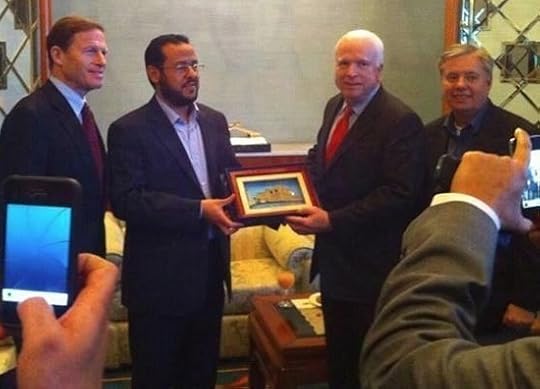
In February 2012, U.S. Senator John McCain, R-Ariz., met in Tripoli with Belhaj and representatives of the Misrata military council, as documented by an Agency France-Press report. McCain reportedly discussed ending the human rights abuses committed in Libya by the 250 militia that Human Rights Watch alleged the Misrata military council controlled.
A photograph from the February 2012 meeting in Libya shows McCain, with U.S. Senator Lindsay Graham, R-S.C., standing at McCain’s left, receiving from Belhaj a plague depicting in Tripoli what is known as “Green Square,” renamed “Martyrs’ Square” after the revolution that toppled Qaddafi from power.
WND has also reported that by November 2011, Belhaj, then acting as the head of the Tripoli Military Council and a former leader of the Libyan Islamic Fighting Group, was holding meetings with officials from the rebel Free Syrian Army officials in Turkey about providing troops and arms to Syria to assist in the fight against the Assad government.
November 16, 2013
Do 3 'tramps' hold key to solving JFK murder?
In 1966, JFK-assassination researcher Richard E. Sprague came across seven unpublished photographs taken by newspaper photographers in Dealey Plaza between 2:20 p.m. and 2:30 p.m. local time – approximately two hours after the shooting – showing three unidentified “tramps” being escorted by two armed Dallas policemen past the Texas School Book Depository and across Houston Street to the sheriff’s office.
Further research indicated the three unidentified men had been found in a railroad freight car in the railroad yard behind the picket fence on the grassy knoll, above the triple underpass.
Dallas Police Sgt. David V. Harkness told the Warren Commission (Vol. VI, page 312) that he pulled “some people” he identified as “tramps and hoboes” off a long freight train in the railroad yard. Harkness testified the men were arrested and “taken to the station and questioned.”
Deputy Sheriff Harold E. Elkins, in an affidavit given Nov. 22, 1963, (Warren Commission, Vol. XIX, page 540) stated, “A little while later a Dallas policeman came to our office with three prisoners who he had arrested on the railroad yards. I took these three to the city jail and turned them over to Capt. Fritz.”
In 1966, law enforcement authorities in Dallas were unable to produce any records of the arrests, and the identity of the “three tramps” seen in the unpublished Dallas newspaper photographs could not be determined.
In the 50 years since the JFK assassination, researchers have produced evidence suggesting the men were key assassination operatives attempting to escape Dealey Plaza, hoping they would be dismissed as vagrants.
Problems identifying the ‘tramps’
In a 1992 release of thousand of pages of Dallas police arrest and investigation reports regarding the JFK assassination, an arrest report filed by Dallas police officer W. E. Chambers documented the three “tramps” were Howard Doyle, John F. Gedney and Gus W. Abrams. The three were arrested as “investigative prisoners” charged with vagrancy and robbery.
Chambers’ report vaguely recorded the three men were “taken off a boxcar in the railroad yards right after President Kennedy was shot.” He noted they were “passing through town” and had “no means of support.” The three were kept in Dallas Police custody until 9:25 on the morning of Nov. 26, 1963, and then released.
An FBI interview with Harkness June 29, 1992, reported: “Harkness had an opportunity to view four photographs of the three individuals identified as Doyle, Gedney, and Abrams. Harkness identified them as three of the individuals who were removed from the train on Nov. 22, 1963.”
Viewed critically, the language appears to sidestep a direct statement that Harkness had positively identified the three men in the photographs as Doyle, Gedney and Abrams
The FBI report added, “On the day of the assassination there were several individuals from the train other than the three individuals previously identified.”
Chambers, in a signed statement given to the FBI on March 3, 1992, indicated he did not recognize the three names on the arrest records.
The FBI further indicated Chambers did not remember filling out arrest reports for Doyle, Gedney and Abrams, although he did acknowledge the handwriting on the forms was his.
“Chambers indicated that on the day of the assassination, a number of people were brought into the Police Department as a result of a police dragnet,” the FBI report said. “Chambers speculated that the three were brought to the station by uniformed officers, and that those officers had not filled out any type of paperwork regarding their detention.”
Chambers also noted that no arrest number or identification number appeared on any of the reports filed for Doyle, Gedney and Abrams, indicating the Dallas Police jail would most likely not have any booking information on any of the three individual.
Other contradictions in the record involve three different FBI reports dated 1992 indicating Doyle had been arrested on a gondola known as a coal car, while Dallas Police records indicate the “three tramps” seen in the seven unpublished Dallas newspaper photographs had been arrested in a railroad freight box car. Gedney claimed he was arrested on a flatbed railroad car that was transporting large sheets of steel. Yet a third FBI report says Doyle, Gedney and Abrams were arrested in a grain car on the freight train.
An additional continuing problem is that the physical resemblance between Doyle, Gedney and Abrams appears tenuous, at best, with no credentialed face-recognition experts affirming a match with the men seen in the seven “tramp” photographs in question.
The controversy over the “three tramps” intensified in 1975 when investigative reporters Alan Weberman and Michael Canfield in their 1975 book “Coup d’Etat in America: The CIA and the Assassination of John F. Kennedy” argued the men in the photographs do not look like tramps. All three were clean-shaven and two had recent haircuts.
“All of them looked well-fed and their shoes were not worn,” Weberman and Canfield wrote.
Weberman and Canfield speculated the two of the tramps resembled Watergate burglars E. Howard Hunt and Frank Sturgis, while the third resembled an Oswald-double identified under the alias Daniel L. Carswell.
Chauncey Holt comes forward
In 1991, Chauncey Holt, a criminal with ties to organized crime figures Meyer Lansky in Miami and Havana, as well as with Peter Licavoli in Detroit, who additionally claimed to have worked for the CIA as a contract agent, came forward to identify himself as one of the three men in the photographs.
In an autobiography Holt published this year titled “Self-Portrait of a Scoundrel,” Holt claimed he played a role in the JFK assassination by forging Secret Service credentials that he transferred on Nov. 22, 1963, to a contact who distributed the them to mobsters and CIA agents participating in the assassination.
Holt identified the other two men as known mob-related murderers Charles Harrelson and Charles Rogers (aka Richard Montoya).
Holt’s claim gained attention when Lois Gibson, a widely recognized forensic artist and facial expert who works for the Houston Police Department, conducted an analysis in which she affirmed her certainty the three men were Holt, Harrelson and Rogers.
According to Holt’s account, on Nov. 22, 1963, he was instructed to wear work clothes and was provided with the location of a boxcar in which he was supposed to hide, containing weapons and firearms. Holt was carrying credentials identifying him as an undercover agent for the Bureau of Alcohol, Tobacco, and Firearms, U.S. Treasury Department.
Holt described how he had driven Charles Nicoletti and Leo Moceri, two well-known gunmen with the Licavoli crime family in Detroit, from Tucson, Ariz., to Dallas in an Oldsmobile station wagon.
Leaving Tucson on Nov. 20, 1963, Holt explained a windstorm in El Paso, Texas, forced them to stop, delaying their arrival in Dallas to the early hours of Nov. 22, 1963.
Arriving late in Dallas, Holt’s instructions were to drop Nicoletti and Moceri at a downtown Dallas hotel and then drive to the parking area behind Dealey Plaza. He was to find a pickup truck with Texas license plates into which he was to place a briefcase containing the false Secret Service identification papers and lapel pins he had forged and falsified.
“One out of area car, a Chevrolet, with Arizona plates drove into the lot, circled the entire area and parked very near the railroad tower,” Holt wrote on page 171 of his autobiography. “Almost immediately, Richard Montoya and Charles Harrelson approached me. I had identification and hand guns, which I was instructed to deliver to them.”
Holt also wrote that he observed a vintage Ford in the parking lot behind Dealey Plaza, driven by a man he recognized as Aldo Vera, an anti-Castro Cuban activist.
“Vera appeared to be listening to a handheld transceiver,” Holt noted.
After the shooting, Holt climbed into the freight train boxcar, as instructed, finding that Montoya and Harrelson were already there.
“At about 1:30 the train moved out, and I gave a deep sigh of relief, although I was still in shock over what had apparently taken place,” Holt wrote on page 177.
Suddenly, the train came to a halt; Dallas Police searching the boxcar apprehended the three men.
“We were ordered out of the boxcar, without any opportunity to present our credentials, or explain that we were engaged in an official investigation for the ATF, at the time all of the excitement continued,” Holt continued. “Shortly thereafter, I arrogated myself to the position of spokesman and explained our cover story to Sgt. D. V. Harkness and he ordered the army of police officers to search the rest of the train. He then turned us over to a pair of portly officers, who escorted us to the Dealey Plaza command post.”
Holt continued his narration: “We were marched south along the railroad tracks, to west of the Texas School Book Depository; then across Elm street and up to the corner of Houston Street to the command post, that had been set up at the Criminal Courts Building. We were turned over to a deputy sheriff, who called [Dallas Police Department Captain] Will Fritz, a man I knew we could trust. Fritz came over from the police station, said a few words to the deputy sheriff and ordered that we be turned over to the resident agent of the FBI, who was Gordon Shanklin.”
Holt explained: “Shanklin turned us loose, at once, and there was no record kept of our ‘detainment.’ The only record of this incident is the photographic record of us crossing the plaza [Dealey Plaza].”
Holt further explained that of the eight or 10 persons arrested in the railroad yard, arrest records were kept for everyone but Holt, Montoya and Harrelson.
How credible is Chauncey Holt?
Holt’s account is remarkable in that he identified in Dallas four individuals suspected of being gunmen in the JFK assassination: Charles Nicoletti and Leo Moceri, as well as Richard Montoya and Charles Harrelson.
Zack Shelton, a retired FBI agent who has spent years since his retirement investigating leads in the JFK assassination, explained to WND that he considered Holt’s testimony credible, not only because of the Lois Gibson’s facial recognition analysis, but also because various details of Holt’s accounts are corroborated by other testimony independently given by known eyewitnesses to the JFK assassination.
Lee Bowers, a “tower man” for the Union Terminal Company who was in the railroad yard tower, elevated some 14 feet above the railroad yard with windows permitting a clear view on all four sides, testified to the Warren Commission in Dallas on April 2, 1964 (Warren Commission Volume VI, page 284).
Bowers testified that among the three vehicles he observed in the parking lot on the morning of Nov. 22, 1963, was a 1959 blue-and-white Oldsmobile with out-of-state license plates and a Goldwater bumper sticker.
Bowers also testified he observed a 1957 black Ford with a Texas license plate “with one male in it that seemed to have a mike or telephone or something that gave the appearance of that at least.”
Pressed by Joseph Ball, the Warren Commission assistant counsel questioning him, Bowers further explained: “He was holding something up to his mouth with one hand and he was driving with the other, and he gave that appearance. He was very close to the tower. I could see him as he proceeded around the area.”
Dallas Police Sgt. D. V. Harkness, in his testimony to the Warren Commission in Dallas on April 9, 1964, (Warren Commission Vol. VI, p. 308) described his activity searching the freight trains in the railroad yard above the triple overpass as follows: “Well we got a long freight that was in there, and we pulled some of the people off there and took them to the station.”
Explaining that Dallas Police searched the freight cars in two large freight trains in the railroad yard following the JFK assassination, Harkness described those apprehended as transients, “tramps and hoboes,” but he neglected to say how many were apprehended.
November 14, 2013
Prosecutor: Mafia planning to assassinate pope
NEW YORK – The Mafia are considering assassinating Pope Francis for his anti-corruption agenda and his threats to reform or possibly even close the Vatican Bank, warned an Italian prosecutor.
The prosecutor, Nicola Gratteri, said members of the Calabrian Ndrangheta Mafia are concerned about the pope’s crusade against corruption, “wearing his iron crucifix, as he rails against worldly goods and plans a total clean up,” the London Daily Mail reported.
Gratteri is the deputy chief prosecutor of Reggio Calabria, the southern region in the “toe” of Italy, across the Straits of Messina from Sicily.
Commenting on the threat, Tom Horn, co-author with Chris Putnam of the 2012 book “Petrus Romanus: The Final Pope is Here,” noted that if something were to happen to Francis, the new Vatican secretary of state he appointed, Pietro Parolin, could take over the papacy.
Horn told WND that by placing a cardinal whose name can be translated as “Peter the Roman” in that position, he has “created a scenario whereby a man whose name literally seems taken from the final line of St. Malachy’s ‘Prophecy of the Popes’ could step into the position of pope, if something were to remove Pope Francis from office, such a accidental death, murder, or imprisonment.”
“The Prophecy of the Popes” emerged in the 1500s at a time of great upheaval after being lost in the Vatican archives for some 400 years. According to Catholic tradition, the author, St. Malachy, the archbishop of Armagh in Ireland from A.D. 1132 to 1136, predicted a sequence of popes that would end with “Petrus Romanus,” or “Peter the Roman.”
In August, WND reported Pope Francis decided to replace the Vatican secretary of state, Cardinal Tarcisio Bertone, a close friend of Pope Emeritus Benedict XVI, with Venezuelan Archbishop Pietro Parolin, a 58-year-old prelate who has worked in Nigeria and Mexico for the Vatican office of secretary of state under Bertone.
The Daily Mail noted that in one of his first sermons, Francis took aim at the Mafia, calling on it to repent for “exploiting and enslaving people.”
“Those who are in the financial arms of the Mafia are concerned by Pope Francis,” Gratteri explained to the Italian newspaper Il Fatto Quotidiano. “Those who until now have been feeding off the wealth and power that comes directly from the church are agitated and nervous.”
Gratteri added: “Pope Francis is dismantling the centers of economic power in the Vatican. If the bosses could take him down they would not hesitate.”
The prosecutor agreed the Vatican security services are among the best in the world, acknowledging the Mafia may not necessarily be capable of assassinating Francis.
“I do not know if organized criminal gangs are in a position to do something,” Gratteri said, “but they are certainly considering it. It is a dangerous time for Pope Francis.”
The London paper reported the Ndrangheta, based in Reggio Calabria, has become the largest, richest and most feared of Italy’s three main criminal organizations.”
“Specializing in cocaine trafficking, the Ndrangheta controls 80 percent of the market in Europe and has invested its profits in northern Italy, Germany and the United States,” wrote Hannah Roberts, reporting for the Mail. “They have forged links with terrorist organizations worldwide and the drug cartels of South America.”
In September, WND reported Pope Francis announced he intends to intensify his fight against corruption at the Vatican by strengthening supervision of the Vatican Bank through the appointment of a special commission of inquiry to investigate and oversee the Institute for the Works of Religion, the formal name of the Vatican Bank.
Wounded eyewitness challenges Warren Commission
WASHINGTON – James T. Tague, the eyewitness to the JFK assassination who was nicked by a piece of concrete sidewalk or a bullet fragment from a shot aimed at President Kennedy, has charged in a new book that the Warren Commission was planning to ignore his testimony until he objected publicly.
“In early June 1964 I read in a newspaper that the Warren Commission had finished its investigation, was sending its Commission helpers home, and was going to write its report: Three shots fired: first hitting Kennedy, the second Connally, the third Kennedy, and the deed was done by a ‘lone nut assassin’ named Lee Harvey Oswald,” Tague writes in “LBJ and the Kennedy Killing.”
“The ‘facts’ were just as (FBI Director J. Edgar) Hoover had stated 48 hours after the assassination,” he says.
In his book, Tague comments that in the six months after the assassination he had not been called to testify before the Warren Commission, even though the FBI interviewed him Dec. 14, 1963.
“Something was wrong,” Tague continues. “I felt the missed shot was important, because it indicated there was more than one shooter. I raised my hand and related to a reporter what I knew – the story was printed nationwide, and I was at last called to testify.”
A close examination of Warren Commission records strongly suggests Tague’s evidence did influence the commission’s conclusions, but not as Tague had expected.
The only way for the Warren Commission to incorporate Tague’s testimony and still conclude that only three shots had been fired, all by Lee Harvey Oswald, was to adopt the “single-bullet theory.”
Make the evidence fit the conclusion
Of relevance to Tague’s testimony is a memo written in April 1964 by Norman Redlich, a special assistant to the Warren Commission. The memo provides evidence the purpose of the investigation was not to examine the evidence of the JFK assassination to determine who shot the president, but to substantiate a politically preconceived conclusion that Lee Harvey Oswald was the “lone gun assassin.”
On April 27, 1964, Redlich wrote a memo to Warren Commission chief counsel Lee J. Rankin indicating the Warren Commission staff had determined Gov. John Connally was hit by the second shot, a different bullet than the bullet from the first shot that hit President Kennedy.
Redlich wrote:
Our report presumably will state that the President was hit by the first bullet, Governor Connally by the second, and the President by the final and fatal bullet. The report will also conclude that the bullets were fired by one person located in the sixth floor southeast corner window of the TSBD (Texas School Book Depository) building.
The purpose of Redlich’s memo was to argue the Warren Commission staff should make a field trip to Dallas to identify as closely as possible the exact location on Elm Street where shots hit Kennedy and Connally, as determined by a close examination of the famous film by bystander Abraham Zapruder.
“Our intention is not to establish the point with complete accuracy,” Redlich wrote.
He specified the goal was not to determine whether or not the assassin could have shot JFK prior to Zapruder frame 190, “but merely to substantiate the hypothesis which underlies the conclusions that Oswald was the sole assassin.”
The wording suggests a predetermined political conclusion. The purpose of the field trip was not to test whether or not Oswald could have fired all three shots with the bolt-action rifle, but to “substantiate the hypothesis” by fixing the earliest possible location where a shooter from that vantage point could have fired the first shot hitting President Kennedy.
“As our investigation now stands, however, we have not shown that these events could possibly have occurred in the manner suggested above,” Redlich conceded. “All we have is a reasonable hypothesis which appears to be supported by the medical testimony but which has not been checked out against the physical facts at the scene of the crime.”
What Redlich was admitting was that the hypothesis that Oswald was the lone assassin came first and the examination of the evidence came second, instead of developing the hypothesis from the evidence.
“If we do not attempt to answer these questions with observable facts,” Redlich argued, “others may answer them with facts that challenge our most basic assumptions, or with fanciful theories based on our unwillingness to test our hypothesis by the investigatory methods available to us.”
When on July 23, 1964, Tague testified to the Warren Commission in Dallas that he had been hit in the cheek by a bullet fragment or a piece of concrete, the Warren Commission had a problem.
The problem was compounded when Tague’s testimony was confirmed the next day by the testimony of Dallas County Deputy Sheriff Eddy Raymond Walthers.
The officer confirmed Tague was struck by a bullet fragment or a piece of concrete that had been dislodged from the curb in the Main Street lane of the three roads that converge at the triple underpass.
Tague’s testimony also was confirmed by photographic evidence showing exactly where he stood to watch the motorcade and documenting the cut on his cheek after the shooting.
Tague was not sure which shot caused the injury, but he believed it was the second or third, not the first.
His testimony forced the Warren Commission to recalculate. If shots one and three hit JFK, and shot two hit Connally, which shot hit Tague?
The Zapruder film set a narrow time frame in which the shooting could have happened, somewhere between 4.8 seconds and 7 seconds, according to the final report. Even a top expert using a bolt-action Mannlicher-Carcano rifle would be limited to three shots in that time range, especially with the need to zero in the target with the scope anew for each shot.
Warren Commission’s conclusion
Warren Commission junior counsel Arlen Specter, later a U.S. senator from Pennsylvania, came up with the “single-bullet” theory, arguing one bullet hit both JFK and Connally, one bullet missed and the third bullet was the fatal head shot that killed JFK.
The problem the Warren Commission faced was that if four shots were fired, there had to be a second shooter, since the commission had already determined Oswald could only have fired three shots in a 4.8- to 7-second interval.
In his testimony to the House Select Committee on Assassinations, Redlich appeared once again to suggest the Warren Commission’s purpose was to find Oswald guilty, not necessarily to determine the truth.
“I think there are simply a great many people who cannot accept what I believe to be the simple truth, that one rather insignificant person was able to assassinate the president of the United States,” Redlich told an executive session of the House panel on Nov. 8, 1977.
November 13, 2013
WikiLeaks reveals secret Trans-Pacific trade deal
NEW YORK – WikiLeaks published Wednesday the highly secret negotiated text for the controversial Intellectual Property Rights chapter of the Trans-Pacific Partnership, or TPP, treaty the Obama administration has been negotiating behind closed doors, without congressional input or approval.
In February, WND first reported the Obama administration plans to ask Congress to grant fast-track authority to finalize the TPP treaty in an accelerated time frame. Congress would be limited to an up-or-down vote that would prevent it from modifying the treaty by amendment.
WikiLeaks reported the TPP is the “largest-ever economic treaty,” encompassing 12 participating nations representing more than 40 percent of the world’s gross domestic product, or GDP. Current TPP negotiation member states include the United States, Japan, Mexico, Canada, Australia, Malaysia, Chile, Singapore, Peru, Vietnam, New Zealand and Brunei.
The WikiLeaks document release was timed ahead of the decisive TPP chief negotiators’ summit planned for Salt Lake City Nov. 19-23.
President Obama has announced his intention to sign the TPP treaty agreement by the end of December. The TPP is the frontrunner to the equally secret Transatlantic Trade and Investment Partnership, or TIPP, between the United States and the European Union.
TIPP negotiations began in January. When the TPP and TIPP treaties are finalized, more than 60 percent of the global economy will be covered by the two treaties envisioned to eclipse national sovereignty with an overarching trade protocol administered internationally.
WikiLeaks’ Editor-in-Chief Julian Assange stated: “The U.S. administration is aggressively pushing the TPP through the U.S. legislative process on the sly.”
The advanced draft of the Intellectual Property Rights Chapter, published by WikiLeaks Wednesday, provides the public with the fullest opportunity so far to familiarize themselves with the details and implications of the TPP.
According to the WikiLeaks statement accompanying the document release, the process of drafting and negotiating the treaty’s chapters has been shrouded in an unprecedented level of secrecy.
The press release notes:
Access to drafts of the TPP chapters is shielded from the general public. Members of the US Congress are only able to view selected portions of treaty-related documents in highly restrictive conditions and under strict supervision. It has been previously revealed that only three individuals in each TPP nation have access to the full text of the agreement, while 600 ’trade advisers’ – lobbyists guarding the interests of large US corporations such as Chevron, Halliburton, Monsanto and Walmart – are granted privileged access to crucial sections of the treaty text.
WikiLeaks stressed the 95-page, 30,000-word Intellectual Property Chapter lays out provisions for instituting a far-reaching, transnational legal and enforcement regime, modifying or replacing existing laws in TPP member states.
“The Chapter’s subsections include agreements relating to patents (who may produce goods or drugs), copyright (who may transmit information), trademarks (who may describe information or goods as authentic) and industrial design,” the WikiLeaks statement said.
The longest section of the Intellectual Property Chapter, titled “Enforcement,” is devoted to detailing new policing measures, with far-reaching implications for individual rights, civil liberties, publishers, Internet service providers and Internet privacy, as well as for the creative, intellectual, biological and environmental commons, WikiLeaks said.
Particular measures proposed include supranational litigation tribunals to which sovereign national courts are expected to defer but which have no human rights safeguards.
The TPP Intellectual Property Chapter states that the courts can conduct hearings with secret evidence.
When he released a draft of the Intellectual Property Chapter in May, Rep. Darrell Issa, R-Calif., chairman of the House Oversight Committee, issued a statement indicating his concern over the proposed language.
“At a time when the American people and Internet users all around the world are rightfully wary of any closed-door negotiations that could adversely impact their ability to freely and openly access the Internet, the Obama Administration continues to pursue a secretive, closed-door negotiating process for the Trans Pacific Partnership,” Issa said.
“I have decided to publish the intellectual property rights chapter of TPP in Madison so that the public can provide input to those negotiating this agreement, and to push this Administration – and the federal government as a whole – to be open, transparent and inclusive when it comes to international intellectual property rights agreements that have potentially serious consequences for the Internet community.”
In August, WND reported Sen. Rand Paul, R-Ky., warned against granting President Obama fast-track authority to push the TPP through Congress.
Paul said fast-track authority would violate the constitutional separation of powers by usurping the power of Congress to exercise independent judgment over trade agreements entered into as treaty obligations of the U.S.
Norquist: Obamacare fiasco puts GOP in driver's seat
WASHINGTON – With the implementation of Obamacare turning into a fiasco, the tables have turned suddenly on the administration, offering Republicans in Congress political advantage, anti-tax activist Grover Norquist told WND in an interview.
“There is no longer one single approach for Republicans in Congress to win on Obamacare,” Norquist said.
“Every failure of Obamacare opens a new avenue of attack,” he said. “The vulnerable Democrats of 2014 will now come begging for cover. Republicans can agree to those ‘fixes’ that move toward greater freedom and say no to ‘fixes’ that protect Obamacare at the expense of taxpayers.”
Instead of Republicans alone wanting to defund Obamacare, Norquist argued, the pressure in Congress to delay or change the law is now coming from Democrats.
Many Democrats, recognizing that millions of Americans are losing their health care plans despite Obama’s promise, fear a voter backlash in the 2014 mid-term elections.
“When both teams in Congress effectively have a veto, it’s a legislative stalemate,” Norquist argued, “and the party that needs to get something done is at a disadvantage.”
Norquist said the Republicans in the House can now “suddenly get changes in Obamacare by sitting tight” and waiting “for the Democrats to come begging to postpone or delay” it.
“The Republicans can agree, but only after the Democrats make concessions they otherwise never would have made,” Norquist said.
Sumo wrestling
Norquist, president and founder of Americans for Tax Reform, explained Congress today is like an evenly matched Japanese Sumo wrestling contest in which the Democrats control the Senate and the Republicans control the House. Neither party has sufficient weight to determine the outcome of legislation without the cooperation of the other.

Grover Norquist
The Republican House can block any legislative initiative Obama and the Democrats in the Senate want to enact, and the Democratic-controlled Senate can refuse to vote on any bill the House passes.
Norquist believes the political damage done to Obama and the Democrats in Congress by the failure of the Obamacare implementation opens up a new chapter in the Sumo wrestling contest in Congress.
The battle is between Democrats who want to raise taxes to increase entitlement spending and Republicans who want to enact fundamental reforms in entitlement programs to cut government spending.
“The tea party handed Republicans a tactical advantage by insisting the United States needs not only to hold the line with ‘no new tax increases,’ but also to force a reduction in spending,” Norquist explained. “Because of the tea party, we now have the sequester in place, limiting government spending for a decade.”
Obama’s first tactical error was to sign the sequester, Norquist argued. His second error was to allow 85 percent of the Bush tax cuts to become permanent. In making these errors, Obama gave up much of his power.
“In 2011, the sequester was a cap on spending that saves $2.5 trillion in spending over the next decade,” Norquist pointed out. “Obama believed the sequester was a trick, believing pro-Pentagon Republicans would eventually abandon the sequester cuts to demand increased spending on defense. Obama really believed that agreeing to the sequester would eventually lead to a tax increase as Republicans sought to increase defense spending.”
Now, with the sequester in place, Norquist argues, the Democrats feel they are “in a choke collar” on spending.
The second big mistake, from Obama’s standpoint, was to agree to make 85 percent of the Bush tax cuts permanent.
“Obama did take back 15 percent of the Bush tax cuts. He won that much. But the price was to give away his ability to threaten a tax hike – simply by refusing to extend the temporary tax cuts. What were temporary and therefore vulnerable tax cuts for 12 years are now permanent.”
Gift from the heavens
Norquist fast-forwarded to today.
“Now we have a gift from the heavens in that the Obamacare implementation involves a website that does not work and millions of Americans realizing they will lose their current insurance, despite Obama promises to the contrary,” he said.
Norquist also credits Rep. Paul Ryan, R-Wisc., for offering to loosen the choke collar on current spending, but only in return for significant long-term cuts achieved thorough entitlement reform. Republicans would trade off some sum, perhaps $20 billion in current spending increases, for entitlement reform, resulting in long-term spending cuts in the range of $2.5 trillion.
Before Ryan and the sequester, the old deal available in Congress was to raise taxes, as demanded by Democrats, in exchange for promises of future spending reductions.
“The problem here always was that once you walk down that road – as in 1982 and 1990 – the tax increases were real and permanent, while the spending cuts never materialized,” Norquist pointed out.
“Ryan’s innovation was to change the old deal into a new formulation in which Republicans are willing to reduce the sequester choke-hold only in exchange for long-term massive reforms in entitlement programs, worth in dollars many times the amount in reductions in entitlement programs than is conceded in dollars in increased spending,” he said.
The Republican tactical advantage right now, Norquist argued, is that they can sit tight on the sequester for the next 10 years and wait for the Democrats to come wanting increased spending.
“So, for the next decade, Republicans can say we will reduce the sequester choke hold, but only in exchange for trillions of dollars in long-term entitlement reform,” Norquist stressed.
“Before Ryan, all the fiscal deals in Congress required a concession by Republicans on tax increases,” he said. “Ryan changed the world because Democrats know that if a Republican president is voted into office in 2016 or 2020, Congress will pass the Ryan plan calling for lowering tax rates with a growth-oriented tax reform program designed to increase tax revenues combined with long-term entitlement program reforms designed to reduce government spending.”
Now, with the sequester pushed by the tea party in place and failure of the Obamacare implementation an obvious problem for the Democrats, the Republicans in Congress can suddenly sit back and wait for the Democrats to push new legislation to delay or otherwise change Obamacare.
“Before the fiasco of the Obamacare administration, the Republicans wanted to prevent or delay Obamacare implementation because Republicans were worried Obamacare might be a huge success with the American public,” Norquist said. “Now that we know the Obamacare administration has been a huge embarrassment to Democrats, the pressure for delaying or changing Obamacare has shifted to the Democrats.”
The Sumo-wrestling calculation of power in Congress has changed fundamentally with the failure of Obamacare, Norquist concludes.
“Now the Democrats are faced with coming uphill with the sun in their eyes,” he pointed out. “All the Democrats can ask for today is poking a hole in the sequester and delaying or changing Obamacare.”
So, when the continuing resolution and debt ceiling issues return to Congress early next year, Norquist believes the Republicans have a new-found advantage that can be pressed by waiting until the Democrats push for delaying or reforming Obamacare.
This, Norquist believes, positions the Republicans in Congress to demand concessions from the Democrats, who need relief from Obamacare for political reasons.
Norquist emphasized that the changes Republicans agree to make on Obamacare “need now to be free-market solutions.”
“We now know it is not true that once Obamacare was in place, we would never get rid of it – a concern Sen. Ted Cruz argued would happen,” he said.
Electoral liability
Norquist said Democrats face the electoral liability if Obamacare remains in place in 2014.
“This is something we did not know for sure would happen until the Obamacare implementation began,” he said.
With their new leverage, Republicans “can sit tight with the sequester in place and 85 percent of the Bush tax cuts made permanent,” he said, ‘and, if played right, we no longer have to vote to repeal, defund, or delay Obamacare – a strategy sure to fail with Obama holding a presidential veto.”
“When the vulnerable Democrats tell us what their problem is with Obamacare, we can demand market-oriented solutions to Obamacare as the price of ‘solving their problem’ – knowing we can keep the government going by passing a new continuing resolution with the sequester unchanged,” he said.
“That’s winning because spending is capped and the Democrats get no more money to spend.”
As Obamacare continues to come apart, Republicans in Congress are going to have opportunities to introduce market-oriented reforms Norquist believes the American people will demand.
“Suddenly, Obama might sign a Democratic Party-generated bill to change or delay Obamacare just like he signed the sequester in 2011,” Norquist concluded. “That’s my point – the table on Obamacare has now turned, and it’s the Democrats in Congress who are now going to push for changes.”
Jerome R. Corsi's Blog

- Jerome R. Corsi's profile
- 74 followers

