
Jerome R. Corsi's Blog, page 340
January 19, 2014
Obama blamed for rebirth of al-Qaida

NEW YORK – President Obama and NATO destabilized Libya politically by allowing al-Qaida and radical Islamic factions to gain control of the country, a Libyan tribal leader told WND.
Sheik Mahmoud Al Sharief, who heads five tribes in the Western mountains of Libya reaching from Tripoli to Tunisia, spoke to WND from Libya in a Skype interview.
“There is a state of anarchy in Libya, he said.
“There is no government now, there is no law and order. Under the old regime Libya was a stabilizing factor in the region, a peaceful nation with a productive economy, but now that the U.S. government and NATO have come in, Libya has become a destabilizing factor in the region, dominated by al-Qaida and al-Qaida related radical Islamic groups.”
He said the “provisional government established by the Obama administration and by NATO is not functioning.”
Based in Benghazi, the National Transitional Council of Libya became the de facto government of Libya during the civil war in which the rebel groups backed by the U.S. and NATO ousted Moammar Gadhafi in October 2011. In August 2012, the NTC formally transferred power to the General National Congress, which is tasked with forming a constituent assembly to write Libya’s permanent constitution.
Al Sharief claimed the current provisional government in Libya constitutes a very weak state that invites al-Qaida extremists a chance to infiltrate and control the country.
Al Sharief said that in his region alone, near Sabratha, roughly 40 miles west of Tripoli, there is a training camp full of al-Qaida members, splinter groups and sympathizers who came from throughout the Islamic world, including Afghanistan, Iraq, Tunisia, Jordan, Yemen, Sudan, Algeria and Pakistan.
Prime spot to strike West
Rich in oil and strategically located, Libya is “an attractive location for al-Qaida and Islamic radicals to strike against Western interests and Western targets,” he said
Al Sharief noted the country is only a few hours by speedboat to Italy or Greece. It neighbors Algeria and Niger, which both border Mali, where al-Qaida recently had gained strength.
“So al-Qaida is now strong, with massive, heavy weapons, and I’m not just talking about sub-machine guns. Al-Qaida has a lot of cash. And al-Qaida now has the advantage of being able to hide behind the weak state in Libya,” he said.
He noted that last year in Algeria a coordinated band of Islamic terrorists attacked a convoy of gas refinery workers, including foreign nationals and expatriates from the United States, the U.K., Norway and Japan. The four-day siege resulted in the deaths of 38 hostages.
“Right now, there are six major al-Qaida training camps in Libya – in Sabratha, in Sirte, in Misrata, in Derna, in Benghazi and in Sabha,” Al Sharief said.
The population of Tajoura has been chased from their homes by the Misrata militia, he noted, allowing al-Qaida groups to train in the empty city.
There are more than 1.8 million Libyans living in exile, he pointed out, in Tunisia, Algeria, Niger, Chad, Morocco, Egypt, Jordan and some European countries.
“This is a result of the campaign by President Obama and NATO to support the so-called ‘freedom fighters who were killing and are now slaughtering the people in a butcher style,” he said.
The country is now in chaos.
“There is no state, there is no government, there is no country,” he said. “No one is in control. There is no law and order. It is anarchy,” he said.
“If you realize the prime minister was kidnapped from his hotel at 3 a.m. in the morning, you will see what a desperate state Libya is in right now,” he added.
Retaliation
On Oct. 10, 2013, Libyan Prime Minister Ali Zeidan was kidnapped at gunpoint by a group of men believed to be former Islamic rebels and taken from the hotel in Tripoli where he lived to be driven to an undisclosed location. He was released several hours later after members of a Tripoli-based militia stormed the house where he was being held hostage.
The kidnapping was believed to be in retaliation for a U.S. Special Forces raid that seized Nazih Abdul-Hamed al-Ruqui. Known as Abu Anas al-Libi, he is a Libyan al-Qaida suspect with a $5 million bounty on his head for playing a suspected role in the 1998 bombings of the U.S. embassies in Kenya and Tanzania.
Al Sharief told WND there have been repeated unconfirmed reports in recent months that U.S. Navy ships offshore Libya have been launching unannounced missile attacks on al-Qaida training camps in the country.
He further confirmed a report WND published in December that Abdul Hakim Belhaj, an al-Qaida operative who was a principal organizer of the attack on the U.S. compound and annex in Benghazi, remains a major al-Qaida force in Tripoli.
“Even more than Belhaj, Khalid al-Sharif has been appointed by Prime Minister Zeidan to be deputy defense minister for Libya, even though he is still al-Qaida,” Al Sharief continued. “Ansar al-Sharia, the militant arm of the 17th of February Brigade, is also al-Qaida aligned.”
He concluded the interview with worries about the future of Libya.
“The only hope for the future is for the people of Libya to reunite and to throw these radical Islamic elements out of the country,” he said.
JoAnne Moriarty helped arrange the Skype interview with Sheik Mahmoud Al Sharief.


January 18, 2014
Pot. Kettle. Black: U.N. grills Vatican over sex
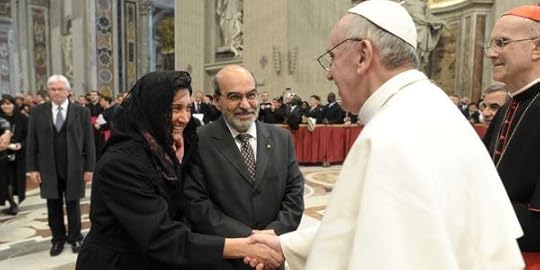
Pope Francis meets with U.N. officials in March 2013
UNITED NATIONS – Last Thursday in Geneva a panel from the United Nations Convention on the Rights of the Child, in a open hearing televised live on the Internet, grilled Vatican officials over the handling of cases of sex abuse by clergy, while neglecting to reference the many different sex scandals involving U.N. personnel that have plagued the organization for decades.
Bishop Charles Scicluna, the Vatican official responsible for prosecuting clergy accused of sex crimes over 10 years, from 2002 until 2012, explained to the U.N. panel that it is not the policy of the Holy See to cover up sex crimes committed by the clergy.
Archbishop Silvano Tomasi cautioned the U.N. panel that the legal jurisdiction of the Vatican to punish clergy criminally was often trumped by criminal laws within the jurisdiction in which the accused clergy resided.
The Vatican ratified the U.N. Convention on the Rights of the Child in 1990, but did not submit any reports until 2012, when the Vatican reported it was aware of 612 new cases of sexual abuse charges in 2012, 418 of which involved minors.
Since the 1970s, sex abuse scandals involving clergy have cost the Vatican a loss of credibility across the globe, with accusations the Holy See’s reaction until recently has been to shuffle the accused clergy to another diocese or assignment in an effort to cover up rather than prosecute the crime.
Pope Francis copes with sex-abuse scandal
In December 2013, after refusing a U.N. request for information on alleged sexual abuse cases involving the clergy, Pope Francis announced through Cardinal Sean O’Malley, the archbishop of Boston, the decision by the Vatican to set up a child sex-abuse committee involving a panel of experts charged with producing guidelines of conduct for Catholic clergy and church officials.
In 2002, Cardinal Bernard Francis Law, then the archbishop of Boston, was forced to resign after accusations of sexual misconduct by priests in the Archdiocese of Boston. The resignation was triggered by particularly sensational accusations of child molestation involving Father John Geoghan tracing back to 1984 that resulted in Geoghan’s criminal conviction for indecent assault and battery on a 10-year-old boy.
Pope Francis raised further questions about the Vatican’s sincerity in prosecuting clergy accused of sex abuse when Law was given an appointment as archpriest at the prestigious Basilica of St. Maria Major in Rome.
Last Thursday, however, in a particularly blunt homily delivered at a Vatican Mass, Pope Francis explained scandals in the Catholic Church happen because there is no living relationship with God and his Word, thus corrupt priests, instead of giving “the Bread of Life,” give a poisoned message to the faithful.
“But are we ashamed?” Pope Francis asked in the homily broadcast by Vatican Radio.
“So many scandals that I do not want to mention individually, but all of us know … we know where they are! Scandals, some who charged a lot of money [to] the shame of the Church! But are we all ashamed of those scandals, of those failings of priests, bishops, laity? Where was the Word of God in those scandals; where was the Word of God in those men and in those women? They did not have a relationship with God! They had a position in the Church, a position of power, even of comfort. But the Word of God, no!”
On Friday, the Associated Press reported Pope Benedict XVI defrocked nearly 400 priests in 2011 and 2012 for molesting children.
In a document prepared for release to the U.N., the Vatican confirmed a dramatic increase over the 171 priests removed in 2008 and 2009 for alleged sexual abuse.
The AP acknowledged “a remarkable evolution in the Holy See’s in-house procedures to discipline pedophiles since 2001,” when then-Cardinal Joseph Ratzinger [subsequently elected Pope Benedict XVI] ordered bishops to send to Rome for review all cases of priests credibly accused of sexual abuse.
Et tu, U.N.?
Yet even as the Vatican is making strides to explain to the U.N. its efforts to clean house of sexual abuse, the international body headquartered in New York has its own skeletons in the closet.
On March 13, 2005, for example, Washington Post staff writer Colum Lynch reported “a culture of sexual permissiveness” has plagued U.N. peacekeeping operations worldwide for the past 12 years.
“The reports of sexual abuse have come from U.N. officials, internal U.N. documents and local and international human rights organizations that have tracked the issue,” Lynch wrote. “Some U.N. officials and outside observers say there have been cases of abuse in almost every U.N. mission, including operations in Ivory Coast, Sierra Leone and Kosovo.”
On May 8, 2006, the BBC reported a widespread scandal in which UN peacekeepers were demanding “sex for aid” from girls as young as 8 years old in Liberia.
In 2008, an international scandal developed when U.N. peacekeepers in Haiti were involved in gang-rape charges in the Ivory Coast, and in 2011, Uruguayan President Jose Mujica apologized to Haitian President Michel Martelly over the alleged rape of an 18-year-old Haitian man by Uruguayan U.N. peacekeeping troops then in Haiti.
Despite a U.N. “zero tolerance” policy toward sexual abuse announced in 2003, the U.N. has focused serious attention on addressing sex crimes among more than 120,000 personnel deployed in 16 different peacekeeping missions globally, the New York Times reported in 2011.
“What do we do when those we entrust with our greatest hopes betray that trust?” asked Gerald Caplan writing in The Globe and Mail published in Canada on Aug. 3, 2012. “If the betrayers are United Nations peacekeepers, the answer seems to be nothing at all. There is distressing new evidence, most of it reported here for the first time, that foreign soldiers in the Democratic Republic of Congo can sexually and violently violate young girls with impunity so long as they wear that iconic blue beret or blue helmet.”
In 2013, the United Nations acknowledged in what appears to be a continuing problem for the U.N. worldwide its peacekeeping mission in Mali had received allegations of serious misconduct by its peacekeeping troops then in Mali, including an alleged incident of sexual abuse.
“The secretary-general is treating this matter with the utmost seriousness and, in line with established procedure, is in the process of notifying the troop-contributing countries,” Secretary-General Ban Ki-moon’s spokesman, Martin Nesirky, told a news briefing in New York on Sept. 22, 2013, in reference to the sexual abuse allegations against U.N. peacekeepers in Mali.
January 16, 2014
Pope Francis launches Vatican Bank purge

NEW YORK – In yet another dramatic attempt to introduce financial discipline and order to the Vatican, Pope Francis replaced on Wednesday four of the five cardinals overseeing the Vatican Bank.
At the same time, the Vatican refused to dismiss persistent rumors Francis may simply decide to close the Vatican Bank altogether.
The four cardinals on the five-member Commission of Cardinals Overseeing the Institute for the Works of Religion, or IOR, the formal title of the Vatican Bank, were removed only 11 months into their five-year terms as commissioners, having been appointed by Pope Emeritus Benedict XVI, who resigned as pope last February.
Most prominent of the four dismissed cardinals was Cardinal Tarcisio Bertone, who served as Vatican secretary of state, arguably the most powerful Vatican office next to the pope, during the papacy of his close friend Benedict.
Benedict steadfastly supported Bertone through a series of crises that called into question Bertone’s integrity and honesty. The crises included a money-laundering scandal involving the Vatican Bank that resulted in the sacking of the bank’s head, Gotti Tedeschi, a highly respected Italian economist and banker. Another scandal centered on Paolo Gabriele, the pope’s butler, who was criminally prosecuted for confiscating and photocopying more than 1,000 pages of sensitive Vatican documents over six years that he released to an Italian journalist for publication.
As WND reported in August, Francis surprised veteran Vatican observers by deciding to fire Bertone as Vatican secretary of state, replacing him with Venezuelan Archbishop Pietro Parolin, a 58 year-old prelate who has worked in Nigeria and Mexico for the Vatican office of secretary of state under Bertone.
Wednesday, Parolin, who is expected to be elevated to the rank of cardinal next month, was one of the four new Vatican Bank commissioners appointed by Francis to take Bertone’s place.
Also replaced was Cardinal Domenico Calcagno, the current president of the Administration of the Patrimony of Apostolic See, another Vatican financial entity submitted to independent outside audit after questions of financial mismanagement were raised, as well as Cardinal Pedro Scherer of Sao Paolo and Cardinal Telesphore Toppo of Ranchi, India.
Added to the commission along with Parolin were Cardinal Santos Abril y Castello, archpriest of the Basilica of Santa Maria Major in Rome, Cardinal Thomas Collin of Toronto and Cardinal Christoph Schönborn of Vienna.
The only cardinal to remain on the commission is Cardinal Jean-Louis Tauran, the president of the Pontifical Council for Inter-Religious dialogue.
Will Francis close the Vatican Bank?
Reuters reported Francis has not ruled out closing the Vatican Bank, a possibility WND reported Dec. 4, 2013.
On Nov. 28, 2013, Francis appointed his private secretary, Alfred Xuereb, a prelate from Malta, as supervisor over the activities of the Vatican Bank. His assignment was to oversee the activity of the special investigative pontifical commission established in June 2013 to study Vatican Bank reform. He also was to oversee the activity of a second pontifical commission Francis organized in July 2013 to study the organization of the economic-administrative structure of the Holy See.
Two days later, the Vatican Bank announced it had appointed Rolando Marranci, a 60-year-old long-time outside consultant to the Vatican, to be the general-director of the Vatican Bank. His assignment is to take charge of operations as the Vatican Bank seeks to implement a series of expected reforms.
In December 2013, Moneyval, the Council of Europe’s monitor of anti-money laundering activities responsible for countering financial terrorism, released an evaluation of the Vatican Bank in which it concluded: “Further important measures still need addressing in order to demonstrate that a fully-effective regime has been instated [at the Holy See], particularly in respect of supervision of the financial institutions.”
Yet, despite stating his intentions clearly and putting in place a new, more trusted management team, Francis has no assurance that his efforts to reform the Vatican Bank will be successful.
Founded in 1942 as the Institute for the Works of Religion, the Vatican Bank is one of the most secretive banks in the world, operating with 114 employees and more than $7 billion in assets.
Traditionally, the Vatican Bank has refused to cooperate with Italian banking authorities and international monetary authorities on the basis that the Vatican is a sovereign state that is not subject to the control of governmental authorities outside the Vatican.
Bertone eased out
Cardinal Bertone, who turned 79 in December, had a long history with Cardinal Ratzinger before Ratzinger became Pope Benedict XVI.
From 1995 to 2002, Ratzinger worked with Bertone as his No. 2 at the influential Congregation for the Doctrine of the Faith in the Vatican.
A few months after he was elected pope, Benedictine asked Bertone to take up the position of Vatican secretary of state.
In January 2010, when Bertone reached 75, the age of retirement for Curia cardinals and presented a letter of resignation to the pope, Benedict was adamant he needed Bertone to stay on as Vatican head of state because he wanted to maintain “their precious collaboration,” as reported by Andrea Tornielli in the Italian newspaper La Stampa.
Benedict XVI steadfastly supported Bertone through the money-laundering and butler scandals.
In their role of directing the Congregation for the Doctrine of the Faith, Cardinals Ratzinger and Bertone released for the first time to the public the Third Secret of Fatima at a press conference June 26, 2000.
In 2007, Bertone published a book, “The Last Secret of Fatima,” with a foreword authored by Benedict, defending the publicly released text of the Third Secret as the entire secret, arguing that in publishing the text, the Catholic Church had withheld nothing.
The Third Secret is a highly controversial apocalyptic prophecy many believe forecasts an assassination on a future pope that is occasioned by moral corruption within the church and a lack of faith among the clergy that threatens the very survival of the Roman Catholic Church. The Third Secret was communicated by the Virgin Mary to three young Portuguese shepherds in a series of visions starting May 13, 1917.
Pope John Paul II believed Our Lady of Fatima intervened to save his life in the assassination attempt in St. Peter’s Square at Vatican City May 13, 1981, the anniversary of the first apparition of the Virgin Mary to the three children of Fatima.
Recently, the controversy over the Third Secret resurfaced when Italian journalist and television personality Antonio Socci and American attorney Christopher Ferrara began publishing their claim the Vatican had refused to make public a second part of the Third Secret that contained the exact words of the Virgin as revealed to the children of Fatima.
In his 2006 bestselling book, “The Fourth Secret of Fatima,” Socci contended a Fatima text intentionally kept secret by the Vatican predicts catastrophes for the Catholic Church and the world that include End Days punishment by God, leading to Jesus Christ returning to earth for Judgment Day.
January 15, 2014
Eyewitness confirms Benghazi attack was terrorism
NEW YORK – An eyewitness to the attack at the main U.S. compound in Benghazi interviewed exclusively by WND from Libya via Skype confirmed the report released Wednesday by the U.S. Senate Select Committee on Intelligence that concluded the Obama administration misled the American public by maintaining the incident was not related to terrorism.
Speaking from Libya, Ahmed Salem, a young political activist opposed to radical Islamic terrorism who witnessed the Benghazi attack, told WND that al-Qaida and other radical Islamic militia groups, including some from Egypt, launched a pre-planned, well-organized, heavily armed attack on the U.S. compound.
“It began shortly after 9 p.m. at night in Libya, and at first it was designed to look like a protest made up of extremists,” said Salem, who noted that he lives near the compound.
“But the idea this was a protest over the movie was completely a pretext. This is the way of al-Qaida,” Salem explained.
He said that many times during the civil war to overthrow Moammar Gadhafi, Islamic rebels began attacks on military compounds with what at first looked like a protest.
“But the so-called ‘protestors’ had guns on them,” he said. “The attackers on the Benghazi compound were extremists. I could tell because of their beards and the outfits, and they were heavily armed.”
He said “there was no way this was a civilian protest.”
“When they got near the compound, the attackers began firing with the AK-47s they brought with them concealed from view,” Salem said.
He argued the attack on the Benghazi compound was well planned. He said he did not witness the subsequent attack on the CIA annex.
“When the attack began, Islamic militia set up check-points all over Benghazi, to block the roads, so even people who lived there could not get to their homes,” he said. “All over the neighborhood of the consulate the checkpoints stopped anyone from coming into the compound area.”
He detailed that the organization and planning included creating checkpoints around the U.S. compound during the attack.
“I saw one of the people who lived near the U.S. compound in Benghazi who was trying to photograph what was happening with his cell phone,” he said. “The militia beat him up and took his cell phone away from him.
“No one in their right mind can say the attack on the Benghazi compound was spontaneous,” he insisted. “Covering that neighborhood with those checkpoints took advance planning. The whole neighborhood was surrounded – checkpoints, heavy weapons, everybody stopped – the militia looked like the government or the police in your country shutting off an area systematically.”
Salem described how the Benghazi attack began.
“They started to march and they were protesting about the movie about Prophet Muhammad and they started shooting. When they started shooting, the Libyan guards hired by the U.S. to protect the compound returned fire,” he said.
Americans flee
Salem recounted how most of the Americans in the compound escaped.
“After the first wave of the attack, the so-called ‘protestors’ retreated, and that’s when the heavy guns appeared, about a half-an-hour later,” he said.
But there is very important information here,” he emphasized. “Then after the first clash between the so-called ‘protestors’ and the Libyan guards, two land cruisers evacuated the U.S. compound with U.S. personnel aboard. I saw them leaving the compound with my own eyes. At first I thought the U.S. personnel at the compound got out.”
Salem said that at first, the Islamic fighters attacking the compound did not realize Ambassador Christopher Stevens was there.
“They thought it was impossible, because if Stevens was there, the Americans would have gotten Stevens out in one of the Land Cruisers,” he said.
“But they left Stevens there. I don’t know why, but maybe they intentionally left him there. The reason is not clear to me. The U.S. personnel leaving in the Land Cruisers had a clear way out. It was a surprise to us all that Ambassador Stevens was there in the compound. The attack was on 9/11 and Benghazi is not exactly the safest place to be.”
Foreign Islamic radicals attack
Salem said it took about an hour for the Islamic radicals to start entering the U.S. compound and begin looting and burning the buildings.
“I can’t say for sure how many of the attackers were al-Qaida,” he said. “But I am positive there were members of Ansar al-Sharia there. Ansar al-Sharia are all Libyans.”
He said he also heard an Egyptian accent among the fighters from many different countries who were attacking the U.S. compound.
“Even the names the attackers were using are thousand-year-old names that are used in other Islamic countries, but not in Libya. The old Islamic names are used, for instance, in Afghanistan where the Taliban want to initiate the age of the prophet in this age,” he said. “I could also tell there were foreigners among the attackers because the outfits they were wearing were not the traditional Libyan outfits.”
He noted that in the second phase of the attack, the terrorists were shooting bazookas toward the U.S. compound.
“I feared from the heavy firing gun fire and bazookas that I was going to be dead,” Salem said. “But the attackers were surprisingly nice to me. The attackers gave the impression they were after Americans, not Libyans. But this was not the case. The attackers fired at the Libyan guards at the gate with the intention of killing them.”
After the guards ran away, the Islamic fighters overran the compound.
“Within two hours, the attackers began infiltrating the compound and extracting things – computers, weapons,” he said. “I saw a bunch of M-16s they took – a suitcase and a vault that they put in a pick-up truck and drove away. The attackers burning the compound were trying to level the compound to the ground. Starting with the second phase of the attack, there was no American resistance at all.”
The Libyan 17th of February Brigade
Salem stressed the suspicious nature of the Libyan guards.
“The Libyan guards were shooting at the attackers, but they didn’t stand and fight,” he said. They ran away.”
Salem pointed out that the U.S. Embassy in Tripoli contracted with the 17th of February Brigade to provide the Libyan guards at the U.S. compound in Benghazi.
“The 17th of February Brigade is composed of rebel militia that organized originally to attack Qadhafi,” he said. “These same militia groups organized under the 17th of February Brigade were the main attackers against Benghazi compound. That is the irony.”
He explained that Ansar al-Sharia is a small but very radical extremist military group – the “zero combat guys” or the “SWAT team” within the 17th of February Brigade.
“The top group involved in organizing the Benghazi attack was definitely the 17th of February Brigade,” he said.
Salem said it was between 1 a.m. and 2 a.m., after the looters were in the compound, when the attackers realized Stevens was in the compound after all.
“The looters were from various radical Islamic militia groups. They took everything, even the potatoes and vegetables out of the kitchen,” he said.
Militia members entering the compound found Stevens lying dead in the burned-out wreckage of the compound,” said Salem.
“I did not know the person they found was Stevens, but I saw them abusing the body by beating it, unfortunately,” he said. “When the looters realized Stevens was dead, they carried his body out and took him to the general hospital. The fact that Stevens was killed in the attack was not made public in Libya until the next morning.”
‘Beyond chaos’
Salem emphasized how unsafe the U.S. compound was in Benghazi.
“Especially after the movie, and because it was the anniversary of the 9/11 attack, we thought Ambassador Stevens would have been in Tripoli,” he said. “The U.S. compound in Benghazi was not safe. It is surrounded by farms; it’s not a place where an ambassador could stay under these circumstances.
He said that on the evening of the attack, he didn’t see any extra security measures.
Salem said it took three days after the attack before any government officials came to search and secure the U.S. compound.
“In the three days immediately after the attack, the U.S. compound was completely open and unprotected,” he said. “You could come in and search the wreckage. Anyone could come in, see everything, take photographs, and leave – it was this easy.”
He noted there were other Arabs who worked at the U.S. compound who were hurt and some were killed in the attack.
“The employees included Libyans, one from Sudan – a cook, I believe – and others who were working in the compound,” he said. “The only ones who managed to escape were the Libyan guards and the two Land Rovers of U.S. personnel who got away during the attack.”
He described the attack as “beyond chaotic,” but he noted that not a single one of the attackers was killed or even hurt.
“Even the Libyan guards were shooting so as not to kill anyone,” he said. “The Libyan guards knew that if they killed even a single attacker, the other attackers would not tolerate this. The force of the attack overwhelmed the Americans quickly. It was not exactly like a fair fight. It was like an elephant versus a bird.”
Call for select committee
Rep. Frank Wolf, R-Va., the author of legislation to create a House Select Committee on Benghazi, released a statement Wednesday following the release of the Senate Select Committee on Intelligence report on Benghazi.
Wolf said: “Perhaps the most telling part of the report is in the ‘additional views’ section, which points out that ‘important questions remain unanswered as a direct result of the Obama Administration’s failure to provide the committee with access to necessary documents and witnesses.’ This is unacceptable.”
Wolf noted the report also failed to broach the subject of what the CIA was doing in Benghazi.
“We are never going to get all the answers to what happened that night until there is a House Select Committee that can reach across jurisdictional boundaries, compel testimony and documents that the administration continues to withhold from the Congress and protect those who may want to testify about the events of that evening,” he said.
“I also remain deeply troubled that no one has been held accountable for what happened that night. I have spoken with family members of those killed and they have made it clear that accountability is what they want most.”
WND reported the personal belongings of Ambassador Stevens, including his camera, cell phone, identification papers and various private documents, are being kept locked in a safe in the possession of Bin Hameed in Libya; Bin Hameed has been identified as an Islamic extremist in Benghazi who allegedly participated in the attack.
WND further reported concerns the State Department hired armed militia of the 17th of February Brigade to provide external security to protect the doomed Benghazi U.S. compound. The Brigade included the al-Qaida-linked Ansar Al-Sharia, a group that advocates the strict implementation of Islamic law in Libya and elsewhere, and took credit for previous attacks against other diplomatic posts in Benghazi.
January 14, 2014
GOP set to fast-track 'New World Order' pact
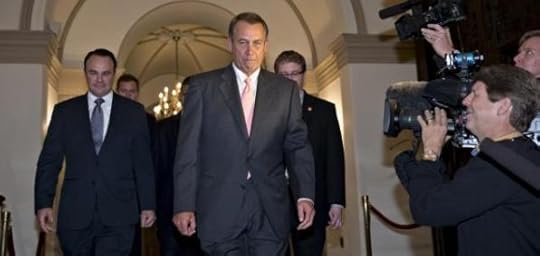
NEW YORK – Republicans in the House are preparing to follow the lead of the White House and Senate Majority Leader Harry Reid to rubber-stamp the Trans-Pacific Partnership, or TPP, the most sweeping free-trade agreement since NAFTA.
The White House seeks to pass it with a simple majority vote, without so much as introducing a single amendment to modify the language of the agreement it has negotiated behind closed doors.
On Jan. 9, 2013, in a little-noticed press release, Senate Finance Committee Chairman Max Baucus, D-Mont., together with ranking member Orrin Hatch, R-Utah, and House Ways and Means Committee Chairman Dave Camp, R-Mich, announced they were introducing “fast track” trade promotion authority legislation as a prelude to bringing up the TPP for expected passage in the near future.
Jerome Corsi’s “Late Great USA” uncovers government deceptions that threaten U.S. sovereignty
With House Speaker John Boehner, R-Ohio, already deciding to vote with Senate Democrats to grant fast track authority for congressional consideration of the TPP, the only remaining opposition to the bill seems to be coming from House Democrats.
Pressured by labor union constituents, the House Democrats have concluded the massive Trans-Pacific trade deal capitulates to corporate interest groups, including the U.S. Chamber of Commerce, placing under international control important U.S. environmental, public-health and labor standards.
The House Democrats are concerned that more U.S. union jobs will be lost in the free-trade “fast track” steamroller Republicans under Boehner and Democrats aligning with Reid plan to run through Congress.
Last year, 151 House Democrats opposed to TPP, led by Reps. Rosa DeLauro, D-Conn., and George Miller, D-Calif., wrote a letter to President Obama stating their opposition to using “outdated ‘Fast Track’ procedures that usurp Congress’ authority over trade matters.”
A statement issued Jan. 9 by DeLauro and Miller, joined by Rep. Louise Slaughter, D-N.Y., referenced last year’s letter and advanced the argument by stating:
“For too long, bad trade deals have allowed corporations to ship good American jobs overseas, and wages, benefits, workplace protections and quality of life have all declined as a result,” DeLauro, Miller and Slaughter said in a joint statement. “That is why there is strong bipartisan opposition to enabling the Executive Branch to ram through far-reaching, secretly negotiated trade deals like the TPP that extend well beyond traditional trade matters. At the core of the Baucus-Camp bill is the same Fast Track mechanism that failed us from 2002-2007.”
The lawmakers said their constituents “did not send us to Washington to ship their jobs overseas, and Congress will not be a rubber stamp for another flawed trade deal that will hang the middle class out to dry.”
“Instead of pursuing the same failed trade policies, we should support American workers by making the necessary investments to compete in today’s global economy,” they wrote.
With Boehner’s decision to support Obama on TPP, the Republican Party appears ready to ignore concerns raised by GOP conservatives and various tea-party groups that the 12-nation deal further undermines U.S. sovereignty. The opponents argue it places major sectors of the U.S. economy under a new dispute-regulation mechanism that takes precedence over U.S. judges and courts.
Most seasoned congressional watchers expect Obama, Reid and Boehner will ultimately succeed in ramming TPP through to passage. But they believe it won’t happen without labor-supporting House Democrats and conservative House Republicans concerned about sovereignty wrangling to obtain last-minute concessions.
As WND reported, “fast track authority” is a provision under the Trade Promotion Authority that requires Congress to review a free-trade agreement, or FTA, under limited debate, in an accelerated time frame that is subject to a yes-or-no vote by Congress without any provision for Congress to modify the agreement by submitting amendments. “Fast track authority” is also intended to reassure foreign partners that the FTA negotiated by the executive branch will not be altered by Congress during the legislative process.
The TPP is the first part of a two-ocean globalist plan the Obama administration is working quietly to put into place. The goal is to follow up the passage of the TPP with the finalization of the Transatlantic Trade and Investment Partnership between the United States and the European Union.
As WND previously reported, President Obama in his 2013 State of the Union address, announced the addition of the Transatlantic Trade and Investment Partnership to the agenda that would complement the Trans-Pacific Partnership free-trade agreement:
To boost American exports, support American jobs and level the playing field in the growing markets of Asia, we intend to complete negotiations on a Trans-Pacific Partnership. And tonight, I’m announcing that we will launch talks on a comprehensive Transatlantic Trade and Investment Partnership with the European Union – because trade that is fair and free across the Atlantic supports millions of good-paying American jobs. (Applause.)
The promise of creating new jobs drew congressional applause despite legitimate concerns the promise is hollow, as previous trade agreements, including NAFTA and U.S. participation in the World Trade Organization, have resulted in the loss of millions of high-salary U.S. jobs overseas to nations within the partnership with less expensive job markets.
Advancing the NWO agenda
The globalists advising the Obama administration appear to have learned from the adverse public reaction to the Security and Prosperity Partnership of North America, or SPP, during the administration of President George W. Bush. Obama has avoided the leader summit meetings that exposed to a critical alternative news media the international “working group” coordination needed to create international free-trade agreements.
The Obama administration has shut down the Security and Prosperity Partnership website, SPP.gov. The last joint statement issued by the newly formed North American Leaders Summit, operating as the rebranded SPP, was issued April 2, 2012, at the conclusion of the last tri-lateral head-of-state meeting held between the U.S., Mexico and Canada in Washington, D.C.
Now, with the Trans-Pacific Partnership, the Obama administration appears to have leap-frogged SPP ambitions to create a North American Union by including Mexico and Canada in the TPP configuration.
The 12 nations involved in the TPP are Australia, Brunei, Canada, Chile, Japan, Malaysia, Mexico, New Zealand, Peru, Singapore, Vietnam and the United States.
A graph presented in the CRS report on the first page shows the reach of the agreement across the Pacific, including Peru and Chile in South America; Australia and New Zealand; Malaysia and Vietnam in Southeast Asia; Singapore; and Japan.

As seen in the North American detail below, trade from Canada extends down into roughly Oklahoma in the United States, and trade from Mexico extends north roughly to Colorado.

North American Detail: Trans-Pacific Partnership
At the same time, trade from Mexico is seen both as extending up into the United States, reaching across the Pacific Ocean to the Asian and Pacific Rim nations involved in the free trade agreement.
Note: There is a poll embedded within this post, please visit the site to participate in this post's poll.
Management shakeup as Salem buys Eagle Publishing
NEW YORK – Salem Communications announced Monday the acquisition of Eagle Publishing Inc., including Regnery Publishing, HumanEvents.com and Redstate.com, as well as the sister companies Eagle Financial Publications and Eagle Wellness, completing a deal WND first announced was in the works Dec. 30.
David Evans, president of Salem New Media, confirmed to WND that the current president of Eagle Publishing, Jeffrey J. Carneal, has decided to leave Eagle Publishing now that the acquisition is complete.
Carneal has been at Eagle Publishing since 1993, when Tom Phillips, Eagle’s founding president, recruited Carneal to assist him in establishing the company.
Evans told WND that Carneal’s move was a mutual decision and he expressed his wishes for Carneal’s continued success in his future ventures.
WND was not able to reach Carneal for comment.
Evans confirmed that Marji Ross will stay on as president of Regnery Publishing.
According to Evans, Salem Communications paid $8.5 million to acquire Eagle Publishing guaranteed, structured with an initial purchase price of $3.5 million on Friday, plus $2.5 million on Jan. 10, 2015, and another $2.5 million on Jan. 10, 2016. Additional payments of up to $8.5 million will be paid if revenue benchmarks are met in 2014, 2015 and 2016.
Evans expressed enthusiasm at the acquisition, noting the combination of the strength of Salem Communications in conservative radio broadcasting and Eagle Publishing in conservative publishing offers a bright prospect.
“Adding Eagle’s business units to Salem’s already considerable portfolio of multi-media assets creates a conservative media powerhouse,” said a Salem Communications press release announcing the acquisition.
“The two companies represent many of conservatism’s finest voices in talk radio, book publishing and digital media. Salem’s syndicated programming, individual radio stations, and popular websites reach millions of listeners and readers across the country, while Regnery Publishing, RedState.com, and Human Events provide compelling ideas and opinion to millions of conservatives online and in print. The acquisition of these highly regarded conservative media properties will allow Salem to strengthen and deepen their already extensive presence in the conservative market.”
The Salem Radio Network is currently syndicating talk, news and music programing to some 2,400 affiliates nationwide.
Founded in 1947, Regnery Publishing first established itself by publishing conservative classics such as William F. Buckley’s “God and Man at Yale,” in 1951, followed by Whittaker Chambers’ “Witness” in 1952.
Choosing to publish a select number of books each year, Regnery bestsellers have in recent years have included “Unfit for Command: Swift Boat Veterans Speak Out Against John Kerry,” co-authored by John O’Neill and Jerome Corsi (the author of this article) in 2004, as well Michelle Malkin’s “Culture of Corruption: Obama and His Team of Tax Cheats, Crooks, and Cronies” in 2009, and David Limbaugh’s “The Great Destroyer: Barack Obama’s War on the Republic” in 2012.
Human Events, often touted as President Reagan’s “favorite newspaper,” has been a conservative stalwart since “the nation’s first conservative weekly” was established in 1944.
Eagle Publishing, a private company, was established by Tom Philips in 1993. Phillips entered publishing in 1974, founding Phillips Publishing in the garage of his home in Chevy Chase, Md., with a small staff and a view to expand into the then-thriving independent newsletter business.
Run by Ed Atsinger, CEO, and Stu Epperson, chairman of the board, Salem Communications is a public company, traded on NASDAQ (Symbol: SALM). Since the company’s initial public offering in July 1999, Salem Communications has grown from 46 to a total of 99 radio stations, with 61 stations in the nation’s top 25 markets and 29 in the top 10.
In December 2011, the American Arbitration Association released a ruling in the arbitration case involving a dispute over royalties brought by three Regnery authors (including Corsi), ruling in favor of Regnery on all counts.
January 13, 2014
Champion of North American integration dies
 To the end of his life, Professor Robert A. Pastor fought to bring into reality his idea of North American integration.
A long-time professor of international relations and the director of the Center for North American Studies, Pastor died Jan 8 at the age of 66 after a three-year battle with cancer.
On Oct. 31, a little more than two months before he died, Pastor chaired a conference at the Center for American Studies at American University titled “The NAFTA Promise and the North American Reality: The Gap and How to Narrow It.”
Pastor organized the conference to fulfill a request made by Vice President Joe Biden a month earlier.
Jerome Corsi’s “Late Great USA” uncovers government deceptions that threaten U.S. sovereignty
At the U.S.-Mexico high-level, economic dialogue Sept. 20, 2013, at the Mexican Ministry of Foreign Affairs in Mexico City, Biden gave a speech in which he urged further North American integration.
Biden said “you take a look at the United States, Mexico and Canada, you’d sit there and say, ‘Why? Why isn’t there even more cooperation?”
“It’s just so natural geographically, politically, economically,” Biden said.

Robert Pastor
The day before his last international conference started, Oct. 30, American University posted on the university’s website Pastor’s vision of NAFTA at a crossroads nearly 20 years after being implemented.
“I decided that I was going to step down as the director of the center, and I wanted to do one last conference,” Pastor said. “There’s a concern about the state of the economy, the state of immigration reform, and a North American strategy is a good way of dealing with both of these issues.”
‘Father of the North American Union’
In 2006, I wrote an article, “Meet Robert Pastor: Father of the North American Union,” in which I charged that Pastor’s view of North American integration risked giving away U.S. sovereignty in a stealth fashion to a newly forming North American Union. It follows, I argued, the stealth model globalists in Europe used to move from a free-trade agreement under the auspices of the European Common Market to what today is the full-fledged regional government of the European Union.
Pastor almost immediately objected, arguing his vision of North American integration did not include the creation of a regional government. While he was willing to champion what he called a “North American Community,” Pastor always denied his intent was to form a North American Union as a regional government.
Since 2006, WND covered Pastor’s various speeches and conferences related to his “North American project.”
WND gave Pastor the opportunity to publish a commentary in his name without editorial changes or comment.
In the May 9, 2007, article, Pastor labeled as “false” all accusations that he was promoting a North American Union, advocating the creation of a North American community called the amero or seeking to erase U.S. borders and discard the Constitution.
“I do not propose a North American Union; I propose a North American Community,” Pastor wrote. “They are very different. A Union – like the United States – is a merger of states into a unified central government. A Community is composed of three sovereign governments that seek to strengthen bonds of cooperation.”
Many times, Pastor agreed to be interviewed by WND, and while we disagreed over policy, I always found him to be a gentleman who knew how to frame his arguments in a challenging and engaging fashion.
Interestingly, Pastor got his Ph.D. from the same school I attended, Harvard University’s Department of Political Science. Pastor receiving his degree in 1977, five years after I received my degree in 1972.
Where Pastor specialized in foreign policy studies, my specialty was political philosophy.
Never in our various published exchanges and comments did I find personal exception to comments or to the substance of his analysis. I am honored he always kept our disagreements on the type of elevated level the professors who taught us at Harvard demanded.
Distinguished career in government, academics
Pastor’s early professional career included a working association with the Institute for Policy Studies.
There he participated on the Ad Hoc Working Group on Latin America, which produced a 1977 report, “The Southern Connection: Recommendations for a New Approach to Inter-American Relations.” The report argued for the U.S. to adopt a policy of “ideological pluralism,” a code phrase widely interpreted by conservatives at the time as demanding sympathy for the revolutionary socialist forces taking hold in Latin America. The forces included the communist Sandanistas and other left-leaning revolutionary groups in countries such as El Salvador.
From February 1975 to January 1977, Pastor was executive director of the Linowitz Commission on U.S./Latin American Relations.
The Linowitz Commission supported President Carter’s decision to negotiate a treaty to turn over the Panama Canal to Panama.
Pastor left the Linowitz Commission to become director of the Office of Latin American and Caribbean Affairs in the National Security Council in the Carter White House.
There Pastor served as Carter’s “point man” in getting the Senate to narrowly vote for the Carter-Torrijos Treaty on April 18, 1978, despite strong opposition from conservative politicians, including Ronald Reagan.
In December 1993, President Bill Clinton nominated Pastor to be U.S. ambassador to Panama.
Pastor’s nomination was approved by a 16-3 vote in the Senate Foreign Relations Committee, and his confirmation looked virtually certain.
The nomination failed, however, and was withdrawn by the administration in February 1995 after Sen. Jesse Helms, R.-N.C., swore to prevent a Senate vote. Helms objected to Pastor’s nomination in part because he saw Pastor as a key figure in the behind-the-scenes politics that “gave away” the Panama Canal.
As WND has previously reported, Robert Pastor’s 2001 book, “Toward a North American Community,” argued that North American integration should advance through the development of a “North American consciousness” by creating various institutions, including a North American customs union and a North American development fund for the economic development of Mexico.
Pastor also was vice chairman of the May 2005 Council on Foreign Relations task force report, “Building a North American Community.” The report presents itself as a blueprint for using bureaucratic action though trilateral “working groups” constituted within the executive branches of the United States, Mexico and Canada to advance the North American integration agenda.
January 12, 2014
Look out! Obama weaponizing IRS
WASHINGTON, D.C. – “Non-profit groups must prepare to fight back [against] the IRS on yet a second front,” warns Cleta Mitchell, a partner in the Washington-based law firm Foley & Lardner LLP, well-known for providing expert legal advise to conservative groups seeking tax-exempt status.
In discussions throughout the Capitol, Mitchell has expressed her concern new rules proposed by the IRS demonstrate once again the Obama administration is determined to keep tea-party groups from having the type of impact on the mid-term elections this November that they had in 2010, when Republicans grabbed majority control of the House of Representatives.
“This is a real assault on the First Amendment rights of American citizens, and we need to do everything we can to stop the IRS from implementing these new rules,” Mitchell says.
Mitchell has produced in a YouTube video a briefing in which she explains the goal of the IRS is to limit the free speech of conservative groups:
She is urging conservatives groups and individuals to file comments with the IRS right away, arguing it is “impractical, burdensome and unacceptable for the IRS to interject itself into the workings of every citizens group in the country.”
The legally constituted function of the IRS, Mitchell argues, is to collect tax revenues, “not to snoop and trample on First Amendment rights of the citizens.”
At stake this November is the possibility conservative tax-exempt groups campaigning for conservative Republican candidates for Congress might increase the Republican majority in the House and grab enough seats in the Senate to topple the current Democratic Party majority, she explains.
The Democrats in Congress appear this year to be particularly vulnerable given the debacle witnessed by the nation in the Obamacare implementation plus increasing economic data that shows job growth slowing, with historic numbers of Americans dropping out of the labor force.
How to file comments opposing IRS proposed rule
Conservative groups or individuals may submit comments electronically opposing the proposed rule changes at Regulations.gov, searching for the citation IRS REG-134417-13, an Internet search that yields a page entitled “Guidance for Tax-Exempt Social Welfare Organization on Candidate-Related Political Activities.”
The proposed rules can be found published in the Federal Register here, again under the title “Guidance for Tax-Exempt Social Welfare Organization on Candidate-Related Political Activities,” dated Nov. 29, 2013.
In a fact sheet Mitchell is distributing to conservatives, Mitchell is advising clients to file comments before the deadline on Feb. 27, 2014, to a series of new regulations the IRS proposes to implement with the goal of making sure conservative organizations with 501(c)4 status are prohibited before the upcoming mid-term elections in November 2014 from any activity associated with supporting a political candidate or influencing the outcome of an election.
“Conservative groups that do not submit comments to the IRS opposing these rule changes before the Feb. 27 deadline will not have standing to participate in the final rule-determination process required by law before the rules are implemented,” Mitchell explained.
Mitchell is encouraging conservative groups and individuals to insist in their filed comments that the IRS must hold public hearings in open forums around the nation before these proposed new regulations are implemented.
IRS war against conservatives
“With these new regulations,” Mitchell argued, “the goal is to restrict the free speech of conservatives in the United States. Progressives tend to focus on process issues, and these new IRS regulations are a direct attempt by the political left to rewrite the rules of political engagement unfairly in their favor.”
Last week, the IRS scandal deepened when the Washington Times reported the Justice Department selected Barbara Kay Bosserman, a DOJ trial lawyer, who had contributed to Obama’s presidential campaigns in 2008 and 2012 as well as to the Democratic Party, to lead the criminal probe into the IRS targeting conservative groups to deny their applications for tax-exempt status.
Mitchell in her discussions with conservative groups has explained the activities the IRS seeks to define as “candidate-related political activities,” subject to taxation and reporting to the IRS, are basic 501(c)4 activities such as grassroots lobbying, candidate forums, candidate debates, voter registration drives, voter guides and issue advocacy.
“The IRS is fully aware this is a war in which conservative groups are being targeted,” Mitchell explains, noting the proposed IRS new rules do not apply to labor unions or trade associations. “The Obama administration is not looking for ways to restrain labor unions from using member dues to conduct similar activities.”
Historically, labor union political support has gone to Democratic Party political candidates since the end of World War II, while the upsurge in tax-exempt filings have come from conservatives and especially from the many tea-party groups formed since the economic downturn dating back to 2008.
January 9, 2014
Rising interest rates risk stock-bubble burst
WALL STREET – As interest rates begin to rise, the danger intensifies that the current stock-market bubble could burst with disastrous consequences to retirement savers with 401(k) and IRA accounts.
The Federal Reserve Open Market Committee in its first meeting under incoming chairwoman Janet Yellen decided to continue “pumping money” into the economy at a strong level.
The policy, known as “quantitative easing,” has been continued with a reduction of only $10 billion a month from the $85 billion maintained by former chairman Ben Bernanke.
The probability of the stock-market bubble bursting will increase if interest rates continue to rise as the Fed maintains QE at a level of $75 billion a month. The scenario suggests the Fed has lost the ability to contain interest rates by adjusting monetary policy.
The notes of the last Federal Reserve Open Market Committee policy meeting, Dec. 17-18, 2013, were released to the public Wednesday. They indicated some of the 10 voting policymakers are worried about “an unintended tightening of financial conditions if a reduction in the pace of asset purchases was misinterpreted as signaling that the committee was likely to withdraw policy accommodation more quickly than had been anticipated.”
The language was crafted to reassure investors nervous about rising interest rates that the Fed was going to try to steer a difficult-to-maneuver, cautious path in which QE would remain aggressive despite concerns of FOMC policymakers that a perceived “economic recovery” threatened rising interest rates.
Those concerns appeared justified this week when the U.S. Treasury set out to sell $30 billion of three-year securities at the lowest level of market demand perceived since last October, pushing the yield of the 10-year note lower for a second day in a row.
With interest rates and price in bonds historically demonstrating an inverse relationship – when interest rates rise, bond yields typically decrease – deterioration in U.S. Treasury yields will signal caution to savvy investors.
The minutes of the FOMC meeting released this week have led Wall Street to anticipate the Federal Reserve will continuing a policy of “tapering” QE by reducing it an additional $10 billion a month at the next FOMC meeting scheduled for Jan. 28-29, with the expectation the Fed will stop buying U.S. debt altogether in December 2014.
As Wall Street anticipates interest rates rising in the near future, a speech by Federal Reserve Bank of Boston President Eric Rosengren is drawing widespread attention.
Rosengren, who just finished a year’s service on the FOMC, was a vocal supporter of the Fed’s QE policy of keeping interest rates at or near zero. He was the sole dissenter in his last vote as a member of the FOMC in December 2013, opposing the decision recommended by outgoing Fed chairman Ben Bernanke that the Fed should begin reducing its purchases of U.S. government-issued debt in the near future.
Worried that QE tapering was almost certain to give momentum to rising interest rates, Rosengren’s carefully worded speech still managed to convey his concern that ending QE too rapidly could cause an interest-rate spike, resulting in increased interest costs. In a chain reaction, increased interest expense could bring the cost of making interest payments on the federal debt to levels that could tank the economy.
For instance, if interest rates were to rise, as many economic experts anticipate – with yields on the three-month treasury rising to approximately 4 percent by 2018 and 10-year Treasuries to approximately 5.2 percent – interest payments on the federal debt will increase to $505 billion in 2018 from the current level of $255 billion.
By comparison, the still rancorous sequester only cut government expenses by some $85.3 billion in the first year.
Greenspan and ‘Goldilocks’
In particular, Rosengren, in his speech to the American Economic Association’s annual meeting in Philadelphia Jan. 4, reminded his audience of the sensitivity of housing prices to rising interest rates in 2007, the period just prior to the bursting of the housing-market bubble.
“In 2007, the Boston Fed’s Regional and Community Outreach staff documented how foreclosures were disproportionately impacting low-and moderate-income neighborhoods around New England,” he said. “Families experiencing a ‘life event’ such as an unemployment spell, a divorce, or health issues in a rising housing market can sell their house. However, those same problems occurring during a period of falling housing prices often resulted in foreclosure.”
In his attempt to continue the economic expansion of the 1990s while restraining inflation, then-Federal Reserve chairman Alan Greenspan attempted, beginning in May 2004, to allow interest rates to rise “just right,” hence “Goldilocks,” to sustain balanced economic growth without inflation.
Unfortunately, Greenspan’s modest interest-rate increases were enough to tank a then runaway subprime mortgage market in which the fall in housing prices resulting from high monthly mortgage-payment prices caused a raft of foreclosures that hit low- and moderate-income homeowners, causing the mortgage market to crash in 2008.
After Sept. 11, Greenspan and the Federal Reserve began cutting interest rates aggressively in an effort to jump-start a badly shocked U.S. economy back into robust activity.
“For a full year-and-a-half after September 11, 2001, we were in limbo,” Greenspan wrote in his 2007 book, “The Age of Turbulence: Adventures in a New World.” “The economy managed to expand, but its growth was uncertain and weak. Businesses and investors felt besieged.”
Greenspan is open about his policy during this time.
“The Fed’s response to all this uncertainty was to maintain our program of aggressively lowering short-term interest rates,” he wrote.
Under Greenspan’s direction, the FOMC extended a series of seven cuts made in early 2001 to lower the fed funds rates down to around 1.25 percent by the end of 2002, a figure Greenspan admits “most of us would have considered unfathomably low a decade before.”
Greenspan admitted the Fed was aware that maintaining these low interest rates “might foster a bubble, an inflationary boom of some sort, which we would subsequently have to address.” But he claimed the Fed was worried the economic slowdown after Sept. 11 might cause deflation, a concern of professional economists around the world after experiencing the deflation that plagued the Great Depression of the 1930s.
As 2007 came to a close, Greenspan was a hero on Wall Street.
Investors who had made billions of dollars hailed Greenspan’s low-interest policy as the key to engineering an unprecedented surge of wealth on Wall Street.
At the close of 2007, those warning that the economy had peaked and the real-estate bubble had already burst were dismissed as prophets of doom whose ill tidings risked spoiling the party.
As 2008 began, pundits were predicting the Dow would climb past 15,000 without much difficulty.
Unfortunately, such optimism was unfounded, as Greenspan and the Fed managed the federal funds rate up from a low of 1 percent in May 2004 to a plateau of 5 percent maintained for a year. From the last quarter of 2006 until approximately the last quarter of 2007, Greenspan and the Fed began lowering rates in fear the upward adjustment violated the Goldilocks rule in being “too much” instead of “just right.”
In December 2007, few realized that month would later be regarded as the official start of the most severe economic downturn in the U.S. since the Great Depression of the 1930s.
Rosengren’s fear was that the decision of the Fed to begin tapering QE could trigger a rise in interest rates that would cause a repeat of the mistake the Fed made under Greenspan, this time causing the stock-market bubble to burst.
Déjà vu: Jerry Brown eyeing White House?
WASHINGTON, D.C. – In 2016, for a second time, Hillary Clinton may have serious competition if she plans to seek the Democratic Party nomination for president.
“Don’t be surprised if California Gov. Jerry Brown runs for president in 2016,” James V. Lacy, author of the newly published “Taxifornia: Liberals’ Laboratory to Bankrupt America,” told an appreciative audience at a book-signing hosted by Grover Norquist, president of Americans for Tax Reform, at the Palm restaurant in Washington, D.C., Wednesday evening.
“Remember the ‘Massachusetts Miracle’ touted by the mainstream media in 1980 when the Massachusetts governor ran for president against Vice President George H. W. Bush?” Lacy asked. “Well, the mainstream media is doing it again, running a series of articles this time promoting the ‘California Miracle’ resulting from the economic policies of Gov. Brown.”
Lacy is a third-generation native Californian, who with his wife Janice, a former deputy chief counsel of the Republican National Committee, are partners in their law firm and political communications company, Wewer & Lacy LLP, based in Laguna Niguel, Calif.
In a 1988 speech given to the Commonwealth Club of California, Republican presidential candidate George H. W. Bush recast the Michael Dukakis “Massachusetts Miracle” as the “Massachusetts Mirage,” characterizing the governor as “just another big-spending, liberal Democrat who would drive our economy into decline.”
Bush’s counterattack scored points by charging: “My opponent ranks first in spending increases. Second in tax hikes. If this were the Olympics, his composite score would make him the gold medal winner in the tax-and-spend competition”
Brown unsuccessfully sought the Democratic Party nominations for president in 1976, 1980 and 1992. He was the Democratic candidate for the U.S. Senate in California in 1982 and previously served as California governor from 1975 to 1983.
Lacy begins “Taxifornia” echoing the George H. W. Bush attack on Dukakis.
“California is no longer the Golden State, and liberalism is to blame,” Lacy writes. “Tax-and-spend liberals who are in control have created a state that taxes and regulates more than any other state in the country, and have engineered a rotting economy with among the highest unemployment of any state in the nation. No wonder that businesses and residents are fleeing the state.”
Yet, the Los Angeles Times bragged Wednesday that Brown is planning to propose a $155 billion budget that includes an 8 percent increase in general-fund spending with billions of dollars of new spending on schools, health care, social services and environmental programs “as California reaps the benefits of an economic turnaround.”
The Los Angeles Times stressed Brown’s administration expects a $4.2 billion state budget surplus by the end of June 2014, “as opposed to the $26.6 billion deficit Brown encountered when he took office in 2011,” succeeding California’s Republican governor, Arnold Schwarzenegger.
Still, a U.S. Census poverty report published in November 2012 pegged California’s poverty rate at a national high of 23.5 percent during 2009-2011. The figure incorporates California’s high cost of living and the effect of safety net programs such as food stamps, considerably higher than the 16.1 percent poverty measure California reported in 2011 based on conventional reporting methodologies.
Even more discouraging, the Public Policy Institute of California reported in August 2013 that the majority of poor people in California live in working families, with 37.3 percent of poor families having at least one family member working full-time, while in another 25.6 percent someone is working part time.
Lacy insists liberalism is the problem in California.
“Long-term liberal dominance of California’s levers of power has brought a pervasive philosophy to government up and down the state that results in far too much spending and too much taxation,” he notes.
“The tax-and-spend liberal philosophy has caused low-achieving public schools; local government bankruptcies; some cases of grossly overpaid public employees; huge, under-funded public employee pension liabilities; a hyper anti-business, job-killing regulatory climate; and unacceptably high persistent unemployment, especially in minority communities.”
The U.S. Department of Labor’s Bureau of Labor Statistics reported in December 2013 that unemployment in California was 8.5 percent, a statistic that ranked California as 46th worst state in the percentage of the labor force unemployed, in a month when the national unemployment rate declined from 7.3 percent to 7 percent.
Lacy cited a March 2013 Field Poll that reported 72 percent of California voters described the state’s economy as being in bad times, while 61 percent described unemployment as very serious and just 36 percent expected job opportunities to improve in 2014.
He also documented that Californians pay the highest marginal state income tax in the country, 13.3 percent, as a result of the passage of Brown’s “Proposition 30″ income tax rate in November 2012, as well as the highest sales taxes in the country, ranging in localities from 7.5 percent up to 10 percent, the legal limit.
Lacy further calculated California and its local governments are at least $648 billion in debt, and depending on how public employee pension liabilities are calculated, the debt could be as high as $1.1 trillion.
In May 2013, USA Today reported 10 troubled cities in California could well follow the city of Stockton, where U.S. Bankruptcy Court Chief Judge Christopher Klein ruled in April 2013 that federal bankruptcy law trumps a California law that says money owed to the state pension fund must be paid.
At the time of the bankruptcy, Stockton owed the California Public Employees Retirement System, CalPERS, about $900 million to cover pension liabilities, even after Stockton issued $165 million in city bonds to keep up with CalPERS payments as property taxes nose-dived during the nationwide economic downturn, reported Bloomberg/BusinessWeek.
“Stockton has tried to restructure some debt by slashing employment, renegotiating labor contracts, and cutting health benefits for workers. Library and recreation funding have been halved, and the scaled-down Police Department only responds to emergencies in progress,” Bloomberg/BusinessWeek further reported. “The city crime rate is among the highest in the nation.”
Silicon Valley venture capitalist Tim Draper gained national attention in November 2013 when he filed a petition with the California attorney general’s office proposing to break up California into six different states, arguing it is “too big and bloated.”
“California is clearly broken and urgently needs to be fixed,” Lacy concludes, doubtful that California’s current state legislature, dominated as it is by liberal Democrats, will ever cut taxes to attract the business needed to create the quantity of jobs required to jump-start the state’s economy.
Typical is a letter written by nine California legislators on Jan. 7, 2013, asking Brown to issue an executive order to prohibit the California Division of Oil, Gas, and Geothermal Resources, DOGGR, within the Department of Conservation, from allowing fracking in the state until health and environmental concerns are addressed. The measure aimed to block implementation of Senate Bill 4 passed in 2013 with the support of Brown, establishing a permit system for fracking.
Citing historian Arthur Schlesinger Jr. at the Washington book-signing event, Lacy remains hopeful the pendulum will swing away from liberal Democratic control as the reality of California’s serious economic maladies penetrates establishment media. It’s a media, he says, that is determined to advance Brown’s national political aspiration by promoting the narrative of the “California Miracle.”
In the long-term, Lacy argues, the formula for real economic reform in California is simple: The state will not become more competitive economically until more Republicans win seats in the legislature.
Jerome R. Corsi's Blog

- Jerome R. Corsi's profile
- 74 followers

