
Jerome R. Corsi's Blog, page 15
November 16, 2025
WATCH: U.S. military kills 3 more alleged drug smugglers on ‘Designated Terrorist Organization’ vessel
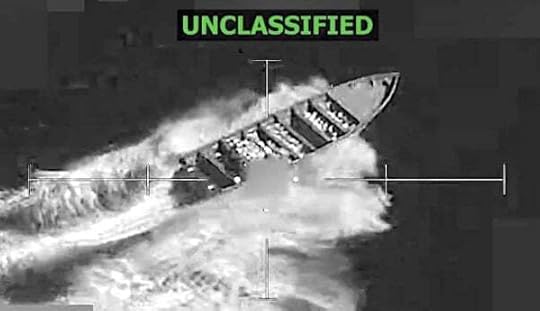 Suspected narco-terrorists just moments before being struck by the U.S. military in the Eastern Pacific on Saturday, Nov. 1, 2025
PALM BEACH, Florida – The U.S. military on Sunday announced that American Armed Forces in the Eastern Pacific Ocean killed three suspected narco-terrorists Saturday, allegedly carrying narcotics “on a vessel operated by a Designated Terrorist Organization.”
“On Nov. 15, at the direction of Secretary of War Pete Hegseth, Joint Task Force Southern Spear conducted a lethal kinetic strike on a vessel operated by a Designated Terrorist Organization,” the U.S. Southern Command said on X, along with explosive video of its operation.
It did not specify the name of the designated terrorist organization.
“Intelligence confirmed that the vessel was involved in illicit narcotics smuggling, transiting along a known narco-trafficking route, and carrying narcotics,” said Southern Command.
“Three male narco-terrorists aboard the vessel were killed. The vessel was trafficking narcotics in the Eastern Pacific and was struck in international waters.”
On Nov. 15, at the direction of Secretary of War Pete Hegseth, Joint Task Force Southern Spear conducted a lethal kinetic strike on a vessel operated by a Designated Terrorist Organization. Intelligence confirmed that the vessel was involved in illicit narcotics smuggling,… pic.twitter.com/iM1PhIsroj
— U.S. Southern Command (@Southcom) November 16, 2025
This latest strike was announced the same day the USS Gerald R. Ford aircraft carrier, packing more than 4,000 sailors along with F/A-18 Super Hornet fighter jets and long-range Tomahawk missiles, arrived in the Caribbean.
Adm. Alvin Holsey, Southcom’s commander, indicated: “The USS Gerald R. Ford Carrier Strike Group’s deployment represents a critical step in reinforcing our resolve to protect the security of the Western Hemisphere and the safety of the American Homeland.”
 A Navy F/A-18F Super Hornet prepares to land on the flight deck of the USS Gerald R. Ford during flight operations in the Atlantic Ocean, May 11, 2020. (U.S. Navy photo by Mass Communication Specialist 2nd Class Ryan Seelbach)
At least 83 suspected narco-terrorists have been killed since early September, as the U.S. hit 21 alleged drug-smuggling vessels in the Caribbean Sea and Eastern Pacific.
President Donald Trump is among those who have branded Venezuelan President Nicolas Maduro an “illegitimate leader,” accusing him of leading an international drug-smuggling operation.
On Friday, Trump said he has “sort of made up” his mind concerning the next steps on Venezuela.
Q: Have you decided if you are going to invade Venezuela?
Trump: “Ya. But I can’t tell you.” pic.twitter.com/DIGyxFbJ0I
— Home of the Brave (@OfTheBraveUSA) November 15, 2025
“I sort of made up my mind,” the president told reporters. “I can’t tell you what it would be.”
Asked on CBS’ “Face the Nation” Sunday about Trump’s potential military action in Venezuela, U.S. Army Secretary Dan Driscoll said: “We have a lot of training in that part of the world. We’re reactivating our jungle school in Panama. We would be ready to act on whatever the president and [secretary of] war needed.”
President Trump suggested this weekend he’s made a decision on U.S. military action against Venezuela, and Army Secretary Dan Driscoll says the Army “would be ready to act on whatever the president and Sec. Of War needed.”
Pressed on whether any orders have been given, Driscoll… pic.twitter.com/q7zRNM2H3f
— Face The Nation (@FaceTheNation) November 16, 2025
When pressed on whether or not any orders have actually been issued, Driscoll said: “We don’t talk about those kinds of things, but we would be ready, if asked.”
As WorldNetDaily reported last week, in what was called an unprecedented step, the United Kingdom said it would no longer share intelligence with the U.S. about suspected drug-trafficking boats in the Caribbean, as it does not wish to be complicit in the military strikes, believing them to be illegal.
CNN noted Britain’s decision “marks a significant break from its closest ally and intelligence sharing partner and underscores the growing skepticism over the legality of the U.S. military’s campaign around Latin America.”
Follow Joe on X @JoeKovacsNews
‘Significant break’: U.K. reportedly stops sharing intel with U.S. over deadly drug-boat strikes
/*! This file is auto-generated */!function(d,l){"use strict";l.querySelector&&d.addEventListener&&"undefined"!=typeof URL&&(d.wp=d.wp||{},d.wp.receiveEmbedMessage||(d.wp.receiveEmbedMessage=function(e){var t=e.data;if((t||t.secret||t.message||t.value)&&!/[^a-zA-Z0-9]/.test(t.secret)){for(var s,r,n,a=l.querySelectorAll('iframe[data-secret="'+t.secret+'"]'),o=l.querySelectorAll('blockquote[data-secret="'+t.secret+'"]'),c=new RegExp("^https?:$","i"),i=0;i<o.length;i++)o[i].style.display="none";for(i=0;i<a.length;i++)s=a[i],e.source===s.contentWindow&&(s.removeAttribute("style"),"height"===t.message?(1e3<(r=parseInt(t.value,10))?r=1e3:~~r<200&&(r=200),s.height=r):"link"===t.message&&(r=new URL(s.getAttribute("src")),n=new URL(t.value),c.test(n.protocol))&&n.host===r.host&&l.activeElement===s&&(d.top.location.href=t.value))}},d.addEventListener("message",d.wp.receiveEmbedMessage,!1),l.addEventListener("DOMContentLoaded",function(){for(var e,t,s=l.querySelectorAll("iframe.wp-embedded-content"),r=0;r<s.length;r++)(t=(e=s[r]).getAttribute("data-secret"))||(t=Math.random().toString(36).substring(2,12),e.src+="#?secret="+t,e.setAttribute("data-secret",t)),e.contentWindow.postMessage({message:"ready",secret:t},"*")},!1)))}(window,document);
WATCH: U.S. military kills 14 alleged drug traffickers in strikes on 4 boats
/*! This file is auto-generated */!function(d,l){"use strict";l.querySelector&&d.addEventListener&&"undefined"!=typeof URL&&(d.wp=d.wp||{},d.wp.receiveEmbedMessage||(d.wp.receiveEmbedMessage=function(e){var t=e.data;if((t||t.secret||t.message||t.value)&&!/[^a-zA-Z0-9]/.test(t.secret)){for(var s,r,n,a=l.querySelectorAll('iframe[data-secret="'+t.secret+'"]'),o=l.querySelectorAll('blockquote[data-secret="'+t.secret+'"]'),c=new RegExp("^https?:$","i"),i=0;i<o.length;i++)o[i].style.display="none";for(i=0;i<a.length;i++)s=a[i],e.source===s.contentWindow&&(s.removeAttribute("style"),"height"===t.message?(1e3<(r=parseInt(t.value,10))?r=1e3:~~r<200&&(r=200),s.height=r):"link"===t.message&&(r=new URL(s.getAttribute("src")),n=new URL(t.value),c.test(n.protocol))&&n.host===r.host&&l.activeElement===s&&(d.top.location.href=t.value))}},d.addEventListener("message",d.wp.receiveEmbedMessage,!1),l.addEventListener("DOMContentLoaded",function(){for(var e,t,s=l.querySelectorAll("iframe.wp-embedded-content"),r=0;r<s.length;r++)(t=(e=s[r]).getAttribute("data-secret"))||(t=Math.random().toString(36).substring(2,12),e.src+="#?secret="+t,e.setAttribute("data-secret",t)),e.contentWindow.postMessage({message:"ready",secret:t},"*")},!1)))}(window,document);
‘No refuge or forgiveness’: U.S. now strikes drug-smuggling boat in PACIFIC, killing 2
/*! This file is auto-generated */!function(d,l){"use strict";l.querySelector&&d.addEventListener&&"undefined"!=typeof URL&&(d.wp=d.wp||{},d.wp.receiveEmbedMessage||(d.wp.receiveEmbedMessage=function(e){var t=e.data;if((t||t.secret||t.message||t.value)&&!/[^a-zA-Z0-9]/.test(t.secret)){for(var s,r,n,a=l.querySelectorAll('iframe[data-secret="'+t.secret+'"]'),o=l.querySelectorAll('blockquote[data-secret="'+t.secret+'"]'),c=new RegExp("^https?:$","i"),i=0;i<o.length;i++)o[i].style.display="none";for(i=0;i<a.length;i++)s=a[i],e.source===s.contentWindow&&(s.removeAttribute("style"),"height"===t.message?(1e3<(r=parseInt(t.value,10))?r=1e3:~~r<200&&(r=200),s.height=r):"link"===t.message&&(r=new URL(s.getAttribute("src")),n=new URL(t.value),c.test(n.protocol))&&n.host===r.host&&l.activeElement===s&&(d.top.location.href=t.value))}},d.addEventListener("message",d.wp.receiveEmbedMessage,!1),l.addEventListener("DOMContentLoaded",function(){for(var e,t,s=l.querySelectorAll("iframe.wp-embedded-content"),r=0;r<s.length;r++)(t=(e=s[r]).getAttribute("data-secret"))||(t=Math.random().toString(36).substring(2,12),e.src+="#?secret="+t,e.setAttribute("data-secret",t)),e.contentWindow.postMessage({message:"ready",secret:t},"*")},!1)))}(window,document);
‘WE ARE HUNTING YOU!’ Watch U.S. military explode a SECOND narcoterrorist drug boat from Venezuela
/*! This file is auto-generated */!function(d,l){"use strict";l.querySelector&&d.addEventListener&&"undefined"!=typeof URL&&(d.wp=d.wp||{},d.wp.receiveEmbedMessage||(d.wp.receiveEmbedMessage=function(e){var t=e.data;if((t||t.secret||t.message||t.value)&&!/[^a-zA-Z0-9]/.test(t.secret)){for(var s,r,n,a=l.querySelectorAll('iframe[data-secret="'+t.secret+'"]'),o=l.querySelectorAll('blockquote[data-secret="'+t.secret+'"]'),c=new RegExp("^https?:$","i"),i=0;i<o.length;i++)o[i].style.display="none";for(i=0;i<a.length;i++)s=a[i],e.source===s.contentWindow&&(s.removeAttribute("style"),"height"===t.message?(1e3<(r=parseInt(t.value,10))?r=1e3:~~r<200&&(r=200),s.height=r):"link"===t.message&&(r=new URL(s.getAttribute("src")),n=new URL(t.value),c.test(n.protocol))&&n.host===r.host&&l.activeElement===s&&(d.top.location.href=t.value))}},d.addEventListener("message",d.wp.receiveEmbedMessage,!1),l.addEventListener("DOMContentLoaded",function(){for(var e,t,s=l.querySelectorAll("iframe.wp-embedded-content"),r=0;r<s.length;r++)(t=(e=s[r]).getAttribute("data-secret"))||(t=Math.random().toString(36).substring(2,12),e.src+="#?secret="+t,e.setAttribute("data-secret",t)),e.contentWindow.postMessage({message:"ready",secret:t},"*")},!1)))}(window,document);


‘A VERY BIG DEAL!’ Trump pummels GOP lawmakers who refuse to pursue congressional redistricting in Indiana
 (Official White House photo by Daniel Torok)
President Donald Trump on Sunday pushed for the ouster of Republican state lawmakers in Indiana, as he pummeled their unwillingness to pursue congressional redistricting could cause the GOP to lose its majority in the U.S. House of Representatives.
“Very disappointed in Indiana State Senate Republicans, led by RINO Senators Rod Bray and Greg Goode, for not wanting to redistrict their State, allowing the United States Congress to perhaps gain two more Republican seats,” Trump began in a lengthy post on Truth Social.
“The Democrats have done redistricting for years, often illegally, and all other appropriate Republican States have done it. Because of these two politically correct type ‘gentlemen,’ and a few others, they could be depriving Republicans of a Majority in the House, A VERY BIG DEAL!”
The redistricting frenzy was sparked this year by Texas, which was soon followed by California.
Trump noted: “California is trying to pick up five seats, and no one is complaining about that. It’s weak ‘Republicans’ that cause our Country such problems – It’s why we have crazy Policies and Ideas that are so bad for America.
“Also, a friend of mine, Governor Mike Braun, perhaps, is not working the way he should to get the necessary Votes. Considering that Mike wouldn’t be Governor without me (Not even close!), is disappointing!
“Any Republican that votes against this important redistricting, potentially having an impact on America itself, should be PRIMARIED. Indiana is a State with strong, smart, and patriotic people. They want us to see our Country WIN, and want to, ‘MAKE AMERICA GREAT AGAIN!’
“Senators Bray, Goode, and the others to be released to the public later this afternoon, should DO THEIR JOB, AND DO IT NOW! If not, let’s get them out of office, ASAP.”
NBC News reported a spokesperson for Goode indicated the state senator said earlier this month that “that he would not take a public stance unless and until he saw an officially introduced map and legislation on the floor of the State Senate.”
“He respectfully maintains that position,” said spokesperson Lance Gideon.
The critical comments from Trump come days after Bray, Indiana’s Republican Senate leader, announced there was not enough support in the chamber to seek redistricting.
“Over the last several months, Senate Republicans have given very serious and thoughtful consideration to the concept of redrawing our state’s congressional maps,” Bray said Friday.
@GovBraun is supposed to be the leader of the Indiana Republican party, but apparently has more important things to do as RINOS actively assist the ‘men in women’s dressing rooms’ party!@bray_rodric is NOT a conservative representative, he’s a socialist!
Fight back, damnit!… pic.twitter.com/LST4kGNI55
— imSteveMcQueen (@imSteveMcQueen) November 15, 2025
“Today, I’m announcing there are not enough votes to move that idea forward, and the Senate will not reconvene in December.”
Follow Joe on X @JoeKovacsNews
The thin line between disorder and order is logistics
 Oregon Army National Guard soldiers load shipments of personal protective equipment in Oregon, April 12, 2020, for distribution to counties and tribes throughout the state to support COVID-19 response efforts. (National Guard Photo by Sgt. 1st Class Zachary Holden, Oregon Military Department)
When discussing strategy, especially military strategy, two foundational texts inevitably come to mind: On War by Carl von Clausewitz and The Art of War by Sun Tzu. Though separated by more than two millennia and rooted in vastly different cultures, both works continue to shape how we think about conflict, power, and decision-making. Quoting Clausewitz or Sun Tzu has become a kind of shorthand for strategic literacy. Clausewitz’s famous line, “War is nothing but a continuation of politics with the admixture of other means,” (On War, Book 8, Chapter 6, Section B.) remains central to modern strategic theory. His more cynical observation, “The conqueror is always a lover of peace; he would prefer to take over our country unopposed,” (On War, Book 6, Chapter 5, “Character of Strategic Defense”) still resonates in today’s geopolitical climate. Sun Tzu’s aphorisms, such as “The supreme art of war is to subdue the enemy without fighting” (The Art of War, Chapter 3) and “All warfare is based on deception,” (The Art of War, Chapter 1) are frequently cited to highlight the psychological and indirect dimensions of conflict.
These quotes reflect deeper philosophical differences. Clausewitz viewed war through the lens of European statecraft and total war, while Sun Tzu emphasized balance, subtlety, and preemption. Together, they form a strategic canon that continues to influence not only military thinking but also business and politics. In the digital age, strategic quotes are just a search away. While this accessibility democratizes strategic discourse, it also risks reducing complex ideas to soundbites. Yet beneath these well-worn phrases lies a deeper truth: in warfare, some elements change rapidly, while others remain remarkably constant. One of those constants is the role of logistics.
Regardless of the political narratives used to justify war, whether framed as national security, ideological struggle, or humanitarian intervention, the underlying motive is often economic. At its core, conflict frequently revolves around control: control of resources, control of trade routes, control of production, and ultimately, control of wealth. To state it simple, all wars are basically about money and wealth. How it is created, distributed, and maintained. Everybody wants a piece of the cake, relative to their understanding of their contribution to overall values and entitlement. This also includes limitation or destruction of wealth creation for a perceived enemy. If the enemy loses more than oneself, victory can be proclaimed. These economic drivers, however, rarely stir public emotion. They are abstract, systemic, and difficult to rally around. Instead, they are cloaked in more compelling stories of freedom, justice, or survival, which resonate with the human psyche and mobilize support. While the reasons for war may be dressed in rhetoric, the machinery of war is grounded in material reality. And that reality is shaped by technology. As new tools emerge, they do more than enhance firepower, they redefine how wars are fought, how armies are organized, and how societies prepare for conflict. The evolution of warfare is not just tactical; it is structural. It changes the very architecture of defense.
The Industrial Revolution offers a clear example. It didn’t merely alter how societies produced goods; it revolutionized the logistics of war. Mass production enabled the creation of standardized weapons, munitions, and uniforms. Railroads allowed rapid troop movement and supply distribution. Telegraphs accelerated command and control. The battlefield expanded beyond the front lines to include factories, rail yards, and ports. War evolved into war between supply chains, a contest of industrial production capacity and distribution capacity, as much as military strategy. This transformation continues today. Digital technologies, autonomous systems, and cyber capabilities are reshaping the landscape once again. But the principle remains unchanged: the tools of war evolve, and with them, the demands on logistics, coordination, and societal resilience.
The evolution of weaponry has always mirrored the evolution of logistics. Gunpowder weapons, once limited to cumbersome cannons, gradually became more portable and precise, culminating in the handheld rifle. The addition of the bayonet transformed this firearm into a hybrid tool, part projectile, part blade and thereby bridging the ancient art of close combat with the mechanized lethality of modern warfare. This fusion of old and new reflected a broader trend: as weapons became more sophisticated, so too did the systems required to support them.
The next great leap came with the invention of oil and gasoline engines. These technologies revolutionized mobility, enabling the rise of mechanized warfare. Trucks, tanks, aircraft, and naval vessels extended the operational reach of armed forces across vast terrains and oceans. But with this mobility came a new vulnerability: dependence. Fuel, spare parts, maintenance crews, and repair infrastructure became as critical to victory as soldiers and weapons. The battlefield was no longer just a place of combat; it was a network of supply chains.
This shift elevated logistics from a supporting role to a strategic centerpiece. World War II exemplifies this transformation. The Allied victory in Europe was not solely the result of superior tactics or battlefield heroism; it was a triumph of industrial coordination and transcontinental supply. The ability to produce, transport, and sustain military operations across oceans and continents proved decisive. Entire factories, railways, and ports became instruments of war. Even earlier conflicts underscore this truth. Napoleon’s disastrous Russian campaign was not undone by enemy fire, but by logistical failure, his army starved and froze as supply lines collapsed. In each case, the outcome of war was shaped not just by who fought hardest, but by who planned furthest.
In recent years, especially following Russia’s invasion of Ukraine, logistics has returned to the spotlight. One quote often attributed to Sun Tzu, “The line between disorder and order lies in logistics,” has gained popularity. It’s frequently cited in reference to the infamous stalled Russian convoy outside Kyiv, which became a symbol of poor planning and coordination. Interestingly, this quote doesn’t appear in canonical translations of The Art of War. It may be a modern reinterpretation, replacing Sun Tzu’s emphasis on “coordination” with the contemporary term “logistics” (The Art of War, Chapter 5, Verse 4). But the sentiment holds. Sun Tzu’s philosophy of preparation, foresight, and indirect action aligns well with the modern understanding of logistics as the backbone of operational success. Whether the quote is authentic or not, it captures a timeless truth: maintaining order in the chaos of war depends on the systems that support the fighting force. Logistics is not just about trucks and warehouses; it’s about enabling strategy.
In contemporary discourse, logistics is often reduced to technical domains such as production systems, transportation networks, and inventory management. These are the observable components, the infrastructure that moves goods and sustains operations. But in the context of warfare, logistics is far more than a supply chain, it is the architecture of order and synchronization. Its opposite is not inefficiency, but chaos, and in war, chaos is rarely accidental. It is often the deliberate objective of the adversary. Both Clausewitz and Sun Tzu understood this well. Clausewitz warned of the “fog of war,” the unpredictable friction that disrupts even the most meticulous plans. Sun Tzu, centuries earlier, emphasized deception as a strategic weapon, to confuse, mislead, and destabilize the enemy. Together, they reveal a timeless truth: war is not only fought with weapons, but with uncertainty, and logistics is the system designed to resist that uncertainty.
If logistics is the mesh that holds order together in war, then it must be woven into the fabric of society long before conflict begins. In today’s unpredictable world, where disruption is often a deliberate strategy, reactive logistics is no longer enough. Success depends on proactive planning and the creation of ability to handle most crises, either alone as a country or as a member of an alliance, like NATO. This is the essence of Article 3 in the North Atlantic Treaty. Logistics, including societal preparedness, should not be treated as a technical afterthought or a wartime emergency measure. Instead, it must be integrated into peacetime governance, civil preparedness, and infrastructure planning. The concept of total defense, where civilian institutions are ready to support military operations and respond to crises, becomes essential, not just in war, but also in everything from pandemics and natural disasters to cyberattacks and hybrid warfare.
Clausewitz’s enduring insight, that “War is nothing but a continuation of politics with the admixture of other means,” reminds us that strategy does not begin on the battlefield, but in the political arena. Every conflict is preceded by a series of political choices, including those made by potential adversaries seeking to impose their will. These choices shape not only the nature of war, but also the conditions for peace. To navigate this landscape, politics must evolve beyond rhetoric and ideology. It must become a mechanism for coordinating societal resources, building resilience, and investing in the capabilities required to deter aggression.
This includes recognizing that peace, while noble in aspiration, is fragile without preparation. In line with the Latin adage “Si vis pacem, para bellum,” which translates to “If you want peace, prepare for war,” the desire for peace must be matched by the willingness to defend it. Those who advocate for peace without investing in defense, however well-intentioned, risk leaving their societies vulnerable to coercion, or worse. In this light, the global peace movement, despite its moral clarity and humanitarian goals, has often found itself as an unwitting pawn in a larger geopolitical game. Its ideals are genuine, but its influence is limited when confronted by actors who view peace not as mutual understanding, but as submission.
True peace is not passive. It is not simply the absence of conflict, but the presence of strength. It is a condition built not on hope, but on capability and capacity. This begins with logistics: the systems, institutions, and foresight that transform political will into strategic preparedness. Logistics is the connective tissue between intention and action, between sovereignty and survival. Many dictators, through history, have started wars without considering the logistics aspect on war. Prioritizing offensive and impressive weapons, which look good on display, over support systems, like fuel trucks and maintenance units.
In this context, disruption becomes a weapon of choice. One of the most effective ways to undermine an opponent’s ability to organize, mobilize, and defend is not through direct confrontation, but through the strategic targeting of logistics and infrastructure. This form of warfare does not seek victory through overwhelming force, it seeks erosion. It dismantles the enemy’s capability to resist, piece by piece, until conflict becomes unnecessary or one-sided. It is a war of attrition fought in silence, where the battlefield is the supply chain, the power grid, the digital backbone of society. This is the timeless truth: war is often won before the first shot is fired. Victory belongs to those who prepare, who anticipate, and who build systems that can withstand pressure.
History offers abundant proof that logistics is not merely a support function, it is a strategic weapon. In the Peloponnesian War, Sparta did not seek to annihilate Athens through direct confrontation. Instead, it pursued a campaign of attrition, systematically ravaging Athenian farmland and severing supply routes. The goal was not destruction, but exhaustion, to force surrender by eroding the city’s ability to sustain itself. A few centuries later, the Roman Republic demonstrated the power of logistics on a grand scale. During the Second Punic War, Rome’s ability to endure Hannibal’s invasion was not solely due to battlefield tactics, but to its logistical depth. While Hannibal famously crossed the Alps and won dramatic victories at Trebia, Lake Trasimene, and Cannae, he was ultimately unable to capture Rome. Why? Because Rome’s vast network of roads, fortified supply depots, and resilient agricultural base allowed it to replenish armies and sustain prolonged resistance. The Roman strategy of attrition, the Fabian tactics, avoiding direct confrontation while gradually cutting off Hannibal’s access to reinforcements, was a logistical triumph. Rome’s infrastructure was not just a symbol of civilization; it was a weapon of endurance.
The Crimean War (1853–1856) further exposed the critical role of logistics in modern warfare. British and French forces, though technologically advanced and tactically capable, suffered immense setbacks due to poor supply chains, inadequate medical support, and mismanaged transport. The harsh winter of 1854-55 revealed the vulnerability of armies unprepared for sustained operations. Soldiers froze and starved in a scale that the own logistics failures killed more of the own soldiers then the enemy. The war prompted sweeping reforms in military supply systems and medical care, including the pioneering work of Florence Nightingale, whose efforts highlighted the link between logistics and medical care all the way to effect operational effectiveness. The Crimean War was not just a clash of empires; it was a turning point in recognizing that victory depends as much on sustaining troops as deploying them. In World War II, the Allies employed a similar logic on a vastly larger scale. Strategic bombing campaigns targeted the lifeblood of the German war machine: oil refineries, rail hubs, and industrial factories. These strikes were not just tactical, they were existential. By 1944, the Luftwaffe was no longer grounded by superior Allied air combat, but by a lack of fuel, spare parts, and production capacity. The skies were cleared not by dogfights, but by logistics.
These examples reveal a consistent pattern: wars are shaped, and often decided, by the ability to sustain effort over time. The battlefield may capture headlines, but the supply line determines outcomes. And in today’s world, where hybrid threats target infrastructure rather than armies, the lessons of history are more relevant than ever. The rise of autonomous and semi-autonomous systems, including drones, has blurred the line between military and civilian domains. Criminals and non-state actors now exploit these technologies to challenge law enforcement, disrupt logistics, and intimidate communities. The use of drones to attack police convoys or smuggle weapons into prisons illustrates how logistical disruption is no longer confined to wartime. It is a daily reality in urban security, demanding a redefinition of resilience and preparedness.
True peace is not the absence of war; it is the presence of resilience. It is not silence, but preparedness. It is not a passive state to be preserved, but an active condition to be cultivated. The myth of peace as quiet must be replaced with the reality of peace as resilience: the ability to absorb shocks, adapt under pressure, and recover from disruption. In a world where threats are increasingly asymmetric, covert, and infrastructural, deterrence is no longer defined by military might alone. It is defined by the ability to mobilize, sustain, and regenerate, across all sectors of society.
Logistics, in this context, is no longer a military concern confined to wartime operations. It is a societal imperative. It is the architecture of sovereignty, the invisible framework that enables a nation, or an alliance of nations, to function under stress. In the age of hybrid warfare, where the first strike may be silent, digital, or disguised as malfunction, the first line of defense must be embedded in every system we rely on: energy grids, communication networks, transportation corridors, healthcare systems, and governance structures. These are not just civilian assets; they are strategic terrain.
In the twenty-first century, the logic of logistics extends far beyond the battlefield. The same principles that determine victory in war, like redundancy and preparedness which we can call societal resilience, now govern the stability of global economies. The supply chain has become the new frontline of geopolitics. States no longer seek to seize territory alone, but to control the flows of energy, data, minerals, and technology that sustain modern life. The concept of security of supply emerges precisely from this realization: that strategic autonomy depends not only on defense capabilities, but on the ability to procure and sustain critical goods and services under stress.
The globalization of production that once promised efficiency has instead created a web of vulnerabilities. The concentration of semiconductor production in Taiwan, rare earth elements in China, and pharmaceuticals in India and China has transformed trade into a strategic weapon. In peacetime, these dependencies appear benign, the natural outcome of comparative advantage. In crisis, however, they become instruments of coercion. Just as Napoleon’s army starved on the road to Moscow, modern societies risk paralysis when the flow of critical inputs is disrupted, whether by blockade, sanctions, cyberattack, or political leverage.
Recent crises have revealed the fragility of this system. The COVID-19 pandemic exposed how even advanced economies lacked secure access to vaccines, protective equipment, and basic medicines. The pure lack of localized production capacity opened a new field of competition between friendly countries, who all wanted equipment to help their own citizens first. The Russian invasion of Ukraine showed that Europe’s dependence on Russian gas was not merely an economic issue, but a strategic vulnerability that shaped foreign policy itself. Meanwhile, China’s dominance in refining critical minerals such as lithium and rare earth elements grants it immense leverage over global green-energy transitions. Each of these cases demonstrate that logistics, and the security of supply chains, are now central to the conduct of statecraft.
Recognizing these dynamics, NATO and the European Union have begun to integrate security of supply into their strategic doctrines. NATO’s Article 3 emphasizes national resilience as the foundation of collective defense, while the EU’s initiatives under the Strategic Compass, the Critical Entities Resilience Directive (CER) directive, and the Critical Raw Materials Act seek to diversify sources and build redundancy across essential sectors. These frameworks reflect an emerging understanding that deterrence no longer depends solely on military preparedness, but on economic continuity, the ability to sustain societies and armed forces when the global market fractures.
This is the paradox of imposed stability: peace offered not as mutual understanding, but as submission. Clausewitz understood this dynamic well when he wrote, “The conqueror is always a lover of peace; he would prefer to take over our country unopposed.” In this view, peace is not a shared goal, it is a strategic condition engineered by the stronger party. It demands silence, not strength. And it is precisely this kind of peace that must be resisted, not with rhetoric, but with preparedness.
In this sense, security of supply is the geopolitical manifestation of logistics. It is the architecture of sovereignty in an age of interdependence, where control over supply chains equates to control over nations’ freedom of action. The contest of our time is not only over territory or ideology, but over who commands the nodes, chokepoints, and standards of production that sustain civilization itself. Those who master logistics in its modern, systemic form, spanning energy, data, materials, and manufacturing, will define the boundaries of order in the twenty-first century and beyond.
Sun Tzu’s wisdom, though ancient, continues to illuminate the foundations of modern strategy. The one quote, “The line between disorder and order lies in logistics,” captures the essence of what makes a society resilient in the face of conflict. Its sentiment is unmistakably aligned with Sun Tzu’s philosophy: victory is not won through brute force alone, but through preparation and strategic foresight. Logistics is the dividing line between chaos and control. Far from being a simplistic soundbite, this quote encapsulates the complexity of modern defense. It reminds us that without a coherent and resilient logistical foundation, the threshold for defeat lowers dramatically, even in the absence of a visible enemy. If the full complexity of modern logistics is not in order, then the need for an adversary to cause collapse is diminished. In today’s interconnected world, the difference between resilience and vulnerability is often just a thin line and that line is logistics.
Freddy Jönsson Hanberg, Director of Security of Supply Centre of Excellence & Member of the Royal Academy of War Sciences
Daniel Ekwall, PhD, Professor at University of Borås and Swedish Defense University
Per Skoglund, PhD, Lieutenant Colonel, and senior lecturer at Swedish Defense University
Thomas Ekström, PhD, Senior consultant at Rote Consulting AB
This article was originally published by RealClearDefense and made available via RealClearWire.Yes, a $750 bidet: Public university goes on spending spree with your tax dollars

Topline: Former Utah State University President Elizabeth Cantwell has not been able to wash herself clean of the controversy surrounding her spending — especially not with the $750 bidet she bought with taxpayer funds.
The university will undergo a full audit after a preliminary review by the Legislative Auditor General found “concerning” purchases and “several risks” with the school’s oversight rules.
The investigation began after the Salt Lake Tribune exposed $661,800 in questionable expenses from Cantwell’s office, including new cars and travel around the country.
Key facts: The Tribune reviewed over 500 pages in expense reports from Cantwell’s short, 18-month tenure as president. The spending included $43,000 for a Toyota SUV and an unknown amount for a Chevrolet SUV, both for Cantwell. Another $28,000 paid for an air-conditioned golf cart that shuttled Cantwell across campus. The campus police officer serving as her driver got a new $300 suit.
The vehicles used another $5,300 in gas. And for some reason, Cantwell needed to rent yet another car in October 2023 for $1,200.
Cantwell also spent almost $80,000 on 48 trips across Utah and the U.S. The bill included tickets for a Utah Jazz basketball game and a $11,400 trip to a seminar at Harvard University.
Cantwell spent 141 days traveling, according to the Tribune. That’s 23% of the time she was in office.
She saved her largest purchase for last. The Tribune found that on Jan. 31 of this year, Cantwell authorized a $245,900 renovation of her office. Six days later, she announced she was stepping down in March to become president of Washington State University.
The renovation included a $750 bidet from Amazon, a $3,000 “executive chair” and a $430 mirror.
Search all federal, state and local salaries and vendor spending with the world’s largest government spending database at OpenTheBooks.com .
Background: shows Cantwell earned over $567,000 in 2024. She took home another $233,000 in benefits, according to the Tribune.
Before her spending spree began, Utah State had already been ordered by the state legislature to reduce its spending by $12.6 million.
Summary: The pending state audit will paint a clearer picture of Cantwell’s spending, but it is a poor replacement for stronger oversight rules that could have prevented the purchases before they began.
The #WasteOfTheDay is brought to you by the forensic auditors at OpenTheBooks.com
This article was originally published by RealClearInvestigations and made available via RealClearWire.Momentum has shifted to affordable, reliable energy

This article was orginally published at The Empowerment Alliance and is re-published here with permission.
Momentum is a crucial factor in success in all walks of life. In sports, a high-performance team builds confidence and enthusiasm, often leading to a string of wins. In politics, legislative victories or a growing list of endorsements pressures others to line up in support of a cause or candidate. And in business, a rising stock or product often continues to climb because its momentum attracts attention and leads to growing demand.
In the energy business, momentum in recent years was on the side of renewables, primarily thanks to government subsidies financing wind and solar initiatives and regulations designed to erect roadblocks to legacy energy enterprises.
Clearly, things have changed. The momentum has shifted. Thanks to the Trump administration removing barriers for our most affordable and reliable energy sources, a whirlwind of activity designed to deliver natural gas to consumers across the nation is underway at a frenetic pace.
Just during the last couple of weeks of October alone, various companies announced a flurry of activity. To highlight just a few:
In Louisiana, Williams Companies unveiled a strategic partnership with Woodside Energy “to advance Louisiana pipeline and liquefied natural gas projects,” leading to more capital investment.
The deal involves an investment in the Louisiana LNG project in which Williams “will acquire 80% ownership in and become operator of Driftwood Pipeline LLC, which includes the construction of Line 200, a fully permitted greenfield pipeline connecting Woodside’s Louisiana LNG facility to multiple pipelines, including Transco and Louisiana Energy Gateway.”
Williams said it expects its investment “will total $1.9 billion in capital for development of the pipeline and LNG facilities.”
In Tennessee, East Tennessee Natural Gas, owned by Enbridge, announced that “construction on the 122-mile pipeline through the Upper Cumberland for the Ridgeline Expansion Project will begin soon.” The company said it received a notice to proceed on Oct. 7 from the Federal Energy Regulatory Commission.
Construction was expected to begin Nov. 1, according to Enbridge. “The pre-construction activity began on Oct. 20,” according to the report. The pipeline “will supply natural gas to the new Tennessee Valley Authority Kingston Energy Complex.”
In Ohio, a new bill, SB 294, mirrors federal legislation recently introduced by U.S. Rep. Troy Balderson (R) aimed at qualifying natural gas as clean energy and designed to “compel the Ohio Power Siting Board to favor energy projects it deems both ‘clean and reliable,’” as one industry site described it.
The bill would also “declare renewable sources like wind and solar ‘unreliable.’”
In Texas, Phillips 66 and Kinder Morgan Inc. announced “the commencement of a binding open season for transportation service on the Western Gateway Pipeline (Western Gateway), a newly proposed refined products pipeline system.”
The project “will facilitate the transportation of refined products from origin points in Texas to key downstream markets in Arizona and California, with connectivity to Las Vegas, Nevada via Kinder Morgan’s CALNEV Pipeline.”
A press release spelled out an impressive delivery network across parts of Texas, Arizona, Missouri, California and Nevada.
Compare the level of excitement and activity for legacy energy with the worries and warnings coming from the renewables industry about its own state of play, including on the world stage.
BloombergNEF recently held a London summit with renewables leaders to address the fact that “the European renewables boom is colliding with growing systemic pains. Record levels of negative power prices, particularly in Spain, are reshaping how risk is distributed across producers and buyers of renewable electricity.”
One of the topics was Europe’s Contract for Difference (CfD) model, which amounts to a contract between a renewables company and a government-backed counter-party agreeing on a fixed price for wholesale electricity. The idea is to stabilize revenues for renewables while encouraging investment by removing fear of volatile electricity prices. In other words, it’s one more way for the government to artificially prop up the renewables industry.
Encouragingly, one panelist at the summit seemed impressively grounded in reality. Dr. Alexandra von Bernstorff, managing partner for Luxcara, a German-based company specializing in renewable energy investments, said she was not a fan of CfDs because “they made the industry lazy.”
“We need to face the fact that we have a product and we have to sell the product like everyone else,” she said. “And I need to think about, do I have connections or not? Do I have customers or not? Can I produce cheap enough or not? As an industry, we should have gotten into these questions much earlier. So I’m a big fan of having free market negotiations. And if it’s difficult, then become creative.”
Wow. Such refreshing economic practicality almost provides hope for the renewables industry after all. Sadly, as Dr. von Bernstorff noted, her opinion on CfDs is not widely shared across the European renewables industry.
The renewables industry is dealing with “systemic pains” and second-guessing its approach in Europe, despite the overwhelming support of government leaders, as Europeans nervously face an uncertain energy future. In the U.S., meanwhile, new projects and improved delivery networks for our most affordable and reliable energy sources are being regularly implemented across multiple states.
For most households and businesses, long-term economic success depends on dependable and cost-efficient energy. In the U.S., momentum is on their side.
Gary Abernathy is a longtime newspaper editor, reporter and columnist. He was a contributing columnist for the Washington Post from 2017-2023 and a frequent guest analyst across numerous media platforms. He is a contributing columnist for The Empowerment Alliance , which advocates for realistic approaches to energy consumption and environmental conservation.
This article was originally published by RealClearEnergy and made available via RealClearWire.Paris climate agreement at 10 years: Agenda is crumbling

COP30, the UN climate conference, is underway in Belem, Brazil. Thousands of representatives from all over the world have journeyed to discuss how to cut carbon dioxide (CO2) emissions to try to fight human-caused climate change. But ten years after the Paris Climate Agreement, the global consensus on climate change is crumbling.
COP30 is the thirtieth “conference of the parties.” The first took place in Berlin in 1995. At COP21 in Paris in 2015, more than 190 countries signed the Paris Climate Agreement, pledging to cut emissions and to limit global warming to 2 degrees Celsius above pre-industrial levels.
About 50,000 people are attending COP30 from more than 190 nations. But key world leaders are not attending, including President Xi Jinping of China, Prime Minister Narendra Modi of India, and President Donald Trump of the U.S. Climatism, the ideology pushing for a global transition to Net Zero energy, faces a rising tide of opposition across the world.
Two weeks before COP30, billionaire and philanthropist Bill Gates posted a memo to COP30 on his website titled “Three Tough Truths About Climate.” In it he states that “Climate change is a serious problem, but it will not be the end of civilization,” and also that “Unfortunately, the doomsday outlook is causing much of the climate community to focus too much on near-term emissions goals … ” He also said that “Our chief goal should be to prevent suffering, particularly for those in the toughest conditions who live in the world’s poorest countries.”
This is a remarkable change of position for Mr. Gates, who has spent billions in the fight against climate change over the last two decades. In 2021, he wrote a best-selling book titled How to Avoid a Climate Disaster. His shift of emphasis away from stopping emissions to solving real world problems is a move away from climate alarmism and toward common-sense policy.
President Trump called climate change “the greatest scam ever perpetrated on the world” in his address to the UN General Assembly in September. During the last 10 months, the Trump Administration has shut down permits for offshore wind, slashed subsidies for wind, solar, and electric vehicles, cut climate funding, and banned climate change rhetoric in government documents. The U.S. is not sending delegates to COP30.
But in addition to the U.S., opposition to Net Zero and Climatism is rising in other nations. Reform UK, the opposition party led by Nigel Farage in the UK, is now using the phrase “Net Stupid Zero.” Reform UK is now leading in some political polls.
Alternative für Deutschland, the number two political party in Germany, wants to tear down all wind turbines, calling them “windmills of shame.” Germany has more than 20,000 wind turbines installed, one of the highest densities in the world. Last month the Nationals party in Australia voted to abandon support for Net Zero. Nationals leader David Littleproud said, “We believe in reducing emissions, but not at any cost.” Australia, Germany, the UK, and other nations are struggling with escalating energy costs and no apparent benefit from Net Zero policies.
What have thirty UN climate conferences accomplished since 1995? The answer is “no measurable climate benefit.” Since 2000, the world has spent about $10 trillion on renewable energy, but hydrocarbons─coal, natural gas, and oil─still provided 87% of world energy in 2024 according to the Energy Institute.
Since 1965, global energy consumption has quadrupled and has accelerated since 2000. Every year the world adds about an additional UK worth of energy consumption. Except for the recession year of 2012 and the COVID-19 year of 2020, wind, solar, and other renewables failed to generate enough new energy to provide for the global increase in consumption, let alone replace hydrocarbons.
Last year, former U.S. Secretary of State John Kerry said, “There shouldn’t be any more coal-fired power plants permitted anywhere in the world.” But global coal consumption continues to rise. Today, more than 6,500 coal-fired power plants operate across the world and another 1,000 are in planning or under construction. In 2024, coal provided 34% of the world’s electricity, the largest source of power.
Global energy consumption will continue to rise. The U.S. has about 80 vehicles for every 100 people, but vehicle usage in Africa and India remains below 10 vehicles for every 100 people. Today, developed nations use up to 20 times as much plastic as poor nations on a per-person basis. Developing nations will continue to use more hydrocarbon fuels to enable their economies to grow.
As Mr. Gates has observed, poverty still characterizes many of the world’s people. Almost 700 million people do not have access to electricity and another two billion have blackouts or brownouts every other day. Over two billion people do not have access to clean water. Millions die each year from malaria, typhoid, and other diseases. World leaders should concentrate on these real problems, instead of unfounded concerns about carbon dioxide emissions.
From the political scene to the continued growth of hydrocarbon energy, the global climate consensus and the push for Net Zero is crumbling. It’s time for nations to return to sensible energy policy.
Steve Goreham is a speaker on energy, the environment, and public policy and author of the bestselling book Green Breakdown: The Coming Renewable Energy Failure.
This article was originally published by RealClearEnergy and made available via RealClearWire.The Marines need to evolve back to the future

 U.S. service members with 3d Battalion, 3d Marines and 2nd Squadron, 14th Cavalry Regiment, embark an MV-22 Osprey with Marine Medium Tiltrotor Squadron 268, Marine Aircraft Group 24 on Marine Corps Training Area Bellows, Hawaii, Nov. 30, 2021. (U.S. Marine Corps photo by Cpl. Patrick King)
It’s hard for senior military officers, particularly a group of them, to admit that they are wrong, but the Marine Corps’ senior leadership is inching in that direction regarding its disastrous Force Design strategy. We need to make it easier for them.
In 2018, the Corps described itself as a full service provider capable of tailoring force packages world-wide ranging from small hostage rescue operations all the way up to fielding corps sized combined arms teams capable of supporting the army in large scale combat operations such as Desert Storm and Iraqi Freedom.
In 2019, all that changed. The Commandant at the time decided to convert the Corps into a China oriented missile heavy force and abandoned much of the combined arms capability to afford the conversion. By misinterpreting the National Defense Strategy (NDS) of 2018, he divested the Corps of all of its tanks and heavy engineering equipment, much of its cannon artillery, and significant aviation assets.
The 2018 NDS focused on deterring China but in no way directed the Marine Corps to divest their ability to conduct combined arms large scale combat operations.
Many former and current marines thought this to be a serious mistake in the continuing evolution of the Corps. The result has been an intellectual civil war. Much like the reaction to the protestant reformation, the “Jesuits” of the counter-reform have caused the Corps to modify its approach.
Recently, many of the “reforms” of the 2019 revolution called “Force Design” (Force Design 2030 at the time) have been walked back, and their programs have been modified.
The current commandant and his three star assistants have slowly but surely de-emphasized the reliance shore-based missiles on sand spits in the South China Sea meant to deny the Chinese naval dominance.
The concept called for an operational construct called Expeditionary Advanced Force Operations (EABO) using small units called Stand-in Forces (SIF) armed with near obsolete anti-ship missiles on the sand spits to try to sink Chinese combatant vessels.
Many senior retired marine leaders (and some active ones writing with pseudonyms to protect their careers) in the counter-reform movement have indicated a desire to go back to a more balanced combined arms force. It is becoming obvious that at least some of the active duty senior officers agree. The question is, how to do it without admitting you were totally wrong?
The answer is evolution. Slowly change EABO and SIF into more traditional missions. The Marine Corps has always had the capability to wage naval choke point warfare using missiles fired from fighter/attack aircraft. There is no need for vulnerable and logistically unsupportable marine units on isolated islands to conduct suicide missions in the South China Sea firing near-obsolete missiles. Marine Corps aircraft flying from Guam and the Philippines or Okinawa would be more effective and pose less risk than vulnerable ground based units on sand spits in the South China Sea.
If operating from disbursed expeditionary airfields on the existing territory of U.S. allies such as Okinawa in Japan and the Philippines, these aircraft could assist the Navy in sea control operations in a much safer and secure manner than the original Force Design construct. These fields could be designated as “new” EABO and the aircraft redesignated as “new” SIF. This approach would allow the Marine Corps to begin to rebuild itself into a true combined arms force capable of fighting a major conflict anywhere without the embarrassment of admitting that the original Force Design was a truly marginal idea.
The question now is how to rebuild the Corps to its pre-2019 capabilities without offending the delicate sensibilities of those who created the debacle and are still on active duty?
I have said in these pages before that a good start would be to create experimental units to begin to rebuild lost capabilities by forming test units of armor, heavy engineers, and artillery to experiment with improved capabilities more capable than those lost in the emergence of Force Design. Creating company sized experimental units in the near term would give the Marine Corps the capability to provide a Marine Expeditionary Brigade (MEB) capable of contributing to a major regional contingency.
Frankly, it will take at least a decade to recreate a Marine Expeditionary Force (MEF) capable of conducting pre- 2019 combat operations on the scale of Desert Storm or Iraqi Freedom; that is the bad news. The good news is that they will do so with state-of-the-art robotic systems armor, heavy engineers, and artillery based on lessons learned from Ukraine, Gaza, and Lebanon.
As the Marine Corps passes it 250th birthday, it has an excellent opportunity to reinvent itself into a force capable of dealing with any challenge facing our nation in the 21st century.
Gary Anderson retired as Chief of Staff of the Marine Corps Warfighting Lab. He served as a Special Advisor to the Deputy Secretary of Defense.
This article was originally published by RealClearDefense and made available via RealClearWire.Will Trump lose the world or reshape it?

Where is President Donald Trump’s foreign policy taking us? Two prominent observers of the international scene look at the same facts yet come to very different conclusions. Hal Brands, a senior fellow at the American Enterprise Institute, penned a piece in Bloomberg that contends that Trump’s focus on the Western Hemisphere risks stripping American resources from Europe and the Middle East. Walter Russell Mead in the Wall Street Journal argues that far from being a hemispheric isolationist, Trump is reshaping the globe. Who is right?
Brands has a history of demeaning Trump’s approach to the world. He is an Atlanticist and a Eurasianist who believes that the United States must continue to take the lead in defending Europe, our allies in the Middle East and in Asia. Brands is fond of invoking Sir Halford Mackinder’s geopolitical concepts, but he does so selectively by omitting Mackinder’s last iteration of those concepts made during the Second World War. Brands seems to believe that America’s interests in the geopolitical pluralism of Eurasia means that we must be equally strong and equally committed to Europe, the Middle East, and the Indo-Pacific. But that is a recipe for imperial overstretch, as Walter Lippmann warned in his small but important book The Cold War in 1947.
Brands surprisingly praises Trump’s reinvigoration of the Monroe Doctrine, though he criticizes Trump’s “meddling” in Brazilian politics, his threatening messages to Greenland and Panama, his mass deportations of illegal aliens to Latin American nations, his attacks on narco-terrorists in the Caribbean, and his aggressiveness toward Venezuela. Apparently, Brands wants Trump to be kindler and gentler in his approach to our hemispheric neighbors. But Brands mainly worries that Trump’s America First policies are weakening our position in Eurasia.
Walter Russell Mead sees things quite differently. Trump, he writes, is busy all over the world engaging in a “blizzard of activity,” including negotiating trade deals with, and imposing tariffs on, friends and foes; attacking narco-terrorists at sea; escalating the conflict with Venezuela; promoting the fragile ceasefire in Gaza; threatening Islamists and the regime in Nigeria over the massacre of Christians; and his whirlwind trip to Asia, including a meeting with Japan’s new prime minister and China’s President Xi. Mead also cites President Trump’s recent interview on 60 Minutes, where he demonstrated, in Mead’s view, that he “isn’t retreating from the world. He aims to reshape it.”
Mead understands that the United States is a global maritime power. Where Brands invokes Mackinder, Mead would invoke Alfred Thayer Mahan. Back in 2008, Mead wrote an important book titled God and Gold: Britain, America, and the Making of the Modern World, which celebrated America’s use of capitalism and sea power to promote and protect its global interests. “The decisive factor in the success of the English-speaking world,” he wrote, “is that both the British and Americans came from a culture that was uniquely well positioned to develop and harness the titanic forces of capitalism as they emerged on the world scene.”
For Mead, Mahan’s concept of sea power combined economic and military means to promote U.S. interests:
In Mahan’s sense, sea power is more than a navy. It is more than control of strategic trade routes. It means using the mobility of the seas to build a global system resting on economic links as well as on military strength. It means using the strategic flexibility of an offshore power, protected to some degree from the rivalries and hostilities of land powers surrounded by powerful neighbors, to build power strategies that other countries cannot counter. It means using command of the seas to plant colonies whose wealth and success reinforce the mother country. It involves developing a global system that is relatively easy to establish and which, once developed, proves extremely difficult to dislodge.
Mackinder, too, understood the value of sea power. In Britain and the British Seas, Mackinder wrote: “The unity of the ocean is the simple physical fact underlying the dominant value of sea-power in the modern globe-wide world.”
Unlike Brands, Trump understands that American resources are not limitless and American interests are not equal in the Western Hemisphere, Europe, the Middle East and the Indo-Pacific. Geography dictates that our first priority is the Western Hemisphere. China and India’s rise—both Mahan and Mackinder predicted this development—dictate that our second priority must be the Indo-Pacific. Europe and the Middle East, while not unimportant, are now peripheral interests to the U.S. in global geopolitics. So, Mead is right, and Brands is wrong.
Francis P. Sempa writes on military and foreign policy.
This article was originally published by RealClearDefense and made available via RealClearWire.Artificial intelligence to win the next war
 Navy Seaman Michael Smith, assigned to the USS Thomas Hudner, operates a sonar console during a submarine exercise as part of UNITAS 25 while underway in the Atlantic Ocean, Sept. 20, 2025. (U.S. Navy photo by Seaman Kellen Landis)
This Veterans Day is a reminder that our armed services have earned the title of the world’s most lethal fighting force. Through blood, sweat, and bravery, America’s military has dominated the past 250 years of combat. But winning wars in the next century will require the defense community to stop treating AI like a potential adversary and embrace it as our trusted ally.
In the years since I retired from active duty, military technology has rapidly advanced. Indeed, the pace of change has only accelerated under the Trump Administration.
Spurred by the President’s AI Action Plan and Secretary Pete Hegseth’s focus on rebuilding our military, the Pentagon has forged promising partnerships with leading AI innovators. Just this summer, the Pentagon’s Chief Digital and Artificial Intelligence Office (CDAO) awarded contracts worth up to $200 million each to OpenAI, Google, Anthropic, and xAI. Tech on display at the recent AUSA conference – from ShieldAI’s X-BAT autonomous takeoff fighter jets to Anduril’s Eagle Eye modular AI-powered soldier headsets – only confirms that the future is here.
Recent actions from Congress and the White House laid the groundwork for this transformation. But, especially with the federal government stuck in a shutdown, policy alone won’t lead to operational outcomes. That’s where the private sector comes in.
Even with government activity grounded to a near-halt and 2026 appropriations uncertain, private sector pioneers are open for business and committed to the relentless pursuit of AI excellence. Nimble start-ups and established innovators continue working directly with mission partners to deliver AI-driven capabilities. If carried to their full potential, these AI/ML solutions could unlock new tactics and sharpen our competitive advantage across domains.
Here’s what the U.S. military’s AI future could look like:
At command centers – MetroStar’s MIDAS Artificial Intelligence/Machine Learning (AI/ML) legacy code migration solution facilitates rapid access to mission critical intelligence and fortifies federal IT systems against enemy cyberattacks. Beyond cost and efficiency savings for analysts, this means reduced technical debt, enhanced system performance, and stronger security for warfighters across domains.In the air – Drones running on ShieldAI’s Hivemind mission autonomy teaming tool execute fully autonomous intelligence, surveillance, and reconnaissance missions, freeing human operators from tedious manual input when planning routes and navigating crowded skies.On the ground – OverlandAI’s fully autonomous tactical vehicles traverse unforgiving terrain, amplifying ground-power, replenishing equipment, and scouting hostile environments, all without risking human lives. At sea – Saronic Technologies’ autonomous surface vessels, equipped with advanced sensors, identify and track maritime targets and navigate tricky waters with adaptive path planning, increasing mission accuracy while minimizing unnecessary warfighter risk. At training camp – New recruits test their skills prior to actual conflict with CAE’s digitally immersive, multi-domain training simulations, allowing warfighters to train on more realistic scenarios and turning novice soldiers into seasoned vets before their first mission.During my active duty deployments, fractured data networks, cybersecurity vulnerabilities, intelligence gaps, and basic human error were constant hurdles. Crossed wires or maintenance bottlenecks could stall an operation for hours. These already built and ready-to-scale AI/ML solutions can deliver the actionable insights human forces need to make the decisions that create decisive battle advantages.
To meet this moment, several steps are necessary. The Pentagon should broaden access for trusted technology partners to innovate inside the defense enterprise. Training programs must invest in AI literacy at every level, ensuring that troops understand and trust the tools they are given. And most importantly, the Department must move beyond isolated proofs of concept to scale successful AI solutions.
Ultimately, as the nation honors those who have served this November, we must move from reflection to action and equip the next generation of military men and women with the tools they need to win wars of the future. Artificial intelligence will never replace the courage, judgment, or sacrifice of those in uniform. But it can ease their burden, sharpen their decision-making, and increase their chance of coming home victoriously.
With AI as our ally, the wars of the future are America’s to win.
John Adams, U.S. Army Brigadier General (retired), is President of Guardian Six Consulting and former Deputy U.S. Military Representative to NATO’s Military Committee. He worked with military representatives of NATO and Partnership for Peace member nations to develop policy recommendations for the political authorities of the Alliance and helped coordinate the transfer of authority in Afghanistan from US to NATO control. He has a B.A. in economics from North Carolina State University, Raleigh, an M.A. in International Relations from Boston University, an M.A. in English from the University of Massachusetts at Amherst, an M.A. in Strategic Studies from the U.S. Army War College and has completed the US /Russia Flag Officers’ Program at Harvard University.
This article was originally published by RealClearDefense and made available via RealClearWire.‘My life in danger’: Marjorie Taylor Greene says Trump put ‘a target on my back’ by calling her a ‘traitor’
 U.S. Rep. Marjorie Taylor Greene, center, smiles as President Donald Trump and First Lady Melania Trump greet guests along the rope line at the Congressional Picnic, Thursday, June 11, 2025, on the South Lawn of the White House. (Official White House photo by Daniel Torok)
PALM BEACH, Florida – After being labeled by President Donald Trump as a “traitor,” “fake politician” and “ranting Lunatic,” U.S. Rep. Marjorie Taylor Greene says the commander in chief has put a target on her back, placing her very life in danger.
“Being called a ‘traitor’ isn’t just hurtful, it puts a target on my back and puts my life in danger,” the Republican from Georgia said.
Appearing Sunday on CNN’s “State of the Union,” Greene told host Dana Bash, “The most hurtful thing he said which is absolutely untrue is he called me a traitor and that is so extremely wrong. And those are the types of words used that can radicalize people against me and put my life in danger.”
I stood with President Trump when almost no one else would. I campaigned for him all over this country and spent millions of my own dollars helping him get elected.
That’s why being called a “traitor” isn’t just hurtful, it puts a target on my back and puts my life in danger.… pic.twitter.com/LPDjpldExn
— Rep. Marjorie Taylor Greene (@RepMTG) November 16, 2025
On Saturday, Greene revealed that in the wake of Trump’s verbal attack on her, “I am now being contacted by private security firms with warnings for my safety as a hot bed of threats against me are being fueled and egged on by the most powerful man in the world.
“The man I supported and helped get elected. Aggressive rhetoric attacking me has historically led to death threats and multiple convictions of men who were radicalized by the same type rhetoric being directed at me right now.
“This time by the President of the United States. As a woman I take threats from men seriously.”
Speaking to reporters at Palm Beach International Airport Sunday evening, Trump said: “I don’t think her life is in danger. Frankly, I don’t think anybody cares about her.”
JUST IN – REPORTER: Rep. Marjorie Taylor Greene says her life is in danger.
PRESIDENT TRUMP: “Marjorie TRAITOR* Greene. I don’t think her life is in danger. Frankly? I don’t think anybody CARES about her!” pic.twitter.com/9JNyyQv068
— Eric Daugherty (@EricLDaugh) November 16, 2025
The congresswoman said she believes her push to release all the files concerning convicted pedophile Jeffery Epstein prompted Trump’s rage against her.
“Unfortunately, it has all come down to the Epstein files, and that is shocking,” Greene told Bash.
“I stand with these women. I stand with rape victims, I stand with children who are in terrible sex-abuse situations, and I stand with survivors of trafficking and those that are trapped in sex trafficking. And I will not apologize for that. I believe the country deserves transparency in these files. And I don’t believe that rich, powerful people should be protected if they have done anything wrong.”
When asked by Bash if there were something in the Epstein files that Trump doesn’t want Americans to see, Greene responded: “The women themselves that I have talked to have over and over again said that Donald Trump did nothing wrong.”
The women I’ve talked to, over and over, have said President Trump did nothing wrong. Some even told me they voted for him.
I have no idea what’s in the Epstein files, but they are the ones asking for them to be released.
Their voices should be the loudest, and I’m listening to… pic.twitter.com/fIv1pHZBGg
— Rep. Marjorie Taylor Greene (@RepMTG) November 16, 2025
“Quite a few of them even told me they voted for him and those are the women I would like to see in the Oval Office with support. I would like to see all of the women there with support,” she continued.
“I have no idea what’s in the files. I can’t even guess. But that is the question everyone is asking is: ‘Why fight this so hard?'”
Greene’s remarks come the day after a Trump triple-blast against her on X.
“Marjorie ‘Traitor’ Green is a disgrace to our GREAT REPUBLICAN PARTY!” Trump wrote, spelling her last name incorrectly.
He also said: “All I see ‘Wacky’ Marjorie do is COMPLAIN, COMPLAIN, COMPLAIN! It seemed to all begin when I sent her a Poll stating that she should not run for Senator, or Governor, she was at 12%, and didn’t have a chance (unless, of course, she had my Endorsement — which she wasn’t about to get!). She has told many people that she is upset that I don’t return her phone calls anymore, but with 219 Congressmen/women, 53 U.S. Senators, 24 Cabinet Members, almost 200 Countries, and an otherwise normal life to lead, I can’t take a ranting Lunatic’s call every day.
“I understand that wonderful, Conservative people are thinking about primarying Marjorie in her District of Georgia, that they too are fed up with her and her antics and, if the right person runs, they will have my Complete and Unyielding Support. She has gone Far Left, even doing The View, with their Low IQ Republican hating Anchors.”
Greene pushed back against Trump’s claim about discussions with him about interest in higher office.
“That is absolutely not true. I have never had a conversation with President Trump about running for Senate or governor. Those decisions were completely my own,” she said.
“And after the past two months of the government shutdown, Americans saw exactly why I would never want to be in the Senate!”
The President said I criticized him because he pushed me not to run for Senate or governor in Georgia. That is absolutely not true.
I have never had a conversation with President Trump about running for Senate or governor. Those decisions were completely my own.
And after the… pic.twitter.com/cAjIL45JCY
— Rep. Marjorie Taylor Greene (@RepMTG) November 16, 2025
“I also haven’t called him. White House logs would prove that. The only messages I posted were the ones I actually sent, asking him to get involved because the American people want the Epstein files released. That’s it.”
Follow Joe on X @JoeKovacsNews
‘Ranting lunatic’: Trump officially cuts off support of Marjorie Taylor Greene
/*! This file is auto-generated */!function(d,l){"use strict";l.querySelector&&d.addEventListener&&"undefined"!=typeof URL&&(d.wp=d.wp||{},d.wp.receiveEmbedMessage||(d.wp.receiveEmbedMessage=function(e){var t=e.data;if((t||t.secret||t.message||t.value)&&!/[^a-zA-Z0-9]/.test(t.secret)){for(var s,r,n,a=l.querySelectorAll('iframe[data-secret="'+t.secret+'"]'),o=l.querySelectorAll('blockquote[data-secret="'+t.secret+'"]'),c=new RegExp("^https?:$","i"),i=0;i<o.length;i++)o[i].style.display="none";for(i=0;i<a.length;i++)s=a[i],e.source===s.contentWindow&&(s.removeAttribute("style"),"height"===t.message?(1e3<(r=parseInt(t.value,10))?r=1e3:~~r<200&&(r=200),s.height=r):"link"===t.message&&(r=new URL(s.getAttribute("src")),n=new URL(t.value),c.test(n.protocol))&&n.host===r.host&&l.activeElement===s&&(d.top.location.href=t.value))}},d.addEventListener("message",d.wp.receiveEmbedMessage,!1),l.addEventListener("DOMContentLoaded",function(){for(var e,t,s=l.querySelectorAll("iframe.wp-embedded-content"),r=0;r<s.length;r++)(t=(e=s[r]).getAttribute("data-secret"))||(t=Math.random().toString(36).substring(2,12),e.src+="#?secret="+t,e.setAttribute("data-secret",t)),e.contentWindow.postMessage({message:"ready",secret:t},"*")},!1)))}(window,document);
‘Lost her way’: President Trump ‘surprised’ at Marjorie Taylor Greene
/*! This file is auto-generated */!function(d,l){"use strict";l.querySelector&&d.addEventListener&&"undefined"!=typeof URL&&(d.wp=d.wp||{},d.wp.receiveEmbedMessage||(d.wp.receiveEmbedMessage=function(e){var t=e.data;if((t||t.secret||t.message||t.value)&&!/[^a-zA-Z0-9]/.test(t.secret)){for(var s,r,n,a=l.querySelectorAll('iframe[data-secret="'+t.secret+'"]'),o=l.querySelectorAll('blockquote[data-secret="'+t.secret+'"]'),c=new RegExp("^https?:$","i"),i=0;i<o.length;i++)o[i].style.display="none";for(i=0;i<a.length;i++)s=a[i],e.source===s.contentWindow&&(s.removeAttribute("style"),"height"===t.message?(1e3<(r=parseInt(t.value,10))?r=1e3:~~r<200&&(r=200),s.height=r):"link"===t.message&&(r=new URL(s.getAttribute("src")),n=new URL(t.value),c.test(n.protocol))&&n.host===r.host&&l.activeElement===s&&(d.top.location.href=t.value))}},d.addEventListener("message",d.wp.receiveEmbedMessage,!1),l.addEventListener("DOMContentLoaded",function(){for(var e,t,s=l.querySelectorAll("iframe.wp-embedded-content"),r=0;r<s.length;r++)(t=(e=s[r]).getAttribute("data-secret"))||(t=Math.random().toString(36).substring(2,12),e.src+="#?secret="+t,e.setAttribute("data-secret",t)),e.contentWindow.postMessage({message:"ready",secret:t},"*")},!1)))}(window,document);
Jerome R. Corsi's Blog

- Jerome R. Corsi's profile
- 74 followers

