Paul David Adkin's Blog, page 35
December 23, 2015
NOTES ON HEIDEGGER, BEING, AND THINKING
For Heidegger, the human is used by Being through its thinking. The human essence is therefore reflected through genuine thinking (as homo sapiens), which is what connects the human with Being.
Our idea is that life originates from non-Being in a wilful or meaningful way in order to make Being out of a universe perceived. In this way the Sapiens enriches Being through perceiving, knowing and understanding it.
Heidegger associated this with the concept of the caretaker, or the caretaking hand that shapes Being through its perception and understanding of it. This care of Being is carried out through the Sapiens’ technology of language.
Heidegger called language: the House of Being, and it is through language that the Universe is known and understood. It is through language that Sapiens has become Sapiens, and it would be impossible to imagine Sapiens without a properly functional language. Being, then, is caught up with being-described: described after it has been uncovered. An unveiling that takes place through perception or intuition – through presencing or through imagination. The tremendous importance of Sapiens’ relationship to Being and hence to the Universe, depends on Sapiens’ objectivity and, subsequently, its alienation from reality. In order for Sapiens to fulfil itself, it must step aside from reality and its natural drives in order to preserve it and imagine it from all angles.
It is therefore a Sapiens delusion to see ourselves as the protagonists here. Nevertheless, we are the creators of the Reason for Being of the Universe, created by the Universe to instil and guarantee that reason. Sapiens is the centre of reality that is standing aside, slightly askew from reality, and will have to position itself at a further obliquity if it is to properly uncover and describe everything and shape reality accordingly.



December 4, 2015
Transcending Our Hysterical Quixotic Age
Žižek makes a link between the end of opera and the beginning of psychology. The voice of authentic opera had to evolve into an atonal Schoenbergian cacophony in order to capture the hysterical voice of our contemporary condition.
But where does this hysteria come from?
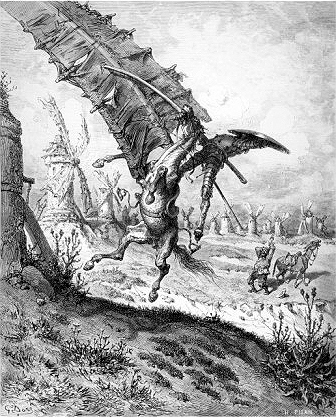
We think that its roots are not in the birth of psychology, but that it appeared much earlier. That in fact it can be seen in the birth of the modern novel, in Cervantes’ Don Quixote. In order to talk about our hysteria therefore, we need to talk about our Quixotic condition, which summed up comes to: you must even though you cannot. Or: you must do the impossible.
Did our modern human condition evolve out of a striving for that? And, if the tragic 20th century was driven by a Quixotic force, what will the motor of the 21st century be?
Hysteria is bad, and the contemporary world’s quest for achieving the impossible was a psychological motor behind so much of the disastrous aspects of the 20th century, which was undoubtedly a very tragic hundred years. Nevertheless, that does not have to mean that the future has to become an apocalyptic development of that same hysteria – as many believe it is. What if the impossible actually does become possible? What if Don Quixote’s insanity suddenly becomes realistic?
Technological developments have put us on a very real threshold from where the impossible now looks feasible. If this is true, then the 21st century should be a transcending of hysteria, allowing our Quixotic side to lose its madness and be seen for what it always could have been – inspiration. Such an optimism suggests that the future will be driven by a realization that the impossible is really quite possible, and from this – we must do the impossible because it is not impossible at all.
And yet, although we have arrived at a technological threshold in which our Quixotic dreams of human progress are made possibilities, there is still a pragmatic, skeptical Sancho Panza element holding us back. If we think about the current energy debate and the need for the development of affordable, green technologies, we can see a clear example of how a new, contemporary dialectic has arisen between Quixote and Sancho. A Quixote who is inspired and knows that his dreams can become realities, whilst the skeptical Sancho Panza is forever arguing that cheap renewables are a fantasy and that the only practical solutions is to keep going with what we’ve got. The same dialectic seeps into philosophy and politics. Whilst Quixotic dreamers try to see beyond the borders of nations, races and religions, for the abolishing of guns, and the end of war, poverty and hunger, the new sarcastic Sancho keeps reminding them that they both tried that once and it failed, with disastrous consequences; and that it would be madness to ever try it again.
In theory, with scientific advances, Quixotic positivism should eventually diminish the dictatorship of the pragmatic and propel achievements once more into the sphere of the truly great. But, why is this not already the case?
Of course Sancho Panza has a great benefactor now. He no longer works for Don Quixote, he lost in faith in the Knight of the Sad Countenance and abandoned him centuries ago, embracing skepticism instead. Now, Sancho Panza represents the beliefs of the System itself. Sancho’s current benefactors are the members of a System which transforms possibility into an impossibility that we should strive for in order to become enslaved not by the realization of the possibility itself, but by the idea of it. While the object of desire is unrealized it can still be exploited, and what capitalism is striving for is exploitation. Turn dreams into dollars – that is the function behind our System, and it well knows that once the dream becomes a reality, the exploitive power is lost.
Pragmatism is, therefore, a term used to defend exploitation and convert the possible into the impossible dream. It is a barrier between us and possible achievements, and subsequently authentic progress. It is a wall between civilization and humanity. Only by pulling this barrier down will we ever liberate possibility, rendering the impossible as something possible.
Of course, this also means that while pragmatism exists as a constantly skeptical force against inspiration, the hysterical, Quixotic paradox will be perpetuated. And … the human condition will remain hysterical.
In order to transcend hysteria, we need to bring the System down. In order to do that, we must ask what is happening and compare it with what could be happening. Bob Dylan’s Mr Jones’ dilemma that something is happening but he doesn’t know what it is, is not enough. He, and all the other skeptical Sancho Panzas, must be shown the real possibilities ahead of us, and, by so doing, brought to understand and believe in all the variegated complexities of the possibilities of the impossible.


December 2, 2015
Pleasure and Spock’s Father
In his Critique of Judgement, Kant begins by relegating aesthetics to the subjective, or to a condition of being determined by the subjective. That which concerns whatever gives us pleasure or displeasure cannot be objectified.
If we think of the Vulcans in Gene Rodenberry’s Star Trek series, we are presented with an advanced hominid race – Vulcans are a completely logical species of Sapiens who have no emotions. But would it be right to assume from this that they don’t experience pleasure. If Kant had been able to watch Star Trek he would have found them intriguing. If the fictional Vulcans can find a way of surpassing the subjectification demanded by his pleasure principle, then perhaps it is possible for human beings to do so as well. Followed by the subsequent question of – would we ever want to?
According to Star Trek myth, the Vulcans were originally a passionate, emotional race of Sapiens hominids who developed techniques to suppress those passions. Perhaps we could have imagined such a development in humanity if the Stoic school had become a universal institution in human educational programmes. But perhaps, to understand the fictional Vulcans positively then, instead of emphasising their oppression of passions, we could place an emphasis on the fact that they found a way of objectively analysing and drawing logical conclusions from their tastes – that which Kant says is impossible.
For a Vulcan, every sensation is analysed in order to determine and subsequently understand what the physical sensations are telling them when pleasure is felt, and why. This logical process, and the gap it creates between the experience and the understanding of that experience, dampens or cools the intensity of the experience itself. The result is that the pleasure or displeasure dissolves into something else – into understanding.
Star trek’s first officer, Mr Spock, despite the fact that he is actually only half-Vulcan, is often accused of being in-human because of his inability to enjoy the intensity of emotions. Nevertheless, in actual fact, Spock’s, and the Vulcans’, logic is also our most human of qualities.
Science fiction does try to see it otherwise, and it has created an abundance of these hyper-logical, creatures, or robot versions of them, or AI machine like HAL, in order to see how inhuman they are in comparison to us. Nevertheless, the greatest error would be to programme androids with the ability to experience emotions and make subjective their experiences to a sense of pleasure or displeasure – or develop a fear of their own mortality. Such robots would destroy us. It is precisely the judgements we form from the pleasure principle and our subsequent reactions that make us so dangerous for each other. A robot with a sense of personal taste would be one that desires, and a robot that desires will eventually do, or try to do, what it wants. A powerful intelligence combined with a strong, subjective sense of personal tastes would be the most dangerous monster imaginable.
Likewise, as humanity develops technologically, so must our ability to control our emotional side develop. If the homo sapiens is to evolve and not destroy itself, it will have to do so in the same way that the mythical Vulcans were able to do so – by conquering the emotional side through logic.
Immanuel Kant, Critique of Judgement, I, i, §₁, p.35


November 28, 2015
The Psychology of Capitalism (1) DEMAND – NEED = DESIRE
This formula (Demand – Need = Desire) comes from Žižek, after Lacan’s Love – Appetite = Desire. But how does this work?
For Lacan, love is a demand, and he talks of the demand of love and the appetite for satisfaction. But not all demands are love and not all love is a demand. Is the appetite for satisfaction the same as need?
At the immediate level of needing to satisfy our physical appetites, the answer would be yes – I am hungry → I have an appetite for food = I need to eat something. A plate of spinach is given the hungry individual. He or she doesn’t particularly like spinach but the hunger is dominant and he or she devours the insipid dish to satisfy that hunger. After the hunger has abated, what is left over? Nothing. There might still be spinach on the plate, but the hunger has gone and the hunger was everything so there is no need to finish the spinach. If it is eaten it will certainly not be with any gusto, for after the hunger is satiated there is no desire left. On the other hand, give the individual a plate of his or her favourite food. The ration is ample enough to satisfy the appetite, the need for food and the hunger is quelled. Nevertheless, the individual is left wanting more. And … this is desire.
In this way we see that desire is a going-beyond need. In its essence it is a demand for more than one need.
Now, by understanding desire this way, we reveal how capitalism works in the realm of desire and needs.
In a mechanical sense, capitalism is a motor for desire which is a transcendence of the relationship between demands and needs that pulls us into a yearning for the unnecessary.
I love pizza. I am hungry. The pizzeria offers three sizes: individual, medium or family size. The family size is enormous; the individual ration is small but sufficient. Desire, however, entices me to buy the middle-size pizza. It will leave me stuffed, feeling unwell even, but … such is desire. The pizza lover after me buys the family sizer. He is alone and won’t be able to finish it, but … he also likes cold pizza. Or he’ll reheat it for breakfast tomorrow.
In this case, the equation is not Demand – Need = Desire but (demanded)Supply – Need = Desire. For capitalism to work, supply must create demand. It is not enough for a business to estimate what people want, it has to create that want. It has to create the market for itself. The realism of consumerism is not that we can have what we would like, but only that which is there. The illusion is that we can get whatever we want in the market place or the department store. Reality, on the other hand, is that we want what we imagine we can get there. What we really want is very often not to be found. One just has to look for a certain style that is no longer in fashion, or a replacement for a broken part of an old machine, or even a pair of shoe-laces for an old pair of shoes or a tooth brush that will slip into one’s old toothbrush-holder, or … a lightbulb that won’t have to be replaced every year, or a medicine to cure one’s arthritis, or a tomato that tastes like the tomatoes we had when we were kids …
For the capitalist market to exist there needs to be obsolescence. The shorter the life-span of a product the better. In the equation Supply = Need + Desire, it does not matter what the values of Need and Desire are as long as both of them have some degree of positive value. The real value for the capitalist is determined by the value in Supply itself, which is really the factor of availability. The greater the availability value is, the more likely it is to generate the Need and Desire necessary to make it a successful business proposition. The main aim is to fill the shelves with your products and leave no room for competition. This is why companies create their own competition – they are filling the space of Supply which determines our Desires and Needs.


November 25, 2015
IDEALITY AND IDENTITY … and freedom

There is nothing until it is perceived. The thing itself is nothing until it is “discovered”. This Idealist concept can be applied to our own identities. We are not how we perceive ourselves to be, but how we are perceived to be when we are “discovered”. Nevertheless, we want to be known in the way we want to be perceived as being and not in a way that those who don’t really know us misconceive us to be. Freedom, therefore, becomes a struggle against mass-perception which is itself a molding force, an attempt to make the individual conform to the way it tells us we should be perceived.
Perception, and therefore identity, can be measured qualitatively and/or quantitatively. In an oppressive regime of imitation, the quantitative is promoted to the detriment of the qualitative. For example, it may be more important the number of likes or friends on your Facebook site than the depth of communication you have with those friends. Nevertheless, without depth of communication the quality of perception remains superficial and regarded as weak. To be superficially perceived has a reciprocal effect on one’s identity. My life is more meaningful and satisfying if I perceive and am perceived in a deep way than if I am conceived of in a wide-spread way. Nevertheless, that is not the trend. In the future we might measure the meaningfulness in our lives through the quality of information that arises from a Google search of our name. This sounds terrible, but the Internet has already become a determining factor in our being perceived and our quality of perceiving.
But if transparency is a vital force in our identity, how do we explain or qualify our fundamental need for privacy? Our need to hide ourselves for whatever reason: because we want to transgress; because we want the peace and silence of privacy; because we are tired of being misunderstood …?
Privacy, in this sense, is linked to freedom. A distrust is found of the way we are perceived because we are perceived in a way we don’t want to be perceived. Very few of us have the strength to openly flaunt our vices for fear of the judgement that will fall on us. De Sade is still the great hero of freedom: by standing naked before society he sacrificed his identity to society’s conceptions, relegating that identity to that of transgressor. In reality, he must be admired for his freedom, but un-esteemed for his superficiality and for the psychological and physical cruelties that his emancipation inflicted on his own victims. In fact, if we examine de Sade’s case closely, we see that freedom is intrinsically impossible. If our identity is always suspect to perception, it is forever subject to judgement.
We cannot escape perception in order to be free, quite the contrary, we have to confront it with our transgressions. With that which, for the eye of the perceiver, are our darkest perversions. The free spirit must inevitably dirty itself in order to obtain that freedom. In this paradox we find reflected the Faustian concept of a pact with the Devil. The soul can only be freed if you are prepared to stain it with your perversions. But who dares?
Can there be a better control mechanism than this?


November 9, 2015
Descartes’ Perfect Being

Descartes argued that a perfect being cannot be created out of something less perfect. Common sense immediately refutes this: we merely have to imagine any great artist and consider his or her development. Let’s take Beethoven as an example, and imagine his first lesson before the piano. A first lesson that was the first spark of a process that eventually produced the 9th Symphony.
What we take for God can also be created out of something much baser, even something as flawed as humanity.
Certain it is that Beethoven could never have arrived at our Beethoven without being prepared to work at it. Perfection doesn’t come about by accident. Likewise, for humanity to achieve its great destiny and become the God it alone can imagine, then it must get to work.


November 4, 2015
The Sublime

The sublime experience is one which is elevated and inspires awe. Some would say, an experience that touches us or moves us deeply. Many would say that the experience of the sublime is a feeling that behind the phenomena lies some substantial but inaccessible thing – like God, for instance. Because of this the sublime is often put forward as an example to demonstrate the presence of God in our lives. But, we think this is a total misreading of the sublime.
In fact, the experience of the sublime is not that which points toward the inaccessible at all. The experience of the sublime is really a discovery of the real substantiality of things. What the sublime experience tells us is that there is a substantiality in all things, but habit and closeness have robbed us of the magic of it. A magic which is really based in the simple fact that we are perceiving it.
The first great miracle of the Universe is that it exists. The second great miracle – almost more miraculous still – is that we can perceive it. And the greatest miracle of all is that we know we perceive it. The sublime is the experience of knowing that we perceive existence, and that that is a miracle. It has nothing to do with God.
When we see the light behind the grotesque or the beauty in the monster’s interior, we are making a leap from our subjective prejudice to the universal perception. All sublime feeling is an immersion in the universal, whether that be the universality of our species or the universality of the Universe itself. The sublime is a perceiving that suddenly blasts out of a state of not-perceiving. A great work of art can move us in a sublime way on repeated occasions because it is always opening up different doors for us to perceive things from. However, the sublime sensation of the work will not be generated if we have it hanging on our living room wall or if it is a recording that we listen to every day. The sublime has to be a surprise, a way of snapping us out of our subjectivity. Sometimes it can be an absolute shock, as if we were suddenly pushed under water at a moment of complete lethargy when we had practically forgotten we were even floating.


November 2, 2015
Human Purpose in our Unconscious Universe

The Universe is either blind or not. A belief in God is a belief in a universe that knows itself because it can perceive itself. The difficulty with the idea of God is primarily the problem of conceiving how this omniscience could possibly be. If we manage to do this we believe we face an even greater difficulty – if the Universe can perceive itself, what is the purpose of life in such a universe? For a conscious universe, life, and its own perception of the universe could only be a distraction for the universe and its own perception of itself. In a conscious universe, life would be undesirable as it would distort the same, pure consciousness of the Universe itself.
As such, we believe that the presence of life in the Universe proves that the Universe cannot be self-conscious.
The Universe is blind. It is an eye which cannot see itself, and it has nothing to see outside itself. Nevertheless, the evolution of the Universe and its cosmological fine tuning indicates that it intuits itself in an unconscious way. At some time in its blind creation it came to intuit its own possibility of Being. It even seems possessed of a primitive determinism that has been capable of organising itself into its present complex form with complex organisms like human beings.
However, in order to be sure of its own existence, the blind Universe must create a way of seeing itself for what it is. How can this be done if it can only operate within itself? It only has power inside its own limits of space and time.
The Universe can only operate according to its own laws of physics, within its own material reality. To see itself, the eye that does not see must create a perceiving entity within itself. A kind of mind’s eye. An imagination for itself. To perceive itself, the Universe had to create something that could perceive within itself. It needed to create life.
The Universe is either blind or not. A belief in God is a belief in a universe that knows itself because it can perceive itself. The difficulty with the idea of God is primarily the problem of conceiving how this omniscience could possibly be. If we manage to do this we believe we face an even greater difficulty – if the Universe can perceive itself, what is the purpose of life in such a universe? For a conscious universe, life, and its own perception of the universe could only be a distraction for the universe and its own perception of itself. In a conscious universe, life would be undesirable as it would distort the same, pure consciousness of the Universe itself.
As such, we believe that the presence of life in the Universe proves that the Universe cannot be self-conscious.
The Universe is blind. It is an eye which cannot see itself, and it has nothing to see outside itself. Nevertheless, the evolution of the Universe and its cosmological fine tuning indicates that it intuits itself in an unconscious way. At some time in its blind creation it came to intuit its own possibility of Being. It even seems possessed of a primitive determinism that has been capable of organising itself into its present complex form with complex organisms like human beings.
However, in order to be sure of its own existence, the blind Universe must create a way of seeing itself for what it is. How can this be done if it can only operate within itself? It only has power inside its own limits of space and time.
The Universe can only operate according to its own laws of physics, within its own material reality. To see itself, the eye that does not see must create a perceiving entity within itself. A kind of mind’s eye. An imagination for itself. To perceive itself, the Universe had to create something that could perceive within itself. It needed to create life.

The Universe is the subject that does not know itself. It is substance evolving toward subject. But how can such an evolution take place? What we are talking about is an evolution of consciousness, evolving from perception into knowing. It’s an evolution we have seen in our own world. The evolution of our own species: the process that transformed the protozoa into a Da Vinci or an Einstein. Human purpose is to know the Universe, both without and within – to invent and create according to our knowledge and sculpt from the material that is to create an even better Universe, the Universe that ought to be.
The Universe is the subject that does not know itself. It is substance evolving toward subject. But how can such an evolution take place? What we are talking about is an evolution of consciousness, evolving from perception into knowing. It’s an evolution we have seen in our own world. The evolution of our own species: the process that transformed the protozoa into a Da Vinci or an Einstein. Human purpose is to know the Universe, both without and within – to invent and create according to our knowledge and sculpt from the material that is to create an even better Universe, the Universe that ought to be.


October 31, 2015
Globalisation and The Death of Democracy

One of the aims of globalisation was to separate politics from economics, and yet in practice it has merely reduced the political to a slave-status, servicing the dictatorship of the global marketplace. The Economy, the economic world and its institutions, are not chosen by the people – the polis is for politics. Given free rein, the market will transcend politics, creating its own cultures that are totally at the mercy of Wealth. The creation of global, macro-economics is, therefore, an immaculate fraud against democracy and freedom. The logic of the fraud being that: in order to create a firm and unquestionable dictatorship, the people should firstly be given the illusion of democracy by allowing them to vote for their local and state governments while, at the same time, shackling those same governments to the dictates of the world market place. As such, no matter who the people elect for their governors, it can have no effect on the will of the market. What pushes wealth unto the wealthy is the economy, not the parliaments, and the polis are never asked to vote for any of globalisation’s economic institutions, even though the World Bank and the IMF are the real forces shaping our lives.
Without control of the economy, the life-blood of the State (money) is also pushed out of the realm of political control. The politicians try to put on a brave face, but even the neo-liberal parties are made to look like helpless buffoons before their electorates when the power that really runs the economy (Wealth) decides to get tough and make sure everything is flowing completely in its own favour. Local anger is vented at the local government – the economic regime is too abstract, or too distant. After all, how can it govern us if we didn’t vote for it?
Democracy melts away. There is no democracy at all. We didn’t vote for those who make decisions now. We all live in one huge global dictatorship.
It does not matter what the international financing institutions do or might do, whatever is done is carried out without any democratic mandate. Yet, they can do whatever they like. And though they may assure themselves that they are acting responsibly they are still acting without our blessings, and operating behind our backs.


October 27, 2015
POLITICS, GOD OR ART?

Politics is dying and God is making a comeback. Could it be that the religions will save capitalism? As the impossibility of the consumer society becomes clearer and clearer, doesn’t it make more sense to reach out toward a purposeful impossibility rather than a nihilistic one? Or perhaps there is a more positive, creative alternative to both politics and God. Could the saviour of humanity be something like Art?
* * *
Humanity has been tormented by eternity ever since it was able to conceive it. The great and magnificent eternal fantasy versus our own petty ephemeral natures. Eternity is the fundamental reason for all religions and all art. We can believe that God is dead or never existed, and we can tell ourselves that Picasso is shit and Da Vinci overrated, but we cannot escape the eternal void that envelopes our own existence.
Religion and art, and hence technology, politics and the economy, all come from the same anxiety: they are ways of dealing with ephemerality. Nevertheless, each of them has a completely different way of operating, with completely different aims. Religion is constantly grasping after another reality – one which is eternal. Within the eternal paradise of the religious lies everything that is good, having filtered out the evil components of this reality. Art, on the other hand, is a yearning to create the eternal in this world. It is an anxious struggle to uncover and preserve: a building process; a concept of eternity as a becoming rather than an enveloping reality that we eventually move into when we die. Religions try to remain eternal themselves – although this has been proven to be impractical and so it has adopted a politic of becoming.
Politics has a circular moving dynamic, dependent on separation and ideological dialectics to keep itself alive and seemingly evolving. But the circular implies a process of devolution as well as evolution. The economy is a layering distraction, placing us firmly in the present with a yearning towards the void of the immediate future.
Our capitalist economy, however, is completely devoid of the eternal. In fact, it could be considered an anti-eternity, which is why some have associated it with the devil’s work. It uses money to flow through reality in a way that makes it seem the blood of reality. Its great force of exchange and communication works in a meshing, netting way over our lives, entrapping us all.
But despite this entrapment, we cannot escape the eternity that envelops everything. It haunts us with its enormity, with an idea of tremendous possibility and great purpose – that the reason and purpose that fades away in the ephemeral world has to exist out there in the infinite void. The great empty void – if only we could fill it. In the beyond is the purpose that the economic mesh lacks. But we are likewise trapped by the ephemerality of our own reality. The spiritual and religious are impossibilities that can only be embraced via faith. To make the eternal seem practical we need another force, another way of stepping over – the practical results of our intellectual and spiritual creativity that we call art.