Paul David Adkin's Blog, page 30
December 6, 2016
Let’s Rock: The Essence of the Independent Artist — P.D. Adkin Singer Songwriter

We have a few physical instruments; a microphone; an audio interface, lots of cables and a computer with software that allows us to do all the rest. Our statement is: we have no power, but we do have the will to make our musical statement.
via Let’s Rock: The Essence of the Independent Artist — P.D. Adkin Singer Songwriter



November 17, 2016
THE HOLY GRAIL IN THE MINOTAUR’S LAIR
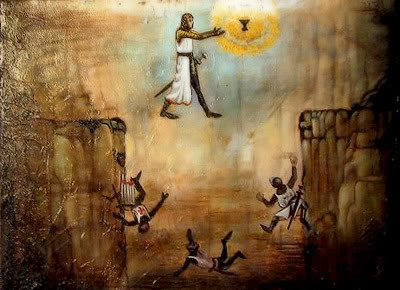
We have been driving a juggernaut along a road leading directly to a cliff edge. If we continue going straight, we will topple into an abyss. Obviously, we cannot continue the way we are going. To avoid annihilation, we have one of two choices: we can either turn left toward a Utopia, or right into a Dystopia. It seems obvious to us which decision is the best one. And yet … most of those on board started screaming to the driver to turn right … and he has. Why? Why did we choose to go in the direction of a Dystopia before a Utopia?
Part of the problem rests in the common perception that Utopia is an impossible space. That it is no-place and therefore must be dismissed straight away. Dystopia, on the other hand, is an inevitability and therefore linked to reality. If reality and pragmatism tells us that we cannot make the world a better place, then at least we can try and protect ourselves against the evil mess that surrounds us.
In truth, our present reality is limited. But limited only by the labyrinth built around us that we call Civilisation. This maze has always been a way for managing the limitlessness of potentials in order to control them for a central cause: The cause being, the accumulation of Wealth and the protection of the wealthy classes. However, existence in the labyrinth has become precarious. The world around it is being devoured by the Minotaur that we feed at the centre of the labyrinth itself. But soon there will be nothing left for any of us to eat, and storms will come and wash us away. If we don’t get out of here, we are doomed. In order to escape we need a map, and we have to tread carefully. But how can we manage a labyrinth from within?
First, one must get a mental overview of it. It requires an intellectual transcendence through reason and the abstract; through mapping and synthesis: and this is a philosophical process.
Secondly, one has to have an anchoring in order to move confidently and lucidly within the maze. An Ariadne’s thread that will enable the hero to retrace his/her steps. With the anchoring one can creep into the unlimited enclosure and look for a way out into the limitlessness beyond its walls without feeling lost; always in touch with the overview, the mental map which provides the hero with an understanding of the maze.
The maze of our Civilisation is infinitely complex and the way out is too far away for any individual to find it in a single lifetime. In fact, it has required tens of thousands of years of intellectual mapping to get to this point we are at now. But that does not mean that a way out is impossible. There is a parallel between the labyrinth and the Grail myth.
The Grail, which cannot be reached, is the goal. It is the learning made on the journey which makes the Grail. So, in reality the Grail does not exist now, but will exist, created out of our endeavours to reach it. The goal/Grail is only holy and spiritual until we see the physical reasons for finding it. Once the physical purpose of the Grail is believed in, then authentic purpose becomes manifest.
Psychologically, the Big Other is resolved. The Big Other doesn’t exist but will exist, through rational, human endeavour.
But to get there, we have to start believing in the possibility of Utopia. In order to get the perspective needed to map the labyrinth properly and see the potential of Utopian limitlessness, a revolutionary thread is needed that will anchor humanity in partnership with the Universe as a vital element in the Universe itself. Only be flying above the maze into the ever-expanding space outside can we find a way out of our doomed enclosure. The enemy to this anchoring-in-the-absolutely-unlimited, is Wealth, which is the force maintaining the labyrinth that we call Civilisation. Utopia is an antithetical concept for Wealth, which thrives on models of Dystopia. Our Wealth-Civilisation is the enemy of Utopia, maintained by an anti-human historical narrative that it itself has created.
Nevertheless, once the lethal aspects of Dystopia are recognised, the Utopia becomes a necessary driving force; a Utopia which is itself envisaged out of necessity.


November 15, 2016
Patriotism, Fascism, and the Death of Democracy

Our Civilisation of Wealth has used very different kinds of political ideologies to sustain itself but its ugliest version is undoubtedly Fascism. That a vulgar and fascistic, personality-cult leader has now become President of the USA is shocking, but not so surprising if we consider that the fascism has always been there in a latent form.
The Great War against Fascism of 1939-45, that we call the Second World War, did not actually defeat fascism. Yes, it defeated Hitler and Mussolini and the personality cult regime in Japan, but it did not defeat fascism. It did not defeat fascism because it did nothing to eradicate the patriotic pride of the national states. There were victors and losers in the war: one way of perpetuating the patriotic spirit defeat another manifestation of those sentiments; in the Second World War “democratic” fascism defeated “authoritarian” fascism with the help of the national-socialist regime of Joseph Stalin.
Authoritarian fascism is best defined by the term National Socialism and the key word in fascism is National. The patriotic spirit behind the democratic forces that defeated Hitler were nationalistic and therefore fascistic forces. All forms of wall building and border defining ideologies are inherently nestling fascist frameworks. All nationalism and patriotic feelings are essentially fascist sentiments. Even the great bridge building ventures since World War II, like the European Union and Globalisation have always clung on to the maintenance of state sovereignty, and by doing this we have maintained the roots of fascism under every progressive tree.
The problem of fascism is that, once the National State establishes its power it needs to extend its boundaries if it wishes to keep progressing. The fascist state is always a little empire, and the Fatherland Empire will always want to expand into neighbouring Fatherlands. The same expansionist need is also an essential part of neo-liberal capitalist growth. However, the capitalist powers that defeated Hitler, knew that they did not need the muscle of dictatorship to perpetuate itself and its growth, in fact, they understood that tyranny was counterproductive to expansion. Fascism had to be subtler, and democracy was a far more efficient machine for allowing the rich to get richer and for Wealth to legitimise itself. Civilian upstarts like Hitler, or military reactionaries like Franco were themselves a bigger threat to Wealth than the pseudo-freely elected parliamentary systems. Control from the unquestionable legitimacy of the ballot-box, contained within an easily controllable patriotic ambience, is the apotheosis of power that Wealth needs to maintain itself.
In theory, Democracy should be the system that favours the masses, but by restricting it within the patriotic bubble this is hardly ever the case. The seemingly illogical results of the Brexit referendum, the Colombian peace referendum, or the seemingly impossible election of a fascist president in the emblem of the Free World that has been the USA, seems to indicate that the democratic process no longer works. But, really, veiled with the mask of patriotism, democracy has always been an easily manipulated motor for the National Socialisms that pull the strings.
As for the United States, where democracy is so widely revered, a heavy paradox has always lain over that system; for an idea of politics favouring the masses is associated there with the “evils” of socialism, that most Americans think is an un-democratic process. By rejecting socialism, the Americans reject the role of the people in democracy. When the will of the people rejects the power of the people, then the situation lies in an essential paradox that is profoundly absurd and invites dangerously ridiculous solutions like authoritarian fascism.


November 11, 2016
The Serious Ridicule Campaign
On 11th November, 2016, we woke up to find that the most famously disgusting man in the world had been seriously, ridiculously voted in as the 45th President of the USA. Donald Trump is seri…
Source: The Serious Ridicule Campaign


The Serious Ridicule Campaign — P.D. Adkin Singer Songwriter
On 11th November, 2016, we woke up to find that the most famously disgusting man in the world had been seriously, ridiculously voted in as the 45th President of the USA. Donald Trump is seriously ridiculous. Seriously ridiculous because his ridiculousness has to be taken seriously. But, the seriousness of that ridiculousness does not […]
via The Serious Ridicule Campaign — P.D. Adkin Singer Songwriter


October 11, 2016
THE PARANOID DEMANDS OF CAPITALISM
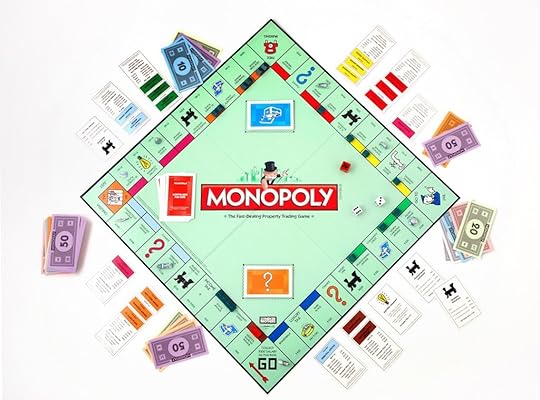
Capitalism demands results. For this reason, it begins scientifically and ends anti-scientifically. The experiment in science is an attempt to prove the validity of a theorem, while in capitalism the experiment has to prove the validity of a dogma.
For the capitalist, the Universe revolves around his or her reality, which is how to make as much profit as possible from MY object. The total immersion in and obsession with this MY, which later becomes an insincere OUR, makes capitalism essentially a paranoiac.
Obviously a world dominated by the paranoid civilisation that is global-capitalism is hardly suited to humanism. For this reason, human-rights are for the majority of human beings, a largely deceitful concept. This lack of faith is part of an inverted condition of mutual suspicion because, in capitalist terms, anything that deals with the human is also untrustworthy. The human, for the capitalist, is a malicious concept, designed to undermine and diminish the MY which is “MY OBSESSION”.
But … what is the MY in capitalism?
It is not “me” but rather what I produce in order to obtain profits for myself, with the emphasis on the profits. The MY reality is equivalent to MY PROFITS.
Results in capitalism are, quite simply, PROFIT INCREASE. This is what capitalism demands. To be a good capitalist you must be obsessed with money. When the capitalist system talks of progress it means Maximising Profits.
The big letters manifest themselves proudly in the capitalist mind: P= Profit; Progress; Power and M= Me; Maximum; Money. PM and MP – capitalist fantasies ardently opposed to the letter H.
THE GIFT OF COMMUNISM
Communism was a great gift for capitalism because it enabled it to channel its hatred for the human into another term. It would have been difficult for the capitalists to maintain an aggressive dialectic against its real enemy humanity, but communism gave it the opportunity to do just that without the slightest complex of guilt.
It is hard to argue the ethical position that humanity is trying to rob me of my freedom to make profits, but the image of the communist oppression of individuality, easily transferred onto even milder forms of leftist politics like social-democracy, can be a seemingly valid argument to protest against an anti-capitalist tyranny perpetrated by humanity. Human-rights activists or ecologists now become easily slandered as “communists”.
Nevertheless, when the capitalist thinks of the left, he or she is really thinking of humanity. Humanity is the real enemy of capitalism.
CAPITALISM’S MONOPOLY DEATH-KNELL
For the capitalist, competition is healthy, it keeps the capitalist on his or her toes. But, how can MY PRODUCTS compete against Humanity? In order to keep the ruthless game of competition alive, everything must remain fragmented – there can be no monopolies.
And here we get to the paradoxical nature of capitalism: the aim of capitalism is to get results; which is to maximise profits; which is to grow; which is to swallow the competitors; which is to create your own competition; which is to become a monopoly – which is the death of capitalist freedom; which is the death of capitalism.
This is the contradiction rooted in the very essence of capitalism itself. the obsessive paranoia of the capitalist, constantly pushing forward to get results, can only, if successful, convert the capitalist – in the focal point of everyone else’s paranoias.


October 4, 2016
THE WOEFULNESS OF WEALTH AND THE LOTTERY OF LIFE
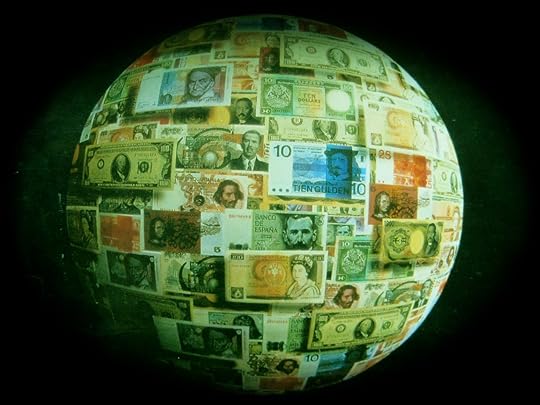
Wealth has always been a reactive and cynically pessimistic force, for it essentially raises and protects itself by stimulating and encouraging whilst at the same time destroying or negating the great hopes of humanity. In fact, through its manipulation of all the agents of power, it replaces humanity with fantasies of the national spirit, of religious crusades or jihads, of the glory of Empire, or, in the case of capitalism, with the illusion of individual freedom and the achievements such phantasmagorical freedoms can bring.
All of these fantasies have a common cause – to dehumanise the human and diffuse any common aims through separation and segregation. Wealth is about disconnection, the establishment of differences. The stance of Wealth is of Us against Them; of Master and Slave; of our Gain against their Loss.
The result of the accumulation in Wealth of the Few is an intensifying of the Poverty of the Many. Capitalism has long been successful in creating the mirage of satisfaction through the seeming great progress toward the technological man. But the price paid by Wealth in the mechanisation and digitalisation of society is one of an unveiling of its own trickery. As civilisation falls deeper into an unauthenticity, society becomes more and more scarred by the false, virtual reality imposed on them; a reality lacking in true potentials; where everyone has an opportunity to be successful, whether talented or not, but success depends on it being an elitist concept. Only a small few can be truly successful, even though anyone and everyone has a chance. Life therefore becomes a lottery, and as more players come into the game, the prize swells but the chances of winning it are less and less.
But the mirror of the simulated reality of false potentials that we are facing has formed fissures and cracks. The distortions caused by these cracks allows us to look past the false image in order to discover that everything is mounted on an empty blackboard. Below the fragile surface of the mirror there is … nothing.


September 28, 2016
POLITICS AS A DESIRE FOR NON-POWER
The cry for Real Democracy demands a reappraisal of the voting systems that undemocratically favour two major parties, nearly always the centre right and centre left. liberal-democratic parties, who themselves ensure a continuation of the dominant capitalist-economy of the global world civilisation. Most Western-style democracies have cheating mechanisms which are designed, according to their supporters, to provide “strong” governments.
From a point of view of political comfort, the cheating mechanisms seem to be necessary for maintaining a desirable stability. We have seen in the last few years how the arrival of more radical parties into the governmental scenario (e.g.: in Greece, Spain and Italy) has done little to make any fundamental changes to the system. Anti-capitalist parties have been castrated by the global capitalist-economy. Because of this, the System falls into an impossible paradox in which winning power becomes political suicide for radical parties.
But what if the objectives of winning the elections were radically opposed to power itself: that instead of gaining power, the objective of the radicals is to create non-power? Can we imagine a political party with an anti-power ideology? Of course this sounds like anarchism, but let’s ask why anarchism is so scarcely seen in democracies? Why do we think we need power so much when, over and over again, we see how greedy and selfish it is?
The reason is that Power in our economics-driven society is inextricably tied to the flow of money. Power makes and distributes the wealth. It is an underlying belief in our society that without money we would die, and this means Power is related to survival, and only when Power threatens our survival, as it did in 18th century France or 20th century Russia and China, will major revolutions take place. That Power is inextricably aligned with Wealth is no secret, but when that alliance is seen as a threat by societies to our welfare and as an endangering force in our lives, it starts to be questioned, and the seeds of revolution begin to sprout.
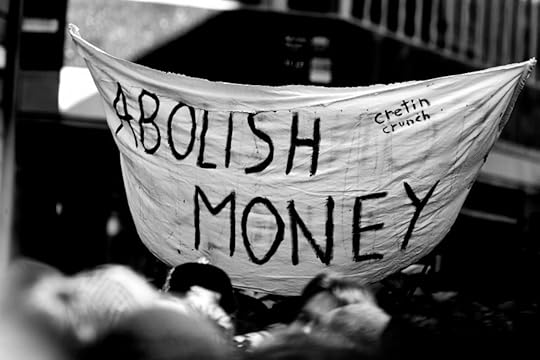
However, a real revolution can only truly hope to succeed if it attacks the real source of the problem, which is the relationship between Power and Wealth, and which stems from the inextricable bond between Power and money. In other words, only by questioning monetarisation and envisaging societies in which money as we know it no longer has to play a part, will successful revolution or purposeful political change ever come about.
But for this to happen, political activists have to enter the political scene not with a thirst for power, but with a desire for non-power.


September 16, 2016
Anti-Fanaticism
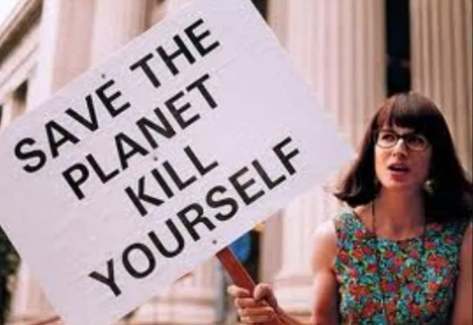
The world today needs great ideas. Human society needs inspiration. However, these very needs imply another necessity for extreme caution.
Our anti-human historical process teaches us that great ideas are embraced by Wealth through the apparatus of Civilisation and converts inspiration and creativity into ideology and dogma. For this reason, all good ideas have to be handled with protective gloves, not to protect our hands but in order to safeguard them from our own society’s greed.
We can use terms like Fascism or Stalinism to represent the idea of a total immersion in ideology, but likewise we could talk of Opus Deism or Mormonism, or we can unify all of these dogmas under the umbrella of Fanaticism.
The 21st century has arrived with its own peculiar narratives: the dialectic between Fanaticism and Anti-fanaticism is one of these; but this dialectic is itself swamped by a far more powerful squabble between the fanatics themselves. The seemingly age-old bickering between religious fanatics has made a comeback, in a brutal, violent way, and this is also fostered and favoured by a political ideology fanaticism, which is in truth an economic ideology. This creates a powerful and destructive dynamic that mitigates human progress and creativity whilst inflating Wealth.
Civilisation today is driven by an internecine struggle of alliances and enemies. On the one hand there are the champions of the spirit and on the other the upholders of the material. Both of these fanatical movements promise great rewards for their followers, and both of these streams create currents of wealth creating power that flow through and nurture each other.
Neither option keeps everyone happy, but together they offer a great alternative to each other: if you don’t want to be subject to one side of civilisation’s fanaticisms’ coin, then you can join the other side without needing to denounce civilisation at all. Only the fanatics are trying to escape now.
Of course this seems to be anti-intuitive: isn’t fanaticism a threat to Civilisation? Aren’t the fanatics Barbarians? This is what Civilisation would have us believe: but the real answer is “no” and “no”; Civilisation feeds its fanatics for its own benefit.
As for the Anti-fanatics: all people who are not fanatics are, potentially, anti-fanatics. However, the anti-human historical process has always shown us how easily the mechanisms of Civilisation can be used to turn non-fanatics into absolute “believers” in an historical blink of an eye. As for the anti-fanatical purist, they also have the fanatic in them: the fanaticism of the anti-fanatic. And in this sense the looming scenario is dismally pessimistic: one can only combat fanaticism fanatically. A new paradox emerges, and with each paradox a new challenge to overcome it. How do we overcome Fanaticism without being fanatical?
We imagine pockets of anti-fanatics, swimming lonely and anonymously within the great schools of ideologies; immersed because they have to be, but following the rules without conforming to the fanaticism. We think these anti-fanatics have to exist, because without them the dialectics of society would be self-contained between “spirit” and “material” and between each sections own inner squabbles; and this would have provoked a rapid collapse of civilisation itself.
Or, in other words, civilisation still exists today because of the true anti-fanatic current that flows within it.
The Anti-fanatics are cynics and scientists. They are sceptics and visionaries. They visualise Utopias and deconstruct the Heterotopias that dominate and disfigure our reality. They seem to be a tiny minority, but this may be an illusion created by complexity. Lines seem straight until we magnify them. Closer inspection always reveals an inner chaos, a deeper yearning for a more creative fabric forming existence.


August 25, 2016
Where does our Conception of God come from?
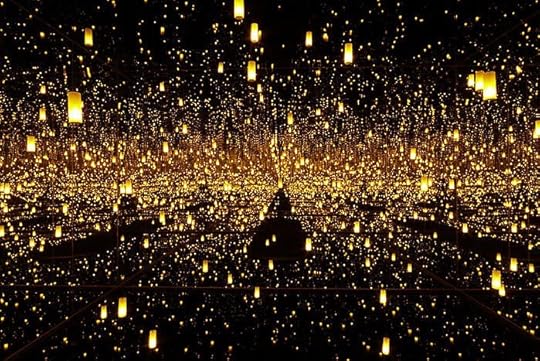 Yayoi Kusama: Aftermath of Obliteration of Eternity, 2009
We didn’t conceive and refine the Judaeo-Christian concept of God out of natural phenomenon or even logical deduction – apart from a First Cause, there is no logical need for God. Instead, it was formed out of a mainly intuitive comprehension of Humanity’s own potential. The image we have of God is a reflection of what our own collective intellect could be capable of being and producing, and of the incredible power that a highly advanced and evolved humanity could be capable of achieving if it survives, and manages to develop in a progressive way, for millions of years to come.
At the moment we have to be considered very poor candidates for the Master of the Universe. Nevertheless, we stand at a crossroads that demands that we must now take an optimistic evolution into consideration or perish. It is time to shake off our tremendous nihilism and pessimism and admit that an anthropogenesis into a God-like species is an idea that ultimately reflects our own collective potential – albeit in a far, far distant future. Of course, the entire history of our civilisation has been a process of turning our backs on that potential; God was created in our own image to mitigate the obligation to become godly ourselves. The responsibility is awesome, but sooner or later we will have to embrace it or disappear: that is the ultimate choice between purposiveness and nihilism.