Russell Atkinson's Blog, page 99
December 25, 2015
Fly the Flag on Christmas
Merry Christmas
Merry Christmas everyone. I just put up the flag on this marvelous, sunny, cold Christmas Day. In case you didn’t know, the law says to do so. That’s right, there is a Flag Code enacted by Congress and signed into law by the President telling us when to fly the flag. It says:
36 U.S. Code §174 (d) Particular days of display
The flag should be displayed on all days, especially on New Year’s Day, January 1; Inauguration Day, January 20; Lincoln’s Birthday, February 12; Washington’s Birthday, third Monday in February; Easter Sunday (variable); Mother’s Day, second Sunday in May; Armed Forces Day, third Saturday in May; Memorial Day (half-staff until noon), the last Monday in May; Flag Day, June 14; Independence Day, July 4; Labor Day, first Monday in September; Constitution Day, September 17; Columbus Day, second Monday in October; Navy Day, October 27; Veterans Day, November 11; Thanksgiving Day, fourth Thursday in November; Christmas Day, December 25; and such other days as may be proclaimed by the President of the United States; the birthdays of States (date of admission); and on State holidays.
Now you know. But don’t worry, the Flag Code is advisory, not mandatory. The FBI won’t be coming to get you if you don’t fly it today. I hope you do, though.


December 23, 2015
The Hunter by John Lescroart
 The Hunter by John Lescroart
My rating: 4 of 5 stars
Shades of Harry Bosch! Wyatt Hunt, the lead character, is adopted and finds out his birth mother was murdered decades earlier. Of course he has to find the murderer. So the basic premise is taken right from Michael Connelly’s playbook, who probably took it from someone else. The differences are minor. Hunt is a private eye, while Bosch is on the job with LAPD. But in the end, the book works.
I’m a Lescroart fan and have loved some of his books. A couple weren’t up to snuff in my opinion, but here he is in fine form. The author doesn’t title his works as a series, but there are familiar faces in this one, which adds a comfort level to the story. It’s more than a little too touchy-feely for my taste, causing the plot to drag at times, but the prose is strong and clear. The dialogue, if overlong, is sometimes sappy, often snappy. Perhaps the best aspect of the book for me is that the investigation part, the core mystery solving, is mostly believable. There’s no deus ex machina here. As a retired FBI agent I am usually picky about ridiculous investigative methods or serendipitous revelations. The cell phone magic is a bit science fiction, but it turned out to be largely unimportant. Hunt follows logical leads in a methodical manner like real detectives do. I really like that.
As with most of his works, the main setting is San Francisco. I’m not a fan of that cold, dirty city but having some familiarity with the locations resonates to an extent. There is an added bonus that Hunt travels to a remote location where some of my wife’s distant relatives still live. I’ve never been there, but the vivid and appealing descriptions make me wish I’d taken the opportunity. We were invited there once long ago. One other aspect of the book that really worked is the tie-in to real-life historical events, which gave it a particularly creepy credibility.
December 20, 2015
Anagrams on the News
Sanders apologizes to Hillary over data breach = Oh, the poor, crazy liberal’s raids lose advantage
December 16, 2015
Adrenaline by John Benedict
 Adrenaline by John Benedict
My rating: 4 of 5 stars
The author and all the main characters are anesthesiologists, so of course a murder mystery from this crew is going to trot out every possible way an anesthetist can kill someone, intentionally or otherwise. You will not want to undergo that elective surgery anytime soon after reading this book. Still, if you like medical mysteries, it’s a fun read.
I enjoy science or medicine based books, fiction or non-fiction. The author does not talk down to the reader in this one, so be prepared for a lot of medical jargon, acronyms, and hospital slang. I like that, but some will get lost in the mumbo-jumbo. The prose is clear and intelligent, but the author is a bit clumsy with the exposition, where one main character spends an inordinate amount of time explaining anesthesia basics to a medical student. He’s trying to educate the reader, but it strains credulity to think a third-year medical student didn’t already know at least half that stuff. Most readers will lose patience with all the doctor’s “war stories,” too, I think. The plot could move faster.
The main characters are developed reasonably well, although the author is rather heavy-handed in his depiction of the bad guys. I was waiting for a Bwah-ha-ha to appear. The ending is predictable but still suspenseful, action-packed, and satisfying.
December 15, 2015
Mass shootings and bombings
Consider the following table of the 21 worst mass shootings in the U.S. since 1949:
Killer
No. killed
Killer’s race/religion
Year
Other
Seung-Hui Cho
32
Korean
2007
Adam Lanza
28
White
2012
George Hennard
23
White
1991
Vet
James Huberty
21
White
1997
Charles Joseph Whitman
18
White
1966
Vet
Patrick Henry Sherrill
14
White
1986
Syed Farook/Tashfeen Malik
14
Arab/Muslim
2015
Jiverly Wong
13
Chinese
2009
Eric Harris/Dylan Klebold
13
White
1999
Kwan Fai Mak/Benjamin Ng
13
Chinese
1983
Nidal Malik Hasan
13
Arab/Muslim
2009
active dutysoldier
George Banks
13
Mixed black/White
1982
Howard Unruh
13
White/Jewish
1949
Vet
Aaron Alexis
12
Black
2012
Vet
James E. Holmes
12
White
2012
Mark Barton
12
White
1999
Michael McLendon
10
White
2010
Christopher Harper-Mercer
9
White
2015
Dylann Roof
9
White
2015
Jeff Weise
9
Amer. Indian
2005
The data I reviewed goes to 30 but I got tired of formatting the html. The rest of the killers did not include any Arabs or Muslims. If you look at the 10 worst bombings in U.S. history, they range from the worst: Timothy McVeigh, a white army vet and killer of 169 to Ramzi Yousef, the only Muslim in the group, who barely squeezed in with a body count of 6.
The conclusion is obvious. The categories of people who are the most dangerous to us are, in order: gun lovers, males, whites, current or former U.S. military, Chinese or other east Asian. I propose that we ban all people falling in any of these categories from entering the United States. We should have the FBI start a registry on all these categories and track them all.
All right, I’m being flip over a very serious subject. I have left out the 9/11 attack which dwarfs all of these because it was neither a shooting nor a bombing. I do not mean to minimize that horrific attack or the evil character of ISIS and Al Qaeda. I’m all for tough action against both, although I’m not sure what that consists of. The soldiers of those organizations are fighting from behind computer screens, using bizarre propaganda to turn the minds of unstable, hate-filled people around the world to kill randomly. The foot soldiers in Iraq and Syria pose us no danger as long as we don’t go there and put ourselves in the line of fire. But the important thing I want to convey is that we should know who our real enemy is. You and I are at least ten times as likely to be shot and killed by that white guy next door who carries a gun “to protect us from those evil Muslims” than we are by a Muslim terrorist. It’s probably closer to a thousand times more likely. Don’t let racist bigotry drive your fears. I want you to be safe.
Sources: Fox News, CNN, Wikipedia
http://fox6now.com/2015/12/03/the-30-deadliest-mass-shootings-in-u-s-history/
http://townhall.com/columnists/johnhawkins/2013/04/16/the-10-worst-bombings-in-us-history-n1568828
December 14, 2015
Shoe size survey final results
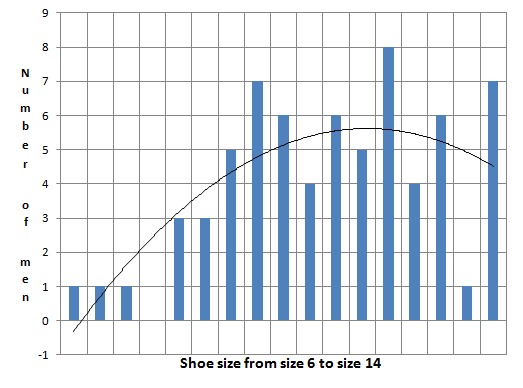
Some time back I posted a survey asking people to share their shoe sizes. That’s because I have very small feet and have trouble buying shoes and even socks. I was curious to see how much of an oddball I really was … with regard to feet anyway. Some people probably thought I had a foot fetish, but actually I find feet rather unattractive as bodily features go. Anyway, I now have 97 valid responses, of which 69 are male and 28 female and I’ve decided that’s enough to show the final results for males. I’m afraid not enough women responded to put much analysis into it, but I’ll post some figures below. For now, look at this chart for the men (click to enlarge).
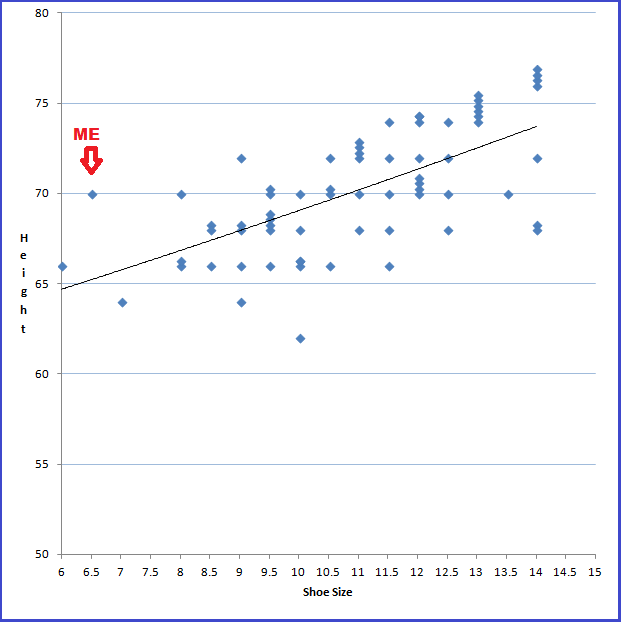
It confirms my suspicions that I am really at one extreme. Of all the responses, only one male had smaller feet than me, and he is only 66-67″ tall. I’m shown as 70 inches, but I’m actually a little over 71″. The choices were in two-inch units. He was also a teenager, so he can be expected to have larger feet (and more height) later. Of all the responders, mine shows the greatest distance to the left of the black trend line, which means I have the smallest shoe size relative to height of any male surveyed. There were some that were at least as far to the right of the trend line, indicating large feet for their height, but they were all or nearly all young men age 13 – 16. Their feet are probably just growing faster than their leg bones. Their height will probably catch up after their feet stop growing, and they’ll move up into the mainstream area.
The average male shoe size was 10.9 and the average height was 70.7 inches (adjusted for the two-inch units.) The most common size for male responders was 12, with 9-1/2 and 14 coming in close behind. See the next graph. Since my survey only went to size 14, that size 14 bar is actually 14 or larger. The survey is totally unscientific, of course, and I expect that people with unusually large or small shoe sizes were more likely to respond than others, so a true normal curve would probably be higher in the middle and shallower at the ends. That would actually make me more of a rare specimen (sounds better than oddball) than the graph shows.
Women, I’m sorry I don’t have pretty graphs for your results, but your average shoe size was 8.5 exactly and average height 65.4 inches. The most common sizes were 7 and 8, with 5 people each. The height ranged from 60 inches to 76 inches.
I’ve left the survey up for now, but I’ll be deleting it in a few days in case you want to take it, but I will not be reanalyzing the responses.
December 12, 2015
Answer or not? Open or not? Survey
I was once having trouble locating an event cache (my car GPS took me to the wrong spot) so I called a geocacher I knew was at the event for help. He didn’t answer. The call went to voicemail. He never listened to the message. Eventually I found the event and asked why he didn’t answer my call for help. He said he didn’t recognize the number, so he didn’t answer. I was shocked and a bit offended. Admittedly, he was a casual friend, not a close friend, and he did not have me in his address book, so I am sure his phone did not display my name. Still, what if it was something important – police, perhaps, or a close friend or relative who is using a stranger’s phone due to an emergency? Or a fellow geocacher needing a lifeline? I always answer my cell phone, but then I almost never get spam voice calls on my cell phone.
My home phone is another story. At least 90%, maybe 95%, of the calls there are junk calls – salespeople, charity fundraisers, etc. I sometimes answer it, but usually let it ring. However, I can understand why people would let a land line call go to voicemail. The difference with me, though, is that if I let it go to voicemail, I will listen as the person records the message and pick up if it’s someone I know if I can, or I will listen to the message later and return it promptly. Spam callers don’t leave voice messages in my experience.
Texts are yet another story. I don’t have a smart phone. When I first got my cell phone, at least 90% of the texts I got were spam, and they cost me 20 cents each. I got sick of paying for texts I didn’t want so I had texting blocked. I’ve never regretted that decision. Anyone who wants to reach me in text form can do so by email. I’m usually at my computer if I’m not out running, at the gym, driving, or someplace else where I wouldn’t be able to use a cell phone anyway. Besides, texts are too short to be meaningful. If you have something worth saying, say it in full grammatical sentences. LOL and WTF are not meaningful. I know of at least one person I followed on Twitter who said she never responded to emails because normal people only text.
Then there’s email. One correspondent I had never put a subject line on her emails. Since emails without subjects are a sign of of spam, hacked accounts, or a virus attack, I almost never open them. In fact, they go right to my spam folder since I have a filter for that. I just happened to see hers in my spam folder (which I don’t check very often) and decided to check it, even though I assumed it was someone hacking her account. Surprisingly, it contained a legitimate message. I replied to her that it was lucky I saw her email since I rarely see those without subject lines. She seemed amazed and answered “that’s just the way I roll.” (That’s the same answer Arnold Schwarzenegger gave when asked about his philandering, by the way.) Needless to say, our correspondence did not last long. If you want to reach me, call me or email me; don’t text. I won’t get the text or any message that one was sent, nor will you get a message that it didn’t arrive. And if you email me, put a subject line on it so I know it’s really you.
I doubt I’ll change anyone’s behavior since everyone seems to think they’re doing it right and everyone else should conform to them. I suppose I fit that description myself. If you disagree with me, well, there are two more ways to tell me so: you can always fill in that webform here on my blog in the About the Author/Contact link in the top menu or fill in the short (7 questions) survey below (click link). Please share the survey link. I’d like to get as broad a range of answers as possible.
December 9, 2015
Dead Before Morning by Geraldine Evans
 Dead Before Morning by Geraldine Evans
My rating: 5 of 5 stars
Inspector Rafferty is a student of hard knocks, a touch rough around the edges perhaps, while his aide, Sergeant Llewellyn, is the quintessential highbrow intellectual with a university education and a decidedly priggish side. The interplay between the two is endlessly entertaining, often hilarious. They are faced with a corpse without one – a face, that is. A young woman with a mutilated face and no clothes is found dead on the grounds of a psychiatric hospital. Suspects abound: the insufferable Sir Anthony, who runs the hospital and is known for his philandering, various staff members, nurses, even the dead girl’s father. The author cleverly provides ample motive for a half a dozen suspects, but they all seem to have solid alibis or other impediments to being the successful denouement of the case.
While trying to solve the murder, Rafferty must also contend with an Irish mother who is trying to marry him off to a distant cousin and yet another distant cousin languishing in jail who expects Rafferty to spring him free. Woe to the poor Inspector!
I just loved this book. The mystery was in the style of Agatha Christie, where plenty of suspects are presented and although one at the end is revealed, it might have been almost anyone else. The charm of the book is the dialog between Rafferty and Llewellyn, who could qualify as the Bertie Wooster and Jeeves of the detective set.
I listened to the newly released audiobook and this made a huge difference. The acting by the reader was superb. His rich voice and varying regional accents were a delight. As an American I can’t tell a Welsh accent from a Scottish one despite my mother’s maiden name being Welsh. Even so I could certainly enjoy the subtle shift in tone and class between the two detectives, each of whom was given a distinctive voice.
This audiobook was provided by the author, narrator, or publisher at no cost in exchange for an unbiased review courtesy of AudiobookBlast.com.
Are audiobooks the new ebooks?
I recently read an article about how audiobooks are now outselling print books, at least in some genres and markets. This does not surprise me. I recently had my second Cliff Knowles book, Cached Out, made into an audiobook with a professional narrator. I have been surprised at how well it is selling. It has been out only a little more than a month and so far has sold more copies than the same book’s Kindle sales since July and about five times the print sales of that book for that same period. I don’t believe the first month’s sales are indicative of how well it will sell over the next few months because the narrator and I have both been distributing free download codes for the audiobook, which no doubt has boosted sales. Still, even if you subtract all of those sales, the regular paid sales are still more than the Kindle or print sales.
I can understand this phenomenon. I love audiobooks, too. I read more books than I listen to, but that’s only because print (or ebook) versions are more available through various sources such as libraries and Kindle promo sites than audiobooks. But that’s changing. With Audible.com, an Amazon subsidiary, now ruling the market audiobooks are relatively cheap in download form. Gone are the days of the packet of CDs. Once the price hurdle is surmounted, the benefits of an audiobook are huge, and obvious. You can listen while doing something else. The something else is most often driving or jogging, two activities where you can’t watch a screen or hold a print book. Long-haul truck drivers and fitness buffs are among the biggest fans of audiobooks. I also got a touching email from a fan who has a physical disability and can’t read who loved my audiobook.
I like to have them in the car, too, but at the moment I can’t unless I get the CD version, and the libraries are phasing those out. They’re too expensive to buy in that format in quantity, so I bought a Kindle Fire. I love it for reading, but now I’m starting to listen to audiobooks on it, too. The speaker is surprisingly good, but it’s also easy to plug into my home stereo system. I can do the same for the car, but I need to get another cable for that. Of course earbuds or earphones work, too, but I’ve never liked those.
Perhaps an even bigger advantage to audiobooks is the dramatic presentation. A good actor can make a character come alive and bring out the suspense or humor or other qualities in the writing. Think about it. Would you rather read a Shakespeare play or watch one? Read a movie script or watch the movie? Whatever the reason, audiobooks are growing faster than any other segment of the publishing business, according to the article. I’ll have to see how Cached Out is doing for a few months before I decide, but I am already thinking about which of my books to make into the next audiobook.
By the way, I still have a few promo codes available. Contact me if you want a copy of the Cached Out audiobook. I can’t promise I can accommodate you since I need to dole those out carefully to reviewers, podcasters, and other who will help promote the book, but I’ll see what I can do. You can contact me through the contact form on the About the Author/Contact link in the top menu bar.
December 6, 2015
GUT SHOT – the rest
Here’s my holiday gift to the readers who have been following Gut Shot on this blog. I am posting a link to the remaining portion that hasn’t been posted here yet, i.e., Chapter 17 to the end. Just click on the link below. If you missed some or don’t want to read it in that form, here’s another preset: you can download the Kindle version of it for $.99 before Christmas. Just keep watching Amazon for it. Enjoy.
Gut Shot (Chapter 17 to the end)