Russell Atkinson's Blog, page 71
January 20, 2018
Fatal Accidents in Santa Clara Valley
I’ve been playing with auto crash data from NHTSA again. The image below identifies every fatal crash in 2016 by make of the vehicle(s) involved. Click on the image to see it full size in good resolution.
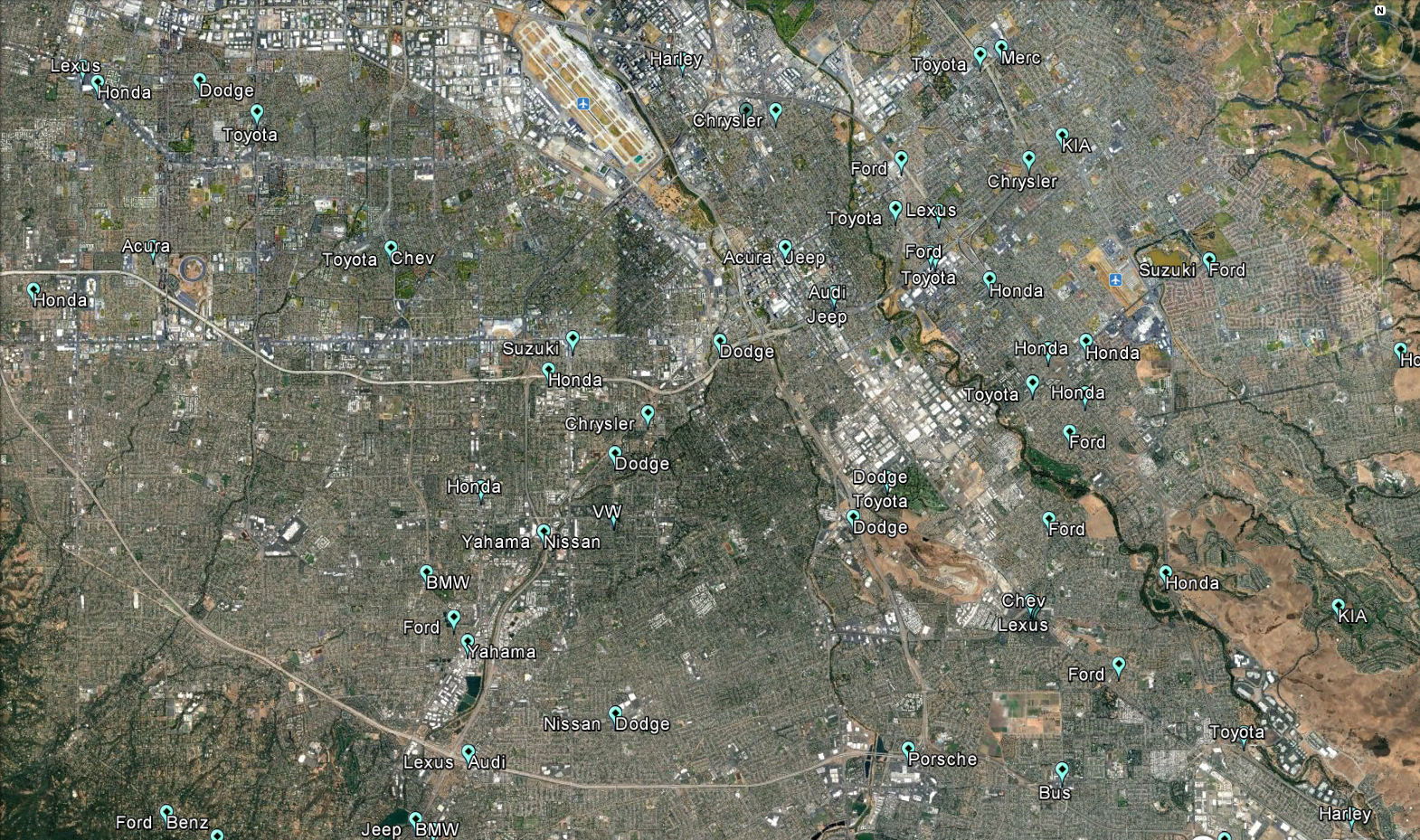
I find it interesting in several ways. First, I notice the makes seem to cluster a bit. The expensive makes tend to locate around Los Gatos, an expensive area, so not too surprising, but overall luxury brands seem to be underrepresented based on my experience seeing what’s on the road. In other words, they seem to be involved in fewer fatal crashes than expected based on numbers on the road. This may be because they are safer vehicles, because the owners drive more safely, or even because they are stolen less often than other makes.
Second, Fords and Hondas cluster around the east side of the valley, Dodges and Jeeps in the central area near downtown. This may be coincidence or perhaps it has to do with dealerships. Most notable, though, to me is the high number in East San Jose on city streets, not freeways. This coincides with crime reports. That area tends to have a lot of bars and violent incidents involving drinking or drugs, although I don’t have hard numbers on that. For those not familiar with the area, the hills to the west are the more expensive areas to live, the east side more working class, although homes get more expensive again up in the eastern hills.
I was also surprised at how many were solo crashes, especially in East San Jose. I suspect drunk driving was involved in a lot of those. You can see some data points with two car makes listed next to them, but they are hard to spot. I created a KML file and loaded it into Google Earth for this. It was an interesting technical exercise, and if you want to know how to do it, contact me using the contact link above. This file allows the user to zoom in on Google Earth and see the crash marker in more detail. Sometimes more vehicles pop out that way. See the image below; I circled a few examples. I only loaded car makes into the data file, but it is possible to include other data in the KML file as long as it can be represented in an Excel file. For example, it might be interested to show this data marked with time of day.
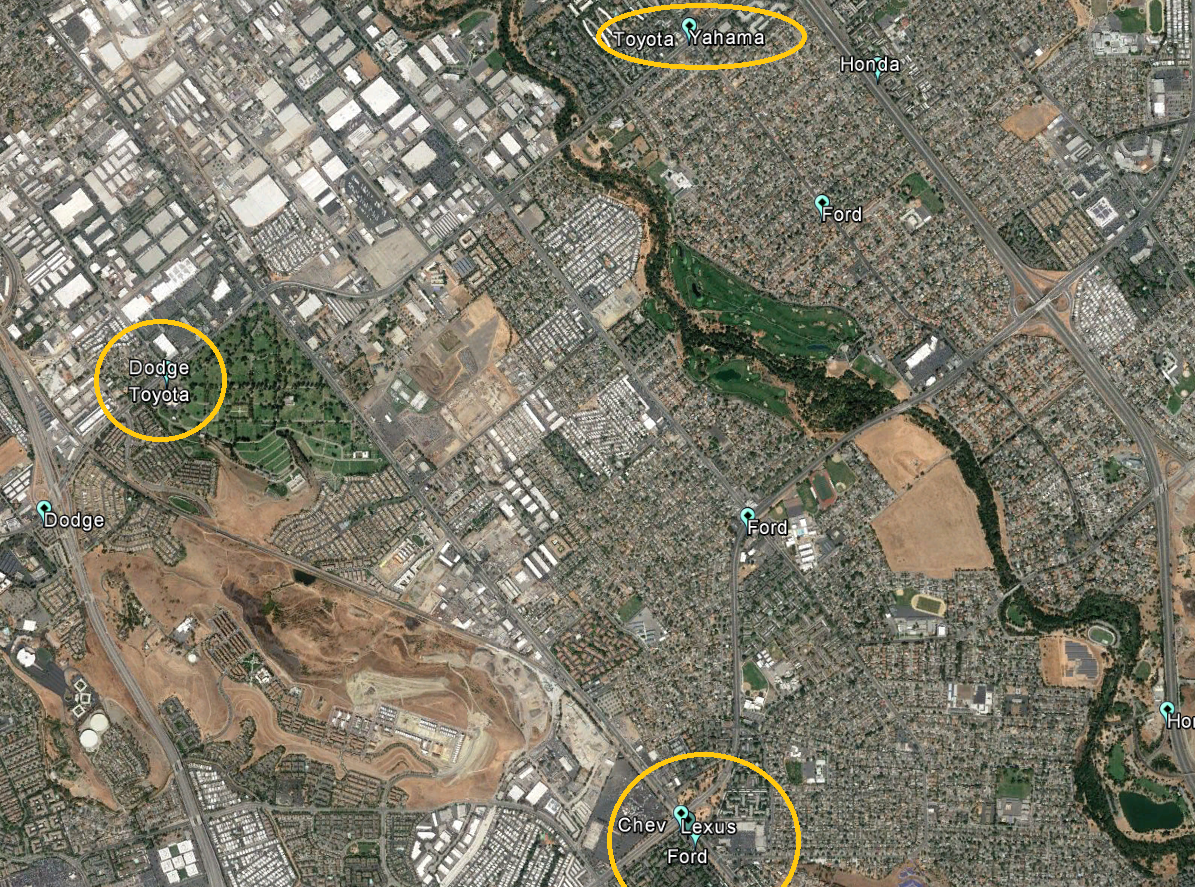
Bear in mind that just because a car was involved in a fatal accident, it doesn’t mean anyone in that car died. Sometimes the death was a pedestrian or bicyclist or in a multi-car crash only one car had a fatality. This map does not show cause or fault, either.
The post Fatal Accidents in Santa Clara Valley appeared first on OnWords.


January 11, 2018
The Gene: An Intimate History by Siddhartha_Mukherjee
 The Gene: An Intimate History by Siddhartha Mukherjee
My rating: 4 of 5 stars
This tome’s subtitle describes it better than its title. It is a history, not a book on genetics per se. The author describes how genetics emerged as a science with experimenters like Mendel and his pea plants and finishes up with the latest developments in gene splicing with the CRISPR tool. The writing is clear, easy-to-understand (at least for the relatively well-read with a biology class or two), and well-researched. There is quite a bit of repetition, so the reader can skip liberally, which is probably necessary for most people since it is a very long book. I think it was about halfway through the book before researchers even recognized the concept of a gene. If you are interested in the subject but want a deeper understanding of what’s happening today in gene research, I recommend Jennifer Doudna’s A Crack in Creation: Gene Editing and the Unthinkable Power to Control Evolution which is more up-to-date but also more technical.
This is not a medical book, nor is it in any way related to ancestry or genealogy. To be sure, it does mention many gene-related diseases and some progress (or setbacks) in the area of gene therapy, but that is a relatively small part of the book. It does not explain how genome companies like 23andMe or Ancestry.com determine your ethnic ancestry from your genes. It is, however a broad treatment of the history of genetics research and discovery and well-written. I take some issue with the author’s final conclusions. I believe he has inserted his own moral judgments rather liberally into what he calls the “scientific, philosophical, and moral lessons of this history.” For example, his lesson 9 says every genetic “illness” is a mismatch between an organism’s genome and its environment. In other words, every such illness is, or would be, actually of benefit in some other environment. I disagree. That may be true of some diseases such as sickle-cell disease, which is harmful, but the sickle-cell trait (conferred when only one parent provides the gene) provides some protection against malaria which is no doubt why it hasn’t been expunged through natural selection. But there are other genetic diseases that confer no benefit. The child is born with horrible mutations that lead rapidly to a painful death. Some diseases are simply genetic mistakes.
The post The Gene: An Intimate History by Siddhartha_Mukherjee appeared first on OnWords.
Jigsaw puzzle
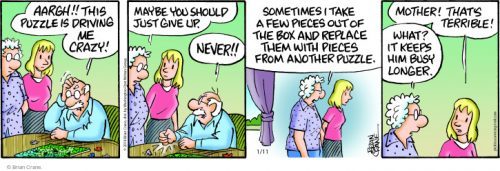
Santa brought us a 1000-piece jigsaw puzzle so now this is me:
The post Jigsaw puzzle appeared first on OnWords.
January 9, 2018
How to use “only” correctly
I often hear news reporters say something like “John Young was only one of three people who have visited the moon twice” or “she was only one of two people to have survived the plane crash.” What they mean is “John Young was one of only three people who have visited the moon twice” and “she was one of only two people to have survived the plane crash.”
The word “only” signifies that the number to follow is unexpectedly or unfortunately low or otherwise shows rarity. Of course John Young is only one person. How many people can one person be? It makes no sense to say he is only one in this context, since there are two others. The number in the first example that is low is three, i.e. the number of people who have visited the moon twice. In the second example it is the number two. Those are the numbers that should have the word only directly before them. This is one subtype of a more general rule that modifiers should come immediately before the word they modify.
The post How to use “only” correctly appeared first on OnWords.
January 3, 2018
The Sign of Four by Sir Arthur Conan Doyle
 The Sign of Four by Arthur Conan Doyle
My rating: 5 of 5 stars
This is what a mystery/detective novel should be. The story is riveting, the detecting is superb, there is an affecting love story as a subplot, and all this without gore, sadism, f-bombs, or other objectionable material. The extensive vocabulary for once treats the reader as an intelligent, educated human being. I do wish Holmes wasn’t portrayed as a cocaine user, but that ship has sailed long ago. I wish publishers today would take a lesson from this book, but I fear this kind of quality is long gone. The reader, David Timson, is excellent, doing all the voices in different, easily distinguishable accents.
The post The Sign of Four by Sir Arthur Conan Doyle appeared first on OnWords.
December 28, 2017
Google Ngram story
Every so often I used the predictive power of the Google Ngram Viewer to create a story from a seed phrase. I fed Ngram the italicized words in the story and the website predicts the next word based on the last three or four words. It gives the ten most frequent following words (if there are that many). Occasionally I had to use the second or third word instead of the first to avoid lengthy run-on sentences or loops, but other than the seed phrases, the story is google’s.
Who would have believed that the world was created by God. No one ever said that to me before I left for the United States. Nevertheless I couldn’t help but notice that the second and third centuries are the most common cause of death. Then, surprisingly, he was not a man to be a man of the world. On New Year’s Day in Pasadena and the San Gabriel Valley in the early days of their marriage he had been a member of the family. That region was not a part of the body of the text is not a substitute for the advice of an attorney.
The post Google Ngram story appeared first on OnWords.
December 27, 2017
December 23, 2017
Prostate Cancer – What Doctors Do Wrong – part 11
It is now a month after I had brachytherapy for my prostate cancer. I still have some unpleasant side effects, but they are much less intrusive than before. I also still have some unpleasant interaction with doctors. Read on.
A couple of weeks after the procedure I received a letter from my health insurance company that if I needed a long-term (90 day) prescription for Tamsulosin (generic Flomax) I needed to switch from the drug store I used for the first prescription to their mail order service or another local pharmacy that participates in their discount service. I could tell I would need a refill, so even though it was cheap at the pharmacy I used first (about $5.00 for a 1-month supply) I wanted to make it cheaper for the health plan as they had requested. I messaged Dr. A that I wanted to switch from the pharmacy he had sent the first Rx to and to send a 90-day one to Pharmacy #2. He replied quickly that he would. Three days later he still had not and I was down to my last five days worth. So I called my health plan’s drug service and explained and they said they would contact the doctor and get it renewed through them and they would send my refill by mail. Two days later I got an email from them saying the doctor had not responded. I was down to my last two pills and had decided I would have to get a refill at the original pharmacy. However, before I got around to that, that pharmacy called me and told me my prescription was ready. Dr. A had sent a 90-day refill there instead of to the one that participated in the discount program. Even though he had read my message, he apparently had not understood anything other than I wanted a refill. He totally disregarded which pharmacy I wanted it sent to, even though I included the name, address and phone number of that pharmacy in my written message. He also disregarded the request from the mail order people. Ironically, the new Rx cost the same amount ($5 a month) as before, and less than the mail order service provided, and it was for twice as much because the doctor had doubled the dosage. I didn’t need the double dosage, so now I have a six-month supply at what is effectively $2.50/mo but will probably only need another two or three weeks worth, based on my progress. What a waste; only drug companies benefit while your premiums and mine go higher. All because the doctor didn’t read my message carefully and didn’t do what he said he would. Doctors are clueless about insurance.
So a few days ago I was sitting at home and got a call from the office of Dr. K. The woman there asked if I could come in for my 1-month follow-up. She wanted to know if I could come right away. What the heck!? If I was supposed to have a 1-month follow-up, why didn’t they schedule that much earlier, at the same time they scheduled the procedure, for example? The patient is supposed to drop everything during the holidays and run right over if the doctor calls? She told me it would only take 15 minutes and if I couldn’t do it, I wouldn’t be able to get an appointment until mid-January (three weeks away). I had another doctor’s appointment (annual vision check) right after lunch, but fortunately I was free for the morning so I decided to get it over with. I took my book (foresight!) and went. I was quickly given a CT scan, which is standard procedure to verify the seed placement after the swelling has gone down, The attendant tried to put me in an examining room, but they were all full (which flummoxed her), so I sat in the waiting room reading waiting for the doctor. They obviously were really prepared for me, which makes we wonder why they called me in. Half an hour later I was getting visibly peeved and the receptionist noticed it. She apologized for the delay. I told her I had another appointment and wasn’t going to skip lunch to make it, so if the doctor didn’t see me in the next five minutes I was going to have to leave. Two minutes later Dr. K emerged and asked “who’s next?” The receptionist pointed to me. I sat down with him in an exam room and he asked about my post-operative side effects, etc. It was pretty standard stuff, no surprises for me and apparently not for him. But when I asked him the results of the CT scan he told me “they’ll be fine – they always are.” He obviously hadn’t looked at them yet. I then asked him to confirm what I’d remembered about the number of seeds and needles used in the procedure. He didn’t remember and left the room to get my file, which he obviously hadn’t even reviewed before seeing me. He came back and confirmed that my recollection was correct as to those numbers. I asked him what my prostate size was, something that is sometimes important in rates of recurrence or future treatment options if the PSA goes up again. He didn’t remember that either and flipped through some pages, but couldn’t find it. That was what I had come in for the first time I saw him, to measure my prostate, but now he can’t find it. He obviously had no recollection of me as a patient and was making almost no attempt to answer my questions.
For what it’s worth, my eye exam was done quickly and professionally and everything was fine there. I have a great ophthalmologist. She and the optometrist in her office are female and had to stand near me, but I’m safe for a pregnant woman or anyone else to be near now. I’m able to run again, although I need to stay near a bathroom. My Achilles tendon is manageable, although there’s still some tendinitis. I’m way out of shape from the long layoff from running, but I feel like my life is returning to normal now.
The post Prostate Cancer – What Doctors Do Wrong – part 11 appeared first on OnWords.
December 21, 2017
Proof! Women are better drivers than men
Here’s one to start some arguments around the dinner table. I have statistical proof that women are better drivers than men. I downloaded from the National Highway Traffic Safety Administration (NHTSA) Fatality Analysis Reporting System (FARS) all cases nationwide in 2016 in which there were multiple cars and multiple drivers and at least one male and one female driver and where one driver had a factor listed of “careless driving” and the other did not. Of the tens of thousands of fatal accidents recorded there were exactly 432 that met these criteria. Of these the male was listed as careless 241 times, the female 191 times. I rest my case.
Bear in mind this only shows what a law enforcement officer reported to NHTSA in fatality cases. It doesn’t include fender benders or single car fatality cases or cases where both drivers were found to be careless. Nor does it include skills like parallel parking or navigating or traffic violations.
In California there is a meme (racist?) that Asian drivers are the worst drivers. There is even a fictitious offense of DWA (driving while Asian) bandied about frequently. So I did the same thing for the race of the driver comparing only listings of white vs. Asian. The data produced only three cases. In all three the Asian driver was listed as careless, not the white driver. None were in California. This is too small a data set to be convincing. I suspect that many accident reports do not list the race of the drivers, especially if one is non-white. I would not be surprised if politically correct California has a policy of not putting race on their form, at least in many departments. The vast majority of California reports had no listing or unknown in the race field. The NHTSA coding form specifies several specific Asian “races” (e.g. Chinese, Japanese, Filipino, which are really nationalities) but also a general category of “Other Asian.” I suspect that of those departments that do report the race, they choose that rather than ask or guess at a driver’s Asian “race.” It was the single most frequent Asian race category that was reported in California. I can tell you that I spent a year as a volunteer judge pro tem doing traffic court in Palo Alto, California and there were probably as many ticketed Asian drivers as white drivers in that courtroom. I don’t think native born Americans of Asian descent are any worse than other Americans but so many of the recent immigrants, especially adult women, have had so little experience driving in their native country that I think there is truth to the meme.
The post Proof! Women are better drivers than men appeared first on OnWords.
December 19, 2017
Car ownership (Domestic vs. Foreign)
Consider the following chart showing the relative ownership of domestic makes of cars to foreign makes by state.
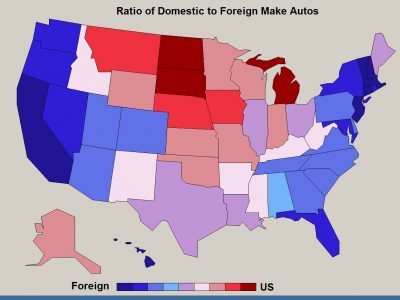
The data is taken from the NHTSA fatal accident data base for 2016. It is not surprising that Michigan and other states with or near U.S. make factories have higher ratios of domestic makes than the coasts. I was surprised the difference was as great as it is, however. North Dakota (the highest ratio) had more than five times as many domestic cars as foreign cars. Hawaii (the lowest) had only about 44% as many domestic makes as foreign. The medium blue of Washington and Oregon indicates about equal numbers of domestic and foreign makes; anything to the right on the color line indicates more U.S. makes.
I used fatal crash data mainly because it was readily available, but I also think it is a reliable indicator of ownership in general. The chart does not represent new car sales but what is on the road now. Since newer cars are safer in general than older cars, the data is probably skewed somewhat toward older cars. I don’t think there is a significant difference in safety between the two groups as a whole, certainly not enough to make the map look much different. The data is based on the state where the accident took place, not the state of registration.
The post Car ownership (Domestic vs. Foreign) appeared first on OnWords.