Russell Atkinson's Blog, page 58
March 23, 2019
Red Notice by Bill Browder
 Red Notice: A True Story of High Finance, Murder, and One Man’s Fight for Justice by Bill Browder
My rating: 4 of 5 stars
This true life thriller hit number one on the New York Times best seller list. It provides a well-written narrative of the story of how the author, Bill Browder, made millions investing in Russian stocks under the Yeltsin regime and when Putin and his thugs took over, managed to pull his investments out just in time before the assets were all stolen by the oligarchs. But the real story is what happened afterward. I don’t want to give spoilers but let’s just say what is revealed from the cover: it’s a tale of murder and one man’s fight for justice.
I knew nothing about this case before reading the book. The closest I’d come was hearing that Donald Trump, Jr. met with a Russian lawyer to get dirt on Hillary Clinton and the cover story had something to do with adopting Russian children and the Magnitsky Act, whatever that was. The 2016 election is not part of this book as all the significant events took place before that, but it is quite political toward the end and drags at times because of that. The first half could be a bit tighter, too, but all in all it was a very interesting and engaging read. It may change your views toward Russia and some Western European countries.
The post Red Notice by Bill Browder appeared first on OnWords.


March 21, 2019
New cryptography site
I post here on cryptographic topics from time to time. I also hosted a Google+ “community” called Recreational Cryptography. Google is terminating Google+ at the end of the month, so I have recreated that same community on this platform here: http://cryp.ackgame.com/greetings/.
The new site is open to everybody. Click the link to see more.
The post New cryptography site appeared first on OnWords.
The news in What3Words
From time to time I’ve used What3Words to gain insight into the news. See my previous post here, for example. It’s time to take another look. You’ll need to zoom out to get a better idea on most of these.
The recent college.exam.scandal took place here in northern California among other places. You wouldn’t expect a soap.opera.star like Lori Loughlin to live just outside Akron, Ohio, but the scandal is nationwide. As you probably know, a Texas tennis coach.took.money to “recruit” a student who didn’t play. He was quite.promptly.fired and exiled to Siberia. Lori’s daughter Olivia Jade, a young.video.star on YouTube should have been in Chicago, but instead was aboard the USC President’s yacht.sailing.throughout the seven seas when the scandal broke on how she got in to that “auspicious” institution.
The post The news in What3Words appeared first on OnWords.
March 18, 2019
The Moonstone by Wilkie Collins
 The Moonstone by Wilkie Collins
My rating: 5 of 5 stars
This Victorian classic is generally credited as being the first detective novel. The Moonstone is a large diamond of religious significance to certain Indians. Legend has it that a curse follows the gem. The story begins with a tale of the diamond having been wrested from India by a British military man. Eventually it is given to a lovely young Rachel Verinder as a birthday present. It goes missing that same night. Lurking about outside are some suspicious itinerant Indian jugglers. The occupants of the house include partygoers and family among the gentry and various servants, including one with a criminal background. The police are called and Sergeant Cuff, a renowned detective, is on the case. The book is a long one and many mysteries requiring solving: who took the gem and where is it now, who will win (or lose) Rachel’s affection, what about the paint smear? All of these and more are eventually solved. I did not guess the final solution to the main one of the diamond. The plot is well crafted and it is a fair mystery.
The cast of characters is large and the story is narrated by several of them in turns. I listened to it as an audiobook from Naxos. There are several versions now since the book is in the public domain; I can recommend this one. It is a long book, 17 disks, which is all the better if you are looking for something to keep you interested for a long drive or set of commutes. You may be taken aback by the blatant male chauvinism and class prejudice, but it merely reflects the views of its day. If you enjoy Downton Abbey or Upstairs, Downstairs, this won’t bother you. If you don’t, then you might want to rethink this choice, but I can tell you I’m no fan of Downton and still enjoyed this classic mystery.
The post The Moonstone by Wilkie Collins appeared first on OnWords.
March 13, 2019
College admission cheating scandal
I read the FBI affidavit in the Boston part of the case and can correct some bad reporting out there. Most of the students did not know their parents were cheating for them. One poor slob did so much better on the SAT the second time (with the bribed proctor) he thought he’d gotten smarter and wanted to take it again. How must he feel now that he knows he is as dumb as he thought? Many of the kids did know. Some were coached on answers during the exam. One didn’t even show up for the exam. Another showed up for only one day of the 2-day exam.
Some, maybe most, of the coaches did not take the bribes for their own personal enrichment. They had the checks made out to the school account for their athletic program. The money was then used for scholarships, equipment, expenses, etc. of the program. I’m not justifying it, but it’s not a whole lot different from a rich alumni donating a building and getting his child in that way, the so-called “legacy” students. In both cases, a deserving student is denied admission because of the clunker, but the school benefits in a way. I was surprised at how often the child ended up not attending, or not even applying to the college that was bribed. In one case the parent got Singer (the ringleader) to consider the half a million bucks a deposit on a future child.
Most of the publicity is about the two actresses, the celebrity effect, but the vast majority of the cheating parents weren’t famous. Many were real estate developers (sound familiar?) or entrepreneurs. Quite a few were here in the Bay Area: Palo Alto, Atherton, San Francisco.
The post College admission cheating scandal appeared first on OnWords.
March 12, 2019
Ruminations on earbuds and college admission cheating
I haven’t posted anything for a while, so I decided to share a random thought or two. I have a smart phone now, although it still seems like a foreign object to me. I don’t have earbuds. I tried earbuds back when the Sony Walkman and similar devices arose, but they were supremely uncomfortable, wouldn’t stay in my ears, and the sound quality was too poor for music, although adequate for audiobooks. So I am always mystified and a bit disappointed when I see people walking around or sitting in various places listening to something on their phones or iPods using earbuds instead of interacting with the world around them. However, I recently realized that earbuds are truly a boon to society. I’m now a big fan of earbuds. Why? Because they spelled the end of boom boxes. Yay!
I just watched the evening news where the top story was about the college entrance cheating scandal. It’s reprehensible what these people did, of course, but I can tell you what they’re defense is going to be: “We love our children and wanted the best for them. Is that so bad?” They will of course not mention anything about the children who earned a spot in those elite schools legitimately but were denied admission because of the scheme. The relative placement of these two subjects is not representative of their importance.
The post Ruminations on earbuds and college admission cheating appeared first on OnWords.
March 4, 2019
The Stranger in My Genes by Bill Griffeth
 The Stranger in My Genes: A Memoir by Bill Griffeth
My rating: 4 of 5 stars
The author was talked into getting a DNA test by his cousin as they were both genealogy buffs looking to explore family history. The results came back showing his father, the man who raised him, was not his biological father, or so it seemed. His first reaction was denial. Then as he studied more about inheritance and DNA he understood that it might be true and there could be several explanations for it. I know of at least three.
I enjoyed this book for several reasons. The least important one is that the author has the same name as my favorite uncle. I’m also a genealogy buff and have had my DNA done, with a surprise in store for me there. The author takes a long time getting to the meat of the story, but the book is generally well-written. The aspect that I found most compelling, if somewhat difficult for me to grasp, is how emotionally he took this revelation. It consumed him for years and tore him apart. Whom should he tell? Was it a lab error? Should he ask his 95-year-old mother about it? It seemed to me that it should not have been so surprising. If you don’t want to know that kind of information, don’t take a DNA test. There are multiple bold face warnings about this kind of thing on the testing company websites and instructions.
The other aspect that truly surprised me was how little he and his other relatives understood about DNA. The father gives a boy his Y Chromosome. Why is that so hard to understand? The author’s oversimplification of much of the DNA science was a disservice, too. This is really junior high science class stuff, but apparently it baffles and frightens a lot of people. The book gave me a sense of how deeply some people feel about their identity, or at least what they think of as their identity.
I have one warning. I listened to the audiobook that was produced by Silicon Valley Reads. It was an odd, rather amateurish production and the reader, while not bad, exactly, had an odd cadence that I found disconcerting, almost like he was reading to very small children. I suggest reading this one.
The post The Stranger in My Genes by Bill Griffeth appeared first on OnWords.
February 23, 2019
Death of the Written Word
The written word is dying. I don’t know when it will die, but the day is rapidly growing closer. As a writer I decry this fact often in this blog, but as a scientist (at heart, if not by training) I recognize it as inevitable and not an inherently bad thing.
First, let’s examine the evidence for it. Go online anywhere, e.g. Facebook, Nextdoor, etc., and see how people write. In a word: badly. In two words: very badly. In third world countries where illiteracy has always been high, even poor people have cell phones. They can communicate with others without ever having to learn to read or write. They’ve skipped the written stage and are none the worse for it. Technological advances like Siri, Alexa, and Google Assistant have become very popular and very good. It is now possible for me to talk to my phone and get a good answer or action. Now that I have arthritis in my hands, I should probably use it more, but I am so used to being on my keyboard, I haven’t really gotten on board with that. People in the first world are more and more likely to communicate by posting photos or videos. People read fewer books than ever before, at least printed books. Audiobooks are increasingly popular and, of course, video media such as broadcast television, discs, and streaming are the standard form of entertainment now. Newspapers are dying.
It’s easy to blame technology for this, and indeed it is the main driver of the trend. But the word blame carries a negative judgment that I think is undeserved. Take a look at human history. Man in his modern form, homo sapiens, evolved around 100,000 years ago. Although it is hotly disputed when spoken language evolved, or even what constitutes language among primates, most scholars seem to think it reasonable to say that by the time homo sapiens arrived on the scene, so did spoken language. So we’ve been talking for 100,000 years. We evolved with the ability to speak and understand others’ speech, and those abilities evolved with us. On the other hand, written language first appeared about 5,000 years ago. In other words, for 95% of human existence, especially the time period when man evolved into a modern “civilized” creature, he only needed to be able to speak and understand speech. Even before that, man’s predecessors had learned to make and understand sounds to communicate various things such as warnings of predators, or even joy. The written word was a great invention that allowed for permanence and consistency, but wasn’t used by most humans until very recently. The prevalence of dyslexia and the well-established fact that many or most students learn better from oral instruction than from reading are evidence that man really hasn’t evolved as a reading being, but as a speaking being.
Now that technology is making it possible, I believe the written word will fade into antiquity much like the abacus, slide rule, and chiseling on stone tablets. It will always exist in some form, of course, but will be a subject for historians and archaeologists the way Latin and cuneiform are today. Perhaps I shouldn’t be so picky about bad spelling and grammar. I believe written language is unnatural from an evolutionary standpoint, but bad grammar in spoken language is still bad. It leads to misunderstanding and to being relegated to a lower class. Learning to write well, and to be able to read difficult material, is still important to be able to lead a full and rewarding life.
The post Death of the Written Word appeared first on OnWords.
February 16, 2019
February 13, 2019
Supreme Court geography
Our country’s checks and balances are based primarily on the independence of the three branches of government: executive (President), legislative (Congress) and judicial (Supreme Court). The separation of federal and state government is another way, but that’s not my focus. I got to wondering how representative the U.S. Supreme Court is of the country as a whole. The responsibility of interpreting the U.S. Constitution and statues involves value judgments: how much process is “due”; what legislation is “appropriate?” These and many other words in the Constitution are very subjective.
Of course the judicial branch is not supposed to be subject to the vagaries and political pressures of the election process, but it is still arguable that the entire country’s legal system ought not to be ruled by an elite few with a restricted, insular view of such values. Therefore I researched where every Supreme Court justice grew up and where they received their legal education. I limited my review to those who served within the last 100 years, after the “lower 48” were all states. Consider these maps:

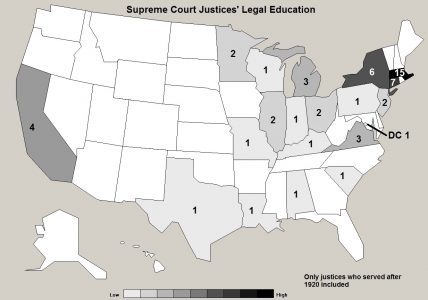
The numbers show how many justices grew up or were educated in those states. There were a total of 56 researched. Some justices moved throughout their youth, but I did my best to identify the state for which they would considered a “native son” or “native daughter,” usually where they lived during middle and high school years which I consider formative. The second map generally shows where they attended law school, but many justices in the earliest part of the range never graduated from law school and may not ever have attended law school. “Reading the law” with a law firm or judge and then taking the bar was a common method of obtaining a legal education up until the 1960s or so. The maps do not necessarily reflect where the justices practiced law, which did include some states not shown as represented (such as Wyoming).
The northeast is heavily represented, some may say over-represented, especially in the second map. Almost all of the those educated in Massachusetts, Connecticut, New York, or New Jersey were from Ivy League law schools (Harvard, Yale, Columbia, and Princeton respectively). The Midwest gets some fairly decent representation at least on the top map, but the Deep South and West seem to be short-changed. Some very populous states, such as Florida and North Carolina, have not had a justice appointed in the last 100 years, and Texas has had only one. This trend toward the Ivy League has gotten stronger in recent years, which seems surprising considering the push for diversity in other parts of government. The last justice to serve who didn’t attend an Ivy League law school was Sandra Day O’Connor (appointed in 1981). Kentucky surprised me, but it was probably an important swing state between the north and south in the early 20th century and I suspect politics played a part in those appointments. The most recent Kentuckyan to serve was Chief Justice Fred Vinson (1937 – 1943). Many of the justices were politicians before their appointments and quite a few came from very modest circumstances, although most were from relatively prosperous, well-educated families.
The post Supreme Court geography appeared first on OnWords.