Russell Atkinson's Blog, page 60
January 13, 2019
Candy Man again
I just noticed that my prior post with a link to my very first YouTube video is not working, so I’m reposting the YouTube link. The song is Candy Man.
The post Candy Man again appeared first on OnWords.


The Curious Incident of the Dog in the Night-Time by Mark Haddon
 The Curious Incident of the Dog in the Night-Time by Mark Haddon
My rating: 3 of 5 stars
It’s difficult to put a star rating on this one. It’s written in the first person through the eyes of a severely autistic English boy (Christopher) who is also a math whiz. Or maths as they say over there. As such, the language is stilted and simplistic. The “plot,” which Christopher considers to be a mystery, is nothing more than a recounting of his experiences involving a neighbor’s dog who was killed and his own broken home.
I have a severely autistic nephew and I’m very sympathetic to the author’s attempt at bringing understanding to the public of how autistic children think and feel. However, I can’t say I liked the book. I feel almost guilty that I don’t like it better, but the language was boring and, frankly, not very realistic in my experience. I understand the author has extensive experience with autistic children, so perhaps he knows some who speak and act like Christopher, but my nephew is less gifted and more normal. He is a great bowler, though. He once bowled a 300 game. I didn’t hate the book, but I did find myself skipping over a lot of it, especially the digressions where Christopher explains ordinary things. I understand better now how women feel about mansplaining.
The post The Curious Incident of the Dog in the Night-Time by Mark Haddon appeared first on OnWords.
January 12, 2019
“Dark side of the moon”? NOT!
Now that the Chinese have put a lander (the Chang’e-4) on the far side of the moon, news announcers all over America have been saying it landed on the dark side of the moon. Wrong! The far side gets just as much sunlight as the near side. When the moon is full the far side is dark but when it’s a new moon, the far side is in full sunlight. Is it any wonder American kids are so bad at science when authority figures put out bad science?
The post “Dark side of the moon”? NOT! appeared first on OnWords.
January 2, 2019
Semiosis by Sue Burke
Semiosis is a science fiction book about the colonization of a distant planet by humans – pilgrims of a sort. I gave up on it after about 60 or 70 pages, so I’m not posting an actual review or a star rating. I didn’t give it enough of a chance to judge its real merit, but I thought it would be useful to some readers to know that it starts slow and drags from there. It is rather depressing at the beginning, too, but there’s reason to see hope based on reviews and promotional blurbs. If you’re into world-building sci-fi, you may like it.
The post Semiosis by Sue Burke appeared first on OnWords.
January 1, 2019
Welcome 2019
I haven’t had much to blog about the last few days but I felt I should at least welcome 2019 in with a post. I wish all my readers a happy 2019. For Christmas I got myself a new laptop and some UnderArmour running pants. My kids gave me a combination crossword-jigsaw puzzle. and a book on breaking codes with Python. I’ve already solved the crossword part and now I’m using the finished crossword as a guide to complete the jigsaw. That’s it for now. Stay safe.
The post Welcome 2019 appeared first on OnWords.
December 25, 2018
Command Authority by Tom Clancy
 Command Authority by Tom Clancy
My rating: 3 of 5 stars
I’d call this vintage Tom Clancy except it’s very current, not vintage. It is, however, true to form: lots of combat at all levels – hand-to-hand, small arms, and military force. The story involves the doings of both Russian and western spy agencies in Ukraine during the period of Russia’s takeover of the Crimea, threatening to move on Kiev. That story line stars Jack Ryan, Jr., son of President Jack Ryan. At the same time there is a back story starring Jack Sr. when he was a CIA analyst. The chapters switch back and forth in time. Major players are the Russian FSB and a fictional(?) organized crime syndicate called the Seven Strong Men as well as the CIA and British IO’s. The combat scenes are detailed and very credible as Clancy shows his encyclopedic knowledge of armaments and tactics. The political side is also more sophisticated and at least a bit more nuanced than some of his early books. Like those, this one is too long, but sometimes that can be good, especially if you’re listening on a long drive. Clancy’s writing style has improved, too, or perhaps he’s gotten better editors. I can give it a solid three and a half stars.
I listened to the audiobook (14 disks). It was narrated by Lou Diamond Phillips (Henry from the Longmire series), who did an excellent job.
The post Command Authority by Tom Clancy appeared first on OnWords.
December 21, 2018
I See You by Clare Mackintosh
 I See You by Clare Mackintosh
My rating: 3 of 5 stars
A woman sees her own photo in an advertisement in the personals section of the newspaper along with a phone number. It’s a non-working number. She is disturbed because it would appear to others that she is a prostitute. It turns out there are more women to whom this happens. Then we learn that some are victims of rape or murder. The police are slow to accept this as a serial crime and there is rivalry between the meek transit policewoman and the tough homicide cop running the main investigation. I can’t give this a strong recommendation as the ending was too predictable and the evil character running the mysterious “Find the One” website was overdone. The dynamics between the officers seems very artificial, too. Up until the end, though, it was engaging enough and kept me interested, so I can give it three stars. I listened to the audiobook and the reader was good.
The post I See You by Clare Mackintosh appeared first on OnWords.
December 20, 2018
Kinship and Distance

The above chart shows the relationship between my relatives and their physical distance from me. If you read my preceding post you’ll see that 23andMe provides a map showing the location of one’s DNA relatives (for those who have shared that information). That made me wonder how far (or close) people people generally move or settle in relation to their family.
I’ve lived in several cities around the country including Seattle and New York, and even Tokyo, Japan for my senior year abroad, but I ended up settling for my adult life about eight miles from where I grew up in the San Jose area. In the above chart, degree 1 includes my closest relatives, i.e. those people who share 50% of my DNA, which is my children, siblings, and parents. Degree 2 is those with 25%, such as grandparents, aunts, uncles, nieces, nephews. Using my own genealogical information and family knowledge, along with a few Google searches, I was able to go out as far as some second cousins (Degree 5). The 6th level shown is taken from that 23andMe map. I used all the 3rd cousins I could find on that map, and no doubt that relationship is only estimated based on shared DNA, not actual generational kinship. Most of those shown on the map were 4th cousins or higher.
The vertical axis is logarithmic, so the actual increase in distance as the kinship increases is much greater than it appears. The trend line shown is exponential, which ironically looks straight because the Y-axis is already logarithmic. In my case, then, it seems clear that generally the more distant the kinship (i.e. “blood” relationship) the farther my relatives are from me. I suspect that is true generally, but I’d be interested in seeing demographic trends for the U.S. and world populations. I’d guess that in the less developed countries, families stay closer together for more generations. I found dozens of charts and articles online, but none that answer this question directly. Of course, such demographic trends change, and can do so rapidly. A number of recent articles mention how more millenials are living with their parents, reversing the trends of recent years. Whatever the trends, it’s fun to see how widespread my family is, even if I don’t know many of them.
The post Kinship and Distance appeared first on OnWords.
December 19, 2018
DNA Relatives Map
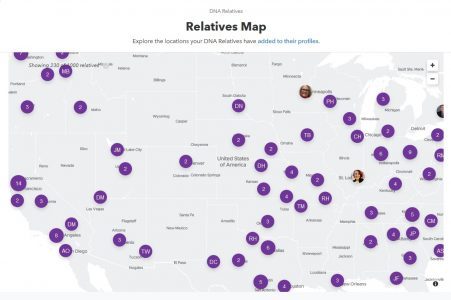
I had my DNA sequenced by 23andMe. There are earlier posts about the rather interesting findings, so feel free to search the blog for those. The search box is to the upper right. They now have a cool new feature: a map showing the current location of all of a customer’s DNA relatives who have agreed to share that data. The map below shows a screenshot of mine. A customer can zoom in closer and see the initials or profile pictures of those relatives and for some of them, even their full name if that’s shared. When zoomed out like this it shows circles with the number in that area, but one can get the individual data for those just by clicking there or zooming in there. I only have one listed in Europe – a woman in London (if that’s still considered Europe) – although there are others there who probably aren’t sharing that information. There’s one in Alaska, one in Hawaii, one in Canada, and several in the U.S. cut off at the edges. None of the ones I checked out were any closer than 4th cousin, though. There are two or three living within twenty miles of me. Maybe I’ll find an excuse to contact them someday. Here’s the map.
The post DNA Relatives Map appeared first on OnWords.
December 14, 2018
Superhuman by Rowan Hooper
 Superhuman: Life at the Extremes of Mental and Physical Ability by Rowan Hooper
My rating: 3 of 5 stars
Hooper examines people who exhibit extraordinary abilities in several categories, including intelligence, longevity, bravery, and many other dimensions. I found the treatment to be superficial, mostly anecdotes about some unusual individuals and what they attribute their own abilities to. He delves into the science, but it seems the science doesn’t really answer the main question that is the theme of the book: what makes these people so “superhuman?” For some of the dimensions, there is a clear genetic explanation at least to an extent. Intelligence and musical ability fall into that category, although genetics are only part of the explanation. The author never really resolves anything. The book has the feel of an assignment from his agent or publisher. I can’t live on my royalties from my last one, so what should I write about next? I know, “superhumans” sounds cool.
Once I realized that this isn’t a school assignment and I don’t have to read all of it, I began skipping around and reading about just the extreme abilities that interested me. He has them neatly organized into chapters. I began enjoying the book much more after that. It was like reading a few articles from a magazine. There are some interesting tidbits among the filler.
The post Superhuman by Rowan Hooper appeared first on OnWords.