Russell Atkinson's Blog, page 62
November 7, 2018
Redistricting explained (and illustrated)
In talking with friends, I’ve found there is some confusion over why redistricting is important, First of all, what is redistricting? It’s when a state government divides up the state into voting districts for election purposes, such as for Congressperson or state assembly. It could also be the same action by a city or county government for local seats like councilman. The U,S. Constitution as interpreted by the courts requires that each person’s vote be of equal value, sometimes called the “one man, one vote” rule. In practical terms this means that districts must be drawn to have roughly equal number of voters in each. This can be done fairly or unfairly. It is usually done by a committee appointed by a governor and thus dominated by the governor’s party, although methods vary in different states. Redistricting committees usually end up trying to protect their party’s power, or at least protect specific incumbents.The Constitution requires a census every ten years followed by redistricting to ensure that Congress reflects the current population distribution.
Here are three examples to illustrate why it’s important. Assume the state in the drawing has five congressional seats and two parties we’ll call orange and green represented by the 20 icons. The voters are 60% green (12 icons) and 40% orange (8 icons) distributed as shown.
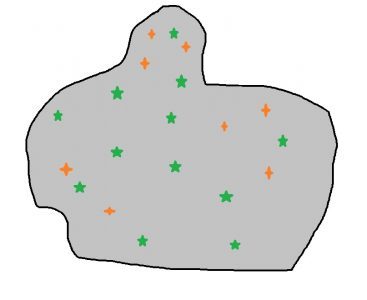
One would expect that two of the five seats (40%) would go to the orange party and three (60%) to the green if lines were drawn in a neutral, unbiased manner. Courts, by the way, have also ruled that lines must be drawn logically from a geographic viewpoint, too. The next image illustrates what would probably be considered fair.
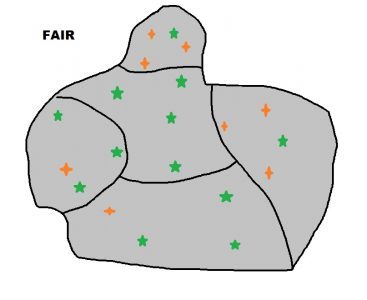
Based on where majorities are located, orange would get two seats and green three, and the districts appear to be logical geographically, too. However, if green is in control of redistricting it might try to draw the lines as follows:
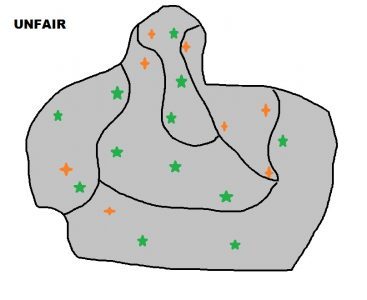
See how that almost certainly gives Green four of the five seats since they have a 3-to-1 voter ratio in four. Notice also that the districts have odd shapes. This is where the term gerrymandering comes from – districts drawn this way are said to resemble salamanders. Courts often strike these down and have been known to appoint their own committees or special masters to redraw the lines more fairly.
Now consider the following district lines.
There are two safe districts for Green in the middle, but the other three districts are split 50-50. They could go either way. The district lines appear to be rational from a geographic standpoint. A court would probably consider this fair even though it might result in Green representatives in all five districts or three being Orange. However, suppose the two purplish districts are currently represented by popular Orange incumbents who consider their seats safe. The Orange party, if they’re lucky enough to be in control, might like this one better than the first (fair) one above, assuming the incumbents aren’t worried about the 50-50 split in their districts. This way they have a 50-50 chance at picking up a third Orange seat. In real life it is quite possible, and has often happened, that a minority party can retain, even guarantee, control in its state.
A friend recently seemed worried that redistricting could affect the U.S. Senate. No, it can’t. Why not? Because there are no U.S. Senate districts. The entire state is the one and only district for any Senate race. There are simply no lines to draw. You can’t redraw state boundaries. Every voter in the state can vote on every U.S. Senate race in their state. State senates, however, like state assemblies or legislatures, have districts, so they are subject to being gerrymandered.
The post Redistricting explained (and illustrated) appeared first on OnWords.


October 29, 2018
Beneath a Scarlet Sky by Mark Sullivan
 Beneath a Scarlet Sky by Mark T. Sullivan
My rating: 4 of 5 stars
This adventure/war story centers on Pino Lella, a real live character who lived in northern Italy during World War II. When Italy was defeated by the Americans, the German Nazis took control of the north and subjugated the Italians much as they subjugated the countries that had fought against them. If the book is to be believed, Lella helped Jews and other escape through the Alps to Switzerland under the guidance of a priest who ran a boy’s school. Then Lella returned to his family home where they insisted he join the Organization Todt, a work force of locals that served the Nazis. To avoid spoilers, I won’t describe more except to say many exciting adventures and dangerous events occur in the book.
The book is listed as a novel, yet all the characters are real historical figures. The events seem so sensationalized that it is difficult to believe they all happened as described, but I did not find that troubling. It was a good thriller, true or not. I felt it was too long and there were plenty of places to cut, but the story flowed smoothly. If you don’t like reading about nasty people doing atrocious things, this is one book to avoid, but the overall story arc was not overly dark. It is a war story, after all.
The post Beneath a Scarlet Sky by Mark Sullivan appeared first on OnWords.
October 27, 2018
Anagrams on the News – Cesar Sayoc
Cesar Sayoc, one white supremacist = O, nice! he’s a screwy Trump associate
Maybe not so screwy, just your average Trump supporter.
The post Anagrams on the News – Cesar Sayoc appeared first on OnWords.
October 24, 2018
Presidio by Randy Kennedy and Suicide Club by Rachel Heng
I haven’t posted anything in a while, so I felt I should put something up here for my multitude of readers. I try to post reviews of all the books I read, but sometimes I don’t read them. That is, I don’t read enough of them to post a fair review. That’s the case with the two in the title today. I just couldn’t get into the premise enough to keep reading after a chapter or two.
Presidio by Randy Kennedy centers around a ne-er-do-well easy-goin’ chap who doesn’t like owning things so he just goes around stealin’. Some may find him charming but I didn’t.
Suicide Club by Rachel Heng portrays a future New York City where the privileged classes enjoy lives as long as three hundred years as long as they eschew almost everything pleasurable (like facial expressions and food) and have frequent upgrades of skin and other tissues. Another cup of tea that wasn’t mine.
The post Presidio by Randy Kennedy and Suicide Club by Rachel Heng appeared first on OnWords.
October 9, 2018
Warning Light by David Ricciardi
 Warning Light by David Ricciardi
My rating: 2 of 5 stars
The best that can be said about this comic book without pictures is that it’s not offensive (other than a bit of torture). At least there’s no swearing or pornographic sex scenes. The story line is trite and hackneyed and the writing is easily understood by the average sixth grader. The hero is a CIA analyst who, without any prior training as a field agent, is sent to Iran on an intelligence mission. Where have we heard that before? (Clancy’s novels, The Condor series, and many more). He gets captured and easily overpowers numerous armed soldiers and various guards, escapes from multiple confinements, and encounters various women, all of whom are drop-dead gorgeous. I won’t say more so as not to give spoilers, but, really, why not just give him a cape and a Fortress of Solitude.
One bugaboo of mine that appeared here was the portrayal of the bad guys, in this case the Iranian military. The superior officer tells the lieutenant that if he fails in his mission to find the fugitive, the prepared grave will be used for him. Right. An army really has great recruiting success when they execute any soldier who fails in an assignment. I’ve seen that so many times with schlock fiction and TV shows, usually with gangs, mafia, etc. where the leaders are so evil they even kill their own members and loyalists for the smallest failure. The ending is absolutely ridiculous and apparently is a setup for more in a series.
The post Warning Light by David Ricciardi appeared first on OnWords.
October 8, 2018
Fueled by high winds
The local moronic news team ran a banner under the announcer talking about a brush fire in Suisun as “fueled by high winds.” Wrong again. It may be fanned by winds but wind is not a fuel. The banner also misspelled Suisun as Suisin. C’mon guys, you can do better.
The post Fueled by high winds appeared first on OnWords.
October 7, 2018
Believe Me by J.P. Delaney
 Believe Me by J.P. Delaney
My rating: 1 of 5 stars
If you’re into BDSM (that’s bondage, discipline, sadism, masochism for the uninitiated) you’ll like it. I’m not, so I didn’t.
The post Believe Me by J.P. Delaney appeared first on OnWords.
October 5, 2018
Rainbirds by Clarissa Goenawan
 Rainbirds by Clarissa Goenawan
My rating: 3 of 5 stars
Since I review a lot of mysteries, I should begin by saying that although there is a murder here, and it does get solved, the book is not really the sort of murder mystery that appeals to mystery fans. It’s really more of a psychological drama mixed with a bit of a romance novel. The main character, Ren Ishida, a recent Keio University graduate, decamps to a small town to investigate the murder of his beloved older sister. Ren is young and handsome, and apparently quite the roue. He takes a temporary job teaching English at a cram school, the same school where his sister had been working. He soon gets to know the people in his sister’s life, and gets to know himself a lot better, too.
The most interesting aspect of this book to me was the portrayal of Japanese life. I don’t know how accurate it is now, but it does not at all comport with the Japan I knew in the 1960s when I was an exchange student there. If accurate, it depicts a much more westernized country at least in the aspect of dating and sex than I knew back then. When I was there most university students still met their spouses through their parents and relatives, and premarital sex was almost unknown, at least among the upper class. If a boy asked a girl out, usually after a year or two working up the courage, it was almost tantamount to a marriage proposal. The characters in this book are as randy and casual about sex as American millenials.
The book is well-written, although stylistically it may sound a bit stilted to American ears. But that’s because it adheres to the semi-formal and somewhat dated manner of English speech that I know from my Japanese days, so it is authentic. In the end, I felt that the plot didn’t really lead anywhere very satisfying, but overall it was interesting enough to garner three stars.
The post Rainbirds by Clarissa Goenawan appeared first on OnWords.
October 2, 2018
Why your running app is lying to you
Runners, hikers, geocachers, cyclists and many others use smartphone apps or dedicated GPS units to measure how far they’ve gone and to calculate their pace. What they don’t realize is that the apps and units routinely underreport the distance traveled, that is, tell you that you traveled a shorter distance than you actually did. Sometimes they overreport it. For competitive runners and others, this can be a serious drawback because it becomes difficult to judge your true pace, which you need to know for proper race planning. Why is this happening?
To understand this, first we need to examine how these apps and GPS units work. They all rely on the Global Positioning System (GPS) network of satellites which in turn relies on the WGS84 datum. What is that? For a detailed description, click the link. For our purposes, the important thing to know is that the system assumes the earth is a perfect spheroid, that is, it’s smooth like an egg or a billiard ball. Smoother – perfectly smooth, in fact. Thus when you move from point A to point B, the algorithms at work in your app take the coordinates of those two points and measure the distance between them with the assumption you are moving over a smooth, level surface. It also assumes you moved in a straight line. Both of these assumptions are seldom true in real life.
If you don’t believe me, you can test this easily. Google Earth uses this same methodology and datum. Take the point in Yosemite Valley with these coordinates: . Paste these coordinates into Google Earth (GE): N37 43.700 W119 38.250. The elevation according to GE is 4143 feet. Now do the same with N37 43.830 W119 38.160. The elevation shows as 7129 feet. That point is atop El Capitan. Mark these with the stickpins from the top menu then measure the distance between them using the ruler tool. It shows a distance of about 900 feet. But the elevation (vertical) distance alone is almost 3000 feet. If you could fly from the first point to the second in a straight line, 900 feet is the distance your app would report to you. Clearly that’s too small and the reported pace would be too fast. Even though GE knows of the elevation difference, it doesn’t use that to compute distance between points. Your app is the same.
Consider the following cross-section where C is the mountaintop and A and B are the valley floor.
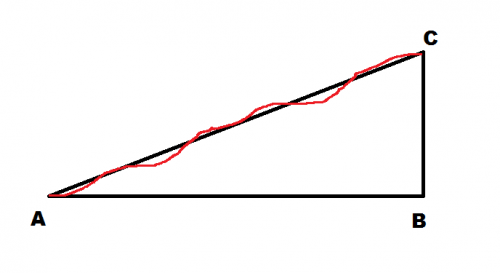
If you go from A to C the distance reported will be AB, not AC. But even AC would be wrong since you don’t travel the black line AC but that wiggly red line that goes up and down through the hills. All those elevation changes are not taken into account. The true distance would be more than AC but less than AB+BC.
Your app or unit can also overreport distances. Take, for example, a geocacher on a level trail in the forest. Elevation is not a factor. He stops at the location of the geocache which we’ll say is hanging in a tree, a particular, identifiable tree so he doesn’t move around much. He stands more or less in the same place for ten minutes trying to spot the cache in the leaves. The app or GPS unit, due to the tall trees and position of the satellites at that time, may have an accuracy of only 80 – 100 feet or so. As he stands there, the app thinks he moved 80 feet one way then 100 feet another direction every split second, or whatever its effective sampling rate is. It can report that he moved a quarter mile while he stood in the same place simply because it’s not that accurate. Most of these issues do not apply to road-based apps because the programmers have access to accurate traveling distance over known streets and highways and use that rather than pure GPS data. At least, I think that’s true. If you run or cycle on measured tracks, just use a stopwatch, not your app. You can compute the pace yourself since you know the distance.
The accuracy of the unit is affected by many things including the quality of the unit, the terrain, and the location of the satellites at the time. Phone apps are generally less accurate than dedicated GPS units. Even on a known level road, a GPS-based unit/app can cut off curves if it doesn’t get a reading all the way around the bend. On a straight line path it can record your route as veering off to one side and the other, like a drunken sailor (no offense to the sailors out there). That could result in overreporting. If you really want to know the exact distance of your regular run, bike, or hike, use better methods like a well-calibrated bicycle odometer or at least average the same exact route many times and compare your app or unit to known distances like the local high school track to adjust the readings.
The post Why your running app is lying to you appeared first on OnWords.
October 1, 2018
The Freeze-Frame Revolution by Peter Watts
 The Freeze-Frame Revolution by Peter Watts
My rating: 3 of 5 stars
Hard-core sci-fi fans will appreciate the imagination and credible-sounding future tech in this one. The Eriophora, a craft that seems more like a modified planetoid powered by a black hole, is hurtling around the Milky Way for hundreds of thousands of years. Its crew of 3000 souls is in frozen suspended animation most of the time, and are sometimes referred to as meatsicles. The Chimp, an automated AI bot, wakes one “tribe” of humans every so often to assist with its main mission, building gates in the galaxy that apparently connect in some way to other gates or even back to earth, in order to make it possible for the human diaspora to spread galaxy-wide. Any individual human is thus awake only a day or two and then returned to animation for another century or millennium until needed again. In this away they age very slowly. Everyone on board is thousands of years old, but biologically only, say, in their thirties. There are no star ship battles or aliens. It’s all humans.
A contingent of crew decides that life is not worth living under these conditions and seeks to rebel against the Chimp’s control. A rebellion of this sort poses many challenges since the conspirators are only awake a few days every century or three and the Chimp can see and hear everything. I liked the premise and Watts has a great touch with the jargon, although he admits in the Acknowledgments that it is all “handwavium.” This is a short novella, an easy read, and, I learned only from reviews, part of a series called the Sunflower cycle. You may want to explore that series and read them all in a different order. This is probably not the best one to start on if you plan to do that, but I enjoyed it as a stand-alone book.
The post The Freeze-Frame Revolution by Peter Watts appeared first on OnWords.