Russell Atkinson's Blog, page 33
October 12, 2021
Noise: A Flaw in Human Judgment by Daniel Kahneman
 Noise: A Flaw in Human Judgment by Daniel Kahneman
My rating: 3 of 5 stars
This dry tome is a rigorous academic review of the title issue: noise. Noise is distinguished from bias, and the author describes how both affect decision making and introduce errors in judgment. Examples include how criminal sentences vary greatly for nearly identical offenses, how individuals judge more harshly on the Monday after their hometown team lost than they do if the team won, how insurance claims adjusters evaluate losses differently, and many others. It provides some useful guidance for some decision makers, but for most people it does little more that provide a few counterintuitive curiosities, which can be entertaining. For the academic in this field, it is a well-documented exploration of the topic and worth reading and keeping as a reference.
The post Noise: A Flaw in Human Judgment by Daniel Kahneman appeared first on OnWords.


October 6, 2021
The Holmes trial – observations
Judge Davila, the presiding judge over the Elizabeth Holmes trial, is an exceedingly gentlemanly, one might even say courtly (pun intended), judge. However, he is not efficient. I have spent decades in and out of both federal and state courts and I can tell you this with confidence. He repeats himself and waffles on questions that should be handled with a quick ruling. His rulings seemed very reasonable to me, but he is extending this trial unnecessarily. I don’t wish to be mean-spirited but he doesn’t seem that sharp. At one point he referred to witness Rosendorff as Mr. Rosenberg and he repeatedly pronounced the company name thuh-RAH-nose, accent on the second syllable. Everyone else pronounces it THARE-uh-nose.
The AUSA (Bostic) and the defense counsel (there were several) seemed unusually deferential to the judge (although, of course, all lawyers must defer), and quite competent. This was a much quieter environment than I’m used to in Superior Court, especially on Law and Motion days. It’s one of the reasons I preferred to litigate in federal court. Much of the seeming calmness can be attributed to the Covid-19 restrictions, with limited seating and required masks. Both sides made their points well enough, but there were no bombshells.
It strikes me that there was some unwarranted gamesmanship going on. Both of the jurors who asked to be excused should have been excused before the trial began, removing or at least reducing the risk of a mistrial due to running out of jurors. It’s not clear where the fault for that lies. The jurors were probably less than honest or forthcoming in their initial questioning during voir dire. I suspect they are only now realizing how onerous the burden before them is and are looking for any excuse to get off. It may also be the case that one or both of the lawyers should have questioned these jurors more carefully and challenged them either for cause or by use of a peremptory challenge. However, the judge may not have allowed the attorneys sufficient challenges, discouraging this, and he may not have allowed for a sufficient number of alternate jurors in the first place. Maybe they’re all to blame.
Another example of the gamesmanship is that question Bostic asked that was later struck. The defense could have objected at the time it was asked, but instead let it ride, hoping to create the opportunity as described in my prior post. I’m surprised the judge didn’t mention that in justifying his ruling. Of course, defense may have also not wanted to bring attention to that question (and its likely answer) in front of the jury. Bostic also did not object to the judge’s striking the question and answer because the jurors had already heard both, and an instruction to the jury to disregard it just reemphasizes the point, or as the defnese put it, “you can’t unring the bell.”
Holmes made an impression of sorts, although not the one most news outlets seem to harp on. I did not find her striking, although she has nice hair, i.e. expensive looking and very blonde. The most noticeable thing to me about her was how tall she sits. Sitting at the defense table she was half a head taller than either of the male attorneys on each side. Standing she seemed fairly tall, but nothing like she did sitting. She may have been wearing heels of some sort, but that wouldn’t affect her sitting height. I didn’t see anything different about her chair, so I guess she’s just really long in the waist.
The jurors were a motley crew. There was a chubby young guy looking very blue collar and a slim white-haired fellow looking like a 60-year-old runner. He had an intent look, while several of the jurors rarely looked at the witness. They each had screens in front of them which were continually displaying exhibits, mostly emails. The AUSA must have been trained to get those off the screen fast once he was on the next line of questioning. He was quick to ask for that. He wanted the jurors to be paying attention to the witness, not reading emails. I was a bit surprised that the judge mentioned that jurors are brought in from as far away as Santa Cruz County and even Monterey County. This is a much broader geographic pool than used in county courts.
The post The Holmes trial – observations appeared first on OnWords.
The Elizabeth Holmes trial
Today I watched the trial in a San Jose federal courthouse of Theranos founder Elizabeth Holmes. This was week five of the trial. Scheduled today was redirect examination of the prosecution witness former Theranos Lab Director Adam Rosendorff. Instead it began with a surprise: a juror asked to speak with the judge. This had to be done in open court, although out of the presence of the other jurors. The juror, an Asian woman with a strong accent, was a Buddhist. According to her, because of her religion, she felt she must forgive and was in doubt whether she could ever vote to send someone to jail. She commented about Holmes “She’s so young.” The Assistant U.S. Attorney (AUSA) argued for her removal as a juror and that met with no objection from the defense despite the fact that she would presumably be favorable to the defense. The judge removed her.
This was quickly followed by a request from the alternate juror who was called upon to replace the Asian woman. This juror, another immigrant, claimed to have trouble because English was her second language and because she had never been a juror. The judge explained that many jurors have English as a second language and the juror had already been questioned about her English, which she previously had said was good. She sounded fluent to me. The AUSA objected to her removal and the juror was not excused.
I feel certain that the reason the defense did not object to the removal of the first juror is that she would be the second juror to be removed, thus reducing the number of alternates to three from the original five. If granted, at the rate it’s going, there could very well be too few jurors by the end of the trial, which would result in a mistrial and the government would have to start all over or drop the case. That’s also probably why the prosecution did object to the removal of the second juror.
After those developments the redirect of Mr. Rosendorff resumed. The prosecution used that occasion to paint Theranos in general and Holmes in particular as using faulty Theranos devices, called Edisons, for patient blood tests even though they knew the results weren’t accurate, thus endangering patients. The defense then questioned him again on re-cross. In between, though, there was an argument about the AUSA’s final question on redirect. He had asked the witness how Theranos compared to other labs he had directed when it came to problems and questions from physicians who distrusted the results. The answer had been that Theranos was much worse than any other. The defense wanted to use this to open up questioning about a host of other labs and their problems. The judge waffled on this and eventually agreed to give a curative instruction to the jurors, striking that question and answer, but denying him the right to question about other labs.
That’s the basic newsy stuff prior to lunch. I didn’t stay for the afternoon session. In my next post I’ll give you some of my own impressions of the people, the court, and the process.
The post The Elizabeth Holmes trial appeared first on OnWords.
October 4, 2021
The Lady Astronaut of Mars by Mary Robinette Kowal
 The Lady Astronaut of Mars by Mary Robinette Kowal
My rating: 3 of 5 stars
Although listed as a “novelette,” this book is really just a short story. It should be considered nothing more than a snack, not that snacks are bad. The protagonist is/was the first woman to Mars and is now, at age 63, living on that planet with her dying husband. The story is all about the conflict between her yearning to return to space and her desire to stay with her husband to the bitter end. It’s nicely written but with one very odd anomaly: all computer programming is done using punch cards and magnetic tape. Huh? And maybe abacuses? No matter when this is supposed to be taking place, Mars colonization and computer punch cards are not contemporaneous.
The post The Lady Astronaut of Mars by Mary Robinette Kowal appeared first on OnWords.
October 1, 2021
The Cover Wife by Dan Fesperman
 The Cover Wife by Dan Fesperman
My rating: 5 of 5 stars
This top-notch thriller was a bit of a surprise to me. I knew it was a CIA-related story and not current day and had high reviews. I thought it was going to be yet another Cold War Soviet vs. The West story, a genre that I think is past its prime. Instead it turned out to be set in 1999 in Germany involving the West vs. Al Qaeda, not the Soviets.
The story had its share of exaggerations and dramatizations that render it inaccurate, but it has captured the look and feel of real operations against high-profile targets. As a retired FBI agent who worked counterintelligence for most of my career, I can attest to this. I was pleased to see the CIA and FBI agents working together, at least at the street level. The author resorted to the stale trope of inter-agency rivalry at the higher levels, which makes for drama but is totally unrealistic. Still, the story never lost the patina of credibility. The protagonist, Claire, is a bit too much of a TV version heroine – very good-looking, capable of taking down men in hand-to-hand combat, and so on, but there was very little of that. It was largely an accurate portrayal of what surveillance is like and all the things that can go wrong when the lines of communications are not good. It also tells the story from the viewpoint of a member of the Al Qaeda group being monitored. The suspense builds throughout on both sides of the line.
The post The Cover Wife by Dan Fesperman appeared first on OnWords.
September 30, 2021
The Incomplete Book of Running by Peter Sagal
 The Incomplete Book of Running by Peter Sagal
My rating: 3 of 5 stars
This very short, easy-to-read book has several amusing anecdotes and displays the author’s usual wit. So it’s entertaining enough to earn its three stars. But I felt cheated with this one. I was expecting a book primarily about running, although I knew that the author, the host of a radio show I like, would put a sardonic spin on it. Instead I found the author wrote an ego-driven combination of self-flagellation about his failure as a husband and father and a humblebrag about his running prowess and volunteer work, such as it is. If you’re a huge Peter Sagal fan and are interested in his quasi-memoir, then you’ll probably enjoy this.
The cover is a near clone of Jim Fixx’s iconic work including a photo of a man’s legs wearing running shorts and shoes, so I think it’s fair to assume the average reader, like me, is a runner and most interested in that. I have news for you, Peter; we’re not interested in your marital failure or how fast you run. Nor are we interested in how fat you were and certainly not in your toilet habits. The author is an obsessive runner, a habit (hobby?) that probably contributed to his troubles, and he does not set a good example for other runners to follow. I found his running advice almost entirely wrong. If you want to stay healthy and enjoy running into old age, you should avoid running on pavement as much as possible, rarely if ever enter races, avoid running clubs, and don’t run to the point of exhaustion unless truly necessary, e.g. qualifying for a job-related fitness test. Keeping track of your times, weight, and so on, is fine, and running with a buddy is fine, too, if you can find someone who runs exactly the same pace and distance you do. Otherwise avoid it. And, for Pete’s sake, take care of the “egress” problem he obsesses about before you run.
The post The Incomplete Book of Running by Peter Sagal appeared first on OnWords.
September 26, 2021
Google Trends – NFL teams
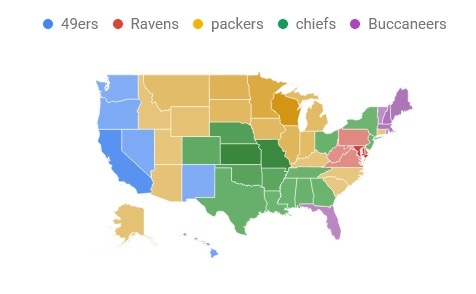
I haven’t posted about recent Google search trends lately, so I decided to check out what’s hot there. It seems that all the most frequent searches these days are National Football League (NFL) teams, I picked five teams that usually have a good national following, including the most recent Super Bowl teams, to see who’s garnering the most interest. This chart represents how these five fare nationally compared to each other. Obviously there’s some regionality. This map represents searches over the past year. I’m sure it changes week by week depending on who won or lost or who got injured or otherwise made the news.
The post Google Trends – NFL teams appeared first on OnWords.
September 22, 2021
Guilt at the Garage by Simon Brett
 Guilt at the Garage by Simon Brett
My rating: 3 of 5 stars
This piece of fluff might easily have been imagined as an outline for a one-episode TV mystery. There’s not much to it. I’m learning more about what publishers do to make a book marketable, and it isn’t pretty. A couple of posts ago I mentioned a 500-page that was squeezed down to 350 pages by use of small font and narrow margins. This book, at a scant 185 pages, is stretched to feel larger by use of extra-thick paper and some pointless digressions in the story.
The heroines are two single ladies in a small English town who double as amateur sleuths. They look into the mysterious death of an elderly garage owner who dies from a gearbox falling on him in the service pit. It’s all quite implausible, but the book is populated with a collection of zany characters and village life in rural England is skewered good-naturedly. It’s a quick and inoffensive read.
The post Guilt at the Garage by Simon Brett appeared first on OnWords.
September 17, 2021
Just Get Home by Bridget Foley
 Just Get Home by Bridget Foley
My rating: 2 of 5 stars
I liked the premise of the book, so I took a chance. It sounded sort of post-apocalyptic without the apocalypse (just a big earthquake) or the pseudo-science. It’s your basic disaster movie/earthquake thriller. I only got a third of the way through before giving up. The entire storyline was nothing but nastiness- child abuse, rape, looters, bullying, sadism. I can only give it two stars because it was readable if you can stand the content.
The post Just Get Home by Bridget Foley appeared first on OnWords.
September 14, 2021
A Short History of Tractors in Ukrainian by Marina Lewycka
 A Short History of Tractors in Ukrainian by Marina Lewycka
My rating: 4 of 5 stars
The author has presented us with a heartwarming, at times outrageous, and thoroughly entertaining story of a semi-functional family of Ukrainian refugees who settled in post-war England. When a 36-year-old gold digger from the Ukraine latches on to the widowed 84-year-old father of two feuding sisters, they form a united front to fight back. If this were a television show or movie, it would be called a dramedy. The father works on his seminal work about tractor history while lusting after the voluptuous bosom of his new love. The book sold a million copies and was nominated for the Man Booker Prize (British equivalent of a Pulitzer).
The post A Short History of Tractors in Ukrainian by Marina Lewycka appeared first on OnWords.