Russell Atkinson's Blog, page 29
March 9, 2022
Lemon by Kwon Yeo-sun
 Lemon by Kwon Yeo-Sun
My rating: 1 of 5 stars
After reading the entire book I have no idea who did what. A beautiful girl died, years pass, and another crime occurs, but I don’t want to give a spoiler so I won’t say more on the plot. There were multiple suspects in both the crimes – pretty much the same people – but no one seems to have a motive and it’s never revealed who did either. I couldn’t even tell which character was narrating each chapter. Each was in the first person but there was no label or chapter heading to reveal who it was. In most of them it became obvious, but in several of the key ones, it wasn’t. The writing was also awkward and wandering into irrelevant anecdotes. I don’t know if it was bad writing or bad translating but this is definitely a book to skip. Its best (or least bad) feature is that it was very short.
The post Lemon by Kwon Yeo-sun appeared first on OnWords.


Cost of energy per mile – gas v. electric
With gas prices soaring, there’s a lot of outrage among the public. Everyone’s prone to blame someone, usually the “opposite” party’s policies. There’s no question that the Republican tax cuts and the Democrat spending plan have both contributed to the current inflation. But let’s just look at the cost of driving a car.
Stop blaming politicians and look in the mirror. If you’d purchased an electric vehicle (EV), you wouldn’t be having this problem. I drive a Volvo XC40 Recharge, an EV. My rough calculations put my energy cost per mile at around 7.5 cents. My wife’s car, an Acura gas car, costs over 20 cents a mile at today’s prices and that doesn’t include other costs the EV doesn’t have like oil changes and the $75 I just paid for a smog check. In California the electric grid uses very little fossil fuel so it’s not affected by the Russia oil ban. America’s policy is to eventually be almost all EV. Norway has done it. It’s time everyone got on board with it. The petroleum age is ending.
The post Cost of energy per mile – gas v. electric appeared first on OnWords.
March 6, 2022
Worbot updated
I now have enough puzzle solutions to make some meaningful observations about my Worbot program that solves the daily Wordle puzzle. First, here are my Wordle stats (left) and Worbot’s (right).
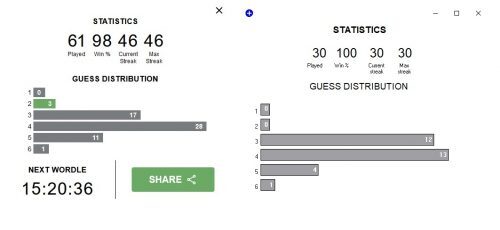
Obviously, I started tracking Worbot stats a month or so after I started working the puzzle myself, hence the different totals. The stats on the right also don’t show the first few attempts where I tested the program, including the one where it failed to solve PROXY.
As you can see, Worbot has a better record than I do. It has three times as many solves in three attempts than in five. My ratio is about 2 to 1. It plays in hard mode, too; I don’t. In case you don’t know what hard mode is, it means that you must use the letters that have been identified in prior guess each time you guess. Worbot also takes it further and cannot guess a word that uses a letter than has previously been shown NOT to appear in the target word, i.e. the gray letters become off limits. I think the key to its success is the word lists I have programmed it to use. The list it uses for its initial guess is limited to 64 words that: 1) have all or almost all high-frequency letters; and 2) have been verified to appear in the actual Wordle program target word list (2315 words). The program chooses randomly from those 64. It at least has a chance of getting the word on the first try, although it hasn’t succeeded at that yet. Neither have I.
The main list that Worbot uses for all subsequent guesses is my normal master 5-letter word list, but ordered by frequency in English. That master list (over 4,000 words) does NOT use any knowledge of the official Wordle list. So later guesses may be of words that have no chance of being the correct one. Nevertheless, the fact that it searches the list in order of frequency makes it highly likely it will find the most common word that fits all the previous clues from the colored squares. I believe this increases the chance that it will guess the right word in fewer guesses than me, since I make guesses based on instinct and general vocabulary with no knowledge of whether other words may be more common. That’s because I have made the assumption from the relatively low number of words in the official Wordle list that all of the target words are quite common.
By the way, I had fun programming the statistics page to look much like the Wordle one. That was actually the hardest part of the programming.
The post Worbot updated appeared first on OnWords.
February 27, 2022
The Spy and the Traitor by Ben MacIntyre
 The Spy and the Traitor: The Greatest Espionage Story of the Cold War by Ben Macintyre
My rating: 5 of 5 stars
This is by far the best book I’ve read in many months, perhaps years. It is outlandish and unbelievable, yet it has the added distinction of being absolutely true. It is the story of a KGB agent who spied for England. When I joined the FBI this is the kind of case I hoped one day to be involved in. It never came to pass, because this is the sort of case that happens once in a lifetime to an intelligence agency and only a tiny handful of people ever know about it at the time due to its absolute secrecy.
The beginning is well-written, but unexciting, setting the stage by introducing the characters and refreshing for us the realpolitik history of the Reagan-Thatcher-Andropov-Gorbachev era. I remember it well, but younger readers will find it eye-opening. By the second half of the book, the tension ramps up. PIMLICO, the mole, rises in the KGB and becomes more valuable, while at the same time the intelligence he provides puts him at greater risk as it is used. He is eventually put in peril. As it happens, western intelligence has its own mole betraying its secrets to the KGB. I’ll leave it there to avoid spoilers, but rest assured the last third of the book is a page turner. Do yourself a favor and don’t read through the photographs until the very end, as they contain some spoilers for what comes later.
The post The Spy and the Traitor by Ben MacIntyre appeared first on OnWords.
February 24, 2022
Law & Order season 21 – a disappointment
One of my favorite television shows was the original Law & Order starring Jerry Orbach as detective Lennie Briscoe. The writing involved complex legal issues in addition to the clever detective work. The acting and writing were excellent. It ran for 20 years, from 1990 to 2010. So I was excited to see it coming back starting tonight in Season 21. The various spinoff series were too gory or sensationalized with an unappealing set of actors. I never watched any of them for more than one episode.
Unfortunately, the reboot is poorly done. I’ve already taken it off my watch list. The writing is bad, the casting is bad, the acting is bad, the main characters are all unlikable, and it’s succumbed to the same problems as the spinoffs – more gore, more swearing, more overall nastiness. My wife called it ham-handed. I can’t recommend it.
The post Law & Order season 21 – a disappointment appeared first on OnWords.
February 20, 2022
Tridigital cipher solving algorithm continued
In my last post, I mentioned key pruning. What I mean by that is halting the recursion (and allowing it to go back a level and continue with another word) based the nature of the keyblock. In particular, the block always has three rows. This means any given digit may have at most three letter equivalents. Thus I put a testing routine in the recursion routine to look for conflicts of this sort. If the word being tested passes the first conflict test, e.g. THEIRSOME in the last post, it then goes through a routine to count how many letters are represented by each digit. THEIRSOME is represented by 107735607. The 7 enciphers E and I while the 0 enciphers H and M. Since there are no cases where a digit represents four or more letters, this is a possible solution so far. This is not surprising since we’re only on level 2. If one of them represented four different letters, the recursion ends at that level, the test word SOME would be rejected, and the next word in the four-letter word list would be tried.
This example is so short that there are thousands of valid solutions (which is why Tridigital is a hobby cipher, not a real-life one). One my program found was “had some by their,” which even makes sense as a phrase. But with more words, especially longer ones, it will soon be the case for incorrect combinations that one or more digits represent more than three letters. This typically happens on the level three or four recursion.
The other technique I use is scoring. Since all solutions that pass through the conflict testing consist of valid words, the usual scoring techniques such as tetragram frequency or word list scoring don’t work. So I reorder each potential solution array back to its original order and test pairs of words for frequency. I use Google N-gram data to determine this. The better the score, the higher in the display the solution is placed. Although this doesn’t speed up processing per se, it’s makes it much easier for me to spot a correct solution, or at least a likely correct segment in the solution early on. I don’t have to continuously scroll through dozens or even thousands of possible solutions as the program runs. The best ones are right up at the top.
As an example, the demo problem produces these possible solutions immediately:
had some by their
man some by their
arm some by their
had some up their
may some up their
man some up their
The most natural-sounding one is on top because the three two-word combinations (had some, some by, by their) score the highest in frequency. One of the other solutions may actually have been the first one found, but the display is in order of frequency score. Of course, we know none of these are the correct solution, but they are all valid.
This in turn allows another shortcut. If I spot a solution, or even a partial solution, I can abandon the program and use the digit-letter equivalencies revealed to run through my word lists in a separate program to identify any key words that can produce a keyblock with the same letters in the same columns, such as E and I in one column, H and M in another. Typically only about four or five words have to be solved before I have enough digits to find the original keyword and hat. Once I have those, I can solve any incorrectly solved or not yet solved parts by hand.
The post Tridigital cipher solving algorithm continued appeared first on OnWords.
Tridigital cipher solving algorithm
If you are not familiar with the Tridigital cipher, go to the American Cryptogram Association cipher types page and be sure you understand how it works. I’ll use the same keyblock on that page as an example.
N O V E L C R A F T6 7 0 3 5 2 8 1 4 9
D R A G O N F L Y -
B C E H I J K M P -
Q S T U V W X Z - -
pt: t h e i d e s o f m a r c h
CT: 0 3 0 9 5 6 0 7 9 5 8 9 1 0 7 7 3.
Note that every plaintext letter has only one digit that represents it, i.e. plaintext D is always enciphered with 6 in this case. The opposite is not true. The 6 can also represent B or Q. The spaces in the plaintext are always represented by the digit on the far right, 9 in this case. In the example, 0 is the highest digit and represents 10. The columns are numbered in alphabetical order according to the “hat” NOVELCRAFT. The ciphertext is a string of digits.
Step 1 is to find the spaces in the ciphertext, that is, determine which digit is the one on the far right. Since the plaintext will never have two spaces in a row, most digits can be eliminated by the fact they appear doubled in the ciphertext. For others, it is usually easy to judge by using the lengths of the words that would be produced by the possibilities. One might result in a 27-letter word, another in five different one-letter words. Those you can eliminate. This is just a preliminary step, not the heart of the algorithm.
Step 2. Once you have the ciphertext divided into word lengths with spaces inserted you need to prepare your word lists. Create arrays for each word length. To speed up solution I order the words by frequency, i.e. how common they are in English, but this is not necessary.
Step 3. Create an array of the ciphertext words, ordering them from longest to shortest, but keep a key so you can restore them to the order they appear in the original text. In the example, the elements would be 10773, 5607, 030, 58. In real problems, there are going to be some longer words, which is essential to an efficient algorithm.
Step 4. Begin testing words of the right length for the first word. Check for conflicts. Since WHICH is the most common 5-letter word, that would be the first one tested. We see the H’s would be represented by two different digits, 0 and 3, so it cannot be the first word. Go to the next word, THEIR in my list. There are no conflicts. The E and I may both be in the same column in the keyblock and thus both represented by 7. Save the word in a temporary array or string of possible solutions. Feed this word into recursive routine that is the key to the algorithm along with the level, i.e. 1 ion this case since this is the first word.
Step 5. Recursion. The recursive routine must first check to see if it has already completed all the levels. If it has, it has found a possible solution. That should be printed, displayed or saved in some fashion unless its score makes it untenable (I’ll discuss scoring later). If it’s not yet complete, start testing words from the next word list, the one with words the same length as the next level. In our example, that’s words of length 4 for word two, ciphertext 5607. In my list, THAT would be the first word tested and it would conflict with its own ciphertext (T would be represented by 5 and 7) as well as with the first word. In my list, the first 16 words would conflict, landing on SOME as a possibility. The E is represented by 7 in both words, THEIRSOME. This combination is fed back into the recursion routine with the new level (2, here) and the process is repeated until a full solution is found or all the words on some level are tried without finding a possibility to send on to the next level. The trial words are then backed out of the temporary array or string and the next word at each level is tried until all the levels are tried back to level one where the process is repeated.
The experienced programmer, or cryptographer, will realize that the process as described above will eventually find the solution, but would take impractically long, especially with longer ciphertexts. The key to making this work is to find an efficient way to prune the words tried. There are two basic ways I’ve found, although there may be others. The two I use are key testing and scoring. I’ll save those for my next post.
The post Tridigital cipher solving algorithm appeared first on OnWords.
February 18, 2022
If I Disappear by Eliza Jane Brazier
 If I Disappear by Eliza Jane Brazier
My rating: 4 of 5 stars
Sera is obsessed with a true crime podcast about missing women, young unattached women who disappear in Northern California. She’s the (now trite) unreliable narrator of the story. She’s a mess, after a divorce and having lost a child, the obsession is her life. Rachel, the podcaster, inexplicably stops podcasting and Sera is determined to find out why. She is convinced Rachel has been killed. She heads to Rachel’s remote ranch off the Klamath River where Rachel’s parents own a summer riding ranch for tourists. Everyone up there is weird and something clearly is not right, but she’s the outsider stirring up trouble among the hostile locals.
I was slow to get into this story. It is told in the first person, which is not unusual, but written as though Sera is talking to the missing Rachel, e.g., “I can’t believe you never told me. All this time you were trying to save others.” I’ll give it style points for originality, but I found it off-putting at first. The author has a knack for ratcheting up the suspense as the various characters shift in and out of the role of chief suspect. Is there even a crime? No one there has reported one. Her parents tell Sera she was killed by a gang, but everyone else says she just took off to get away from her crazy family. Sera’s parents hate and distrust the local townspeople and the feeling is mutual. None of the characters are likeable and there’s not a lot of meat to this story, but the answer as to what happened to Rachel (and possibly those missing victims in the podcast) is well hidden until the very end. I’d give it three and half stars if I could, but I’ll squeeze out four.
The post If I Disappear by Eliza Jane Brazier appeared first on OnWords.
February 17, 2022
Gazpacho vs. Gestapo
In case you missed it, last Tuesday the far right wacko congresswoman from Georgia, Marjorie Taylor Greene, claimed that House Speaker Nancy Pelosi was sending gazpacho police to investigate the capitol riot. Apparently she doesn’t know the difference between cold soup and Nazis. This is surprising, since she is one of those. Apparently a lot of other people in this country also aren’t familiar with the meaning of gazpacho. Look at these two Google Trends charts. The top one is a comparison of how often and where the terms were searched on Google during the month of January. The searches were about the same frequency and randomly distributed. The bottom chart shows the searches this month. Nearly all of that blue searching has been in the last three days.

Greene is the same woman who claimed that Jewish space lasers were setting the forest fires in California last March.
The post Gazpacho vs. Gestapo appeared first on OnWords.
February 10, 2022
Varsity Blues update – cost of trial
It’s been a while since I last wrote about Varsity Blues, the college admissions scandal. Two defendants, both parents who bribed school officials to get their children admitted to colleges of choice, went to trial rather than plead guilty. Both were convicted last October. Yesterday the first of them, Gamal Abdelaziz, was sentenced to one year and one day in prison along with two years supervised release after prison, a $250,000 fine and 400 hours of community service. The other defendant, John Wilson, will be sentenced next week. He was convicted of tax charges in addition to the college conspiracy charges, so he may get an even longer sentence.
These two men are the first two to choose trial rather than taking a plea deal. It cost them at time of sentencing. The longest sentence given out prior to this was for nine months. That defendant, Douglas Hodge, paid more money and was more directly and actively involved in the bribes on behalf of four children than most other parents. There have been several other defendants convicted in recent months, too. To see the whole list, here’s the authoritative link: Varsity Blues.
The most outrageous case is the one defendant who was pardoned by Donald Trump right before he left office. Robert Zangrillo, a Miami developer, was let off scot-free. The White House claimed that various businessmen and even a USC trustee (a major Trump supporter), advocated for the pardon for Zangrillo, but those businessmen all denied having any input on the pardon or contact with Zangrillo or the White House. The White House statement on the pardon also claimed that Zangrillo’s daughter Amber was earning a 3.9 GPA at USC, but the school confirmed that she was not enrolled there. The lies from that man never end.
The post Varsity Blues update – cost of trial appeared first on OnWords.