Russell Atkinson's Blog, page 35
August 9, 2021
Computer cipher solving – Lesson 5¾ : cribs revisited again
I’ve written two previous posts (here and here) about how cribs can be used in solving ciphers, especially by those who program computers. However, I omitted a rather obvious use that doesn’t require computer coding knowledge. That method is to determine the cipher type of an unknown cipher.
Some ciphers are presented as puzzles but the cipher type is not given. Many geocaching puzzle caches are prime examples. If a crib is given, or can be guessed, it can be used to confirm or eliminate the cipher type. If you are a computer programmer, you can write code that will “drag” a crib across the ciphertext to determine if it could possibly fit there, although that’s not easy for some types. If you don’t program there is still an easy way to do this. There are free websites by programmers who will perform this function for you. Here are two that I use sometimes, although I have my own crib draggers for many cipher types.
The Scytale This one even shows you a worksheet with all letter placements.
BION’s gadgets This one checks many periods at once for some types and shows the exact placement. For some types it also shows the ciphertext and plaintext matched up.
Even if you can’t positively determine a cipher type by crib dragging, you may be able to eliminate one or several types, thus reducing the types you have to consider. For some ciphers this can be done by eye, without a computer or website. For example, suppose the ciphertext shows word divisions and the crib is TOMORROW. There are two 8-letter words in the ciphertext, but neither of them has the doubled letters in positions 5 and 6 or the repeats where the O’s should be. You can eliminate simple substitution (Aristocrat), Key Phrase and Tridigital (if it’s numerical). Could it be a Ragbaby? If the key digit is 0 somewhere in either of those two ciphertext words, you may be able to confirm or eliminate one or both of them as possible placements. For Condi and Sequence you probably can’t confirm the type, but if the ciphertext doesn’t have a W, say, you can eliminate Sequence, which is a transposition type. There are often easier ways to determine a cipher type, but cribs can be useful in this way.
The post Computer cipher solving – Lesson 5¾ : cribs revisited again appeared first on OnWords.


July 29, 2021
The Hunting Party by Lucy Foley
 The Hunting Party by Lucy Foley
My rating: 4 of 5 stars
I read this because I liked The Guest List so much. This one is not quite as good, in my opinion. It’s still a fun read and I recommend it to any mystery fan who hasn’t already read The Guest List. A group of thirty-something Oxford alums gather for an annual New Year’s Eve party, this time in a remote Scottish hunting lodge. The characters are mostly vain, entitled, hard-drinking, immature louts behaving badly. The characters aren’t likeable and aren’t supposed to be. From the subtitle we intuit that a murder will take place, which indeed we do learn early on. However, the author has cleverly concealed who it is until late in the book, referring at first to the victim only as “the guest.” With this bunch, we’d be quite happy if they all got bumped off.
Most of the narration jumps back a few days to give us the backstory on all the characters leading up to the present. It is told from multiple viewpoints, mostly in the first person. It would seem original if I hadn’t already read The Guest List. Personally, I like narration from multiple viewpoints, but not everyone does. The same goes for jumping back and forth in time, although I’m lukewarm on that. Stylistically the two books are so similar that I recommend reading only one as the second one you read will seem derivative. In particular, they both provide us with two main mysteries to ponder for most of the book: who’s the victim and who’s the murderer. That’s clever once; twice is lazy and irritating. The characters are all very similar in the two books, as well. The ending was a bit disappointing, but also had a nice touch I enjoyed that was missing in the other book.
The post The Hunting Party by Lucy Foley appeared first on OnWords.
July 28, 2021
Where your people settled, part 2
In my last post I showed some maps of where Germans, Italians, Irish, Swedes, and Greeks are the most densely settled in the U.S. Now I want to show you a few more. First, the Scots. I would have thought they settled in the same places as the Irish, but those are distinct countries that came in different waves. The Scottish settled largely in Appalachia and the South, although the large contingent in Maine is consistent with the large Scots population just across the border in Eastern Canada. Nova Scotia actually means New Scotland. The coal mining industry may have been part of the explanation, too. I’ve read that Scottish and Welsh coal miners were recruited to mine the coal in Appalachia.
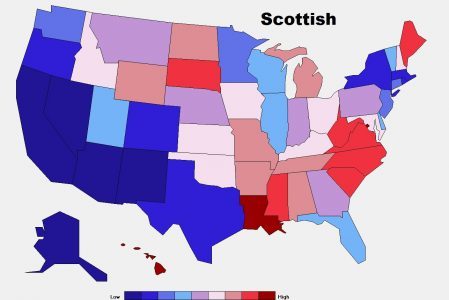
I’m a little surprised about Hawaii, but that’s what the data shows. Now, how about some smaller, more recent immigrant groups? Here’s the Vietnamese:
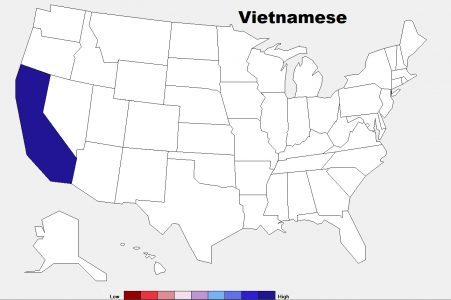
The white color indicates that the number of Vietnamese named people in the overall time period from 1910-2018 is too small to register in my tool. Only California had enough to register any at all. It’s not surprising that the number is small and that they, like any Pacific nation, would settle in California. I also ran the data for Armenian names and got the same result. California was the only state with enough to show. They are a European nation, of course, so the explanation may be something simpler: modern day refugees fleeing (the Armenian genocide took place during World War I) and settling in one of the newest, most quickly developing states. California also has warm weather and those two countries are warm weather lands.
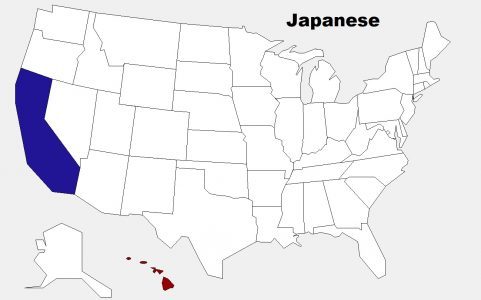
Last, but not least, are the Japanese. Once again the numbers are small, but they register in two states: Hawaii and California. I think the numbers would be bigger if I used another method of counting than names, because in my experience many Japanese-Americans named their children with traditional American names, especially since the 1930s when Japan was looking like an enemy.
The post Where your people settled, part 2 appeared first on OnWords.
July 26, 2021
Where your people settled
It’s no secret that many immigrant groups to the U.S. formed communities with other countrymen. It’s interesting to see that there are some patterns to where those communities formed. Climate seems to have been a big part of it. Take a look at these maps.
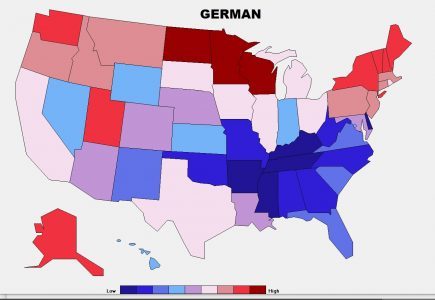
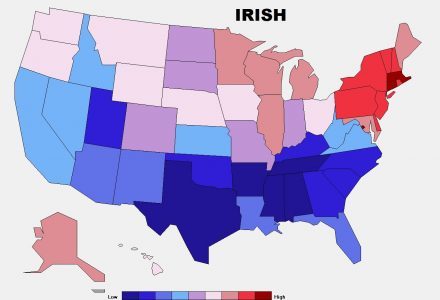
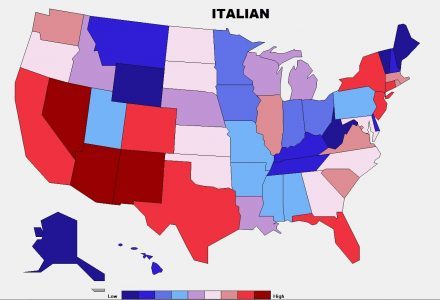
In each of these The darker red indicates the highest density of people with that heritage, blue the lowest density. The data is taken from U.S. Census data from 1910 – 2018 so it shows long-term trends. I chose 20 names that are common to each of the nationalities shown and not common in other groups and measured what percentage of the total names in that state they represented. Note that Germans, from a more northern, colder, country tended to settle in northern parts of the U.S. while Italians flocked to the hot weather states. The Irish, no surprise, are densest around Boston and vicinity. I doubt climate had much to do with that; both are heavy fishing communities, which is a more likely explanation. Here are some more examples:
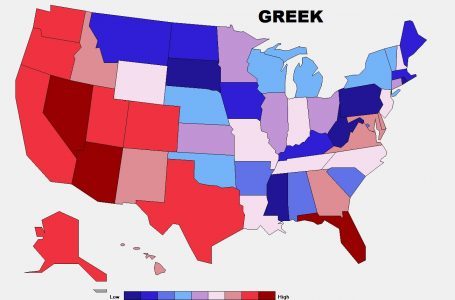
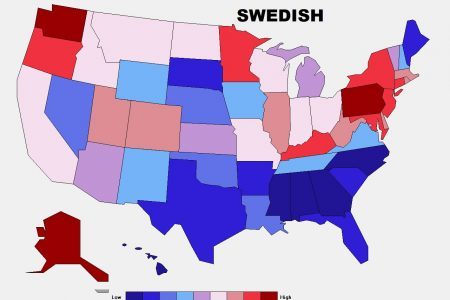
Again we see a cold climate group, Swedes, migrating to cold states while the warm-weather Greeks settled in hot states. Of course there are many factors influencing where immigrants settle, or where established Americans choose to move, including wanting to be near others with similar backgrounds.
A note on interpreting these maps: I’ve only compared each ethnic group to that same group in other states. You can’t tell from these whether Germans are more or less common than Greeks, say, in a given state, only whether those of German heritage are more common per capita in state A than in state B. If you have a nationality or ethnic group you’re curious about, post your request it in the comments or contact me using the contact form in the menu above and I’ll try to post a map for that group.
The post Where your people settled appeared first on OnWords.
July 21, 2021
Understatement
We’ve all misjudged others from time to time. In particular, we may mentally write off someone who is really quite accomplished at something and refer to them using an understatement. Sometimes it can be the opposite – how bad something or someone is may be minimized with an understatement. Here are some well-known understatements.
Fred Astaire, now recognized as Hollywood’s best or at least most successful dancer of all time, auditioned for a role before he was successful. The executive who watched him wrote, “Can’t sing. Can’t act. Slightly balding. Can dance a little.”
When British Airways Flight 9 flew through volcanic ash near Indonesia in 1982, the captain made this announcement over the intercom: “Ladies and gentlemen, this is your captain speaking. We have a small problem. All four engines have stopped. We are doing our damnedest to get them going again. I trust you are not in too much distress.”
Then of course there was Apollo 13 and the famous line “Houston, we have a problem.”
Charles Darwin was underestimated by his family and peers. He himself wrote, “I was considered by all my masters and my father, a very ordinary boy, rather below the common standard of intellect.”
Oprah Winfrey was fired from one of her first television jobs because, as her boss said, she was “unfit for TV.” That one, like Darwin’s, wasn’t really an understatement, but a misstatement, but the same sort of misjudgement.
Another intentional understatement like the Flight 9 one, made to prevent a bad situation from becoming worse, was that of Antarctic explorer Laurence Oates. Knowing he was slowing down his troubled expedition, he left them during a blizzard with the words, “I am just going outside and may be some time.” He was never seen again. His three companions continued on, but his sacrifice was in vain: they all died days later, frozen to death. His statement was only known from the records in the notebooks of his companions.
The post Understatement appeared first on OnWords.
July 12, 2021
What3Words name game redux
A couple of years ago about the website what3words.com, which connects every location on Earth to a set of three words. It’s fun to check out some combos that are surprisingly appropriate – or not. Here are a few more examples:
frozen.frozen.frozen is in New South Wales, Australia, a few meters from lush subtropical forest.
dreamer.magic.navigate puts you appropriately on the pedestrian path through Sleeping Beauty’s Castle in Disneyland, but sleeping.beauty.castle will land you in Damascus, Syria for some reason.
On the grounds of The Alamo in San Antonio you might find maybe.stray.limbs, but if you were expecting to fight.against.invaders here, you’d be disappointed, as that location is in Sudan, near South Sudan where the fight for independence from Sudan was fought only a few years ago.
You may recall that the Oscar winning film Driving.Miss.Daisy took place in Atlanta, Georgia, but W3W informs us that it is instead in central Kazakhstan.
If you’re into alt-right conspiracy theories, you will probably not be surprised to learn that deep.state.central is headquartered in Kyiv, Ukraine. No doubt Hunter Biden set it up there.
The post appeared first on OnWords.
July 7, 2021
Solving a Bazeries Xenocrypt cipher
In the July-August 2021 issue of The Cryptogram, the magazine of the American Cryptogram Association (ACA), the Xenocrypt section contained a Spanish language Bazeries cipher to be solved. A crib was provided as a possible entry. I was able to solve it relatively easily with some computer programs I have. I’ll explain how. If you’re strictly a paper-and-pencil solver, this post will probably not be of much use to you, which is why I’m putting it on my blog instead of submitting it to the magazine as an article.
If you are not familiar with the Bazeries cipher, as implemented by the ACA, I suggest reading the description here. Etienne Bazeries invented or improved on other ciphers as well, but this article refers only to the ACA version. The term Xenocrypt simply means a cipher in a foreign language. A crib is just a section of the original plaintext known to appear somewhere in the text.
First, consider how to solve a Bazeries cipher using a computer if you know the language of the plaintext, English, for example. It is a relatively simple matter for a programmer to write a program that takes every number from 1 to 999,999, the key, convert it to text form using a conversion table or module, use that as a simple substitution key, and use the numerical key to transpose the resulting text back to its original form. The transposition can take place before or after the substitution step. The results will be the same. The decryptions can be tested to see if they resemble English, or, if you have a crib, test to see if the crib appears in a trial decryption. I have a program that does that. I also have Spanish language tetragram frequency data in a file I can substitute for my English data. However, that won’t break this cipher. Why not? Because I don’t have the Spanish conversion table for the numbers. I don’t know how to write large numbers in Spanish, so the program won’t convert to proper plaintext.
It’s possible for me to look up how to convert those numbers in Spanish and to write a conversion table, of course, but that’s a lot of work and likely to be error-filled. Instead, here’s the method I used.
Step 1: I reversed the ciphertext. Every computer language has a simple command for that. Reversal is critical to the next step because a hillclimber relies on on tetragrams (or other n-grams) to be in order. As long as one or more digits larger than 3 appear in the key, there will be many tetragrams in the right order.
Step 2: I input the reversed ciphertext to my simple substitution hillclimber with the test language set to Spanish. The output was jumbled due to the transposition operation of the Bazeries, but parts of the crib appeared in the best decryptions.
Here’s the crib: no se conforma a
Here’s a section of the best-scoring trial decrypt: …asdelpenormsn formaala con sedelque noualctiaint…
It’s easy to see that is the section containing the crib. The program found what appeared to be the best substitution and I could see where in the decryption the crib appeared. However, several different transposition keys could produce segments like this, even if the substitution was not 100% correct.
Step 3: I then reversed the new text, and saved it, what was now plaintext Spanish with short reversals of varying length. The ciphertext was then back in its original order, except it had been translated letter-for letter, although I couldn’t be certain it was 100% correct.
Step 4. I ran my regular Bazeries program with one small subroutine added. After each transposition step I commanded it to search for a 13-letter stretch of text that has the same pattern of repeats as the crib. I used pattern search instead of searching for the exact crib because I couldn’t be certain the substitution was correct. The pattern should still appear even if one or two letters were substituted incorrectly. If the pattern was found, it printed on the screen the complete decryption (without any conversion/substitution step since it had already been substituted). However, it turned out that too many incorrect keys produced stretches with that pattern, but did not contain the crib or a valid plaintext. So I looked back at the best decryption in Step 2 to see approximately where in the text the crib appeared. I was able to narrow down the possible starting point to a very small range. I then re-ran the Bazeries program limiting it to that part of the decryption. But then it found no solutions!
Step 5. I realized that I had counted the crib position from the top in step 4, but the text I was looking at from step 2 had been reversed. Therefore I should have counted from the bottom. I did that and adjusted the range to search the new ciphertext. When I ran it again, the program found the pattern in the right spot and printed out exactly one decryption: – the complete, correct decryption!
The post Solving a Bazeries Xenocrypt cipher appeared first on OnWords.
July 5, 2021
While Justice Sleeps by Stacey Abrams
 While Justice Sleeps by Stacey Abrams
My rating: 2 of 5 stars
Abrams has presented us with another example of a killer of a plot concept ruined by horrible writing. In addition, her poor choice of a reader sunk the book even farther. The reader’s normal narrator voice was fine, but when she was reading dialog she failed miserably. The lead character, a twenty-something Supreme Court law clerk, sounded like a frightened ten-year-old. All the male characters sounded identical, making it hard to distinguish who was talking, and all sounded like B-film thugs.
The great concept is that a U.S. Supreme Court Justice falls into a coma just before a major split-decision vote is to be cast and his clerk, Avery, is given his legal guardianship, i.e. the power over whether he is to live or die. Evil entities want him to die to block the upcoming vote. Avery is faced with difficult decisions and is bullied and threatened by dark and mysterious forces. She is also left with puzzles to solve by the justice who clearly anticipated such a scenario and expected her to succeed. Great plot idea.
But then there’s the horrible writing. Abrams apparently has never met an adverb she doesn’t love to overuse. She turns nouns into verbs or adjectives. “The porch was sturdied by …”, “over the clayed ground.” She must have scoured her thesaurus for every obscure 10- or 12-letter synonym to replace common words in her first draft. Here’s one of her more appalling and hilarious attempts at erudition:
As it was, a permanent case of nausea jitterbugged with nerve-searing apprehension which metastasized into unadulterated panic. Pundits raptured at President Stokes’s capacity to infuse the recitation of a name with an intimacy that’s left the listener with a certainty of her unique place in the world. … That ability translated itself into throngs of voters who failed to heed the clarion calls from a bewildered press dutifully chronicling misdeeds.
I didn’t know whether to laugh or gag. How could an editor let that go by?
Yet another mystifying question is why she chose to portray the federal government as almost completely corrupt and evil. It is books like this that feed the deep state conspiracy theories of the far right groups she so famously opposes in her real life as a political activist. Which side is she on?
The post While Justice Sleeps by Stacey Abrams appeared first on OnWords.
July 4, 2021
Fourth of July humor
Here are a few jokes, er, profound observations, for this fine holiday:
Eagles may soar but weasels are not sucked into jet engines.
I find it ironic that colors red white and blue stand for freedom until they are flashing behind you
You should fly the flag on the Fourth. I once asked a friend “What’s the best thing about living in Switzerland?” He didn’t know but he said that the flag is a big plus.
The post Fourth of July humor appeared first on OnWords.
June 19, 2021
The politicization of disease
It seems that diseases are now either Democrat or Republican. At least whether or not Americans care about getting one is a Democrat or Republican thing. It is truly bizarre that our society has come to this point.
The graph below shows the relative interest in the Delta variant of the Covid-19 virus over the second week of June compared to how each state or district voted in the 2020 presidential election. Click on the image to pop it out and enlarge it for better viewing.

Delta variant vs. Biden Vote
The blue line represents the percent of searches on the term “Delta variant” during the second week of June, 2021 when medical and news sources were talking about how another Covid-19 surge could be hitting the United States led by the Delta variant that originated in India. The data is taken from Google Trends. On the left end, the District of Columbia had the highest percent of searches on that term, so that number was set as a benchmark of 100%. On the far right, the state with the lowest percent of searches on that term, Mississippi, searched on it only 30% or less than one-third as often as those in D.C. The red line is self explanatory: it shows the percent of the popular vote Joe Biden won in the 2020 presidential election in each state. The correlation is unmistakable. Although it’s a gross generalization, it appears that the stronger one supported Donald Trump, the less concern one has about getting Covid. Why? Trump caught the virus and nearly died from it. His oxygenation level was in the 80s, definite ICU territory. He suffered a life-threatening illness. During the campaign he bragged about bringing the vaccines to fruition and he got vaccinated himself. One would expect his followers to, well, follow his example. Somehow, though, ignoring Covid or scoffing at it is the only acceptable attitude for many. Trump could save the lives of many of his followers by coming out publicly encouraging them to get these vaccines he is so proud of.
An acquaintance of mine recently became very sick with symptoms that look very much like Covid-19. He’s one who has bought into the far right conspiracy theories about the deep state and has repeatedly asked me how deep the corruption goes in the FBI, since I’m a retired FBI agent. He has refused to get vaccinated or tested for Covid. He has so far refused to go to a hospital. I don’t wish him ill, but I find it hard to have any sympathy for him, either. I do feel sorry for his wife. If you check my past posts, you’ll see I have called this pandemic an exercise in natural selection. I stand by that characterization.
The post The politicization of disease appeared first on OnWords.