Russell Atkinson's Blog, page 128
February 20, 2014
Run v. Jog
Q: What is the difference between the words “run” and “jog”? Or more specifically, what is the difference between a “runner” and a “jogger”?
A. Ten years ago when I was a lot faster and I’d pass a group of moms and their kids, one of the moms would call to her kids, “Watch out for the runner.” Now they say, “Watch out for the jogger.”


February 19, 2014
Obesity
How fat are we getting in this country? Interestingly, I seem to be getting smaller while getting bigger. Sound impossible? Not accordingly to today’s clothing manufacturers.
I used to buy large size men’s shirts, at least when they were long-sleeved. Flannel shirts, for example. I’m just under six feet and have a thin build. I had to buy large because medium was too tight at the shoulders and the sleeves weren’t long enough. Yesterday I bought some long-sleeved shirts and had to buy medium. This is counter-intuitive since my waist size has actually gone up by one inch in the last year or so, and I’m the same weight I have been for the last 40 years.
The explanation, of course, is that Americans are getting so fat at so young an age that clothing manufacturers and retailers are using the increased average size as the basis for sizing. Yesteryear’s large is today’s medium. Part of it may also be that kids are wearing baggier clothes than they used to, but I think obesity is the greater culprit.
Personally, I prefer to think of it as proof I am slimming down despite my increased waist size!
February 18, 2014
Sesame Street on Grammar
I wish I could say it this well.
February 15, 2014
Bye bye facebook
I’ve officially given up on facebook. There are several reasons for this. The most important reasons are mirror images of each other: I don’t see most posts by most of my friends and they don’t see most of mine. Facebook is the victim of its own success. It has become such a universal platform that regular users now have hundreds of facebook friends. Most of those post to facebook frequently, even when they have little of importance to say. It has deteriorated into a Twitter, that diarrhea of the small screen.
This has forced fb into a practice of prioritizing posts. For a long time I could assign to each friend one or more check marks to show “only important” posts or just “life events.” I don’t know how facebook determined these, but I seemed to get most of the stuff I was interested in. Some fb friends were prolific posters and I had to remove them from my feed because I just didn’t have the time or interest, but overall the system worked. Now I only have the choice to follow or not follow. Like Twitter. Even then fb doesn’t show every post by every person I am following. There are just too many, so it determines through some algorithm what is most interesting, based on how often people interact with a post.
When I post, they show me how many people have seen my post. I have over 100 fb friends, but most posts are typically seen by only 35 or so. So I don’t know who has seen my posts and who hasn’t. I have no problem with people choosing to not follow me as I do the same thing, but sometimes for some of the groups I’m in, I think it’s important that at least that group see the post, yet I am unable to be assured they have.
Yet another problem is the proliferation of pictures. Now with every mobile phone having a camera, people take snapshots everywhere they go. Sorry, but I am not interested in the photos of you standing with your neighbors, or yet another shot of the forest or a sunset, or your latest vacation, no matter who you are. Been there, done that.
Lastly, fb is now giving me 50 choices for my sexual identification? 50! Really?! Unreal – literally. It has become an exercise in surrealism – a theater of the absurd. It’s time to say goodbye.
So from now on I will post my comments in specific forums – the Nissan Leaf forum for electric vehicle related posts, theGBA.net for geocaching, or the mailing list for ex-FBI agents for FBI stuff. If you own facebook stock, I recommend you sell it. It is, ironically, too successful to do well.
February 5, 2014
Ship Of Theseus – A Grand Adventure
 Ship of Theseus by Doug Dorst
My rating: 5 of 5 stars
This book (SOT for short) is a grand adventure. Experience it in its full hardback version, not the ebook. It is beautifully crafted to appear to be an old library book, complete with call number on the spine and checkout history stamps on the inside. The pages are made to look yellowed at the edges and the font is chosen to look straight from the 1950s. Scattered throughout the pages are various inserts – letters, postcards, photos, and even a code wheel – all appearing authentic. Be careful when you open it so they don’t all fall out. They are placed at logical spots in the story.
The novel unfolds in at least four chronological stages. It also takes place both in print and in the handwritten margin notes, which I saved until after I had read the printed story. First is the original novel purportedly written by V.M. Straka, a controversial and reclusive mid-20th century author who was active in the radical left-wing movements of the 30s and 40s – labor riots, anti-fascist groups, and especially opposed to an industrialist/arms dealer. SOT is his last book, published by his long-time translator F.X. Caldeira, in 1959, years after his death. The tale is a bizarre allegorical account of the travels of S., an amnesiac-turned-assassin fighting the agents of the evil munitions provider in the story, modeled after Straka’s real-life nemesis. It is filled with the dark imagery one might expect from the mind of J.J. Abrams (cf. Lost) one of the creators of the book. One quickly gets the idea the story is more than what it appears to be on its face.
The translation, including Caldeira’s foreword and footnotes, form yet another story. The reader soon realizes that the footnotes, too, contain some secret, undisclosed information. Odd wording, misaligned characters and other clues tell us that the footnotes are trying to communicate something secret – but what, and to whom?
Then going back through the margin notes from the beginning we learn that the book is being passed back and forth between Eric, a graduate student, and Jen, a senior English major who works in the campus library. Eric’s dissertation work on Straka is being stolen by his former advisor (who had him “expunged”) and his ex-girlfriend. Jen becomes his ally in solving the mysteries surrounding Straka: who was he really? Did he commit suicide or was he murdered? What were Caldeira’s footnotes all about? Whom did the characters in SOT represent in real life? All the while they have to fight off the evil professor and ex-girlfriend (who also happens to be Jen’s TA in a lit course).
Eric writes in black ink, block letters. Jen uses blue cursive. As things become more tense they switch colors to green and orange,and eventually red and purple. Will Eric and Jen ever meet face-to-face? Will Eric get back into academia? Will Jen graduate after her TA flunks her? All these dramas play out together.
The very concept is worth several stars, but the cleverness of the story and the marvelous artwork both on the page and in the inserts makes this one of the most enjoyable books I’ve read in years. I highly recommend it.
View all my reviews
January 28, 2014
Vocabulary
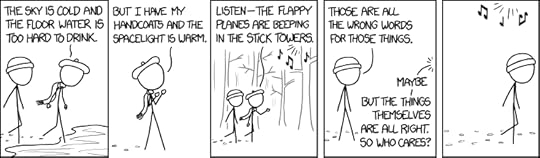
Okay, so the Word Police part of me had to repost another xkcd.com comic. There is a lesson here:
January 25, 2014
Not so bulletproof
I’ll depart from the usual lighter tone of this blog to discuss something that touched a nerve with me. Recently a police officer in the Bay Area was killed by “friendly fire.” That is, another officer with him shot him in the chest, causing a fatal wound.
The exact circumstances of the shooting have not yet been made public. It may have been a case of misidentification, i.e. the shooter thought his fellow officer was a “bad guy,” or it may have been an accidental discharge. What has been made public is the fact that the victim was wearing a “bulletproof vest” and yet died from a chest wound. Some people may assume there must have been a defective product for this to have happened. Not so.
The vests we were issued in the FBI were called BPUs, or Ballistic Protective Undergarments. We were supposed to wear them for all arrests and other potentially dangerous situations, such as some searches. Unlike patrol officers, we did not wear them on a day-to-day basis. Ours were ridiculously thick and bulky. They were so wide at the shoulder that it was difficult even to steer a car while wearing one. They dug into the upper arm and kept it from moving straight to the front. No patrol officer would put up with such a design for a full shift, much less every day. That’s why the typical vests worn by police officers are thinner and have much larger armholes.
Armholes are one of the biggest areas of vulnerabilities with these vests. The area of the chest just below the neck is another. The abdomen is yet another, and of course, they do nothing to protect the head and neck. Perhaps the least known weaknesses, but significant nonetheless, is the overlap at the sides. The vests are shaped somewhat like double aprons – two flat pieces joined by straps in the middle, forming the head hole. The head is slipped between the straps; the flat pieces hang down in front and back. They are wide enough to overlap on the sides, where there are Velcro closures to pull them snug. The problem there is that the overlap can catch a bullet and direct it inside the vest instead of outside. The wearer is supposed to pull the front piece over the back piece to prevent this, since most shots are presumed to originate from in front of the officer, but a shot can come from the rear.
The opening scene of my third Cliff Knowles novel, Fatal Dose, describes a scenario where an officer receives a chest wound despite his vest. That scene is not fiction. I described as accurately as I could a very scary video I saw at firearms training years earlier. That video was taken from an officer’s dashcam.
There are several lessons to be taken from this. First is not to trust these vests to be bulletproof. Not only do they have uncovered areas such as i described, but they also can’t stop high-powered rifle bullets. Second, don’t be too quick to judge officers who shoot quickly. Certainly in the latest shooting someone screwed up somehow. But officers make arrests and enter hostile locations regularly. It is easy to understand why some feel the necessity to be quick on the trigger.
There was a saying I heard in the FBI more than once:
It’s better to be judged by twelve than carried by six.
January 20, 2014
Code
I’m not a professional programmer, but I write a little code for my hobbies. This cartoon struck me as so true.
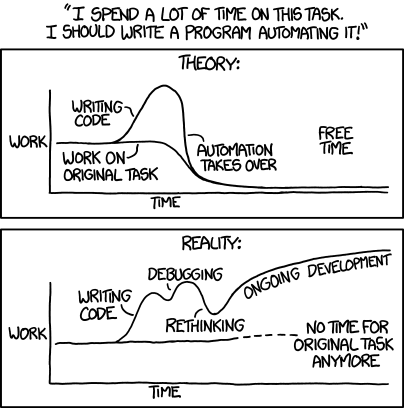
Automation comes from ‘auto’ meaning self and ‘mate’ meaning screw.
courtesy xkcd.com
January 14, 2014
Wear a tie
I just learned that someone I know, a young man, just got a new job. He was overseas when he applied for it and could not interview in person, so the interview was done via Skype. Because of the nature of the job, most other candidates did the same. After he got the job he was told that one of the reasons he got it was because he wore a tie during the Skype interview.
The point, of course, is that good impressions are important. This young man was well-qualified and had other pluses going for him, but that’s not always enough. This confirms my own view that you are doing yourself a disservice if you don’t strive to make a good impression every way you can, whether it’s a job interview or that first Match.com meeting. That includes your language. The young man I mentioned also speaks well. He’s polite and uses good grammar.
One other thing worth noting: the interviewer did not tell the losing candidates that they lost because they were wearing tee shirts or sweatshirts. In other words, if you aren’t making a good impression for any reason – your posture, your clothes, your tattoos, your language – people aren’t likely to tell you (except maybe your mother), but you will continue to lose out. It’s up to you to recognize your own shortcomings (or at least listen to your mother) and straighten out.
January 1, 2014
Happy New Year
Another bon mot from The Cryptogram
A new science combines cosmology and cosmetology.
Its proper field of study of course will be the make up of the universe.
Happy New Year.