Russell Atkinson's Blog, page 123
August 2, 2014
TV driving
Have you ever noticed how people drive on TV? I’m not talking about the car chases or scenes from a distance. They drive like pros there. I’m talking about those close-up shots in the front seat where the driver is talking to a passenger. They wiggle the driving wheel all over the place. If they drove like that in real life they’d flip the car every time they went to the grocery store. Not only that, they don’t look at the road. They look over at the passenger for 30 seconds or more at a time. I can’t pay any attention to what they’re saying because I’m waiting for the crash. Or for the pedestrian to fly over the windshield. Of course I know that they aren’t actually driving. They’re sitting in a car on a flatbed truck and the truck driver is doing all the actual vehicle operation. Which is why all the buildings don’t look right, either. They’re too low when you look out the car window. Is there no TV director in the world who actually drives himself or herself? It’s Hollywood, for heaven’s sake. Everyone drives in LA. Why do they let their actors do that? Sheesh.


August 1, 2014
Unabomber – a very mixed bag
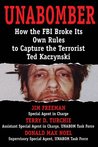 Unabomber: How the FBI Broke Its Own Rules to Capture the Terrorist Ted Kaczynski by Jim Freeman
My rating: 3 of 5 stars
I enjoy real-crime books, especially those involving the FBI, and I enjoyed this one, but it’s not for everyone. It’s full of many nuggets of fascinating facts buried in a mountain of pedestrian writing. Since I do offer some criticisms, let me first say that the authors and the whole Unabomber Task Force members mentioned here presided over the identification, capture and successful prosecution of the Unabomber, a serial killer. You or I might have been his next victim had they not succeeded. Results matter and they got the results, so they deserve credit for that. Bravo. But this is a book review, not a performance review.
First, the good. The book gives a very realistic view of the FBI, exposing many errors, foibles, egos, and so forth without sugar-coating. It provides many details of the case that I had never read about before, like the fact that for 16 years, no one who worked the case bothered to check to see if one of the first bombs, one found lying on the ground with plenty of postage, would fit in the nearest mailbox. All kinds of theories were formed about why the bomber chose to plant it there instead of mailing it. How is it possible no one thought that this might be due to the fact it wouldn’t fit in the mailbox? The federal jurisdiction was so fractured that the various agencies (ATF, FBI, Postal Inspectors) were not even aware that three of the bombs were made by the same bomber for years because they didn’t compare notes or case files. One of the bomb labs thought one bomb was intended to be a dud. Later, the other two agency labs disproved that. And so on. If you’re a fan of this kind of crime detail, as I am, this book is worth wading through.
The high point of the book is not how the case was finally solved. It was solved not by the FBI but by the Unabomber himself the same way most criminals are caught. He kept committing crimes until he made a mistake and exposed himself. In this case, he wrote a “manifesto” and sent it to some newspapers, and when it was published someone who knew him, a relative, turned him in. This sort of crowdsourcing is as old as the hills. Before TV and the Internet it was done with wanted posters. I seem to recall reading once long ago that Kaczynski had been identified as a suspect early on but was even rejected by the FBI as a non-viable suspect. That’s not mentioned in the book, so I can’t be sure that’s true. But basically, he outed himself by his arrogance, insane compulsive hatred, and his need to promote his “philosophy.”
That’s not to take away from all the hard work done by the task force, both before and after he was identified. Just because various methods didn’t work doesn’t mean they weren’t worth trying or that anyone was deficient. Many clever approaches were tried but did not pan out. That’s no doubt reality in law enforcement.
Where the book shines is in how it highlights what’s wrong with the FBI and other federal law enforcement. Some of it is well-known, such as the splintered jurisdiction, the bureaucratic in-fighting to get “control” or glory, or a better career position. But to me this book demonstrates what is an even greater problem: the FBI and other feds do not hire smart people. Not the really smart ones, anyway, the dropouts from MIT and Stanford Engineering. Instead of hiring Sherlock Holmeses they’re hiring graduates of Podunk State for their trigger pull and ability to wrestle large felons to the ground. It’s the Federal Bureau of Investigation, for Pete’s sake, not the Federal Bureau of Patrol. It still thinks of itself as a police agency instead of an investigation agency. It should be the varsity, but from the way it’s portrayed in this book, it’s basically bouncers with college degrees. In the British system, Scotland Yard Inspectors, brainiacs (theoretically at least) who don’t carry guns, do the investigating and call in the brawny constables when an arrest needs to be made. Something like that should be done with the FBI, but of course that will never happen. The pay and early pension of the FBI, higher than regular civil servants and even higher than other federal investigative agencies, is keyed to the “danger” and “stress” and need to carry weapons, so they have to be given police work to justify that. So we see in this book the comedy of errors that early investigators made gleefully pointed out by the main author of this book. I suspect there were plenty his own task force made that didn’t make print, but as I said, they presided over the capture and deserve credit.
As for the writing, my description as pedestrian is charitable. The book is replete with grammar, punctuation, and wrong word errors. (Ordinance for ordnance, poured for pored, rationale for rational, feint for faint, etc.) The authors should have splurged and hired an editor, or at least a proofreader. The primary author (the SAC) seems never to have learned the objective case, or maybe just doesn’t recognize a preposition or transitive verb when he sees one. (“joined Terry and I”, “paused to urge both he and Joel” etc.) This mistake permeated the whole book, with only one instance of correct pronoun usage (at 62% of the way through according to my Kindle) when there were multiple objects. Maybe he missed 7th grade. 90% of the book consists of descriptions of meetings and how he wrested or kept control from other bureaucrats. It sounded like he viewed other agency heads and FBI executives as the main enemy rather than the Unabomber. His self-congratulatory tone is also hard to stomach since the SAC’s main contribution, beyond appointing some competent worker bees, seems to be buying donuts and occasionally interrupting his golf game to listen to what the bees actually accomplished.
Perhaps most troubling is the pervasive cowardice described during the end game by FBI executives, prosecutors, and DOJ officials. No one was willing to make a decision about whether to release the manifesto, or whether to arrest or search Kaczynski because if it turned out wrong, it would hurt their career. If you care about your career, you shouldn’t be in the FB I or DOJ. You should be caring about protecting the public from killers. How about just doing what is most likely to result in the capture of the killer? This concept seemed easy enough for the journeyman agents to understand – Puckett, Moss, and Noel, assuming the book has it right. They seem to be the ones who finally got the impetus going to do what’s right. This top-level cowardice aspect left me with a despairing feeling about the future of he FBI, but this stark reality depicted here is probably what is most important in this book. Let’s hope Director Comey reads it.
View all my reviews
July 29, 2014
Cliff Knowles #4 is on the way
If you’ve been wondering why I haven’t been very active on this blog lately, it’s because I’ve been busy writing the fourth Cliff Knowles mystery. I don’t know when it’ll be done, but it will be months, not weeks. I can hardly wait to see how it comes out.
July 20, 2014
A wonderful, true, thrilling, heart-warming story
 The Boys in the Boat: Nine Americans and Their Epic Quest for Gold at the 1936 Berlin Olympics by Daniel James Brown
My rating: 5 of 5 stars
This non-fiction best seller has so many reviews I realize mine will only be read by people who follow my reviews or blog, but for those people I say GET THIS BOOK AND READ IT. It’s a wonderful, thrilling, true, heart-warming story. My father was on crew at the U. of Washington as a coxswain so I had a special reason to read it, but I would have done so anyway. I listened to the audiobook and the reader was superb. I can’t praise this book enough. I’ll stop here, since people are more likely to read short reviews than long ones.
View all my reviews
July 16, 2014
July 5, 2014
Review of The Martian by Andy Weir
 The Martian by Andy Weir
My rating: 5 of 5 stars
This is sci-fi as it was meant to be. Not the fantasy goblins in space garbage that passes for sci-fi. This hovers on the edge of plausibility while mixing suspense with a sardonic wit. An astronaut is marooned and left for dead on Mars early in a Mars mission due to a storm, while his crewmates are forced to leave to return to Earth. By fluke serendipity he survives the storm. From there, it’s Robinson Crusoe on Mars. He’s lost communication with Earth because the main radio dish was blown away. Through sheer ingenuity, brilliance, and a lot of science, he devises a plan to survive until the next Mars mission, four years later. But that plan fails. That’s all I’ll say about the plot.
The research and knowledge that went into the writing of this book is mind-blowing. It’s a tribute to NASA and all the scientists, engineers, and visionaries of all types around the world who have made our tentative ventures into space a reality. There will be readers who get tired of all the technical explanations. Even I did as it neared the end, as the human drama was so compelling. But I’m enough of sciencist – not a scientist and certainly not a Scientologist – but a believer in and fan of science – that I just lapped it up. I’m also just ignorant enough to be unable to see what are no doubt some major holes in the science so I didn’t get turned off by any such quibbles. Just suspend your disbelief a smidgen and enjoy the ride.
View all my reviews
June 28, 2014
Our ignorant newsies
Our newscasts regularly describe how American children are not competitive with other countries. This is attributed to inferior education, government policies, bad curricula, parenting, etc. I think they ought to take a look in the mirror first. The grammar, spelling, and logic on display in our TV newscasts, newspapers, etc. from mainstream media are atrocious. Yes, teachers do it, too, but they aren’t paid what NBC and CBS anchors are. You’d think for that kind of money the networks could hire someone who knows how to speak English. It’s no wonder our children don’t measure up when they hear stuff like this every day. The first four I hear constantly from newscasters on all networks. The last few indicate in green who said or wrote that.
“It’s impossible to understate the importance of diet and exercise.”
["impossible to overstate"]
“…said we would not step foot in…”
["would not step in..." or "would not set foot in" -- step is intransitive, set is transitive]
“Everyone doesn’t understand how to…”
["Not everyone understands how to..." as written it means no one in the world understands]
“The facts infer…”
[imply, not infer. The listener or reader infers. Facts or speakers imply.]
“Dinosaur bones recently found in Argentina are from the largest mammal ever to walk the earth.”
[Dinosaurs were not mammals. Lester Holt, NBC]
“Disasters keep coming, one after the next.”
["...one after the other." The word next means it is the one that comes after. Local ABC anchor]
“Hiring additional employees will only exasperate the risks.”
["exacerbate the risks". An ex-FBI agent "expert" on cyber security.]
“…kept as a momento…”
["memento" - it's based on the word "memory". Chelsea Clinton]
Review of Lion Plays Rough by Lachlan Smith
 Lion Plays Rough by Lachlan Smith
My rating: 3 of 5 stars
This book was satisfying overall, if not exceptional. Call it summer reading. The legal stuff was pretty accurate, but the characters were rather stereotyped. I enjoyed the local color since I used to live in the Oakland hills very near where some scenes take place. In fact, the main character drives right by my old house in a car chase scene. The mystery keeps you guessing until the end, although I wouldn’t call it suspenseful. I found the insertion of the character Teddy to be too much political correctness and not very plausible, but some people will enjoy the character development there.
View all my reviews
June 25, 2014
Review of Blood Money by James Grippando
 Blood Money by James Grippando
My rating: 1 of 5 stars
This book was a big disappointment. I’m always looking for mystery series that I can devour over months or years, and this is one of a lengthy series that might have fit that bill. Unfortunately, it was not to be. The book had its problems early on, but it wasn’t bad enough to abandon until p. 140. I finally gave up there after one of the most ludicrous FBI scenes in all of literature.
The main character, a lawyer, receives a death threat, so his FBI agent girlfriend arranges for the FBI to provide personal protection in his home and an “encrypted line.” The line is so he can talk securely to his clients and apparently anyone else since the murderer seems to be able to tap his line or hack in. For starters, there’s no FBI jurisdiction. It’s a murder threat to a normal citizen, not a federal witness or judge or official. The locals would handle it (probably by increasing patrols, and that’s all.) His girlfriend, the agent, had moved out so she wasn’t threatened, and even if she had been, the protection would be on her, if anyone, not him. Second, they don’t provide security for anyone that I know of besides the FBI Director and his family, although they may post agents at the homes of kidnap victims’ families until the ransom is paid or the victim released. At least that’s the way it was in my 25 years in the FBI. Third, how in blazes is that “encrypted line” supposed to work? The author’s unclear on the concept. Anyone with an IQ over 75 knows that if you encrypt something, it can only be understood by someone who can decrypt it. So is the FBI going to run out and install the decryption technology at the homes and offices of everyone the lawyer calls before he calls them? If they didn’t, all the recipient would hear is white noise. Encrypted telecommunication, at least the FBI kind, is classified and would never be installed in any civilian’s home, which is an unsecure environment. It only goes from government office to another government office or classified site, like a defense contractor and requires a SCIF or at least a level 3 safe, and most importantly, the same decryption technology and key as the sender. Absolutely laughable.
I was so disgusted I had to stop. How does stuff like this get by the editors, anyway? They must have a very low opinion of the intelligence of their readers.
View all my reviews
June 17, 2014
Review of Sting of the Drone by Richard A. Clarke
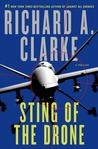 Sting of the Drone by Richard A. Clarke
My rating: 5 of 5 stars
It’s been a long time since I gave 5 stars to a book, but this one had me eager to turn the next page all the way through. As the title and reviews indicate, it is themed entirely on drones, in particular, military drones, although a few civilian ones play a role.
Of course, drones are a controversial topic, with objectors conjuring up visions of Big Brother and an oppressive surveillance society, while supporters, apparently including the author, are glad the U.S. finally has an effective weapon against the jihadists bent on attacking and killing Americans. I see both sides of that argument and the politics of it play no role in my rating. I just thought it was an exciting thriller. Of course there are plenty of explosions, death, and cool technology described, so if that’s not your thing, skip it.
Full disclosure: I’m a retired FBI agent and an owner of a DJI Phantom quadrotor, i.e. “drone”, so perhaps that colors my view. Drones can be useful tools for public safety agencies, including fire and police departments. I use mine responsibly for aerial photography, such as for scenery or videoing events (at the request of the organizer). I think of it as an aerial tripod, that’s all. I don’t spy on people and I don’t fly where it would bother people or endanger anyone. I wish I could say the same about all multirotor owners, but there have been some pretty irresponsible folks posting videos of crashes or injuries (of the drone or its owner, not cars or others) they caused by flying irresponsibly, so I don’t want my positive review of the book to suggest I approve of the sort of reckless cowboy mentality some owners have. Real life is not a video game, folks.
I will also say that, based on the FBI scenes in the book, there is a lot of exaggeration of the capabilities of the technology and an understatement of the bureaucracy involved. I doubt drones can do half of what is depicted, at least with the ease and efficiency described in the book. That’s okay; this is fiction. A real-life James Bond couldn’t do the things the book/movie version does, either. Just read it for its entertainment value and you’ll enjoy it.
P.S. Several Goodreads reviewers pointed out some typos or other errors. I checked where they indicated and my library copy is free of the mistakes mentioned. They seem to have been fixed in the final editing.
View all my reviews