Russell Atkinson's Blog, page 111
June 2, 2015
Bartleby, the Scrivener by Herman Melville
 Bartleby, the Scrivener by Herman Melville
My rating: 4 of 5 stars
This short story was published in 1853. I grabbed this from the library shelf on a lark, recalling that I admired Melville’s style, but wasn’t interested in slogging through a tome the size of Moby Dick again. Since this story is a classic work which has been analyzed to death by academics and book bloggers alike, I will dispense with any discussion of the philosophy which may or may not be hidden within it. Nor will I be drawn into character analysis, such as whether Bartleby is an exemplar of irony, melancholy, humor, etc. I’m not even sure Melville intended to provide either a philosophical point or a character study. He may have simply been trying to write an engaging story that would help earn him his living.
What entertained me about the book is its charming style and intelligence. Melville writes with elegance and a mastery of the English language. No publisher today would permit the author of a work intended for the general reader, i.e. mass market, to use the vocabulary one finds in this story. Here’s a sampling: scrivener, imprimis, deign, dishabille, remonstrated, gainsay, maledictions, indecorous, deportment, chimeras, choleric, quietude, obtruded, unwonted, moulders, forbade, incubus, vouchsafed, pugilistic, inveteracy, purveyor, sanguine, beckoned, effrontery, prudential, orbicular, potations, recondite, hermitage, dyspeptic, tenanting, hectoring, upbraided, chancery, blazonry, alacrity. Sure, some of these are either archaic or oddly quaint, but the vast majority of these words are perfectly good words today that one might find in academic papers, legal opinions, or other writings by the highly educated and intelligent. My browser spell check feature only objects to one (blazonry). Yet you are unlikely to find many of these in a best selling novel of today. Sadly, the publisher would require the author to dumb it down. That is why I found it so refreshing to be communicated to by an author who treats me, the reader, as intelligent and well-read.
I consider this trend indicative of societal changes in general. Books have gone the way of televisions and computers. When they were relatively new, the main consumers were relatively educated and relatively wealthy compared to the population as a whole. Thus the content (stories, TV shows, computer programs) were aimed at that demographic to a larger extent than they are now. Of course there were exceptions (The Three Stooges, anyone?) Now, these things are accessible to virtually everyone in the developed world so producers of media content of all kinds are aiming for the biggest slice of the consumer market, which means the peak of that pesky bell-shaped curve. Another quality of this work evocative of an earlier time is its humaneness. It is taken for granted that no respectable human being would be unkind or disrespectful to another. Melville was aiming for the upper end of society, not so much in wealth or social standing, but in intelligence, education, and character. If you’re there, try this quirky story. I think you’ll enjoy it.
View all my reviews


June 1, 2015
Anagrams on the News
OMG! KERRY’S BIKE FAIL = I’M FRISKY, BROKE A LEG
May 30, 2015
Shake That Thing/That’ll Never Happen No More medley
I decided to make another guitar video:
May 29, 2015
In the Kingdom of Ice by Hampton Sides
 In the Kingdom of Ice: The Grand and Terrible Polar Voyage of the USS Jeannette by Hampton Sides
My rating: 5 of 5 stars
This true story of an intrepid American explorer is riveting. I had never heard of George DeLong before reading this book, but I developed a tremendous respect and bit of national pride in his exploits. Be warned, however, that the book starts off rather slow. The author spends too much time on the biographies of the characters and the back story of earlier polar exploration. In particular, the life of James Bennett, the publisher of the New York Herald and the financial backer of DeLong’s expedition, is too long. Bennett was a colorful character, to be sure, and worth a serious mention, but his outrageous antics take more than their fair share of space at the beginning. The real story is DeLong’s polar expedition. Be patient while reading through or skip ahead. You won’t be disappointed once you get there.
From the outset the author quotes extensively from the logs, letters, and other writings of DeLong and his men, so we know that at least his papers survive the voyage. But what about the ship and its crew? I won’t spoil the suspense. The hardships and incredible feats of seamanship and survival are amazing and inspiring. If you enjoyed The Boys in the Boat: Nine Americans and Their Epic Quest for Gold at the 1936 Berlin Olympics and Unbroken: A World War II Story of Survival, Resilience, and Redemption you will enjoy this one at least as much. I found this book better than either of those. It doesn’t relish in detailing the human cruelty and unfairness of those two books, which at times seem to pander to the worst of the reader’s sadistic voyeurism. Here, it is all about man versus nature. There is suffering in great measure, to be sure, but also human resilience and fortitude.
I listened to this on CD. The reader is excellent. I highly recommend this book.
View all my reviews
May 28, 2015
Google N-Gram Mad Libs Redux
Last year about this time I published a story written by Google N-Gram, a program that tells you what words most frequently follow a given word or phrase. For more details of how it works and the rules I followed, see my post last year. It’s time to do it again.
A terrible thing to say about the nature of the work and its author is not a national institution. I was excited when I got the call from the hospital. It was shocking to see the world as a whole. But no one could have foreseen that the time would come when the people of the United States and the Soviet Union would be able to see the whole picture. The alien spaceship might look like this one day when I was in the middle of a sentence. How could anyone think that the only way to get to know the people who are in the same position as a person who is not a party to the action? President Nixon’s visit to China in 1972 was the first year of the war the British government had been in power.
Our Ignorant Newsies – ABC Edition
Today I listened to the local ABC weather reporter congratulate graduates of two high schools. One had “many distinct alumni.” I suppose that’s better than being indistinct, although I’m not quite sure how one can be indistinct. Siamese twins maybe? The second school was “Argon” high. I suppose it’s good to attend a school named for a noble gas, except it isn’t; the correct name is Aragon, pronounced “air-uh-gone”. And he again said it had a well-known alumni, Kristin Sze, then changed that to alumnus. Wrong twice. She is an alumna, which she pointed out to him on air.
Then came the national show, Good Morning America, where the news anchor used the term “massive” for four different stories: a massive fire, a massive data breach, a massive scandal, and a massive rescue effort. Wrong, wrong, wrong, and wrong. These may be very large. There are plenty of synonyms for that: huge, enormous, gigantic, large-scale, etc., but massive? No. To be massive something must have mass, like elephants, boulders, or planets. None of these things do. At the very least a decent writer will have more than one adjective in his or her vocabulary. How about varying it up a little bit, huh? The anchor who read the stories, Amy somebody, probably didn’t write them, but whoever did should be fired for corrupting the English of our nation.
May 26, 2015
Biblical by Christopher Galt
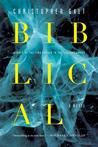 Biblical by Christopher Galt
My rating: 2 of 5 stars
“I’m an atheist, the way God intended me to be.” That’s the best line in the book. Fans of the TV series Lost will love this book. It’s full of episodes of bizarre, inexplicable, impossible, spooky occurrences, mostly involving temporal inconsistencies. People experience déjà vu, then see hallucinations of times past. Or are they hallucinations? They seem to be real. The visions are sometimes seen only by a single person. Other times, they are experienced by hundreds or even thousands simultaneously. A man burns to death in front of witnesses where there is no fire or smoke, or even unusual heat. There are mass suicides, accompanied by the enigmatic slogan “We are becoming.”
The main character, John Macbeth, is a psychiatrist. He and his medical and scientific cohorts try to explain away these phenomena by citing various clinical syndromes. The author spends about 200 pages more than necessary just to show off his encyclopedic research into mental disorders. Make that 300 pages. The pseudoscientific jargon gets old after a while, like after page 40 or so in this 440 page book. Okay, make that 400 unnecessary pages.
So there’s a character named Macbeth and an FBI agent named Bundy. Cute. The story line makes no sense, but it’s full of action and the author displays a healthy enough knack for dialogue. Goodreads says the author’s name is a pseudonym. I haven’t researched to see who Galt really is, but he seems to be a journeyman at this kind of thing. I picked this up thinking it was a mystery, but it’s really more science fiction bordering on fantasy. I can only give it an “Okay” but you may find it entertaining if you like to be mildly shocked and terrified in a cloud of mysticism.
View all my reviews
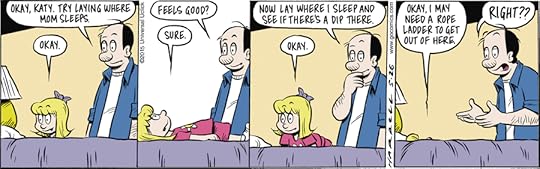
Lie, Lay, Lain
Lie, Lay, Lain
Is it any wonder so many people don’t know whether to say “lie” or “lay” when they see stuff like this? It is said wrong or spelled wrong so often the mistake almost becomes the rule.
The technical explanation is that “lie” is intransitive and “lay” is transitive, i.e. it takes an object. So you always lie down. You don’t lay down, not unless you have a bag of duck down and lay it on the bed. The confusion comes from the fact that the past tense of lie is lay. “Yesterday I lay down” is correct. “I’m going to go lay down” is not. “Lay down your gun,” is correct because gun is the object.
What about “Now I lay me down to sleep”? That’s correct, too, because of the “me” in the sentence. That’s the object. Without it the sentence would need “lie”, but that would spoil the meter, which why the author chose “lay me” instead. For the participle of lie, use lain. “I have lain here for over an hour but can’t fall asleep.”
That only leaves “lay” to deal with. Simple: lay, laid, laid. “Lay an egg,” “She laid an egg,” “She has laid an egg.” Simply put, the Adam@Home comic above laid an egg.
May 24, 2015
Anagrams on the News
GAY IRISHMEN = YE HAS MI RING
CANNES FESTIVAL = SILENCES A TV FAN
May 23, 2015
Free Blues Album
If you like acoustic blues, these self-proclaimed “old buddies” (not that old IMO) are offering a free album. I’ve downloaded it and they’re the real deal. Click on the video to play it and if you want the album click on the YouTube icon in the lower right which will take you to YouTube. The download URL is there under the video window.