Russell Atkinson's Blog, page 115
March 5, 2015
Sturgeon
My wife bought sturgeon today so of course I had to write a limerick:
An impecunious surgeon
Can only afford to eat sturgeon.
He'll save and he'll scrimp
Till the cost of gulf shrimp
Is something he's able to splurge on.


March 4, 2015
Anagram on the News
ERIC HOTEHAM = A HOMIER TECH
March 1, 2015
Anagram on the News
LEONARD NIMOY PASSED = I, NERD, AM SO OPENLY SAD
February 27, 2015
Movie Analysis, part III – Art
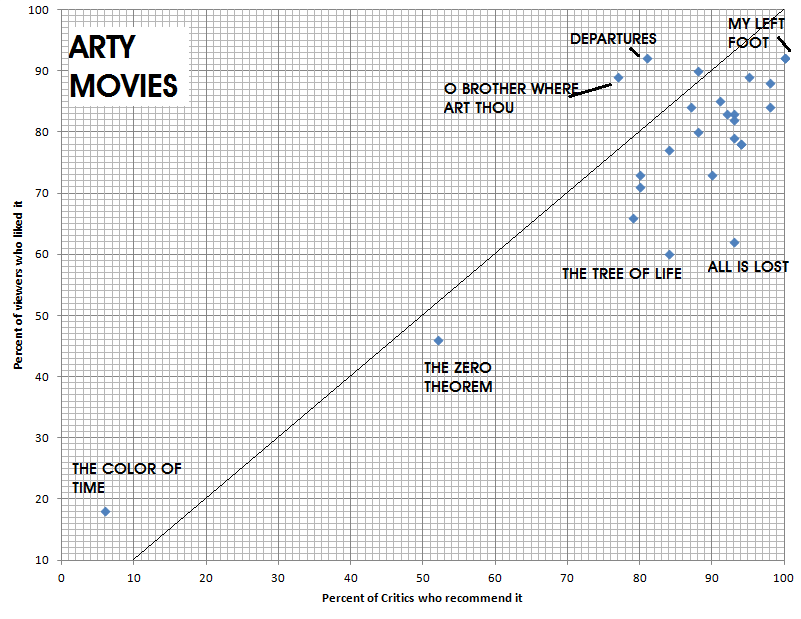
The next in my series of obvious conclusions is that movie critics like arty movies better than the general viewing public does. Take a look at the chart to confirm this if you feel a need. So what are “arty” movies? Again, very subjective on my part. Arty mostly refers to the art of movie-making, although I think there are a few movies where the subject matter of the movie is art or artists. I marked as arty any movie that seemed to use non-traditional (or formerly traditional but long out-of-favor) techniques (e.g. silent film, stop-motion, filming over 12 years or with 12 different directors), and movies that critics rather uniformly described as exceptionally artistically done. Since there aren’t too many, I’ll post the entire list at the end. Feel free to disagree with my label; it’s my blog so there’s nothing you can do about it. You can, however, contact me through the contact form on the “About the Author/Contact” link in the top menu. I’m obscure enough that I don’t hear much from readers, and I enjoy exchanging emails with those who do contact me. I used to allow comments on this blog, but 99% of them were spam, even with a spam filter, so I gave that up as a time waster.
I’ve marked a few outliers on the chart. For what it’s worth I liked Departures, My Left Foot, and All Is Lost. I didn’t like O Brother, Where Art Thou? I haven’t seen any of the other labeled ones. This will be the last movie analysis post for awhile, but I plan to keep adding movies and resume the analysis in future posts. There are still some surprises in store.
Here’s the list of “arty” movies:
My Left Foot
The Broken Circle Breakdown
The Commitments
Kon Tiki
The Tale of the Princess Kaguya
The Artist
Boyhood
Hugo
Force Majeure
All Is Lost
Birdman
Midnight in Paris
Nebraska
Coraline
The Spanish Prisoner
Life of Pi
The Tree of Life
Departures
Get On Up
Quartet
O Brother, Where Art Thou?
The Zero Theorem
My Winnipeg
Populaire
Song of the Sea
The Color of Time
February 26, 2015
Movie Analysis, part II – Politics
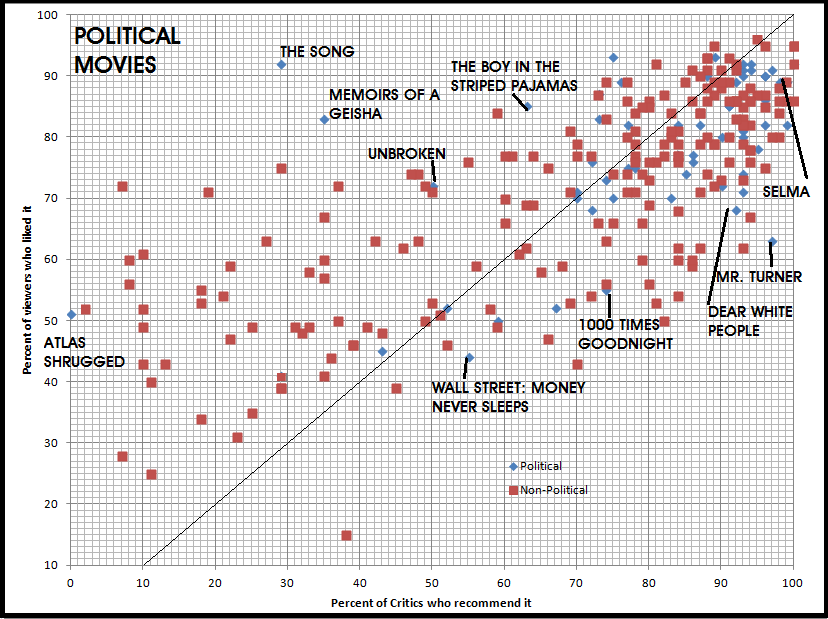
I’ll start with the conclusion here: movie critics are more liberal than the general population. Duh! This probably falls somewhere in the category of bears in the woods and the religion of the pope. Still, now you have data to prove it. The above chart shows political movies in blue and non-political ones in red. It’s not hard to see that a large majority of the blue diamonds are to the right of the diagonal line, meaning the critics ratings were higher than the viewers’ ratings. That could just mean that critics like political movies more than the general population does, and that’s probably true, too, but more significant is which movies fall on the right and left sides.
Before I go on, you may ask how I distinguished between political and non-political. I was a subjective judgment on my part, so feel free to discount the validity, but most were pretty obvious choices. Almost anything that had a strong theme related to traditional GOP-Dem type politics was included, but I also included anything heavily themed on social issues that are controversial or divisive, such as race relations, drugs, religion, women’s rights, and sexual orientation. Examples are Selma and Dallas Buyers Club. Less obvious are the ones I included because they were controversial or political within a particular community, even if not among the general public, such as Temple Grandin and Kon-Tiki. Most documentaries, fact-based (or “inspired”) movies, and biopics were included because they almost all dealt with controversial events or people. In case you’ve noticed some dots on this chart that weren’t there in yesterday’s, that’s because I used a larger percent of my database in order to include more political movies. Political movies in general had fewer viewers.
I’ve labeled most of the notable outliers, i.e. where the greatest differences are between viewers and critics. Since there are fewer of those on the left side, let’s examine those first. The Boy in the Striped Pajamas and Unbroken are both World War II movies where the Allies are the good guys and the Axis are the bad guys. It’s not difficult to see where these would be more appealing to conservatives than to liberals, but not by a great deal, which is why they rate fairly high with the critics, too. The Song is a faith-based story according to the description. You should be able to figure out which side of the political spectrum that falls on. As for Atlas Shrugged, if you are having trouble understanding why a total of zero critics liked it, go back to Poly Sci 1 or read the book. Perhaps less obvious to some is Memoirs of a Geisha. It’s not inherently political in its subject matter, although the notion of a geisha as an oppressed or exploited woman is not hard to put onto the political scales, but I think it likely offended critics for another type of politics: movie politics. The star was Chinese, not Japanese like the character, and the time frame depicted, spanning world War II, is one in which there was bitter hatred between those two nations. The director, screenwriter, and author of the book on which it is based are all white. I remember reading an article where the Hollywood elite allegedly thought this was an inherently Japanese story that should have been told and acted by Japanese, not their former enemies.
I’ll leave to you to look up the movies I’ve labeled on the other side of the line. I don’t think it will be difficult to reach agreement that they are more appealing to liberals than to conservatives. Lastly, we have to explain why the bulk of the blue diamonds falls to the right of the line, much more so than the bulk of movies in general. If movies, on average, are basically neutral, or equally biased on both sides, the dots should be more or less equal on both sides, if my premise about critics is true. That one is easy to explain. Movie makers and media people in general are more liberal than the general public. It is not the case that movies are evenly distributed over the political spectrum. A lot more “liberal” movies and made than “conservative” ones. Anyone who follows politics know that it is Democrats who go to Hollywood for campaign funds. Sure, we can point to Ronald Reagan and Clint Eastwood as conservatives, but they’re the exceptions that prove the rule.
February 25, 2015
Movie Analysis, part I

I enjoy playing with data from time to time, and I enjoy movies, so I decided to compare how critics rate movies and how the viewers rate them. Take a look at the above chart. First, for you data hounds and methodology freaks, I’ll describe how I compiled it. All the ratings come from Rotten Tomatoes or Flixster, so neither the critics nor the viewers represent the universe of people in either category. Older (i.e. not so computer/social media savvy) people and foreigners, for example, may not be well represented. The movies to be included come from several sources: the ones I’ve rented or rated in Netflix since January 2011, including ones I streamed; nominees for Best Picture at the academy awards 2011 – 2014; all movies that made the top box office listing either in theaters or rentals according to Rotten Tomatoes for the last three months or so; several lists from major publications of the best all-time movies of several genres, e.g. thrillers. This last category is the only one that includes many older films. I may have rented an occasional older film, but the data is skewed toward newer releases. I acquired data on almost 300 movies but then sorted it to take only the 250 that had the most viewer ratings to eliminate some oddball losers, cult films, etc. I wanted movies with sufficient viewer input to be statistically significant. The cutoff number turned out to be 3400 viewer ratings. The number of viewer ratings correlates highly with box office numbers, but there could be some movies that get an inordinate number of ratings from very avid fans despite mediocre box office success, or limited success in the U.S. All used for this chart also had at least 20 critics’ ratings except for three, which had 8, 10, and 13 on that website.
As I understand it, the critics were given only two choices: to “recommend” a movie or not. Viewers could rate on a five-star system, and the website converts that to a single number representing the percentage of viewers who “liked” the movie. That means the percentage who rated it 3.5 stars or higher. These two rating systems are not exactly equivalent, but the percentages of critics who recommend and viewers who “like” a movie are close enough in general to make comparison useful.
The diagonal line in the chart represents equality in percentages between viewers and critics. Each little blue diamond is the rating for a particular movie (or possibly more than one in the case of identical ratings). So any diamond to the left of the line is a movie that viewers rated higher than the critics and those on the right, the critics liked better. The closer to the upper right corner, the more a movie was a favorite in both categories.
So what does this chart show? Not much yet, since I haven’t shown you many movie names or other data, but I threw in a few teasers so you can begin to get an idea of what it could show. I labeled the ratings for a few of the outliers, that is, movies where the viewers and critics differed the most. What characteristics do you think would be most common in those movies to the far left of the line, i.e. fan favorites that critics hated? How about the other way? I’ll give you one that applies to outliers on both sides of the line: low viewership. Generally speaking, those movies were “specialty” movies that were seen and reviewed by relatively few people. This was not always true, however. Memoirs of a Geisha, for example, was a mainstream movie, although not a box-office smash by any means.
Wait! you may say. There’s Temple Grandin up near the corner, quite close to the diagonal line, highly rated by critics and viewers alike, yet it barely made the cutoff in terms of number of viewer ratings. True enough, but there are two reasons for this: first, it’s an older movie (2010) that I happened to rent a couple of years ago, and Rotten Tomatoes wasn’t as widely used back when it came out, and second, it’s a biopic (e.g. biographical in nature) of someone who was not widely known. I’ve found that documentaries and biopics generally got significantly lower viewership numbers than pure fiction movies of all types. Of course there are exceptions. And what about Whiplash, a movie that’s gotten the highest viewer rating of all, and you’ve probably not even heard of it? It’s at the opposite end of the timeline. It’s brand new and I’ve found that when movies first come out, they are generally watched (and rated) by those who are big fans of that particular genre, star, or in some case, series. The viewer ratings are usually high at first, but I can guarantee you that by the time that one comes out on DVD it will be several, maybe many, viewer rating points lower. So don’t put too much credence in the validity of these ratings, especially for brand new releases.
So there are a few hints about what the data can show. In future posts I’ll explore some of the interesting correlations I’ve found. I think they’ll surprise you. As a reward for reading all the way to here, I give you a list of the most popular movies (over 100000 viewer ratings) that were rated the highest by viewers and by critics. You may consider putting them on your list.
Top Viewer ratings:
1. Amélie
2. Rear Window (1954 version)
3. American Beauty
4. Guardians of the Galaxy
5. (tie) X-Men: Days of Future Past
5. (tie)The King’s Speech
Top Critics’ ratings
1. Rear Window (1954 version)
2. Toy Story 3
3. Gravity
4. 12 Years a Slave
5. True Grit (2010 version)
February 23, 2015
Anagrams on the News
BIRDMAN GOES BIG = BRINGS MEDIA GOB = BRING BAD EGOISM
BOKO HARAM THREATS = ABHOR THE AMOK RATS
February 18, 2015
The Good Girl by Mary Kubica
 The Good Girl by Mary Kubica
My rating: 3 of 5 stars
The crime being investigated in this book is a kidnapping, a refreshing change from the usual serial murderer. Mia is the daughter of a wealthy judge; she’s kidnapped by Colin, a ne’er-do-well from the underclass. The story is told primarily by three voices – Mia’s mother, the detective investigating the case, and Colin. The scenes switch back and forth from “Before” and “After”. During the “After” scenes we learn that Mia is back home with her mother months later, but is suffering from a memory loss, so we don’t don’t know what happened between those two nebulous time frames. Some people may find the changing voices and times disturbing or confusing, but I had no trouble following the storyline.
The author writes well and I found the characters credible. I’ve always liked seeing the same story told from multiple points of view, but that’s not exactly what happens here. The three characters are each telling different stories, i.e. what they did or what happened to them during the months. The ending has a twist to it that I didn’t anticipate, but I can’t say that contributed much. What makes the book interesting is the way the characters develop.
As a former FBI agent I know something about how kidnappings are investigated, although this begins as a missing person case, not a kidnapping. I found the police procedure part to be relatively believable and well-done, better than most such books by non-law enforcement writers.
View all my reviews
February 17, 2015
Redwood City in February – 68 degrees
I was geocaching with a friend recently and had my DJI Phantom with me so I took some random video and aerial stills. It was a cold (about 68 degrees F. at 11:00 AM) February day in Redwood City. Ha ha ha. Eat your heart out, Boston! And people wonder why anyone would live in California with our astronomical real estate prices.
Music credit: “Two Finger Johnny” Kevin MacLeod (incompetech.com) Licensed under Creative Commons: By Attribution 3.0
February 11, 2015
Anagrams on the News
AMERICAN SNIPER = INSANE CRIME RAP
YEMEN NOW = ENEMY WON