Michael Hyatt's Blog, page 60
June 28, 2017
What Ike’s Secret D-Day Letter Shows Us About Leadership
3 Things Eisenhower Got Right About Storming the Beaches
D-Day is known as a great victory for the allied forces, the beginning of the end for the Nazis as over 150,000 troops pushed into Europe in the first wave of an invasion by sea. But it easily could have gone the other way. We can learn a great deal from the difference.

A draft letter by Supreme Allied Commander Gen. Dwight Eisenhower shows us what kind of leadership it took to invade at Normandy on June 6, 1944. He didn’t take victory for granted and was fully prepared to take the blame if his plan failed.
Mea Almost Culpa
From the National Archives come these incredible words in Eisenhower’s own handwriting:
“Our landings in the Cherbourg-Havre area have failed to gain a satisfactory foothold and I have withdrawn the troops,” he wrote.
He explained that the “decision to attack at this time and place was based upon the best information available. The troops, the air and the Navy did all that Bravery and devotion to duty could do. If any blame or fault attaches to the attempt it is mine alone.”
The general obviously had a lot on his mind that day, because he accidentally misdated it for July!
There are 3 lessons that leaders of organizations can take from Eisenhower’s never delivered mea culpa.
1. Eisenhower practiced extreme ownership.
Extreme ownership is an idea that the civilian sector has borrowed from the military and we can see it on full display in Eisenhower’s own writing. It’s hard to get any clearer than “any blame or fault…is mine alone.”
Eisenhower was the general in charge. He had decided to invade in this place at this time. If it didn’t work out, he was going to get blamed anyway. He didn’t see any point in denying it or trying to deflect blame on the troops who he was already putting in the line of fire.
The general was prepared to do this because it was second nature to him. When we find ourselves facing great challenges in our organizations, we ought to be just as forthright in owning the problem and thereby owning the solution.
2. He used contingent thinking.
Eisenhower understood that should this go wrong, he was going to have to say something. He didn’t want to come up with something on the spot, so he committed thoughts to paper.
This is similar to what I mean when I say that activation triggers are so important. The letter is evidence of contingent thinking (“if x, then y”), which is an incredibly important tool for reaching your goals.
It helps if you think things out in advance, so that you do fewer stupid things in the moment. This isn’t being a fatalist, it’s acknowledging that there are going to be obstacles in our paths. We’ll fare better if we have some contingency, or kernel of a plan, for how to deal with those obstacles. In this case, he would have withdrawn the troops and looked for a better opening.
3. He addressed the downside.
There are limits to what we can know. We can’t see the future. Even with good information, we can only guess what other people are going to do.
In many ways, Eisenhower won on D-Day not by ignoring the downside of what his army was about to undertake, but by understanding exactly what was on the line—and working diligently to prepare them for invasion using all the means at his disposal.
One of those means was misdirection. He used a broken German cipher and props, including fake, portable tanks, to convince the planners of the Third Reich that the invasion would happen elsewhere. The ruse gave allied forces a fighting chance on the beach that morning.
“
If you think things out in advance, you do fewer stupid things in the moment.
—MICHAEL HYATT

Eisenhower thought the D-Day invasion was a good plan, and it was. About 5,000 troops died in the first wave of the invasion in an assault that could easily have cost tens of thousands of lives.
Yet it was a better plan than it otherwise would have been because he took the possibility of failure, and his role in it, so seriously. Leaders today could learn a lot from his example.
Question: Have you seen any of these characteristics modeled in current leaders or peers? What impact did it have on their team? You can leave a comment by clicking here.






June 26, 2017
5 Reasons You’re Still Procrastinating
How to Get Over It and Finally Get Things Done
At work, you feel stuck in the deepest rut of all time. You try to move forward but the groove is deep and you’re wedged in there pretty good. Sound familiar?

It happens to most leaders at some point. I’ve found the best way to get yourself out of the rut is to understand the reason you’re there in the first place. There are 5 big reasons that people get stuck along the way.
Reason #1: You aren’t clear about your goals.
Goals that lack clarity are merely wishes. “I’d like to make a million dollars this year.” Wouldn’t we all!
It’s better to set out ambitious but realistic goals that include the target and some concrete ways to reach it. “I am going to increase our sales this year by 10 percent by cold-calling a few prospective clients every workday” is a clearer goal that you just might achieve.
If you haven’t set a clear destination, don’t be surprised if you can’t seem to get any momentum.
Reason #2: You haven’t identified your why.
Motivation matters. There are plenty of ways out there to increase your productivity, but few of the folks who offer countless life hacks have stopped to consider the why of it.
So when you get stuck, step back and ask yourself, “Why do I want to reach this goal again?” and find your reasons: To make more money, to feel a sense of accomplishment, to take more time off, to go home this weekend and not have this hanging over my head.
Whatever your key motivations, when you find yourself dragging your feet, stop to remind yourself why you wanted to do this in the first place. Reconnecting with your why will always help.
Reason #3: You haven’t chunked the project down to bite-size pieces.
Goals are big things that are going to take a lot of effort over time to accomplish. People can get stuck focusing on the enormity of it. To reach your goals, focus instead on the chunks or steps that you’ll need to get there.
I should add the caution that while larger goals ought to challenge us, the steps toward getting to our goals should not. These steps need to be inside our comfort zone and ought to require little or no courage to do.
The trick is to cut the giant into enough pieces that he is no longer menacing.
Reason #4: You are distracted by too many tasks.
If left unchecked, the whirlwind of activity in your organization will constantly distract you from reaching your goals. So simplify.
The most helpful concept for me is what I call “The Big 3”. I teach that you should only have three main tasks per day. To focus on three and only three, you have to filter your tasks and eliminate, automate, or delegate everything that is outside your Desire Zone™.
You can also have a small list of non-essential tasks that can be handled at the beginning or the end of the workday. Your attitude toward these things ought to be, “If I get to them, fine, and if not, that’s okay, too.”
Reason #5: You haven’t built in any accountability.
According to Dr. Gail Matthews, built-in accountability is one of two primary ingredients for goal success. You need someone who will hold you accountable without succumbing to your excuses.
Their purpose in this context is not to shame you but to remind you of the road you set out on, and why getting over the finish line will be worth it.
“
Set ambitious but realistic goals that include the target and concrete ways to reach it.
—MICHAEL HYATT
Question: What’s one area in which you’ve been procrastinating lately? Which of these five reasons is the culprit? You can leave a comment by clicking here.


June 24, 2017




June 23, 2017
When Aptitude Is Not Enough
3 Questions to Ask Yourself Before You Shake Things up
I’ve said before many times that the key to job satisfaction is moving away from your Drudgery and Disinterest Zones and toward the Passion and Proficiency of your Desire Zone.

Some readers have raised a good question about this shift. “It’s easy to tell what I’m passionate about,” they tell me, “but how do I determine if I am proficient at something?”
Results Matter
It’s easy to assume that just sitting down and thinking through your professional strengths is all it takes to get clear on your proficiency. However, I don’t think that’s the case. In fact, I’d suggest that proficiency is something you cannot determine on your own, because it doesn’t exist in a vacuum. There is a lot of overlap between aptitude and proficiency but they are not the same.
Aptitude is an ability or knack for doing something. But we’re not necessarily going to be proficient at all those things we have an aptitude for, and the difference really matters.
In business, proficiency is externally validated. The attributes of proficiency – knowledge, skills, and experience – generate results that other people can measure and reward.
You’re not truly proficient unless you’re able to deliver results in the role you were hired for, or that you’ve convinced your organization to shift you into.
“
You’re not truly proficient unless you’re able to deliver results in your role.
—MICHAEL HYATT
This can be frustrating to workers who are tired of the job they have now but haven’t yet convinced their employer to move them into a different role.
In such cases, you may be tempted to throw in the towel and strike out on your own. That move could be either a great idea or a huge mistake. How can you tell the difference?
Don’t Quit Your Day Job
We’ll get to that in a second. First, let me suggest what you might do with an aptitude that does not clearly rise to the level of a proficiency.
Let’s say you’re good at hitting a baseball. That’s great, but it doesn’t mean you ought to quit your job and chase a career in the game. Instead you might join an adult team and play on weeknights and in weekend tournaments.
Or say you are good at playing the guitar. That doesn’t mean you ought to put together a band and tour the country. Maybe you can join the worship team at church or play with friends or come out to open mic nights and just enjoy it.
There shouldn’t be anything unsatisfying about this approach. Most of us have more aptitudes than we can realistically pursue in our professional life. It’s not a bad idea to use those aptitudes to help us figure out what to do to find fulfillment in our personal lives.
Ask Before You Leap
Now back to the question of when a career transition may be in order. Before you decide to change positions within your company or strike out on your own, I suggest that you ask yourself these 3 questions:
What do I feel passionate about doing instead of my current work?
Am I proficient at it?
How do I know that?
The last question is key. “I just know” is not a good answer. Again, it all comes back to external validation.
To take the two examples above, let’s say that while you are pursuing your aptitudes as hobbies, people see your talent and constantly encourage you to take it to the next level. Let’s further foresee that you get serious interest from a talent scout or a record executive.
These would be examples of external validation of your proficiency at these disciplines. When this happens, pay attention and at least consider moving your life into a whole new and more satisfying zone.
Because when you have both passion and proficiency, you can often get a third p into the equation that makes all of this possible: profits.
Question: In what areas do your passions and proficiencies overlap? What external validation have you received in these areas? You can leave a comment by clicking here.


June 21, 2017
How to Get More Cash Cows
4 Ways to Separate the Milk From the Dogs
It’s one of the toughest questions in business: Who should you be working with? Several years ago, when I was CEO of Thomas Nelson, I had one of those moments of clarity that has broad application for organizations.

The “aha!” moment came when I was thinking about our professional relationships with authors and agents. Some relationships were highly profitable and enjoyable. Others were also quite profitable but a constant drain on our staff and resources.
Still others were enjoyable but not very rewarding financially. And of course there were the worst kind of relationships from our perspective: unprofitable and annoying.
Drawing the Matrix
To sort them out, I imagined a two-by-two matrix, similar to the Boston Consulting Matrix. The horizontal axis represented maintenance and the vertical axis represented profit. Then I drew that matrix out. Click here to download the pdf.
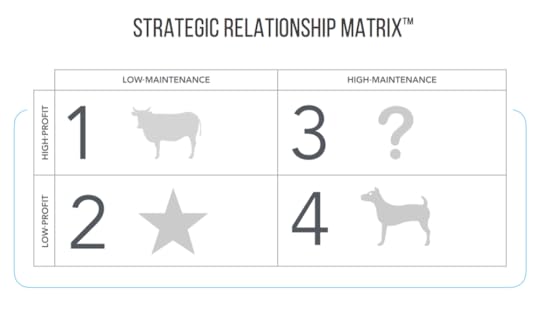
When I stepped back to look at it, I realized that it describes just about every kind of professional relationship you can have. That’s because every business relationship falls somewhere on the continuum of profitability: highly profitable, marginally profitable, or completely unprofitable. Every professional relationship also requires a certain amount of maintenance that we can plot on the other axis.
Setting Relationship Priorities
This idea became practical for me when I realized I could use this matrix to figure out how to prioritize my clients. It can provide that same clarity for you, too.
Priority 1
These are the high-profit/low-maintenance relationships. They don’t require a lot of energy to service, and they yield big profits.
Client relationships that fall into this category are delightful. Everyone is happy. The secret to success in business is to develop more of these relationships. They are the cash cows.
Priority 2
These are the low-profit/low-maintenance relationships. The reason these relationships are second in priority is because they have at least half of the equation right: they are low maintenance.
Your hope is that with a little work, you can also make them highly profitable. They are the bright and shining stars with lots of unreached potential. In terms of how you allocate resources, these should be your second priority.
Priority 3
These are the high-profit/high-maintenance relationships. These are probably the most frustrating. They seem too profitable to exit. But they require so much maintenance, you are often left wondering whether it is worth the effort. As a result, they are a perpetual question mark.
The key is to try and move these relationships into the Priority 1 quadrant. If you can’t do this, then it’s best to bite the bullet and exit the relationship. These difficult partnerships drain time you could otherwise invest in finding more Priority 1 relationships or in making your Priority 2 relationships more profitable.
Priority 4
These are the low-profit/high-maintenance relationships. They are “dogs” at least in terms of the value to your organization. They are a huge waste of resources. They wear out your staff. They have little or no potential. It can be tough to face, but the sooner you come to grips with this reality, the better.
Getting rid of relationships that fall into this category will allow you to reclaim resources you can invest in finding or serving Priority 1 clients. Typically, once you exit this kind of relationship, you wonder why you didn’t do it sooner.
Plot Your Relationships, Plot Your Course
I suggest that you take some time and plot your current business relationships on this matrix. Once you’ve done that, here are some practical strategies for how to proceed by region.
Priority 1 Action: Schedule time to prospect for more of these clients and make time to super-serve the ones you have. They may be low-maintenance but a little extra attention might pay big dividends.
Priority 2 Action: Schedule time to brainstorm with your team how to make these more profitable. You like working with these people. If you can make it more rewarding to do so, everybody wins.
Priority 3 Action: Schedule time to have the hard conversation about why this relationship might not be a good fit.
Be frank with these folks. Tell them that you value their contribution but you also value your team’s time and effort. Help them better understand the costs of what they’re demanding–and the impact of those demands on your working relationship.
Sometimes having that difficult discussion is all it takes to create a change in their behavior and move them closer to the low-maintenance category.
Priority 4 Action: Schedule a time to have the hard conversation with the client about why your relationship is not a good fit.
Be professional, though they may have been rude to you and your team. Tell them that you’ve done some hard thinking and it just isn’t worth doing this anymore, wish them the best, and call it a day.
Put Yourself on the Matrix
Incidentally, this Matrix also works in reverse. To determine where you might fall on someone else’s grid, just write a quick list of what would define a profitable, low-maintenance relationship in your space. Here’s an example of a list I made while I was at Thomas Nelson to gauge how we were doing.
Profile of the Ideal Publisher
High Profit
Low Profit
1. Demonstrates a win-win financial paradigm.
1. Demonstrates a win-lose financial paradigm.
2. Offers competitive advances and royalty rates.
2. Does not offer competitive advances or royalty rates.
3. Makes advance and royalty payments on a timely basis.
3. Takes forever to pay advances or is slow in paying royalties.
4. Maximizes product sales through every market channel.
4. Focuses on only two or three market channels.
5. Proactively manages client’s backlist and, as a result, maximizes royalty income.
5. Allows backlist titles to languish or slip out of print, costing the author royalty income.
6. Refers prospective author clients to us (i.e., the agent).
6. Wouldn’t think of referring a prospective author client to us, let alone do it.
Low Maintenance
High Maintenance
7. Sees the agent as a partner (i.e., a customer), welcomes his involvement, and reinforces his role with the author.
7. Sees the agent as an adversary (i.e., “the enemy”), resents his involvement, and tries to undermine his role with the author.
8. Has a standard contract for the agency so that contracts can be negotiated quickly.
8. Everything must be negotiated from scratch every time, adding cost and frustration.
9. Distributes easy-to-understand royalty statements.
9. Distributes confusing royalty statements.
10. Responds promptly to inquiries, proposals, and completed manuscripts.
10. Is slow or negligent in responding to inquires, proposals, and completed manuscripts.
11. Takes the initiative to prepare a written marketing plan and follows up on it.
11. Only prepares a marketing plan when the agent demands it and then, once created, hopes the agent and the author forget about it.
12. Proactively provides information—including sales information—to the agent on a regular basis.
12. Reactively provides information to the agent—if at all.
13. Under-promises and over-delivers, thereby making the agent look good with his or her clients.
13. Over-promises and under-delivers, thereby making the agent look bad with his or her clients.
14. Includes the agent in all communication with the author.
14. Circumvents the agent either intentionally or unintentionally.
15. Responds quickly to rights reversion requests.
15. Drags feet in responding to rights reversion requests.
Looking it over, I realized that we had some improvements to make so that we could land in more authors’ and agents’ Priority 1 zone. After all, isn’t that where we’d all like to be?
You Decide the Quality of Your Relationships
Here’s why it matters: In business, it’s easy to slip into a limiting mentality that the quality of your relationships is beyond your control. That’s especially true when you have a difficult client whose business is paying your bills. But that’s the beauty of this Matrix. It provides you the clarity you need to take informed action.
Now that you have a tool to measure the quality of your relationships, you have the agency you need to improve them. Perhaps for you that’s scouting for new Priority 1 clients, or setting up systems to make a Priority 3 client lower-maintenance, or working to better your own business practices to become the kind of partner everyone wants.
“
The secret to success in business is to develop high-profit, low-maintenance relationships.
—MICHAEL HYATT
Whatever it looks like for you, choose a next step and get busy improving the quality of your business relationships. A more enjoyable work life (and perhaps an increase in revenue) are waiting for you on the other side of those efforts.
Question: What is your next step to increase the quality of your business relationships? You can leave a comment by clicking here.


June 19, 2017
How to Fire a Monster Client: The Steps
4 Ways to Let Go and Move on to Greener Pastures
When I wrote recently about firing monster clients who eat up disproportionate time and resources, one reader replied, “Great idea. Do you have a guide for how exactly we should do that?”

It was a good question. A guide like that would have been useful to me earlier in my career. I have had to let many clients go over the years, and it hasn’t always ended well.
First Warning Signs
For instance, when I was CEO of Thomas Nelson I had an author I’ll call Mary. She was really full of herself. She wanted her book fast-tracked, so we were pushing it through production and pushing the contract through legal at the same time. That’s almost never a good idea, by the way.
When Mary got the initial mock-up of the cover from the designer, she didn’t like it. That was fine. We could’ve done something else. But she said to the designer, “This is unacceptable. My guess is you’re only pushing this particular concept because you’re fat.”
The designer came to my office in tears, told me what happened, and asked what we could do about the cover.
Now, I can take a certain amount of abuse myself, but when you mess with my team that’s a different story. I called up Mary and asked if she had said that to the designer. She admitted it.
“What were you thinking?” I asked, and not rhetorically.
“These are the people that are here to help you succeed,” I said. “This doesn’t help you. This doesn’t help me. I have your contract on my desk. I’m not going to sign unless you send the designer flowers to arrive tomorrow with an apology.”
Mary apologized and did what I asked but made it clear in the next few months that she had learned nothing from being called on the carpet.
If at First You Don’t Fail
About six months later, the publicist assigned to Mary’s book told me she was extremely difficult to work with. She was rude and refused to cooperate with simple requests. In fact, she had called the publicist an idiot.
So I picked up the phone and called Mary again. She admitted she called the publicist an idiot and didn’t stop there. She spewed nothing but complaints against a person who had been working very hard to promote her book.
I let her go on for a minute and then cut her off. I told her that she didn’t know what she was talking about, that this publicist was one of the most respected in the industry, and that I was cancelling the next two books of her three-book contract.
“This is the last conversation you’re going to have with me,” I said and angrily hung up.
After I got off the phone with her, I started feeling remorseful. I called her agent, told him what had gone down and invited his feedback. He had had similar experiences with her, it turned out, and he decided this was the final straw for him as well.
So how did I do? As we will see from looking at the steps below, I did some things right and some things wrong in firing Mary. Here’s how I would fire a monster client today:
Step 1: Identify the Problem
Before you fire a client who has done something that you don’t like, do some evaluation. Ask yourself: Is this a pattern of behavior or is this a one-off? All of us can have monster moments. Next question: Does it square with your values? If it’s a character issue, I know I’ll ultimately have to let them go, but it’s also important not to make snap or ill-informed judgments.
That’s why I called Mary up, asked for her side of the story, and gave her a chance to make things right. I went ahead and allowed the first book to be published because at least she was honest about it and did what I asked. Had that been the end of it, she might not have been a monster client.
Step 2: Evaluate the Problem Client
As you work with clients, patterns of behavior start to emerge. Some relationships will be great. Others will be decent with occasional rough patches. And others will represent an ongoing drain on you, your team, and your resources.
In the second phone conversation with Mary, I determined she was a drain. Like the previous infraction, she treated one of my team members badly. But this time her response was even worse. This time she doubled down by badmouthing my publicist to me.
Enough was enough. She was obviously never going to improve, so I knew what I had to do.
Step 3: Initiate the Break
Firing Mary was the right call, but probably not the way I did it. If you experience remorse after you do something, it’s a good indicator some part of what you did was not kosher.
When firing monster clients, you are going to have to initiate the break, but you should be in control and not let your anger get the best of you. Yes, this person might have been pushy, insulting, and demeaning. But your job is to end the business relationship, not tell her off.
“
Don’t spend all your creative time maintaining horrible clients. Fire them and move on.
—MICHAEL HYATT
There are two ways you can initiate the break:
Either have a hard conversation and be done with it, or
Change the relationship in such a way that they want to move on.
You can raise your rates significantly, for instance, and monster clients will usually move along.
Step 4: Move On
You’ve got to take the high road with monster clients. Learn your lessons, but don’t badmouth former clients. (And, yes, many biographical details of Mary have been changed to protect her identity.) Instead, move on and make new plans. It’s healthy for you and can be even better for your business.
I’ve never regretted firing a monster client. But too often people put up with monster clients because they wonder, “How will I replace him and the revenue he brings in?”
The problem is you’re spending all your creative time to maintain a horrible relationship. Imagine what would be possible in your business if you had all that capacity and energy back. My guess is that you could quickly and easily replace your monster client in a way that’s more profitable and won’t keep you up at night.
Question: Have you ever fired a monster client? How did you handle it? You can leave a comment by clicking here.


June 17, 2017



June 16, 2017
Why You Don’t Need to Be Involved in Every Social Media Channel
3 Simple Steps to Get Traction and Build Your Following
I get asked a lot, “How do you find time to do it all? If I participate in every social media channel, I don’t have time to do anything else!” Exactly.

The reality is that I don’t do it all. You can’t be everywhere in social media—and you won’t be effective trying. But the good news is that if you narrow your focus, you can get serious traction and build your following.
There’s an old Chinese proverb that says a person who chases two rabbits catches neither. We’ve all seen that in dozens of different contexts, haven’t we? The more we add to our plates, the less we accomplish. We waste our efforts because we can’t focus them.
Social media is no different. Thankfully, the old proverb can teach us three simple steps to get traction and build our social media following:
Pick your rabbit. You can’t master every channel, but your audience isn’t in every channel. To get traction and build your audience, you need to focus where your audience most heavily congregates.
There are several ways to find this out. You can do a reader survey or research the available demographic data, but the best place to start is a simple inventory of your current social media engagement. Where you getting the most traction right now? Focus your attention there.
Study your rabbit. Once you’ve chosen the channel where your audience is congregating, serve them better by studying the culture of that channel. Every channel has a culture of its own. Signing up for every service, posting the same content the same time in each one, and hoping something sticks is a recipe for failure.
A couple of years ago, I almost quit Facebook. Why? I didn’t understand the unique culture of Facebook. Once my friend Amy Porterfield explained it to me, it started making sense, and now it’s a major part of my strategy. Every channel has tricks and nuances that will enrich the experience of you and your audience.
Bag your rabbit. Now that you’ve identified the channel and have spent some time learning its unique culture, it’s time to bag the rabbit.
What content works best for your chosen channel? Create that content.
What are the best times to post? Post at those times.
What level of engagement is best? Engage at that level.
What if you already have some presence in several different channels? I would post as minimally as possible in the peripheral channels—put them on autopilot if you can—and double your efforts in your main channel. That’s where you want to focus your attention and cultivate your audience.
Once you’ve bagged one rabbit, you can pursue another. I heavily focus on Facebook, Twitter, and Instagram. It took me a while to get the hang of Instagram, but I’m now getting great traction and building my following.
“
You can’t be everywhere at once, and you won’t be effective trying.
—MICHAEL HYATT
It’s critical for long-term success that you enjoy working in the channels you choose. Sometimes we hear that such-and-such channel is key and if you don’t have a presence you’re sure to fail. But that’s not so.
All you need to do is pick the channel that works best for you and your audience. If you follow these steps, I’m confident you can get the traction you want and build the following you deserve.
Standing out online takes time and strategic work. This just scratches the surface of what you could do—and the traction you could achieve—as you build your online presence. Most people use social media as a traffic booster and a way to engage with people following their blogs or websites.
If you’re interested in more ideas for engaging well online, you’ll love Platform University. This is a membership site I founded that can give you expert knowledge on gaining more readers, fans, followers, and customers online. People who join Platform University are ready to make a positive impact on the world around them, and they do it with the essentials they learn in our content library and private community.
Public enrollment for Platform University is almost over. It closes TONIGHT after 11:59 p.m. Pacific, so make sure you check it out now!
Question: What social media channel do you get the most engagement on? Why? You can leave a comment by clicking here.


June 14, 2017
George Washington Shows Us How Leaders Are Readers
5 Lessons From America’s First Bookworm-in-Chief
Most Americans think of George Washington as a great leader and the father of our country, but I bet few of us think of overdue library books.
When Washington was president, he borrowed two books from a New York library and forgot to return them. According to a humorous but true story the fines for books that late might come to $300,000 today. His estate at Mt. Vernon paid a whopping $12,000 to replace just one of the missing volumes.
Bookworm-in-Chief?
While we tend to remember Washington as a man of action more than letters, he was both. Most leaders are also voracious readers. As the new book George Washington: A Life in Books reminds us, Washington was a great collector and a diligent reader of books.
Amazingly, as author Kevin Hayes notes, “No one ha[d] ever written an intellectual biography of George Washington” before he tackled the subject. In fact, he says, “One historian sought to discourage me, asserting that the documentary materials simply do not exist to tell such a story.”
Many of Washington’s contemporaries were literary stars. Benjamin Franklin was as famous for his words as for his diplomacy. Thomas Jefferson’s library formed the core of the Library of Congress. And Alexander Hamilton’s pen is selling out Broadway plays today.
But Hayes was onto something. Washington wasn’t showy about it, yet he took book learning seriously. It just took a bit more work to gather together the clues.
It turns out that Washington’s library was broken up, and much of it was sold off after his death. So Hayes tracked many of those books down to see what our first president wrote in the margins.
From those marginal notes, from Washington’s published and unpublished writings, and from his library catalogues, the historian was able to give us a much richer picture of Washington’s mind at work.
5 Lessons from Washington’s Reading
Based on what he presents in his book, it seems to mere there are at least five lessons Washington’s reading can teach leaders today.
1. Read Widely
One myth about Washington is that he preferred only practical writing, instructing him how to best fertilize his farm and soldier and the like. Hayes shoots that down hard. Of course Washington read practical books. He also read biography, poetry, history, and novels.
Washington didn’t stick to things that were immediately relevant because he had a big enough imagination to see beyond that. As his life showed, that sort of imagination can help leaders to see what others might not.
2. Use Books to Challenge Yourself
The first book Hayes could find that Washington put his signature to—as in, “this book belongs to George Washington”—was The Sufficiency of a Standing Revelation in General, and of the Scripture Revelation in Particular, by Rev. Offspring Blackall. Typographical evidence shows that Washington likely got the book when he was just nine years old but didn’t tackle it until his mid- to late-teens.
“Even if he could not fully appreciate the book’s text when he inscribed the title page in his boyhood, he apparently looked forward to the day he would,” says Hayes. “Understanding Blackall took on the quality on an intellectual goal, something to strive for and achieve.”
We can also use books to challenge ourselves. Most of the books we read can be either practical or for leisure, but once in a while we ought to tackle something tougher to stretch our minds and sharpen our thinking.
3. Organize Your Personal Library
The future general and president took great care in organizing his library. He catalogued his books to help get a handle on the information swirling on the pages around him.
It might not be necessary for us to be as meticulous as Washington was. But it’s a good idea to have some idea how your library is organized so you can retrieve books quickly when you want to consult them.
4. Record Your Thoughts on Books
Washington wrote in the margins of some books, kept a diary which mentions books and wrote more than 900 pages of notes on what he had read.
We can do all of those things today to record our thoughts and return to them. In fact, it’s far easier today with keyboards and note-taking apps like Evernote. Here’s the system I use and recommend.
5. Use Your Learning to Write Your Own Thoughts
We don’t often think of Washington as an author. But during his life, Washington actually published a few short books. And he was a great writer of letters. The Library of America collection of his writing is almost 1,200 pages long.
“Washington was a reluctant author, but sometimes his professional responsibilities compelled him to publish what he wrote,” Hayes tells us. And it’s the same with leaders today.
“
Imagination can help leaders to see what others might not.
—MICHAEL HYATT
If we’re reluctant to write down what we’ve learned along the way, we should consider Washington’s example—not only in writing but especially in reading. The books he read shaped the nation he led.
Question: As a leader, what do you do to maximize your reading experience? You can leave a comment by clicking here.


June 12, 2017
Reach Is Not the Same as Influence
How to Build Trust and Make an Impact Online
One way you can reach a larger audience quickly is to piggyback on established email lists from bloggers and businesses with similar interests.

“Third party email marketing, whether for Business to Business (B2B) or Business to Consumer (B2C) is a great way of finding new customers and can be an awesome resource for new, fresh leads,” Andrew Paul explains in a post for Email Answers.
He’s right, but there’s a catch. Social media experts often describe email lists in terms of size and freshness—in other words, “How many people opted in to this email list and how recently?” But there’s a third factor at work as well: influence.
Looking to make an impact online? Grow an engaged following with Platform University, the all-in-one solution for building a successful blog, website, or social media page. Don’t struggle any longer to share your important message with the world. Get access to all the expert resources you need for just $1.22 a day. Public registration ends on June 16 at 11:59 p.m. Pacific, so enroll now!
Paper Influencers
Back when we were launching 5 Days to Your Best Year Ever™ the first time, I noticed something peculiar. A few affiliates who had the biggest lists did not get the greatest results. Several affiliates with smaller lists produced far more sales than we expected. The same thing has happened in subsequent launches.
I had seen something similar in book publishing when I was CEO of Thomas Nelson. An author might have a significant platform on paper—big social media numbers, a large email list, and so on.
But those numbers didn’t always add up to action. Sometimes an author’s new book would release, and people on their lists didn’t seem to care.
I wondered, “Why the disconnect?” After some digging, I decided It comes down to three factors: investment, trust, and expectation. Miss these and you’re not going to get the results you want.
1. Is Your Audience Invested in Your Message?
Wired magazine cofounder Kevin Kelly introduced the idea of “1,000 True Fans” in a classic article. He argued that most creators won’t ever see blockbuster success. But they can have enough success to sustain a profitable business if they cultivate 1,000 true fans.
“A True Fan is defined as someone who will purchase anything and everything you produce,” says Kelly. “They have a Google Alert set for your name. … They can’t wait till you issue your next work.” In other words, they are invested in you, and your message.
This is critical when building a list because subscribers who aren’t invested won’t move the needle. The affiliates with smaller lists drove more sales because their audiences cared enough to respond when they spoke.
2. Does Your Audience Trust You?
What the smaller affiliates in the launch lacked in size, they made up for in trust. When they said a product was worth buying, their audiences believed it and acted on it.
Trust comes down to one question: Can I count on you? If audiences can rely on you for high-quality content and recommendations that interest them, then even a small list can churn big numbers. The affiliates with smaller lists drove more sales because their audiences counted on their recommendation.
3. Does Your Audience Expect to Buy?
Some of the affiliates that were okay in the first two departments still had trouble making the sale because their audience did not expect the product pitch, the price, or maybe both.
True Fans are happy to buy when the offering fits their needs. Not everybody on a list is a True Fan. So when they see a pitch they ignore it or even scoff at it.
That’s why the size of the list almost didn’t matter. A person with a small list of people who expect to buy from time to time will see far better results than a person with a massive list of people who expect everything for free.
You’ve got to train followers to expect the pitches. The goal is to turn lesser fans into True Fans. It takes time and practice, but eventually you can find and cultivate relationships with people who love to buy what you curate and create.
Looking to make an impact online? Grow an engaged following with Platform University, the all-in-one solution for building a successful blog, website, or social media page. Don’t struggle any longer to share your important message with the world. Get access to all the expert resources you need for just $1.22 a day. Public registration ends on June 16 at 11:59 p.m. Pacific, so enroll now!
In business as in life, the quality of relationships matters much more than the quantity. That’s why hustling to build a big list is not as important as laboring to create greater investment, deeper trust, and eager expectation with your True Fans. They’ll keep coming back for more.
“
In business, the quality of relationships matters much more than the quantity.
Question: Have you been more focused on the size of your list—or the quality of your connection with your audience? What do you need to do differently? You can leave a comment by clicking here.