Michael Hyatt's Blog, page 64
April 20, 2017
Why I Decided to Publish a Paper Planner
Achieve Your Greatest Goals by Keeping Them in Your Day-to-Day Routine
Late last year I read David Sax’s new book, The Revenge of Analog. The premise? After years of being pushed aside by digital solutions, analog applications have been making a surprising comeback. That resonated with my own experience.

Most of my audience knows me as a techie. But I was in the book business for decades, and I love paper. It’s the best reading app around.
I’m also convinced it’s the best way to ensure you stay productive and reach your goals. That’s why I’m so excited about my brand new Full Focus Planner™.
When I first announced it last week, there was a lot of excitement—and some curiosity. Some asked, Why would you release a paper planner? Isn’t that a step backwards? Not at all.
There are three basic reasons I was convinced the first version of The Full Focus Planner™ had to be analog.
1. A Concrete Solution for a Real-life Problem
One of the biggest reasons people don’t reach their annual goals or feel swamped by their daily tasks is that there’s no practical link between them.
In the whirlwind of daily life, people lose visibility on their major goals and initiatives. Once that happens, it becomes harder to filter the important from the merely urgent. Projects start cramming the week without adding up to real achievements.
Despite people’s best intentions, they soon find themselves overwhelmed and no longer making progress. They can’t see the forest for the trees, and they feel lost in a maze of mundane tasks.
If that sounds like you, the last thing you need is another mobile or desktop app.
“
If you’re swamped with your task list, the last thing you need is another mobile or desktop app.
—MICHAEL HYATT

Digital solutions fall easy prey to the out-of-sight-out-of-mind problem. Instead, going analog is one of the best tricks for maintaining goal visibility. A physical tool like The Full Focus Planner™ keeps your goals front-and-center and makes them a cinch to review.
It also allows you to easily connect your goals to your daily task list, so you’re taking definitive action to achieve what matters most each and every day. I’ve been doing this for years now, so it’s second nature for me. But I wanted to design a product that would connect the dots for everyone else.
2. Your Brain Likes Paper More than Screens
There are many benefits to digital planners, but they’re not always best. In fact, research shows people who take notes on paper actually learn and retain more than those who use laptops. Why?
The reason is that handwriting:
Engages different parts of your brain
Forces you to more fully process your thinking
Creates more and better memory cues for later recall
Gives you an edge in understanding and remembering concepts
Manually writing notes and tasks, and processing your day and week on paper, engages your mind on a higher level.
In addition—and you probably know this from painful experience—digital devices can be incredibly distracting. When it comes to focused work, they can get in the way by tempting you to jump between applications, chopping your focus into smaller and smaller fragments.
“Computers are not inherent sources of distraction,” says Professor Clay Shirky, “but latter-day versions have been designed to be, because attention is the substance which makes the whole consumer internet go,” adding, “hardware and software is being professionally designed to distract.”
Who’s got time for that? Not me. Not you. Paper is brain-friendly tech.
3. Focus Is Your Most Powerful Tool
The issues of visibility and distraction both relate to focus. And this is critical.
The difference between achieving your goals and not achieving your goals has almost nothing to do with your available time. We all get 24 hours a day, 168 a week. The way to achieve your goals is to make maximum use of the time we all have by leveraging the kind of focus very few know how to harness.
To help you do that, The Full Focus Planner™ incorporates not only my proven goal-achievement methodology, it also includes several key frameworks from my personal productivity system.
This not only forms the practical link between major goals and daily tasks, it also keeps you laser focused on the next actions that will move the needle. And with regular review cycles built in, you can quickly get back on track even if you temporarily lose sight.
“
To achieve big goals, you must leverage the time we all have with the focus few know how to harness.
—MICHAEL HYATT
I’ve used and examined dozens of planners over the years. Honestly, none met my expectations or my standards. That’s why I decided to create The Full Focus Planner™. I was committed to designing a solution I wanted to use myself.
I’m convinced you’ll want to use it too. It’s the best system I know for integrating goal achievement and personal productivity. And to ensure you can immediately put it to work for yourself, I created eight short coaching videos to walk you through each of the features and show you how I use it.
The Full Focus Planner™ is available for preorder, starting today. You can find out more by clicking here.
Question: Do you struggle to coordinate your daily tasks with your yearly goals? You can leave a comment by clicking here.






April 19, 2017
Recovering the Lost Art of Note Taking
5 Simple Ways to Create Your Personal Time Machine
If you spend much time in meetings or presentations, note taking is a survival skill. But I’m surprised at how few people bother to do it. Those who do sometimes express frustration at how ineffective it can be.

I don’t recall anyone ever teaching me how to take notes. I didn’t learn it in school—not even college. Nor did I learn it on the job. It was something I had to pick up on my own.
That’s probably true for a lot of people, and I bet it’s why so few people bother to take notes. No one has ever told us why it’s important or how to do it. That ends here. I’m going to share not only why you should take notes but also offer four suggestions on how to do it better.
Reasons for Note Taking
To begin with, note taking enables you to stay engaged. The real benefit is not what happens after the meeting but during the meeting itself. Taking notes not only keeps us focused, it also triggers critical, constructive thinking.
If I don’t take notes in meetings or presentations, my mind wanders. But when I do, I stay more alert and involved. As a result, my contribution is more likely to add value. For this reason, I take notes even if someone is officially taking minutes.
Note taking also captures in-the-moment insights, questions, and commitments. Not everything can be resolved immediately. Some ideas take incubation. Questions require further research. Commitments require followup that cannot be done until after the meeting. Without a way to capture these, they’ll just get lost.
Your notes are like a time machine that let you go back days, weeks, even years. I can’t tell you how many times my notes have saved my bacon—not only when trying to resolve a dispute, but in holding people accountable or retrieving a key insight I subsequently forgot.
Finally, note taking communicates the right things to the other attendees. This is probably my favorite reason of all. When someone takes notes, it communicates to everyone else that they’re actively listening and that what others are saying is important.
If you’re in leadership, it also subtly establishes accountability. Your people think, If the boss is writing it down, he probably intends to follow-up. I better pay attention. As a leader, your example speaks volumes. If you take notes, your people will likely take notes. If you don’t, it is likely they won’t.
But how can you more effectively take notes?
5 Ways to Create Your Personal Time Machine
There are numerous note-taking systems. Here is the one I use:
1. Choose the Right Tool
If you have something that’s working for you, great. It could be an state-of-the-art app or yellow legal pad. Whatever’s working for you, stick with it. I usually recommend a journal-formatted notebook, specifically Moleskine. I’ve used the Large Ruled Journal for years and never go anywhere without it.
2. Give Your Notes Structure
Especially if the meeting or the presenter is unstructured. I give each new meeting or subject its own heading, along with the current date. Imposing order and hierarchy with headers, numbered sections, and nested bullets is a big help. This focuses your thinking and simplifies review and retrieval.
3. Record Whatever’s Important or Interesting
I recommend recording any or all of the following things: the presenter’s outline, questions being asked or addressed, key insights you have independent of what’s being said, along with any useful illustrations, jokes, anecdotes, diagrams, or quotes.
4. Use Symbols So You Can Quickly Scan Your Notes Later
I indent my notes from the left edge of the paper about half an inch. This allows me to put my symbols in the left margin. I use four:
If an item is particularly important or insightful, I put a star next to it.
If an item requires further research or resolution, I put a question mark next to it.
If an item requires follow-up, I put an open square next to it. When the item is completed, I check it off.
If I have assigned a follow-up item to someone, I put an open circle next to it. In the notes, I indicate who is responsible—or just put their initials the circle. When the item is completed, I check it off.
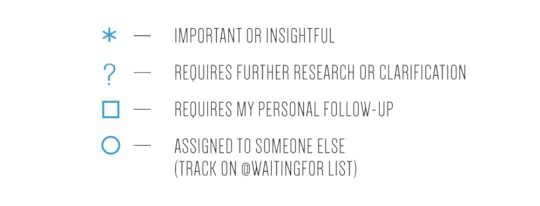
(By the way, I recommend this system in my new Full Focus Planner™. Sign up here to be the first to know when it’s available.)
5. Schedule Time to Review Your Notes
This is key. I scan my notes immediately after the meeting if possible. If that is not possible, then I do it at the end of my workday. If I miss several days, I do it during my weekly review.
Regardless, I take action on those items that I can do in less than a few minutes. Those that will take longer I drop in my task manager and intentionally procrastinate till a later date.
No one can count on total recall. Great notes are the closest thing to a time machine we’ll ever get.
“
Taking great notes is the closest thing we’ll ever get to a time machine.
—MICHAEL HYATT
Question: What do you find helpful when you are taking notes? You can leave a comment by clicking here.


April 17, 2017
4 Essential Disciplines for Getting Things Done
How to Avoid the Death of Your Project
Do you remember the last time a major initiative died in your organization? Did it go down with a loud crash, or was it slowly and quietly suffocated by competing priorities?

Organizations operate within a whirlwind of activity. All the calls, meetings, deliverables, and urgent deadlines combine to smother new initiatives.
But, if we take the advice of FranklinCovey’s Chris McChesney, we can step outside the whirlwind and make progress on major goals.
McChesney is the bestselling coauthor of The 4 Disciplines of Execution. He has helped organizations such as Marriott, Kroger, Coca Cola, and Lockheed Martin implement the 4DX process to achieve large-scale positive change in their organizations.
I recently spoke with McChesney about the 4DX process. Studying how organizational initiatives break down and what it takes for them to succeed has been his “myopic focus” since 2001, he said.
My team has already benefited from the 4DX process. We started using the system last year. I bet mastering these four disciplines can help your team as well.
1. Focus on the Truly Important Goals
Most of the tasks in the day-to-day running of your organization are urgent but not necessarily important for creating high-level change. These tasks represent the whirlwind, and they have their purpose.
“Please don’t think that the whirlwind is bad. It’s life support. That’s what’s keeping you alive,” he told me.
He even went so far as to suggest that organizations “give the whirlwind 80 percent” or four days out of a five day workweek. But he begged companies, “Don’t let it take 100 percent.” We’ve got to preserve time and energy for truly important goals.
When setting these goals it’s important to be specific because goals often “masquerade as concepts.” It’s important to translate those concepts into targets and then break those targets down into smaller pieces.
Ask, “What’s the starting line? What’s the finish line? By when?” said McChesney. “That has a way of locking in an idea.”
2. Act on Lead Measures
In pursuing goals, McChesney makes a crucial distinction between lag and lead measures. Lag measures are what has happened. It’s important information to know but not as important to achieving goals as lead measures.
Lead measures are measures of what is being done—by individuals, by teams, by the company as a whole—to drive toward your larger goals. Instead of looking back, they’re all about what’s happening right now.
This information is often harder to track but far more important to keep things on track.
3. Keep a Public Scoreboard
To ingrain important goals into your organization’s culture, you need buy-in across the organization. The best way to do that is to turn your goals into a game that matters to all of the players.
Rex Tillerson, current U.S. secretary of state, did this when he was CEO of Exxon Mobil. He devised a badge system based on his experience as an Eagle Scout.
According to most accounts, his employees thought these corny at first but found themselves competing for them anyway. They couldn’t help themselves. They came to enjoy the game and moved the company forward in the process.
4. Build in Accountability
The best way to fight back against the whirlwind is to make the truly important urgent as well. To do that, McChesney recommends establishing a brief, regular check-up meeting.
While people are working, they’re thinking about what they’re going to present in the weekly meeting. It’s not just a question of how did I keep the plates spinning? Instead, it’s how did I advance my organization’s goals?
It’s a great strategy my team has taken to heart. Every week we check in and track how we are working to win the game.
Why It Works
McChesney spent a lot of time discovering these four disciplines and eventually backward-engineered them from personal and organizational successes.
The most surprising thing to him and his colleagues, he said, was just how well it worked when people implemented the system in real life. Even cynics in organizations found themselves playing the game and making positive contributions.
“
Don’t just keep the plates spinning. Determine which activities will actually advance your goals.
—MICHAEL HYATT
To learn more about the four disciplines, check out my conversation with Chris McChesney and his book, The 4 Disciplines of Execution.
Question: Which steps do you need to take today to accomplish your current priorities? You can leave a comment by clicking here.


April 15, 2017



April 14, 2017
No New Blog Post Today [Good Friday] [Announcement]

No New Blog Post Today [Good Friday]
I am not posting a new blog post today in light of Good Friday. I hope you enjoy time with family and friends during this holiday weekend. I look forward to connecting with you again next Monday.


April 13, 2017
The 2 Most Important Qualities You’ll Need to Succeed [Appearance]

In this Entrepreneur article, my quote, “You can’t steer a parked car.”, is used to explain why you must get moving to succeed.
Event:
The 2 Most Important Qualities You’ll Need to Succeed


Why United’s PR Disaster Didn’t Fly
In Time of Crisis CEOs Must Exercise Extreme Ownership
United Airlines CEO Oscar Muñoz apologized Tuesday afternoon to the doctor who was forcibly removed from an over-packed Chicago-to-Louisville flight on Sunday.

Muñoz called it a “truly horrific event.” “No one should ever be mistreated this way,” he said, pledging on behalf of his company, “we take full responsibility and we will work to make it right.” United would “fix what’s broken so this never happens again.”
But will that be enough to restore the billion-plus in lost market value and regain the trust of countless consumers? It’s hard to tell at this point because of how badly he bungled the crisis when it mattered most.
How Not to Apologize
Muñoz initially offered a defensive, legalistic apology Monday in public and then backpedaled on most of that in a letter to employees that quickly leaked to the public.
In that letter, Muñoz called his customer, Dr. David Dao, “disruptive and belligerent.” He said that United employees “followed established procedures” in calling in airport security who “were unable to gain his cooperation and physically removed him from the flight as he continued to resist.”
Airport security did this by bloodying Dao and dragging him down the aisle of the plane. Outraged passengers whipped out their smartphones and let the world see what was happening.
By first evading responsibility for the situation, Muñoz turned a terrible mistake that could have cost United thousands of dollars into one already costing hundreds of millions and which could easily end his job.
Own the Narrative
While it’s good to see United’s CEO do the right thing, even belatedly, the rest of us can take a lesson right now from his mismanagement of the crisis. If circumstances ever force you to address a public disaster, take a deep breath first and remember these three facts.
There’s always a narrative. That’s especially true in times of crisis. People are going to tell stories about your organization, some of which you know are off-base, false, or agenda-driven.
The important thing to know is this: In the middle of the crisis, nobody cares what you think about that. In fact, what you have to say isn’t going to break through that narrative unless you recognize the second fact.
Extreme ownership is the only way to control the narrative. Take a page out of the Navy SEALs and own the failure. Take full responsibility from word one. Say,
Something went terribly wrong here. The full responsibility lies with my organization—specifically with me. We will do whatever it takes to make things right and learn from this experience so that it never happens again.
A sincere statement like that throws water on the fire—maybe not enough put out all the flames, but enough to keep the from burning down your organization.
You can correct false narratives, judiciously. You have to be careful here. It’s easy for it to come off like excuse making. But if you fully own the problem, you might earn enough credibility in the moment to address angles and solutions that steer the narrative your direction.
If Muñoz had exercised extreme ownership from the start, he would have been in a much better position to tell a positive story about how his airline normally works and will work better going forward.
What Might Have Been
When critics snark, “Why not stop overbooking instead of beating up passengers when you do? Oh right. Money,” Muñoz might have shown how overbooking really isn’t the problem here.
Instead, after owning mishandling the situation with Dao, Muñoz might have shown how the modern overbooking/bidding system has been a boon to consumers. It ensures fares aren’t inflated to cover empty seats and that flights aren’t grounded in the event of accidental overbooking. People forget, but that’s how it used to work—costly and inconvenient.
Even when the bidding system doesn’t work, federal law mandates involuntarily bumped passengers are owed several times what they paid for the fare. Editor David Freddoso recently gave up his seat and ended up “about $1,200 better off for the experience.”
“
Leaders who exercise extreme ownership can prevent a bad situation from becoming a tragedy.
—MICHAEL HYATT
An airline CEO should know this side of the narrative better than anyone. But he lost the chance to look generous, humane, or even remotely sympathetic. No one will care about anything he says going forward—even if it’s to their benefit. Why? Because he squandered the only real chance he had at restoring trust.
Remember, there’s always a narrative. Leaders who exercise extreme ownership can prevent a bad situation from becoming a tragedy. Do the right thing the first time and you might even end up as the good guy in the story.
Question: How would you have handled the United situation? You can leave a comment by clicking here.


April 12, 2017
Introducing the Full Focus Planner
A Foolproof Plan to Accomplish Your Goals and Achieve More by Doing Less
Tell me if this sounds familiar: You’ve got big goals for the year. Maybe for your career, your health, your family, and the like. But it’s easy to lose visibility in the whirlwind of daily life.

You’re productive, no question. Sometimes you’re flying faster than a tornado. But to what end? It’s like there’s no practical link between your long-term goals and your daily tasks.
When our goals and tasks don’t sync, we get frustrated and fail to make the progress we want. But what if there were a tool that kept your goals visible all year long and helped you stay focused on the critical next steps to accomplish them? Now … there is.
Yesterday someone in our Private Best Year Ever™ Facebook Group posted this:
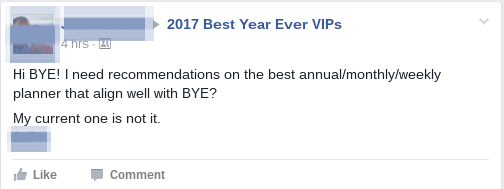
The timing of his comment couldn’t be better. And I know what he means. I’ve personally used and tested dozens of planners. None of them met my expectations or standards.
As a result, my team and I have been working for months on a planner that combines my proven goal-setting process with my daily productivity system. It’s the missing link that ties your daily tasks to your yearly goals so you’re constantly making progress.
I said, “Let’s take the frameworks from our goal-setting course, 5 Days to Your Best Year Ever™, and our Free to Focus™ productivity methodology and combine them.” Over 30,000 people are already using these two systems to accomplish more than they previously imagined. Now there’s a single tool that fuses them together and multiplies your effectiveness.
This approach is how I work, day by day, week by week, and quarter by quarter. My new Full Focus Planner™ connects the dots and lets anyone put this approach to work for them. It’s like an insurance plan for achieving your goals.
Honestly, I designed this planner for myself. It’s the one I want to use. And it’s almost ready.
Here’s what The Full Focus Planner™ does to help you stay focused and reach your goals:
Complements your digital calendar and replaces any other organizer you’re using.
Facilitates easy goal tracking and review so you never lose sight of what matters most.
Prioritizes your tasks so you’re always maintaining momentum on the activities that help you reach your goals.
Optimizes your weekend for maximum rest and rejuvenation.
Goes with you everywhere your life happens: the office, the coffee shop, the kitchen table, wherever.
Most of what we hear about productivity is just doing more at a faster rate. I’m not interested in that. And I assume you’re not either. We want to plan our lives to accomplish what matters most while sustaining margin for the relationships and self-care that make it all worthwhile in the first place.
The Full Focus Planner™ makes that possible.
You don’t have to let your most important goals get lost in the whirlwind of daily life. And you don’t have to hustle day in and day out without making progress toward the goals that will make a difference in your life and in the lives of those you love.
The Full Focus Planner™ equips you to plan your year, design your day, and achieve your biggest goals. We’ll be rolling it out soon. Click here to be the first to know when it releases.


April 11, 2017
What Could an Online Course Be Worth to Your Business?
Discover Course Creation Essentials in Amy Porterfield’s Free Master Class
I was amazed to hear the other day that online education is now a 100-plus billion dollar industry. But to be honest, I’m not totally surprised.

Based on the way business is changing, the Internet is not just another way to learn new information. It’s the way that many people prefer to learn new information. Conferences and live events, once the go-to for promoting a product or message, are now just another piece of a much larger puzzle.
Since I used to spend a lot of time speaking at conferences and events, I can testify to their limitations (as well as my own!). It was thrilling, but also very taxing. I could only help a certain number of people at a time. But when a friend introduced me to the online course model, I realized that this was the way to exponentially increase the number of people I could help—and simultaneously keep myself from burning out.
But creating a successful online course is far from straightforward. It’s an incredible investment. An online course could significantly impact the bottom line for your business, but only if you have the keys to making it high-value and profitable.
Course Creation: How Does It Happen?
My friend Amy Porterfield has nearly perfected the system for online course creation. And I’m glad she has, because I would have made a lot of blunders without her input. Amy is one of those rare teachers who is able to make the complex simple.
Soon, Amy is going to be teaching a free, LIVE master class on how to create your first profitable online course. If you’ve ever been the least bit curious about how to make this happen for your business, you do not want to miss this opportunity. I’ll be there co-hosting this special event—and answering your questions during a live Q&A session.
The master class is called How to Create Your First Profitable Course in 60 Days. It’s focused on best practices for what to do (and what not to do) when you’re developing curriculum, selecting tools, and marketing to your audience.

If you’re interested in attending, you can sign up here.
It’s all online, so you can join us from the comfort of your home or office. Amy’s going to share the five essential ingredients for developing a successful online course. And let me tell you—they’re not only what has made her own course catalog successful, but they’re a common thread in nearly every highly profitable course she’s ever seen.
What Could This Be Worth to You?
What could an online course be worth to your business? It might be time to find out. And even if you’ve developed courses before, Amy can take your process (and profitability) to the next level.
I wouldn’t say it if it weren’t true for me—Amy’s work has been invaluable to my own business and course creation.
If you’re an entrepreneur, coach, consultant, small-business owner, or a freelancer of any kind, this is for you. Be prepared to add a new, high-leverage element to your value offering. Amy always provides excellent information, and she’s already researched and field-tested the best approaches for you.
Seriously, this could be a game-changer for your business, so don’t miss the chance to learn more. Claim your spot at Amy’s free master class before we fill up.
I hope to see you there!


April 10, 2017
6 Ways to Write a Bestseller (And Build Your Brand) [Appearance]
My book, Platform: Get Noticed in a Noisy World, is referenced in this Entrepreneur article as one of the best for learning the tools for a bestselling book.
Event:
6 Ways to Write a Bestseller (And Build Your Brand)