
L.M. Long's Blog, page 12
May 29, 2014
Improving Your Writing Through Your Best Assets
In my search to improve my writing, I like to read what other writers do and I often find myself learning from them. Such is the case with Hope Clark who started the Fund For Writerswebsite and newsletter. Last year, her writing of encouraging words for writers was very informative. Check this out:
 Hope Clark with her dog, Roo at the beach
“When we become a writer, we often have a goal in mind. We envision the "one day" of being a successful writer, which to many means a book. To some it's a special book after several near-misses. To others it's a reputation and a long list of bylines.
All too soon after we begin this journey, we realize that long-term goal is pretty far down the path . . . almost out of sight. Then we wonder if we are on the right path. That writing gold ring seems too distant to take seriously. Most quit.”
She points out that we can use our assets or our other talents to improve our writing skills by writing about them. What Hope says is that “we underestimate who we are and what we can do. And we greatly underestimate how those identifying factors and talents factor into who we are as writers.
So think of and write down your top five talents or what you like to do the most besides writing. The sky is the limit as it could be gardening, exercise, reading, baking, organizing, sewing or crafts, parenting; the list can go on forever and this is a whole opportunity of topics to write about.
As Hope says, it does takes time to become a “successful” writer. Meaning earning a fair income from what we create which means others are reading our stuff. But as we are honing our craft in consistently writing day after day and week after week, what are the short term successes we can experience? We can be published online in other areas by submitting articles to magazines, online e-zines and blogs. This opportunity helps give us motivation to keep writing.
Personally I have learned to diversify my writing. I have been published under the topics of homeschooling children, book reviews and raising Christian children. It is amazing when you can “google” your name and find how much your writing is available for the public. We can continue to write all we want of whatever we love to do and we can improve our writing skills as we go.
As Hope suggests in what she calls “diversified writing” we can learn:

1. how to write better 2. how to find our voice 3. how to develop a platform 4. how to approach agents and editors 5. how to be patient 6. how to appreciate good writing 7. how to write our dream project better
So keep your mind on your goal of writing that great American novel or romance-mystery but add on what interests you and what you have been actively doing for the past five, ten or twenty years and you will double or triple your readership.


May 26, 2014
Ideas Surround Us
I'm a SAHM and sometimes I wonder, if I spend most of the time within the walls of my house, where do I get inspiration from in regards to writing? Sometimes, I feel like, there's a lot of blank slates in my head with no inspiration to draw from.
Then I remember the advice given by a presenter, Karen Hoover, at a conference. Inspiration is all around you if you look for it.
So, here's a few things that came up lately that may end up in my books somewhere along the way. If not, they're just fun anecdotes.
I stood in line at the dollar store to pay for birthday party favors, when I noticed a spider crawling along the gum rack in front of me. I took off my shoe, killed the spider, and replaced my shoe. I looked up at the cashier, the woman ahead of me completing her purchase and the woman behind me, who had now taken a large step backward. I said one simple word of explanation, "Spider," and all three women breathed a sigh of relief, that I wasn't crazy (still debatable;)). That can go in a book.
Walking my daughter through New York City for the first time, (There's lots of fantastic ideas to be had whenever you introduce someone to a place or an activity for the first time.) she asked about the homeless man begging on the subway, the rats on the subway, and the impromptu street performance while we ate a pretzel at Union Square. Oh, and she saw Elsa from Frozen get on a bus. Any of these can go in a book.
The other day I was listening to a song (a country one about This Ain't My Mamma's Broken Heart or whatever the actual title is) and I thought, there's a whole story I could write about a woman (the mother) who is a true Southern Lady and how she doesn't show the cracks in her soul when her husband dies and how that affects her whole family.
Ideas can be found as I walk around my neighborhood, listen to music, go through the mundane housekeeping tasks, on outings with my family, at rehearsals for the musical I'm in this summer, waiting in the line at the store, etc. The possibilities are endless. They are everywhere, if I just open my eyes to see them.
My task is to learn to strip away my tunnel vision and see them. This is made easier by the simple fact that my kids are old enough to not cause me infant/toddler sleep deprivation. Wait until I get that from their teenage years!
Of course, those will be rich idea years too. Think of all the stuff they might do that could be immortalized (to their ever-living embarrassment) in a book.
Now, please excuse me while I go fold a load of laundry and think up the next scene for my book.
Where do you find your ideas? What will you see/do/run into today that could jump start your creativity?
Then I remember the advice given by a presenter, Karen Hoover, at a conference. Inspiration is all around you if you look for it.
So, here's a few things that came up lately that may end up in my books somewhere along the way. If not, they're just fun anecdotes.
I stood in line at the dollar store to pay for birthday party favors, when I noticed a spider crawling along the gum rack in front of me. I took off my shoe, killed the spider, and replaced my shoe. I looked up at the cashier, the woman ahead of me completing her purchase and the woman behind me, who had now taken a large step backward. I said one simple word of explanation, "Spider," and all three women breathed a sigh of relief, that I wasn't crazy (still debatable;)). That can go in a book.
Walking my daughter through New York City for the first time, (There's lots of fantastic ideas to be had whenever you introduce someone to a place or an activity for the first time.) she asked about the homeless man begging on the subway, the rats on the subway, and the impromptu street performance while we ate a pretzel at Union Square. Oh, and she saw Elsa from Frozen get on a bus. Any of these can go in a book.
The other day I was listening to a song (a country one about This Ain't My Mamma's Broken Heart or whatever the actual title is) and I thought, there's a whole story I could write about a woman (the mother) who is a true Southern Lady and how she doesn't show the cracks in her soul when her husband dies and how that affects her whole family.
Ideas can be found as I walk around my neighborhood, listen to music, go through the mundane housekeeping tasks, on outings with my family, at rehearsals for the musical I'm in this summer, waiting in the line at the store, etc. The possibilities are endless. They are everywhere, if I just open my eyes to see them.
My task is to learn to strip away my tunnel vision and see them. This is made easier by the simple fact that my kids are old enough to not cause me infant/toddler sleep deprivation. Wait until I get that from their teenage years!
Of course, those will be rich idea years too. Think of all the stuff they might do that could be immortalized (to their ever-living embarrassment) in a book.
Now, please excuse me while I go fold a load of laundry and think up the next scene for my book.
Where do you find your ideas? What will you see/do/run into today that could jump start your creativity?
May 22, 2014
Writing a Great Book Review
It's fun to write a book review. It's fun to share opinions, to hear what others have to say, to find books that we otherwise might not know about, and it's also a great way to bring traffic to your blog. No matter your reason for writing book reviews (it might even be for school, and not for the Internet at all), these tips should be helpful. (I say "should" because, really, I can hope that they are, but I can't know for certain.)
I've been a media reviewer for about five years now, and I've developed a style that works for me. I'll outline it below, and then you can tweak it to fit your own needs and parameters. It's all right if you copy it step by step, too - whatever works best for you.
1. After I've read the book, I let it sit for a day or two and let it percolate in my brain. I think about the plot, the characters, the things I wondered as I was reading, the questions I felt were left unanswered.
2. When I sit down to write the review, I give a synopsis of the plot in my own words. Yes, you can use the text off the back of the book, but I personally prefer to write one of my own. It presents my interpretation of the book, rather than what someone else wants me to think about the book.
3. After I've written the synopsis, I will make a criticism sandwich. That is to say, I share something I liked about the book, something I felt could have been stronger, and then I close with another thing I liked. I rarely just praise without mentioning something I would have improved - I am a critical reader, and so I spot things. That's just what happens when you work as an editor. You see stuff. I think it's important that a potential buyer know for certain what they are buying. I also feel that the author can grow and strengthen their talents as they hear what they might have done better. But I also feel that writing in and of itself is a huge accomplishment, and I don't ever want the author to feel slammed or harshly criticized. If I can't be helpful, constructive, and edifying, then *I shouldn't be critiquing. Simple as that.
4. And that moves us on to my fourth point. I try hard to keep my comments helpful and edifying. If I totally hate a book and can't find anything good to say about it, I will contact the author or the publicist - whoever sent it to me - and I will explain to them that the book didn't quite fit me, and that I'd like to pass it on to another reviewer. This is the most fair way for me to handle it - I don't believe in ripping people up, but instead, I believe in allowing them to learn and grow from their experiences.
5. I always like to talk about how the book made me feel or the things it made me think about. That's what makes the review unique to me. Anyone can post the text from the back of the book, but it's hearing what the reviewer felt while they were reading that will sell the book.
6. I always, always include a purchase link to the book. The book review should tell about the book, it should tell how I feel about the book, and it should give my reader a way to buy the book when they are done reading my review.
In a nutshell, those are my tips for writing a great book review. Some reviewers like to include the author's bio, or interview questions with the author, or book club-style questions. All of that is great. The main thing I can offer is this - be yourself and share how the book impacted you. When you do that, you will rarely go wrong.
*I do want to make one clarifying statement - there are some book reviewers who do like to mention all the negatives and things they didn't like, and I'm not saying they shouldn't do that. It's their choice. I'm explaining what works for me, and every reviewer will have their own philosophy and their own take on what makes a review great.
I've been a media reviewer for about five years now, and I've developed a style that works for me. I'll outline it below, and then you can tweak it to fit your own needs and parameters. It's all right if you copy it step by step, too - whatever works best for you.
1. After I've read the book, I let it sit for a day or two and let it percolate in my brain. I think about the plot, the characters, the things I wondered as I was reading, the questions I felt were left unanswered.
2. When I sit down to write the review, I give a synopsis of the plot in my own words. Yes, you can use the text off the back of the book, but I personally prefer to write one of my own. It presents my interpretation of the book, rather than what someone else wants me to think about the book.
3. After I've written the synopsis, I will make a criticism sandwich. That is to say, I share something I liked about the book, something I felt could have been stronger, and then I close with another thing I liked. I rarely just praise without mentioning something I would have improved - I am a critical reader, and so I spot things. That's just what happens when you work as an editor. You see stuff. I think it's important that a potential buyer know for certain what they are buying. I also feel that the author can grow and strengthen their talents as they hear what they might have done better. But I also feel that writing in and of itself is a huge accomplishment, and I don't ever want the author to feel slammed or harshly criticized. If I can't be helpful, constructive, and edifying, then *I shouldn't be critiquing. Simple as that.
4. And that moves us on to my fourth point. I try hard to keep my comments helpful and edifying. If I totally hate a book and can't find anything good to say about it, I will contact the author or the publicist - whoever sent it to me - and I will explain to them that the book didn't quite fit me, and that I'd like to pass it on to another reviewer. This is the most fair way for me to handle it - I don't believe in ripping people up, but instead, I believe in allowing them to learn and grow from their experiences.
5. I always like to talk about how the book made me feel or the things it made me think about. That's what makes the review unique to me. Anyone can post the text from the back of the book, but it's hearing what the reviewer felt while they were reading that will sell the book.
6. I always, always include a purchase link to the book. The book review should tell about the book, it should tell how I feel about the book, and it should give my reader a way to buy the book when they are done reading my review.
In a nutshell, those are my tips for writing a great book review. Some reviewers like to include the author's bio, or interview questions with the author, or book club-style questions. All of that is great. The main thing I can offer is this - be yourself and share how the book impacted you. When you do that, you will rarely go wrong.
*I do want to make one clarifying statement - there are some book reviewers who do like to mention all the negatives and things they didn't like, and I'm not saying they shouldn't do that. It's their choice. I'm explaining what works for me, and every reviewer will have their own philosophy and their own take on what makes a review great.
May 19, 2014
Derailed Deadlines
by H. Linn Murphy
Luce sat at her desk, unprepared and oblivious to the encroaching deadline. She had an article due but hadn't thought about it in a couple of months, having buried herself under a mountainous pile of work she couldn't shuck off.
Her helium hand was continuously getting her in trouble, until she barely had time to deal with her own manuscript. She offered to drive for school field trips, bake cookies for an end-of-the-year choir party, sew costumes for the last school play for her high school senior, teach five hundred cub scouts how to paint, organize and execute a family dinner for battling siblings, and do the accounting for the family's nearly due taxes, among a thousand other tasks. Cinderella had nothing on Luce Lamont.
Luce ran her fingers through her shaggy up-do and looked up from the pile of receipts, realizing she hadn't done anything on her own manuscript in weeks. The taxes were driving her insane, she'd sewed the arm on her daughter's princess costume on backwards, that evil carbon smell was eking out of the oven again and she smelled like a longshoreman.
"Forget this!" she thundered. "I'm going back to my book!" She slapped on her blinders and prepared to spin the threads of her story into the Great American Novel.
But it didn't come.
She sat there staring at the monitor detesting her book for its recalcitrance. Why couldn't it be the one thing in her life to fall gently and easily into place? She glanced up at her calendar.
Then she saw it.
She had a deadline, which was nearly past.
Luce banged her head into her keyboard, causing several of the buttons to pop off and fling behind the adjacent armchair and bookcase. She just stopped herself from swearing and crouched down to try and find the errant buttons. Why did everything have to crash down on her at once? And when had she gotten so allergic to calendars and marking things on them?
She felt like a magician. Someone had asked her to pull a rabbit out of her top hat and then stomped all over it until it was a puddle of black silk. How was she supposed to do it with all the other obligations she had nipping at her heels?
She finally put her head down and began to pour out her heart in prayer, her troubles flooding out in a cathartic rush.
At the end of it all, the words fell into line like tiny black soldiers.
Luce sat at her desk, unprepared and oblivious to the encroaching deadline. She had an article due but hadn't thought about it in a couple of months, having buried herself under a mountainous pile of work she couldn't shuck off.
Her helium hand was continuously getting her in trouble, until she barely had time to deal with her own manuscript. She offered to drive for school field trips, bake cookies for an end-of-the-year choir party, sew costumes for the last school play for her high school senior, teach five hundred cub scouts how to paint, organize and execute a family dinner for battling siblings, and do the accounting for the family's nearly due taxes, among a thousand other tasks. Cinderella had nothing on Luce Lamont.
Luce ran her fingers through her shaggy up-do and looked up from the pile of receipts, realizing she hadn't done anything on her own manuscript in weeks. The taxes were driving her insane, she'd sewed the arm on her daughter's princess costume on backwards, that evil carbon smell was eking out of the oven again and she smelled like a longshoreman.
"Forget this!" she thundered. "I'm going back to my book!" She slapped on her blinders and prepared to spin the threads of her story into the Great American Novel.
But it didn't come.
She sat there staring at the monitor detesting her book for its recalcitrance. Why couldn't it be the one thing in her life to fall gently and easily into place? She glanced up at her calendar.
Then she saw it.
She had a deadline, which was nearly past.
Luce banged her head into her keyboard, causing several of the buttons to pop off and fling behind the adjacent armchair and bookcase. She just stopped herself from swearing and crouched down to try and find the errant buttons. Why did everything have to crash down on her at once? And when had she gotten so allergic to calendars and marking things on them?
She felt like a magician. Someone had asked her to pull a rabbit out of her top hat and then stomped all over it until it was a puddle of black silk. How was she supposed to do it with all the other obligations she had nipping at her heels?
She finally put her head down and began to pour out her heart in prayer, her troubles flooding out in a cathartic rush.
At the end of it all, the words fell into line like tiny black soldiers.
May 15, 2014
Falling in love with sparkly new ideas--for keeps
By Suzanne Warr
Once upon a time my dear friend sent me a writer's block--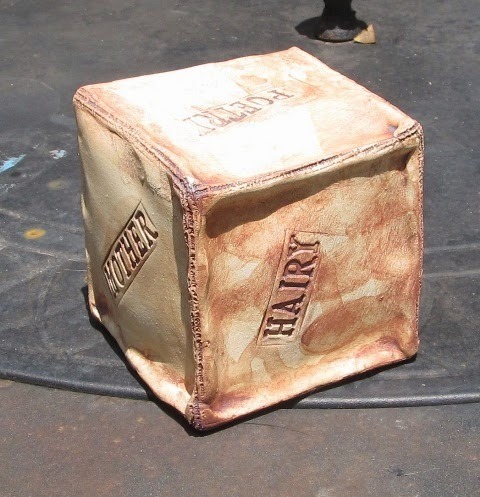
And I treasure it, but mostly cause it's such a great joke. I know there are those who struggle to come up with ideas, and I know how easy it would be to think that an overabudance of ideas would be heaven. But, in reality, those of us that can't turn off the idea spigot no matter how fast it flows can feel overwhelmed and almost crushed by the weight of too many choices.
So, how do you select that new project? How do you know if it's the one? Writers often talk about going with the idea that speaks to them, that gets them most excited, and that's not a bad place to start. Consider this quote, though, which was said by my wise (and well-published!) friend James Maxey, and I'm requoting from a mutual friend, Luc Reid's, blog. Got all that? Okay, here's the quote:
For me, that means sometimes waiting on a novel concept until I can find the deeper connection I know I'll need that goes beyond the excitement of a shiny new idea. Other times, it's love at first sight and I know in my gut that we're meant for each other. Either way, I hope that with every novel I can give it my whole heart and all the energy required to help it reach its full potential, and maybe let me stretch to reach mine, too.
How do you choose which project to work on next?
Once upon a time my dear friend sent me a writer's block--
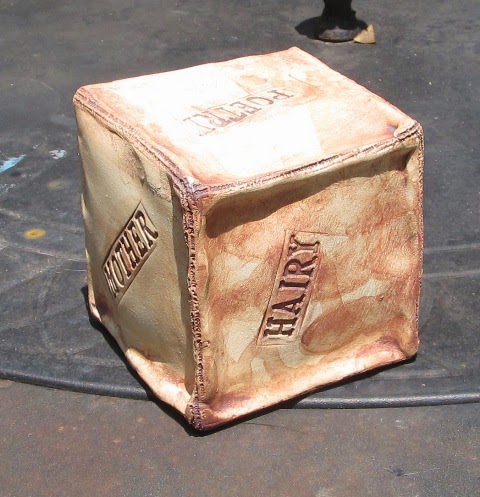
And I treasure it, but mostly cause it's such a great joke. I know there are those who struggle to come up with ideas, and I know how easy it would be to think that an overabudance of ideas would be heaven. But, in reality, those of us that can't turn off the idea spigot no matter how fast it flows can feel overwhelmed and almost crushed by the weight of too many choices.
So, how do you select that new project? How do you know if it's the one? Writers often talk about going with the idea that speaks to them, that gets them most excited, and that's not a bad place to start. Consider this quote, though, which was said by my wise (and well-published!) friend James Maxey, and I'm requoting from a mutual friend, Luc Reid's, blog. Got all that? Okay, here's the quote:
For what it’s worth, I think mere excitement is a vastly overrated reason to commit to a novel. Excitement is sufficient grounds to take part in a one night stand, but committing to a novel is more like choosing someone to marry. There needs to be that initial passion, but there has to be something stronger beneath it. The novel has to share your values and your long term goals. You have to be willing to stand by it in sickness and health, through riches and poverty. You’re going to see this novel without its makeup on. You’ll have to be there to comfort it when it gets the flu and has bad things pouring out of every orifice. You’ll have to keep believing in it when it hits low points, when it’s lost its way and no longer moves you to passion. You’re going to have to keep going home and sharing a bed with it even though other younger, better looking, more clever novels flirt with you.I found that incredibly insightful, and would take it one step further. You also have to love that novel enough to spend your holidays with your novel-in-laws, and be prepared to love whatever children (sequels) you and that novel make together. No matter how they turn out.
The long term rewards of such a relationship make it all worth it. You write the novel, edit it, polish it, and all the time it edits and polishes you. At the very least, you should emerge from a finished novel as a better writer, but I also think it’s possible to emerge from a novel as a better person.
For me, that means sometimes waiting on a novel concept until I can find the deeper connection I know I'll need that goes beyond the excitement of a shiny new idea. Other times, it's love at first sight and I know in my gut that we're meant for each other. Either way, I hope that with every novel I can give it my whole heart and all the energy required to help it reach its full potential, and maybe let me stretch to reach mine, too.
How do you choose which project to work on next?
May 12, 2014
My weight loss journey
It was horrible. I hadn't stepped on a scale in probably 6 months, but when I was at my sister's house visiting during the LDS Storymakers conference, she had one of those cool, super advanced scales. I couldn't help myself. I just wanted to see it work. Bad Idea-yes, but motivating- yes. I was the heaviest I'd ever been- 189 pounds. I felt ill. I couldn't believe it.
All my younger life I had been skinny. I didn't need to try, I just was. Even after my first four kids I was around 120. Then things changed. I started having panic attacks, and the doctor put me on medicine. Another friend of mine told me that the medicine would slow my metabolism and that I would gain weight. At the time I thought nothing of it, after all, not having panic attacks was worth it. Two years passed and I was fine. My husband and I talked about having more children, and soon baby #5 was on the way. Unfortunately, I ended up with gestational diabetes and bloomed up to 160 lbs. Worse, the weight didn't go away after the baby was born like it always had before. Then came baby #6 and at 180 lbs I peaked. Did I mention I'm 5'3.
It has now been over 5 years since my last baby, and the weight just won't go. For awhile I was doing Nutrisystem and exercising and got down to 164 lbs. Then the weight stayed the same. After two months I gave up, discouraged. I'm not an over eater. Sure, I love my fast food, but I'm not a huge snacker nor do I binge eat.
After I saw the scale at my sister's house I knew it was time to step things up again. I actually enjoy exercising on my stationary bike or elliptical, so I've started up again. Plus, I decided to go back on Nurtisystem, not the whole plan, I actually don't like the food (thought the frozen stuff is SO much better now), but the a la carte menu. The are several things I enjoyed and you just can't get them anywhere else. What sucks is that they just won't let you order their food, you have to pay an a la carte fee. Ugh. However, I did notice that Walmart is now selling Nutrisystem in their Diabetes aisle. They have the muffins, shakes, and cookies that I like.
So here I go again. Wish me luck. I feel like no matter how hard I try that I more maintain my weight than lose it. Plus, I've heard you have to do at least an hour of cardio plus strength training everyday, so about 2 hours. What mom has that much time? It is not a realistic goal unless someone has nothing on their schedule everyday of the week. Hmm, not me. So, I'll keep to my 1 hour of cardio and dieting and cross my fingers.
-Dorine
All my younger life I had been skinny. I didn't need to try, I just was. Even after my first four kids I was around 120. Then things changed. I started having panic attacks, and the doctor put me on medicine. Another friend of mine told me that the medicine would slow my metabolism and that I would gain weight. At the time I thought nothing of it, after all, not having panic attacks was worth it. Two years passed and I was fine. My husband and I talked about having more children, and soon baby #5 was on the way. Unfortunately, I ended up with gestational diabetes and bloomed up to 160 lbs. Worse, the weight didn't go away after the baby was born like it always had before. Then came baby #6 and at 180 lbs I peaked. Did I mention I'm 5'3.
It has now been over 5 years since my last baby, and the weight just won't go. For awhile I was doing Nutrisystem and exercising and got down to 164 lbs. Then the weight stayed the same. After two months I gave up, discouraged. I'm not an over eater. Sure, I love my fast food, but I'm not a huge snacker nor do I binge eat.
After I saw the scale at my sister's house I knew it was time to step things up again. I actually enjoy exercising on my stationary bike or elliptical, so I've started up again. Plus, I decided to go back on Nurtisystem, not the whole plan, I actually don't like the food (thought the frozen stuff is SO much better now), but the a la carte menu. The are several things I enjoyed and you just can't get them anywhere else. What sucks is that they just won't let you order their food, you have to pay an a la carte fee. Ugh. However, I did notice that Walmart is now selling Nutrisystem in their Diabetes aisle. They have the muffins, shakes, and cookies that I like.
So here I go again. Wish me luck. I feel like no matter how hard I try that I more maintain my weight than lose it. Plus, I've heard you have to do at least an hour of cardio plus strength training everyday, so about 2 hours. What mom has that much time? It is not a realistic goal unless someone has nothing on their schedule everyday of the week. Hmm, not me. So, I'll keep to my 1 hour of cardio and dieting and cross my fingers.
-Dorine
May 8, 2014
TAGLINES: Have Fun with Them

By: Monique BuchegerI recently attended one of my favorite writing conferences this week: LDStorymakers in Salt Lake City. I attended the conference in years past as a wanna be author, as a newbie author, and now as an author launching my fourth published book.Writing conferences are a great way to meet new readers, agents, publishers, and fellow authors. Without exception, I have met all of the above, in addition to making a few new friends.In preparation for this conference I wanted to make new bookmarks, since my last ones sported my old covers. I wanted to include all four of my fabulous new book covers.
 At the last conference I attended: Superstars Writing Seminars, I learned an important rule about the nitty-gritty part of the writing and publishing business (editing, marketing, formatting, making covers, and other art, etc.): Do what you are good at and want to do … and hire out the rest.In a time crunch, and not feeling particularly creative, I gave my awesome illustrator—Mikey Brooks, a quick call. (See the above picture.) He came through for me, as I knew he would.Mikey put all four covers on the front and then added some other art work to fill in the spaces. On the back he added my contact info and left a big space to write a quick comment and signature.Some fans want a signature and that’s a good place to add one. Plus, people are less likely to throw away a signed bookmark.
  (A tip I learned from Tracy Hickman, an internationally best selling fantasy author from last year’s Superstars Seminar.)You can also add a QR code to direct people to the online site of your choice: like your blog or author FB page.In addition to the artwork, he suggested that I include a tagline. We brainstormed and came up: Operation Secret Sisters: Two Determined BFFs plus Two Reluctant Parents MIGHT Equal One Happy Family. Taglines give a quick overview of what people might expect in a book or movie. They should include the protagonist(s), a conflict, and an antagonistic presence.
 They must also be short. Technically, my tag line is probably a little long at 15 words. Ideally— they should 10 words or less—but coming up with a tagline to do justice for 4 books is even harder than creating a tagline for one book. I decided to use some poetic license and make an exception since it is going on my bookmarks for the entire series.My first book “The Secret Sisters Club” has been described as “Parent Trap” Meets “An American Girl,” so we decided to play on my main characters’ secret mission in that book: Operation: Secret Sisters. In the following books, the theme of becoming sisters is always a subplot or minor arc, while the girls also navigate through new obstacles and conflicts in their lives that have nothing to do with becoming sisters.While trying to defeat the biggest bully in 6th grade in book 2: Trouble Blows West and trying to make sense of a “crazy-blast-from-the-past” that puts the girls at odds with one another in book 3: Simply West of Heaven, and dealing with one of the girl’s lousy-excuse-for-a-birth-father in book 4: Being West is Best, both girls come to terms with the sometimes unpleasant reality that their dream of becoming sisters, might actually turn into a nightmare.However, since they are best friends, they have some great motivation to work through the difficulties to attain their goal of “round-the-clock-girl-talk” and the “ultimate sleepover” that never ends.Most movies and books now have taglines. For example, the Harry Potter series can be broken down to 6 words: Boy Wizard Battles Evil Dark Lord, Parent Trap could become: Twice the Fun, Double the Trouble. Frozen: The Ice Guy? The Nice Guy? The Snowman or no man? Or Pixar’s Brave: Change Your Fate. I found these on rotoscopers.com.
 You can make up your own … and if you are an author, you really should. If you are a reader, it might be a fun challenge to reduce your favorite book or movie to a few words with some of your friends. If you take the challenge, please share. I’d love to hear from you.Laugh lots, love much, write on!
May 6, 2014
But I'm not good enough...
I just did this to myself. I worked for hours on a blog post this morning about honoring our mothers. I was happy with it. And then I saw the other posts. The amazing posts on editing and proofreading and marketing.
And I deleted my post.
Not completely. I sent it over to my family blog. But I decided it wasn't good enough to be around such amazing authors. It didn't fit the mold.
Too often we second guess ourselves. We look at everyone else and see what they've done and decide that ours just doesn't add up.
And the mold? The mold is all a joke. Yes, we need to have our books edited and have them look good. Yes, we should make them the best they can be. But that's where the mold ends.
There are millions of story ideas out there. Mine are going to be different than yours. That's the joy of being human. We all have likes and dislikes. My favorite book is something that someone else might think was awful. That's okay!
While taking a class on making our own brand, I was stuck. I kept feeling like I was a failure because I couldn't find that perfect image that would say who I am. I couldn't come up with ideas for how to explain what I write or what I do. But that's not true. I know what I write. I know that I write strong families. I know that I write about overcoming trials and being much stronger because of them. Just because I couldn't verbalize those ideas doesn't mean I don't know what I can do.
We all have our strengths and weaknesses. We need to stop comparing our weaknesses to other people's strengths and realize that we are awesome as we are.
Write that book. Be that mommy. Teach that lesson. Be who you are because no one else can be. If you're quirky, awesome. Welcome to the club!
I fully believe that we as writers are hard on ourselves to keep us humble. It means that we will work just a little harder, edit just a little more, and do the very best we can so that we will put forth our best work. And if we do all that, we are good enough.
And I deleted my post.
Not completely. I sent it over to my family blog. But I decided it wasn't good enough to be around such amazing authors. It didn't fit the mold.
Too often we second guess ourselves. We look at everyone else and see what they've done and decide that ours just doesn't add up.
And the mold? The mold is all a joke. Yes, we need to have our books edited and have them look good. Yes, we should make them the best they can be. But that's where the mold ends.
There are millions of story ideas out there. Mine are going to be different than yours. That's the joy of being human. We all have likes and dislikes. My favorite book is something that someone else might think was awful. That's okay!
While taking a class on making our own brand, I was stuck. I kept feeling like I was a failure because I couldn't find that perfect image that would say who I am. I couldn't come up with ideas for how to explain what I write or what I do. But that's not true. I know what I write. I know that I write strong families. I know that I write about overcoming trials and being much stronger because of them. Just because I couldn't verbalize those ideas doesn't mean I don't know what I can do.
We all have our strengths and weaknesses. We need to stop comparing our weaknesses to other people's strengths and realize that we are awesome as we are.
Write that book. Be that mommy. Teach that lesson. Be who you are because no one else can be. If you're quirky, awesome. Welcome to the club!
I fully believe that we as writers are hard on ourselves to keep us humble. It means that we will work just a little harder, edit just a little more, and do the very best we can so that we will put forth our best work. And if we do all that, we are good enough.
April 29, 2014
Promoting your book through Social Media.....

With another change in our Mommy Authors, I'll be writing each month as well.....Often times writers get comments like the ones listed here............
We all have to overcome this
I find that I really love to read about how other authors promote or write so these five tips were very helpful. I can't remember where I found them but here they are....
Five tips found to help promote books with social media •Make connections before you need them. You can’t start a Twitter account the day your book launches and expect to be an instant success, said Natalie Lin, online publicist at John Wiley & Sons. You need to start developing your audience long before you have something to market to them, she said. New writers have the most to gain from social networks, said literary blogger Levi Asher, since a social presence can help an up-and-coming author prove to a publisher that their work has an audience. Asher cited author Tao Lin as a rising talent who is gaining a cult following through his use of social networks.
•Join conversations that aren’t about you. You can’t build meaningful connections with fans by just talking about yourself all the time, Lin said. If you want to make authentic relationships, trying joining in conversations about other topics that interest you, she suggested. Lin also suggested using your social presence to reach out to bloggers and other influences that you respect. Asher agreed, noting that when an author approaches him about reviewing their book, he’s more likely to consider the request when the author can send him a personal note and demonstrate a little familiarity with his work.
•Use social media to feed your work. Your Twitter account isn’t just a promotional vehicle, said A.J. Jacobs, author of “The Year of Living Biblically” and other memoirs. Your social-networking experiences can actually help you develop ideas. Jacobs recently tweeted about his wife waking up in a bad mood after she had a dream about him flirting with another woman. Jacobs told the panel that after he sent this message, several of his followers responded that they’d had similar experiences with their spouses. What seemed like a freak occurrence at first might actually be a common problem that Jacobs
could explore in an article.
 •Use your social presence to support other promotions. Asher said he doesn’t see social media as a platform for driving direct sales so much as for building buzz and promoting events. The publishing business is changing, and part of that transformation may mean that Web events and non-book merchandise may become a larger part of an author’s income, he noted. Publicist Meryl L. Moss said having a strong social presence can make it easier for an author to score a guest appearance on a TV or radio program. Moss pointed out that when new authors have a strong YouTube video under their belt, it can go a long way toward allaying a television producer’s fears that they won’t be able to hold up their end of an interview. Several panelists pointed out that many of the bulwarks of traditional publishing — media appearances, live events and even books themselves — are in a state of flux or even decline. Having a healthy personal brand online may a vital part of surviving and adapting in this new publishing environment, they said.
•Stick with it. Shifting from the private process of writing a book to the public process of promoting it can be a jarring experience for a writer, said Asher. Many writers become frustrated when they don’t develop an online following right away, he noted — or worse yet, when the people they connect with first aren’t fans, but harsh critics. Developing a real following takes time, and even then, your fans may still be critical of your work. Jacobs said he routinely received notes from fans alerting him to factual errors in his books. Authors need to be willing to open themselves up to critics and trust that their fans will take care of them in the long haul, Lin noted. “You need real stamina to make it work,” she said.
As an author, I'm always looking for ways to promote my book. This is an ongoing, uncomfortable job as authors are always having to push their writing... I haven't made a twitter account yet because I just don't want that much information on my phone but there are other ways to promote your writing with social media if you feel the same way as me.One of the hardest things to do is to keep doing it..... sticking to a plan and then having the passion to keep pushing yourself is a feat in of itself... Just keep writing.......writing..... writing and just keep promoting...promoting....promoting.Speaking of promoting...I found this really cool blog of Grant Snider's creative cartooning and he has a lot more of these very entertaining cartoons... See here for the rest of the blog....
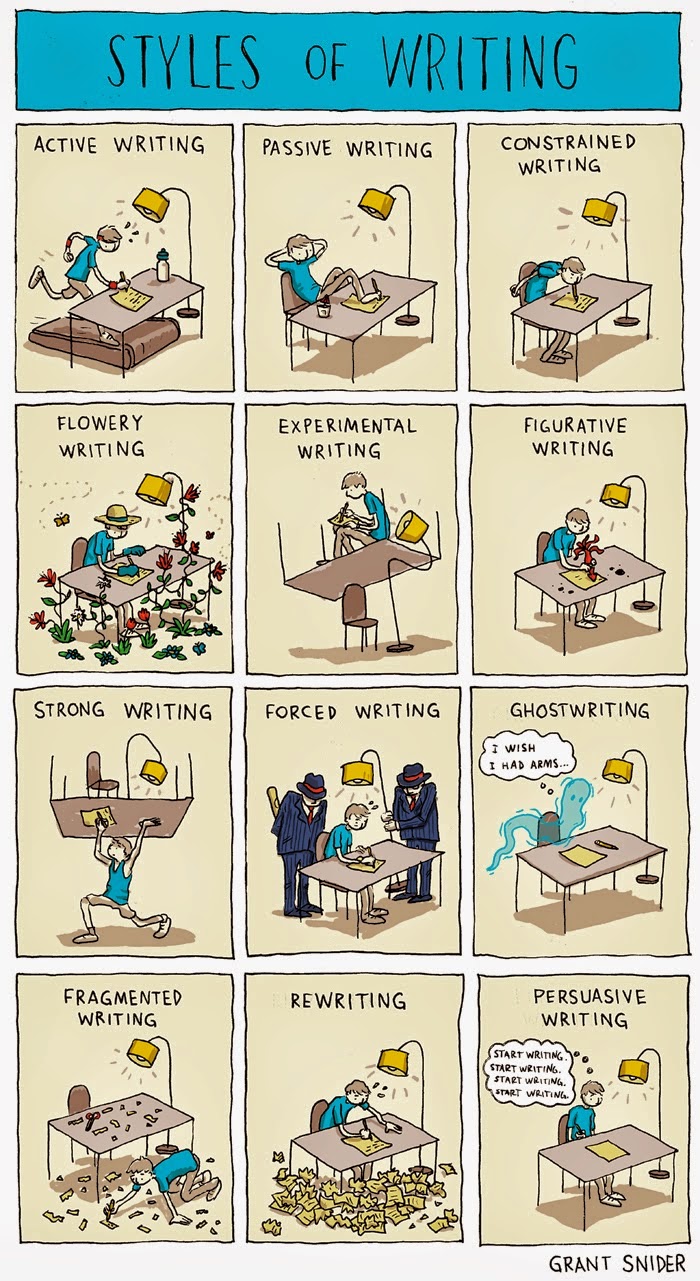 Happy Writing
April 24, 2014
Say What??
My husband and I both moved around quite a bit when we were children. My husband has lived in Salt Lake, California, Germany, Texas, and Oregon, to name a few. I've lived all over Utah, with brief stints in Nevada, California, and Virginia. It will come as no surprise that our communication patterns are quite different from each other's.
When I say the word "Yeah," I mean, "I agree with you."
When my husband says the word "Yeah," he means, "I heard what you said."
Would you believe I didn't figure this out until we'd been married for about sixteen years?
All that time, I was getting frustrated because I'd tell him something or ask him something, and I'd think he was agreeing with me. Then when it came up later and it turned out that he did not agree with me, I felt like he wasn't listening to me or that he was changing his mind all over the place. One day, like a bolt of lightning out of the sky zapping me in the forehead, I realized that we were speaking two different dialects. I said to him, "When you say 'Yeah', what does it mean?"
He had a very confused look on his face when he said, "It means that I heard you." I explained what it means to me, and suddenly, an issue we'd been struggling with for sixteen years was resolved. Now when he says "Yeah," I ask, "Do you mean that you heard me or that you agree with me?" This gives us the chance to understand each other better and avoid disagreements later.
I'm sharing this because it's pertinent to your writing. Different regions use different words and phrases in different ways, and if you're using a term that doesn't have a universal meaning, you could confuse your reader. They might think you mean something else entirely, and that might change the meaning of the story for them. As you write and as you edit, seek to be very clear with what you mean so you're all on the same page (ha ha). A confused reader is not a repeat customer.
When I say the word "Yeah," I mean, "I agree with you."
When my husband says the word "Yeah," he means, "I heard what you said."
Would you believe I didn't figure this out until we'd been married for about sixteen years?
All that time, I was getting frustrated because I'd tell him something or ask him something, and I'd think he was agreeing with me. Then when it came up later and it turned out that he did not agree with me, I felt like he wasn't listening to me or that he was changing his mind all over the place. One day, like a bolt of lightning out of the sky zapping me in the forehead, I realized that we were speaking two different dialects. I said to him, "When you say 'Yeah', what does it mean?"
He had a very confused look on his face when he said, "It means that I heard you." I explained what it means to me, and suddenly, an issue we'd been struggling with for sixteen years was resolved. Now when he says "Yeah," I ask, "Do you mean that you heard me or that you agree with me?" This gives us the chance to understand each other better and avoid disagreements later.
I'm sharing this because it's pertinent to your writing. Different regions use different words and phrases in different ways, and if you're using a term that doesn't have a universal meaning, you could confuse your reader. They might think you mean something else entirely, and that might change the meaning of the story for them. As you write and as you edit, seek to be very clear with what you mean so you're all on the same page (ha ha). A confused reader is not a repeat customer.


