L.M. Long's Blog, page 10
August 11, 2014
What's that about Wisdom?
by Suzanne Warr
Let me tell you something funny. In a little over a week, my oldest will be heading off to college. Two weeks ago, we would have told you that we were on target for that change, and maybe ahead of the game. Today, we're scrambling around pulling pieces together...and wondering if we'll get to it all. How'd we slide so fast? Well...let's just say I admire otters. ;)
Honestly, most of it's just the usual hangups you come across when working out something like this. We'd planned to drop him from our car insurance 'cause he won't have a car and won't even be in the same state...but the car insurance refuses to drop him unless we have proof that he's moving to some other insurance. Which, he's not. He won't have a car. But that makes no difference to them so we'll be visiting our most fav party place, the DMV, and changing his license to an ID so we can make them drop him. He's also having trouble getting his bank card to work (just an electronic snafu) and the banks been helpful trying to straighten it out...but he still may not have it fixed before he needs it. And, the list goes on.
The most troublesome bit, though, is at least rather poetic--he's had complications from having his wisdom teeth pulled. This means that we'll be lucky if he's healed up (and recovered from a week+ of liquid/soft foods) in time to hit campus and start classes...but will definitely not be ready for his audition for jazz combo placement. Kinda hard to play a trombone with a swollen mouth, and besides, the dentist has forbade him from practicing!
So, why is this all making me chuckle? Because this, as I explained to him recently, is what the 'adult world' is all about. Yes, what should be a two minute call to activate a bank card may take twenty minutes, or two weeks. Yes, what should be simple oral surgery may hit a snafu and take time healing. Yes, the DMV will always take the longest possible stretch of time you can give it--cubed. It requires self control to remain polite, and an effort to be optimistic in this adult world, and a mega dose of patience won't hurt...which are all key ingredients to wisdom. How appropriate, then, that in our case it all kicked off with that lovely rite of passages that is getting one's wisdom teeth extracted.
Welcome to the adult world, my son. We move slower than you'd like, but we'll get you somewhere better.
Let me tell you something funny. In a little over a week, my oldest will be heading off to college. Two weeks ago, we would have told you that we were on target for that change, and maybe ahead of the game. Today, we're scrambling around pulling pieces together...and wondering if we'll get to it all. How'd we slide so fast? Well...let's just say I admire otters. ;)
Honestly, most of it's just the usual hangups you come across when working out something like this. We'd planned to drop him from our car insurance 'cause he won't have a car and won't even be in the same state...but the car insurance refuses to drop him unless we have proof that he's moving to some other insurance. Which, he's not. He won't have a car. But that makes no difference to them so we'll be visiting our most fav party place, the DMV, and changing his license to an ID so we can make them drop him. He's also having trouble getting his bank card to work (just an electronic snafu) and the banks been helpful trying to straighten it out...but he still may not have it fixed before he needs it. And, the list goes on.
The most troublesome bit, though, is at least rather poetic--he's had complications from having his wisdom teeth pulled. This means that we'll be lucky if he's healed up (and recovered from a week+ of liquid/soft foods) in time to hit campus and start classes...but will definitely not be ready for his audition for jazz combo placement. Kinda hard to play a trombone with a swollen mouth, and besides, the dentist has forbade him from practicing!
So, why is this all making me chuckle? Because this, as I explained to him recently, is what the 'adult world' is all about. Yes, what should be a two minute call to activate a bank card may take twenty minutes, or two weeks. Yes, what should be simple oral surgery may hit a snafu and take time healing. Yes, the DMV will always take the longest possible stretch of time you can give it--cubed. It requires self control to remain polite, and an effort to be optimistic in this adult world, and a mega dose of patience won't hurt...which are all key ingredients to wisdom. How appropriate, then, that in our case it all kicked off with that lovely rite of passages that is getting one's wisdom teeth extracted.
Welcome to the adult world, my son. We move slower than you'd like, but we'll get you somewhere better.


August 8, 2014
Build It and They will Come by Monique Bucheger
.jpg)
On a recent trip to Walt Disney World, I came across these signs on a wall in the Animal Kingdom. The wall surrounded a new project being constructed in the park. No one could see the new project, just the wall surrounding it. It was camouflaged very well—for a huge building-sized anomaly in the heart of Africa. The cream wall held several motivational sayings such as this, but otherwise was pretty nondescript.
Then I realized that this poster translated very well to what we do as authors—and moms. As a mom, I don't want my kids exposed to the seedier, sadder, uglier parts of the world and do my best to show the world at its best, hoping my kids will strive to keep those images in their minds as they travel through this journey called life. Sure, they get exposed to hurtful people, sad images, and events, but I don't allow those people and places to take up much space and time in my children's journey when I can help it.
I teach my kids that we can minimize such things by giving some thought to where we choose to be, how we choose to behave, how we choose to react to, and what we choose to embrace. At the same time that they don't choose the worst, they can be empowered by choosing to be in good places, read wonderful literature, listen to amazing music, attend uplifting events.
As authors, we transport readers into "our worlds." Those worlds ideally are not without conflict or any more perfect than the "real" world, but while there, we want our readers to see and hear and feel a story we want to share. Each author has a different motivation for the story they write, and each reader will perceive it differently yet than the author intends—and that's okay—and even the point. That's what makes it personal to the reader and helps them connect to a story they choose to read.
Tracy Hickman, an internationally best-selling author for over thirty years, points out that authors are the only artists who cannot fully see and appreciate how their art affects the beholder—simply because the their art plays out on the stage in the reader's mind. But if we do it well enough, the performance touches the reader's heart.
And when a heart is touched, there is no limit to the good that can be done.
.jpg)
August 4, 2014
As I became a mom and started all the sports and act...
As I became a mom and started all the sports and activities with my kids, I learned that it’s okay sometimes to say no. If life has gotten crazy and you can’t take one more thing, turn something down so you can stay sane.
Somewhere along the way I forgot that little piece of advice. But is it so bad? As long as I’m doing what needs to be done with my family and church, is it bad to volunteer for a few more things?
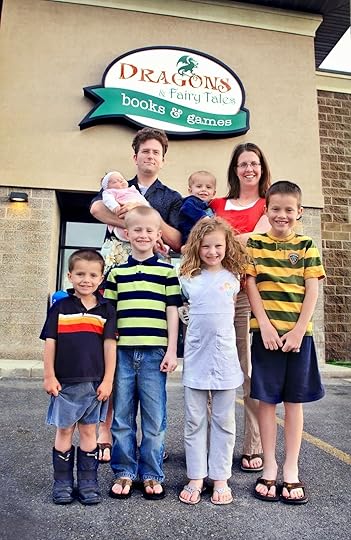
In 2010 I owned a cute little bookstore called Dragons & Fairy Tales. It only lasted a year before funding ran out and I chose to close the store. The store had brought so many amazing experiences and I was able to meet authors that helped me with ideas to jumpstart my writing career.
 Fast forward four years and my mind has been going back to my bookstore. I want it so badly it hurts. I’ve thought of reopening, but this time with a kickstarter to help fund it. Right around the time I was thinking of ways to make it possible, I was approached by a lady out here in Eagle Mountain that wanted to restart the arts council that had been tried several times.
We met and discussed ideas in a group of about ten people. And guess who volunteered to be the director over literary arts? Yes, that was me. One of our visions for the future is to have a theater/museum/bookstore. I’m so excited, I can hardly stand it.
Along with that, I’ve volunteered to help with LDStorymakers, a book festival, and a few other opportunities that have come up. Every time I volunteer, I decide whether or not it will affect my time with family, or if it will interfere with other projects I’ve jumped into.
So, why not? Why not put yourself out there and do something you’ve always wanted to? Why not volunteer to help the groups you belong to? If you don’t, who will? It’s easy enough to wish that someone would start a group or open a business, but why not do it yourself?
Somewhere along the way I forgot that little piece of advice. But is it so bad? As long as I’m doing what needs to be done with my family and church, is it bad to volunteer for a few more things?
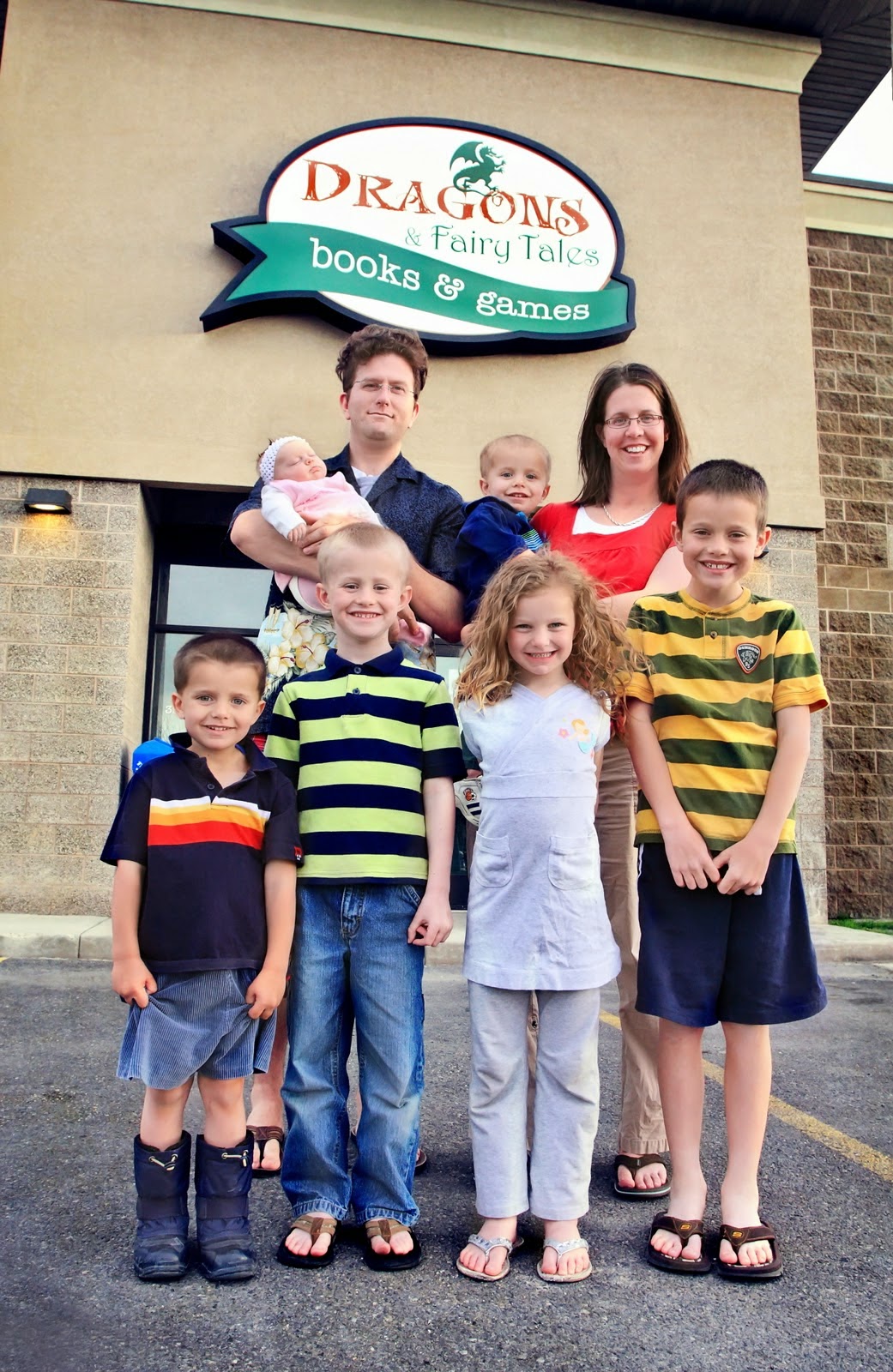
In 2010 I owned a cute little bookstore called Dragons & Fairy Tales. It only lasted a year before funding ran out and I chose to close the store. The store had brought so many amazing experiences and I was able to meet authors that helped me with ideas to jumpstart my writing career.
 Fast forward four years and my mind has been going back to my bookstore. I want it so badly it hurts. I’ve thought of reopening, but this time with a kickstarter to help fund it. Right around the time I was thinking of ways to make it possible, I was approached by a lady out here in Eagle Mountain that wanted to restart the arts council that had been tried several times.
 We met and discussed ideas in a group of about ten people. And guess who volunteered to be the director over literary arts? Yes, that was me. One of our visions for the future is to have a theater/museum/bookstore. I’m so excited, I can hardly stand it.
Along with that, I’ve volunteered to help with LDStorymakers, a book festival, and a few other opportunities that have come up. Every time I volunteer, I decide whether or not it will affect my time with family, or if it will interfere with other projects I’ve jumped into.
So, why not? Why not put yourself out there and do something you’ve always wanted to? Why not volunteer to help the groups you belong to? If you don’t, who will? It’s easy enough to wish that someone would start a group or open a business, but why not do it yourself?
July 31, 2014
Dream the Dream: How badly do you want to publish?
The reality for many people who want to finish their first book is that many times their writings and writing time gets pushed to the way side. Over the last several years I have been taught the value of dreaming. Day dreaming is necessary for everyone who wants to fill a goal; an idea that has been thought about for many years.
 As a young mother, I day dreamed a lot about getting my own books published or finding myself on many by-lines for syndicated articles and here I am, 25 years later realizing I have accomplished just that. I have written and published five books and have over 300 articles published in newspapers and online websites with many syndicated all over the world and it all started with a dream.
 The book, Put Your Dream to the Test: 10 Questions to help you see it and Seize It, by John C. Maxell has incredible power. If you have ever read his writings ---they are always motivational and uplifting.
Start by answering these ten questions about your writing dream:
1. Is my Dream really my dream?
2. Do I clearly see my dream?
3. Am I depending on factors within my control to achieve my dream?
4. Does my dream compel me to follow it?
5. Do I have a strategy to reach my dream?
6. Have I included the people I need to realize my dream?
7. Am I willing to pay the price for my dream?
8. Am I moving closer to my dream?
9. Does working toward my dream bring satisfaction?
10. Does my dream benefit others?
We are writers with creative ideas and answering question four would help us realize that most of us are compelled to write.
He discusses the fact that if we have a dream, (for example to write a novel or non-fiction book) then we should have a strategy which refers to question five. After answering the above ten questions you have a solid concept of what you want our of your dream. Review and answer the rest of the questions which follow:
 1. Find your present position: Ask yourself where you are now in your plans to fore fill this writing adventure.
2. Discover your future position: Where do you want to go? What will my dream look like when I have achieved it?
3. See the positions in between: Find the pathway that lies between the first two. What steps must I take to get from my present position to my future one?
Examine all your Actions: A. Do something: start the process by doing something today, right now, immediately. Do something today that relates to your dream. Do something every day that relates to your dream
B. Consider all your options: Once you figure out a plan for reaching your dream there is danger that you will become inflexible and stick to your plan no matter what. Sometimes it’s wiser to explore all options and be flexible.
C. Utilize all your options: This is what really caught my eye: John Maxwell himself had written a dozen or so books and realized he wasn’t making an impact with his writing. That is unbelievable to me. How could someone write a dozen books and think they hadn’t made an impact on anyone? But he did and he feels other authors or creative people do the same thing. They write a book, they send it to a publisher and then they hope for the best. But as Mr. Maxwell says “hope is not strategy”. So he came up with a plan.
PLAN:1. Come up with an idea for a really good book. Make an outline of your ideas.
2. Find a team of people who will help you (like ANWA or other writing groups)
3. Make a deadline for yourself. To do great and important tasks two things are necessary: a plan and not quite enough time. Meaning the plan will be set and not having quite enough time makes you work a little bit harder.4. Creativity: brain storm with your team to come up with ideas
 5. Opportunity: Thinking up ideas is great but you still have to get people interested enough in your book so they will read it. Mr. Maxwell taught seminars from his book and sold copies. (The book he wrote after this whole experience is called Twenty-One Irrefutable Laws of Leadership which has been used for many motivational seminars and workshops.)
Check this out:
So dream, dream, dream all that you want to accomplish and then take notes and get busy. There are many dreams to dream here on earth and not enough time. We can accomplish much with our actions and our plans.
July 28, 2014
Pioneers: Old and New
I’m a day late. I was on vacation and the month of July has flown by. Anyone else feeling incredibly behind? There was so much I planned to get done this summer, but it seems the weekly house cleaning is a challenge to accomplish and more often than not I’m checking email via phone. Really, I can’t even get to the computer every day. What is sucking up all my time? Well, I know the answers to that, but I’m not going to list them. The idea makes me anxious and stressed. And who needs that in summertime? I’ve been reflecting on what to say.
Thursday was Pioneer Day, an important cultural day in my religion. This is the day the LDS entered the Salt Lake Valley after crossing the plains for months on end, daily dealing with lack of food, lack of sleep, illness, and the occasional pause to bury a loved one in a too shallow grave. Their daily sacrifice was far more than what I’m called on to give each day and puts my ‘to do’ list (write this blog post and publish my next book) in pathetic perspective with theirs: survive and endure to the end.
So, why would the Pioneers undertake such an arduous, back breaking, and heartbreaking journey? Because God told them to is the short answer, but I believe it has to be something more than that. To undertake leaving a comfortable home and your possessions behind you’d have to have an incredible amount of faith along with the hope and belief that something even better awaited you at the end. I couldn't do as the Pioneers did. But then, they might look at my life and think they can’t do what I do. They might appreciate that they lived in a simpler time when life was all about family, running the farm, and wholesome living. I’m sure they’d be grateful for indoor plumbing and running water, but what would they make of our cars, electronics, obesity and the decision to forcefully unplug to spend time with our loved ones? Quite the conundrum.
So, what does all that have to do with mothers and authors? Well, really not much. Except, both motherhood and writing require sacrifice, are back breaking and heartbreaking, and push you past your limits, sometimes to the breaking point. Yet, we persevere and endure to the end because we believe there is something amazing awaiting us and we believe we will be better people for the journey when we arrive at the destination point.
So, here’s the Pioneers and to all of us who make journeys great and small, sacrifice, and give our very best to make a better life for all our families.
What Pioneers in your life will you celebrate?
Thursday was Pioneer Day, an important cultural day in my religion. This is the day the LDS entered the Salt Lake Valley after crossing the plains for months on end, daily dealing with lack of food, lack of sleep, illness, and the occasional pause to bury a loved one in a too shallow grave. Their daily sacrifice was far more than what I’m called on to give each day and puts my ‘to do’ list (write this blog post and publish my next book) in pathetic perspective with theirs: survive and endure to the end.
So, why would the Pioneers undertake such an arduous, back breaking, and heartbreaking journey? Because God told them to is the short answer, but I believe it has to be something more than that. To undertake leaving a comfortable home and your possessions behind you’d have to have an incredible amount of faith along with the hope and belief that something even better awaited you at the end. I couldn't do as the Pioneers did. But then, they might look at my life and think they can’t do what I do. They might appreciate that they lived in a simpler time when life was all about family, running the farm, and wholesome living. I’m sure they’d be grateful for indoor plumbing and running water, but what would they make of our cars, electronics, obesity and the decision to forcefully unplug to spend time with our loved ones? Quite the conundrum.
So, what does all that have to do with mothers and authors? Well, really not much. Except, both motherhood and writing require sacrifice, are back breaking and heartbreaking, and push you past your limits, sometimes to the breaking point. Yet, we persevere and endure to the end because we believe there is something amazing awaiting us and we believe we will be better people for the journey when we arrive at the destination point.
So, here’s the Pioneers and to all of us who make journeys great and small, sacrifice, and give our very best to make a better life for all our families.
What Pioneers in your life will you celebrate?
July 24, 2014
Before You Send Out to Readers ...
So you've gotten your manuscript ready to go out to readers. You're excited because you know how close you are to being ready for submission . . . you'll get this feedback, you'll make the suggested changes, and you're finished, right? Well, pretty close. But don't think this step is going to be a piece of cake. That's a mistake a lot of writers make -- they hurry and get the manuscript out to readers before it's really ready.
Here are some tips to help you get that manuscript as ready for readers as you possibly can -- keeping in mind that if you take out the glaring problems now, your readers will have an easier time spotting the more complex problems.
1. Go through and do a search for "was." Most of the time, when the word "was" is used, you can change it to more of an active voice. Instead of saying, "She was sitting on the porch," say "She sat on the porch." This brings your reader into closer contact with the story, and it eliminates the repetitive use of "was."
2. Go through and do a search for "that." Most of the time, "that" is used when it's not needed. "She thought that he'd be there to pick her up at three." Take it out and see what you've got ... "She thought he'd be there to pick her up at three." It's the same thing, but "that" gets repetitive and makes your sentences wordy.
3. Go through and make sure all your punctuation is still there. I've noticed when I edit for people that as they take out words they've been told to take out, sometimes the punctuation gets taken along with it, erased accidentally by the cursor being in the wrong place.
4. Go through and take out fully 3/4 of your adverbs. Keep only the ones that are absolutely needed -- most are indicated by the context, anyway, and aren't necessary.
There you have it -- four steps to help make your manuscript ready for readers. These aren't the only things to watch out for -- there are many -- but these are the most common mistakes and the most common detractors from the story. With these things out of the way, your readers will be able to concentrate on the things that remain and help you polish the story until it shines.
Here are some tips to help you get that manuscript as ready for readers as you possibly can -- keeping in mind that if you take out the glaring problems now, your readers will have an easier time spotting the more complex problems.
1. Go through and do a search for "was." Most of the time, when the word "was" is used, you can change it to more of an active voice. Instead of saying, "She was sitting on the porch," say "She sat on the porch." This brings your reader into closer contact with the story, and it eliminates the repetitive use of "was."
2. Go through and do a search for "that." Most of the time, "that" is used when it's not needed. "She thought that he'd be there to pick her up at three." Take it out and see what you've got ... "She thought he'd be there to pick her up at three." It's the same thing, but "that" gets repetitive and makes your sentences wordy.
3. Go through and make sure all your punctuation is still there. I've noticed when I edit for people that as they take out words they've been told to take out, sometimes the punctuation gets taken along with it, erased accidentally by the cursor being in the wrong place.
4. Go through and take out fully 3/4 of your adverbs. Keep only the ones that are absolutely needed -- most are indicated by the context, anyway, and aren't necessary.
There you have it -- four steps to help make your manuscript ready for readers. These aren't the only things to watch out for -- there are many -- but these are the most common mistakes and the most common detractors from the story. With these things out of the way, your readers will be able to concentrate on the things that remain and help you polish the story until it shines.
July 17, 2014
Punting Piranhas (or I Need a Nap)
by H. Linn Murphy

Slacker Mommy signing in. This has been my day:
*2am--go to bed after running, writing, meetings, and random hijinx or however the heck *you spell the dang thing.
*4am--bathroom break
*6am--second bathroom break
*7am--send son off on his high adventure camping trip and the Hubs to work
*9am--check mail and give son his health waver
*9:15am--clean room and make bed
*11am-4pm--help a friend clean, pack to move, and unpack the truck at the other end
 *5pm--paint a lawn gnome (my son will be so thrilled since he hates lawn gnomes) and some gingerbread for the house (not the edible kind) while watching Gilmore Girls re-runs (you can't beat the wit)
*6pm--make a delicious and oh so healthy veggie soup for dinner
*7pm--work on mail and suddenly remember I have this blog post (flogging to begin momentarily)
*7:05pm--write like the wind, Silver
 *7:29--eat soup alone with the Hubs since the girls bailed when they found out we were having soup
*7:30pm-plus--prepare for staffing at cub camp tomorrow and the next day (owl pellets and liquid nitrogen and bucky balls and giant weather balloons. Yay!!!)
*Somewhere in there--write at least 100 words on one of my WIPs for the ANWA site so I'll be in the running for a prize sometime
*Copious spare time--Hunt down what died in the fridge and embalm it
*Somewhere else in there--hang the laundry that has been sitting in the basket for cough_a_day_cough getting rained on
*Midnight--clean more things and make sure everybody has clean pants and staff shirts and they aren't sitting out there in that basket of nasty-smelling stuff
*Some nebulous time after midnight--rack 'em up, Judy


Slacker Mommy signing in. This has been my day:
*2am--go to bed after running, writing, meetings, and random hijinx or however the heck *you spell the dang thing.
*4am--bathroom break
*6am--second bathroom break
*7am--send son off on his high adventure camping trip and the Hubs to work
*9am--check mail and give son his health waver
*9:15am--clean room and make bed
*11am-4pm--help a friend clean, pack to move, and unpack the truck at the other end
 *5pm--paint a lawn gnome (my son will be so thrilled since he hates lawn gnomes) and some gingerbread for the house (not the edible kind) while watching Gilmore Girls re-runs (you can't beat the wit)
*6pm--make a delicious and oh so healthy veggie soup for dinner
*7pm--work on mail and suddenly remember I have this blog post (flogging to begin momentarily)
*7:05pm--write like the wind, Silver
 *7:29--eat soup alone with the Hubs since the girls bailed when they found out we were having soup
*7:30pm-plus--prepare for staffing at cub camp tomorrow and the next day (owl pellets and liquid nitrogen and bucky balls and giant weather balloons. Yay!!!)
*Somewhere in there--write at least 100 words on one of my WIPs for the ANWA site so I'll be in the running for a prize sometime
*Copious spare time--Hunt down what died in the fridge and embalm it
*Somewhere else in there--hang the laundry that has been sitting in the basket for cough_a_day_cough getting rained on
*Midnight--clean more things and make sure everybody has clean pants and staff shirts and they aren't sitting out there in that basket of nasty-smelling stuff
*Some nebulous time after midnight--rack 'em up, Judy

July 14, 2014
The Battle Continues
 Well, my battle with weight continues. As I mentioned on a previous post, I seem to be getting older and larger. Ugh! I've been trying to watch what I eat and doing cardio at least 4 times a week, but it is not helping. I found this out when I went into the doctor for something minor and they asked me to step on the scale. I was actually excited, because I hadn't weighed myself in awhile and with the semi-diet and exercise, I was sure I lost some pounds. Wrong. I actually was up to 192. Holy Moly.
The shock was awful. To be working on something and have it not happen was so discouraging. What to do? I finally decided to face reality. It's not just me. It is the medication I'm on. For the last ten years I've been on Prozac for anxiety. In the beginning my weight was fine, but after all these years, and two more kids, I've reached a plateau. So, I decided to do some research. It was time for Google. I researched how to loose weight while on Prozac. Tons of articles and books popped up, and after awhile of reading, I realized they all said the same thing, basically that there was not much I could do. Yep, I was stuck.
Anti-depressant weight gain is well documented and doctors know all about it. The problem is that there is no solution, besides going off your medicine. Some suggested trying to change to a different anti-depressant, but as I continued reading, even that didn't show great results. Research showed that small doses of anti-depressants could result in weight gain of 20-40 lbs. A larger dose, which is mine, can result in 60-100 lbs gained. Wow.
Many of the experts I researched said the same thing, the battle is in controlling the weight. The solutions mentioned included exercise (of course) and a different type of diet than the one I thought I should be on. The difference- I was told to eat carbs. Yep, the enemy. But, for those that are on anti-depressants, the medicines themselves can cause slow metabolisms, sugar cravings and late night carb (bad carb) cravings.
Evidently serotonin is highest in the morning and naturally degrades throughout the day. So, usually breakfast and lunch are fine, but those on anti-depressants have cravings in the late afternoon and evenings which cause binge eating. The articles I read suggested that you should eat proteins in the morning and at lunch, but for late afternoons and dinner you should eat healthy carbs like whole grain pastas and oatmeal. Why? Because cabs naturally boost your serotonin levels back up, reducing the chances of binge eating. Who knew?
Several of the articles I read mentioned this book- The Serotonin Power Diet by Judith J Wurtman and Nina T Fusztajer. I ordered it from Amazon and can't wait to read it. I'll do a follow up soon and let you know if things are working.
July 10, 2014
Shedding old process, and growing a new one
I have a clearly established novel writing process, that's worked well for me in the past. I have confidence in it, and feel secure in my approach. It's similar to how people Nano, though I've actually never done it in November. It works like this: in the days or weeks before diving in, I research and clarify what I'm going to write, knocking out most the world building and getting a good sense for the characters. I may even make skirmishes into certain scenes, or write short snippets of back story. Then, when I actually start writing the novel, I commit to the process of writing my book and focus intently on it. I don't read any other fiction, especially in my genre or age category. I clear my calender of any non-writing commitments I can, and put the family on auto pilot. I use the playlist I built while developing the project to tune everything else out, and I write. Usually I average 3-5k words a day, depending on how well I cleared my calender and what the family's needs are. On good days I hit 7k plus words. My book becomes my everything, and even when I'm not writing I'm obsessing about it, dreaming about it, and busily working on plot cards to keep it rolling forward at optimum speed.
I love that process--and it's turned out some pretty great books! Using this method, I've written up to three books in one year while also keeping up a break-neck schedule outside of writing. It works for me. But, right now, I'm throwing it out the window.
Why would I do that? Why, if I'd found a method of writing that was successful, would I toss it out? Because my life has changed, and I've realized that if I don't adapt with it, my writing will suffer. I have editing commitments now, both to the publisher I freelance for, and to writing friends who are up against deadlines of their own, and who I don't want to disappoint. Editing involves reading, obviously, and means I can't obsess over my book and push all other books aside. I've also started a book club (which involves reading, of course!) and find I simply can't clear my mental schedule so thoroughly as I did in the past. So, I've taken the aspects of my old process that seemed most essential, and renegotiated my approach in hopes that I can adapt them to my new process.First up, was mental space. I can't stop reading other books, but I can designate when and how I'll work on those other projects. Where possible, I've moved the reading of other books (that aren't my WIP) out to the couch, in the living room.Second is focus. Since I can't close out the world so thoroughly as I'd like, I've created a new space where I can write behind a closed door. In that space, I've forbidden myself from using the internet (except for the briefest research, directly book related) and where social networking, email checking, etc. are absolutely forbidden.I've extended the influence of my playlist to other things which help me focus, and heighten my writing mood. These include treasures I've collected over the years, as well as papers that inspire me.I've dialed back my goals for word count each day--I'm only aiming at 1,500 to 2k words a day, now. This will be more achievable than my prior word counts, given my other commitments, but will let me still reach my goals and have the sense of accomplishing my task.I think setting up a new space was the key factor in making this work, and for that I de-junked and reorganized one half of my bedroom closet. It's a little odd to be writing surrounded by my shirts and skirts, but I'm pleased with how it turned out.
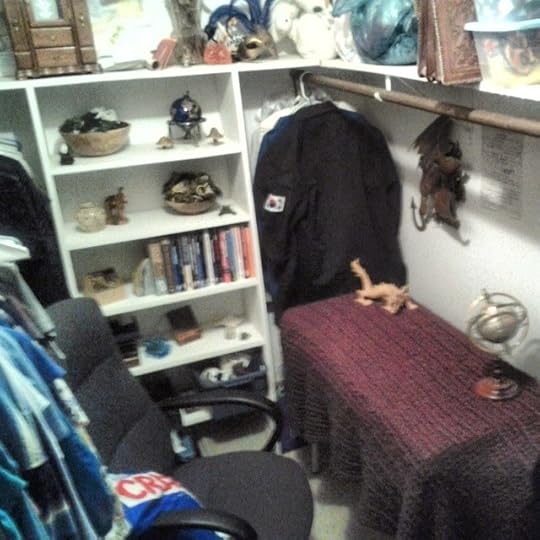
Most important, so far, it's working! And realizing that I can adapt, as a writer, and press on no matter what changes my life brings gives me a confidence that is well worth any initial discomfort. Here's hoping I can keep it up, and that the book I produce is my brightest to date!
I love that process--and it's turned out some pretty great books! Using this method, I've written up to three books in one year while also keeping up a break-neck schedule outside of writing. It works for me. But, right now, I'm throwing it out the window.
Why would I do that? Why, if I'd found a method of writing that was successful, would I toss it out? Because my life has changed, and I've realized that if I don't adapt with it, my writing will suffer. I have editing commitments now, both to the publisher I freelance for, and to writing friends who are up against deadlines of their own, and who I don't want to disappoint. Editing involves reading, obviously, and means I can't obsess over my book and push all other books aside. I've also started a book club (which involves reading, of course!) and find I simply can't clear my mental schedule so thoroughly as I did in the past. So, I've taken the aspects of my old process that seemed most essential, and renegotiated my approach in hopes that I can adapt them to my new process.First up, was mental space. I can't stop reading other books, but I can designate when and how I'll work on those other projects. Where possible, I've moved the reading of other books (that aren't my WIP) out to the couch, in the living room.Second is focus. Since I can't close out the world so thoroughly as I'd like, I've created a new space where I can write behind a closed door. In that space, I've forbidden myself from using the internet (except for the briefest research, directly book related) and where social networking, email checking, etc. are absolutely forbidden.I've extended the influence of my playlist to other things which help me focus, and heighten my writing mood. These include treasures I've collected over the years, as well as papers that inspire me.I've dialed back my goals for word count each day--I'm only aiming at 1,500 to 2k words a day, now. This will be more achievable than my prior word counts, given my other commitments, but will let me still reach my goals and have the sense of accomplishing my task.I think setting up a new space was the key factor in making this work, and for that I de-junked and reorganized one half of my bedroom closet. It's a little odd to be writing surrounded by my shirts and skirts, but I'm pleased with how it turned out.
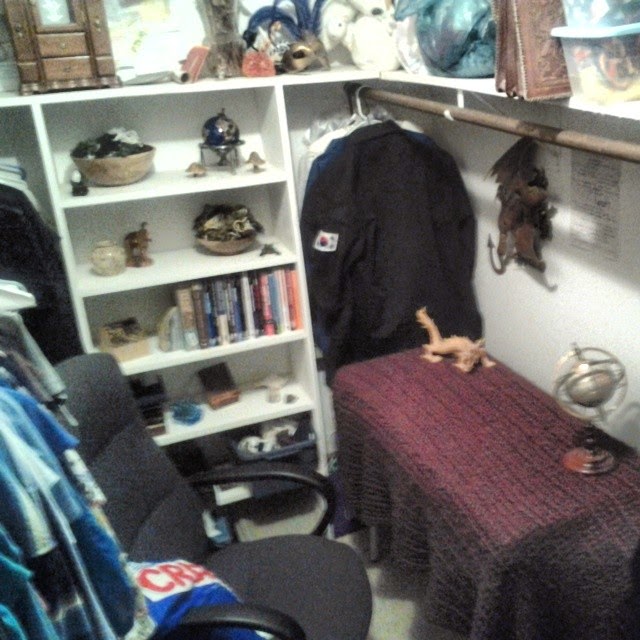
Most important, so far, it's working! And realizing that I can adapt, as a writer, and press on no matter what changes my life brings gives me a confidence that is well worth any initial discomfort. Here's hoping I can keep it up, and that the book I produce is my brightest to date!
July 7, 2014
DEADLINES by Monique Bucheger

DEADLINES
We all have them.
Sometimes they look like: Submit a short story by midnight on July 31st and sometimes it means leave the house by 8:30 am to get to your dentist appointment by 9 am. Deadlines have a way of helping us prioritize how we spend our time—why go grocery shopping in the morning during your prime writing time when you can go after you drop the kids off for soccer practice and be back to pick them up on time because the store is a block from practice?

If your deadline involves multiple steps like decorating the all-purpose room for a Valentine’s Day dance, you need to plot out what it takes to make each step successful: Are you going to order the decorations online? Then you need to allow for delivery time. Are you going to the store to buy them? Then you might want to purchase them the day before you are to be at the church or school so that you have time to organize them and make sure you have everything you need before you start putting them up a few hours before the guests arrive.With kids and writing, there are all kinds of deadlines: first drafts are due to beta readers by X date, finished manuscript to your editor by Y date, kids to school by 8 am—preferably lunch in hand and dressed in clean clothes for the day. (In some households properly brushed hair is a bonus and in others it is mandatory. J ) So what do you do if life happens? The car won’t start and the dentist may or may not be delayed depending on whether you can get a jump or you have a backup vehicle.If the baby pukes on her outfit or the 2 year-old dumps his bowl of cereal over the dog’s back, you may have some additional time management issues, depending on whether these occur at 7 am or 8:25am.
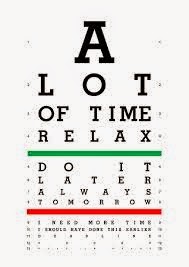
Some things are no brainers. If you are trying to get to a dentist appointment by 9 am THIS morning, you probably aren’t going to be working on the manuscript due NEXT WEEK to your editor at 8:30 am or even 7:30—you’ll be focused on getting the kids out the door on time. But if you decide to watch an 8 hour marathon of Dr. Who the day before your final manuscript is due to your editor, you may be causing yourself a lot of unnecessary anxiety.So, deadlines and time-management skills should go hand-in-hand. A sense of humor is also a great tool to pack in your tackle box of life. We all know the saying: the best laid plans of mice and men oft times go awry.

Perspective also has bearing on deadlines: missing that dentist appointment may be considered more tragic if you have a toothache than if you are just scheduled for a checkup. Making a deadline for a submission call for a short story may not matter if the magazine will do it again next month. However, honoring a deadline for the opportunity to submit a story to an anthology alongside your favorite author may spur you to spend hours creating your best work. DEALING With DEADLINES:1) Acknowledge deadlines and what it takes to achieve them2) Manage your time accordingly: set yourself up to succeed3) Honor your deadlines to others AND yourself. Give yourself plenty of time to do your best work.4) Because life happens inconveniently and unexpectantly at times: be flexible if need be. Some deadlines can be adjusted without much harm, but it is very important to treat other people’s time with respect. If your editor has blocked out next Monday, Tuesday and Wednesday for YOUR manuscript, don’t expect her to bump her next client on Thursday just because you couldn’t turn yours in until Wednesday at 5 pm. (On a side note: If you go into labor 6 weeks early, chances are she’ll work with you. But barring things that are really out of your control—make every effort to honor your commitment to other people—your kids included. If you read them a story every night at bedtime, you might need to make it a short story if you are on deadline, but read the story.)5) Have a sense of humor. Almost nothing we due will literally or figuratively scar us or anyone else for life. Having a good attitude makes life run more smoothly and enjoyably. Your toddler dumping his cereal on the dog may cost you 5 minutes in clean-up time, but the look on the dog’s face may give you a good laugh or a reminder to lighten up. Who knows, it might even give you a fun scene in a current or future Work In Progress. J