Eric C. Sheninger's Blog, page 25
July 19, 2020
Tracking COVID Cases to Better Safeguard Students and Educators
Safety is at the top of the minds of all educational stakeholders, especially teachers and parents. News outlets are flooding all channels with advice on what schools should and should not do. The CDC has also released specific guidelines to help guide the reopening of schools and the subsequent re-entry of students. There are no easy answers or solutions during these unprecedented times, but we can all agree that the health and safety of every child and adult are of paramount importance. To that end, it is critical that all groups have a seat at the table to add input and suggestions to any plan being developed. For some suggestions on how to do this in a meaningful way, check out this post.
All any district can do is meticulously plan while trying to foresee as many possible scenarios that could occur once schools are reopened. Many questions and associated challenges will undoubtedly arise. The key is to be ready for them. A proactive approach entails the establishment of protocols to track and report COVID cases across a school district while abiding by privacy laws. Doing so provides an additional safeguard for students and staff to complement social distancing, hybrid learning models, hygiene stations, and facemasks. It is critical that everyone knows who has been infected or has come in close contact with people that have tested positive for COVID. Access to this vital information will then allow for staff to quarantine as necessary.

I recently wrote about a fantastic tool called ZippSlip that every district should consider as a means to streamline communications. It is a cloud-based mobile app that supports all communication sent from the school to parents like student registration, athletic waivers, permission slips, mass notifications in multiple languages, dynamic use of video, and the list goes on and on. You can now add another essential feature to that list as Zippslip now can seamlessly collect data on COVID for tracking purposes that can assist with safety until the virus is eradicated. Below are some specific highlights from a brief on their website:
In addition to collecting data from families regarding students, districts, and schools can also report information related to staff infections or recent contact with others who have the virus. Together, the data in the dashboard can be used to help adjust plans to keep in-person learning going or make the decision to move to remote learning. In the end, it is just one more resource to help ease the many concerns that are out there. For more detailed information check out this downloadable slide deck.
The decision to reopen schools is a contentious one, to say the least. With infection rates rising in many states, educators and families are justified in their concern and fear for their safety. If reopening occurs under duress, a solution such as ZippSlip can help ease, but not eradicate, some concerns.
All any district can do is meticulously plan while trying to foresee as many possible scenarios that could occur once schools are reopened. Many questions and associated challenges will undoubtedly arise. The key is to be ready for them. A proactive approach entails the establishment of protocols to track and report COVID cases across a school district while abiding by privacy laws. Doing so provides an additional safeguard for students and staff to complement social distancing, hybrid learning models, hygiene stations, and facemasks. It is critical that everyone knows who has been infected or has come in close contact with people that have tested positive for COVID. Access to this vital information will then allow for staff to quarantine as necessary.

I recently wrote about a fantastic tool called ZippSlip that every district should consider as a means to streamline communications. It is a cloud-based mobile app that supports all communication sent from the school to parents like student registration, athletic waivers, permission slips, mass notifications in multiple languages, dynamic use of video, and the list goes on and on. You can now add another essential feature to that list as Zippslip now can seamlessly collect data on COVID for tracking purposes that can assist with safety until the virus is eradicated. Below are some specific highlights from a brief on their website:
ZippSlip offers a solution to electronically collect and track COVID symptoms and risk information from students' parents attending the school. Quickly deployed, ZippSlip allows parents to securely update their students' information from a browser or via the ZippSlip app. School administrators can track COVID risk information on customizable dashboards that include trend charts, heatmaps, and other relevant analytics. In one glance, administrators can monitor district-wide information and then quickly take mitigation steps. With a couple of clicks on ZippSlip's administrator portal, administrators can find students with symptoms, their siblings, and which schools and classes are at risk.
In addition to collecting data from families regarding students, districts, and schools can also report information related to staff infections or recent contact with others who have the virus. Together, the data in the dashboard can be used to help adjust plans to keep in-person learning going or make the decision to move to remote learning. In the end, it is just one more resource to help ease the many concerns that are out there. For more detailed information check out this downloadable slide deck.
The decision to reopen schools is a contentious one, to say the least. With infection rates rising in many states, educators and families are justified in their concern and fear for their safety. If reopening occurs under duress, a solution such as ZippSlip can help ease, but not eradicate, some concerns.


July 12, 2020
Purchasing Devices Does Not Equate to Learning
The COVID19 pandemic unearthed many harsh realities for education across the globe. One of the more glaring issues was the vast digital divide that still exists in many places, especially the United States. Inadequate WIFI and the availability of computers at home for kids to use for learning caught many educators off guard. Remote learning was a monumental challenge for districts and schools that already had made large-scale investments in devices, but it was even more so where inequity was prevalent. Many kids were automatically at a severe disadvantage as a result, which will most likely result in extreme learning loss and ever-widening achievement gaps.
It is okay to admit that we were ill-prepared before and during the pandemic. Now is the time to seize on lessons learned as schools prepare to move into uncharted territory whether the COVID19 rages on or begins to subside. Teaching will and must be different. Leadership must and will be different. Most of all, the learning culture will most certainly be different, and it will be a travesty if it is not. We have begun to see some change as more and more school districts are purchasing devices for all of their students. Every day I see new articles highlighting the millions of dollars; in some cases, spent to either begin to close or eradicate the digital divide. There are also forward-thinking districts who either purchase WIFI hotspots for kids or park WIFI-enabled busses around the community for family access. All of these efforts are to be commended.
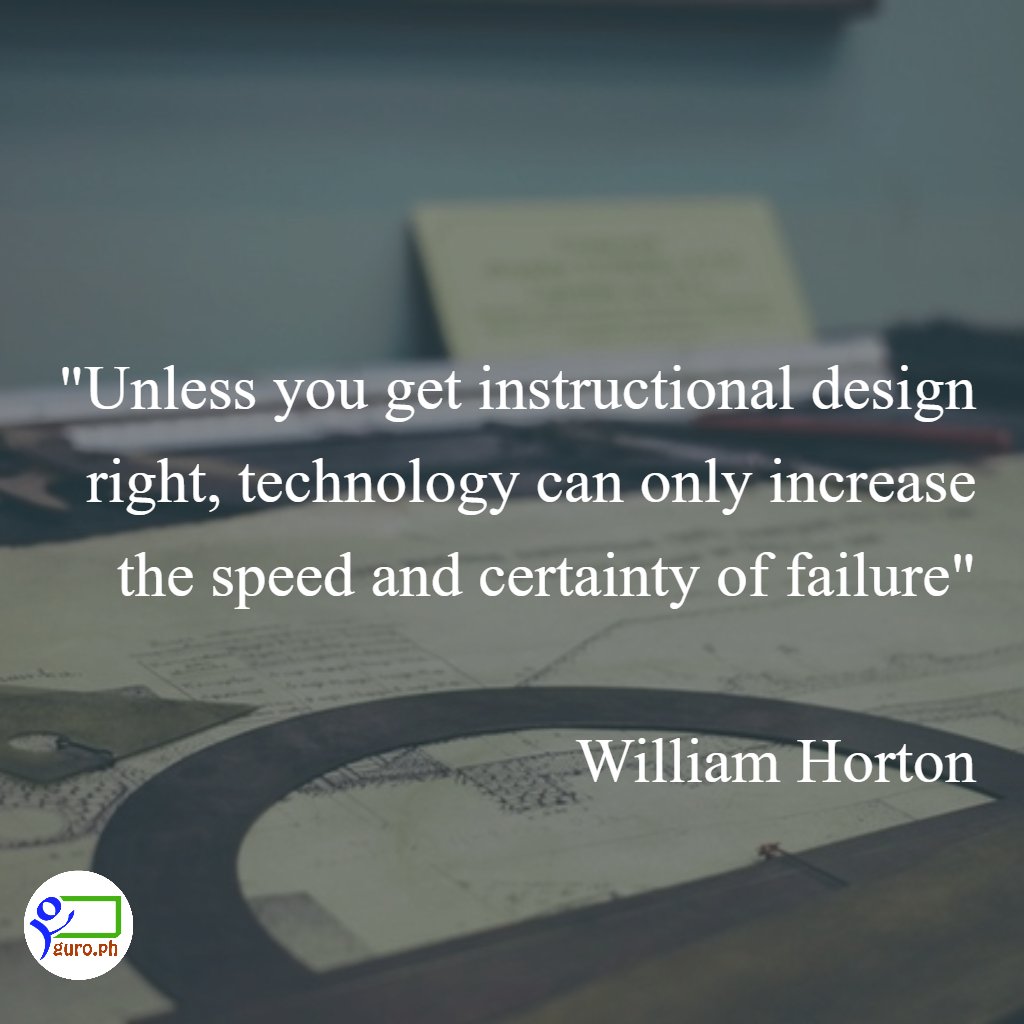
Here is the rub in all of this. Time and time again, even well before the pandemic hit, schools had a thirst for ensuring that there was a device in the hands of every student. William Horton says it best, "Unless you get instructional design right, technology can only increase the speed and certainty of failure."

Below are some lessons we learned after hitting the reset button on our Bring Your Own Device (BYOD) initiative in order to get it right that I captured in a 2015 post.
OngoingJob-embeddedSupported with coaching (face-to-face or virtual)Personalized and differentiatedFacilitated by people who have done the work and implemented successful change that resulted in improved student learning outcomes and achievementDirectly correlated to professional practiceAligned with research and case studiesAddresses real challenges educators faceSustainable over timeBefore COVID19, I always cautioned districts and schools to be wary of putting the cart before the horse. I am not sure that I would offer the same advice as we now know there is a great deal of work to be done to ensure digital equity for all kids. However, I am still steadfast in my opinion that just purchasing devices does not equate to learning, nor will it in the future if proper supports are not in place. Teachers need training and job-embedded coaching. Principals need support so that they know what to look for and can give their staff actionable feedback. Superintendents and central office administrators need to be able to determine the efficacy of the investment. Check out the International Center for Educational Leadership's (ICLE) vast services and Digital Practice Assessment (DPA) process to fill this gap.
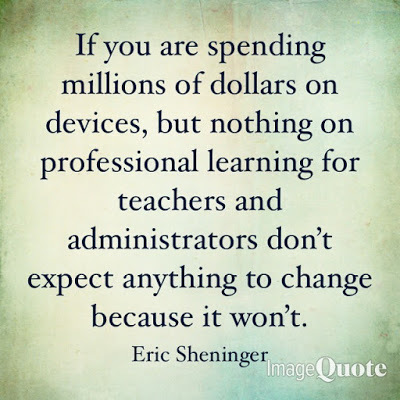
Just putting a device in kids' hands and expecting learning miracles to materialize is wishful thinking at best. Ongoing support is needed to usher in pedagogical change while building capacity. Teachers and administrators deserve this investment if large sums of money are being spent on devices. Without this support, the overall goal of the purchase might never be realized.
It is okay to admit that we were ill-prepared before and during the pandemic. Now is the time to seize on lessons learned as schools prepare to move into uncharted territory whether the COVID19 rages on or begins to subside. Teaching will and must be different. Leadership must and will be different. Most of all, the learning culture will most certainly be different, and it will be a travesty if it is not. We have begun to see some change as more and more school districts are purchasing devices for all of their students. Every day I see new articles highlighting the millions of dollars; in some cases, spent to either begin to close or eradicate the digital divide. There are also forward-thinking districts who either purchase WIFI hotspots for kids or park WIFI-enabled busses around the community for family access. All of these efforts are to be commended.
Here is the rub in all of this. Time and time again, even well before the pandemic hit, schools had a thirst for ensuring that there was a device in the hands of every student. William Horton says it best, "Unless you get instructional design right, technology can only increase the speed and certainty of failure."
Below are some lessons we learned after hitting the reset button on our Bring Your Own Device (BYOD) initiative in order to get it right that I captured in a 2015 post.
We found great success at my school during our digital transformation by focusing on pedagogy first, technology second if appropriate mindset. Not only was there a focus on solid instruction, but we also provided numerous supports for our teachers in the form of ongoing and job-embedded professional learning opportunities. If the expectation was to integrate technology with purpose to support or enhance learning, we made sure everyone was prepared to do just that.For technology to live up to the hype, pedagogy must change, whether learning is face-to-face, remote, or based on a hybrid model to ensure student and staff safety. Drive-by professional development did not work in the past. What has and will continue to make a difference are supports that incorporate the following:
OngoingJob-embeddedSupported with coaching (face-to-face or virtual)Personalized and differentiatedFacilitated by people who have done the work and implemented successful change that resulted in improved student learning outcomes and achievementDirectly correlated to professional practiceAligned with research and case studiesAddresses real challenges educators faceSustainable over timeBefore COVID19, I always cautioned districts and schools to be wary of putting the cart before the horse. I am not sure that I would offer the same advice as we now know there is a great deal of work to be done to ensure digital equity for all kids. However, I am still steadfast in my opinion that just purchasing devices does not equate to learning, nor will it in the future if proper supports are not in place. Teachers need training and job-embedded coaching. Principals need support so that they know what to look for and can give their staff actionable feedback. Superintendents and central office administrators need to be able to determine the efficacy of the investment. Check out the International Center for Educational Leadership's (ICLE) vast services and Digital Practice Assessment (DPA) process to fill this gap.
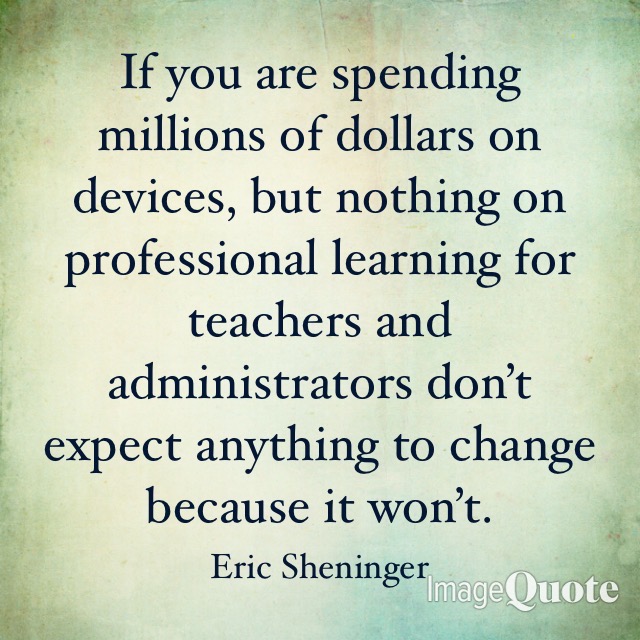
Just putting a device in kids' hands and expecting learning miracles to materialize is wishful thinking at best. Ongoing support is needed to usher in pedagogical change while building capacity. Teachers and administrators deserve this investment if large sums of money are being spent on devices. Without this support, the overall goal of the purchase might never be realized.
July 5, 2020
Don’t Forget About Educator Safety When Reopening Schools
We are all in the midst of some very challenging times, regardless of our profession. When it comes to education, schools are grappling with reopening safely here in the United States. There are no easy answers or choices here. As schools across the country are now virtually all closed for summer break, preparations are being made, and hopefully, comprehensive plans are being developed. However, in the midst of all of this, COVID19 cases are rising in many states. Those planning to begin reopening in phases have pushed the pause button. On top of it all are conflicting messages about what is the best course of action.
When it comes to students, the American Academy of Pediatrics (AAP) has come out strongly in favor of schools having students return to the classroom in the fall despite the ongoing risks associated with COVID-19, as reported in the Huffington Post. Below is an excerpt.
 Image credit
A recent story from ABC News highlights the fear and frustration felt by many educators.

No matter how great the planning process is, the result won't be perfect or even acceptable for all. As many districts and schools are considering hybrid-learning models for kids that incorporate flexible schedules and choice, the same should be offered to teachers who are experiencing the issues laid out in the ABC News piece. It is difficult for me even to suggest what this should look like. However, think about the different options and choices your district or school is offering students and adapt accordingly to teachers. A one-size-fits-all approach just won't cut it, and we owe it to them, to our teachers, to do everything possible to support them as they come back to work, whatever that form might be. Strong and compassionate leadership will be critical to ease concerns while developing a successful plan for reopening.

It's not just teachers we need to worry about, but also administrators and every other adult who is asked to work in a building. Considerations should also be made for these people if the same COVID-19 concerns are prevalent. The challenge and inherent opportunity are to begin to think about what types of work have to be done in-person and those that can be completed remotely.
The time is now to put all the cards on the table while considering various options for staff that need them. Forcing anyone into a painful or uncomfortable decision because of COVD-19 risks, both direct and indirect, must be avoided. If not, then we might very well see a mass exodus of educators this school year.
When it comes to students, the American Academy of Pediatrics (AAP) has come out strongly in favor of schools having students return to the classroom in the fall despite the ongoing risks associated with COVID-19, as reported in the Huffington Post. Below is an excerpt.
"The AAP strongly advocates that all policy considerations for the coming school year should start with a goal of having students physically present in school," the group said in an update to its guidance for school re-entry. The guidance asserts that "the importance of in-person learning is well-documented," and that evidence already has emerged of "negative impacts" on children due to school closures in the spring.It is tough to deny the negative impacts the pandemic has had on kids such as learning loss, widening achievement gaps, social-emotional issues, and in some cases, a lack of physical activity and proper nutrition. Education Week provides a wealth of information and resources for schools in this recent piece focusing on developing the right schedule to meet the student needs. The bottom line is that schools need to reopen for their sake, but at what cost? As much as kids need to be in school learning, there is mounting pressure and concerns, rightfully so I might add, from adults who fear for their health and safety.
 Image credit
A recent story from ABC News highlights the fear and frustration felt by many educators.
Some teachers around the country say they are nervous about returning because of underlying health conditions or concerns about infecting family members. Others say they are frustrated by the lack of clear guidance from officials about what's safe. And for some, it's about child care if their own kids are only back at school for a handful of days during the week. The result is an inevitable clash between leaders pushing aggressive reopening policies in states like Texas and Florida and teachers, some of whom say local officials need to think more about what they are asking teachers to do.All re-entry plans must emphasize health and safety above all else, something that I highlight in this post. The process should be a collaborative one that enlists the input from teachers, students, administrators, and community members. Any plan that actually succeeds in helping people feel at ease about reopening schools will incorporate many of the ideas that the group decides upon based on consensus.

No matter how great the planning process is, the result won't be perfect or even acceptable for all. As many districts and schools are considering hybrid-learning models for kids that incorporate flexible schedules and choice, the same should be offered to teachers who are experiencing the issues laid out in the ABC News piece. It is difficult for me even to suggest what this should look like. However, think about the different options and choices your district or school is offering students and adapt accordingly to teachers. A one-size-fits-all approach just won't cut it, and we owe it to them, to our teachers, to do everything possible to support them as they come back to work, whatever that form might be. Strong and compassionate leadership will be critical to ease concerns while developing a successful plan for reopening.
It's not just teachers we need to worry about, but also administrators and every other adult who is asked to work in a building. Considerations should also be made for these people if the same COVID-19 concerns are prevalent. The challenge and inherent opportunity are to begin to think about what types of work have to be done in-person and those that can be completed remotely.
The time is now to put all the cards on the table while considering various options for staff that need them. Forcing anyone into a painful or uncomfortable decision because of COVD-19 risks, both direct and indirect, must be avoided. If not, then we might very well see a mass exodus of educators this school year.
June 28, 2020
Leading in Uncertain Times
The concept of leadership hasn’t changed, although the conditions under which leaders work and learn sure have. Prior to COVID19, the vast amount of uncertainty in education lay in societal changes resulting from the 4th Industrial Revolution. The world of work was being disrupted right before our eyes. A rapid evolution in artificial intelligence, automation, and advanced robotics should have served notice to anyone in the education space that things needed to change. No longer did a “this too shall pass” mantra carry any weight. In the end, though, scalable change resulting in a transformation of teaching, learning, and leadership was more of an exception as opposed to the rule.
Then the COVID19 pandemic came crashing down on the world. Schools were not prepared, as nearly no one could have envisioned the mass closings for extended periods of time. Triage resulted as educators valiantly put remote learning plans in place while attempting to overcome a myriad of challenges. As the virus continued to leave its mark, the world began to rise up in the wake of George Floyd’s murder. A social justice movement formed in ways that many of us have never seen, which in turn has raised the central role that education must play to combat racism. Curriculum must be revised, assumptions taken head-on, and a school culture that focuses as much on equality and equity as it does everything else.
The bottom line is that the world has been turned upside down, and this is not necessarily a bad thing. In times of uncertainty, strong leadership is needed more than ever.

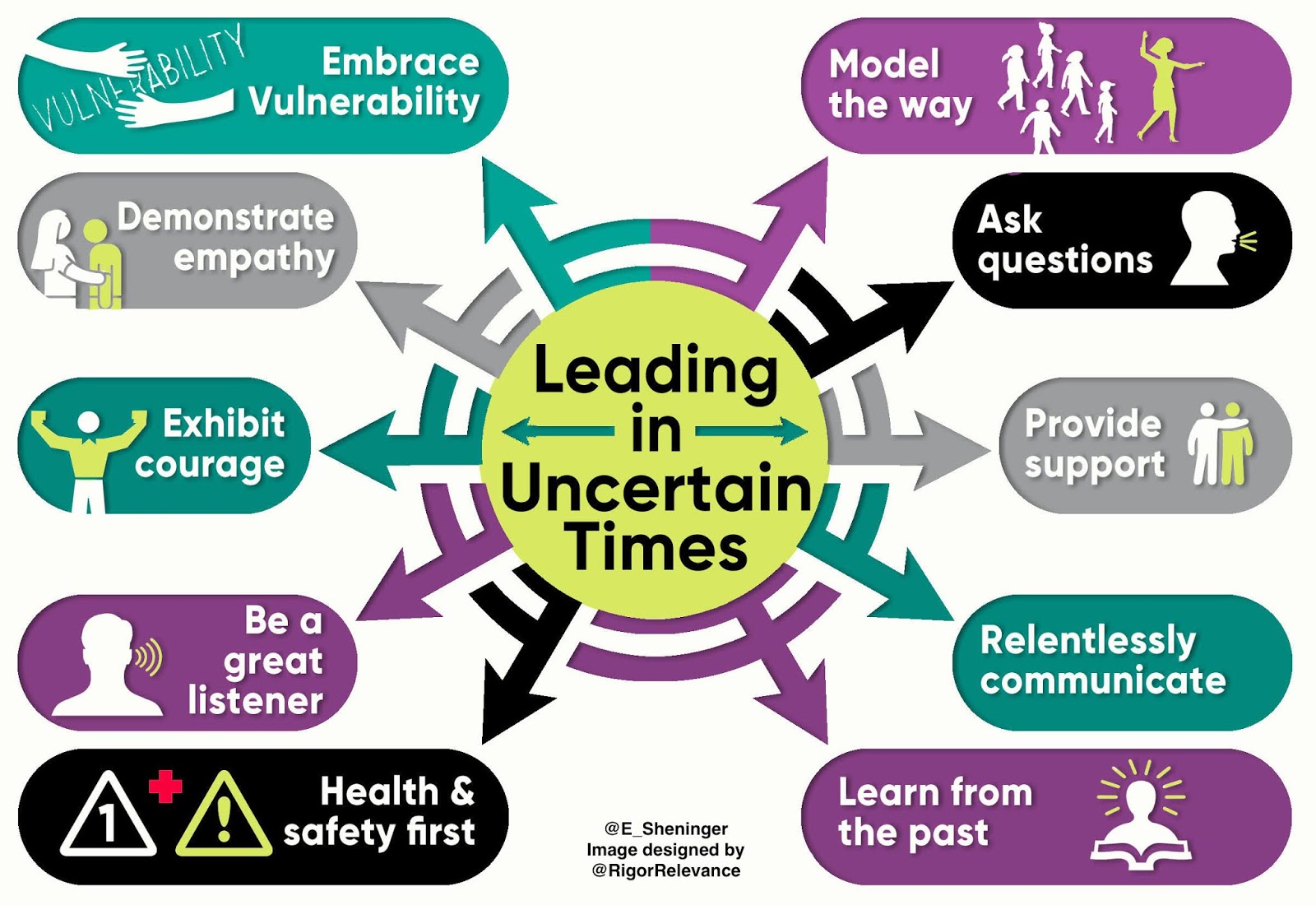
Embrace vulnerability
It is a misconception that being vulnerable means you are weak. On the contrary, it is a sign of strength. Brene Brown shares the following in Dare to Lead, “vulnerability is the emotion that we experience during times of uncertainty, risk, and emotional exposure. It is having the courage to show up, fully engage, and be seen when you can’t control the outcome.” Leaders use this as a tool to build strong relationships with the people they work alongside by making known what is going on in their heads. As the saying goes, …sharing is caring.
Demonstrate empathy
Empathy is the ability to understand and share the feelings of another. I shared the following in a previous post, “As leaders, it is important for us to imagine ourselves in the position of our students, staff, and community members. This gives us a better perspective on the challenges and feelings of those we are tasked to serve. Better, more informed decisions can result from “walking in the shoes” of those who will be most impacted by the decisions that we make.” Empathetic leadership builds trust and helps to create a culture where change will be more readily embraced in uncertain times.
Exhibit courage
Now is the time to challenge assumptions, tackle bias, take risks, make bold decisions. To move forward with needed change, we need leaders who are able to persevere in the face of uncomfortable situations and not back down when things get difficult. Don’t be afraid to step outside your comfort zone.
Be a great listener
There are many ways to earn respect and build trust, both of which are needed to get change efforts off the ground. Active listening helps to accomplish both while opening up a leader to new ideas, strategies, and feedback. Research has shown many positive outcomes associated with excellent listening skills.
Health & safety first
As we continue to move forward in unprecedented times, the pandemic has made painfully clear that health and safety must supersede everything else. Closing achievement gaps and addressing learning loss will always be critical, but in challenging and disruptive times leaders must emphasize Maslow’s over Bloom’s.
Model the way
Leadership is not about telling people what to do. It’s about taking them where they need to be. Don’t ask others to do what you are not willing to do yourself. Empowerment rests on leading the way through observable actions. Modeling helps to instill belief.
Ask questions
No one has or will ever have all the answers. To assume as much is unrealistic, to say the least. One could even say that there are no definitive answers in uncertain times. The best leaders ask questions, and the more of them the better. Developing, asking, and following up on the right questions can lead to answers that will help usher in the changes that are needed now and in the future.
Provide support
Support can come in many forms, such as resources, time, and professional learning opportunities. It can also manifest itself through many of the points listed above, such as showing empathy, listening, putting safety first, and modeling. Leaders need to determine what types of supports they can readily provide as well as those that need to be acquired, such as needed professional learning on re-entry, personalized/blended learning, and implementing hybrid models. We at the International Center for Leadership in Education (ICLE) are ready and willing to assist is needed.
Relentlessly communicate
You will not find an effective leader who is not an effective communicator. It’s all about getting people the right information at the right time through the proper means. During uncertain times you can’t communicate too much. Digital leadership is essential, and it compels us to meet our stakeholders where they are at while employing a multi-faceted approach.
Learn from the past
A great deal has been learned since the onset of the pandemic and the social justice movement. We can ill afford to continue to do what we have always done and expect a different or better result that aligns with reality. Critical lessons have been learned, which can lead to new opportunities to transform teaching, learning, and leadership. Leaders need to make sure past mistakes are not repeated.
None of us know what the future holds in the face of these unprecedented times. What we do know is that schools and educators need leaders to guide them in ways that help to subdue the fear and confusion that naturally arises during uncertain times. Leaders set the tone, and they are needed more than ever to step up and accept this responsibility.
Want to learn more? Check out the presentation I did on the topic below.
Leading in Times of Uncertainty with Eric Sheninger from Pear Deck on Vimeo.
Then the COVID19 pandemic came crashing down on the world. Schools were not prepared, as nearly no one could have envisioned the mass closings for extended periods of time. Triage resulted as educators valiantly put remote learning plans in place while attempting to overcome a myriad of challenges. As the virus continued to leave its mark, the world began to rise up in the wake of George Floyd’s murder. A social justice movement formed in ways that many of us have never seen, which in turn has raised the central role that education must play to combat racism. Curriculum must be revised, assumptions taken head-on, and a school culture that focuses as much on equality and equity as it does everything else.
The bottom line is that the world has been turned upside down, and this is not necessarily a bad thing. In times of uncertainty, strong leadership is needed more than ever.
Embrace vulnerability
It is a misconception that being vulnerable means you are weak. On the contrary, it is a sign of strength. Brene Brown shares the following in Dare to Lead, “vulnerability is the emotion that we experience during times of uncertainty, risk, and emotional exposure. It is having the courage to show up, fully engage, and be seen when you can’t control the outcome.” Leaders use this as a tool to build strong relationships with the people they work alongside by making known what is going on in their heads. As the saying goes, …sharing is caring.
Demonstrate empathy
Empathy is the ability to understand and share the feelings of another. I shared the following in a previous post, “As leaders, it is important for us to imagine ourselves in the position of our students, staff, and community members. This gives us a better perspective on the challenges and feelings of those we are tasked to serve. Better, more informed decisions can result from “walking in the shoes” of those who will be most impacted by the decisions that we make.” Empathetic leadership builds trust and helps to create a culture where change will be more readily embraced in uncertain times.
Exhibit courage
Now is the time to challenge assumptions, tackle bias, take risks, make bold decisions. To move forward with needed change, we need leaders who are able to persevere in the face of uncomfortable situations and not back down when things get difficult. Don’t be afraid to step outside your comfort zone.
Be a great listener
There are many ways to earn respect and build trust, both of which are needed to get change efforts off the ground. Active listening helps to accomplish both while opening up a leader to new ideas, strategies, and feedback. Research has shown many positive outcomes associated with excellent listening skills.
Health & safety first
As we continue to move forward in unprecedented times, the pandemic has made painfully clear that health and safety must supersede everything else. Closing achievement gaps and addressing learning loss will always be critical, but in challenging and disruptive times leaders must emphasize Maslow’s over Bloom’s.
Model the way
Leadership is not about telling people what to do. It’s about taking them where they need to be. Don’t ask others to do what you are not willing to do yourself. Empowerment rests on leading the way through observable actions. Modeling helps to instill belief.
Ask questions
No one has or will ever have all the answers. To assume as much is unrealistic, to say the least. One could even say that there are no definitive answers in uncertain times. The best leaders ask questions, and the more of them the better. Developing, asking, and following up on the right questions can lead to answers that will help usher in the changes that are needed now and in the future.
Provide support
Support can come in many forms, such as resources, time, and professional learning opportunities. It can also manifest itself through many of the points listed above, such as showing empathy, listening, putting safety first, and modeling. Leaders need to determine what types of supports they can readily provide as well as those that need to be acquired, such as needed professional learning on re-entry, personalized/blended learning, and implementing hybrid models. We at the International Center for Leadership in Education (ICLE) are ready and willing to assist is needed.
Relentlessly communicate
You will not find an effective leader who is not an effective communicator. It’s all about getting people the right information at the right time through the proper means. During uncertain times you can’t communicate too much. Digital leadership is essential, and it compels us to meet our stakeholders where they are at while employing a multi-faceted approach.
Learn from the past
A great deal has been learned since the onset of the pandemic and the social justice movement. We can ill afford to continue to do what we have always done and expect a different or better result that aligns with reality. Critical lessons have been learned, which can lead to new opportunities to transform teaching, learning, and leadership. Leaders need to make sure past mistakes are not repeated.
None of us know what the future holds in the face of these unprecedented times. What we do know is that schools and educators need leaders to guide them in ways that help to subdue the fear and confusion that naturally arises during uncertain times. Leaders set the tone, and they are needed more than ever to step up and accept this responsibility.
Want to learn more? Check out the presentation I did on the topic below.
Leading in Times of Uncertainty with Eric Sheninger from Pear Deck on Vimeo.
June 21, 2020
Moving to a Hybrid Learning Model
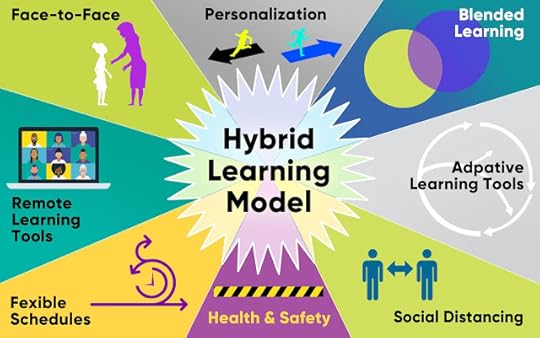
We don’t know for sure what education will look like in the future, but one thing is for sure, and that is the need to adapt and evolve. The pandemic shuttered schools across the globe, and lessons, some of which were very hard, were learned. As re-entry planning either begins or continues in earnest, the priority must be to transform learning in ways that provide kids with the best experience possible while ensuring the safety of all. It goes without saying that this is no small feat. In a previous post, I outlined eight specific focus areas, in no particular order, that can help to usher in a new and better normal. Now decisions must be made as to what this will actually look like in reality.
Business as usual just won’t cut it. The lessons learned during COVID19 provide opportunities to re-envision what schools can be. Now efforts have to be made in developing a practical path forward. So, what might this look like going forward? My thinking as of late has been around a hybrid learning model. At this point, they are just thoughts, but each can be a powerful catalyst to initiating and sustaining a transformation of education at scale. The premise though is to not only incorporate what has been learned up to this point during one of the most disruptive times in history but also to perceive what might come next. Failing to prepare for the unknown or addressing the slew of challenges that arose when schools were closed means that nothing was learned.
The premise of a hybrid learning model is to combine traditional and non-traditional methodologies to improve education while ensuring that high-quality learning for all kids is the gold standard. To start, a workable definition must be established to begin creating a vision for this model. Take this definition from Learning Technologies:
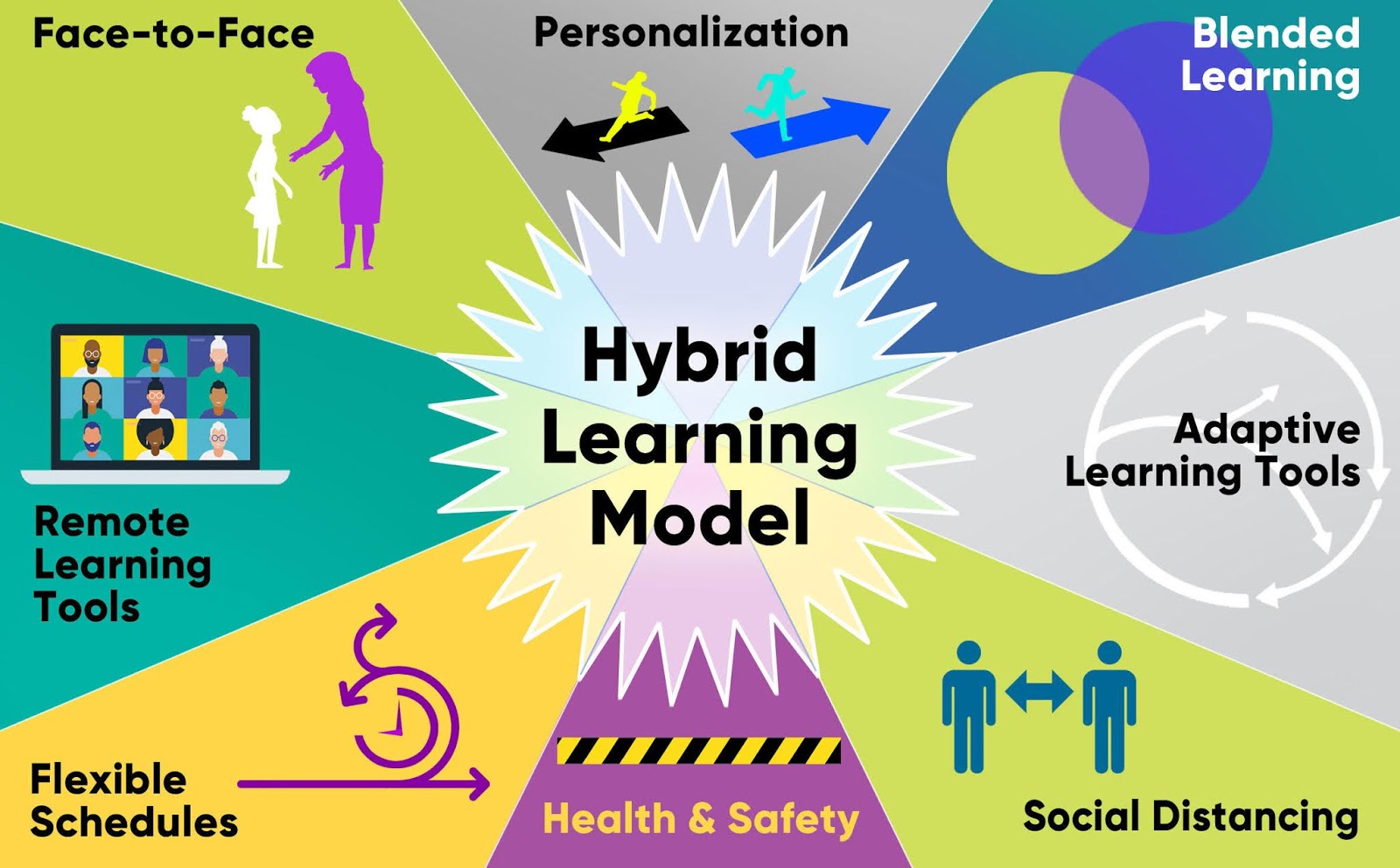
Face-to-face
It’s not a matter if, but when kids return to school. The most powerful relationships for students form through interactions with teachers, administrators, and peers. In most cases, the consensus is that high-quality instruction and effective pedagogy are facilitated best when educators are physically with their students. The key is to utilize the time better.
Personalization
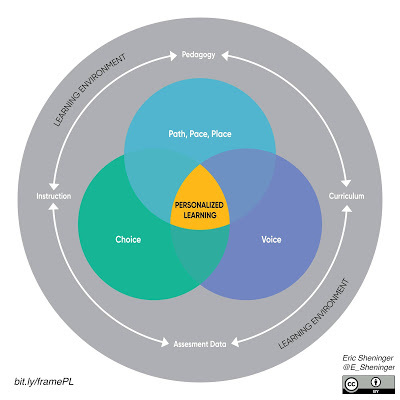
Personalized learning represents a movement from the “what” to the “who” as a means to facilitate student ownership of the learning process. It consists of high-agency strategies that focus on voice, choice, path, pace, and place both with and without technology. Check out this post for more detailed information.
Blended Learning
One of the best strategies to personalize the experience for students is blended learning. Blended instruction is what the teacher does with technology. Blended learning is where students use tech to have control over path, place, and pace. The key is to focus on sound pedagogical strategies that will help to ensure improving student learning outcomes.
Adaptive learning tools
The success of a hybrid model does, in part, rely on the purposeful and strategic use of technology. These can be instrumental in providing needed or supplemental support to close achievement gaps, provide independent practice, and help learners move ahead if they have already mastered the content. Blended pathways are the best options for the seamless integration of adaptive learning tools.
Social distancing
With new and potential clusters of COVID19 appearing, many schools across the globe will be mandated to implement social distancing measures. A hybrid model accounts for this fact, and its success relies on budgeting, existing space redesign, and professional learning support.
Flexible schedules
The premise behind any hybrid-learning model is altering the “traditional” school day schedule (and calendar for that matter) to make the best use of time and resources. The literature on this goes way back, and it just makes sense. Flexible scheduling patterns address the concern for more appropriate learning environments for students and respond to the need, not for schools to be more organized, but to be more flexible and creative in their use of time (Spear, 1992). Flexible scheduling allows schools to optimize time, space, staff, and facilities and to add variety to their curriculum offerings and teaching strategies (Canady & Rettig, 1995). Pandemic or not, this is long overdue.
Remote Learning
Distance and virtual are appropriate where all kids have access to a device and the Internet. Remote, on the other hand, focuses on both digital and non-digital pathways to keep realistic learning going. With social distancing and flexible schedules having a considerable role in any hybrid learning model, the need to adequately prepare for and implement remote learning while ensuring equity is paramount. For more information, check out my entire remote learning series.
Health and safety
I will echo what many others have said, “Maslow’s before Bloom’s.” Above all else, we need to make sure each and every person in a school system feels safe, and measures are taken to both prevent and address any COVID19 issues. For more specifics, refer to this post.
As I stated previously, these are just some ideas that are floating around in my head. What I do know is that learner and educator success going forward will rely on a hybrid-learning model. Business as usual in the face of current challenges and those lurking in the shadows down the road has given us all a golden opportunity to transform education. My hope is that schools take it.
Canady, R. L. & Rettig, M. D. (1995). Block scheduling: A catalyst for change in high schools. Princeton, NJ: Eye On Education
Spear, R. C. (1992). Middle level team scheduling: Appropriate grouping for adolescents. Schools in the Middle, 2(1), 30–34.
Business as usual just won’t cut it. The lessons learned during COVID19 provide opportunities to re-envision what schools can be. Now efforts have to be made in developing a practical path forward. So, what might this look like going forward? My thinking as of late has been around a hybrid learning model. At this point, they are just thoughts, but each can be a powerful catalyst to initiating and sustaining a transformation of education at scale. The premise though is to not only incorporate what has been learned up to this point during one of the most disruptive times in history but also to perceive what might come next. Failing to prepare for the unknown or addressing the slew of challenges that arose when schools were closed means that nothing was learned.
The premise of a hybrid learning model is to combine traditional and non-traditional methodologies to improve education while ensuring that high-quality learning for all kids is the gold standard. To start, a workable definition must be established to begin creating a vision for this model. Take this definition from Learning Technologies:
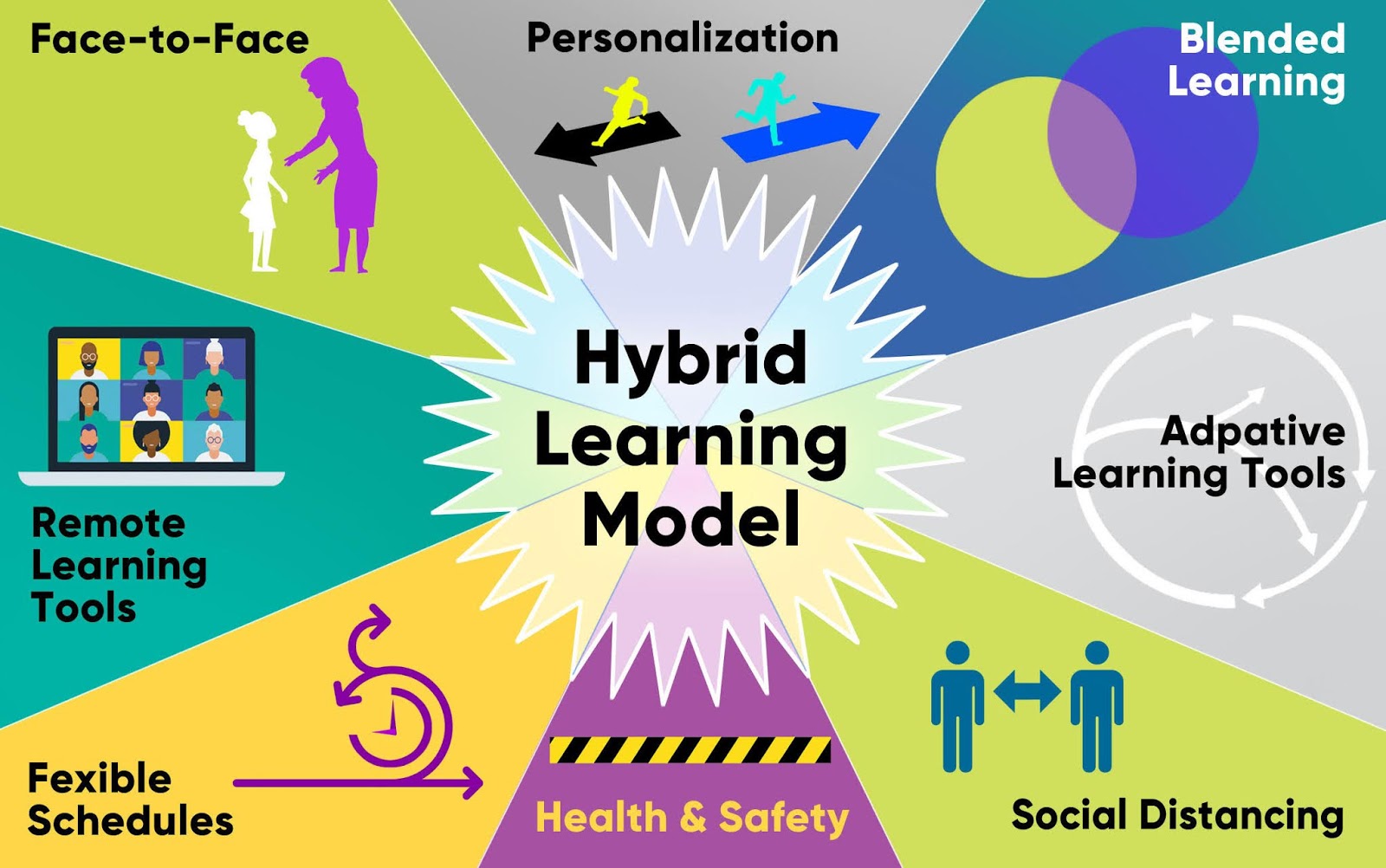
Hybrid learning combines face-to-face and online teaching into one cohesive experience. Approximately half of the class sessions are on-campus, while the other half have students working online. Although that may sound like a cut-and-dry formula, a lot of planning is needed to ensure that hybrid works well, allowing its two formats to capitalize on each other’s strengths.There is a lot more detail in this report that they developed. Hybrid, in the context of this post, represents the combination of two or more different things. Some might argue that education has always embraced this approach. Yes, to some extent, but definitely not scaled in a way that has led to system-wide transformation. With the inherent challenges ahead, a uniform hybrid model is necessary for success. The image below begins to visualize what this could look like as schools begin to transform teaching, learning, and leadership.
Face-to-face
It’s not a matter if, but when kids return to school. The most powerful relationships for students form through interactions with teachers, administrators, and peers. In most cases, the consensus is that high-quality instruction and effective pedagogy are facilitated best when educators are physically with their students. The key is to utilize the time better.
Personalization
Personalized learning represents a movement from the “what” to the “who” as a means to facilitate student ownership of the learning process. It consists of high-agency strategies that focus on voice, choice, path, pace, and place both with and without technology. Check out this post for more detailed information.

Blended Learning
One of the best strategies to personalize the experience for students is blended learning. Blended instruction is what the teacher does with technology. Blended learning is where students use tech to have control over path, place, and pace. The key is to focus on sound pedagogical strategies that will help to ensure improving student learning outcomes.
Adaptive learning tools
The success of a hybrid model does, in part, rely on the purposeful and strategic use of technology. These can be instrumental in providing needed or supplemental support to close achievement gaps, provide independent practice, and help learners move ahead if they have already mastered the content. Blended pathways are the best options for the seamless integration of adaptive learning tools.
Social distancing
With new and potential clusters of COVID19 appearing, many schools across the globe will be mandated to implement social distancing measures. A hybrid model accounts for this fact, and its success relies on budgeting, existing space redesign, and professional learning support.
Flexible schedules
The premise behind any hybrid-learning model is altering the “traditional” school day schedule (and calendar for that matter) to make the best use of time and resources. The literature on this goes way back, and it just makes sense. Flexible scheduling patterns address the concern for more appropriate learning environments for students and respond to the need, not for schools to be more organized, but to be more flexible and creative in their use of time (Spear, 1992). Flexible scheduling allows schools to optimize time, space, staff, and facilities and to add variety to their curriculum offerings and teaching strategies (Canady & Rettig, 1995). Pandemic or not, this is long overdue.
Remote Learning
Distance and virtual are appropriate where all kids have access to a device and the Internet. Remote, on the other hand, focuses on both digital and non-digital pathways to keep realistic learning going. With social distancing and flexible schedules having a considerable role in any hybrid learning model, the need to adequately prepare for and implement remote learning while ensuring equity is paramount. For more information, check out my entire remote learning series.
Health and safety
I will echo what many others have said, “Maslow’s before Bloom’s.” Above all else, we need to make sure each and every person in a school system feels safe, and measures are taken to both prevent and address any COVID19 issues. For more specifics, refer to this post.
As I stated previously, these are just some ideas that are floating around in my head. What I do know is that learner and educator success going forward will rely on a hybrid-learning model. Business as usual in the face of current challenges and those lurking in the shadows down the road has given us all a golden opportunity to transform education. My hope is that schools take it.
Canady, R. L. & Rettig, M. D. (1995). Block scheduling: A catalyst for change in high schools. Princeton, NJ: Eye On Education
Spear, R. C. (1992). Middle level team scheduling: Appropriate grouping for adolescents. Schools in the Middle, 2(1), 30–34.
June 14, 2020
Upgrading Family Communications
As technology continues to evolve, it will continue to become an even more embedded component of society. With that being said, it is essential for school leaders to meet their stakeholders where they are at and engage them in two-way communications. Digital leadership calls for a multifaceted approach using both traditional and new-age strategies to ensure that the right message reaches stakeholders in a timely fashion. We can't assume communication staples such as snail mail (i.e., paper mailings), newsletters, or websites are the most effective or the only way to get information out.
In an article for ASCD, I laid out three specific areas that are critical to effective communication:
Transparency - Leaders can tackle the constant perception battle by providing more frequent and accurate updates about the daily work occurring in schools. Flexibility - A multifaceted digital communications strategy allows all stakeholders a choice as to how they want to consume information and interact with the school.Sharing the good news and important information - In a time when the good news about schools is hard to come by in the mainstream media, school leaders can now become the storyteller-in-chief. It is also vital to get needed information to stakeholders quickly and seamlessly.The COVID crisis has laid bare opportunities to improve how we communicate between schools and parents. Budgets are under stress, so why invest in a mess of multiple communications applications and paper? I'll tell you that I have personally experienced this as a principal and seen in many districts school staff who are asked to print, collate, distribute, collect, read and process all kinds of paper forms and documents. Often these are in multiple languages! School teachers and other staff spend countless hours on this work, and it is taken for granted. Students are then asked to act as couriers carrying paperwork to parents during the school year. The whole chain of communications, when paper is used, involves staff, students, and parents. Is this even effective? It sure is costly in both money and time.
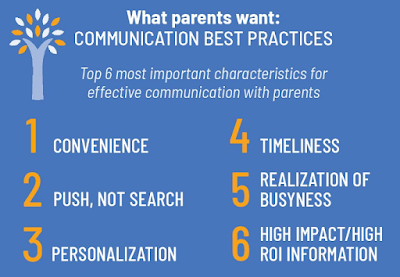 Image credit
What do parents experience? Almost all districts and schools have multiple ways to connect to parents, including paper, email, phone dialers, portals, websites, etc. Is it any wonder that parents are often confused and frustrated with how their districts are communicating? What is this all costing? Now in the COVID era, keeping parents informed and engaged is more important than ever. Furthermore, given the need to reduce costs and unnecessary labor, districts and schools must commit to simplify and become fully electronic in their communications. It is now possible to finally simplify and enhance parent communications, get rid of all the paperwork they have to complete while saving time and costs. But how do we get to this utopia of simplicity, lower costs, and achieve more effective communications? It may not be as hard as you think. Of course, you will hear and face a number of issues within your district or school:
You may be told or feel that parents won't use an electronic system. This is inaccurate. Yes, there are always a few that will not adopt new technology, but smartphone statistics show that 95% of adults with school children have at least one smartphone at home. Are these really the people who won't connect electronically?What about parents with no internet? The good news is that parents with smartphones do have internet even if they don't have cable internet at home.You have staff that are reluctant to change. Yes, there is always inertia. On the other hand, who likes paperwork? Does this push-back outweigh the costs?You may have too many apps already. Many districts and schools over the years have indeed adopted multiple systems, each solving a specific problem. It's also true this has led to higher costs and more confusion amongst parents and staff. So, the opportunity here is to clean house, simplify, and save costs.I am reminded of a school communications application I discovered years ago as a principal that directly speaks to these issues. ZippSlip is a cloud-based, mobile app that supports all communication sent from the school to parents like student registration, athletic waivers, permission slips, mass notifications, dynamic use of video, and the list goes on and on. ZippSlip in one platform that includes multiple types of communications: electronic forms, multimedia, text, and recorded voice, all in multiple languages. The broad set of capabilities will help you consolidate and simplify.

ZippSlip saves costs in three ways:
Eliminating paper, printing, and distribution.Replacing other applications such as the mass/emergency notification system, survey tools, email tools, workflow apps, and other communications tools. ZippSlip provides a comprehensive set of communications features for administrators and teachers.A considerable reduction in time spent on paperwork by staff.There are other issues you may be dealing with consistently. While many schools now commonly use social networks to inform the community, these come with drawbacks. Some adults shy away from social media, making it tough to get high adoption rates. I am not saying that you shouldn't use these valuable tools, but the goal should be to connect and engage with as many stakeholders as possible. As a robust alternative to social media, ZippSlip supports ZippGrams. These are multimedia, multilingual newsletters, which include text, video/images, and polls. A regular newsletter complemented with digital assets such as video sent by the principal or superintendent will go a long way in keeping the parents involved. You can even include a poll to elicit quick feedback.
Just as teachers differentiate instruction for a variety of learning styles in the classroom, schools should differentiate their communication efforts if we want true partnerships between home and school. Leaders have the power to shape the culture of our schools. Using a solution like ZippSlip as a lever, you can open the door to new ways of learning, thinking, financial savings, and communicating for all members of your community.
In an article for ASCD, I laid out three specific areas that are critical to effective communication:
Transparency - Leaders can tackle the constant perception battle by providing more frequent and accurate updates about the daily work occurring in schools. Flexibility - A multifaceted digital communications strategy allows all stakeholders a choice as to how they want to consume information and interact with the school.Sharing the good news and important information - In a time when the good news about schools is hard to come by in the mainstream media, school leaders can now become the storyteller-in-chief. It is also vital to get needed information to stakeholders quickly and seamlessly.The COVID crisis has laid bare opportunities to improve how we communicate between schools and parents. Budgets are under stress, so why invest in a mess of multiple communications applications and paper? I'll tell you that I have personally experienced this as a principal and seen in many districts school staff who are asked to print, collate, distribute, collect, read and process all kinds of paper forms and documents. Often these are in multiple languages! School teachers and other staff spend countless hours on this work, and it is taken for granted. Students are then asked to act as couriers carrying paperwork to parents during the school year. The whole chain of communications, when paper is used, involves staff, students, and parents. Is this even effective? It sure is costly in both money and time.
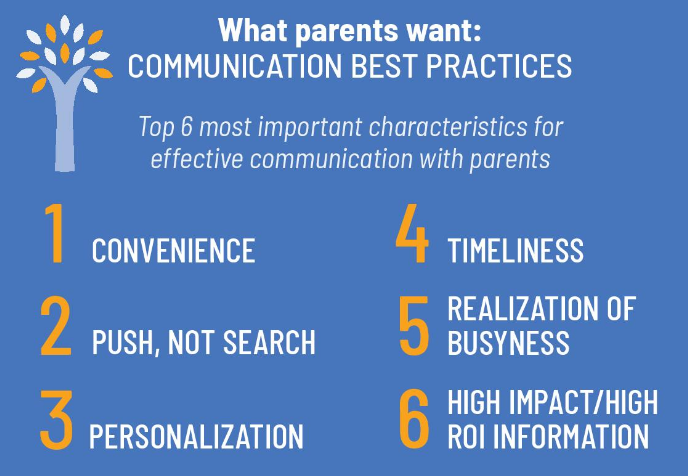 Image credit
What do parents experience? Almost all districts and schools have multiple ways to connect to parents, including paper, email, phone dialers, portals, websites, etc. Is it any wonder that parents are often confused and frustrated with how their districts are communicating? What is this all costing? Now in the COVID era, keeping parents informed and engaged is more important than ever. Furthermore, given the need to reduce costs and unnecessary labor, districts and schools must commit to simplify and become fully electronic in their communications. It is now possible to finally simplify and enhance parent communications, get rid of all the paperwork they have to complete while saving time and costs. But how do we get to this utopia of simplicity, lower costs, and achieve more effective communications? It may not be as hard as you think. Of course, you will hear and face a number of issues within your district or school:
You may be told or feel that parents won't use an electronic system. This is inaccurate. Yes, there are always a few that will not adopt new technology, but smartphone statistics show that 95% of adults with school children have at least one smartphone at home. Are these really the people who won't connect electronically?What about parents with no internet? The good news is that parents with smartphones do have internet even if they don't have cable internet at home.You have staff that are reluctant to change. Yes, there is always inertia. On the other hand, who likes paperwork? Does this push-back outweigh the costs?You may have too many apps already. Many districts and schools over the years have indeed adopted multiple systems, each solving a specific problem. It's also true this has led to higher costs and more confusion amongst parents and staff. So, the opportunity here is to clean house, simplify, and save costs.I am reminded of a school communications application I discovered years ago as a principal that directly speaks to these issues. ZippSlip is a cloud-based, mobile app that supports all communication sent from the school to parents like student registration, athletic waivers, permission slips, mass notifications, dynamic use of video, and the list goes on and on. ZippSlip in one platform that includes multiple types of communications: electronic forms, multimedia, text, and recorded voice, all in multiple languages. The broad set of capabilities will help you consolidate and simplify.
ZippSlip saves costs in three ways:
Eliminating paper, printing, and distribution.Replacing other applications such as the mass/emergency notification system, survey tools, email tools, workflow apps, and other communications tools. ZippSlip provides a comprehensive set of communications features for administrators and teachers.A considerable reduction in time spent on paperwork by staff.There are other issues you may be dealing with consistently. While many schools now commonly use social networks to inform the community, these come with drawbacks. Some adults shy away from social media, making it tough to get high adoption rates. I am not saying that you shouldn't use these valuable tools, but the goal should be to connect and engage with as many stakeholders as possible. As a robust alternative to social media, ZippSlip supports ZippGrams. These are multimedia, multilingual newsletters, which include text, video/images, and polls. A regular newsletter complemented with digital assets such as video sent by the principal or superintendent will go a long way in keeping the parents involved. You can even include a poll to elicit quick feedback.
Just as teachers differentiate instruction for a variety of learning styles in the classroom, schools should differentiate their communication efforts if we want true partnerships between home and school. Leaders have the power to shape the culture of our schools. Using a solution like ZippSlip as a lever, you can open the door to new ways of learning, thinking, financial savings, and communicating for all members of your community.
June 7, 2020
Are Schools Ready for What Comes Next?
At the beginning of 2020, no one could have foreseen the impact of the pandemic. In the face of a myriad of obstacles, educators have stepped up to implement remote learning to get through the remainder of the academic year. Now schools are either winding down or starting back up depending on where they are located in the world, as the pandemic still has a grip globally. A post-Covid19 world will be here eventually, but it is anyone’s guess when that will actually be. As schools grapple with the unknown questions and challenges at the top of everyone’s mind, here are a few that I hope resonate:
Will school be safe for everyone?Will parents send their kids to school?Will teachers come back?How will social distancing work?How will you focus on mental, just not physical, health of students and staff?Will the lessons learned during the pandemic be applied to create a better learning culture for kids?What happens if we open up school, and we are asked to shut down again because of a new outbreak?What will the schedule look like?How will reduced budgets ensure safety, hygiene, and needed professional learning?If you are not thinking about these questions and others that pertain to your current or potential future situation, begin to now. There are no easy or straightforward answers, unfortunately. That’s why planning now is critical. Along the way and during implementation, constant reassessment and pivoting will be needed to ensure success. In my last post, I addressed some strategies that can be used to address the health and safety of all kids and adults.

There is another pressing issue that schools need to be prepared for, and that is how they will step up to address systematic racism. Tragedy after tragedy here in the United States provides a stark reminder that not much has changed. George Floyd might be the latest unconscionable murder, but as everyone knows, it wasn’t the first. We need to make sure it is the last. It is not the sole responsibility of African Americans to tackle these issues. All of us must combat racism whenever and wherever it occurs. It is our collective responsibility. Individually we all have to do more, myself included.
Education can be a powerful tool to help turn the tide, but where and how do we begin? Venola Mason, my friend and colleague at the International Center for Leadership in Education (ICLE) shared this vital perspective with me.
Discomfort, as well as ignorance, are no excuses.
Silence and inaction just won’t cut it. Our actions define who we are and what we stand for. The same can be said about inaction.
BLACK LIVES MATTER!!!!

My purpose as an educator, at least how I see it, is to provide practical strategies, advice, support, and know when to lean on others who are more experienced and knowledgeable than me. When it comes to the immense challenges facing not just the United States, but all countries in the battle to combat racism, we need to not only to emphasize but listen to and get an understanding of the unique experiences of people of color and work together to develop solutions to create a better world.
What comes next will be determined, in large part, by the actions that are taken now. Schools have to be prepared to address racism and educating kids in a current or post-COVID19 world.
Will school be safe for everyone?Will parents send their kids to school?Will teachers come back?How will social distancing work?How will you focus on mental, just not physical, health of students and staff?Will the lessons learned during the pandemic be applied to create a better learning culture for kids?What happens if we open up school, and we are asked to shut down again because of a new outbreak?What will the schedule look like?How will reduced budgets ensure safety, hygiene, and needed professional learning?If you are not thinking about these questions and others that pertain to your current or potential future situation, begin to now. There are no easy or straightforward answers, unfortunately. That’s why planning now is critical. Along the way and during implementation, constant reassessment and pivoting will be needed to ensure success. In my last post, I addressed some strategies that can be used to address the health and safety of all kids and adults.

There is another pressing issue that schools need to be prepared for, and that is how they will step up to address systematic racism. Tragedy after tragedy here in the United States provides a stark reminder that not much has changed. George Floyd might be the latest unconscionable murder, but as everyone knows, it wasn’t the first. We need to make sure it is the last. It is not the sole responsibility of African Americans to tackle these issues. All of us must combat racism whenever and wherever it occurs. It is our collective responsibility. Individually we all have to do more, myself included.
Education can be a powerful tool to help turn the tide, but where and how do we begin? Venola Mason, my friend and colleague at the International Center for Leadership in Education (ICLE) shared this vital perspective with me.
"This is a delicate issue that can be highly charged with emotion and has a deep historical context. For institutions to recognize that some of the practices in our schools systematically put some students at a disadvantage is difficult to admit. However, now is the time to examine local and state data to bring to light any inequities that may exist to ensure that all students learn in a space where they feel safe and welcomed and have access to a high-quality education."Cornelius Minor recently penned an article titled Why #BlackLivesMatter in Your Classroom Too. I highly recommend you give it a read. In the piece, he outlines different types of racism but also crafts a narrative that compels schools to take action. Below is one section that really stood out.
All of our students matter, but in a society characterized by its dogged refusal to treat all kids and their families equally, it is our moral imperative to affirm that black lives matter. If outcomes continue to be bleak for large groups of people, it diminishes the quality of all our lives. When there is massive disenfranchisement fueled by widespread failure and incarceration, the safety of all our communities is compromised.Cornelius goes on to identify five specific ways educators can take action in classrooms and schools while providing a series of questions to guide the change process. He then ends the article with this powerful statement:
There is no right answer; rather, it’s the questions that help us think about what actions or changes might lead to better outcomes for all of our students, particularly those who are underserved by traditional schooling. Being an advocate for black lives does not mean that I am an advocate against any other lives. When we make the conscious decision to address persisting injustices, this broadens access to justice for everyone.Dwayne Reed stated it well.
If you teach Black kids, it is your responsibility to spark conversations with them (and your colleagues) about race. If you don’t teach Black kids, it is your responsibility to spark conversations with your students (and your colleagues) about race. Discomfort is no excuse.— Dwayne Reed (@TeachMrReed) June 1, 2020
Discomfort, as well as ignorance, are no excuses.
Silence and inaction just won’t cut it. Our actions define who we are and what we stand for. The same can be said about inaction.
BLACK LIVES MATTER!!!!

My purpose as an educator, at least how I see it, is to provide practical strategies, advice, support, and know when to lean on others who are more experienced and knowledgeable than me. When it comes to the immense challenges facing not just the United States, but all countries in the battle to combat racism, we need to not only to emphasize but listen to and get an understanding of the unique experiences of people of color and work together to develop solutions to create a better world.
What comes next will be determined, in large part, by the actions that are taken now. Schools have to be prepared to address racism and educating kids in a current or post-COVID19 world.
May 31, 2020
When Reopening Schools Safety Must Come First
As more and more states and countries reopen their respective economies, schools will soon follow. Early lessons can be learned on how to do this successfully where this has already happened abroad. Even though remote learning might continue in some form preparations for in-person learning have to be made. In a recent post, I outlined eight specific focus areas that should be considered as part of any re-entry plan. The theme of health and safety was weaved throughout, but not emphasized in the image I had created. After receiving feedback from several educators on social media, I rectified this oversight, but it also got me thinking a great deal more about what is on every educator's mind. When school does reopen will it be safe?
Safety is at the top of everyone's mind. A poll conducted by USA Today sheds some light on what essential stakeholder groups are thinking.
I want to take my original question a step further. When schools and districts reopen will it be safe for everyone? Up to this point, the majority of conversations I have witnessed on social media, news pieces, and articles have focused on students' health and safety. It goes without saying that this is an extremely important group and should be emphasized. However, we must not forget all of the people that support kids both directly and indirectly, such as teachers, administrators, secretaries, instructional aides, bus drivers, cafeteria workers, custodians, groundskeepers, and other support staff. The planning and step-by-step process of reopening have to be inclusive of, and sensitive to, everyone who plays a role in the functioning of a school or district.
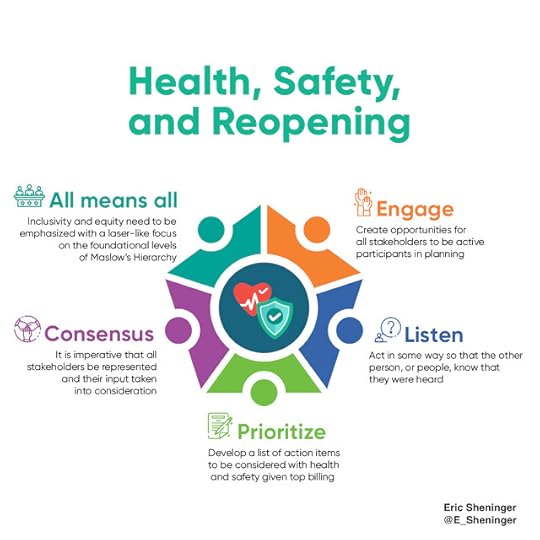
Even though those in power are ultimately responsible for developing a re-entry plan, successfully implementing it relies on all of the groups listed above. Not only does it take a village in this case, but empathy and understanding need to lead the way. People need to feel valued, and the key is to have all stakeholders be an active part of the planning process so that health and safety concerns are not only addressed but acted upon. Below are some critical areas to consider as you or others lead a process to reopen schools safely.
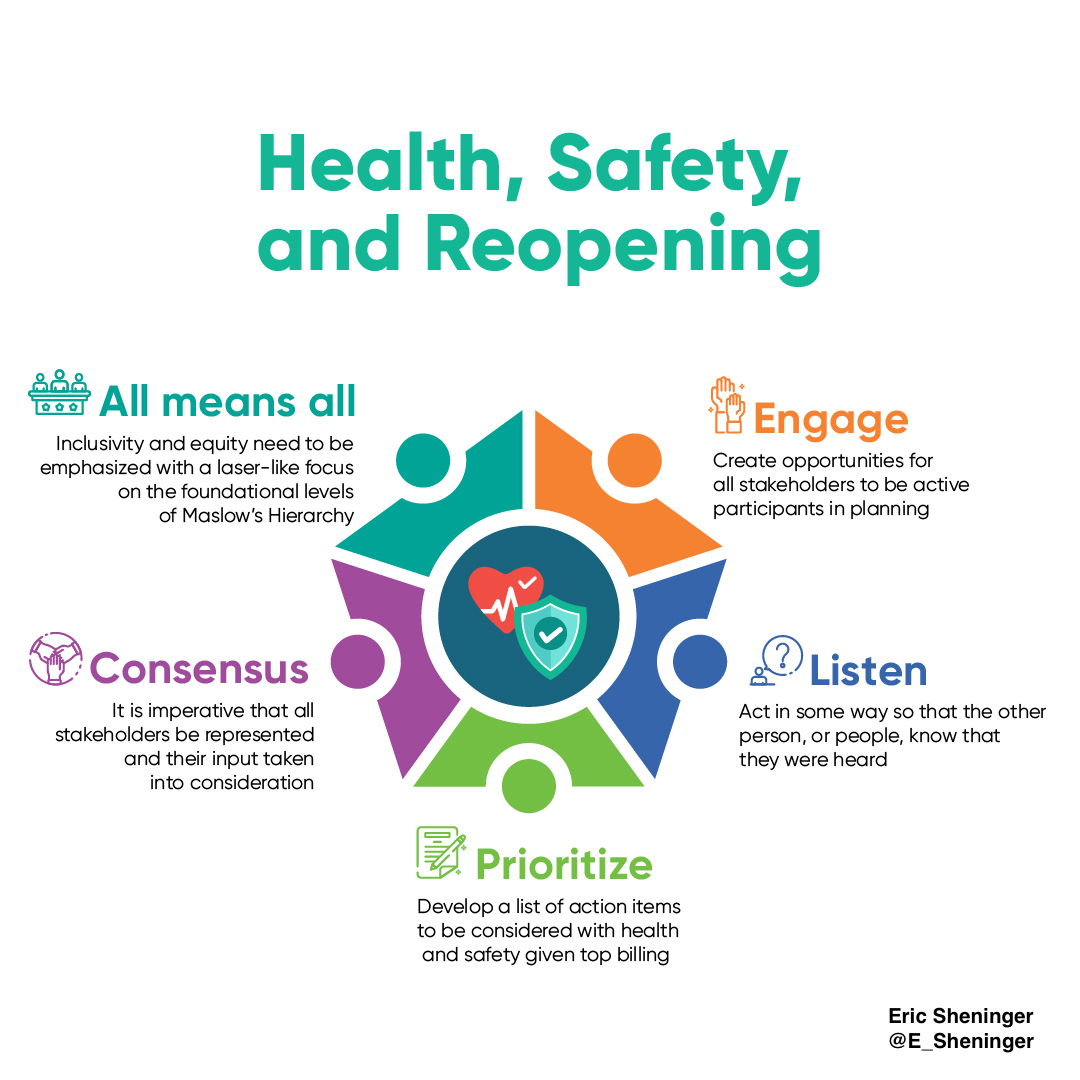
Engage
It is vital to create opportunities for all stakeholders to be active participants in the planning process. If face-to-face meetings and town halls are not an option, set these up virtually. Also, consider creating polls or using tools such as Google Forms and social media to elicit input.
Listen
Engagement only matters if people feel that they are actually being listened to. The best way to illustrate that you have really listened is to act in some way so that the other person, or people, know that they were actually heard. The action could be moving an idea forward or explaining your decision to go in another direction. Share minutes and poll results. Respond to questions and pertinent comments on social media or through email. There will be times during the process when people just want to vent and be listened to. In these cases, the most important thing you can do is show you care. Listening is a lost art that needs to be embraced.
Prioritize
The purpose of the engagement and listening process is to develop a list of action items to be considered. When it comes to the health and safety of all, many valid ideas should be considered. Nonetheless, they will need to be prioritized in order of importance with health and safety given top billing.
Consensus
Sometimes decisions have to be made at the drop of a dime, but this does not. For the big decisions that will dramatically alter school culture post-COVID19, it is imperative that all stakeholders be represented, and their input is taken into consideration. Consensus means coming to a general agreement with those who have offered their perspectives and voices on how to open up schools safely.
All means all
No stone can go unturned when it comes to developing a course of action that impacts every person in a school or district. Inclusivity and equity need to be emphasized with a laser-like focus on the foundational levels of Maslow's Hierarchy, of which health and safety fall into. There will also be unseen issues that staff are grappling with. Sound plans must also account for the mental health needs of kids and adults.
Opening schools back up requires a team effort. People must not only be invited to the conversation, but their input has to be valued. The best way to do this is by following the guidelines listed above and show them that their concerns and contributions have been threaded into a re-entry plan.
Be sure to check out my entire #remotelearning series.
Safety is at the top of everyone's mind. A poll conducted by USA Today sheds some light on what essential stakeholder groups are thinking.
In an exclusive USA TODAY/Ipsos poll, 1 in 5 teachers say they are unlikely to go back to school if their classrooms reopen in the fall, a potential massive wave of resignations. While most teachers report working more than usual, nearly two-thirds say they haven't been able to properly do their jobs in an educational system upended by the coronavirus. A separate poll of parents with at least one child in grades K-12 finds that 6 in 10 say they would be likely to pursue at-home learning options instead of sending back their children this fall. Nearly a third of parents, 30%, say they are "very likely" to do that.Reassurance that schools will be safe has to be backed up by action, and planning must begin in earnest now.
I want to take my original question a step further. When schools and districts reopen will it be safe for everyone? Up to this point, the majority of conversations I have witnessed on social media, news pieces, and articles have focused on students' health and safety. It goes without saying that this is an extremely important group and should be emphasized. However, we must not forget all of the people that support kids both directly and indirectly, such as teachers, administrators, secretaries, instructional aides, bus drivers, cafeteria workers, custodians, groundskeepers, and other support staff. The planning and step-by-step process of reopening have to be inclusive of, and sensitive to, everyone who plays a role in the functioning of a school or district.
Even though those in power are ultimately responsible for developing a re-entry plan, successfully implementing it relies on all of the groups listed above. Not only does it take a village in this case, but empathy and understanding need to lead the way. People need to feel valued, and the key is to have all stakeholders be an active part of the planning process so that health and safety concerns are not only addressed but acted upon. Below are some critical areas to consider as you or others lead a process to reopen schools safely.
Engage
It is vital to create opportunities for all stakeholders to be active participants in the planning process. If face-to-face meetings and town halls are not an option, set these up virtually. Also, consider creating polls or using tools such as Google Forms and social media to elicit input.
Listen
Engagement only matters if people feel that they are actually being listened to. The best way to illustrate that you have really listened is to act in some way so that the other person, or people, know that they were actually heard. The action could be moving an idea forward or explaining your decision to go in another direction. Share minutes and poll results. Respond to questions and pertinent comments on social media or through email. There will be times during the process when people just want to vent and be listened to. In these cases, the most important thing you can do is show you care. Listening is a lost art that needs to be embraced.
Prioritize
The purpose of the engagement and listening process is to develop a list of action items to be considered. When it comes to the health and safety of all, many valid ideas should be considered. Nonetheless, they will need to be prioritized in order of importance with health and safety given top billing.
Consensus
Sometimes decisions have to be made at the drop of a dime, but this does not. For the big decisions that will dramatically alter school culture post-COVID19, it is imperative that all stakeholders be represented, and their input is taken into consideration. Consensus means coming to a general agreement with those who have offered their perspectives and voices on how to open up schools safely.
All means all
No stone can go unturned when it comes to developing a course of action that impacts every person in a school or district. Inclusivity and equity need to be emphasized with a laser-like focus on the foundational levels of Maslow's Hierarchy, of which health and safety fall into. There will also be unseen issues that staff are grappling with. Sound plans must also account for the mental health needs of kids and adults.
Opening schools back up requires a team effort. People must not only be invited to the conversation, but their input has to be valued. The best way to do this is by following the guidelines listed above and show them that their concerns and contributions have been threaded into a re-entry plan.
Be sure to check out my entire #remotelearning series.
May 24, 2020
Work Smarter, Not Harder
I have a secret to share. In my humble opinion, I am not very smart. While others might disagree, such as my mom, I pride myself on being extremely resourceful. However, this was not always my strength. During my years as a teacher and principal, I would spend countless hours planning, researching, and attending professional learning events to hone my craft in order to become a better educator. In all honesty, though, I was just doing what I was taught, and thought were the best ways to grow. The amount of effort put forth resulted in me working much harder than I should have been.
Over the years, I began to delegate more and build capacity in others. I established hiring practices that resulted in the hiring of a lot of smart educators. By investing in, and trusting the people around me, more time was freed up to focus on innovation and large-scale change initiatives to improve school culture. Now, this represented an excellent first step, but probably the most impactful shift to the way I not only thought but worked, came in the unsuspecting form of a little blue bird and a tool called Twitter in 2009. Here is where I finally learned the biggest secret to working smarter, not harder, through the formation of a Personal Learning Network (PLN). The image below illustrates another secret that I have to come clean about, but one that also represents the ultimate power of connected learning.
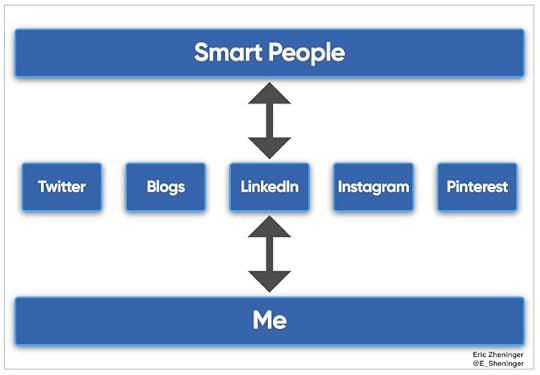
All of us are limited to the people we surround ourselves with in life. Social media has completely disrupted that and, in the process, removed barriers such as time, geography, and money. As I have mentioned for years, the true power of a PLN is not how many people follow you, but the quality and expertise of those with whom you choose to connect and engage with online. No matter the tools used, what results is anyone and everyone can take advantage of collective intelligence. Here is why this matters to everyone regardless of title, position, and power:
Knowledge, skills, intelligence, and resources are an increasingly valuable currency in the digital world. Why would you not want access to all of these when they are readily available?We can now teach each other and learn something we previously had no knowledge of through diverse expertise anywhere, anytime, and from anyone.Life is all about choices. So why not embrace the strengths and skills of others around us, and, as a result, create more opportunity to influence others and to disrupt current thinking? Connecting with those who are doing or leading the work provides needed context and motivation to do the same.It’s all free with a device connected to the Internet.
Every leader, including students, teachers, administrators, community members, and parents, can benefit from a PLN. HERE you can access a quick-start guide.
Connect yourself to the smart people then help your peers, co-workers, and those you serve do the same. To be more effective, we need to realize that there is a wealth of human resources at our fingertips that can help us all do what we already do better. They can push us to take a critical lens to our work, deliver essential feedback, answer questions, and provide support when needed. Together we are better.
Always remember that there is someone out there smarter than you. Admitting this is a sign of strength, not weakness. If you genuinely want to get better, and not work harder in the process, connect with these people using digital tools.
Over the years, I began to delegate more and build capacity in others. I established hiring practices that resulted in the hiring of a lot of smart educators. By investing in, and trusting the people around me, more time was freed up to focus on innovation and large-scale change initiatives to improve school culture. Now, this represented an excellent first step, but probably the most impactful shift to the way I not only thought but worked, came in the unsuspecting form of a little blue bird and a tool called Twitter in 2009. Here is where I finally learned the biggest secret to working smarter, not harder, through the formation of a Personal Learning Network (PLN). The image below illustrates another secret that I have to come clean about, but one that also represents the ultimate power of connected learning.
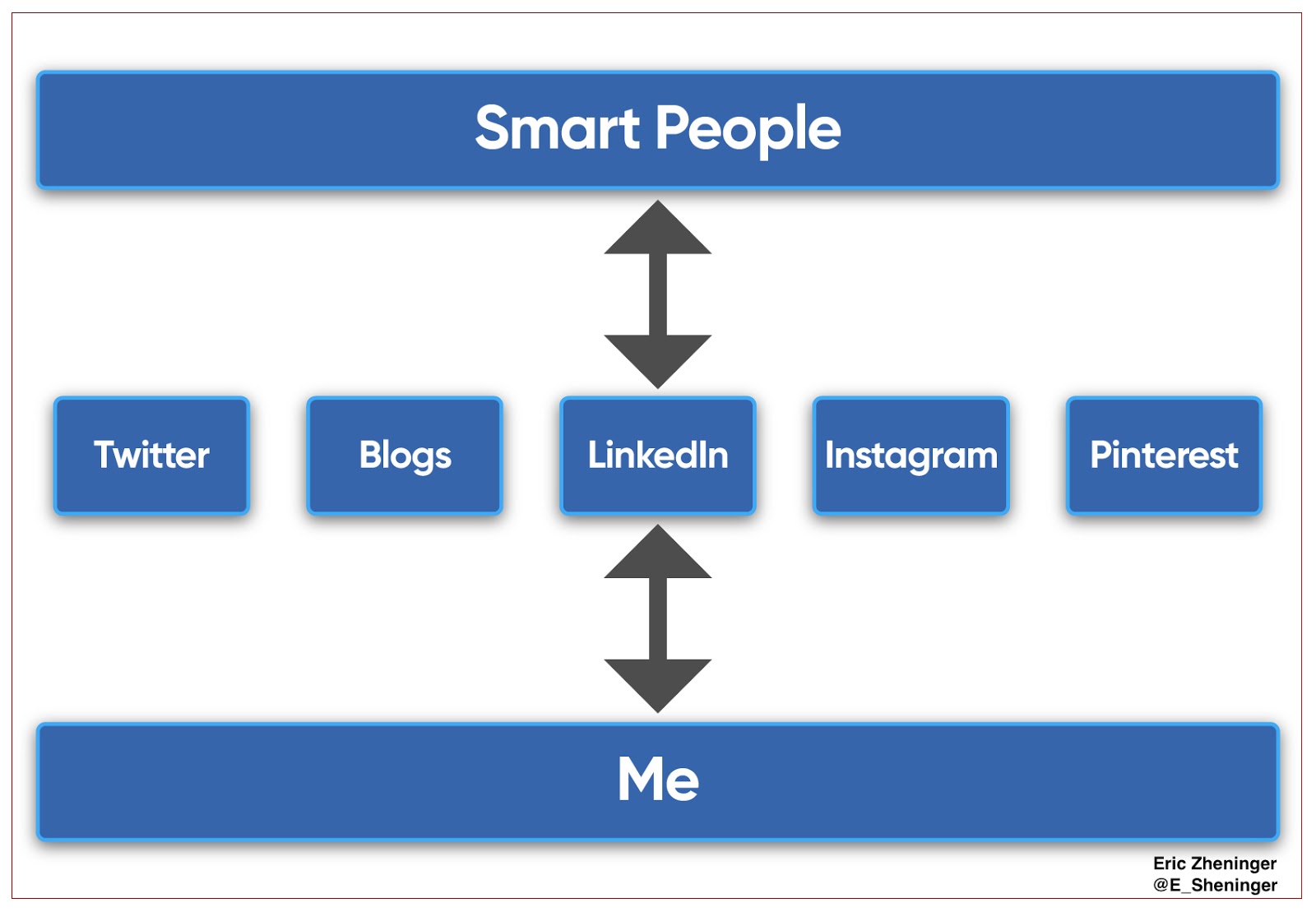
All of us are limited to the people we surround ourselves with in life. Social media has completely disrupted that and, in the process, removed barriers such as time, geography, and money. As I have mentioned for years, the true power of a PLN is not how many people follow you, but the quality and expertise of those with whom you choose to connect and engage with online. No matter the tools used, what results is anyone and everyone can take advantage of collective intelligence. Here is why this matters to everyone regardless of title, position, and power:
Knowledge, skills, intelligence, and resources are an increasingly valuable currency in the digital world. Why would you not want access to all of these when they are readily available?We can now teach each other and learn something we previously had no knowledge of through diverse expertise anywhere, anytime, and from anyone.Life is all about choices. So why not embrace the strengths and skills of others around us, and, as a result, create more opportunity to influence others and to disrupt current thinking? Connecting with those who are doing or leading the work provides needed context and motivation to do the same.It’s all free with a device connected to the Internet.
Every leader, including students, teachers, administrators, community members, and parents, can benefit from a PLN. HERE you can access a quick-start guide.
Connect yourself to the smart people then help your peers, co-workers, and those you serve do the same. To be more effective, we need to realize that there is a wealth of human resources at our fingertips that can help us all do what we already do better. They can push us to take a critical lens to our work, deliver essential feedback, answer questions, and provide support when needed. Together we are better.
Always remember that there is someone out there smarter than you. Admitting this is a sign of strength, not weakness. If you genuinely want to get better, and not work harder in the process, connect with these people using digital tools.
May 17, 2020
8 Key Focus Areas for Developing a Re-Entry Plan
The COVID19 pandemic has radically disrupted both society and education as we know it. The chances of many things going back to the way they were are slim. I can say with confidence that a mentality of TTWWADI (that’s the way we’ve always done it) will not serve many people well going forward. Hard lessons have been learned as countries have shut down their economies. Sacrifices have been made on an unimaginable level. Questions remain as to what the future holds. Through it all, though, we have seen triumph and perseverance that serve as powerful motivating forces that can be used to collectively develop a new normal that might even be better.
Obviously, education is at the top of my mind since it is the profession both my wife and I are a part of, and my kids currently attend public schools in Texas. Both the lessons learned and tolls from the pandemic serve as reminders that we need to be thinking critically about what schools will need to focus on as they re-open in the near future. The bottom line is that re-entry planning has to begin now even though there are still many unknowns. Challenges that might seem insurmountable now have to be addressed. Many will remain well into the new school year, but detailed planning now can help to both mitigate and overcome many of them. New ones will most certainly pop up, so the focus should be on not developing the perfect plan, but instead the best one for your situation.
During the crisis, we have seen digital leadership strategies embraced and innovation take hold despite roadblocks. Successes with remote learning have to be built upon and integrated across the curriculum. In particular, we have seen some kids flourish in this environment. Going forward, a sound plan should be developed so that all learners have a positive educational experience that meets their needs. Below are some key areas to focus on when developing a re-entry plan for the upcoming school year.
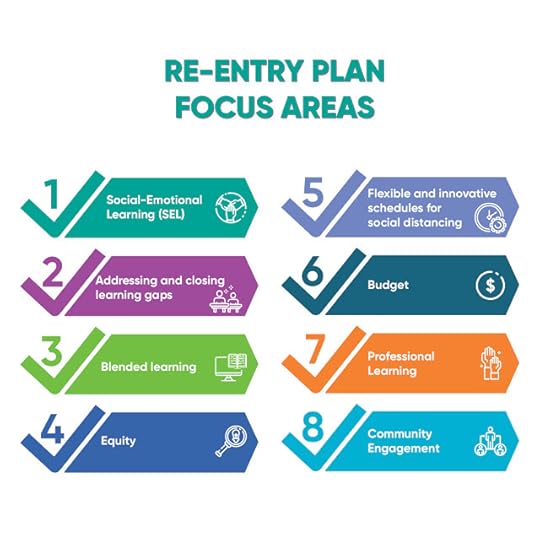
Social-Emotional Learning (SEL)
There might not be a more critical area of focus than SEL. Many students have been traumatized over the past couple of months as a result of inadequate access to food, social isolation, parents being laid off, and in some cases, the lack of a caring adult in the home. Schools, as they have always done, will serve a vital role in getting these kids back on track. The challenge is that we do not fully understand the severity of the impact during the pandemic yet. Hence, it is crucial to start to develop critical supports now.
Addressing and Closing Learning Gaps
Many people are saying that the summer learning loss will pale in comparison to what educators will see when kids return to school. While many schools have valiantly continued with remote learning, some decided that it just wasn’t working. Those that implemented their plans with fidelity still could not fully ensure that all kids completed assigned work, let alone learned. Strategies to help all kids, no matter where they are, will need to be emphasized.
Blended Learning
We have seen schools make considerable investments in technology during the pandemic. Such a blended pedagogy has become an integral component of remote learning plans. Schools can seize on the opportunities inherent with the purposeful use of technology aligned with high-agency strategies to create a more personalized experience.
Equity
COVID19 has unveiled the harsh reality of the inequities that plague learners in virtually every country. Where you live, in particular, has had a direct correlation to whether or not remote learning has been successful in many schools. The “haves” have tended to prosper while the “have nots” have suffered. We can ill-afford not to address this fact. Additionally, the digital divide is wider than many perceived. Access to devices and reliable WIFI needs to be emphasized.
Flexible and Innovative Schedules for Social Distancing
There is no guarantee that when schools re-open that social distancing guidelines will be relaxed. This will vary from state to state and country to country, but pre-planning for this now makes sense as remote learning will probably be needed in some form to begin the academic year. There might very well be limits on how many people can be in a classroom or building at one time, and rooms have to be reorganized to keep kids and adults six feet apart. The need for flexible and innovative schedules that address this, as well as remote blended learning for kids who are not in the building on certain days, will need to be prioritized.
Budget
It is difficult to sugarcoat this one. Many states and countries will be making deep cuts to education. It will take creativity during the planning process to re-allocate funds for routine cleaning, screening for COVID19, hygiene, devices, improvements to bandwidth, professional development, and needed programs, all while retaining current staff. The Center for Disease Control (CDC) just recently released guidelines for schools that can be found in this decision tree. Unfortunately, difficult decisions lie ahead, similar to the Great Recession from 2007 - 2009. Rest assured, schools will emerge stronger and better prepared to meet the needs of all learners.
Professional Learning
For all the previous focus areas listed above to be addressed and implemented successfully, professional learning will be needed. How this is accomplished will vary depending on finances and internal resources. It is essential to identify and map out what specific supports will need to be outsourced and those that can be addressed internally with fidelity. At the International Center for Leadership in Education (ICLE) we have a comprehensive plan to assist districts and schools with re-entry. You can view it HERE. Please reach out if you would like ao to discuss this further.
Community Engagement
For any re-entry plan to succeed, relationships with stakeholders are critical and something I discuss in greater detail in both Digital Leadership and BrandED. Communicate excessively, but also consider eliciting feedback from parents and the greater community to develop the best possible course of action. Embracement by all is crucial to success.
I am sure there are other elements that will be considered. As you map out your plans, keep them generally focused on safety (student and staff) as well as learning. Together we are better and will get through this challenging time.
Be sure to check out my entire #remotelearning series.
Obviously, education is at the top of my mind since it is the profession both my wife and I are a part of, and my kids currently attend public schools in Texas. Both the lessons learned and tolls from the pandemic serve as reminders that we need to be thinking critically about what schools will need to focus on as they re-open in the near future. The bottom line is that re-entry planning has to begin now even though there are still many unknowns. Challenges that might seem insurmountable now have to be addressed. Many will remain well into the new school year, but detailed planning now can help to both mitigate and overcome many of them. New ones will most certainly pop up, so the focus should be on not developing the perfect plan, but instead the best one for your situation.
During the crisis, we have seen digital leadership strategies embraced and innovation take hold despite roadblocks. Successes with remote learning have to be built upon and integrated across the curriculum. In particular, we have seen some kids flourish in this environment. Going forward, a sound plan should be developed so that all learners have a positive educational experience that meets their needs. Below are some key areas to focus on when developing a re-entry plan for the upcoming school year.
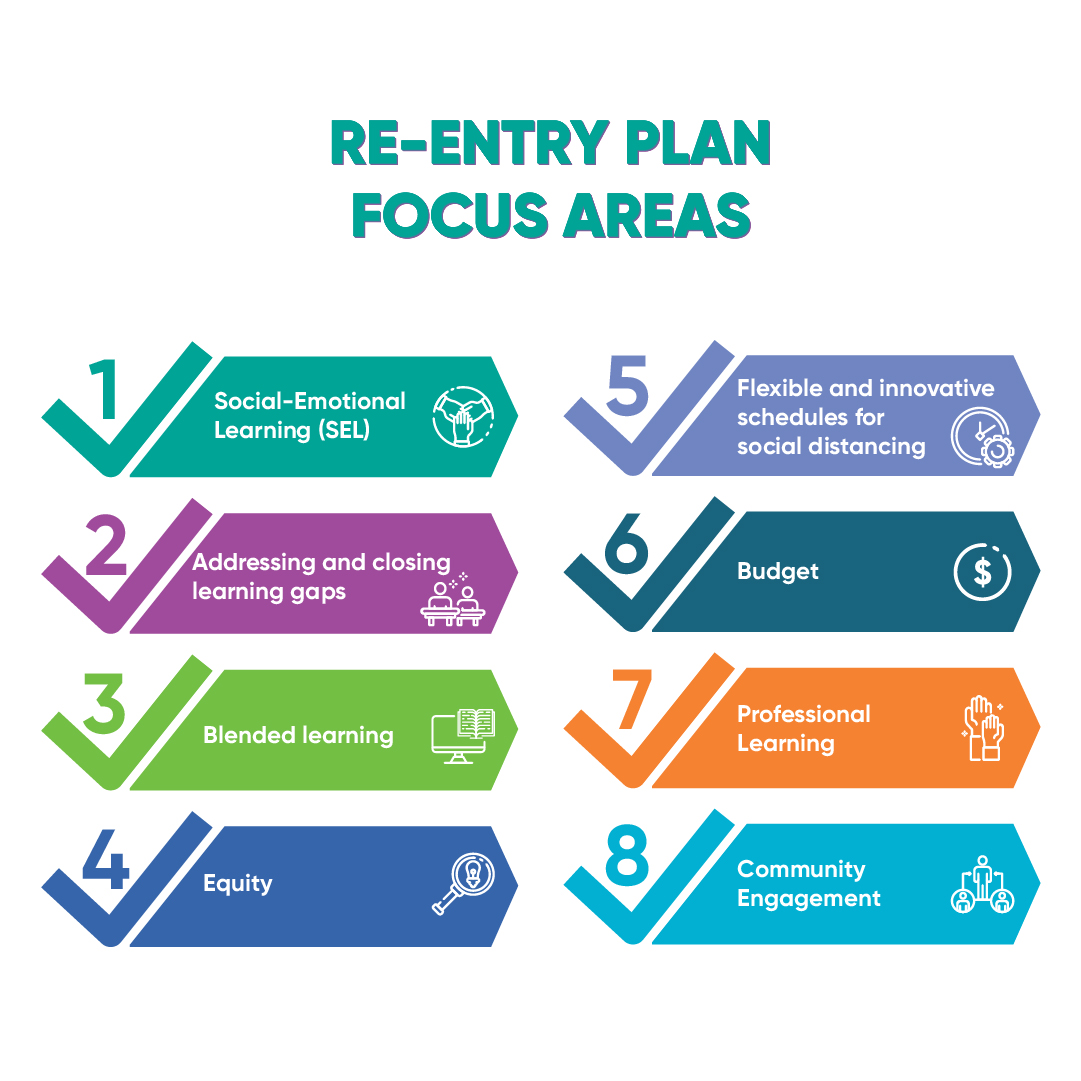
Social-Emotional Learning (SEL)
There might not be a more critical area of focus than SEL. Many students have been traumatized over the past couple of months as a result of inadequate access to food, social isolation, parents being laid off, and in some cases, the lack of a caring adult in the home. Schools, as they have always done, will serve a vital role in getting these kids back on track. The challenge is that we do not fully understand the severity of the impact during the pandemic yet. Hence, it is crucial to start to develop critical supports now.
Addressing and Closing Learning Gaps
Many people are saying that the summer learning loss will pale in comparison to what educators will see when kids return to school. While many schools have valiantly continued with remote learning, some decided that it just wasn’t working. Those that implemented their plans with fidelity still could not fully ensure that all kids completed assigned work, let alone learned. Strategies to help all kids, no matter where they are, will need to be emphasized.
Blended Learning
We have seen schools make considerable investments in technology during the pandemic. Such a blended pedagogy has become an integral component of remote learning plans. Schools can seize on the opportunities inherent with the purposeful use of technology aligned with high-agency strategies to create a more personalized experience.
Equity
COVID19 has unveiled the harsh reality of the inequities that plague learners in virtually every country. Where you live, in particular, has had a direct correlation to whether or not remote learning has been successful in many schools. The “haves” have tended to prosper while the “have nots” have suffered. We can ill-afford not to address this fact. Additionally, the digital divide is wider than many perceived. Access to devices and reliable WIFI needs to be emphasized.
Flexible and Innovative Schedules for Social Distancing
There is no guarantee that when schools re-open that social distancing guidelines will be relaxed. This will vary from state to state and country to country, but pre-planning for this now makes sense as remote learning will probably be needed in some form to begin the academic year. There might very well be limits on how many people can be in a classroom or building at one time, and rooms have to be reorganized to keep kids and adults six feet apart. The need for flexible and innovative schedules that address this, as well as remote blended learning for kids who are not in the building on certain days, will need to be prioritized.
Budget
It is difficult to sugarcoat this one. Many states and countries will be making deep cuts to education. It will take creativity during the planning process to re-allocate funds for routine cleaning, screening for COVID19, hygiene, devices, improvements to bandwidth, professional development, and needed programs, all while retaining current staff. The Center for Disease Control (CDC) just recently released guidelines for schools that can be found in this decision tree. Unfortunately, difficult decisions lie ahead, similar to the Great Recession from 2007 - 2009. Rest assured, schools will emerge stronger and better prepared to meet the needs of all learners.
Professional Learning
For all the previous focus areas listed above to be addressed and implemented successfully, professional learning will be needed. How this is accomplished will vary depending on finances and internal resources. It is essential to identify and map out what specific supports will need to be outsourced and those that can be addressed internally with fidelity. At the International Center for Leadership in Education (ICLE) we have a comprehensive plan to assist districts and schools with re-entry. You can view it HERE. Please reach out if you would like ao to discuss this further.
Community Engagement
For any re-entry plan to succeed, relationships with stakeholders are critical and something I discuss in greater detail in both Digital Leadership and BrandED. Communicate excessively, but also consider eliciting feedback from parents and the greater community to develop the best possible course of action. Embracement by all is crucial to success.
I am sure there are other elements that will be considered. As you map out your plans, keep them generally focused on safety (student and staff) as well as learning. Together we are better and will get through this challenging time.
Be sure to check out my entire #remotelearning series.