Quinn McDonald's Blog, page 34
July 3, 2014
In the Middle of Turmoil
My coaching client sighs. “I think I need to take a break from coaching. I’m so stressed at work and at home, I feel like I’m swimming in a riptide. Once I’m back safely on shore, I can have more ground under my feet and continue.”
I never force anyone to continue coaching, but when I hear this, I am hearing a need for coaching, not a break from it. I feel like saying, “There is no shore; your whole life is a river.” (I realize I shifted the metaphor from ocean to river.)
 Part of the need to “feel ground under your feet” is the word we use to describe someone stable and balanced: grounded.
We associate balance with control. With knowing what will happen next. But that’s largely an illusion driven by hope. We are always in the middle of something–a project, a crisis, a celebration, a decision, a career, an identity. That doesn’t mean we shouldn’t plan, but it does mean that plans change, shift and become impossible without much warning.
Life is a river, and we are always floating, swimming, paddling. There is not a time when everything is suddenly perfect and the world stops so we can enjoy floating blissfully.
 Grabbing enjoyment when you recognize it is a skill that coaching teaches you. So is adapting to a fast-paced life and dealing with change without falling apart.
Coaching works in the middle of turmoil–because it mixes support with accountability, and courage with action. Coaching works best when the client is open to life and change, but it can help people adjust when the world is not stable under their feet. If it’s stable now, don’t expect it to stay that way. You won’t be surprised when change shoots under your feet.
–-Quinn McDonald has had her share of change.
Filed under: Coaching, Life as Metaphor Tagged: balance, change, creativity coaching, life coaching


July 2, 2014
Making Acrylic Skins
Acrylic skins are made with acrylic paint and gel medium. Why not just mix the paint and gel medium on your journal page? Because creating a skin is more versatile. The skin can be cut, stamped, printed, or stenciled. It can be placed where you want it to be, not where it accidentally wound up. It adds an interesting texture and color to your art journal pages.
Here’s how to make your own acrylic/gel skin:
 Cut a piece of plastic wrap about 12 inches x 12 inches. Smooth it out on your work space. Put the plastic wrap on a light piece of paper so you can see and control the color mix. Drip several colors of acrylic paint on the plastic wrap. Don’t use tube watercolors, as they aren’t plastic, and right now, you want plastic.
 Once you have all the acrylic down the way you want it, pour about the same amount of gel medium over the paints, spreading it around as you pour. This is semi-gloss, so it will be clear, but not have a high shine. If you want a high shine, use gloss. You can also use matte medium, but it has a tendency to be a bit translucent rather than transparent. Don’t dismiss it, it’s quite an interesting effect, particularly when mixed with gloss gels.
 Using a palette knife, blend the paint and the gel until you get an interesting mix. Do not over-stir, otherwise you’ll get a muddy color instead of different color blends.
 Once you are finished blending, the hard part starts–patience. Before you peel the skin off it has to have cured overnight–and that’s in Phoenix. You may have to wait longer if it’s humid where you live. Peel it off too early, and you won’t get a single piece, but rather rubbery bits. It does need time, so I like doing skins before I go to bed at night. That way, they are ready the next day. I deliberately made this uneven–thinner and thicker places. I think it’s more interesting to play with.
—Quinn McDonald never got over playing with paints.
Filed under: Art in Progress, Links, resources, idea boosts, Tutorials Tagged: acyrlic skins, making an acrylic skin


July 1, 2014
Mixed and Stitched: A Giveaway
Time for a giveaway! This time it is Jen Osborn’s wonderful book, Mixed and Stitched: Fabric Inspiration and How-to’s for the Mixed Media Artist.
 You have to love a book that starts with a whole chapter on forgetting the rules. It starts with tips for the beginner on setting up your space, fabric, stove-top dying, and using bleach to remove color (but not all the way) from fabric.
Information on stitching is covered in the next section–from sewing machine to sketching with stitches to embroidery and faux felting.
If you aren’t excited by now, consider the projects done by painting on fabric–an inspiration board, a sketchbook, bunting, trinket box, and jelly picnic blanket. There are a lot more projects, too.
It’s published by North Light (who is the publisher of two of my books, too), so

“Out and About Purse” © Jen Osborn
there are plenty of how-to photographs, tips, templates and an inspiration gallery.
Whether you love machine stitching or hand stitching, embroidery or just love fabric, this is a wonderful book to keep you busy and inspired.
Leave a comment if you want to win the book. I’ll choose a winner and announce it on Saturday, July 5th. Check in then to see if you’ve won!
Note: I purchased the book and an giving it away to make someone happy.
–-Quinn McDonald can’t sew, but loves playing with fabric.
Filed under: Giveaway, Links, resources, idea boosts Tagged: book giveaway, Jen Osbon, mixed media, sewing, stitching


June 30, 2014
Copyright Protection or Nothing New in the World
When it comes down to teaching your art, you find yourself in one of two worlds: the kind where you protect your copyright avidly, not handing out how-to sheets for fear of having them stolen or shrugging it off and saying, “everything is derivative anyway. I got my ideas from someplace else, too.”
Those ideas lie at opposite ends of the spectrum, and I’d like to introduce a third idea, maybe a fourth.
First, let me admit I’ve lived at both ends of the spectrum. I was not happy when a fellow artist came into my booth, years ago, took photos of my work, claiming it was because she “loved my display,” then rolled out a line of stunningly similar artwork the next season, priced just below mine.
Nor was I happy when I was in a class on a topic I’d taught often, and was hoping to get out of a rut, and was handed a how-to sheet that looked stunningly familiar. It was familiar, in fact, it was my handout, complete with copyright on the bottom line, photocopied for the entire class.
At some point I decided that everything I taught, every article I published should be something I had already taught to exhaustion, or I was ready to give up. But part of the fun of teaching is getting inspired by students. Would I have to give it up?
Now, I am careful to copyright my work. I send it to the copyright office once a quarter, with payment. That allows me to sue for damages for violators. But I also don’t want to be the copyright police. And I want to promote innovation and creativity. If I do not want anyone to know what I’m working on, I don’t post it anyplace. Or talk about it.
People will always explore, and people will always use what they find. Gracious people ask, kind people give credit. But if you teach, no one can teach the way you do. Your personality combined with your skill and talent make your class. And people will come to your class because you are welcoming and a good teacher. No one can take that from you.
–-Quinn McDonald teaches what she knows.
Filed under: Creativity, Inner Hero/Inner Critic, The Writing Life Tagged: copyright, creativity coach, teaching art, teaching writing


June 29, 2014
Work in Progress–Acacia Tree
In the Australian desert, in a climate like the one around Phoenix, the Acacia tree is called a wattle. The leaves form a distinctive flat, triangular shape, and the branches are often twisted and multi-branched.
 Acacias give us gum arabic, used as a stabilizer in food and as a binder in watercolor paint.
Acacias don’t live long–15 to 30 years, but they grow fast. There are many varieties, all with different colored flowers–red, white, yellow. In the desert, trees form their seed pods in June and July, rather than fall. July and August are a kind of stasis–just hanging on to stay alive till it gets cooler in fall.
The acacia is the subject of my latest letter collage.
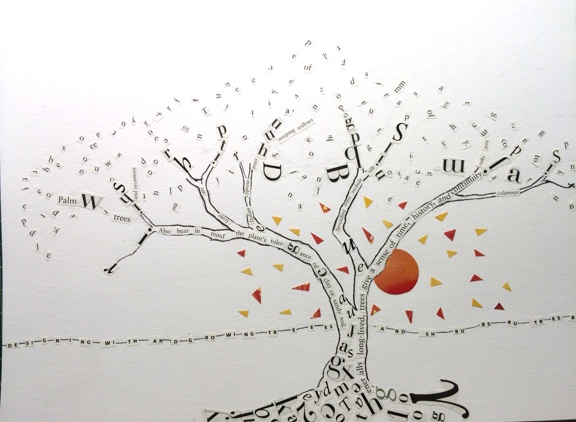 In this one, I added a sun to give another dimension to the tree. While the sun itself is orange and red, all the light surrounding it is cut into triangle shapes. I used pages from a children’s book for the printed color.
 In the detail, you can see that there are sentences about trees that create the trunk and branches. My intention is to get people to see the whole tree, then stay a while longer and look for the detail.
–-Quinn McDonald is working on minimalist collage. She’ll be teaching Monsoon Papers (useful as a base for collage) at Blue Twig studio in Colorado Spring on July 19.
Filed under: Art in Progress Tagged: acacia collage, minimalist collage


June 28, 2014
Creative Hop: June 27, 2014
The best street art uses the existing environment and light to enhance the art. Oakoak, a French artist, makes the most of the environment in which he places his art.

Street art © by Oakoak
In “Heart Art” Oakoak used the existing art and paint smear to create context for his golfer.

Cyclops © by Oakoak
In this piece, the super-hero depends on the time of day and time of year. When the sun slants through the gap between two houses, the super-hero shows his power by beaming a ray of light across the street.
German street artist 1010 creates two-dimensional art that looks like 3D portals into space.

Portal © 1010
The painting above is on a wall. It’s painted to look as if it had depth.

Beyond Binary © by 1010
In this article, the portal is in a brick wall. The magazine is VNA’s (Very Nearly Art) street art issue.

© Agustina Woodgate, rug.
Agustina Woodgate, originally from Buenos Aires (Argentina) now lives in Miami. She believes in the non-Western cultural idea that handmade rugs depict the dream world or spiritual world in hand-woven art.
As raw material, Woodgate uses the “skins” of abandoned stuffed animals, specifically teddy bears. She explains:
It was simply an object. But I also didn’t want to throw it away. That’s when I decided wanted to do something with the bear. In the beginning of the process, I had no idea what was going to happen. I went to a thrift store, got another bear, and started playing around. I looked at all the components that make up a stuffed animal: the stuffing, the fabric, the stitching. I wanted to approach an everyday object in the hopes of making something new.
Enjoy these artistic explorations and have a creative weekend!
—Quinn McDonald is a writer who is involved in collage this weekend.
Filed under: Links, resources, idea boosts Tagged: Creativity, street art, weaving art


June 26, 2014
The Power of String
My brother writes from Switzerland, where he lives. Occasionally, he writes of amazingly elegant and simple solutions that I think of as typically Swiss. It’s a wonderful awareness of different problem-solving adaptations in different cultures. Here is the story:
“I was coming home [riding a bicycle] on a paved, two-lane-wide road without lane markers, common around here. I saw a road sign that signaled ‘cow crossing,’ but it was in an odd place and beat-up looking. I mistakenly assumed it had been left there by accident until I came upon the cows blocking the road and coming toward me.
I’ve mentioned before that the Swiss stake out fields that have been turned into pastures by putting frail poles strung with a single thread of electrified fence. The cows could easily walk through, but because
of the shock, won’t. Thus, when farmers herd them down a street, they block of side streets with string, and the cows, mistaking it for electric fence, respect that.
 Well, this herd was being herded down the street with string. The shoulder of the road was lined with electric fence. The farmer and his wife carried some string perpendicular to the road and to the fence
lining it. The farmer formed the corner, and his children and a farm worker brought up the rear, shaping the line of string into a rectangle. The cows carefully stayed within it as the group walked down the street toward the barn.
As they saw me coming, they narrowed the rectangle, freeing one lane for traffic, and I, and then one or two cars, passed through. The cows carefully stayed within the string.”
A perfect example of elegant problem solving!
—Quinn McDonald loves innovation and ingenuity.
Filed under: Creativity, In My Life, Links, resources, idea boosts Tagged: ingenuity, innovation, problem solving


June 25, 2014
Left-Hand, Right Brain
George H.W. Bush, Bill Clinton and Barak Obama have something in common. And they share the trait with Alexander the Great, Helen Keller, Napoleon Bonaparte, Paul Klee and Whoopie Goldberg. All are left-handed. About 10 percent of the general population is, give or take 3 percent, depending on the study you check.
Most of us left-handers have some degree of ambidexterity, and some people (full disclosure: I’m one of these) write right-handed. Our group is generally a bit older, and would have been left-handed writers, but were changed in school.
 Here’s a tip to tell if you are classified as left-handed: what hand do you brush your teeth with? How about comb your hair? (That was for men, for women, the question is more often, “What hand holds the hair dryer?) Other, more private functions, can also determine if you are left- or right-handed.
What made you left handed? It happened in the womb. LRRTM1 is the gene thought to be responsible, but there is even more involved. According to neurologist Norman Geschwind (for whom the theory is named), some women have higher testosterone levels in the womb, whether or not they have girls or boys. (Want to check if your mom did? Look at your second toe, the one next to the big toe. If it is equal in length (or longer) than the big toe, your mom had higher testosterone levels while she was pregnant, and you are probably left-handed.
How does that work? According to Geschwind’s research, the testosterone levels suppress the growth of the left side of the brain, and the ambitious neurons go over to the right brain and do their growing over there. The more developed right side of the brain, which controls language skills, also controls hand-preference.
The dominant right side can also make you susceptible to dyslexia, stuttering, and some auto-immune diseases. Before I go on, please note that not all of these will happen to you, and you can be firmly right-handed and have that longer toe. These are based on huge samples across demographic lines.
Left-handers are generally more adaptable, because they have to get used to living in a right-handed world. Problem-solving skills are higher among creative people than the general population, and it might come from trying to figure things out.
A few companies have created tools for left-handers. For years, scissors that  claimed to be for left-handers, simply reversed the grips, making left-handers “cut blind”, in other words, the part of the scissors that did the work was still on the original side, and you couldn’t see the part you were cutting. Friskars actually reverses the blade, and I’m grateful to them for thinking this through.
If you are left-handed, there are resources for you. If you are a right-handed parent of a left-handed child, there are also resources for you.
–Quinn McDonald is left-handed and writes right-handed. Determined nuns were stronger than her persistence. However, she writes left-handed when she uses a whiteboard or a flip chart.
Filed under: In My Life, The Writing Life Tagged: Creativity, left handed, reason for left-handedness


June 24, 2014
Procrastinating on Your Way to Your Dream
Yesterday I talked about re-examining the rules you make. To see if they still work. To see if you have outgrown them. Rules we make for ourselves are one way we stall on our way to reaching our dream.

artwork from:
http://grr9.deviantart.com/art/Just-Out-of-Reach-207970059
If your dream is still dancing beyond your fingertips, if you have stalled on the way to getting your dream, maybe it’s time to take ask if you are procrastinating. If you are a perfectionist, you are probably a procrastinator. It’s keeping you from getting to your dream. Because you want the dream to be perfect before the new, perfect you seizes that perfect dream. Oh, and at the perfect time, too. Psssst. . . that’s never going to happen.
So put some traction in your action and grab that imperfect dream, because, after all, it is your dream and doesn’t have to be perfect.
Stop planning, stop talking to people about planning, and take one step toward your dream. Most of us spend too much time making up plans, planning for what could go wrong and then watching as problems surface and things do go wrong. Of course they do, when we keep looking for things to go wrong, we’ll find enough to barricade the dream. Time to take a lyric from Jackson Browne: “Better bring your own redemption when you come/ To the barricades of heaven where I’m from.”

Listen to your heart.
Here’s the biggest thing I learned while I was re-creating my relationship with food: logic is wonderful. If you live in your head, logic sounds like real life. But until you bring emotion into it, you won’t act. Logic lays out the plan, but emotion fuels the action.
The worst emotion you can bring in is fear. It might be an emotion you know well, but it’s not inspiring. Bring in doing a small thing right. Bring in making small steps. Bring in congratulating yourself over small things. Look back and see how far you’ve come. Toward that beat up, crumpled, beloved dream that you are now clutching to your heart.
Update on Is It A Book: I’ve turned in a table of contents, I’ve turned in my sample pages. Right now the acquisitions editor is on vacation. It may be next week till the negotiations are done. I’m grateful to have a smart agent.
–Quinn McDonald is practicing patience as she waits. She horrible at it.
Filed under: Coaching, Creativity, Recovering Perfectionists Tagged: emotions fuel action, perfectionist, procrastinator


June 23, 2014
Creative Boost #623: Re-Think the Old Rules
Rules usually come from pretty good experiences and reasons. But as good as the reasons are, life changes and shifts. It’s good to consider change from time to time. Oh, sure, you’ll be met with “We’ve always done it this way,” and “If it ain’t broke, don’t fix it,”
 Here’s a real-life example. I have three different walking routes: a winter one, a summer one, and a really long one (reserved for cooler days when I have enough time.) I’ve been walking the winter route, even though it’s June. I’ve gotten used to it, and a few times I wonder why I’m not walking the “summer” route. But I’m so used to the winter one, I just kept on walking.
The other day, my walk started just at dawn. For half the walk, I was facing into the sun. On the part that has me walking North, my face cooked on my right side. (Yes I wear sunscreen. It’s still hot, and the hat is not big enough to provide shade). On the second half, which is unshaded, the sun cooked my back. In  winter, on that same route, when the sun rises later, I don’t get the sun in my face, but it warms my back.
So, tomorrow, it’s the return to the summer route. My back will be to the sun for the first half, a tall line of trees for the cross section, and the sun high enough so a slightly tilted brim shields my face on the home stretch.
Here is how we make and use rules:
1. We study the problem with the way things are now.
2. We make rules to solve the problem.
3. Time happens, things change, we still use the old rules.
Every now and then, when you are used to the rules, think about why they were made. It’s good to question them, and just as good to change them when they need changing.
This is particularly true about ideas we have about success, goals, careers, and the definition of happiness.
–Quinn McDonald loves change, but not for change’s sake.
Filed under: Creativity, Links, resources, idea boosts Tagged: changing rules, making rules, rules