Quinn McDonald's Blog, page 30
August 18, 2014
Taking a Compliment
“What a nice blouse!”
“This old rag? I just wear it to clean house.” If you are a woman, you are familiar with this. (Men take compliments more easily). But for women, a compliment has to be denied, shoved back, or minimized.
At an art show, I complimented an artist on her work. “It’s really easy,” she replied, “I just threw some paint on the canvas.” I’ll bet she didn’t, and once she diminished her own work, I found the price a bit high. After all, if she really “just threw paint” on the canvas, it took no planning or thought.
Of course she worked hard on the canvas. Of course she worried about it. But the  second a compliment floats her way, she had to pretend to be someone with no talent, who happens to make a living painting. Why? Because it hurts to admit one has talent, skills, beauty, intelligence, or even good taste. If you own your attributes, you are responsible for them. All the time.
All that may seem like too much work. So we bat away compliments. We don’t want to own them. Most women have also been trained to be humble–particularly older women. We don’t want to seem “full of ourselves,” or risk a “swelled head.” So we deny, deny, deny.
Eventually we believe that we are talentless shlubs who can barely breathe and cross the street at the same time. That doesn’t serve anyone.
First, when you get a compliment, all you need to do is smile, and say, “Thank you!” It’s not hard to do this is you immediately think that you are making the person who paid you the complement happy.
Then, there’s a bit of work to do on yourself. Why don’t you want to be talented, smart, loving, or whatever you got a compliment for? What meaning do you attach to a compliment that makes you shrink from it? Pretend, for the next hour, the compliment is true. Just for an hour. Then you can give it up. If you still want to.
P.S. It helps to give a compliment if you make it about you instead. “Seeing you in that blouse will make me happy all day,” is a compliment that’s hard to turn down.
I read a great quote the other day. It wasn’t attributed, so I can’t send a compliment to anyone for writing it: “It took me a long time to discover who I was not, only then did I discover who I was.”
P.S. For language lovers. “Compliment” (with an i) means a kind expression or praise. You can remember that it’s spelled with an “i” because it’s nice to receive one and nice also has an i in it.
Complement (with an e) is something that fills up or completes something else. “The book cover art was a perfect complement to the chilling story inside.” It means to complete.
--Quinn McDonald has some problems with complements herself. That’s why she writes about it.
Filed under: Coaching, Creativity, Inner Critic, Recovering Perfectionists Tagged: compliments, giving compliments, taking compliments



August 17, 2014
Daily Practice
Practice is necessary to learn anything. Practicing art is another word for getting better.
Practice can take a lot of different shapes. Right now, I’m working on minimalist collage. I was finding it difficult to be as minimal as I wanted to be, so I gave myself permission to do a very busy, color-jammed collage.
When you give yourself permission, your inner critic will show up and tell you that you’ll never sell this “trial and error” pieces. That’s right. You won’t. But I’m not experimenting to sell, I’m experimenting to get better. And unless I try one thing, I won’t know if it works, if I want to do more, or where I need to do some more work.
Here’s the busy piece I did, using a lot of color and largely rectangular or square shapes. Of course, there was a piece of map that didn’t “belong.”

And here’s the piece I did after that. I found three pieces of paper buried at the bottom of my stash–a highly textured blue and green and a sheet printed with stars. I decided to add a fourth color–the orange Monsoon Paper piece. The moon is cut out of the same Monsoon Paper piece, but flipped over, so the color blending on the back shows up.

Both pieces are very different. And because I gave myself permission to play with the first piece and was very strict with myself that I had to “get some minimal work done” with the second piece, it turns out that I like the first piece better.
Sometimes, in our need for perfection, we forget to play. When we allow ourselves to play, our creative work is better, looser, and more free than the one we put all the constrictions on.
Play is a part of getting better at what you do. Don’t push it out of your life.
—Quinn McDonald is a writer who loves collage.
Filed under: Art in Progress, Inner Critic, Inner Hero/Inner Critic, Recovering Perfectionists Tagged: art as fun, perfectionism, practicing art


August 16, 2014
Begging The Question: Getting it Right
Ahem.
[tap, tap, tap].
Can everyone hear me? Thank you.
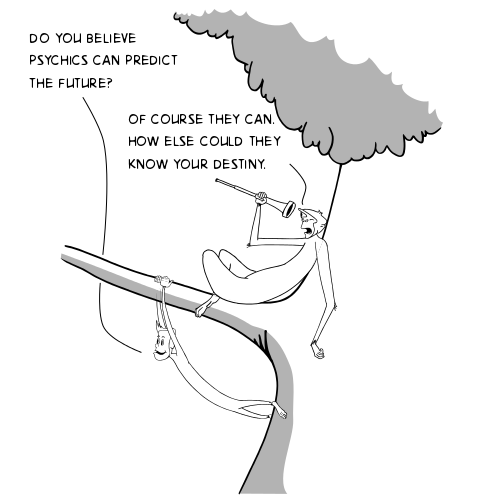
Today’s aggrieved English phrase is “begging the question.” First, what this phrase does not mean. Begging the question isn’t the same as “raising the question,” “asking the question,” or “brings up the question.” No. It is completely different.
“Begging the question” is an example of faulty logic. It actually has nothing to do
From http://fallaciouslogic.net/1/
with asking a question. Another name for it is “begging the claim,” which makes the working parts easier to understand.
When someone begs the question, the speaker draws a conclusion, not from facts, but from something else stated in the sentence. For example: Mean and ignorant people like John should never become department heads.
While “mean and ignorant people should not become department heads” is logical, the very thing that needs to be proven—why John is not good leadership material—is assumed in the sentence.
 Another example: She is a slob because she is unattractive. Maybe the woman is unattractive, but that does not immediately make her a slob. More proof is needed. The sentence relies on proof that is assumed and not proven.
One more: Pollution spouting monster trucks should be banned. The very conclusion that needs to be proven–that monster trucks create a lot of pollution—is missing. It’s just assumed.
Saturday bonus: Confusing words explained
Staunch means loyal or committed in support. “She was a staunch supporter of civil rights.” (It rhymes with paunch.)
Stanch means to stop or restrict, like a flow of blood. (It rhymes with blanch.)
Both words come from the same Old English (via Old French) word meaning “watertight.” While there is a strong trend to let both words mean both things, part of the beauty of the language is in the subtle differences in words that give specific, shaded and nuanced meanings to sentences.
Thank you.
Have a nice day.
—Quinn McDonald loves the English language in all it’s maddening confusion.
Filed under: Links, resources, idea boosts, The Writing Life Tagged: grammar help, logic fallacies, subtle English


August 14, 2014
How to Succeed
Half of being smart is knowing what you are dumb at and not doing it.
One of my favorite sayings. It’s helped me tremendously.

The impossible art of Li Wei.
Almost every time I say that someone replies that if I really want something, I will be able to do it. All it takes is dedication and effort. I love the courage of that statement, but it’s not true. Supposing I wanted to be the prima ballerina of the Phoenix Ballet—not going to happen. Even if I practiced every day for the next 10 years. I took three years of ballet when I was seven, and did not continue. I don’t have the talent or the body type. I am too old to be a professional dancer. (Most retire around age 40.) I have arthritis. All the dedication in the world would not change that.
But the main point of the statement is slightly different and entirely positive. Instead of chasing after impossible dreams, take a look at your skills, talents, experience. Build on those. Thrive.
Don’t focus on your failures, shortcomings and try to ignore them to create a foundation that won’t support your dreams. It’s a waste of your life.
There’s a second half to that saying: The other half of being smart is knowing what you are good at and doing a lot more of it.
It’s always surprising to me how many people want to struggle when they don’t need to.
-–Quinn McDonald is a writer who teachers writing. She wrote that saying in her journal when she was 27 years old.
Filed under: In My Life, Links, resources, idea boosts Tagged: do what you are good at, you can be anything you want to be


August 13, 2014
The Magic Ocotillo
Ocotillo (Oh-koh-TEE-oh) is a desert plant. It’s adaptable and visually interesting. It looks like a bunch of thorny sticks stuck in the ground. In the summer, it drops its leaves.

When it rains or the weather is mild, it develops leaves.

In the Spring, it blooms with extravagant orange-red flowers. (Can’t resist the close-up below).

Here is what amazes me about these plants–when it rains, they grow leaves—fast. In hours. I have an ocotillo in my front yard. We are in the Monsoon right now, and this afternoon and evening we had huge rainstorms. Below is my ocotillo one hour after the rain started. You can see the big thorns and some tiny leaves developing.

An hour later, it looked like the photo below. The leaves are a lot bigger.

And this evening, about two hours after the rain started, the leaves has become full size. It’s sort of like an instant, fast-motion chia pet.

The leaves will stay and absorb water from the atmosphere as long as it stays humid. Once the humidity drops, so will the leaves. This happens as fast as they developed.
When I look at the ocotillo I think of characteristics I’d like to borrow: adaptable, resilient, OK with change, thriving under challenging conditions, sturdy, grounded and amazing. So the next Inner Hero I want to add is Ocotillo.
—Quinn McDonald has no trouble finding Inner Heroes wherever they show up.
Filed under: Life as Metaphor, Nature, Inside and Out Tagged: desert plants, life as metaphor, monsoon season, ocotillo


August 12, 2014
The Fisher King’s Question
It’s happened again. Another suicide, fueled by depression, that pitiless stone in the soul. This time, depression claimed Robin Williams, a stand-up comic who would risk anything for the outrageous, full-force belly laugh.
Right after the shock wore off, the line people say about suicide started to float up: suicide is selfish. It is anything but. Suicide is a choice, the hardest choice of all–to end a pain without bottom, without limits. Suicide crushes families, fans, friends. An easy connection to selfish—the lives plundered of joy and left behind. Still, it’s not selfish. It is the way to make pain give up its grip. No doubt it causes pain for those left behind, but it is a choice that requires some courage to choose. Harder still to commit to because there is no other choice that ends the soul-deep suffering.
Robin Williams was brilliant in a lot of movies–Mrs. Doubtfire, Good Morning Vietnam, Dead Poet’s Society, Popeye, Moscow on the Hudson, The World According to Garp, Good Will Hunting, The Birdcage, Hook, Insomnia, and the one that may have perfectly captured his mercurial and boundless acting ability, Aladdin.
I loved them all, but the one that sticks in my memory is The Fisher King. In it, Williams play a former professor, driven mad by the memory of his wife’s murder, committed by a man who was spurred on by a shock jock’s comment.
What struck me this afternoon was the fit of The Fisher King story and Williams’  life. The story is ancient, because it is a Holy Grail story, part of the Arthurian legend. In the tale, the Fisher King is a wounded man, alive but unable to continue the dynasty, either through impotence or a groin wound. His castle is home to the Holy Grail, although no one knows where the king keeps it. The King’s job is to protect the Grail, but wounded, he cannot protect or defend his home, his family, or the Grail. He spends his day fishing–the only way he can survive the blow of his unfulfilled life or provide for his family.
He is visited by Percival, once as a child, and once as an adult. When the adult Percival comes to the castle, he asks the question that will heal the Fisher King. In heroic quests there is always a question that has to be asked, an impossible task performed, an action on which the entire outcome of the story depends.
In the German epic poet Wolfram von Eschenbach’s Perzival, the question is: “Sir, why do you suffer so?”
None of us knew Robin William’s suffering, but we know that silence is a killer. Our culture doesn’t approve of any perceived mental weakness, and the more the secret of depression is kept, the bigger the horror of it grows.
Allow the pain in your life to speak. Give your friend, your relative, your lover, your partner the gift of the question that heals: Why do you suffer so?
If you know someone who needs to talk, or if you do, call the National Suicide Prevention Lifeline: 800-273-TALK (8255). The group is a series of 163 crisis centers in 49 states. Your call is confidential.
-–Quinn McDonald cherishes the laughter that Robin Williams brought to the world.
Filed under: Life as Metaphor Tagged: depression, Robin Williams, suicide


August 11, 2014
Time Travel
Time moves on whether we use it or not. We can’t speed it up or slow it down, but we are experts at ignoring it.

It’s not time, it’s a tattoo.
Reading through Facebook this morning, I had no desire to post anything. Some days Facebook is like a statue and we are pigeons–swoop in, deposit something, and fly off. I was not connecting to anything. Cute videos, tragic abandoned dogs and car accidents . . .I forget them as soon as they move off the screen. Really, it was just floating in a half-world of unreal experience, none of it memorable.
I got up early this morning to get work done. But first, check Facebook and emails and Pinterest and stop by Twitter. Because, no kidding, I feel guilty if I don’t check in on my. . . what, exactly? My displaced feeling of connection is what. Bumper-sticker philosophy passing as thoughtfulness. Beautiful photographs, funny cartoons. This is not connection. This is not friendship. This is also not doing nothing. It is fueling a low-grade irritation about ideas I have already considered. Still, I can do this because on the internet you can do nothing and rationalize it as social networking, and call it working.
By 7 a.m. when I’d been up for ovr two hours, I has spent the entire time sitting at my desk, staring at my laptop.

Who knows if you are wasting time with the Un-Time clock from randomization.com
I was not relaxing. I was not doing anything, either. I was in some sort of half-awake world of semi-attention, hoping that something would inspire me.
What would really inspire me was rest. It came up like a huge bubble from under a deep pool–if I wanted to rest, I should rest. Stop fooling myself. So I got up, closed the computer, and went back to bed.
I lay on my back, wondering if I should be working. No, I was tired, so I closed my eyes. It felt. . .good. I fell asleep quickly. Slept for two hours. Woke up rested.
When I returned to the computer, I did not check in on Facebook. It ran just fine without me. Instead, I wrote down what I needed to do, set the timer on a reasonable amount of time to accomplish it, and started writing. It worked. Because I was rested.
Lying down is resting. Lying down and opening your iPad is not resting.
I like Facebook, Pinterest and Twitter. But it’s not work and it’s not research. It needs to fit into my goofing-off time. So if I don’t have time to goof-off, I will not call posting on Facebook “working,” and spend 45 minutes reading what semi-strangers are doing.
Rest when I’m tired. Work when I need to work. Goof off when i am done working. That feels better.
–Quinn McDonald had a good nights sleep. Finally.
Filed under: In My Life, The Writing Life Tagged: getting work done, social media work, wasting time on facebook


August 10, 2014
Experience the World
Every action you take sends ripples out and changes the world. That sounds pretty grandiose, particularly if we live isolated lives. But we don’t.
 A client who doesn’t pay on time causes me to use the experience to write up a stricter contract with a clause that charges interest. Maybe a potential client, one who pays well, avoids me because of that.
A relationship that falls apart through a breaking of trust causes the hurt person in the relationship to be more guarded in the next relationship.
The pain you experience in life gets passed on to the next, often innocent, party. The person who has shown every reason to be trusted gets the brunt of the previous relationship–the one that broke down. Is that what experience is?
Questions I wonder about:
1. Does this happen with good experiences, too? Do I remove the interest clause when a client pays on time? (Probably not. I’ll see that as an aberration, still believe in the “norm” of the non-paying client set.)
2. How does experience change how we see the world–and does it always have to be protective or negative?
3. Is there a personal statute of limitations on a bad experience? How many people in our lives have to pay for the one who hurt us?
-–Quinn McDonald wonders about the emotional experience of how we expect the world to treat us.
Filed under: In My Life, Inner Critic Tagged: expectations, experience, learning


August 9, 2014
Journaling Experience
Lisa Sonora is running a 30-day journaling challenge. The challenge is free and she posts about the prompts every day. It’s been years since I journaled on someone else’s prompts. Seemed like an interesting idea. And so far (this is day nine) is has been.

The tag Lisa uses for this journaling challenge. The “click here” doesn’t work in this photo. Use the link in the first line.
Something I’ve noticed–when you have a lot of life’s experiences under your belt, you see journal prompts in ways that life has shaped you. (Or that you have shaped yourself in reaction to your life).
While this journaling experience is an art journal, I’m not doing it that way. I find it too easy to slap down some color or use a stencil and then create a facile reason in my head. Because I have a big imagination, I’m also really good at rationalization, and that’s the wrong direction for this journaling trip.
This is a written journal for me. But I’m allowing myself to think and write visually, as I usually do when I take notes. So it’s part written, part sketch notes.
One of the questions this week was about our life’s purpose. I realized with a bit

My journal entry considering your life’s purpose
of a shock that I better have that figured out by now. I’m well past the time when I have the steak portion of my life ahead of me, ready to slice and serve.
So I drew what appeared in my head: a closely fit puzzle, in which your purpose trickles through layers and connections, changing and remaining the same. Arrows show that you move in more than one direction at once, that experience shapes decisions, and that the goal is often pushed off into a corner, forgotten for the rush of the experience. And those two empty blocks? Well, they come at the beginning and the end. There is always room for growth and not knowing.
-–Quinn McDonald held the door open for someone at the bank yesterday. She felt the cool air rush over her as the other person slowly moved inside. And she knew it was her purpose in life. To hold the door open without expectation, and to feel the cool rush push away the stinging heat in delight.
Filed under: In My Life, Links, resources, idea boosts, The Writing Life Tagged: how to find your life's purpose, what is the purpose of life?


August 7, 2014
Travel, Made Easier
Who Won the Book? The winner of Monday’s give-away of The Right-Brain Business Plan is Barbara Storey! Congratulations, Barbara! Drop me an email and let me know your address and the book will be on its way.
* * * * *
Travel a lot? Then you know the experience of being made into sausage–squeezed, pushed, moved along an assembly line, till you finally plop, encased in ennui, into your seat. It could be far easier. Some airports (Houston’s Bush, Minneapolis/St. Paul, Detroit) already look like shopping malls. But the mall makes us into sausage, too. Here are my suggestions:
1. Make the baggage X-ray ground-level. Most airport have people- movers–flat escalators that move you through the airport straightaways faster than you can walk. Use the same technology to keep passengers from lifting their suitcases, laptop bags, and shoes. The technicians can either be in pits (like a racing car team), or the machines can be lowered. Attached bins keep your wet shoes from dripping on your scarf and coat lining.
2. Color-code your ticket to the terminal. Many airports don’t label the terminal–the signs have numbers corresponding to airlines, but at the last minute, they abandon the terminal numbering system and leave you looking for small door signs. If you are changing planes, you often don’t know what terminal you are in. Color-coded signage would be useful. Color-coding your ticket (particularly the ones on your phone) would make it a lot easier to move through the airport.
 3. Signs over the jetway door tell you what section is currently boarding. The announcements just don’t work in the din of an airport, and the silly names for the special passenger orders (“All platinum, gold, silver, titanium, aluminum and plastic cardholders are now encouraged to board”) are not informative, just confusing.
4. Place big, overhead signage close to baggage claim. The signs would show the city you left from, the flight number, and what carousel your luggage will be on. These signs should be overhead as you go down the escalator to baggage claim.
5. All exit doors are numbered for easy identification. If there is a North side and a South side (as there is in Phoenix) all North doors are even numbers, all South doors are odd numbers. These numbers would be color coded so you know what terminal you are leaving. That way, instructions for catching a taxi, hotel van, or rental car bus would be much easier to follow.
 6. Create an app that shows what food is available at each gate. The same app would show how far you are from your gate as you move through the airport. Do I eat in Terminal C on my way to Terminal E? Will I find something diabetic-friendly at the gate I’m heading toward? Often I see a nice restaurant, but I have no idea how long it will take me to get to my gate. I don’t want to risk stopping for food if it means missing the plane. But when I get to my gate, the only food available is fried, salted carbs. Backtracking is too time consuming.
7. Make toilet stalls big enough to accommodate luggage. No one wants to leave luggage unattended, but the stalls in airports are smaller than stalls at theaters, where you have a purse, but no luggage. Getting your roll-around into the stall and fitting in yourself is often like a game of human Tetris.
What changes would make travel easier for you? Doesn’t have to be an airport. What would make your subway, metro, freeway experience better?
–-Quinn McDonald travels a lot. She’s pretty sure airport designers do not.
Filed under: In My Life, Links, resources, idea boosts Tagged: travel ergonomics, travel improvements, travel made easy