Quinn McDonald's Blog, page 35
June 21, 2014
Summer Classes
Summer is a wonderful time to take classes. Even with kids out of school, there are fewer stresses in life, and the urge to create is strong.
I’m teaching two classes this summer, and would like to see you at either one.
July 19, 2014. Blue Twig Studio, Colorado Springs.
Monsoon Papers: Ink, Water, Words.
You’ll create two sheets of Monsoon Papers, then use them to build an accordion folder or a stitched pamphlet (your choice) of pockets, fold-outs, faux stitching, and scraps of wisdom—small designed pieces of paper on which you’ll write favorite quotes–and tuck into place. You can also add quotes directly on the folder or flaps. At the end of the day you will have a journal packed with quotes and cleverly designed, tucked-away notes!
When: July 19, 2014
Time: 9:30 a.m. to 4 p.m.

Monsoon Papers
Where: Blue Twig Studio Classes 5039 N. Academy Blvd. Colorado Spring, CO 80918
Register: At Blue Twig Shop website or call 719-266-1866.
Blue Twig Studio will send you a supply list. If you do not receive one, please contact me at QuinnCreative AT Yahoo DOT com
August 9, 2014 Frenzy Stamper, Scottsdale, AZ
Easy Does It: The Shipping Tag Journal
Date: August 9 (Saturday) 2014
Time: 9:00 a.m. to 4:00 p.m.
Location: Frenzy Stamper. 7064 E 5th Ave, Scottsdale, AZ 85251
To register: Call Frenzy Stamper (480) 946-0007
Supply list: Frenzy Stamper will supply a list. Or, contact me at QuinnCreative AT yahoo DOT com
Price: $57
 Description: Create a useful, flexible journal using shipping tags. How flexible? It can be a travel journal or mail art. Postcards or bookmarks. Create separate tags and then sort them by date, by color, by theme.
You’ll spend the morning learning techniques to use with the shipping tags–painting, collage, choosing a theme, using ephemera you have. Knowing what to keep and what to discard.
During the afternoon, you’ll make as many pages as you want. You’ll do some writing exercises and have fun creating new ways of exploring journaling.
You’ll create some mail art for yourself and for others, and when you leave, you’ll have learned a new way to journal that is so flexible, fun, and fast you will never be without shipping tags again!
-–Quinn McDonald is an outsider artist and a certified creativity coach. She is teaching only two classes this summer, and would love to meet you at one of them.
Filed under: Quinn's Classes Tagged: monsoon papers, QuinnCreative classes, shippng tag journals


June 20, 2014
Fulfilling the Promise
She was the smallest cat in the pound–found in winter, in D.C., feral and exhausted. I’d stopped by the animal shelter because I was on that side of town, but I didn’t know it was deadline day. Cats that were not up for adoption were euthanized on Tuesdays.
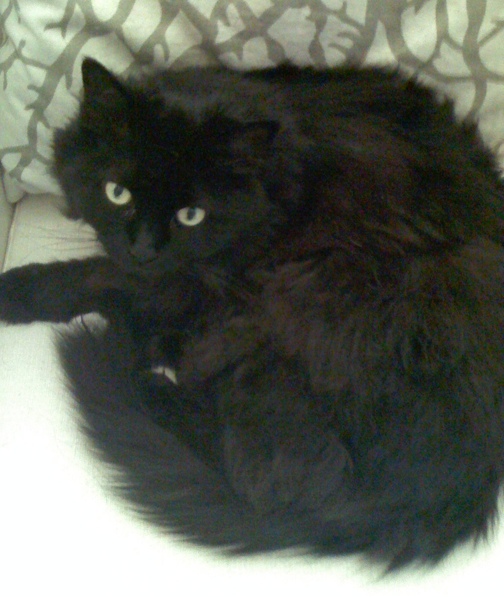
Aretha at five years old.
The shelter worker said placing a black cat needed a previous home inspection–too many people abused black cats. The cat was feral and would never make a good pet. Too much time outside. She was reluctant to schedule a home visit—the paperwork to have this one put down was complete. Still, the adoption wrangled its way through.
When I brought her over the threshold, I made her the promise that I had made all my cats: “I will spoil you and love you and care for you until the day the quality of your life declines. I will not prolong your life to avoid my own suffering.” She bolted behind the bookcase and remained there for more than a week, coming out at night to eat and use the litter box. We abandoned the shelter name “Raven” as not right for her, and named her “Aretha,” after Aretha Franklin. She demanded some R.E.S.P.E.C.T.
For a feral cat, she adapted to home life quickly. Regular food, warm laps, and a bed changed her mind about going out. She was never interested in the door again. She retained odd habits–given a whole bed, she would lie on the hanger left on the edge of the bed or a plastic bag that hadn’t been recycled yet. She slept in the sink when it was hot. She would not wear a collar.

Aretha earlier this month, enjoying catnip and sporting white whiskers.
She’d take a moth down with lightning speed and accuracy. She was a heat-seeker and followed sun patches around not matter where they were–on tables, chairs or floors. Once we moved to Arizona, she loved lying outside until she panted. I’d have to carry her inside for fear of heat stroke. No lizard was safe in our yard. She’d pluck off their tails and play with the squirmy part, leaving the lizard to run off and grow a new tail.
At 14 she developed arthritis, and limped in the morning. We were quite the pair, right out of bed. At 15, her whiskers began to turn white, one at a time, until she had four.
Today, the promise I made to her 16 years ago had to be fulfilled. I was teaching, so Cooking Man took her to the vet because the medicine didn’t work and she was in pain. I was hoping to see her again when I came home, but she was gone already. I am struggling to believe it was the best thing for her, if not for me.
I wish for Aretha a re-birth into another cycle of life. I will miss her sorely in this one.
—Quinn McDonald was owned by Aretha. She has two other cats.
Filed under: In My Life Tagged: cats, pets, putting a cat down


June 19, 2014
The Power of Blank Space
White space. If it’s not in your life you will feel crowded, hemmed in. What is white space? If you’ve ever planned design work, you consider both the space where there are words and images (message space) and the space that is empty–called “white space.”
White space is important. Too much copy and illustration, and the busy page exhausts you. You can’t read any of it. Too little white space and you feel lost and disconnected, not sure you understand what you are looking at.
If you know this already, you might explore “passive white space”–margins and spaces between paragraphs, and “active” white space, the space purposely designed to give your eyes and mind a rest.
 If you are interested in how to use white space in design, read Larisa Thomason’s excellent article “The Use of White Space.” The image on the left is from that article.
So yesterday, when I was having a terrible, no-good, horrible, really bad day (Judith Viorst knows about those days). I felt jammed up by 6 a.m., when I had a competitive assignment to hand in before I left for a teaching assignment.
I made some choices that changed the day. Here’s how I did it:
1. I stopped doing my work. Put the phone down, signed out of email. I needed to distance myself and my frustration.
2. I took a break. I got a glass of ice coffee, looked out the window and did some deep breathing
3. I re-set priorities. This is the hard part. I had to call clients, work on projects, solve some problems. But I knew if I forced myself ahead with the considerable self-discipline I am capable of, I would do more damage than good. I’d make mistakes because I was frustrated; I’d miss correcting those mistakes because I was rushed. I’d create more mistakes and less forward motion.
4. I added white space to my day. I cut out some items I thought I had to do. I added a few administrative tasks that were more noodly, didn’t require a lot of brain power, but needed to be done. I added a half-hour of reading a magazine between tasks. Another spot of white space. I ran some errands. At the end of the day, I had accomplished some necessary items, hadn’t ruined client relationships and felt less harassed and frustrated. I need to be clear here: I chose not to do some important things because the risk of doing them and failing was more probable than being able to push through them successfully. Yes, I put off the thing that has to be done, in order to save it. It is a hard decision to make, and exactly why adding white space is a life saver.
I now have a name for deliberately putting off work because I am emotionally incapable of doing it. This is very different from avoiding work, creating excuses, or not meeting a deadline because you didn’t get up early enough. You know the difference. My day was saved and ended well because I added emotional white space.
—Quinn McDonald occasionally has to fight to nurture her ability to get work done.
Filed under: Coaching, In My Life, The Writing Life Tagged: breathing room, emotional white space, white space


June 17, 2014
Seed Pod Creativity
In Arizona, we are in the Season of Seeking Shade. Oranges stop growing, figs that fall from the branches dry to walnut-shell hardness by the end of the day. Birds sit in the tiniest patches of shades, beak open.
 But there is another fascinating process that unfolds now. Native trees produce seed pods. Most of them are hard and protective–understandable, soft seeds would wither and dry up in hours. Nothing rots here; it’s too dry. Leaves that drop, branches that blow down will be in the same place years later. They will be the bones of trees, bleached and stiff, but not rotting.
In order for seed pods to open, they need a threshing machine. Well, something to break open the pods so the seeds can drop to the dirt and wait for rain. Unless those pods break open, the seed can’t put out roots.

Dish of seedpods
The lucky trees are the ones planted close to sidewalks and roads. The pods fall, we stomp or drive over them, the pods are crushed, the seeds released and ready to be washed into a gully to grow.
I was crunching over pods yesterday, loving the hollow, rattly sound the seeds make in the pods, when I thought how this is creative work. Well, it is like creative work. You have an idea, but it’s not ready to work, to grow, to connect with us. You create an idea-pod, but if you hoard it, nothing happens.
Then you drop your creative pod and other people walk over it, kick it aside, roll over it, and suddenly, the dry husk that made it tough, but not productive, breaks. You can see it in a fresh new light, ready to grow. And that’s when you see that letting it go, not forcing it was what it took to break out into a project that you can do. You had to let it go to make it work.
Quinn McDonald has a thing for seedpods, metaphorically and really.
Filed under: Nature, Inside and Out Tagged: creative seeds, seed pods, summer in Phoenix


June 16, 2014
Is it a Book?
Synchronicity is a funny thing. And when it works in your life, it’s hard to ignore. Not too long ago, I posted about retiring the word scatter, and switching to distill as my word of the year. Too many things were grabbing my attention and dragging it away from what needed tending.

From Carl Jung’s Red Book
Being a writer isn’t easy, but it is my major skill, so I wanted to honor that. And move the art and art teaching over to ripen for a few months without panicking. Explore collage at a slower pace for discovery rather than for lesson plans.
Of course I’m still going to Colorado Springs to teach Monsoon Papers at Blue Twig Studio. But unlike other summers, the schedule is not packed this summer.
Just as I decided that, a publisher contacted me. Would I be interested in writing one of a book in a series? The time frame is crazy, but it’s a topic close to my heart. But being interested led to serious consideration.
 And wouldn’t you just laugh at the synchronicity, a friend of mine has an agent who has done another one of the books in the series. A few emails and phone calls, and I had an agent.
Why an agent if I already have a publisher? Because I need someone to represent me on the contract. A contract lawyer can certainly tell me what’s legal, but for negotiations to represent the writer, an agent is the person with the skills. And this agent already has a track record with the publisher and the topic.
It’s too early to talk about the book series, the agent, the content, or anything else, but if the deal goes through, I will be posting requests for your stories and experiences on the topic. Because I’ll need your experiences and story-telling abilities to make this work.
For now, keep your fingers crossed and grin. Synchronicity lives!
—Quinn McDonald is suddenly a writer with an agent.
Filed under: Inner Hero/Inner Critic, The Writing Life Tagged: book agent, book contract, finding an agent


June 15, 2014
Being an Author
Being a book author means you also have to do your own marketing. Most publishing companies don’t do as much as they did five years ago, and some do nothing at all. That’s now the writer’s job.
So I try to schedule book events rather than book signings. Events are more interesting and have a better chance of attracting people. Libraries are a good place to do an event. You are guaranteed to get people who like reading at a library.
 I called a library to arrange a book signing for my book, The Inner Hero Creative Art Journal.
We join the conversation in progress, as it slides inexorably downhill:
Me: . . . so I wondered if a book signing would be a good mix for your events this summer.
Librarian: Well, I don’t know, maybe if you did a children’s program. . .
Me: The book is really for adults who keep a journal.
Librarian: We are looking to do more performance art this summer, with guests from far away.
Me: Oh. I would have thought you’d be interested in your local writers, too.
Librarian: Look, it’s not like you are exactly J.A. Jance.
What a great praise for J.A. Jance, a writer of mysteries and suspense books who used to live in Tucson and now lives in Seattle. I’m a fan. So I wrote her and told her the story.
Her reply?
Many years ago, the same thing happened to her–except she was told “You are no Norman Mailer.” And then, incredibly, she told me two lesser-known libraries that had been helpful to her before she had several books on the New York Times best seller list.
None of us are all everyone wants us to be. What makes us great is the willingness to be who we have become. With some work, that is better than who we used to be. Because, great or not great, we can’t be anyone else.
--Quinn McDonald is happy about her book. She is always impressed with the kindness of another writer.
Filed under: Inner Hero/Inner Critic, The Writing Life Tagged: authors, J.A. Jance, marketing your book, Writers


June 14, 2014
Creative Hop, June 14, 2014
Mexican artist Octavio Ocampo’s paintings need a second glance. You may have missed the visual trick of the eye, as well as the two meanings that flip back and forth.

Family of birds © Octavio Ocampo
Our visual systems focus on objects we recognize easily first. You may not have noticed the young woman in this scene. Or you may have seen the woman first and had to wait for the birds to come into focus.

Sunlight’s Kiss ©Octavio Ocampo
According to his biography, “He works primarily in the metamorphic style – using a technique of superimposing and juxtaposing realistic and figurative details within the images that he creates. “

Ecstacy of the Lillies © Octavio Ocampo
Ocampo lives and works in Tepoztlan, north of Mexico City. Tepoztlan is the equivalent of Sedona–considered by many to be magical.
Marc Thomasset is a designer and a journaler. He got tired of the rigidity of a lined journal and created one of his own so he could. . . draw outside the lines.
 It’s called the Inspiration Pad. And if the one above is too tame for you, you can always write in one that looks like a topographic map:

Have a creative weekend!
–Quinn McDonald would have loved to hear the marketing pitch for the journal above.
Filed under: Creativity, Links, resources, idea boosts, Nature, Inside and Out Tagged: botanical art, journaling outside the lines, metamorphosis art, nature art


June 13, 2014
The Aha! Moment
After two articles on bullying, I spent some more time processing my emotions around the incident. I’ve done stand-up comedy, and knowing what is funny to an audience and the timing of delivery is key to humor.

Pushable button image from http://meridianvitality.com
And then I had an Aha! Moment. In all the years I was super fat (I had a mirror, so I know), and people said hateful things to me (when I was in the middle seat of an airplane, for example) I actually felt sorry for them. I did not feel shame or diminished. I loved to eat (still do), and knew that fat people are one of the few groups we feel free to openly bash. I was capable of compassion.
Because I was not a fat child, I had no buttons to push.
But the incident at Trader Joe’s pushed all those buttons I had embedded a long time ago.
So the work I have to do is around healing those pushable buttons is about feeling fine about being different. Taking pride in being an outsider. Because when you are outside, you have a bigger view. You aren’t hemmed in. And while everyone inside is bathed in light, it doesn’t guarantee acceptance or happiness.
A good thought for Friday the 13th.
--Quinn McDonald is moving on with a lighter step. (Carefully checking for a banana peel.)
Filed under: Inner Critic, Opinion Tagged: anger, fear, memory, push my buttons


June 12, 2014
Rushing to Judgment With the Crowd
In 2009, Bowe Begdahl walked away from his camp in Afghanistan. In June, 2014, after being held by the Taliban-friendly Haqqani network, he was released.
I am not discussing the trade for Bergdahl, I am discussing what happened next. “News” outlets began to give their opinions as fact. He deserted, said one outlet. He was a loner, said another news outlet, quoting a platoon member who said that Bergdahl did not drink beer or eat barbeque at parties, and then drew the conclusion that he may well be a traitor

Image from prnewswire.com
The first time I heard this, I laughed. In three leaps from non-beer-drinking to loner to traitor? But the more I listened the less likely any of this seemed.
On Yahoo, in the newspaper, on TV–everyone was spouting their opinion as fact. “He’s a traitor.”
“He’s one of those loners who deserts his brothers and sisters in arms.”
Not one of those news sources had spoken to Bergdahl. A few had spoken to members of his platoon–but none of them were in captivity with Bergdahl

Word of Mouth from themontebulldog.org
and none of them knew why he left. Almost everyone had an opinion. I tracked down the source of one and it was the PR department of a political party poll. Under no circumstance that I can think of does a PR department qualify as a news source. None of us knows what was in Bergdahl’s mind. None of us knows why he left his base, or what happened to him in captivity. Bowe Berdahl knows, and maybe the people who are treating him for physical and psychological wounds. He was a prisoner of war, that’s all we know.
I am confounded how anyone can draw any more of a conclusions than that. As a parent myself, I ache for his parents. The support vanished, not because of facts, but through opinions, many unfounded and the lightning fast communication of juicy gossip through social media. Many more rumors started not because of facts, but because the rumor mongers don’t like the President or his actions. Which Bergdahl was not in control over.
And many more people used code words like “loner,” “different,” and “not a team player” to vilify him. Other loners? Syd Barret, founder of Pink Floyd. Barry Bonds, who hit 762 home runs, more than anyone else ever, was a loner. Piet Mondrian, Rachel Carson, Isaac Newton, Beatrix Potter. All loners. All brilliant at their creative path. None dangerous.
Bowe Bergdahl’s story will come out. Until then, let’s remember he is innocent.
—Quinn McDonald wonders what people have against loners. She is one herself.
Filed under: In My Life, Opinion Tagged: gossip, opinions aren't facts, prisoner of war


June 10, 2014
Bullied into a Sense of Humor (Part II)
Note: Yesterday was the first part of this article. And how I developed the sense of humor I have, or don’t have.
Scene: Trader Joe’s close to my house. I am in the checkout line with three items. Most of the lines are filled with people with full shopping carts. In front of me is a couple with their son, age 3 or 4, who is pushing a kid-size cart.
 He pushes up to the counter and starts to unload the tiny cart. He drops the bag of washed, organic spinach just short of the counter. He drops an avocado. He drops a box of FruitFloes. I glance at his parents, expecting them to help, but they are both holding up their cameras, chuckling, videoing this incident with two cameras.
Dad: “Good job, Noah!”
Mom: “You’re going to be a celebrity on Facebook!”
Noah hoists another bag of greens, this time making it onto the counter. He sees the end of the bell rope that checkers ring to call a supervisor. He grabs the rope. Both parents are still videotaping.
 Noah glances at Dad, who says, “Good job, Noah!” Noah glances at me, but I’m wearing sunglasses and not reacting, so he glances at the checker, who looks doubtful. Noah pulls the bell, ringing it loudly. He then laughs, points at me and says, “She did it.” Mom swings around to film me. I stand absolutely still, not wanting to be part of this early-stage drama. Not wanting to be on a Facebook video.
The checker chimes in. “Yes, that woman rang the bell! We’ll blame it on her!” Mom continues to video me. Dad laughs, points and says, “Her fault, her fault!” The checker looks serious and says, “Boy are YOU in trouble!” to me. She winks at Noah’s Dad. Noah is completely into this now, clanging the bell and pointing at me. “You did it!”
I should be laughing, but I’m not. I am feeling. . . shamed. Blamed for something I did not do, no matter how trivial.
Noah rings the bell again, and a manager appears. A thousand unhappy thoughts cross my mind. Would they be blaming me if I were better dressed? A man? Younger, prettier, and not in the “grandma” age range? Why is no one doing a “good job” of explaining to Noah that
He should not be ringing the bell
If he rings the bell, the consequences are his responsibility?
Turning to leave the aisle, I go to stand in another, longer line, not willing to explain anything to anyone. I’m humiliated. This should be rolling off my back, but it’s not. I feel angry, too. Tears are starting up in my eyes behind my sunglasses. I hear echoes of “you don’t have a sense of humor.”
But this time, I decide to do something. During the 20-minute wait in line, I think about what happened. I didn’t protect myself because the woman with the camera would have caught every reaction and I didn’t want to become a meme on Facebook. Because I don’t know how to react in a situation in which I don’t know the rules of engagement. Because although I have lived in the U.S. my entire life, was born here, I still feel like an outsider. Someone who doesn’t belong. Who can’t blend.
After I buy my three items. I approach the woman checker who cheerfully let Noah blame me. I touched her shoulder gently and tell her I felt humiliated and shamed, and it would be lovely if she never blamed an innocent person for someone else’s behavior again. I say it softly and gently because I have had time to prepare.
She looks at me and says, “Everyone was joking. You had no business feeling bad. That’s on you.” I stopped. Breathed. “I am not going to rehearse the event again. All I want you to know is that your words hurt and embarrassed me.”
“That’s not my fault,” she said sharply, “if you don’t have a sense of humor.” Blaming the underdog for not having a sense of humor is the refuge of a bully, and now I understood my own emotions better. “All you need to know,” I said, still softly, “was that what you said hurt me. Whether or not I have a sense of humor, what you did was painful to me. I hurt enough to leave your line so you would not continue to humiliate me. Please don’t do that to someone else.”
And then I left. Shaking. Because I did what no one did when I was three or four years old. Stand up for me.
–-Quinn McDonald is still processing this event. She is the author of The Inner Hero Creative Art Journal.
Filed under: Creativity, In My Life, Inner Hero/Inner Critic Tagged: inner hero, public humiliation, shame, standing up for yourself