Quinn McDonald's Blog, page 38
May 18, 2014
Choosing When You Can’t
A friend was trying to decide whether to stay in a relationship or go. There were plenty of reasons to leave–she didn’t feel heard, she felt belittled, her boyfriend didn’t want to go for counseling and didn’t want her to go either. On the other hand, she had spent years in the relationship and had put effort into making it work. Her boyfriend was funny and made her laugh, even at herself. Pros and cons, on paper, seemed about equal.

Image from People Passionate.com
To stay or to leave? Would leaving seem like giving up? Was she being a quitter instead of someone who worked on her relationships? Was staying in a bad relationship a sign she didn’t care about herself? Couldn’t admit she had made a mistake and move on?
My friend was tortured with her choices. And she kept piling up more reasons on both sides of the issue, but not getting closer to a decision.
“I should be able to sort this out by myself,”she said. “I don’t know how come I can’t make a decision.”
Decision-making is tough because with the decision comes the consequence. Either staying or leaving brings on next steps. Often the steps are unclear. So decision making becomes murky.
I gave my friend a coin. “Heads you stay, tails you leave,” I said.
“You’re kidding, right?” she said, looking at me as if I were a sheep on a bicycle, playing a violin.
“Well, this is the simplest way for you to get to a decision. It takes over-thinking out of the problem. Let’s see what happens,” I said.

Image from BelasBrightIdeas.com
She flipped the coin. Heads. She broke into tears. Hurts and agonies months in the making poured out. I handed her a tissue. At the end of the sobbing came the sentence, “I can’t stay. I’ll die if I stay.” As soon as she sobbed it out, Anne had her answer. By coming up with endless possibilities and choices, Anne has suppressed the answer she already knew. By taking over-thinking out of the pattern that she had developed, she suddenly collided with her emotions and knew the answer she had been suppressing.
My friend left the relationship, and although there were many tears and a few hard days and nights, over time she knew the decision had been right. Looking back she saw that a lot of her indecision was rooted in not wanting to change because change made her feel as uncertain as she felt in staying.
It’s not the tossing of the coin that helped her make a decision, but the emotions that follow it. Emotions often inform clear decisions, because they allow you to focus on what is important to you.
We often block our values because we are scared of honoring them. The coin toss works, even if you know about its purpose, because it make your own feelings clear to you. Our ability to provide many scenarios of the future blocks a clear view sometimes, and tapping into raw emotions provides the only clear view. A coin toss will put you in touch with what you are hiding from yourself. The coin isn’t leading you, the coin gives you permission to see one decision and gauge your choices instead of balancing one pro with another con.
It clears the way to sorting through the issue at hand instead of the fear of making a decision.
–-Quinn McDonald is making a lot of decisions about the workbook she is creating for a client. She feels conflicted.
Filed under: Coaching, In My Life, Links, resources, idea boosts Tagged: choosing, deciding, flipping a coin, honoring values



May 17, 2014
Writer (or Artist’s) Glut

Image from Scooter in the Sticks.
Most creative people eventually hit that edge-of-the-horizon feeling that you’ve come to the crumbly brink of your creative world. The next idea doesn’t show up on time. Missed the train. The next train doesn’t show up at all. The track rolls itself up and over the edge of the horizon, leaving you standing alone, squinting as the hot sun burns out the edge of the sky and drops below your line of vision, sending your last hope of creativity into the twilight shadows. Night descends and leaves you standing without a shadow to rely on.
 If you have never experienced this feeling, you probably aren’t trying hard enough to push your creativity. And before you crack your knuckles to leave me a blistering reply that you always have ideas, stop. This is about you. This post is about having too many ideas, too much of an idea, an idea that rolls in like a giant wave, flattening you against the floor of your studio, pressing you down until bubbles float from your nose and you can’t inhale. That kind of creative overflow.
It doesn’t happen to me often, but when it does, it is overwhelming. I’ve been creative long enough to know that when the dark side of the world appears, it signals the long roll into dawn. But crushed with too many ideas, I feel afraid–I’ll lose the most important one, I’ll develop the wrong one, I won’t be able to figure out the process of this brilliant idea over here. Now what?
The simplest idea I came up with is to save as many of those ideas as possible, get them into some form you can understand, and save them. You can figure out process later. You can figure out sequencing later. What you need to do now, before your short-term memory sneaks out the back door, is get some of the ideas caught.
My two favorite ideas for capturing represent the high tech and low tech spectrum. Index cards, my long-time companions and art supply, are the low tech side. I write down the bare bones idea. Just enough to balance the memory on the tee, so I can whack it across the sand trap and out of danger. No big discussion, no marketing, no audience. Just the rough idea is plenty. If you can’t reconstruct it later, it may not have been as wonderful as you first imagined.
The second idea is a voice-recording app on your smart phone. The one you want to install is the one you know how to work. My first one was incredibly easy to use, but I couldn’t figure out how to play it back. You can imagine how that little fault messed with my mind. Occasionally I still believe the best ideas of my life are wrapped around the gizzards of my iPhone. The new one works better.
Don’t edit. Don’t worry. In fact, I generally don’t read or sort the ideas for several days after a brainstorm. I’m too critical. Or too immediate. I toss the index cards into a box and let them dry out. I’ll take a nice patina’d idea over a damp one, any day.
What’s your storage/retrieval system when your ideas back up and pour over you?
—Quinn McDonald is a creativity coach who helps people put life to their creative ideas.
Filed under: Inner Critic Tagged: capturing ideas, ideas, index cards


May 15, 2014
Brave Because You Have to Be
Today, I fired a client. A client I’ve had for almost six years. A client who gave me a break a long time ago. It took me half a year to decide it was the right move.

Image Credit: Freelance Switch via Entrepreneur.com
Why was it the right move? Because I wasn’t getting paid what I was worth. But that wasn’t enough to quit. Because I had to drive an extra 60 miles for each class, and didn’t get paid mileage. But that, too, wasn’t enough. Because there was always one extra thing I had to do, achieve, or prove–all without extra pay.
The final dust mote that collapsed the relationship was the new contract. As a contract employee (freelancer), I do not receive benefits, and I was asked to sign away my copyright for any class I created or workbook I wrote. They were to belong to the client, and I was not going to get a development fee, either. That may be fine for full-time employees, but it’s not fair or right for freelancers. But if I signed the contract, I would say it was all right for me. And it was not.
So, I took a deep breath, and said I needed to keep the copyright to all my work. The reply was a short laugh, and I was told that “industry standard” was that the client kept all my work, essentially without paying me for development.
So I resigned, or, in a nicer way, fired the client. They’ve given me steady work, and I have done it all to the best of my ability. Gotten solid evaluations. Was happy for many of the jobs.
But like a wife who still loves the husband who beats her, I did not want to leave the relationship. What if nothing else showed up? What if. . . and I stopped myself there. It didn’t matter if nothing showed up. It didn’t matter if a thousand wonderful projects showed up. I was firing the client because it was not all right not to keep the copyright to my own work. That was all. Everything else was details.
It feels odd, even scary to stand up for yourself. But no one else will. And as long as others keep signing those contracts, the client will be able to claim “industry standard.” But I don’t have to accept. It’s only industry standard if I agree.
So here I am, feeling a bit fearful, but very certain that I did the right thing.
–Quinn McDonald is a writer and course developer who puts her best work out, and is proud of it.
Filed under: In My Life, The Writing Life Tagged: firing a client, freelancer, pay for work


May 14, 2014
Feeling Your Way Ahead in the Dark
The light switch on the wall of my studio, conveniently located by the door, doesn’t go anyplace. I’ve plugged lights into every socket in the room, and the switch doesn’t connect to any of them. There is no ceiling light.
When I go into the studio at night, the closest light is on the desk, and I have to

“Finding their way through the dark,” © Quinn McDonald, Monsoon Paper, tissue, ink and watercolor pencil on handmade paper, 2014
walk across the room in the dark. My toes generally begin to protest, begging me to put on shoes. Sometimes I do, sometimes not. I’ve learned to leave a clear path, but sometimes a cat, looking for a cool draft, pushes the chair into my way. I’ve cracked more than one toe that way.
Tonight, as I felt my way into the studio in the dark for the thousandth time, I realized that I had a flashlight on the phone, I could turn on the hall light, but no, I feel my way ahead in the dark. Just like real life.
There are whole weeks, sometimes months, that I feel my way through life in the dark, believing I won’t stub my toes, step on something sharp, or break a fingernail (or a finger) on the outstretched hand, trying to figure out what my next move is, where I am going, all in the dark, without reference to anchors.
There is something to be said for experiencing the dark. It’s becoming familiar now, and I move through it more certainly. Which is nice, because we are promised nothing in life, and much of the time we are in the dark, clutching our plans, and feeling out way through.
–- Quinn McDonald is traveling again, driving through the dark in a place she has never been.
Filed under: Creativity


May 12, 2014
Traveling Shrine
Traveling is an adventure–you meet new people, eat interesting meals, and are awake to new experiences. Traveling is also exhausting and frustrating–airline delays, people acting out, and hotel rooms that make you feel like a stranger missing the comforts of home.
To lighten the discomfort of traveling, I’ve developed some self-care habits that make it possible to put up with frustrations, sleep better, and return home without needing a whole day to fit back into my body. Some examples:
Buy a complete set of makeup for your travel kit–no more plundering your drawer before and after every trip.
Treat yourself to a pair of very comfy slip-on shoes to wear on the airplane so you can run through the airport if you have to, and take a walk when you get to our destination if you want to.
Switch to a Commonplace Journal. Packing a sketch journal and a notes journal and a travel journal means nothing will get journaled.
Bring non-work-related reading material and use flight time to read something fun or interesting. You really can’t work all the time.
Create a ritual for your hotel room. Make it something pleasant or soothing. Using a hotel room as an office then going to sleep with the TV on wrecks your sleep.
My ritual started with a tin of Trader Joe’s breath mints. They look like this:
 A perfect little plastic window in a 2-inch square box. I wanted to make a small traveling Inner Hero shrine, filled with inner heroes that I can call on when I’m in a strange city. Something that calms me to a better self.
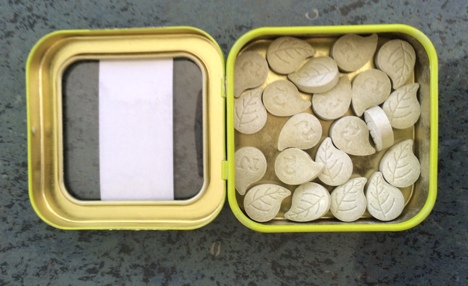 The box is well-hinged and stocked with mild breath mints that are also low in sugar. Perfect all the way around. Note the label blocking the window in the lid. Remove it slowly, heating it with a hair dryer, to get it off. I had to use Goo-Gone to get off all traces of the label. I wiped the inside out with alcohol to get rid of the mint-dust.
 Because the tin is already bright green, I don’t need to paint it. But I wanted to make a series of inserts for the tin, so I cut a template that would fit.
 Using pieces of Monsoon Paper, monoprint scraps, brayered-off pieces of paper, and other colorful scraps, I cut out colorful pieces of art. On the back, I scoured my journals for Inner Hero characteristics. I rounded the corners of each piece then wrote on the back. My Inner Heroes have characteristics that I have or almost have and will get used to, with some practice. Here are a few:
She listens with curiosity, not to form an answer.
She hears fear in angry outbreaks. There is no need to reply in anger.
What is the speaker’s perspective? Can I stand in that space?
She notices when she judges, and considers.
 Sometimes I flip through the colored side, pick something that appeals to me, read the back, and that becomes something to pay attention to the next day. I put the card on the top, so the colored side shows through the window as a reminder.
 Other times, I put my talisman necklace in the shrine with one of the cards to create a focal point of home and heart and use it as a meditation focal point at night or in the morning. It’s easier to meditate in a strange place with a well-loved and comfortable focal point.
Sometimes, I just shuffle through the colored sides, remembering the work they came from originally. It’s calming and grounding. And best of all, the box takes up a tiny bit of space that fits in the side pocket of my backpack, easily available.
—Quinn McDonald travels and teaches. She learns something about every city and she learns something about herself in every city.
Filed under: Creativity, In My Life, Inner Hero/Inner Critic Tagged: creativity coach, inner hero, traveling mercies, traveling shrines


May 11, 2014
The Difficut Mother’s Day
If seeing “Throwback Thursday” shots of happy women and their mothers makes you feel confused or sad; if you couldn’t find a Mother’s Day card because they are all so sticky and sweet, welcome to today’s blog.

Prickly plant seedhead.
If your childhood was happy and you had a mother who gave you everything you needed and no card is sweet enough, today’s blog is not for you. And most likely, you are with your mom, being happy.
Anna Jarvis, who invented American Mother’s Day in 1908 was angered by the commercialization by the early 1920s. So you are not alone if you think the holiday is a lot of hype for cards and candy. Most likely, that’s not your heartache. You never had the mother you needed. The one who comforted you and praised you and loved you when you were unlovable and helped without anger when you sewed the pieces of your gingham skirt together backwards. Twice.
Maybe you chose not to be a mother and everyone asks you why, or you wanted to be a mother and it didn’t happen for you and you are still pretending that’s just fine.
It’s complicated. Whether your mother was cruel or uncaring or clueless, the pain is there. If your mother is still alive, you probably won’t be able to have the big turnaround, awakening and happy ending your friends keep promising you. Not even on her deathbed. It may never happen. And that may have to be OK, too.
If your mother is dead, you may replay scenes, wondering if you had acted differently, if the results would have been different. You’ll never know, but a wild guess tells me No. Some things can’t be changed, fixed, or healed. And never by one person. Two people, a mother and her child, might be able to cobble together a relationship, but it’s hard.
The relationships between mothers and daughters is always hard. There is unwritten jealousy between age and experience and youth and naivete. There is anger in lost opportunities and unmet expectations. For some, the fact that you were a daughter was enough of a disappointment to fill a lifetime. I ran across this quote yesterday, whose poignancy was hard to read:
“Remember that every son had a mother whose beloved son he was, and every woman had a mother whose beloved son she wasn’t. ” – Marge Piercy

The long shadow doesn’t have to haunt you.
But here is a truth you might want to hear right now, today, on Mother’s Day. You cannot be anyone else except the person you are today, with all your faults, experiences, hardships, joys, stumbles, successes and backslides. That is also true of your mother. No matter what happened, your awareness and work brought you to where you are today.
And starting today, you can choose to be generous and kind and patient. Maybe not with your mother, but with the women who surround you. The ones who work with you and don’t meet your expectations. The pretty ones who get promoted ahead of you. The ones who don’t take the opportunities you wanted and they have the freedom to turn down. All those women you meet on your path during the day. You can swallow the angry remark. You can wish them well. You can choose not to judge. That is your choice now. And choosing that freedom instead of choosing retribution is worth celebrating. Today and every day.
–-Quinn McDonald’s mother has been dead for almost 10 years, and the shadow still falls across the path on some days.
Filed under: In My Life Tagged: Mother's Day, Mothers, the mother you have


May 10, 2014
Creative Hop (Saturday, May 10)
Note: Congratulations to Kaisa Mäki-Petäjä, who won Writing Wild. I love her blog, here’s the link to the boulders she draws in her journal. Send me your mailing address to QuinnCreative AT yahoo DOT com. The publisher sent me two books, and I’m giving away the second one as well. Congratulations to Diane Becka, new owner of the second book!
Thanks to everyone who left a comment!
* * * * *
Kaisa has a wonderful nature journal that I have to introduce here. She draws a lot of scenes, but the ones with boulders in them really are special.

From the website Valkoinen Poni.
It’s hard to draw a rock that doesn’t look like it might be ice cream or a cow pie (to stay on the theme), and she does a wonderful job of introducing us to her native Finland.
* * * *
I found this on Facebook via thiscolossal.com: Seventeenth-century artist A. Boogert mixed colors and kept track of them in a journal. What an amazing piece of work.
 There are almost 800 pages of colors, hues and tints–the most comprehensive book of color for its time. There is only one copy of this book, although it was meant for educational use. In my view, a perfect Commonplace Journal.
* * * * * *
Kintsugi is a Japanese method of repairing broken plates, sculpture, teapots with lacquer mixed with gold, silver and platinum.
 The process honors the history of an object without hiding damage. The visible repair makes the item more beautiful than it was when it was whole and perfect. And as so many philosophers have noted, “There is a crack in everything; that’s where the light comes in.” (That particular version is from Leonard Cohen.)
* * * * *
In Tokyo and other urban areas where there aren’t many trees and birds have to scramble to find nesting material, the clever crows have once more adapted to their surroundings.
 Crows steal wire clothes hangers and use them in their nests. They interlock the wires, add a lot less nesting materials, and create long-lasting homes for their broods. You can see more photos on the Beautiful Decay website.
—Quinn McDonald is delighted to live in a creative world.
Filed under: Art in Progress, Links, resources, idea boosts Tagged: art in nature, Creativity, crow nests, Wabi-Sabi


May 8, 2014
Writing Wild (Book Review and Giveaway)
Tina Welling is a fiction writer, known for Cowboys Never Cry, Fairytale Blues and Crybaby Ranch. This book, Writing Wild, is non-fiction; in fact, it is a book about writing. Here’s how Welling describes the book:
Everything we know about creating, we know intuitively from the natural world. Over and over, nature shows us the rules of creativity. . . Writing Wild offers writers, journal keepers, and those others of us who wish to live more fully a direct pathway into a stronger relationship with wildness, both inner and outer. The result is writing that inspires, heal, enlivens, and deeply engages both writer and reader.
 As a model, she takes Joseph Campbell, who wrote, “The goal of life is to make your heartbeat match the beat of the universe, to match your nature with Nature.”
Welling lives in Jackson Hole, Wyoming, a place where (I imagine) you love the natural world, or you move away.
She believes in using all five senses in writing, and has several exercises to show you how to do that, too. She uses a method called “Naming, Detailing, Interacting,” which she describes in detail, so you can learn how to get the most out of a nature walk, and bring it into your writing.
She also shows us how to truly inhabit our body. For many of my coaching clients, the body ends right at the neck, there is a vague connection to fingers (for writing or typing) and then. . .nothing. I’m always surprised at how many writers live their entire lives in their head. Welling pries you out of it with gentle, easy exercises that make you realize how much of your truth lives in your body.
Once you have learned to connect your body to your head, she guides you to understand that intuition is a knowledge we all have, but often don’t trust. And that writing is the healing action that combines body and soul.
One of my favorite parts of the book is the idea that we do not, after all, write what we know. Instead, Welling says, we write to know something, and that something is ourselves. (I found a hint of Inner Hero here.)
Chapter titles include:
Nature as a Writing Partner
The Body Never Lies
Creativity and the Four Elements
Lessons from the Natural World
The Energy of Writing
Follow Your Longing
Wild Spirit
This book is certainly not for everyone. But for hikers, naturalists or writers curious about the world around them, you will find help, validation, and some interesting exercises to help you become the writer you already know you are.
Giveaway: Leave a comment that you want a free copy of the book. On Saturday, I will announce the winner. Make sure you stop by on Saturday, May 10 to see if you won and send me your mailing address. Good luck!
Disclosure: New World Library kindly sent me two copies of the book because I wanted to keep one and give one away.
—Quinn McDonald is a writer who loves to read books about writing.
Filed under: Book Reviews, Book Reviews, Creativity, The Writing Life Tagged: creativity coach, Joseph Campbell, nature and writing, writing


May 7, 2014
Cleaning Up Your Act (and Creativity)
A few weeks ago, when the studio was still a paper dump, the big decision was not to clean it, or even how to clean, but what to keep and what to scrap.
Cleaning out the bookcase was a choice-struggle, but it worked. And then the hard work began. Here’s what I did:

“Inspiration,” collage © Quinn McDonald, 2014. Monsoon Papers on mixed media paper.
For three days, I worked on projects that spoke to me. Carefully chosen, they were the result of a lot of thinking about expressing my creativity in ways that resonate with who I am and who I would like to become.
The next two days were spent in listing the materials needed to make the artwork. Another list for teaching materials. Everything else was considered and put in boxes to give away.
One of my big realizations was that I often buy an art supply thinking it will make my art better: “If I have this glaze, I will be a better painter,” or “If I have this tool, it will make me more creative.” Neither is true. But that “hope in a tube” belief is the foundation of a lot of art and craft supply companies.
Out went the rubber stamps I never used, the watercolors I hoped to get good at, and single-use tools. Out went a lot of brand-name toys I rarely use and bought to make myself feel better. A lot of my purchases fell into the emotional-eating equivalent of chocolate.
I kept everything I use to create collage–papers, inks, paints, watercolor pencils, watercolor markers, different glues, and rulers, cutters, and corner rounders.
My studio is now much airier, brighter, and less cluttered. The equipment I use is at hand, and a school is going to be a lot happier with the art supplies that fill up my trunk.
Creativity needs some good tools, but emotional supply buying is much like emotional eating. It feels good, but it’s not supportive of growth and health.
–Quinn McDonald is a collage artist, writer and creativity coach who lives her belief in creativity.
Filed under: Art in Progress, Journal Pages Tagged: binge buying, paring down, studio clean-up


May 6, 2014
Four New Classes
OK, superstars–I’ve got new classes coming up–fun all the way around.
On May 24th, at Arizona Art Supply, we’ll be turning a small handle-bag (or a gift bag) into a journal. Keeps your secrets to itself. Use it for your tell-all memoir.

You can bind pages of different sizes into your journal.
I’m really happy to have been invited for not one, but two classes at Frenzy Stamper in Scottsdale:
June 7, we are doing Monsoon Papers and turning them into an accordion folder for favorite quotes.

Monsoon Papers
On August 9, I’m back at Frenzy Stamper for a collage class–Easy Does It–Minimalist Collage. I’m tired of “layers on layers” and frantic pages. Let’s dial it back to cool and simple.

Collage: “Flight” ©Quinn McDonald, 2014
But wait! If you are in Colorado (or want to get out the the heat in Phoenix)–meet me at Blue Twig Studio in Colorado Springs for the Monsoon Paper class! That class will be on July 19.

One journal making class, two Monsoon Paper classes, and a collage class–just in time for summer! Details, photos, and registration are on my QuinnCreative website. I hope to see you at at least one event!
–Quinn McDonald is going to have a fun summer meeting new people.
Filed under: Creativity, Quinn's Classes Tagged: art journaling classes, collage class, Quinn's classes