Colleen Anderson's Blog, page 17
November 14, 2013
Tesseracts Interview: Rhonda Parrish

Tesseracts 17 is now out with tales from Canadian writers that span all times and places.
Rhonda is another of the Alberta authors, with her tale “Bedtime Story.” Tesseracts 17 is now availble in stores and through Amazon.
CA: “Bedtime Story” captured the imagination of a child well, like Peter Pan did, but in a way it goes farther underground and into darkness. Do you think this is a story that could be told to children?
I suppose it would depend on the child but for the most part I would say no. Parts of the story are pretty subtle and other parts rather dark. That being said my daughter would have loved this story when she was young, but I suspect she would be more the exception than the rule.
CA: What element was the most important for you to explore in this tale and are you still exploring it?
You know, I’m not even sure. As cliche as it sounds, this story, or at least a large part of it, came to me as a dream. I took notes as soon as I woke up and I let my subconscious chew on it for a good long time before I put pen to paper but even so I’m not completely sure just yet what my dreaming mind was working through when it brewed up “Bedtime Story.” Give me another year or two and then ask me again, I may know the answer by then.

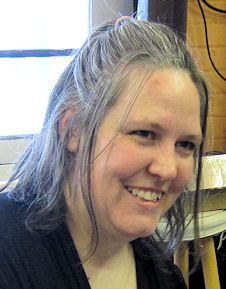
Rhonda Parrish’s “Bedtime Story” delicately balances darkness and the otherworld.

CA: Fairy tales that go back centuries have heroes, or the little man who triumphs over greater odds. Whether it is a simple hobbit and a powerful ring, Jack and the Beanstalk or Harry Potter and Voldemort, it is the will or intelligence that perseveres. Your character is connected to just such a tale, yet she does not directly face those greater odds. Why did you choose to approach it from this angle?
I feel bad because I’d love to have a deep philosophical or some sort of incredibly clever reason for choosing to approach this story from the angle I did, but the truth is, I felt that if I took a more direct route to tell the story, if I picked a different point of view, for example, then it would end up as a novel. At that point in time I didn’t want to write a novel, I wanted to write a short story, so I decided to tell it from Clara’s point of view.
CA: What themes are you exploring right now and will we see Clara again?
I’m working on a large variety of projects these days, with diverse themes. One idea which seems to come up again and again however is that things are not always what they seem. And, when I think about it, I suppose that might be one of the things I was touching on with “Bedtime Story.” Maybe.

As for Clara… I’m not sure. I would love for you to see her again, I’m pretty fond of her, and the world she inhabits so I wouldn’t mind revisiting it. I guess we’ll just have to wait and see if the sandman decides to bring me any more nocturnal inspiration.
Rhonda Parrish is a master procrastinator and nap connoisseur but despite that she somehow manages a full professional life. She has been the publisher and editor-in-chief of Niteblade Magazine for over five years now (which is like 25 years in internet time) and is the editor of the forthcoming benefit anthology, Metastasis. In addition, Rhonda is a writer whose work has been included or is forthcoming in dozens of publications including Tesseracts 17: Speculating Canada from Coast to Coast and Imaginarium: The Best Canadian Speculative Writing. Her website, updated weekly, is at http://www.rhondaparrish.com
Twitter: https://twitter.com/RhondaParrish
Facebook: https://www.facebook.com/rhonda.parrish.31
Filed under: entertainment, fairy tales, fantasy, horror, myth, people, Publishing, Writing Tagged: Albertan authors, Bedtime Story, fairy tale, fantasy, myths, other worlds, Peter Pan, Rhonda Parrish, Tesseracts 17



November 12, 2013
Tesseracts 17 Interview: Megan Fennell

Megan Fennell’s story “Bird Bones” talks about the monsters that live among us.
Tesseracts 17 is now available. In continuing with the Tesseracts interviews, I have Megan Fennell, whose story “Bird Bones” is in the anthology.
CA: Family is at the core of this piece. Have you explored what family means in other aspects of your writing?
Absolutely. In most of what I write there will be at least some screen time given to the concept of families, either family by blood or family by choice. People do truly incredible things and make enormous sacrifices for family that they wouldn’t dream of doing for anyone else. Upon reflection, my stories tend to include a lot of sibling characters, albeit with varying degrees of oddity and functionality. This is probably a side effect of having possibly the best kid sister in the world and thus being intrigued by the nature in which the sibling dynamic can turn bizarre.
CA: Do you think humans run the risk of the god complex by too much scientific tinkering or do you think there are restraints that keep us in check?
There are absolutely restraints that keep us in check, which is why the first trick of writing a mad scientist character (at least in my experience) tends to be isolating them. You mentioned Dr. Frankenstein… Add to that list a few more of my favourite brilliant madmen: Dr. Moreau, Dr. Jekyll, Griffin from the Invisible Man, and you’ll notice that secrecy, isolation and working within limited means play a big part in what they were doing. None of these folks were exactly in line for a government grant. In ‘Bird Bones’, Feyton’s controversial experimentations in his day-job are plagued by protestors and review boards. It’s his secret side project where he can really go wild. I believe that the all-seeing public eye and our tendency to ask this very question will ensure that cutting-edge science never galavants too far ahead of morality.
CA: What else are you working on these days and will we see other tales of transformation or escape?
You’d better believe it! Along with shopping around my short stories and trying to find the illusive market interested in love stories about squid-like aliens, I’m presently in the honeymoon stage with a new YA novel. This typically consists of me wandering around in a smile-y daze like a lovestruck teenager, murmuring happily about these wonderful new people who’ve turned up in my head. I’ll get to the hard work soon enough and start grumbling about it as is good and proper, of course! But yes, the crux of that one will be the nature of being human and the relative weight of what you are versus who you are, so more variations on some of my favourite themes for sure.
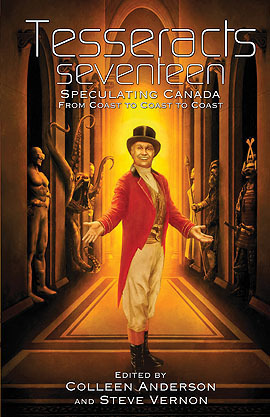
Tesseracts 17 is now out with tales from Canadian writers that span all times and places.
Megan Fennell was born in Victoria, BC, but has spent the majority of her life in a variety of Albertan cities and considers herself a creature of the prairies. Having disqualified herself from the great Calgary versus Edmonton debate by obtaining degrees at both the University of Calgary and the University of Alberta, she now lives with her two cats in Lethbridge, Alberta, drawing inspiration from the more rugged beauty of the Badlands. She has previously been published in OnSpec Magazine and the charity anthology Help: Twelve Tales of Healing.
Facebook Page: https://www.facebook.com/megan.fennell
Twitter: @FennellFiction
Goodreads: http://www.goodreads.com/MeganFennell
Filed under: art, entertainment, flying, people, Publishing, science, science fiction, Writing Tagged: Bird Bones, Canadian fiction, EDGE Science Fiction and Fantasy, family, Megan Fennell, Online Writing, SF, SF authors, speculative fiction, Tesseract, Tesseracts 17


Tesseracts Interview: Megan Fennell
Megan Fennell’s story “Bird Bones” talks about the monsters that live among us.
Tesseracts 17 is now available. In continuing with the Tesseracts interviews, I have Megan Fennell, whose story “Bird Bones” is in the anthology.
CA: Family is at the core of this piece. Have you explored what family means in other aspects of your writing?
Absolutely. In most of what I write there will be at least some screen time given to the concept of families, either family by blood or family by choice. People do truly incredible things and make enormous sacrifices for family that they wouldn’t dream of doing for anyone else. Upon reflection, my stories tend to include a lot of sibling characters, albeit with varying degrees of oddity and functionality. This is probably a side effect of having possibly the best kid sister in the world and thus being intrigued by the nature in which the sibling dynamic can turn bizarre.
CA: Do you think humans run the risk of the god complex by too much scientific tinkering or do you think there are restraints that keep us in check?
There are absolutely restraints that keep us in check, which is why the first trick of writing a mad scientist character (at least in my experience) tends to be isolating them. You mentioned Dr. Frankenstein… Add to that list a few more of my favourite brilliant madmen: Dr. Moreau, Dr. Jekyll, Griffin from the Invisible Man, and you’ll notice that secrecy, isolation and working within limited means play a big part in what they were doing. None of these folks were exactly in line for a government grant. In ‘Bird Bones’, Feyton’s controversial experimentations in his day-job are plagued by protestors and review boards. It’s his secret side project where he can really go wild. I believe that the all-seeing public eye and our tendency to ask this very question will ensure that cutting-edge science never galavants too far ahead of morality.
CA: What else are you working on these days and will we see other tales of transformation or escape?
You’d better believe it! Along with shopping around my short stories and trying to find the illusive market interested in love stories about squid-like aliens, I’m presently in the honeymoon stage with a new YA novel. This typically consists of me wandering around in a smile-y daze like a lovestruck teenager, murmuring happily about these wonderful new people who’ve turned up in my head. I’ll get to the hard work soon enough and start grumbling about it as is good and proper, of course! But yes, the crux of that one will be the nature of being human and the relative weight of what you are versus who you are, so more variations on some of my favourite themes for sure.
Tesseracts 17 is now out with tales from Canadian writers that span all times and places.
Megan Fennell was born in Victoria, BC, but has spent the majority of her life in a variety of Albertan cities and considers herself a creature of the prairies. Having disqualified herself from the great Calgary versus Edmonton debate by obtaining degrees at both the University of Calgary and the University of Alberta, she now lives with her two cats in Lethbridge, Alberta, drawing inspiration from the more rugged beauty of the Badlands. She has previously been published in OnSpec Magazine and the charity anthology Help: Twelve Tales of Healing.
Facebook Page: https://www.facebook.com/megan.fennell
Twitter: @FennellFiction
Goodreads: http://www.goodreads.com/MeganFennell
Filed under: art, entertainment, flying, people, Publishing, science, science fiction, Writing Tagged: Bird Bones, Canadian fiction, EDGE Science Fiction and Fantasy, family, Megan Fennell, Online Writing, SF, SF authors, speculative fiction, Tesseract, Tesseracts 17
November 10, 2013
Come to Bitten By Books for Chilling Tales

Chilling Tales 2, edited by Michael Kelly, is out this month from EDGE.
Hi everyone, I was traveling in Europe and didn’t have time to do more blog posts. I’ll be posting more Tesseracts interviews in the next few weeks and the book is now available. Coming up next week on Wednesday, November 13, however, is an interview with the authors of Chilling Tales 2 at Bitten By Books. My story “Gingerbread People” is one of the selections and I would love to hear what people think of this, as I worked very long and hard at it.
The interview session is a 24-hour real time interview so you can check it out at any time. The event runs from noon central standard time November 13, 2013 through to noon November 14, 2013. If you go to http://bittenbybooks.com/?p=66049 and RSVP before the event you will get an additional 25 entries into the contest for a $50 Amazon gift card, which you can then use to get a copy of Tesseracts 17 and Chlling Tales 2, both from EDGE.
You can ask questions of the authors and as they come online they will answer. This is a chance to get a little more depth into the stories, the authors or the writing process and philosophies. It’s free to do, so stop by. Here are the list of authors and stories, and for once I know every author:
In Libitina’s House by Camille Alexa
Gingerbread People by Colleen Anderson
Meteor Lake by Kevin Cockle
Homebody by Gemma Files
Snowglobes by Lisa L Hannett
The Hairdress by Sandra Kasturi
The Dog’s Paw by Derek Künsken
The Flowers of Katrina by Claude Lalumière
Goldmine by Daniel LeMoal
The Salamander’s Waltz by Catherine MacLeod
The Slipway Grey by Helen Marshall
Weary, Bone Deep by Michael Matheson
Black Hen A La Ford by David Nickle
Day Pass by Ian Rogers
Fiddleheads by Douglas Smith
Dwelling on the Past by Simon Strantzas
Heart of Darkness by Edo van Belkom
Fishfly Season by Halli Villegas
Road Rage by Bev Vincent
Crossroads Blues by Robert J. Wiersema
Honesty by Rio Youers

Available through Amazon. This is my favorite cover of all three.
Other books in which I have stories, that you can find online are Demonologia Biblica, Bibliotheca Fantastica, Artifacts and Relics, Deep Cuts and ReadShortFiction.com, which is free online. The holiday season is coming up so what better way to expand the mind than with reading.

The Book With No End, is in this anthology just out from Dagan Books.

Deep Cuts is published by Evil Jester Press
Filed under: entertainment, horror, myth, people, Publishing, Writing Tagged: anthologies, Bitten by Books, Canadian, Claude Lalumière Goldmine, dark ficiton, Gemma Files Snowglobes, horror, Kevin Cockle Homebody, Michael Kelly, reviews, speculative fiction, writer interviews


October 14, 2013
Tesseracts 17 Interview: Tim Reynolds
Tesseracts 17 has tales from Canadian writers that span all times and places.
Tim Reynolds is one of the four Alberta authors to grace the pages of Tesseracts 17 (already available on Amazon).
CA: Tim, your story “Why Pete?” struck us right away as being true science fiction. It wasn’t a veneer and it had a ray of hope. A lot of space SF seems to be laden with gloom or madness, and yours could have been but you resisted. Was it pure coincidence or did you plan it?
Both, actually. I already write a lot of gloom and madness with my horror (and a new fantasy novel I’m planning) so my science fiction tends to be a bit brighter and upbeat. Of course there will always be death and danger and heartbreak in my stories, but that’s the nature of life. With “Why Pete?”, the upbeat nature sort of came out of the situation. It may sound corny, but once I decided that the hero was female and the computer voice was male, the banter between the characters dictated the tone. It was supposed to be a bit dark and claustrophobic, but when I asked how a well-trained, professional commander would truly react, humour and hope shone through. The last thing I wanted was a screaming, crying cliche. The ending was not planned in detail prior to the writing. I wrote the story and when I got to the part where it all needed to be tied up, gloom and despair just didn’t seem to fit as well as hope. To be honest, my stories ALL end with hope. It may not be the hope the reader or characters expect at the beginning of the story, but there is hope. I’m also known for killing all my characters, some with dignity and some without any grace or style whatsoever. Que sera sera.
CA: Too many SF movies deal with technology doing the characters in? Why do you suppose that is?
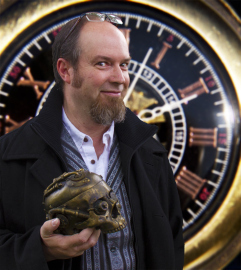
Alberta author Tim Reynolds’ story “Why Pete” is in Tesseracts 17.
I believe that when technology is “doing the characters in” in a film, it’s not SF (or at least not sci fi), it’s horror, or maybe a thriller. If the technology can be replaced with a werewolf, a shark, a dream dude with razor-sharp gloves, or a former camper in a goalie mask, then it’s a horror story written in a science fiction/science environment. The technology can then be symbolic of whatever aspect of mankind (racism, corporations, dictators, religion, etc.) the filmmaker wants to take a shot at. Now, in Alien (the perfect horror film set in space), the technology “doing man in” is actually the android, who sees the pursuit of knowledge as the purest of endeavours, and greater than the needs and wants of the individuals. I think we also use technology as the antagonist in order to avoid offending any particular group (ie., people not of the race, creed, colour, religion, political stance, height, weight, or dietary alignment of the author/filmmaker). Technology is simply a common threat outside mankind, like alien beings. Even slasher films portray their killers as something much less than human. It’s how we can tell such horrific stories and still have the readers come back for more. The sad thing is that worse horrors are perpetrated in reality by “the nice person next door” than any imagined monster or tech in film or literature.

CA: Do you think SF is getting a bad rep these days?
I think Science Fiction has always had a bad rep, because when it’s badly done it’s horrible; but when it’s well-executed, it asks questions and makes proposals and puts forth ideas that scare the hell out of the people whose jobs it is to maintain the order they’ve designed and must maintain. In my mind, good science fiction should shake up the status quo, at least a little bit. If you haven’t pissed off at least one or two people with your story’s ideas/concepts, then you haven’t done your job as a SF writer. I do this in my fantasy as well. I think that a story lacking a belief system (politics, religious, scientific) and something attacking it, is missing an entire layer that takes the story from an enjoyable read to topic of discussion and argument. In my recently submitted novel, I have a character compare Jesus Christ to Adolf Hitler. That sounds incredibly daring out of context, but in fact it fits with the over-all conversation. Of course it’s also meant to infuriate people and have them screaming at me. Even if they’re discussing it negatively, they’re discussing it. “Why Pete?” is not particularly controversial, though, unless you count Lilly and Pete’s different points of view on marital fidelity.
CA: You mentioned that you were looking at a phobia. Do you have other stories where you explore phobias and ones process into or through them?
No, not really. I should clarify that the phobia of being buried alive which inspired “Why Pete?” is not meant to be the character’s phobia, but the reader’s. There’s no way Commander Rayn would have been sent into space if she were claustrophobic, at least in my story. Instead, I want the reader to be terrified and sweating and not coping well in the situation, while the character keeps a level head and solves the problem at hand. In part, the story is meant to say that logic, patience, and a few deep breaths are more effective than freaking out, so calm down and solve the problem. I do enjoy using fear as a motivator, though. None of us know what is beyond death, so that’s always the first one I play with. I have an entire novel, though, where every one of the “team” of heroes is reincarnated whenever they die, so the fear they are working with is that their failure means the deaths of of tens of thousands of others who do NOT get reincarnated. Although I don’t treat it as a paralyzing phobia, I do cripple some of the characters with an overwhelming fear of failure, over and over again. And then I gave the hero MS, just to up the stakes a bit.
CA: In your ideal future of space travel, what would you hope to see and do (presuming that it could be there tomorrow)?
If I won the lottery tomorrow, I would reserve a seat on a shuttle into space, even for 30 seconds of weightlessness. On a bigger scale than my own self-satisfaction, though, I would love to see mankind find efficient and safe ways to colonize space before it’s too late and we’ve beaten ourselves down so far that there’s no money for space exploration any more. I would love to see us also take more risks and push the envelope like the early astronauts did for both Russia and the USA. We will not go as far as we need to by playing it too safe. My story, “Why Pete?”, actually describes where I want us to be going. Mankind should explore and populate the stars. That’s the ideal, what I hope for.
The reality I foresee is much darker and far less positive. I live like an optimist, but I have a great deal of faith in the self-righteous dregs of humanity finding a way to ruin our future. I don’t see a way to fix it and it’s a problem I’m currently wresting with in the sibling-novel (is that a term? I mean a novel set in the same universe with the same backstory, but in a different location and a different set of characters) of “Why Pete?”.
Tim Reynolds is a Canadian twistorian, bending and twisting history into fictional shapes for sheer entertainment. His published stories range from lighthearted urban fantasy to turn-on-the-damned-lights-now horror, and include the story of a bus driver who kills all his passengers, a tale of a dying folk singer’s moments teaching Death a love song, and a dark, depressing view of the near future of reality TV and child-rearing. His first love, though, is science fiction and is working diligently at his first science fiction novel, while marketing an urban fantasy and editing the first draft of a paranormal romance.
His 100-word story “Temper Temper” was a winner of Kobo Writing Life’s Jeffrey Archer Short Story Challenge. He can be found online at www.tgmreynolds.com & www.TheTaoOfTim.com (blog).
Filed under: entertainment, Publishing, science, science fiction, Writing Tagged: Canadian authors, EDGE Science Fiction and Fantasy, new releases, science fiction, speculative fiction, Tesseracts 17, Tim Reynolds


October 7, 2013
Tesseracts 17 Interview: Lisa Smedman
Tesseracts 17 has authors from across Canada. Today’s interview is with BC writer Lisa Smedman, a long time writer and game designer. Her story “2020 Vision” examines the logical side of religion.
Tesseracts 17 is out this month with tales from Canadian writers that span all times and places.
CA: Lisa, your story “2020 Vision” looks at cultlike behavior, politics, and the use of social media. It’s a very strong and disturbing, even ironic, social commentary. Religious topics can always be a very sensitive hotbed of opinion, or even rabid denunciations. What fascinated you enough to write such a story?
The story started from an anecdote a friend told, about being asked whether she believed in God. She said, “No, but I believe in Santa Claus.” That got me thinking about the nature of belief, and blind “faith” being the basis of so many religions. One could just as easily assert that Santa Claus really does exist, utilizing the same “prove he doesn’t” arguments used to assert that God exists.
The story also sprang from the idea that any religion that doesn’t allow one to question its practices and teachings, that doesn’t allow (or even punishes) its followers to laugh at the religion’s foibles, is setting a dangerous precedent, since it sets up the possibility of religious leaders twisting the religion to their own ends — ends that go unquestioned and are blindly obeyed.
To paraphrase the Emma Goldman quote about dancing and revolution: “A religion without laughter is not a religion worth having.”
Another big influence was the movie Life of Brian. In it, an ordinary, bumbling man is mistaken for Christ, and people begin to blindly follow him, hanging upon his every word and finding deep religious significance in his every action. My favorite scene is when a mob of religious fanatics is following him, and he discards a drinking gourd and loses one sandal. Half of the mob cries “We must follow the gourd!” and the other half cries, “No, we must follow the shoe!” and a fight breaks out over these two “sacred” objects as each half of the mob turns on the other. Religions are constantly dividing into smaller and smaller factions, every single one of them convinced that they are the “true” faith.
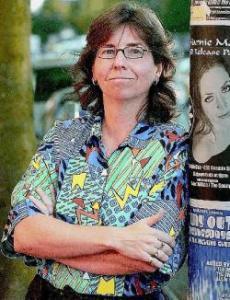
Lisa Smedman is the author of 17 novels, and a game designer.
I’ve often reflected upon why so many religions start out with the message “be nice to each other” and wind up teaching their followers to hurt, with words or deeds, or even to kill.
Life of Brian was boycotted by some Christians when it first hit movie theaters. Ironically, it portrays Christ and his message quite faithfully. When Christ says in his Sermon on the Mount, “Blessed are the meek,” a listener too far away to hear clearly interprets it as, “Blessed are the cheesemakers.” That so eloquently sums up how the original message of a religion can be mangled, by accident, due to translation errors (or be willfully skewed) and yet still regarded as gospel.
Another influence was a talk by the Dalai Lama I attended back in 1981. When asked about religions other than Buddhism, he compared the world’s religions to a smorgasbord, and encouraged people to “eat” whatever dishes most nourished them. Instead of saying “my religion is the only true one” he embraced all faiths that led one to become a better person. That, in my opinion, is what a religion should be: a practice one follows, “eating” only those portions of it that ring true, and rejecting (or perhaps politely declining) the rest.

CA: Do you think fanaticism is ever likely to have logic?
There is a “logic” to fanaticism, but it is a twisted logic. If you ask no questions, pull no threads, the fabric of belief hangs together. But pull one thread and it all unravels. Of course, the fanatics are wearing the “emperor’s clothes,” and never notice the holes.
CA: Have you explored this theme in other work?
I’ve explored many themes in my science fiction and fantasy writing. One I keep coming back to is the nature of identity. As an anthropology major, cultures fascinate me, especially the question of who “belongs” to a social construct and who doesn’t. How groups overlap, how boundaries mutate. Points of commonality that allow us to see other people as “one of us” and the myriad of ways we can divide “us” and “them.” We tend to see things in polarities: A or Z, ignoring all of the letters of the alphabet in between. This theme can be found in 2020 Vision, in the notion of who belongs to a religious group… and who does not, who is “in” and who is “out.”
A native Vancouverite, Lisa Smedman is the author of 17 science fiction and fantasy novels, numerous short stories, two best-selling books on Vancouver’s history, and dozens of roleplaying adventures, primarily for Dungeons & Dragons. She also writes plays and screenplays. Her fiction explores both Canada’s past (the steampunk Apparition Trail, set in the 1800s) and its possible futures. A journalist for many years, she currently teaches game design at the Art Institute of Vancouver. She hosts a biweekly writers group that grew out of the B.C. Science Fiction Association 30 years ago. She is also a mom to two humans, three cats and a pug.
Filed under: Culture, entertainment, people, religion, science fiction, Writing Tagged: Canadian writers, Dalai Lama, Edge, Lisa Smedman, religious satire, SF, specualtive fiction, Tesseracts 17


October 4, 2013
Tesseracts 17 Interview: Rhea Rose
Tesseracts 17 will be out this fall with tales from Canadian writers that spans all times and places.
Another BC author, Rhea Rose’s story “The Wall” graces the pages of Tesseracts 17. It is a disturbing tale of love, obsession and loss.
CA: Rhea, your story “The Wall” is a classic descent-into-madness story, or is it?
I think you can definitely describe this story as a classic descent-into-madness tale. It’s also a horror story. When I wrote it I was playing with both those aspects of storytelling, madness and horror. I asked myself, “Is she crazy” or “Is this really happening?” I decided at some point that the “Wall” needed to be more concrete, more of a real creature rather than an imagining on the part of the main character. At that point, when I made the wall more of a creepy little character, was when the story turned from a one-dimensional descent- into- madness story to a more multidimensional horror tale, as well.
CA: The disturbing imagery both draws the reader in and repulses at the same time. What made you explore such a strange world, and have you ever seen the Wall?
Nope. I’ve never seen the Wall, and I hope I never do, except perhaps in the movie version! When I’m trying to write something scary, I ask myself what are the things that disturb me, and when I figure out what those are, I try to put at least three of them into a story. In this case I wanted to play with the fear of being a mother, the pressures of being responsible for a baby, combined with a fear – the Wall – of something you can’t get rid of, or control.
CA: What do you think it is about madness that fascinates people?

Rhea Rose taps into the vein of madness in her tale. If you’re at VCon this weekend, look for Rhea.
Hmm, madness goes hand in hand with creativity and a connection with genius, so madness can be the negative extreme of both those conditions. The mad scientist is a genius with wondrous creations that are also destructive. The mad woman may have moments of lucidity when wisdom issues forth, losing control of paradigm is terrifying and exhilarating, a kind of madness. Of course real madness, as in the case of diagnosed schizophrenia is just plain terrifying.
CA: Have you dealt with this theme in other pieces of your work?
Only in a meta sense. Descent into story writing is a form of controlled madness, but I can’t think of another story I’ve written that deals with any form of “crazy.” It’s a difficult place to live in even for a short time, which is what you have to do when you’re writing the story. Generally, my characters are trying to deal with the madness that others have foisted on them.
CA: Many of your stories have involved children from their POV. In this case, the child is both peripheral and integral to this piece. Are you done exploring tales which put children into strange dilemmas?
I doubt I am done with children in strange dilemmas, as you say. That seems to be my psyche’s theme, but I do consciously work to move away from those stories, although if a really good one pops into my head I won’t hesitate to write it down. I find children’s responses to the world both fascinating and frightening. It’s such a scary ordeal to have to figure out how the world works when you can’t yet read the instructions.
Rhea is a Vancouver, BC writer and a teacher. She’s a graduate of UBC’s Creative Writing program and a Clarion writer. Most of her work has been published north of the 49th parallel. Her short stories and poetry have appeared in the Tesseracts anthologies. Many of her pieces have been nominated for awards, including the Rhysling award for poetry, and a nomination for an Aurora award. There were a couple of preliminary nominations for Nebula award nominations. A short story of hers appeared in a David Hartwell’s, Christmas Forever anthology. TaleBones has published a short story and poem. Rhea’s Big Foot story (not her foot) was published in NorthWest Passages: A Cascadian Anthology, and a horror tale made it into Tesseracts 10 from EDGE Press, which received honorable mention in BHOTY, as did her latest story in the first Evolve anthology. Look for her most recent poetry at Chizine. http://www.chizine.com/authors/davidclink. All of these stories and many of her poems can be found in her collection, Pandora’s Progeny, at Amazon. Her latest works appear in Masked Mosaic, Dead North and Tesseracts 17.
Filed under: Culture, entertainment, fantasy, horror, people, poetry, Publishing, science fiction, Writing Tagged: anthologies, descent into madness, Horror fiction, poetry, Rhea Rose, short story, specualative fiction, Tesseracts, Tesseracts 17


October 2, 2013
Chi Reading Series Vancouver

The ChiSeries features published authors every quarter. Also in Toronto, Winnipeg and Ottawa.
Coming next week is the third event in the ChiSeries Vancouver, which Sandra Kasturi and Helen Marshall first started in Toronto. I chair the Vancouver branch and we started in April with Claude Lalumière, Camille Alexa and Steve Erikson, with a second in July with Eileen Kernaghan, Linda DeMuelemeester and Hiromi Goto. This third reading has Peter Darbyshire (also writing as Peter Roman) author of Mona Lisa Sacrifice, Melia McClure with her first novel The Delphi Room, and Silvia Moreno-Garcia, editor of Innsmouth Free Press and author of the collection This Strange Way of Dying.

Melia McClure’s The Delphi Room debuts this month.
Melia McClure’s The Delphi Room is a quirky, darkly surreal novel currently out from ChiZine Publications. She has adapted The Delphi Room into a screenplay. Her fiction has been shortlisted in the Canadian Broadcasting Corporation (CBC) National Literary Awards, and she is the editor of Meditation & Health magazine, which is distributed in multiple locations in the United States and Canada as well as in Singapore, Malaysia, Hong Kong and Indonesia. Melia grew up dancing and acting, and now, when not penning strange tales populated by quirky characters, or creating other varieties of writing, she can be found collecting vintage coats, dabbling with paint and perfecting her Charleston.
Click on Melia’s name above and you’ll get a taste of her very evocative writing. If you can’t make Oct. 9, she is having the official launch of her book on Oct. 18 at the Cottage Bistro at 4470 Main St.

Peter Darbyshire’s novels have received rave reviews.
Peter Darbyshire is the author of the books The Warhol Gang and Please, which won the ReLit Prize for Best Alternative Novel. He’s also the author of the supernatural thriller The Mona Lisa Sacrifice, under the pen name Peter Roman. When he has time, he writes strange short stories, but they’re never as strange as real life.
Mexican by birth, Canadian by inclination. Silvia Moreno-Garcia lives in Vancouver with her family and two cats. Her short stories have appeared in places such as The Book of Cthulhu, Imaginarium 2013: The Best Canadian Speculative Writing and Shine: An Anthology of Optimistic Science Fiction. She has edited several anthologies, including Dead North and Fungi. Her first collection, This Strange Way of Dying, is out this year. Her first novel, Sound Fidelity, will be out in 2014.

Silvia Moreno-Garcia is editor of Innsmouth Free Press and author of This Strange Way of Dying.
These authors have impressive writing styles and they’ll be reading from their works next week. The event is free, as are all the Chiaroscuro Readings Series (sponsored in part by ChiZine Publications) across Canada. Other reading events are in Winnipeg, Ottawa and Toronto (which receive some sponsorship from the Ontario Arts Council), where national chair and co-founder Sandra Kasturi has been running monthly readings for about four years.
It’s a great way to spend a rainy or cool October evening. Come out and meet the authors and listen to them read. If you’re in other parts of Canada, check out the ChiSeries there and keep an eye out for more events in other cities in the future. The next one for Vancovuer will be in January. https://www.facebook.com/ChiSeries
Filed under: Culture, entertainment, fantasy, horror, people, Publishing, science fiction, Writing Tagged: Canadian authors, Chizine, CZP, dark fiction, Innsmouth Free Press, Melia McClure, Mexican authors, Mona Lisa Sacrifice, Peter Darbyshire, Silvia Moreno-Garcia, speculative fiction


September 30, 2013
Tesseracts 17 Interviews: Eileen Kernaghan
Tesseracts 17 will be out this fall with tales from Canadian writers that spans all times and places.
Today, I’m continuing the Tesseracts 17 interviews with Eileen Kernaghan, whose poem “Night Journey: West Coast” captures elements that have always been present in the Pacific rainforest. The anthology will be out from EDGE in the following weeks.
CA: Eileen, your poem “Night Journey: West Coast” brings out a spiritual and metamorphic quality to the forest. You’re a BC native. What do you find is the most magical aspect of the province?
Eileen: For me, it’s the forest. I grew up on a farm that bordered on woods and mountains. The forest, when I was a child , was a magical kingdom, full of hidden groves and secret passageways. It was where I spent a great deal of my time, and where I imagined a great many stories that have yet to be written. But in the forest at night there’s a darker kind of magic. I wrote “Night Journey” after an unnerving trip from Courtenay to Nanaimo on the new island highway, in darkness, fog and driving rain. Quite co-incidentally, we had the music from Twin Peaks on the cassette player. I really felt that if we veered from that black ribbon of highway, we could vanish forever.
CA: Are you done exploring the land here in terms of fiction or do you think new ideas are sprouting from the rich earth all the time?
Eileen: I’m not sure about fiction, but I’m certain there’ll be more poems.
CA: What other encounters have you written about that involve the forest or the supernatural qualities of the land?

Eileen Kernaghan is an award winning writer.
Eileen: What comes to mind is my most often published poem, which appeared in an early Tesseracts. “Tales from the Holograph Woods” compares an imagined future landscape where there are no more forests, with an “older physics” where the land was a living entity . (One of the places where it appeared was Witness to Wilderness: The Clayoquot Sound Anthology, which rose out of the protest of 1993. ) As to personal encounters—several poems came out of a visit to Stonehenge, Avebury and Glastonbury, where the magical qualities of the land are inescapable. My novel Sarsen Witch, which is about earth magic, was written before that trip, but when (thanks to a letter of permission from English Heritage) I was able to stand one late evening in the centre of the Stonehenge circle, I knew that I’d pretty much got things right.
Eileen Kernaghan’s speculative poetry collection Tales From the Holograph Woods (Wattle & Daub Books, 2009) draws its themes from science fiction, myth and magic, dark fantasy and fairy tales. Eileen is also the author of eight historical fantasy novels that reflect her fascination with other times and places, from the prehistoric Indus Valley to Victorian England. She was shortlisted in 2009 for the Sunburst Award for Canadian Literature of the Fantastic, and in 2005 for the Sheila Egoff Prize for Children’s Literature. Her latest novel, Sophie, in Shadow, is set in India under the Raj, circa 1914. It will be published by Thistledown Press in spring 2014.
www.eileenkernaghan.ca http://www.eileen-kernaghan.blogspot.com
Filed under: Culture, fairy tales, fantasy, myth, nature, poetry, Writing Tagged: Eileen Kernaghan, Holograph Woods, magical forest, mysticism, poetry, speculative fiction, Stonehenge, Tesseracts 17, Twin Peaks


September 23, 2013
Tesseracts 17 Interviews: Claude Lalumière
Tesseracts 17 will be out this fall with tales from Canadian writers that spans all times and places.
Tesseracts 17: Speculating Canada from Coast to Coast to Coast (Canada has three coasts) is due out in October, from Edge Publishing. It features stories and poetry by Canadians and those living in Canada. Edited by Steve Vernon and me, we were lucky enough to end up with at least one piece from every province and territory (Canada has three territories) except for Nunavut. I’m doing short interviews with all of the authors over the next few months, so stay tuned to find out a little bit more about the authors and their pieces. The anthology begins with British Columbia, where Claude Lalumière was living at the time, and opens with his story “Vermilion Wine.”
CA: “Vermilion Wine” opens the the Tesseracts 17 anthology. Steve and I were immediately impressed and swept in by the mystical, mysterious feel of this piece. How did you come up with the idea of Venera, a shadow city to Venice, and is this anything like other mythical cites, such as Shangri-la, Avalon, Bette Noire or Brigadoon?
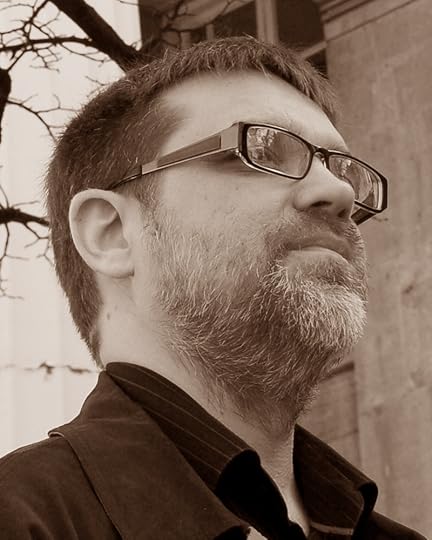
Claude Laumière is the author of many stories and has edited 12 anthologies including, Edge’s Tesseracts 12.
Claude: I first conceived of Venera during my first visit to Venice in 2006. I was tremendously seduced by the sensuality of the place. I had just visited the (now defunct) Museum of Erotica (upon which is based the similar museum featured in “Vermilion Wine”) and Venera popped into my head while riding the vaporetto — the Venetian waterbus. I wasn’t consciously trying to come up with anything, but surrounded by the water and by the architecture of Venice, Venera started to take shape in my mind. Bits of Rome and Barcelona — both of which I also visited for the first time in 2006 — also contributed to the tapestry of Venera. “Vermilion Wine” was written during my third trip to Italy, in spring 2012. Venera is not so much kin to those mythical lands you mention, but more of a thematic hybrid of Ursula Le Guin’s Orsinia and J.G. Ballard’s Vermilion Sands, with perhaps echoes of Arthur Byron Cover’s strange future from his related novels Autumn Angels and An East Wind Coming and of Michael Moorcock’s End of Time society.

CA: Obviously, mythical lands have fueled human imagination for centuries. What do you think draws us to them? Are they all Edens or are some Hells?
Claude: Neither. I think it’s the romance of the unknown — that there might still be places in the world left to discover. That we can never know everything or everywhere.
CA: Will we see other Venera stories or are you done with this idea?
Claude: Actually, I’m working on a book-length mosaic of stories about Venera. The project is called VENERA DREAMS, and “Vermilion Wine” is the fifth episode to appear. Venera first appeared online in “The City of Unrequited Dreams” in Chiaroscuro #43 (January 2010); it next showed up in “Vermilion Dreams: The Complete Works of Bram Jameson” in Tesseracts 14, then a third episode, “Xandra’s Brine” was published in the Dagan Books anthology Fish; more recently, “The Hecate Centuria” appeared online at Three-Lobed Burning Eye #23 (May 2013). There’s more on the way, too, but I can’t talk about those yet. I maintain a page on my website about the progress of the VENERA DREAMS project: http://lostmyths.net/claude/?page_id=1978
Claude Lalumière (lostmyths.net/claude) is the author of two books: the collection Objects of Worship (2009) and the mosaic novella The Door to Lost Pages (2011). He has edited or co-edited twelve anthologies, the most recent of which is Super Stories of Heroes & Villains. With Rupert Bottenberg, Claude is the co-creator of the multimedia cryptomythology project Lost Myths (lostmyths.net). Originally from Montreal, Claude is now something of a nomad.
Filed under: Culture, entertainment, fantasy, myth, Publishing, Writing Tagged: books, Claude Lalumiere, Edge Publishing, fantasy, mythical tales, speculative fiction, Steve Vernon, Tesseracts 17, Writing