Colleen Anderson's Blog, page 15
January 16, 2014
Tesseracts 17 Interview: Dwain Campbell

Dwain Campbell writes a home invasion story with a mix of madcap adventure and genius.
I have only a few more interviews to do with the authors of Tesseracts 17: Speculating Canada from Coast to Coast to Coast, available through EDGE. Today, I bring you Dwain Campbell, from St. John’s, Newfoundland, whose wild tale gallops through the pages of the anthology.
CA: “Hermione and Me” is a madcap adventure. Wherever did you come up with this idea?
Having been a school teacher and guidance counselor for thirty years, I have worked with many a child who struggled with his or her uniqueness. Not surprisingly then, coming of age stories have a certain appeal for me. Of course, in this story the protagonist Meredith is more unique than people can possibility imagine, and her adjustment, her growth as a result of one evening’s adventure, is central. Madcap? It sure is, but anything less than “out of this world” would not challenge two powerhouses like Meredith and Hermione Granger. And as for the home invaders, what can I say, I’m a Roswell conspiracy nut.
CA: In your tale you link genius, imagination and creations of magic. Do you feel that science and magic may be closer together than we imagine?
Definitely. In quantum physics alone theorists are generating pretty scary stuff. Computer chips three atoms wide, where two bits of information can be housed on one sub-atomic thingamajig because it can exist in two states at once, are being actively explored. That will look like magic to all intents and purposes. The psycho-physics interface between brain and mind is getting serious attention too. Perhaps one day the mind can materialize imagined people (as Meredith does) even as computers now do with 3D printing.
But to answer the question more directly, I do believe certain minds can negotiate corners oftime and space that is beyond 99% of us. Magic, or a so far unknown psychological phenomenon that transcends space-time, who is to say?
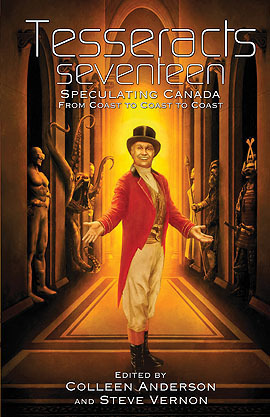
Tesseracts 17 is now out with tales from Canadian writers that span all times and places.
CA: Some paintings are for beauty, others for messages. It’s the same for fiction. Which would you say you story is?
Hermione and Me is likely more satisfying on the message level. Growing up is hard to do; it’s no walk in the park. Fears and insecurities abound. Meredith has them in spades, but she is capable of moving beyond them. It all gets sorted out in the end. That is a message of hope most young people would welcome.
CA: If you could, would you rather meet an alien, or conjure up your own special and real companion?
Alien. In my mind they do exist, and I suspect they are a lot more fascinating, in physical form and sentience, than your basic Klingon or Romulan. The nature of alien cognition and culture is to me an endless source of speculation. I like the David Brin Uplift novels which handle these questions with imagination and intelligence.
CA: What other works do you have on the go or what ideas are you exploring?
I’m writing a series of stories called The Crazy Eights ( nickname of the Princess Louise’s 8th New Brunswick Hussars regiment) following the supernatural adventures of Sergeant Cecil (Plug) Danfield and Captain Tallingate during World War Two. The stories should appeal to Canadian military buffs and those fond of fantasy-realism. I have a few stories of Meredith from “Hermione and Me” as a high school teenager. And, I submit stand alone fantasy stories here and there.
Dwain Campbell is originally from Sussex, New Brunswick. After his university years in Halifax, he journeyed further east to begin a teaching career in Newfoundland. Twenty-nine years later, he is a retired teacher in St. John’s. He hopes to devote more time to his first love, storytelling. Contemporary fantasy is his genre of choice, and Atlantic Canada is a rich source of inspiration. Neil Gaiman is his hero of the moment, though he will reluctantly admit to a lifelong fascination with Stephen King.
Filed under: entertainment, fantasy, people, Publishing, Writing Tagged: alien abduction, aliens, anthologies, child protagonist, Dwain Campbell, genius, Hermione, madcap adventure, Newfoundland writers, speculative fiction, Tesseracts, Tesseracts 17



January 15, 2014
Tesseracts 17 Interview: Willie Meikle

Tesseracts 17 is now out with tales from Canadian writers that span all times and places.
William Meikle hails from Scotland and Newfoundland, and brings us a tale of deep space mystery with “In the Bubble.” http://www.williammeikle.com
CA: “In the Bubble” is hard core SF, in space with a mysterious murder. Do you think when we do head for the stars that humanity will come together against a common unknown (space) or do you think humankind’s baser emotions will still play out their dramas?
I’m a pessimist when it comes to humanity. We’re just too stupid to see beyond immediate gain and look at the big picture—we are already way too far down the line to disaster, and I can’t see us getting anywhere close to the stars. We’ll kill ourselves off first, over food and water rights on a dying planet. There’s a cheery thought to start a new year.
CA: Do you think science will one day take us to being able to read another person’s thoughts? Do you think it will make communication better or worse if this could happen?
I think something close will be possible— some kind of emotion reader should be doable very soon, and people are already working on turning dreams into screen images. I doubt it will improve communication. It will make misunderstandings less common, sure. But it will also mean people would know exactly what you think of them. I foresee a lot more punch-ups.
CA: Would you ever want to literally get inside someone’s head to think, see or feel as they do?

William Meikle writes mysteries that take place in space and in Glasgow.
Nope. Not even remotely. I have enough trouble inside my own head as it is. I think part of what makes us human is trying to figure out what other people are thinking. If we ever actually find out, the mystery is gone. Then what is left?
CA: Since your story is also a crime thriller in space, do you write other mysteries, and do you enjoy reading them?
CA: I do indeed enjoy reading them—I grew up on a diet of Ed McBain, Raymond Chandler and Agatha Christie amid all the genre work I was reading. Quite a lot of that has seeped into my own writing, in particular into my Midnight Eye series. Derek Adams is a Glasgow PI, usually down to his last cigarette and bottle of scotch, wearily fighting his way though the Glasgow underworld and the supernatural elements that keep leaping at him despite his best efforts to avoid it. I’ve also attempted a cozy murder mystery, and have a collection published of weird Sherlock Holmes stories. I suspect there’s more to come.
CA: What other projects do you have in the works?
I’m busy. I’m in the middle of a six book contract with DARKFUSE for horror works, I have a Professor Challenger collection coming this year from DARK RENAISSANCE among other things, and I’m currently coming to the end of the writing of three Sherlock Holmes novellas. After that I have a ghost story collection I want to write, and a space opera novel that’s been gestating for a while, so I’m going to be busy for years to come yet.
William Meikle is a Scottish writer, now living in Canada, with twenty novels published in the genre press and over 300 short story credits in thirteen countries. His work has appeared in a number of professional anthologies and magazines with recent sales to NATURE Futures, Penumbra and Buzzy Mag among others. He lives in Newfoundland with whales, bald eagles and icebergs for company. When he’s not writing he plays guitar, drinks beer and dreams of fortune and glory.
Filed under: Culture, entertainment, people, Publishing, science fiction, space, Writing Tagged: Canadian writers, crime stories, ESP, hard-boiled detectives, Newfoundland authors, SF, Sherlock Holmes, space mysteries, Tesseracts 17, thrillers, Willie Meikle


January 14, 2014
Tesseracts 17 Interview: Rachel Cooper

Rachel Cooper draws some of her inspiration from The Hitchiker’s Guide to the Galaxy.
Rachel Cooper is another of our Nova Scotian writers and writes a story of hope and futility. Website: http://www.inotherwords.biz
CA: “Everybody Wins” is one of those stories I tend to love and hate. Can you speak to the hope and futility in this piece?
“Everybody Wins” didn’t start out to be about hope and futility. It arose from a vivid dream image of a floating sphere and grew into a “what if?” exploration. Or maybe, a “what the heck might that be?” exploration. It developed into an event that might lead to the scenario in Alan Weisman’s The World Without Us, a book whose main idea—world without humans—resonated with me. When I see what humans are doing to the natural world, I feel close to despair, even though countless good people work to protect it. Douglas Adams’ Hitchhiker’s Guide to the Galaxy is an influence, too, of course, with the world ending for a random and banal reason.
We are creatures of hope and futility, following our aspirations—some worthy, some not—and amusing ourselves to death, as Neil Postman put it in his 1985 book. Some of us are inspiring and generous and loving, others are toxic and nasty. Most of us are decent people trying to do the best we can, but we blunder around in the dark.
I suppose the answer to your question is that I myself live in a state of hope but know that we all die sooner or later; and when we do, the things we cared about will be scattered to the winds (or show up on eBay). I also think that animals are closer to humans than we’ve given them credit for—some species display what we would call culture—and the thought of a non-human species flourishing and taking our place as dominant species is an idea I find interesting rather than scary.
CA: Your story has a heavy dose of irony in it, and plays on our current culture of win win win and the numerous lottos and casinos that abound. Do you think humans will always succumb to such greed and need?
Tesseracts 17 is now out with tales from Canadian writers that span all times and places.
They do say (well, Horace Walpole said) that the world is a comedy to those who think and a tragedy to those who feel…. Many of us have lost—or given away—our capacity for deep thought, an apparent trend fueled by the staggering array of technological distractions in our daily lives. We’re drawn to shiny things. Many people have no interest in gambling and lotteries, though, which is why the story’s game includes some prizes that benefit other people.
CA: On an average day, do you see humanity as something with a hopeful or doomed nature?
Are those our only two options? I’m neither a dualist nor a black-and-white thinker, which means most of the time I’m fairly confused. If dithering were an Olympic sport, I’d be wearing gold. My personal belief is that humanity will survive. My personal hope is that some natural correction will result in our being much smaller in number. We’re too great a strain on the planet; we’re pooping all over our nest.
CA: Do your themes tend to reflect darker or lighter notes over all?
This is the darkest piece I’ve written, although death lurks nearby in several of my stories. Writing comedy is the most fun, though. I’ve had two short plays produced; hearing the audience laugh was magic.
CA: What other projects do you have on the go, and will we ever find out where the mysterious artifacts came from in “Everybody Wins”?
Another short play, a fantasy comedy, is finished and submitted, and I’m working on a lighter fantasy story with comic elements. Until I’d written “Everybody Wins,” I hadn’t written any fantasy, but I’m finding it fun to play with. Alas, I have no idea where the mysterious artifacts came from. Cleveland, maybe.
Bio:
Rachel Cooper is a freelance writer and editor in the Annapolis Valley, Nova Scotia. Besides writing for various organizations, she has published articles on science, people and nature. Born in Winnipeg, she grew up in Ontario and has lived in Scotland, France and England.
Facebook: http://www.facebook.com/InOtherWords.biz
Twitter: http://twitter.com/RachelCooper_NS
LinkedIn: http://www.linkedin.com/in/erachelcooper
Filed under: Culture, entertainment, people, Publishing, science fiction, Writing Tagged: EDGE SF & Fantasy, end of the world, Everybody Wins, futility, hope, irony, lotteries, Nova Scotian writers, Rachel Cooper, speculative fiction, stories about lotteries, Tesseracts 17


January 13, 2014
Tesseracts 17 Interview: John Bell
Tesseracts 17 is now out with tales from Canadian writers that span all times and places.
CA: Leaving Cape Roseway speaks to a primal feeling. Do you think that feeling takes on a supernatural quality when we are confronted with the unfamiliar?
A few years ago a veteran lobster fisherman, who grew up on McNutt’s Island in Shelburne Harbour, took me out to the island and showed me the remnants of a once thriving community. As we toured the abandoned buildings and the ruins of fortifications, I wondered how Poe or Lovecraft might respond to this place and its emptiness, transforming a Nova Scotia landscape into mindscape and dreamscape. However, I didn’t want the sense of dread to be too overt. Instead, I aimed for a more subtle evocation of fear and its contours.
CA: Eileen Kernaghan’s poem is of another forest, yet you both have drawn on the power of nature. Once humans created gods and beings to comprehend this power. Do you think we have lost that in our modern age?
Yes, I think we have to some degree; however, our response to nature remains primal (that word again). I think my poem and Eileen’s both speak to a yearning to reconnect with nature, to be enveloped in the natural world. It’s a feeling that combines wonder and fear – maybe even panic. (I’m sure the Germans have a word for it.)
CA: Would you ever wish to truly meet a supernatural or magical being or be in such a place?
I once published a poem, “Loup-Garou,” in the Canadian magazine Dark Fantasy , in which the narrator runs in terror from such
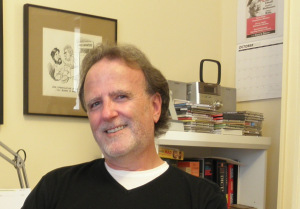
John Bell embraces the mythic in nature and lives in Nova Scotia.
an encounter only to discover, in an EC-Comics-style ending, that he has become the supernatural being. I, too, would probably run in terror.

CA: Do you think the animals of the fields and forest live their lives in a world that is magical or in one devoid of anything but the search for comfort, sustenance and shelter?
I believe there is magic in the natural world for all creatures to experience in their own way. For instance, no one can convince me that crows are not living in a magical world. Just watch them.
CA: What themes do you like to explore in your writing and what other projects do you have on the go?
I am currently editing a book that collects the wartime diary and letters of my wife’s great-uncle, a working-class guy from the north end of Halifax who served as a gunner in the Canadian Army during the First World War. Although he worked all his life as a mechanic, he was also an aspiring writer (his middle name was “Byron”). In fact, his papers include several story manuscripts and rejection letters from pulp magazines such as Adventure. I hope to honour his service and fulfill his literary ambitions.
John Bell was born in Montreal and grew up in Halifax. After a long career at the National Archives in Ottawa, he returned to Nova Scotia and now lives in Lunenburg. He is the author or editor of nearly twenty books, including Invaders from the North, a ground-breaking history of Canadian comics. A former editor of the poetry magazine Arc, Bell has contributed to numerous anthologies, among them Ark of Ice and Nova Scotia: Visions of the Future, both edited by Lesley Choyce. In 1981, Bell and Choyce co-edited Visions from the Edge, one of the earliest Canadian SF anthologies.
Filed under: Culture, entertainment, fantasy, nature, people, poetry, Publishing, Writing Tagged: Canadian authors, dreamscapes, fantasy, magic, nature's power, Nova Scotia landscapes, poetry, speculative fiction, Tesseracts 17


January 6, 2014
Tesseracts 17 Interview: Catherine MacLeod
Tesseracts 17 is now out with tales from Canadian writers that span all times and places.
Today I interview Catherine MacLeod, who lives in Nova Scotia. Tesseracts 17 is available in bookstores and through the internet.
CA: Pique Assiette deals with a secret and a fear, and how they twine together. Yet your character does not succumb to the darkest parts of either of these. Why did you choose not to go down that path?
Mostly because it would’ve been too easy. Myself, I’ve taken the easy way out too many times. I wish I could say I’m better than that, but I’m not. But it makes me feel better if my characters are.
CA: The technique of pique assiette was fascinating to read about and it parallels the mosaic aspect of your character’s life as she pieces together her destiny. Where did you first come across the craft and the idea for this story?
I first read about it in an old “Martha Stewart’s Living” at the Laundromat. The photo accompanying the article showed a patio table topped with pieces of smashed pottery. Beautiful. I wasn’t interested in trying it, but I liked the idea of it enough to keep researching.
CA: Do you think most peoples’ lives are mosaics, where some pieces take longer to assemble, like a puzzle before they’re truly understood?
Absolutely. Most of them never get finished. I use this theme a lot in my stories. Every choice, idea, stroke of luck, is a piece of the big picture.
CA: Your story could have been a tale of redemption or revenge, yet it is one of acceptance. Is this what you set out to accomplish or was it a

Catherine MacLeod writes of mosaics and murder in Pique Assiette.
natural evolution?
It felt natural to me. I’m come to an age where I’ve realized that the best thing about banging your head on a brick wall is stopping–if you can’t fight something, you have to find a way to live with it. But I think this is a revenge story, too–things aren’t likely to end well for Diane’s latest customer.
CA: What other pieces are you working on that you care to share with us?
My story “The Attic” will be in Ellen Datlow’s anthology Fearful Symmetries, coming out next spring from CZP. That sale meant I could cross quite a few things off my bucket list.
Nova Scotian writer Catherine MacLeod’s short fiction can be found in On Spec, Solaris, Black Static, TaleBones, and several anthologies, including Horror Library #4, Tesseracts Six, Tesseracts Fourteen, and The Living Dead 2. She is haunted by Astor Piazzola’s music, Andrew Davidson’s prose, and Derek Jacobi’s voice.
Filed under: Culture, entertainment, fantasy, horror, people, Writing Tagged: anthologies, Canadian writers, Catherine MacLeod, Edge, Ellen Datlow, mosaic, murder, Nova Scotian authors, pique assiette, speculative fiction, Tesseracts, Tesseracts 17


January 4, 2014
Tesseracts 17 Interview: J.J. Steinfeld

J.J. Steinfeld harkens from PEI, where he chases his muse. Photo by Brenda Whiteway
Happy New Year’s, everyone. The year, as is every day, full of promise and possibility. I fell behind in finishing all the Tesseracts 17 interviews before the old year ended. But the good thing about books and stories is that they don’t go bad. Without further ado, I bring you J.J. Steinfeld.
CA: “Unwilling to Turn Around” speaks to that dread that horror movies build on. It’s a very human feeling. Why do you think it is we sometimes don’t want to see what’s following us?
Whether it is in the dark of night or in the darkness of an wavering mind, when we are going through unfamiliar or unchartered terrain, physical or psychological, vulnerability of one’s body and senses became amplified, more apparent, and perhaps we are frightened to confront something following us that might be strange and out-of-place, and potentially dangerous. In a frightened state, seeing something we may not be able to thwart or cope with, makes confronting our fears all the more potent.
CA: Your piece speaks to a very human part of us, yet is also as a sly, light note, make it more satirical than horrific. Why did you choose this angle?
There is a fascinating world just outside our everyday reality and comprehensible definitions, and that world is often mired in the absurd and the incomprehensible. Attempting to confront or chart that absurd reality pulls me strongly to the satirical as to the horrific. In the attempt to either deal with or break free from the absurd and the incomprehensible, the satirical somehow becomes a little more muscular than the horrific.
CA: Would you rather know what lies ahead, no matter how wonderful or terrible, or you would prefer the surprise, no matter the outcome?
I would prefer to be wandering in the cinematic land of surprise and infinite possibilities,
Tesseracts 17 is now out with tales from Canadian writers that span all times and places.
rather than see the film’s ending beforehand, especially if the special effects tamper with my sense of the absurd and wonder and baffling existence.
CA: What do you think is your most effective tool, or technique, when it comes to writing poetry?
I don’t know if I have any effective tools or techniques for writing poetry, unless you want to count lively synapses and a curious psyche as creative tools. Actually, it’s more a strategy of speed, that is, going outside and walking quickly after my sometimes elusive and too often mischievous and cantankerous Muse. The attempt to grab hold of that fleeing Muse, whether the attempt is successful or not, often leads to new ideas and the start of a poem, which will be developed and written when I get back to my hidden-away writing room.
CA: What other projects do you have in the works?
I’m always working on something creative, whether it’s poetry or fiction or plays… My imagination tends to bounce from one creative “project” to another and after a period of time, I start to gather together creative pieces that adhere to my synapses and psyche and put them together into a collection or then attempt to find someone who might want to put on one of my plays. Currently I have two short story collections and a poetry collection, products of my bouncing imagination, that are looking for publishers, and several scripts in search of a theatrical home. As I wait to hear from publishers or theater companies, I polish up and tinker with the contents of these hoping-to-see-the light-of-literary-day manuscripts and stage plays.
Fiction writer, poet, and playwright J. J. Steinfeld lives on Prince Edward Island, where he is patiently waiting for Godot’s arrival and a phone call from Kafka. While waiting, he has published fourteen books, along with five chapbooks, including Forms of Captivity and Escape (Stories, Thistledown Press), Disturbing Identities (Stories, Ekstasis Editions), Anton Chekhov Was Never in Charlottetown (Stories, Gaspereau Press), Should the Word Hell Be Capitalized? (Stories, Gaspereau Press), Curiosity to Satisfy and Fear to Placate (Short-Fiction Chapbook, Mercutio Press), Would You Hide Me? (Stories, Gaspereau Press), An Affection for Precipices (Poetry, Serengeti Press), Where War Finds You (Poetry Chapbook, HMS Press), Misshapenness (Poetry, Ekstasis Editions), A Fanciful Geography (Poetry Chapbook, erbacce-press), and A Glass Shard and Memory (Stories, Recliner Books). His short stories and poems have appeared in numerous periodicals and anthologies, in every Canadian province and internationally in fifteen countries, including in Tesseracts Fifteen, Sixteen, and Seventeen, and over forty of his one-act plays and a handful of full-length plays have been performed in Canada and the United States.
Filed under: Culture, entertainment, fantasy, horror, people, poetry, Publishing, Writing Tagged: anthologies, Canadian fiction, dread, fear, horror, J.J. Steinfeld, poems, satire, speculative writing, Tesseracts, Tesseracts 17


December 30, 2013
Tesseracts 17 Interview: Dominik Parisien

Dominik Parisien tells a tale of magic, madness and mystery.
CA: “My Child Has Winter in His Bones” has the three Ms: magic, mystery and madness. Do you think there is a fine line between true madness and magic?
For me, the poem has a great deal to do with grief, which is a powerful form of madness in many cases. That being said, in this day and age, “madness” and “magic” almost feel like two gradients on the same spectrum, in that they’re both used to qualify things we can’t properly understand, albeit one is viewed as negative and one as positive. If something feels irrational, irregular, we call it mad. If it feels joyful, overwhelmingly special, we call it magical. And what’s magical to one person can be utterly mad for another, and vice-versa.
CA: The climate has been said to play an integral part to the Canadian mindscape, though that could be said of other places as well. Here, you use a different way of personifying winter. Would you say that people often see the elements in a personal or human way?
Personalization of the elements is, of course, nothing new. The Green Man, The Winter Queen, elementals, etc. I think personifying the elements was and is an effective way to facilitate an understanding of them, to explore their significance and our relationship to/with them in various ways. The fact that such personifications occur throughout time and cultures illustrates their importance to us as human beings, both as storytelling modes and as symbolic signifiers. Applied more specifically to CanLit, I think the richness of our landscape and the radical variations in our climate do lead to effective uses of personification and pathetic fallacy, and that’s it’s more or less a natural tendency given where and how we live.
CA: While you wrote this as a poem, could the tale be told as a story or do you think you would lose the
Tesseracts 17 is now out with tales from Canadian writers that span all times and places.
feel that only poetry can give to an image?
I find there’s an immediacy to poetry, a jarring emotionality that resonates more strongly with me than with prose when I’m writing. It isn’t always the case when I’m reading someone else’s work, but when I’m writing my emotional engagement with the subject matter tends to dictate the form. So, in this case it probably couldn’t have been a story. I’d been tinkering with the idea of conveying it as a story, but I kept being drawn back to poetry.
CA: Do you use mystery and the elements in your other works? And are you surviving winter?
I think I focus more on the numinous than mystery in my work, although mystery informs that. I think it’s a mistake to believe that we can understand the world in purely empirical terms. There are things that are unexplainable. Our understanding of the world is always informed by our personal biases, our beliefs, etc., and when we’re introduced to a view that is different from ours, there’s a bit of mystery to that. A bit of magic. And there’s always mystery around us, in one form or another. I like to explore that.
And yes, the elements do play a fairly large part in my work. Another one of my poems, “Since Breaking Through the Ice.” which was reprinted in Imaginarium 2013, explored a similar subject to “My Child…” and might be called a companion piece. One of my favorite pastimes in winter is walking on frozen bodies of water. While I lived near the Ottawa River I would regularly go for walks on the frozen river. I knew the dangers–there are drownings almost every year in the area–but I was careful, and the river and the sound of the ice hold a particular sway over me. A fascination. As for surviving winter, I’m definitely missing snowshoeing opportunities on the river now that I live in Montreal!
CA: As a poet and a fiction author, do you favor one form over the other, or do they hold equal weight for you?
I tend to favor poetry in my own writing. Recently, anyway. I do write the occasional short story, but the poetic form comes to me more naturally. I tend to think in vignettes and snippets, and I enjoy the challenge of conveying story/narrative and character in a compact way, all the while toying with language and form. I also have a background in English Literature and have a particular fondness for poetry. I value and enjoy reading fiction and poetry equally, though.
CA: What other pieces do you have in the works right now?
I’m currently working on a poetry chapbook, comprising original poems and reprints. Otherwise, I edit poetry for Postscripts to Darkness, an Ottawa-based journal of dark and uncanny fiction and poetry. I also recently edited Mike Allen’s poetry omnibus, Hungry Constellations, which will appear in 2014 from Mythic Delirium Books. Finally, I work on various editing projects with Ann & Jeff VanderMeer, such as the recently released Time Traveller’s Almanac from Head of Zeus in the UK and Tor Books in North America.
Dominik Parisien is a Franco-Ontarian living in Montreal, Quebec. His poetry has appeared in print and online, most recently in Strange Horizons, Shock Totem, and Ideomancer, amongst others, and has been reprinted in Imaginarium 2013: The Best Canadian Speculative Writing. He is the poetry editor for Postscripts to Darkness, provides editorial support to Cheeky Frawg Books, and is a former editorial assistant for Weird Tales.
Filed under: Culture, entertainment, environment, fantasy, nature, people, poetry, Publishing, Writing Tagged: Canadian writers, Dominik Parisien, madness, magic, mystery, personifications of winter, poetry, Winter Queen


December 29, 2013
Tesseracts 17 Interview: Elise Moser
Tesseracts 17 is now out with tales from Canadian writers that span all times and places.
Elise Moser brings a softly undulating tale of discovery and transformation in Tesseracts 17: Speculating Canada from Coast to Coast to Coast.
CA: Your story “Sandhill” is one of transformation. Such stories harken back to the earliest myths and rituals. Were you building on that tradition?
I wasn’t building on that tradition in a conscious way, although I like the idea. Really I started off just loving the cranes and trying to think my way closer to them somehow. I think a lot of our human socialization works to separate us from animals and animal consciousness, and we would be better off, as individuals and as planetary citizens, if we could find a way to open ourselves to the animal world again. And then of course once my characters were teenagers, it became all about the struggle through transformation.
CA: Childhood is in itself a transformation until we become adults. Do you think our transformation, like a butterfly or moth’s, ends upon adulthood?
No, with possible exception of some very sad and unlucky people.
CA: Are you exploring this theme in any of your other works?
Yes, probably always, one way or another.
CA: “Sandhill” is also a tale of being one with nature, whether animals or the environment. Where do you feel humankind is in this respect? Do we need to pay more attention to nature or do we, as individuals, manage it as best we can in a modern world?

Elise Moser explores transformation and environment in “Sandhill.”
I gave part of my answer to this question above, but I will add here that I don’t believe we are managing very well at all; on the contrary, our “managing” is disastrous. We need to pay more attention to nature — our nature, the natures of others, the nature of reality, of power, of suffering, of respect and of compassion.
CA: What other projects do you have in the works?
In September my YA novel, Lily and Taylor, which is about a transformation of a different kind, was published, and I have been busy launching and publicizing that. I have written the first draft of a play adapted from “Sand Hill.” And I am developing another project which isn’t ripe enough to pick yet.
Elise Moser has published short stories in journals and anthologies, and coedited two anthologies. Her novel Because I Have Loved and Hidden It came out from Cormorant Books in 2009. She was founding literary editor of Montreal online arts and culture magazine The Rover, and was president of the Quebec Writers’ Federation for three years. Her YA novel Lily and Taylor appeared in 2013 from Groundwood Books, just before her story “Sand Hill” hatched in Tesseracts 17.
Filed under: Culture, entertainment, family, fantasy, flying, myth, people, Publishing, Writing Tagged: cranes, Elise Moser, List of Canadian writers, mythic tales, Online Writing, short story, speculative fiction, tales of transformation, Tesseracts 17, Young-adult fiction


December 28, 2013
Tesseracts 17 Interview: Catherine Austen

Catherine Austen writes of a future with people as commodity in “Team Leader 2040″
I was hoping to get all the interviews done for Tesseracts 17 before the ned of the year but I’m also trying to finish the first draft of my novel and do some jury reading. So, my apologies for all the lags. I’m also going out of order a bit from the table of contents because some people are on holidays. Today, I talk with Catherine Austen who lives in Gatineau, Quebec.
CA: “Team Leader 2040″ riffs off of the popularity of zombie movies, TV and fiction that is pervasive right now. Yet you made your story a much more realistic and possible future. Do you foresee the zombie craze getting to this level?
I don’t foresee it, but if someone were to offer such a park, I think it would have customers. As virtual reality gaming becomes more sophisticated, some players might want a different experience, something retro and grounded, and entrepreneurs might provide a zombie hunting amusement park if it could make money and were legal. Its success–in terms of it being awesome fun–would hinge on the idea that it is harmless and victimless. But people have no problem buying and selling that idea about all sorts of destructive and dehumanizing things.
CA: This tale has a streak of the darkest aspects of our society. Do you believe we could get to such a world as you show, or do you think we are already there?
Tesseracts 17 is now out with tales from Canadian writers that span all times and places.
I think we could get there. I’m not able to judge how close we are because I have led a privileged life in an insular world characterized by its utter lack of desperation. Everyone I encounter day to day is basically kind and generous, so it feels like we’re ages away from such a world as the one in my story. But someone from a slum or a macho backwater or a collapsed country where people are bought and sold right now and entire ethnicities or genders are considered worthless might think we’re pretty close.
CA: In some ways, “Team Leader 2040″ is apocryphal. And while every writer is always showing a scenario, do you consider it a warning at all?
I suppose it’s a warning about how normalized the idea of people as commodities can become if market values are our highest values. But I didn’t write it as a warning. I just wanted to explore the character, the Team Leader, who is in this vulnerable position of having to do a job that’s morally reprehensible. And though it’s a speculative story, I think that basic conflict is timeless.
CA: Would you say human rights are better these days than a century ago, or just that the values have shifted?
I have such mixed feelings about this question. “Human rights” didn’t extend to all that many humans in times past and I think things are better these days, if only in that the circle of concern covers more people–including me, as a woman. There’s no other time or place I would rather be than Canada right now (or maybe back in the ‘80s).
It feels as if some people are more precious than ever while others are more disposable than ever, and maybe that’s just the growing gap between rich and poor. There was a sense in the 20th century that, in between the wars and genocides, we were moving toward more democracy and freedom and shared wealth, which are all good for human rights. But it’s less common to encounter that optimism now. Around the globe there is so much destitution and dislocation combined with the possibility of huge profits for selling your neighbor–and that’s a bad mix for human rights. So, while I don’t think there was an Eden of respect that we’ve fallen from, the future does not look rosy.
CA: What other fiction pieces are you working on right now?
I am working on more short stories about the buying and selling of humans and their parts, all set in the same future world as “Team Leader” (which is also the setting of a sequel to my award-winning teen novel, All Good Children). But I usually write for young people. I have a middle-grade comedy coming out this spring with Lorimer (28 Tricks for a Fearless Grade 6) and a picture book scheduled for 2015 release with Fitzhenry and Whiteside (When Squirrels Stole My Sister). Right now I am revising a teen novel (Can I Keep Him?) that will hopefully be done and out over the next couple of years.
Catherine Austen writes fiction for all ages. Her most recent novel, All Good Children (Orca), won the Canadian Library Association’s 2012 Young Adult Book Award and the 2012 Sunburst Award (YA category). Catherine was born in Newcastle, New Brunswick, raised in Kingston, Ontario, and now lives in Gatineau, Quebec. She is proud to be a Canadian and she hopes our future will not be as grim as the one she imagines.
Filed under: Culture, entertainment, life, Publishing, science fiction, Writing Tagged: Canadian authors, Catherine Austen, future SF, human rights, marginalized society, SF, Team Leader, Tesseracts 17, YA novels, Young-adult fiction, zombies


December 20, 2013
Tesseracts 17 Interview: Lisa Poh
Tesseracts 17 is now out with tales from Canadian writers that span all times and places.
Lisa Poh hails from her home in Montreal, but is also from Singapore and uses a bit of both cultures in her story in Tesseracts 17.
CA: “Graffiti Borealis” deals with the urban landscape, but touches on a very Canadian aspect of landscape, the aurora borealis. Was this your intention?
I didn’t really set out to write a Canadian story. It just struck me that living in Montreal, I should write a story set here, so that was what I deliberately set out to do. When I started thinking about the landscape of Montreal and Quebec, Graffiti and the aurora borealis, two things that fascinate me, suddenly connected. Graffiti surrounds you in this city everywhere you go, and with the bright colors, it can be the most vibrant thing standing out amidst the aging concrete and brick. When I thought about it, it struck me that it was a like an aurora borealis in the city—neon, alive, always shifting, disappearing and reappearing.
CA: Landscape plays quite an important role in this story, especially in feeling a part of or alienated from one’s surroundings. Daniel feels this in several ways. What cultural/societal motifs did you want to highlight?
I think that the immigrant experience always involves feelings of alienation, and simultaneously, of confrontation. There is a lot of push-pull attraction happening on different fronts. You want to integrate, and yet you want to remain yourself. Diversity is a huge part of the Canadian identity in my view. But as an element of society, it is not always something natural or easy. After all, what is assimilation, and what is it we are supposed to assimilate into? I thought it was interesting to have Daniel, who comes from the straight-laced, law-abiding Anglophone Asian track, thrown into partnership with La Guéparde, his opposite in so many ways. But yet, they are the same on some levels and have the ability to relate.
CA: Graffiti is a unique form of rebellion, art, political commentary and cultural nomenclature. Can you speak to those aspects in context to this story?
Lisa Poh uses cultural and urban landscape in her tale “Graffiti Borealis.”
Oh yes. I come from Singapore, a country where painting graffiti on public property is punishable by caning and avenues for political commentary are restrictive. So the proliferation of graffiti here, along with the freedom of political protest, are some of the things I notice the most. My reaction is complex—sometimes repulsed, sometimes admiring. When I guide visitors through the city, I point it out with a mixture of disapproval and pride. Yes, this is Montreal. I tried to express these feelings through Daniel.

CA: Will we be seeing this world or the characters in other tales?
I haven’t any plans but if the inspiration strikes, why not?
CA: What else are you working on right now?
Right now I’m taking a writing break as my typing hands are full with a very vocal four-month-old baby. Once he learns to sleep on his own though, I hope to work on some new stories and a novel!
Lisa Poh is a writer, teacher and communicator who grew up in the tiny tropical metropolis of Singapore, but now lives in Montreal, Canada, with her game designer husband. Together, they consume too much caffeine and own too many books, video games and manga for a small apartment. A graduate of the 2009 Odyssey Writing Workshop, Lisa’s fiction can also be found in Expanded Horizons and Masked Mosaic: Canadian Super Stories. She is also the author of two high school English textbooks used by schools in Singapore. She blogs at http://lishwrite.wordpress.com/.
Filed under: Culture, entertainment, fantasy, people, Publishing, Writing Tagged: aurora borealis, cultural landscape. fantasy, EDGE Science Fiction and Fantasy, graffiti, hidden powers, speculative fiction, Tesseracts 17