Colleen Anderson's Blog, page 11
January 19, 2016
Playground of Lost Toys Interviews: Eikamp and Runté
Today, authors Rhonda Eikamp and Robert Runté. Their tales are both science fiction and involve games of strategy: chess. And while one deals with issues of ego and doing the right thing, the other examines more the consequences of doing the wrong thing, though you could say that in both cases ego blinds the characters.
Rhonda is an American living in Germany and her story was the only one we could accept from out of the country. That meant competition for the spot was very tough and we hung on to a few stories right until the end. Rhonda’s story “The Garden of Our Deceit” is one of the few we received that takes place off planet. It’s far future, as is Lisa Carreiro’s “Makour.”
What was your main reason for submitting a story to Playground of Lost Toys?
I was inspired by the call for submissions and Jonathan Carroll’s wonderful quote. Stories of childhood and toys just strike me as the perfect juxtaposition of innocence and creepiness that you can do a lot with in genre (proven by the stories the editors have put together here!). I started out with something slightly steampunky-Victorian, with the idea of giant powered chess pieces, but the focus ended up on the alien corothai and issues of tyranny and freedom.
Does your story relate at all to anything from your own childhood?

Rhonda Eikamp’s story deals with games, betrayal, control and rebellion in Playground of Lost Toys.
I wasn’t exposed to chess until my 8th-grade math teacher taught us all and set up tournaments. I’d only played sporadically since, and so I played some online games to get the feel again while writing, which made me realize the corothai would want to hang from the ceiling to get a better view of their tournaments.
What theme or idea were you exploring in your story?
I love exploring how alien intelligence and psyches might differ from our own, what the good and bad in being human is and why we will probably never overcome that (and shouldn’t). Would an alien race understand us, our love, relations, humor, the need to play? And I love a good rebellion. I’m interested in how we’re manipulated by those in power, the media, etc. Schools should be teaching kids how to assess what they’re told and how it’s being presented, and to get to the truth. The way news is channeled and selected now, at some point we’ll all be obliviots, knowing only what we want to know.
Is there anything else to do with your story or the theme of the anthology you’d like to mention?
The takes on the theme here are amazing. Each story puts its own twist on playing or on that long-forgotten item from your childhood. Chris Kuriata’s “Fun Things For Ages 8 To 10” even captivated my refuses-to-read 14-year-old.
What other projects do you have in the works, pieces people can buy, or places to find you in the coming year?
I have a story coming up in Pantheon (for which I had to dip into my childhood as well and my memories of tornadoes trying to pick up our Texas house) and a story in Midnight Circus: Age of Legends, which should be out January.
There’s a list of my stories that can be read online, at my (very neglected) blog https://writinginthestrangeloop.wordpress.com/.
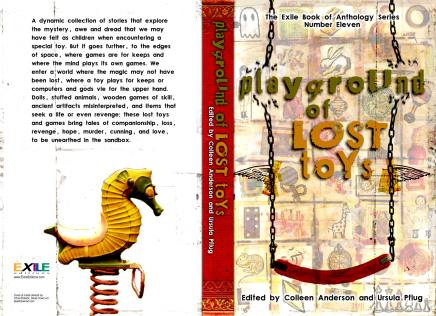
Playground of Lost Toys is available through Amazon published by Exile Writers
Robert Runté’s tale “Hacker Chess” has a lighter tone but examines well the obsessive nature of games, without always taking in a the bigger picture. It’s an amusing look at our current to near future, when all of our devices are automated, linked and “smart.” Robert chose to answer the questions in a block. Robert’s story is like Geoffery Cole’s where the characters get a little too caught up in their games.
What was your main reason for submitting a story to Playground of Lost Toys?
Does your story relate at all to anything from your own childhood?
What theme or idea were you exploring in your story?
Is there anything else to do with your story or the theme of the anthology you’d like to mention?
What other projects do you have in the works, pieces people can buy, or places to find you in the coming year.
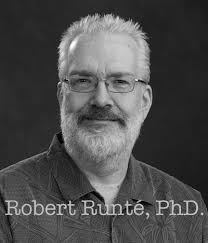
Robert Runte’s “Hacker Chess” is a fun romp in Playground of Lost Toys.
When the call for submissions went out, I had no story, nor any idea for a story that would fit the theme. But I really respected both the editors, and the idea of writing to a specific target appealed to me, so I ended up submitting three stories: the first was too far off the theme; so I wrote the second directly on target, but the editors didn’t go for it; so I wrote the third at the 11th hour, and the editors took that one. That whole process was a lot of fun, actually. And I’ve already sold the first one elsewhere, and the second is off to a CanLit market, so we’ll see.
I would therefore recommend accepting the challenge implicit in writing to a specific theme, however unfamiliar, since that enables one to write several stories more quickly than starting from a blank page. But you have to trust the editors involved: it’s their job to tell you if you missed the target or if the story isn’t up to standard. I knew these two had high standards so that allowed me to play fast and loose, secure in the knowledge they wouldn’t let me embarrass myself.
The second story was right out of my childhood; the first was out of my friend’s childhood; and the third was based on an anecdote told me by another friend. The moral is, anything you tell a writer is likely to be taken down and saved against the day when they can turn it into a story.
“Hacker Chess” is about getting carried away when playing a game, rather than about a specific toy; though we often refer to computers as “toys” when guys get too fixated on having the latest and greatest tech. The main theme of “Hacker Chess,” to the extent that there is one, is recognizing childish behavior, and maybe, you know, to stop doing that. The characters and the world they inhabit are part of several other stories I have on the go, so hopefully I’ll be able to gather them together at some point to create.
The next story I have coming out is “Age of Miracles” in Strangers Among Us, but I am most excited about two books I’ve edited for Five Rivers: Den Valdron’s The Mermaid’s Tale and Dave Duncan’s Eocene Station. Den’s book is the best thing I’ve read in a decade and I consider my discovery of that manuscript the high point of my career so far: it’s going to win every award on the planet. Duncan’s book is SF, something we never see enough of, and the character of Tempest is just brilliant. So, pretty happy about how things are going!
Filed under: Culture, relationships, science, science fiction, SF, Writing Tagged: chess, Colleen Anderson, Exile Writers, Rhonda Eikampm Playground of Lost Toys, Robert Runte, SF, short fiction, speculative fiction, strategy games, Ursula Pflug


January 17, 2016
Playground of Lost Toys Interviews: Cole & Duncan
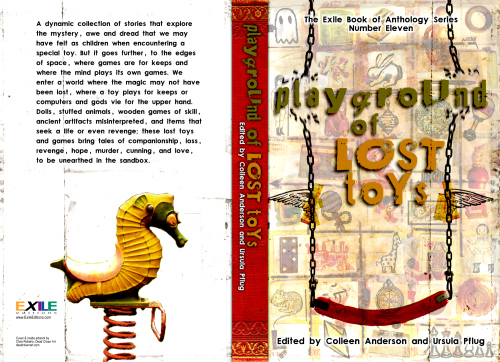 Geoffery Cole and dvs duncan are the featured authors today in the Playground of Lost Toys. Cole’s story “Wheatiesfield in Fall” is humorous but a warning of what happens when you lose touch with the world around you and immerse yourself in games. In this case the game is woven with one’s life and when you defeat the boss, he is in fact your boss in the work world.
1. What was your main reason for submitting a story to Playground of Lost Toys.
The premise worked well with one of the story ideas sitting on my “To Do” pile. The list is very long at this point, as I’ve been working on a novel for the last few years, but I will sometimes take a break from the novel if a theme anthology comes along and it meshes nicely with one of the story buds on the list.
2. Does your story relate at all to anything from your own childhood.
Old video games evoke a different kind of nostalgia than watching a childhood movie or reading a favourite childhood book. I had pneumonia as a kid, and as a result, I had to stay home from school for several weeks. I’m sure I watched lots of TV and read many books during my illness, but all I really remember is playing A Link to the Past on my friend Jamie’s Super Nintendo that he lent to me (we had a Sega Genesis). We’re still best friends, close to twenty-five years later. Every few years I find a SNES emulator and take ALTTP for a spin, and I’m instantly transported back to those days of banana-flavoured antibiotics and the quest for the Triforce. The music alone is enough to make me start looking for a boomerang.
3. What theme or idea were you exploring in your story.
I wanted to explore the gamification of mundane life in “Wheatiesfields in Fall.” In the future depicted in the story, every transaction or interaction is gamified: you gain gold and experience points for performing well at work, at school, playing games. Having marital relations with your spouse also rewards you with experience and gold. Gold lets you buy things in this world, and experience points determines your level, which has far-reaching impacts on your daily life. The main character, the low-level Loufis, lusts after a higher-level woman, Nurse T. By virtue of their level disparity, she is forever out of his reach.
Level determines the jobs you can get, the transportation you can take, the houses you can buys. Level also affects what happens after you die. Loufis works at an Upload Palace, a place where people have their personality uploaded to a computer. Low-level people send their copied personalities to Upland, a digital afterlife, but for higher-level people, they have the option of downloading into a new body. Extra lives, the most coveted resource in video games, become a reality for high-level people in this gamified world. Those who win extra lives also tend to own all the gold, creating a society of rampant inequality.
The antagonist of the story, Mr. Yao, has won several extra lives and has amassed a huge fortune in his centuries on Earth. As he prepares for yet another download, he sends Loufis on a quest to find a video game he played way back in his first life. For Mr. Yao, that video game symbolizes everything he’s lost in his too-many years. For Loufis, it is the key to levelling up and maybe winning Nurse T’s heart.
4. Is there anything else to do with your story or the theme of the anthology, you’d like to mention?
I recently learned that China has created a system that could end functioning much like the level system I described in my story. It is terrifying stuff, and I hope the Chinese people see it for what it is and shut it down. 5. What other projects do you have in the works, or pieces people can buy, or places to find you in the coming year.
5. What other projects do you have in the works, pieces people can buy, or places to find you in the coming year.
I have a story coming out from Nameless Digest next year, and I’ve been asked to contribute a story to Grimm Futures, which has been very fun to put together. I’ll be shopping around my novel Frozen Jellyfish Blues next year as well. Most of my published work is available through my website, www.geoffreywcole.com. Drop by and say hello.
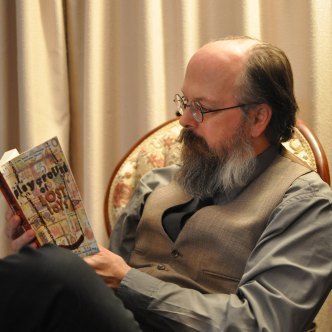
dvs duncan journeys into the Playground of Lost Toys
Next is dvs duncan, who wrote “Treasure,”very much a tale of loss and regret and that wish to capture something of the innocence of childhood and simpler times.
What was your main reason for submitting a story to Playground of Lost Toys.
It liked the premise of the anthology. Perhaps I have never entirely left childhood behind. I still have a fascination with toys and jealously guard a few treasures from my youth. It seemed only natural to write about such things.
Does your story relate at all to anything from your own childhood.
“Treasure” does not relate explicitly to anything in my childhood but every toy I had was imbued with magic. They were my companions and guides on incredible journeys. I have recently been reminded of this while watching my grandchildren play.
What theme or idea were you exploring in your story.
I think that real toys are mysterious and I love a good mystery. A real toy is not just a piece of plastic and metal and cloth. A real toy is something created out of imagination. Its bones might have been fabricated by Mattel or Hasbo, but its flesh and blood are the vision and inspiration of the child that plays with it. It was these latter aspects I wanted to explore and how they reflect our relationship with the work as a whole.
4. Is there anything else to do with your story or the theme of the anthology, you’d like to mention?
I hope that the anthology will inspire people to examine the meaning of toys a little more closely and, by doing so, come to know themselves better. Our toys, and the ways we play with them, tell us something fundamental about who we are.
What other projects do you have in the works, pieces people can buy, or places to find you in the coming year?
I am finishing edits on a novel, a story of how the Victorian village of Chandling on Wode is transported to an alien work where the stalwart Brits are forced to deal with overly inquisitive robot spiders, marauding aliens and a super intelligent computer on a mission to save the universe. Dame Hesta Electra Rutherford is utterly horrified by this unseemly translocation and will have things put to rights. She has a plan and it just might work if they can find a fresh supply of tea.
Filed under: Culture, fantasy, humor, science fiction, SF, technology, Writing Tagged: dvs duncan, Exile Writers, Geoffery Cole, nostalgia, Playground of Lost Toys, tales about games, toys, video games


January 14, 2016
Playground of Lost Toys Interviews: Adler & Davies
Playground of Lost Toys hit the stores in December and is available on Amazon and through Exile Writers. The holidays and being in no WiFi land put another gap in the posting of these interviews so without further ado, here is Nathan Adler and Joe Davies. Nathan, who wrote “The Ghost Rattle,” gives us a a tale about consequences of mistaking something for a toy.
1. What was your main reason for submitting a story to Playground of Lost Toys.
I’d finished a novel, and wasn’t ready to commit to another large project, so I started writing short stories. The Ghost Rattle fit the theme, so I submitted.
2. Does your story relate at all to anything from your own childhood?
It was important that the teenagers in the story weren’t the good or bad guys, just the run of the mill fuck-ups a lot of us probably were when they were younger.
3. What theme or idea were you exploring in your story.
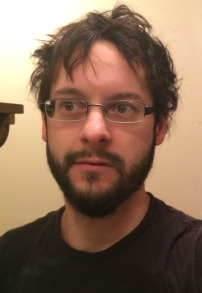
Nathan Adler brings us “The Ghost Rattle,” a different take about Indian burial grounds.
I started out with the idea of having three objects, and three characters, and three ghosts, and how the objects which had once belonged to the dead connected them all together. It was important that the ghosts weren’t purely malevolent, they needed to be as well-realized as the living characters. Tyler’s story-arc is part of a larger narrative that follows the arc of his friends, Dare Theremin and Clay Cutter, and the associated objects and hauntings.
I wanted to tackle the trope of the Indian Burial Ground, which is a pretty common theme in horror movies as the basis for a bunch of scary shit happening, but it’s usually a back-drop without much depth: “Oh yeah, also, this pet cemetery/hotel/house was built on an IBG,” and then never mentioned again. I also had real world events like the Oka Crisis swimming around in my head, which revolved around the construction of a Golf Course on an IBG, and also the flooding of my reserve, Lac Des Mille Lacs First Nation, which unearthed coffins and damaged traditional burial sites.
I think part of mainstream horror narratives is the discomfort settlers have with the reality that this is Indian land, that it’s basically all stolen, and an IBG is this blank canvass for stories of white guilt and fear. So I didn’t want to fall into any of those ways of approaching a story about an IBG with mindlessly angry ghosts. Instead the ghosts have their own histories, and react in very different and unexpected ways.
4.Tells us anything else to do with your story or the theme of the anthology.
The setting of Ghost Lake is part of a larger fictional universe. The story also operates as something of a back-story for the character of Dibikazwinan, as she has living descendants who appear in other stories, and she also has a cameo appearance in a novel I wrote called Wrist, as a minor (living) character in 1872.
5. What other projects do you have in the works, pieces people can buy, or places to find you in the coming year?
My novel called Wrist is slated to come out in the Spring of 2016 through Kegedonce Press, Available for pre-order here: http://kegedonce.com/bookstore/item/73-wrist.html.
I have some of my published writing on my blog here: https://nathanadlerblog.wordpress.com
And I’ll probably be having a Book Launch for Wrist in Toronto sometime in the summer, and doing some readings. And I’ve been working on a collection of inter-related short stories, as well as another novel that follows after Wrist.
Joe Davies wrote “The Compass,” another piece that deals with the consequences in childhood of taking something that is not yours.
The idea for my story, “The Compass,” evolved the way many of my stories do. It began with an image, a moment, in this case two boys pushing their way through tall grass on a bright summer day and that feeling of being young. For me it was an evocative enough moment to build a piece around, but to be honest, I don’t remember the details of the rest of the process very well, or even how the compass presented itself as the lost toy to be. When I write, it feels like what I produce comes together by cobbling the bits and pieces out of whatever I happen to come across while feeling around in the dark. A lot of it may be associative, but if it is, those associations made while writing aren’t usually available to me afterwards when I try to figure out what it is I’ve done.

Joe Davies is the author of “The Compass” where nostalgia and regret play a part.
The genesis of each story is a bit of journey, and a bit of a mystery. The only other thing I can really think of to say about the process is that I know that when I’m writing I don’t try to make a story bend one way or another. I try to respond to what’s happening on the page, to what kind of story it could be, what different directions it could take and to be open to the possibilities. In the case of my story, “The Compass,” I had a couple of details: the image mentioned above, and knowing that somewhere along the way a toy was going to be lost and then found once again. Enough to get a good start.
At the moment I’m working on a couple of projects, both of them short story collections. One is a set of short absurdist pieces where the basic premise or setup of a story gets repeated in another to become a different kind of story altogether. At the moment this project has the ridiculous title Fluff & Balconies (one story of which will appear shortly in The Dalhousie Review; others have appeared recently in PRISM International and Crannog, in Ireland).
The second project is a collection of longer pieces that are derived and spun out of changes happening in our society, for example, the changing roles around gender, and with a particular eye to how men are (or aren’t) adapting. And actually, there’s one other project I’m tinkering with. Lately I’ve unearthed a novel sort of thing I wrote almost twenty years ago, and I’m just weighing the prospect of a rewrite.
Filed under: Culture, fantasy, history, Publishing, spirituality, Writing Tagged: Exile Writers, fantasy, ghost stories, Joe Davies, Nathan Adler, Playground of Lost Toys, short stories, speculative fiction, speculative writing


Playground of Lost Toys Interviews
Playground of Lost Toys hit the stores in December and is available on Amazon and through Exile Writers. The holidays and being in no WiFi land put another gap in the posting of these interviews so without further ado, here is Nathan Adler and Joe Davies. Nathan, who wrote “The Ghost Rattle,” gives us a a tale about consequences of mistaking something for a toy.
1. What was your main reason for submitting a story to Playground of Lost Toys.
I’d finished a novel, and wasn’t ready to commit to another large project, so I started writing short stories. The Ghost Rattle fit the theme, so I submitted.
2. Does your story relate at all to anything from your own childhood?
It was important that the teenagers in the story weren’t the good or bad guys, just the run of the mill fuck-ups a lot of us probably were when they were younger.
3. What theme or idea were you exploring in your story.
Nathan Adler brings us “The Ghost Rattle,” a different take about Indian burial grounds.
I started out with the idea of having three objects, and three characters, and three ghosts, and how the objects which had once belonged to the dead connected them all together. It was important that the ghosts weren’t purely malevolent, they needed to be as well-realized as the living characters. Tyler’s story-arc is part of a larger narrative that follows the arc of his friends, Dare Theremin and Clay Cutter, and the associated objects and hauntings.
I wanted to tackle the trope of the Indian Burial Ground, which is a pretty common theme in horror movies as the basis for a bunch of scary shit happening, but it’s usually a back-drop without much depth: “Oh yeah, also, this pet cemetery/hotel/house was built on an IBG,” and then never mentioned again. I also had real world events like the Oka Crisis swimming around in my head, which revolved around the construction of a Golf Course on an IBG, and also the flooding of my reserve, Lac Des Mille Lacs First Nation, which unearthed coffins and damaged traditional burial sites.
I think part of mainstream horror narratives is the discomfort settlers have with the reality that this is Indian land, that it’s basically all stolen, and an IBG is this blank canvass for stories of white guilt and fear. So I didn’t want to fall into any of those ways of approaching a story about an IBG with mindlessly angry ghosts. Instead the ghosts have their own histories, and react in very different and unexpected ways.
4.Tells us anything else to do with your story or the theme of the anthology.
The setting of Ghost Lake is part of a larger fictional universe. The story also operates as something of a back-story for the character of Dibikazwinan, as she has living descendants who appear in other stories, and she also has a cameo appearance in a novel I wrote called Wrist, as a minor (living) character in 1872.
5. What other projects do you have in the works, pieces people can buy, or places to find you in the coming year?
My novel called Wrist is slated to come out in the Spring of 2016 through Kegedonce Press, Available for pre-order here: http://kegedonce.com/bookstore/item/73-wrist.html.
I have some of my published writing on my blog here: https://nathanadlerblog.wordpress.com
And I’ll probably be having a Book Launch for Wrist in Toronto sometime in the summer, and doing some readings. And I’ve been working on a collection of inter-related short stories, as well as another novel that follows after Wrist.
Joe Davies wrote “The Compass,” another piece that deals with the consequences in childhood of taking something that is not yours.
The idea for my story, “The Compass,” evolved the way many of my stories do. It began with an image, a moment, in this case two boys pushing their way through tall grass on a bright summer day and that feeling of being young. For me it was an evocative enough moment to build a piece around, but to be honest, I don’t remember the details of the rest of the process very well, or even how the compass presented itself as the lost toy to be. When I write, it feels like what I produce comes together by cobbling the bits and pieces out of whatever I happen to come across while feeling around in the dark. A lot of it may be associative, but if it is, those associations made while writing aren’t usually available to me afterwards when I try to figure out what it is I’ve done.
Joe Davies is the author of “The Compass” where nostalgia and regret play a part.
The genesis of each story is a bit of journey, and a bit of a mystery. The only other thing I can really think of to say about the process is that I know that when I’m writing I don’t try to make a story bend one way or another. I try to respond to what’s happening on the page, to what kind of story it could be, what different directions it could take and to be open to the possibilities. In the case of my story, “The Compass,” I had a couple of details: the image mentioned above, and knowing that somewhere along the way a toy was going to be lost and then found once again. Enough to get a good start.
At the moment I’m working on a couple of projects, both of them short story collections. One is a set of short absurdist pieces where the basic premise or setup of a story gets repeated in another to become a different kind of story altogether. At the moment this project has the ridiculous title Fluff & Balconies (one story of which will appear shortly in The Dalhousie Review; others have appeared recently in PRISM International and Crannog, in Ireland).
The second project is a collection of longer pieces that are derived and spun out of changes happening in our society, for example, the changing roles around gender, and with a particular eye to how men are (or aren’t) adapting. And actually, there’s one other project I’m tinkering with. Lately I’ve unearthed a novel sort of thing I wrote almost twenty years ago, and I’m just weighing the prospect of a rewrite.
Filed under: Culture, fantasy, history, Publishing, spirituality, Writing Tagged: Exile Writers, fantasy, ghost stories, Joe Davies, Nathan Adler, Playground of Lost Toys, short stories, speculative fiction, speculative writing
December 20, 2015
Playground of Lost Toys Interviews: Lalumière & Parisien
Today’s authors from Playground of Lost Toys are Claude Lalumière and Dominik Parisien. Their tales range from terror to nostalgic, but both cover grief in very different ways and look at the strong ties of family.
Claude Lalumière has authored many stories and several books. “Less Than Katherine” is a very visceral story, and disturbing. I like stories that make me think and leave a lingering sense, whether of joy or horror.
What was your main reason for submitting a story to Playground of Lost Toys?
I have an obsession to try to be on the table of contents to as many Canadian (and sometimes non-Canadian) theme anthologies as I can. I love flexing that imaginative muscle, to try to find my own stories to tell within the context of a theme I might not otherwise think of.
Does your story relate at all to anything from your own childhood?
Not at all. I have no idea where “Less than Katherine” came from. From
some dark recess of my imagination I don’t have full conscious access to, I suppose.
What theme or idea were you exploring in your story?
That’s for the readers to discover. Whatever I put in the story, consciously or subconsciously, has little or nothing to do with what readers will bring to it, what ideas and themes they will find in it.
What else would you like to say about your story or the theme of the anthology?
The deadline was nearing for Playground of Lost Toys, and I feared I might not come up with anything. Then, one morning, probably too close to the deadline, I woke up with “Less than Katherine” in my mind, completely unbidden, and I wrote it as fast as I could, in three sittings.
What other projects do you have in the works, or pieces people can buy, or places to find you in the coming year?
I’m the author of Objects of Worship (2009), The Door to Lost Pages (2011), and Nocturnes and Other Nocturnes (2013). My fourth book, Venera Dreams, is coming out in 2017 from Guernica Editions. Aside from Playground of Lost Toys, other recent Canadian anthologies that feature my work include: Licence Expired: The Unauthorized James Bond, edited by Madeline Ashby & David Nickle; Fractured: Tales of the Canadian Post-Apocalypse, edited by Silvia Moreno-Garcia; Tesseracts Seventeen, edited by Colleen Anderson & Steve Vernon; Chilling Tales: In Words, Alas, Drown I, edited by Michael Kelly; Dead North: Canadian Zombie Fiction, edited by Silvia Moreno-Garcia. My website is at claudepages.info. I’m going to be at Eurocon in Barcelona on the first weekend of November 2016 (some other 2016 appearances are already scheduled, but I can’t talk about them yet).
Dominik Parisien’s story is ephemeral yet latches onto your heart and pulls. Ghosts may not be something you think of with toys and games, but the games of make believe are sometimes our most vital and imaginative.
What was your main reason for submitting a story to Playground of Lost Toys? And What theme or idea were you exploring in your story?
Memory is a recurring theme in my work in general, but particularly in how it relates to children and the elderly. As Colleen mentioned in her introduction, the “playground of thoughts” is an ideal environment in which to explore memories, for individuals of all ages, so that’s what I decided to do here for Playground of Lost Toys.
2. Does your story relate at all to anything from your own childhood? 3. What else would you like to say about your story or the theme of the anthology?
I’ve wanted to write about a drowned village for years. My late grandfather, Alfred Joanisse, grew up in le Chenail, a village by the Ottawa River that was submerged (relocated for the most part) when the government built the Carillon dam near Hawkesbury. I grew up hearing stories about the village – he even brought me to the remaining stretch of land on several occasions and I still visit when I can–and le Chenail has haunted my imaginative landscape ever since. I tried writing about it repeatedly, but the emotional core of the story eluded me. After grandpa passed I could never quite manage to write about him, or his village. It felt too real, too close. Eventually, I decided to try my hand at the story again (it’s been five years since his death). This time everything clicked. The village here isn’t exactly le Chenail, it’s a composite of that and some of the Lost Villages of the Saint Lawrence River. The people here too are composites, drawn up from family, friends, and some of the elderly I’ve done volunteer work with over the years. It might just be my favourite thing I’ve written so far.
4. What other projects do you have in the works, or pieces people can buy, or places to find you in the coming year?
Other than “Goodbye is a Mouthful of Water,” I have several editorial projects coming up. The first is the very first anthology of Canadian steampunk, Clockwork Canada. The ToC can be found here and it includes two PLT writers: Rati Mehrotra and Kate Story–Clockwork Canada on BlackGate.com. Clockwork Canada will also be published by Exile Editions in May 2016.
In addition, I co-edited an anthology of original fairy tale retellings with Navah Wolfe for Saga Press, an imprint of Simon & Schuster. The book features an all-star group of contributors and the ToC is available here: The Starlit Wood. It will published in October 2016.
Filed under: Culture, family, fantasy, horror, memories, Publishing, Writing Tagged: Canadian author, Claude Lalumiere, Dominik Parisien, ghosts, lost civilizations, murder, Playground of Lost Toys, speculative fiction, terror, Writing


Playground of Lost Toys Interviews
Today’s authors from Playground of Lost Toys are Claude Lalumière and Dominik Parisien. Their tales range from terror to nostalgic, but both cover grief in very different ways and look at the strong ties of family.
Claude Lalumière has authored many stories and several books. “Less Than Katherine” is a very visceral story, and disturbing. I like stories that make me think and leave a lingering sense, whether of joy or horror.
What was your main reason for submitting a story to Playground of Lost Toys?
I have an obsession to try to be on the table of contents to as many Canadian (and sometimes non-Canadian) theme anthologies as I can. I love flexing that imaginative muscle, to try to find my own stories to tell within the context of a theme I might not otherwise think of.
Does your story relate at all to anything from your own childhood?
Not at all. I have no idea where “Less than Katherine” came from. From
What theme or idea were you exploring in your story?
That’s for the readers to discover. Whatever I put in the story, consciously or subconsciously, has little or nothing to do with what readers will bring to it, what ideas and themes they will find in it.
What else would you like to say about your story or the theme of the anthology?
The deadline was nearing for Playground of Lost Toys, and I feared I might not come up with anything. Then, one morning, probably too close to the deadline, I woke up with “Less than Katherine” in my mind, completely unbidden, and I wrote it as fast as I could, in three sittings.
What other projects do you have in the works, or pieces people can buy, or places to find you in the coming year?
I’m the author of Objects of Worship (2009), The Door to Lost Pages (2011), and Nocturnes and Other Nocturnes (2013). My fourth book, Venera Dreams, is coming out in 2017 from Guernica Editions. Aside from Playground of Lost Toys, other recent Canadian anthologies that feature my work include: Licence Expired: The Unauthorized James Bond, edited by Madeline Ashby & David Nickle; Fractured: Tales of the Canadian Post-Apocalypse, edited by Silvia Moreno-Garcia; Tesseracts Seventeen, edited by Colleen Anderson & Steve Vernon; Chilling Tales: In Words, Alas, Drown I, edited by Michael Kelly; Dead North: Canadian Zombie Fiction, edited by Silvia Moreno-Garcia. My website is at claudepages.info. I’m going to be at Eurocon in Barcelona on the first weekend of November 2016 (some other 2016 appearances are already scheduled, but I can’t talk about them yet).
Dominik Parisien’s story is ephemeral yet latches onto your heart and pulls. Ghosts may not be something you think of with toys and games, but the games of make believe are sometimes our most vital and imaginative.
What was your main reason for submitting a story to Playground of Lost Toys? And What theme or idea were you exploring in your story?
Memory is a recurring theme in my work in general, but particularly in how it relates to children and the elderly. As Colleen mentioned in her introduction, the “playground of thoughts” is an ideal environment in which to explore memories, for individuals of all ages, so that’s what I decided to do here for Playground of Lost Toys.
2. Does your story relate at all to anything from your own childhood? 3.
What else would you like to say about your story or the theme of the anthology?
4. What other projects do you have in the works, or pieces people can buy, or places to find you in the coming year?
Other than “Goodbye is a Mouthful of Water,” I have several editorial projects coming up. The first is the very first anthology of Canadian steampunk, Clockwork Canada. The ToC can be found here and it includes two PLT writers: Rati Mehrotra and Kate Story–Clockwork Canada on BlackGate.com. Clockwork Canada will also be published by Exile Editions in May 2016.
In addition, I co-edited an anthology of original fairy tale retellings with Navah Wolfe for Saga Press, an imprint of Simon & Schuster. The book features an all-star group of contributors and the ToC is available here: The Starlit Wood. It will published in October 2016.
Filed under: Culture, family, fantasy, horror, memories, Publishing, Writing Tagged: Canadian author, Claude Lalumiere, Dominik Parisien, ghosts, lost civilizations, murder, Playground of Lost Toys, speculative fiction, terror, Writing
December 18, 2015
Playground of Lost Toys Interviews: Daigle & Carreiro
Today, I have Christine Daigle, whose story “Of Dandelions and Magic” speaks very well to that magic and loss we can experience as children. This is the stuffy story we chose though we had many for the anthology.
I also have Lisa Carreiro, author of “Makour.” This tale is darker and speaks of redemption as well as perseverance by tying into memories from childhood.
What was your main reason for submitting a story to Playground of Lost Toys?
Exile Editions’ history of publishing diverse voices in Canadian fiction was definitely part of the motivation, but the call for submissions to this particular anthology spoke to me because it seemed to be in the vein of what I write; weird sci-fi/fantasy, often with hints of fairytales and dreams.
Does your story relate at all to anything from your own childhood?
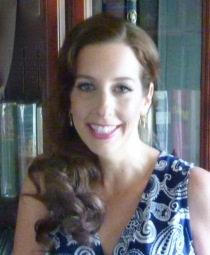
Christine Daigle is author of “Of Dandelions and Magic”
“Of Dandelions and Magic” relates more to my son’s childhood. He has a “towel duck” that’s nearly eight years old and quite ratty. On his last birthday, he wished it would turn into a real duck. Around the same time, our seven-year-old rabbit died and my son started asking me to tell him stories with the rabbit as the star. The initial idea for this story came to life as I pushed him on a swing.
I did, however, have a threadbare doggy as a child that I carried around in the crook of my elbow until stuffing started escaping through the hole I’d worn into the neck, just above the windup key for the music box.
What theme or idea were you exploring in your story?
I was exploring the idea that we lose the beliefs we held as children and, as adults, it’s hard to see the world as a magical place, even if our desire to do so is strong. As we journey back in time to try to recover pieces of ourselves, it’s difficult because we’re fragmented. When we are kids, the world is a frightening place, and as adults, nothing really changes except our ability to filter what we say and to decide what thoughts we choose to listen to. We never really have all the answers, and we don’t really need to have all the answers to keep living with the wonder of a child.
Is there anything else you would like to say about your story or the theme of the anthology.
Penelope Fitzgerald wrote, “The ambition of all children is to have their games taken seriously.” When I first read At Freddie’s, it struck me that Fitzgerald’s aphorism was a good one to file away for future exploration. I’m so glad to see this theme getting the anthology treatment!
What other projects do you have in the works, pieces people can buy, or places to find you in the coming year?
My first co-authored novel, The Emerald Key, was published in July 2015 by Ticonderoga Publications. My most recent short fiction is forthcoming in Sci Phi Journal and the Street Magick anthology (Elder Signs Press). I’m putting the polish on another co-authored dark fiction novel steeped in Irish mythology. I’m planning to start looking for a home for that soon.
And here is Lisa Carreiro’s interview about “Makour.” Her story takes place in space, features dragons and trains. It’s one of two stories that has a train in it.
What was your main reason for submitting a story to Playground of Lost Toys?
“Makour” was inspired by the theme “Lost Toys,” which immediately set my imagination in motion. I’d had the two characters, Pascal and Keirdran, rattling around in my head, but set nothing on the page because none of the escape scenarios worked for me. The word “toys” was the prompt I needed.
2. Does your story relate at all to anything from your own childhood?
As a kid, we had a toy farm set with plastic animals. The foal became my special toy: I endowed that wee bit of plastic with superpowers. He flew everywhere, he rescued the other farm animal toys from all kinds of dangers, and he had adventures throughout the house. I invented dozens of scenarios, always leaving a mess of scattered toys in my room; usually with the foal on top of the dresser watching over the others. I don’t know what happened to it; I simply outgrew it.
3. What theme or idea were you exploring in your story?
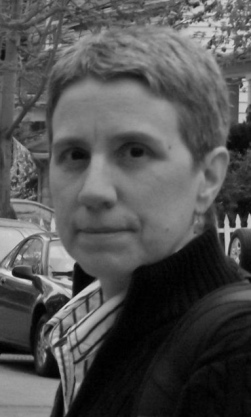
Lisa Carreiro wrote “Makour” a story that spans the far reaches of space and the determination that keeps people going.
The lost toys theme also set me thinking about all those things we lose as we age, not just the toys we loved. Although my childhood in no way resembles Pascal’s, many adults think back on a time, a place, a person, or an object with nostalgia or affection, or perhaps grief for what’s lost. Add a measure of adventure–in this instance journeying among the stars–and possibilities for exploring the theme multiply.
4. Is there anything else you would like to say about your story or the theme of the anthology.
Like many writers, I work around a “day job” that pays the bills. I’ve written fewer shorts in recent years while concentrating on finishing a novel, which I’m about to send out. With that done, I’m focusing again on the short stories. At the present I’m finishing up and polishing a few, which are just about ready: everything from a man who finds a youth who claims to be a god who’s fallen from the sky to a woman travelling to Proxima Centauri with a crew of genetically enhanced tigers.
5. What other projects do you have in the works, pieces people can buy, or places to find you in the coming year?
Some of my earlier short stories have appeared in Tesseracts Eleven, On Spec, and Strange Horizons.
Thanks again to Lisa and Christine. I’ll bring more interviews in a few days when next I meet the internet.
Filed under: Culture, entertainment, fairy tales, fantasy, memories, Publishing, science fiction, SF, Writing Tagged: Christine Daigle, fantasy, Lisa Carreiro, Playground of Lost Toys, Publishing, rabbit stuffies, space travel, Writing


Playground of Lost Toys Interviews
Today, I have Christine Daigle, whose story “Of Dandelions and Magic” speaks very well to that magic and loss we can experience as children. This is the stuffy story we chose though we had many for the anthology.
I also have Lisa Carreiro, author of “Makour.” This tale is darker and speaks of redemption as well as perseverance by tying into memories from childhood.
What was your main reason for submitting a story to Playground of Lost Toys?
Exile Editions’ history of publishing diverse voices in Canadian fiction was definitely part of the motivation, but the call for submissions to this particular anthology spoke to me because it seemed to be in the vein of what I write; weird sci-fi/fantasy, often with hints of fairytales and dreams.
Does your story relate at all to anything from your own childhood?
Christine Daigle is author of “Of Dandelions and Magic”
“Of Dandelions and Magic” relates more to my son’s childhood. He has a “towel duck” that’s nearly eight years old and quite ratty. On his last birthday, he wished it would turn into a real duck. Around the same time, our seven-year-old rabbit died and my son started asking me to tell him stories with the rabbit as the star. The initial idea for this story came to life as I pushed him on a swing.
I did, however, have a threadbare doggy as a child that I carried around in the crook of my elbow until stuffing started escaping through the hole I’d worn into the neck, just above the windup key for the music box.
What theme or idea were you exploring in your story?
I was exploring the idea that we lose the beliefs we held as children and, as adults, it’s hard to see the world as a magical place, even if our desire to do so is strong. As we journey back in time to try to recover pieces of ourselves, it’s difficult because we’re fragmented. When we are kids, the world is a frightening place, and as adults, nothing really changes except our ability to filter what we say and to decide what thoughts we choose to listen to. We never really have all the answers, and we don’t really need to have all the answers to keep living with the wonder of a child.
Is there anything else you would like to say about your story or the theme of the anthology.
Penelope Fitzgerald wrote, “The ambition of all children is to have their games taken seriously.” When I first read At Freddie’s, it struck me that Fitzgerald’s aphorism was a good one to file away for future exploration. I’m so glad to see this theme getting the anthology treatment!
What other projects do you have in the works, pieces people can buy, or places to find you in the coming year?
My first co-authored novel, The Emerald Key, was published in July 2015 by Ticonderoga Publications. My most recent short fiction is forthcoming in Sci Phi Journal and the Street Magick anthology (Elder Signs Press). I’m putting the polish on another co-authored dark fiction novel steeped in Irish mythology. I’m planning to start looking for a home for that soon.
And here is Lisa Carreiro’s interview about “Makour.” Her story takes place in space, features dragons and trains. It’s one of two stories that has a train in it.
What was your main reason for submitting a story to Playground of Lost Toys?
“Makour” was inspired by the theme “Lost Toys,” which immediately set my imagination in motion. I’d had the two characters, Pascal and Keirdran, rattling around in my head, but set nothing on the page because none of the escape scenarios worked for me. The word “toys” was the prompt I needed.
2. Does your story relate at all to anything from your own childhood?
As a kid, we had a toy farm set with plastic animals. The foal became my special toy: I endowed that wee bit of plastic with superpowers. He flew everywhere, he rescued the other farm animal toys from all kinds of dangers, and he had adventures throughout the house. I invented dozens of scenarios, always leaving a mess of scattered toys in my room; usually with the foal on top of the dresser watching over the others. I don’t know what happened to it; I simply outgrew it.
3. What theme or idea were you exploring in your story?
Lisa Carreiro wrote “Makour” a story that spans the far reaches of space and the determination that keeps people going.
The lost toys theme also set me thinking about all those things we lose as we age, not just the toys we loved. Although my childhood in no way resembles Pascal’s, many adults think back on a time, a place, a person, or an object with nostalgia or affection, or perhaps grief for what’s lost. Add a measure of adventure–in this instance journeying among the stars–and possibilities for exploring the theme multiply.
4. Is there anything else you would like to say about your story or the theme of the anthology.
Like many writers, I work around a “day job” that pays the bills. I’ve written fewer shorts in recent years while concentrating on finishing a novel, which I’m about to send out. With that done, I’m focusing again on the short stories. At the present I’m finishing up and polishing a few, which are just about ready: everything from a man who finds a youth who claims to be a god who’s fallen from the sky to a women travelling to Proxima Centauri with a crew of genetically enhanced tigers.
5. What other projects do you have in the works, pieces people can buy, or places to find you in the coming year?
Some of my earlier short stories have appeared in Tesseracts Eleven, On Spec, and Strange Horizons.
Thanks again to Lisa and Christine. I’ll bring more interviews in a few days when next I meet the internet.
Filed under: Culture, entertainment, fairy tales, fantasy, memories, Publishing, science fiction, SF, Writing Tagged: Christine Daigle, fantasy, Lisa Carreiro, Playground of Lost Toys, Publishing, rabbit stuffies, space travel, Writing
December 16, 2015
Writing: Playground of Lost Toys Interview: Cockle
Playground of Lost Toys, published by Exile Editions
Just in time for the holiday season is the release of Playground of Lost Toys, co-edited by Ursula Pflug and me. It is published by Canadian publisher Exile Editions, and available in trade paperback or as an ebook. This is a collection of stories by various authors that center around toys or games, a sense of something lost or found and that connects in some way to childhood.
With that premise we put out a call this year and gathered a wide range of stories from authors. At first we were getting worried. In any genre or style of story there are familiar and popular tropes. For stories about toys, we’ve seen some of these used over and over again in TV and movies, whether they’re creepy or nostalgic. Look at the Chucky horror movies and others that use creepy dolls come to life with a demonic intent. Teddy bears and stuffed animals also are imbued with a strange form of life in a thing that mimics like a living creature. Whether it’s scurrilous teddy bears like the movie Ted, or savior dolls like Buzz Lightyear in Toy Story (much rarer than devil dolls, by far), these childhood toys are very common in stories.
And so it seemed that we were going to end up with tales that did not vary greatly. Many were predictable. I refined the guidelines and we put out notice that we would take very few doll or stuffy stories. After all, the anthology was about all sorts of toys, even alien toys, but it wasn’t a collection of doll stories only. In the end we received a good range of stories, from science fiction to fantasy to horror. I won’t go on longer or I’ll run out of time but I asked the authors to answer a few interview questions. I’ll post these as I can but I’ll start today with Kevin Cockle.
1. What was your main reason for submitting a story to Playground of Lost Toys.
Basically, if I’ve got an idea that fits the antho parameters, and a beginning/middle/end – I’ll submit a story. I never leave any story I’ve written unsent.
2. Does your story relate at all to anything from your own childhood.
God, no. At least, nothing about the dramatic situation relates. I HAVE had a balero since childhood, and it is difficult to play, and I am pretty good at it, but that’s about it for similarity.
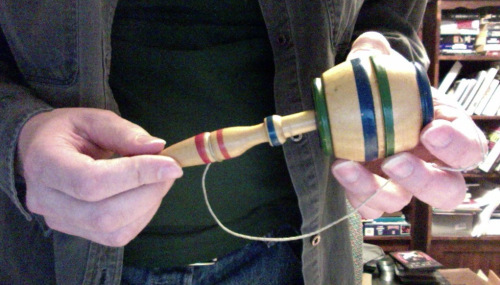
Kevin Cockle’s balero. Photo by Kevin
3. What theme or idea were you exploring in your story.
In broad terms, I was exploring the role “place” plays in identity. Since there’s a natural tension between markets and identity, I contextualized the exploration within a world where citizenship has been privatized. You get to stay in a place if you can afford to: you’re not entitled to stay there simply because you were born there. Cue anxiety.
4. Is there anything else to do with your story or the theme of the anthology you wish to mention?
I had already been thinking about the background concepts – and I had some pre-existing story fragments written – but the “toy” aspect initially made me think I couldn’t participate in this project. Then I remembered the balero, and was able to make the game mechanics the frame for the story. You could say that this story in its final form was more a case of “splicing” than writing per-se. Worked out well – prior to PoLT – I wasn’t getting anywhere with the dramatization of these ideas.
5. What other projects do you have in the works, pieces people can buy, or places to find you in the coming year.
My debut novel Spawning Ground will be coming out in 2016, from Tyche Books. The background world is similar to the one I sketched in “Balero,” and once again the implications of market-norms for identity will be explored. I also have a story coming up in Tesseracts 19, and a couple of film projects in various stages of pre-production. The Whale – a short film I co-wrote with Mike Peterson made it into Cannes this year, so keep an eye out for that on the film-festival circuit.
Thanks to Kevin for answering the interview. The holidays are hitting but where I can I’ll post more interviews so stay tuned.
Filed under: entertainment, fantasy, horror, Publishing, science fiction, Writing Tagged: authors, balero, Canadian Writing, games, Kevin Cockle, Playground of Lost Toys, science fiction, speculative fiction, toys


Writing: Playground of Lost Toys
Playground of Lost Toys, published by Exile Editions
Just in time for the holiday season is the release of Playground of Lost Toys, co-edited by Ursula Pflug and me. It is published by Canadian publisher Exile Editions, and available in trade paperback or as an ebook. This is a collection of stories by various authors that center around toys or games, a sense of something lost or found and that connects in some way to childhood.
With that premise we put out a call this year and gathered a wide range of stories from authors. At first we were getting worried. In any genre or style of story there are familiar and popular tropes. For stories about toys, we’ve seen some of these used over and over again in TV and movies, whether they’re creepy or nostalgic. Look at the Chucky horror movies and others that use creepy dolls come to life with a demonic intent. Teddy bears and stuffed animals also are imbued with a strange form of life in a thing that mimics like a living creature. Whether it’s scurrilous teddy bears like the movie Ted, or savior dolls like Buzz Lightyear in Toy Story (much rarer than devil dolls, by far), these childhood toys are very common in stories.
And so it seemed that we were going to end up with tales that did not vary greatly. Many were predictable. I refined the guidelines and we put out notice that we would take very few doll or stuffy stories. After all, the anthology was about all sorts of toys, even alien toys, but it wasn’t a collection of doll stories only. In the end we received a good range of stories, from science fiction to fantasy to horror. I won’t go on longer or I’ll run out of time but I asked the authors to answer a few interview questions. I’ll post these as I can but I’ll start today with Kevin Cockle.
1. What was your main reason for submitting a story to Playground of Lost Toys.
Basically, if I’ve got an idea that fits the antho parameters, and a beginning/middle/end – I’ll submit a story. I never leave any story I’ve written unsent.
2. Does your story relate at all to anything from your own childhood.
God, no. At least, nothing about the dramatic situation relates. I HAVE had a balero since childhood, and it is difficult to play, and I am pretty good at it, but that’s about it for similarity.
Kevin Cockle’s balero. Photo by Kevin
3. What theme or idea were you exploring in your story.
In broad terms, I was exploring the role “place” plays in identity. Since there’s a natural tension between markets and identity, I contextualized the exploration within a world where citizenship has been privatized. You get to stay in a place if you can afford to: you’re not entitled to stay there simply because you were born there. Cue anxiety.
4. Is there anything else to do with your story or the theme of the anthology you wish to mention?
I had already been thinking about the background concepts – and I had some pre-existing story fragments written – but the “toy” aspect initially made me think I couldn’t participate in this project. Then I remembered the balero, and was able to make the game mechanics the frame for the story. You could say that this story in its final form was more a case of “splicing” than writing per-se. Worked out well – prior to PoLT – I wasn’t getting anywhere with the dramatization of these ideas.
5. What other projects do you have in the works, pieces people can buy, or places to find you in the coming year.
My debut novel Spawning Ground will be coming out in 2016, from Tyche Books. The background world is similar to the one I sketched in “Balero,” and once again the implications of market-norms for identity will be explored. I also have a story coming up in Tesseracts 19, and a couple of film projects in various stages of pre-production. The Whale – a short film I co-wrote with Mike Peterson made it into Cannes this year, so keep an eye out for that on the film-festival circuit.
Thanks to Kevin for answering the interview. The holidays are hitting but where I can I’ll post more interviews so stay tuned.
Filed under: entertainment, fantasy, horror, Publishing, science fiction, Writing Tagged: authors, balero, Canadian Writing, games, Kevin Cockle, Playground of Lost Toys, science fiction, speculative fiction, toys