Colleen Anderson's Blog, page 16
December 19, 2013
Tesseracts 17 Interview: Dave Beynon

Dave Beynon’s tale tells of a great love, and horror born of desperation.
“The Lighthouse Keeper’s Wife” is a classic tale in many ways. Yet you have made it very intimate and human. Do you have a strong connection to lighthouses?
I love lighthouses and I think they come with a romance all their own. They are by nature lonely, isolated places but they are also a symbol of connection. The function of a lighthouse is communication. The light reaches across dark waters to the seeking eyes of mariners. It’s a connection that reminds sailors that they are not alone in the night but the lighthouse’s light is more than that. It’s also a warning. “You are not alone, but don’t come too close. There is danger here.”
Lighthouses are rugged places, exposed to the elements, isolated – just begging to be haunted. They stand at the edges of things. Light and Dark. Land and Water. Civilization and the Unknown. Why shouldn’t a lighthouse stand at the edge of Life and Death as the one does in “The Lighthouse Keeper’s Wife?”
CA: In regards to the human, and inhuman aspects, you deal very gently with cultural attitudes and a great love. Do you think that if we did have means to supernatural “fixes” that more people would be driven to take desperate measures?
Absolutely, yes. I think we only need to look to science and medicine. People without brain function and with little or no chance of recovery can now be kept alive almost indefinitely. It’s easy to say that in a situation like that the plug ought to be pulled so that families might get on with the grieving process. That’s a cold and rational, if realistic, way of looking at it. I think part of being human kindles the hope that, despite evidence to the contrary, there’s still a spark of the person that we love somewhere inside that body hooked up to all those machines. We’ll use those machines to keep that spark alive.
I think if there was a supernatural (or a scientific) way to bring a loved one back from death, it would be doomed to end badly. If
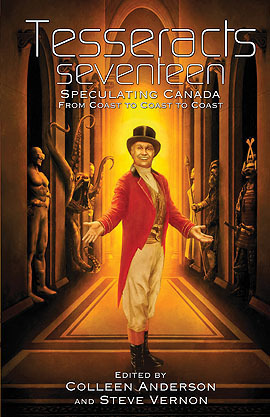
Tesseracts 17 is now out with tales from Canadian writers that span all times and places.
personality, consciousness and a sense of self could somehow endure beyond death, I imagine death—the whole act of life ending, either traumatically or peacefully—is the sort of journey that might change a person. I don’t think the person you’d get back would be the same one you said goodbye to. You might not recognize them—or worse yet, they might not recognize you.
CA: This tale is about fighting death but on a visceral level, with terrible consequences when a foreign curio comes into play. Do you think that in earlier centuries various foreign objects were seen a mystical or supernatural, only because they were unknown?
When I was a kid, I was fascinated by mythology, legends, and fairy tales. That fascination led me down the road to Egyptology, complete with Howard Carter and King Tut’s tomb. I was fortunate enough to see the Treasures of Tutankhamen exhibit at the Art Gallery of Ontario back in 1979. I remember pressing my hands and face against the glass cabinet that held Tut’s burial mask. There’s no doubt about it. It was magical.
I think we tend to have two reactions to things we encounter beyond our cultural experience—awe and fear. Usually a combination of the two. Can you imagine the first European to encounter Chinese fireworks? The first native North American to see a gun fired? Curious objects abound and if we can’t figure out their uses it’s easy to imagine supernatural uses. Why are there standing stones scattered all over Britain? Why did the people of Easter Island commit such time, effort and resources into carving and placing their iconic moai statues around their island? How would we really view an alien piece of technology if one fell into our hands? Would we consider it technology or would the workings be so far beyond us that it would be indistinguishable from magic?
Nowadays (look at me using old-timer talk) we have instant access to cultural databases. If we encounter anything mysterious or intriguing from a different culture, we can dissect it immediately, if we choose. In the past researching a mystery would be a length process that might raise more questions than answers which would add to the idea of mystery or the supernatural. I guess what might border on mystical or supernatural now would be googling a person or an object and finding absolutely no information. In our information rich world, that would indeed be odd…almost magical.
CA: While this is not quite a ghost story, have you dabbled in other tales that deal with the dead in one form or another?
I have a number of real life ghost stories that I love to share on stormy nights and around campfires in the woods. While I haven’t written a traditional ghost story (yet…you’ve got me thinking about one, Colleen), I tend to write stories that deal with people who have suffered the profound loss of loved ones and their different ways of coping. I don’t think there’s anything more impactful than the loss of someone close and by exposing a character in a story to that type of loss you get to see what he or she is made of. In that way, I guess, there are ghosts in my stories because my characters are visited by the memories of those they’ve lost and what is a ghost if not the vivid, enduring imprint of someone who has died?
CA: What projects are you working on now?
I have a number of short stories that I’m working on and there are always more short stories waiting to be written. I have a wonderful skeletal novella about the last hours of a Paraguayan dictator awaiting execution that I’ll be fleshing out to novel length some time next year. In the background, I’m always working on a novel. The current novel is called Doc Merl’s Rolling Apothecary. It’s the King Arthur myth transposed to an old west full of rival land barons, displaced Indians, mysterious railway surveyors, sabre-toothed cats who avoided extinction and the weirdly motivated, pan-dimensional Hoodoo men.
Dave Beynon is a writer of speculative fiction of varying lengths and genres. In 2011, his time travel novel, The Platinum Ticket was shortlisted for the inaugural Terry Pratchett First Novel Prize. Dave lives in Fergus, Ontario with his wife, two kids and Willow, a golden retriever who manages every aspect of his life. Find out more about Dave at his website www.davebeynon.com or if Twitter is more your thing, he’s @BeynonWrites. Fair warning, though – he mostly tweets about crappy weather and stupid things that piss him off.
Filed under: Culture, entertainment, fantasy, horror, people, Publishing, Writing Tagged: Canadian authors, Dave Beynon, fantasy, ghosts, horror, lighthouse, lighthouses, reanimated dead, speculative fiction, Tesseracts 17, The Lighthouse Keeper’s Wife, walking dead



December 18, 2013
Tesseracts 17 Interview: Ben Godby

Tesseracts 17 is now out with tales from Canadian writers that span all times and places.
Ben Godby’s tale takes us to the farthest reaches of the universe and a man with a dark mission.
CA: “Star Severer” was one of the bleaker stories in Tesseracts 17. In one sense it signals the end of everything. Stories like this can be depressing, yet you presented more depth. What were the important elements you were exploring in this piece?
I think I’ve benefited from living in a peaceful time in a peaceful place. I can’t remember who wrote it, but a sentence which recently struck me with its veracity and import was, “Make no mistake, we are living in a golden age.” Not surprisingly, it’s always been hard for me to understand war—or, more generally, the very idea of having “enemies.” On the other hand, I’ve grown up with video games, board games, role-playing games, books, movies, and all other sorts of media that make me—on a visceral level—love war, and love killing, and love having some brute-obvious object of ethically appropriate hatred.
Ben Godby loves games and fantasy, but Star Severer is science fiction with a dark vein.
This tension has caused me to write a lot of stories that explore violence and its necessary ambiguity. In “Star-Severer,” I needed that footchase scene, and I needed Odashi and his soldiers to violently board Mueller’s vessel, because in a lot of ways, violence is what makes stories worth telling and hearing for my narrative consciousness. But intellectually, I abhor violence and don’t understand it—which is why my protagonists are usually unwilling, unwitting, or unhappy soldiers.
CA: This story literally takes us to the far reaches of the universe. Do you write in this universe or these worlds often?
It’s hard for me to write anything that’s anything but fantastic. I have three distinct universes I like to write in, although two of them—one which is decidedly fantasy, and another which is a sort of fantasy-cyberpunk fusion—have begun a sort of mental meld over the last six months. I like reading contemporary, modern, and realistic fiction, but I get bored writing about the mundane world.
This universe, by the way, is the “Children of the Earth” universe, which is marked by conflict between the Children of the Earth, who believe in Terran orthodoxy (Earth’s universal primacy), and “Terretics,” usually colonists of far-flung worlds who have ceased to care for Earth and its imperial ways. “Children of the Earth,” published online in Kaleidotrope, also takes place in this universe. http://www.kaleidotrope.net/archives/summer-2012/children-of-the-earth-by-ben-godby/
CA: The story harkens some to our human condition; that of being a violent species sometimes determined to commit genocide. Do you think we will every move beyond this flaw?
I think humanity is slowly become “gooder,” if I may be permitted such a silly word. At least, the developed nations of the world are becoming less and less willing to kill each other. But, there are still horrible wars committed across the globe every day, and whenever the nuclear stalemate is resolved, large, powerful countries will almost inevitably go to war once again. I hope we move beyond the need to fight each other, but I think this will require the elimination of acquisitive ideologies like capitalism, competitive ideologies like free market economics, and a lot of great science to solve the environmental problems that are creeping up on us and creating more cause for conflict.
CA: Science fiction isn’t as popular as fantasy fiction these days. Do you think it’s too realistic and we wish to escape any sense of reality?
I’ve heard this before, but I actually find that SF is really popular. What’s interesting to me is that SF has evolved a lot more than fantasy. There’s a lot of people who are upset that SF has become really dark and pessimistic, but at least it reflects evolving trends in the psychology of writers and readers. I can’t believe how many fantasy books are, for all intents and purposes, identical to each other minus a few special details: magic works this unique way in such-and-such a world, but it is still a romantic 13th century medieval world with kings and emperors, subjected women, racism, some kind of orc or goblin analogue (e.g. sranc [R. Scott Bakker's fantasy series] or the shanka [Joe Abercrombie]), and a hero quest. I like fantasy, but I want to see it do more, and outside of China Miéville, Jeff VanderMeer, Steph Swainston, and a clutch of other New Weird writers, I don’t see much “evolved” fantasy getting very popular.
CA: What else are you working on now?
An MBA and a rather successful Dwarf Fortress. http://www.bay12games.com/dwarves/ I hate to say it, but with my studies, work, and volunteerism as they’ve been the last year and a half, I’ve barely written anything. I’m hoping to start a new AD&D campaign (which I consider to be a sort of creative writing) in the new year, and once I graduate in August 2014, hopefully I’ll get back on the writing horse. The plan, though, is to write novels rather than short stories. Writing short fiction was always meant to be “practice” for writing novels, although I kind of fell into loving it.
Ben Godby writes mysteriously thrilling pseudo-scientific weird western adventure fantasy tales. He lives in Ottawa, Ontario with a girl, two dogs and a cat. Ben is part of the Codex Writers’ Group and his book reviews have been published in Strange Horizons. He is a business communications specialist, a videogame addict, and a heavy metal enthusiast. He holds a B.A. in Philosophy from McGill University and is a part-time student in the University of Ottawa’s French MBA program.
Filed under: Culture, entertainment, people, Publishing, science, science fiction, Writing Tagged: anthologies, Ben Godby, Canadian writers, genocide, multiple worlds, science fiction, SF, space fiction, speculative fiction, Tesseracts 17, universe


December 7, 2013
Tesseracts 17 Interview: Costi Gurgu

Costi Gurgu’s “Secret Recipes” is both alien and sensual.
Today, I interview the last Ontario author in Tesseracts 17, but not the last author by far.
CA: Of all the tales in Tesseracts 17, “Secret Recipes” was perhaps the most alien. You use the senses in such a unique way that makes the story poetic. How did this idea come about?
A few years back I had a conversation with my Romanian agent about an article he just read, concerning the North American Science Fiction rules—One cannot write a story that happens in an alien world, having only a cast of alien characters. So, not having at least one human character to give the readers the human perspective on the alien world.
I told my agent I can break that rule and make it work. And so it started.
I wrote that year a short story that did just that. I sold it immediately to Anticipatia Magazine (major SF magazine at the time). It has been awarded and reprinted four times.
After its success, I wrote my first novel, Recipearium, breaking the same rule. I sold it several years later; critics and reviewers wrote about it in numerous genre and literary magazines, and it brought me three awards.
The story in Tesseracts17, “Secret Recipes,” takes place in the same universe as the novel, breaking the same rule. In fact it is a prequel to the novel, introducing the main character and his quest.
CA: The story is quite complex, dealing with betrayal, familial honor, and individual accomplishment. Was there one strong ingredient in this recipe or was it a gradual blending that was a natural evolution?
Tesseracts 17 is now out with tales from Canadian writers that span all times and places.
I thought that no matter how “alien” the world and the characters, there have to be some things that are common to our civilization. That’s what should make the story work in the end—the fact that we can identify some of our values with some of their values and eventually understand and empathize with their struggles.
Family is one of those values. And yes, in their world the notion is quite different from here, but in the end that sense of belonging to a certain group of people and a certain place, to a certain system of values that one is exposed to within that group, the mutual feelings that grow inside the relationships of a family, all these are and have been for most of our history intrinsic to our way of living and shaping the reality around us.
So, it all starts with where my main character comes from. Who is he and why does he make the choices he makes?
CA: Do you think that if we ever met an alien species, even as diverse as the ones in David Brin’s Uplift universe, that we would be able to emotionally relate to them?
To be honest, no. At least not in the beginning. And when I say in the beginning, I don’t mean the first year or so, I mean probably the first century or so.
Although when one says “emotionally” we think of this non-rational, spontaneous instinctive reaction, it is not completely so. That “instinctive” reaction is given to us by our system of beliefs, by the way we are educated to react to different stimulus.
“Alienness” is one of the toughest tests we always had in order to pass as civilized people. There are still humans who cannot emotionally relate to other humans of a different religion or ethnicity, which in a way goes back to a certain definition of alienness.
So imagine relating to beings anatomically different from us. Who have completely “alien” and questionable physiological needs. And that means only scratching the surface. Because then we’d have to cope with their spiritual and intellectual needs. And as we struggle to accomplish that, we’d encounter their philosophical and legal system. Their moral code and cultural code.
So, I think the answer is no. We’d need centuries of contact before some of us could really emotionally relate to them.
CA: What would you consider as being your most difficult story to write in terms of worldbuilding and/or alien perspectives and perceptions.
You know when “they” say that one of the biggest problems of Science Fiction stories is that their characters don’t seem to have common human needs? They do not need to eat, use the washroom, make love, drink a coffee or do the laundry?
Noticed that I said make love and not have sex? It sounds nicer somehow. But truth to be told, sex is one essential component of human life and why not presume of any intelligent organic life out there in the universe. And most SF writers have really avoided the subject either by completely ignoring it, or by starting with a kiss and ending with “and after that they made sweet, sweet love.” But that’s a subject for another day.
Well, you could do all that in terms of worldbuilding and it would be fun, especially if there are aliens involved. But now imagine writing an alien love scene and I’m not talking about one of those poetic scenes that have nothing to do with sex. Like oh, the aliens were these giant butterflies and they loved each other flying majestically through a night sky full of spectacular moons.
No, love making that involves real sex organs and secretions and orgasm and the eventual transfer of fluids. All in the name of love… and procreation, hopefully.
It is hard enough to write a human love scene that avoids all that detail and gives the sense of emotional connection as well as physical pleasure. Then, what do you do when your aliens are not humanoids and not even cute little animals or plants, or birds for that matter. When they are really alien and seriously constructed creatures.
An alien love scene could be really difficult to write from any perspective or perception, without alienating your readers. So I could say…Recipearium, my alien only novel.
CA: What other stories are you cooking up?
New beginnings for me this year.
I’m in the middle of a Science Fiction comedy.
Now, this is also difficult to write as humor is so different depending on so many factors, that sometime one would think this should be the true test of emotionally relating to alienness.
I’ve been also trying my hand at screenwriting. Right now I’m working on a short Sci-Fi drama and a long Sci-Fi thriller.
So all things new to me and therefore so exciting that I feel this year was one of the best I had in a long time.
Costi Gurgu is an art director, illustrator and writer living in Toronto with his wife. He worked as the art director of Playboy Magazine, the French fashion magazine—Madame Figaro, and the women’s life-style magazine—Tabu. Costi was also the art director and illustrator of ProLogos Imprint, where he designed their visual identity and illustrated some of the book covers.
As a writer, Costi has published three books and over fifty short stories in Romania, Poland, Hungary, Denmark, England, United States and Canada. He has won twenty-four awards for his fiction. His latest sales include the Danish anthology Creatures of Glass and Light, the DAW Books anthology Ages of Wonder, the Wildside Press anthology The Third Science Fiction Megapack, The Millennium Books anthology Steampunk—The Second Revolution, and Tesseracts 17.
Filed under: Culture, entertainment, fantasy, food, people, Publishing, science fiction, Writing Tagged: alien perspectives, anthologies, Costi Gurgu, David Brin, North American Science Fiction, science fiction, Secret Recipes, SF, speculative fiction, Tesseracts, Tesseracts 17, worldbuilding


December 5, 2013
Tesseracts 17 Interview: Alyx Harvey
Tesseracts 17 is now out with tales from Canadian writers that span all times and places.
Need a little something for the holidays, or a stocking stuffer? Tesseracts 17: Speculating Canada from Coast to Coast to Coast is available online and through EDGE Science Fiction & Fantasy.
Today, I interview Alyx Harvey http://alyxandraharvey.com/.
CA: One of the elements that really struck me about “Anywhere” was its Mongolian feel, and yet it wasn’t really just that culture. We don’t see many Mongolian flavoured tales. Did you intentionally choose to emulate aspects of the steppes and the nomadic races of eastern Asia?
I’ve always been interested in Tibetan and Mongolian culture and though the world of “Anywhere” is not either of those, it certainly has that flavour. I researched the terrain of the mountains in Tibet to ground the story and then it unfolded from there. Lots of research on yak herding which I never thought I’d do!
CA: While geography plays an important part in your tale, it is mostly a story about destiny. There are many speculative stories about someone who is special or great due to their destiny (Frodo, Luke Skywalker, Harry Potter), yet Tashi is a blend of both being special but no more so than any other individual. Give us some insight to Tashi’s destiny and what you wanted to explore.
I wanted to drop Tashi into a world she thought she knew about (the catacombs) and have her discover that she doesn’t actually
Alyx Harvey is also the successful author of numerous YA novels.
know anything about it and what’s more, that means she doesn’t know about where she came from either. Tashi doesn’t fit into her family and she thinks it’s her fault, but really she’s just a piece of another puzzle. And part of her destiny is figuring what that puzzle is.

CA: Do you think that each of us has a destiny? Do many of us ignore our destinies?
I like to think that we might have a destiny, or at least a path. I do love Joseph Campbell, so I think your “destiny” is just “following your bliss.”
CA: The magics in your world are a detriment. Explain how it is that people with such powers could be corralled.
The Sultana is afraid of people with power, both ordinary power and magical “luck,” and so she works hard to control everyone in her world. She sends riders out to grab lucksingers just as they are coming into their powers…before they understand them and can control them. She waits for their most vulnerable moment. If they can control their magic and she can control them in turn, they are taken out of the catacombs and made to join her court. Some are so desperate to leave the catacombs they will happily swear fealty to her, even though she put them there in the first place.
CA: I can very much see this world expanding into a novel. Do you have any plans to use this world or Tashi again?
I would love to follow Tashi and explore the other corners of the world in ‘Anywhere’. It’s definitely on my to-do list!
CA: What other themes or stories are you working on?
I am currently working on a post-apocalyptic YA novel… at least I think that’s what it is. It’s rather slippery and hanging out between genres right now.
Alyxandra Harvey lives in a stone Victorian house in Ontario, Canada with a few resident ghosts who are allowed to stay as long as they keep company manners. She loves medieval dresses, used to be able to recite all of “The Lady of Shalott” by Tennyson, and has been accused, more than once, of being born in the wrong century. She believes this to be mostly true except for the fact that she really likes running water, women’s rights, and ice cream.
Among her favourite books are I by Terri Windling, Jane Eyre by Charlotte Bronte, and of course, Pride and Prejudice by Jane Austen. Elizabeth Bennet is her hero because she’s smart and sassy, and Mr. Darcy is, well, yum.
Aside from the ghosts, she also lives with husband and their dogs. She likes cinnamon lattes, tattoos and books.
Filed under: Culture, entertainment, fairy tales, fantasy, people, Publishing, Writing Tagged: Alyx Harvey, magic, Mongolian fiction, speculative fiction, spirit, Tashi, Tibetan, Young-adult fiction


Tesseracts Interview: Alyx Harvey
Tesseracts 17 is now out with tales from Canadian writers that span all times and places.
Need a little something for the holidays, or a stocking stuffer? Tesseracts 17: Speculating Canada from Coast to Coast to Coast is available online and through EDGE Science Fiction & Fantasy.
Today, I interview Alyx Harvey http://alyxandraharvey.com/.
CA: One of the elements that really struck me about “Anywhere” was its Mongolian feel, and yet it wasn’t really just that culture. We don’t see many Mongolian flavoured tales. Did you intentionally choose to emulate aspects of the steppes and the nomadic races of eastern Asia?
I’ve always been interested in Tibetan and Mongolian culture and though the world of “Anywhere” is not either of those, it certainly has that flavour. I researched the terrain of the mountains in Tibet to ground the story and then it unfolded from there. Lots of research on yak herding which I never thought I’d do!
CA: While geography plays an important part in your tale, it is mostly a story about destiny. There are many speculative stories about someone who is special or great due to their destiny (Frodo, Luke Skywalker, Harry Potter), yet Tashi is a blend of both being special but no more so than any other individual. Give us some insight to Tashi’s destiny and what you wanted to explore.
I wanted to drop Tashi into a world she thought she knew about (the catacombs) and have her discover that she doesn’t actually
Alyx Harvey is also the successful author of numerous YA novels.
know anything about it and what’s more, that means she doesn’t know about where she came from either. Tashi doesn’t fit into her family and she thinks it’s her fault, but really she’s just a piece of another puzzle. And part of her destiny is figuring what that puzzle is.
CA: Do you think that each of us has a destiny? Do many of us ignore our destinies?
I like to think that we might have a destiny, or at least a path. I do love Joseph Campbell, so I think your “destiny” is just “following your bliss.”
CA: The magics in your world are a detriment. Explain how it is that people with such powers could be corralled.
The Sultana is afraid of people with power, both ordinary power and magical “luck,” and so she works hard to control everyone in her world. She sends riders out to grab lucksingers just as they are coming into their powers…before they understand them and can control them. She waits for their most vulnerable moment. If they can control their magic and she can control them in turn, they are taken out of the catacombs and made to join her court. Some are so desperate to leave the catacombs they will happily swear fealty to her, even though she put them there in the first place.
CA: I can very much see this world expanding into a novel. Do you have any plans to use this world or Tashi again?
I would love to follow Tashi and explore the other corners of the world in ‘Anywhere’. It’s definitely on my to-do list!
CA: What other themes or stories are you working on?
I am currently working on a post-apocalyptic YA novel… at least I think that’s what it is. It’s rather slippery and hanging out between genres right now.
Alyxandra Harvey lives in a stone Victorian house in Ontario, Canada with a few resident ghosts who are allowed to stay as long as they keep company manners. She loves medieval dresses, used to be able to recite all of “The Lady of Shalott” by Tennyson, and has been accused, more than once, of being born in the wrong century. She believes this to be mostly true except for the fact that she really likes running water, women’s rights, and ice cream.
Among her favourite books are I by Terri Windling, Jane Eyre by Charlotte Bronte, and of course, Pride and Prejudice by Jane Austen. Elizabeth Bennet is her hero because she’s smart and sassy, and Mr. Darcy is, well, yum.
Aside from the ghosts, she also lives with husband and their dogs. She likes cinnamon lattes, tattoos and books.
Filed under: Culture, entertainment, fairy tales, fantasy, people, Publishing, Writing Tagged: Alyx Harvey, magic, Mongolian fiction, speculative fiction, spirit, Tashi, Tibetan, Young-adult fiction
November 29, 2013
Tesseracts 17 Interview: Mark Leslie

Mark Leslie takes a caper with dramatic ghosts in Hereinafter Referred to as The Ghost.
Today, I interview Mark Leslie, the first of four Ontario authors in Tesseracts 17, and a ghost hunter of a sort.
CA: Hereinafter Referred to as the Ghost is of a very popular trope; ghost stories. In fact, we could have had a full anthology of just ghost and zombie tales, so choosing one of quite a few good ghost stories was a bit of a feat. While your tale is of a haunting, it’s jaunty and fun. Why did you choose such a well worn subject to pursue?
Though I have always written horror fiction, I rarely have ventured into what might be considered the standard tropes of the genre. I have avoided writing stories of vampires, ghosts and zombies and other standard and traditional “monsters” that grace horror fiction. But when I have drawn upon then, I’ve tried to approach the story from what feels like a unique perspective. For example, the first successful “haunted house” story I had published was called “Requiem” and was about a man who collected haunted artifacts. The story explores what might happen if a bunch of different ghosts were thrust together and forced into the same space. Sure, it was about ghosts, but it explored a “what if” that intrigued me. In this case, the idea was whether or not ghosts could be territorial in nature.
In a tale I co-authored with John Strickland called “Til Death Do Us Part?” we explored what might happen if a married couple who constantly fought continued to fight and bicker in the afterlife, and what it might be like for their only son who, believing that his quarreling parents had finally come to an end not only witnesses their postmortem bickering, but gets drawn into it, yet again. It’s a very dark humor treatment of the ghost trope.
For “Hereinafter Referred to as the Ghost” I took a similar exploration. I imagined an afterlife in which there are those who “live” their afterlife in quiet desperation, and others who seek more, who want their death to be something larger than they are—those are the dead who become “actors” and work at playing legendary ghostly roles. I thought it would be fun to look at the concept of a well-known haunted place, such as the Museum of Nature in Ottawa, or the London Tower, and explore some of the behind the scenes elements, with a somewhat tongue-in-cheek look at a struggling actor coming to terms with the loss of his long-held skills and abilities to properly perform the roles he seeks to play.
The story, for me, wasn’t about setting up a scary haunting, but rather exploring what it might be like for someone trying to succeed in making that haunting real for humans. So, sure, it’s a ghost story, but it is not one mean to inspire chills in the traditional sense—it’s one that asks the reader to consider the “what if that perhaps ghosts aren’t what we believe them to be, but rather roles that virtually any “talented” dead spirit can play if only given the chance to strut their stuff on the “stage.”
CA: The story touches on drama, and theater cannot be mentioned without invoking the Bard. While you didn’t bring in Shakespeare outright, how involved was he with your vision for this story?
Tesseracts 17 is now out with tales from Canadian writers that span all times and places.
Shakespeare was at the forefront of my mind when I was working through this tale. When you think of Hamlet, you might consider the thrill, for an actor, to be cast in the legendary role, or of the countless various actors over the centuries who have portrayed the prince in various manners and interpretations on both stage on screen.From Laurence Olivier and Peter O’Toole to Kenneth Branagh, Mel Gibson and Ethan Hawke, so many different actors have played this role as well as many other classic Shakespearean roles, each bringing something unique and different to that.
I imagined the dead auditioning to play legendary and classic ghosts in the same manner that actors might audition to do stage runs of Shakespearean plays, and thus the conflict between my protagonist, Patrick, and the surly “casting director” Snyder.
When I was thinking about actors and their desire to seek out coveted roles—after all, it’s much more prestigious to play the role of Hamlet than to be Horatio or, even worse, a role like Barnardo, one of the sentinels who encounter the ghost of Hamlet’s father in the opening scene of Hamlet.
I took the idea of the different roles actors aspire to and thought about what happened when an actor aged. How sometimes the actor could play the “leading man” roles, and how as time went on, he might be relegated to supporting role material. You see the same thing with news anchors and in sporting professions. Great figures that we admire grow old, drift off into the sunset while we seek out younger, fresher ones to take their place.
I tried to imagine how the same thing might happen for spirits playing the roles of various legendary ghosts around the world. I drew upon the lyrics from one of my favourite Rush songs entitled “Losing It” that explores these themes with both a writer and a dancer, and how, as they grow old the precious moments, the echoes of old applause and everything they had built could slowly slip through their old wrinkled fingers, and I had some fun with it as Patrick faced those same things.
CA: Do you believe that ghosts do exist and if so do you think they have a lasting consciousness or are just after-images, an imprint of one’s life? Have you ever experienced an apparition?
I do believe that ghosts exist. As Hamlet expressed to his dear friend Horatio, there are more things in heaven and earth than are dreamt of in our philosophies. I’ve never seen a ghost, and, as I have explored in a few different stories that I have written, I believe that ghosts can be both a lasting consciousness stuck down here on earth, rather than being fully and properly released into the ether of the afterlife, but that they can also be imprints left in the universe around us, echoes of things that have happened. In my short story “Spirits” for example, I explored the concept of people leaving their spirits behind in a place they were somehow tied to, even without dying; that a place or moment in time or experience can have such a lasting and important impression that the spirit of a person, of a moment, of an experience, can echo in that spot for eternity.
No, I can’t say that I have ever experienced any sort of apparition; at least nothing that I couldn’t attribute to being over-tired or having an over-active imagination.
And that’s a good thing. Because I’m such a chicken that if I did see a ghost, I’d likely pass out or have a heart attack.
CA: Will we see any more escapades in this style of ghostly realm?
Definitely. I have been kicking around another speculative story about ghosts and the side-effects for those who attempt to control or contain poltergeists. It is, in many ways, a tongue-in-cheek exploration, like “Hereinafter” and “Requiem”—except, though it will contain a slight bit of dark humor, it’ll be darker and a bit creepier in delivery, much like a traditional ghost story.
CA: What else do you have in the works and what themes are you exploring?
I’m continuing to compile non-fiction paranormal explorations. My next book in that series of “stories told as true (a term that John Robert Columbo beautifully described this style of book) coming from Dundurn in 2014 will be called TOME OF TERROR and will focus on haunted bookstores and libraries around the world.
My forthcoming novel from Atomic Fez takes a look at how a teenager might deal with a bizarre death curse, where everybody he gets close to dies some sort of tragic horrific death. That book, ironically, draws a great deal from Hamlet as well as from several texts I admire from several different science fiction and horror writers.
And, on Wattpad, I’m currently rolling out the novel A CANADIAN WEREWOLF IN NEW YORK. One might suspect, given that it’s a werewolf novel, that I’m using a popular trope. And I might just be, but the focus of the novel isn’t on the wolf, but on the side effects of being a wolf. The novel opens with my hero, Michael Andrews, waking up as a human in Battery Park with a bullet hole in his leg and no memory of the night before when he was wandering around the city in wolf form. I wanted to focus on how he deals with not having any idea what his canine alter ego was up to, and the various frustrations of dealing with the logistics of having such an affliction while trying to live a normal urban life. It’s a dark humor thriller more than a horror novel, but has been a lot of fun to write. So far I’ve posted up to Chapter Twenty-eight, and the entire thing will be available to read for free here: http://www.wattpad.com/story/3961496-a-canadian-werewolf-in-new-york
Once I finish rolling out this draft I’ll be using reader feedback to do another re-write before either sending it to a publisher or commissioning an editor to help me revise the final version.
Mark Leslie fell in love with storytelling, and, in particular the brand of Twilight Zone style tales he often writes, at an early age, and has been writing pretty much since the first day he discovered the magic of stringing one word after another to create a narrative. The editor of the anthologies North of Infinity II, Campus Chills and Tesseracts Sixteen, Mark has also produced a series of non-fiction paranormal explorations in the books Haunted Hamilton and Spooky Sudbury from Dundurn Press, with more books in that vein in the pipeline. Mark’s One Hand Screaming, published in 2004, contains a selection of previously published short fiction and poetry, and his first novel, I, Death, is slated for publication in late 2014.
Filed under: entertainment, fantasy, history, people, Publishing, Writing Tagged: Ghost, ghost stories, ghosts, Hamlet, Mark Leslie, Paranormal, Tower of London


November 27, 2013
Tesseracts 17 Interview: David Jón Fuller
Tesseracts 17 is now out with tales from Canadian writers that span all times and places.
David Jón Fuller joins me from Manitoba, for another Tesseracts 17 interview.
CA: “Sin A Squay” is a tale of overcoming monsters. We have heard the horror of residential schools and new nightmares seem to be unearthed every day. What drew you to putting this element into your story?
It’s a national horror that was made worse by decades of denial despite more and more residential school survivors coming forward. Despite some indications that people allowed or even wanted their children to attend the schools in the early part of their existence, they just became an institution of systemic abuse and earned their appellation of an instrument of genocide. I wanted to explore this in a context of what that does to people over time – how even escaping them can have a cost, and that the oppression that was perpetrated against the children in the schools – treating them as less than human, and the endemic abuse that comes to light more and more – can leave a lasting mark. But I also wanted to explore how those horrors could be confronted and overcome.
I had doubts whether this was a subject I should even write about, no matter how much research I did – I worried that it wasn’t something that, as a white person, I had a right to write about. But I felt without trying to address it in some way through my fiction, I would just be ignoring it, and adding to the silence, in a sense. Whereas I think anyone who learns about what the residential schools system did to so many First Nations people for so long would be within their rights to condemn it as horrific.
CA: Have you seen or experienced aspects of residential schools or your own childhood traumas that you used to draw on for this story?
No – nothing on the scale of something like this. Tough times for me as a kid meant dealing with the occasional bully or being the “new kid” at school. Definitely not a systemic oppression, or even life-scarring single event. And like the majority of white people in Canada, I grew up privileged to live with many doors open to me as a default. I relied a lot on research to create the characters and the background for this story.
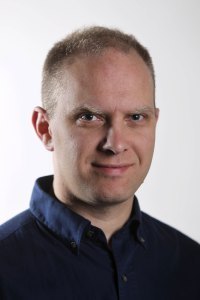
David Jón Fuller explores the horrors of residential schools in Sin A Squay.

CA: You have two different monsters in your tale; the beasts that prowl the mythic landscape and residential schools. Why did you feel this story worked better with the mythic or horrific element?
Partly because I think the fear of certain monsters says something about the culture in which they are feared. Some monsters have embodied fears of our animalistic natures, and of the “wilderness” – and I think that speaks to a Western European (particularly continental) fear of predators. Hand-in-hand with that went the European colonialist attitude that white people were “civilized” and everyone else was to some degree “savage” (read: wild). I wanted to turn that around a bit, and look at how that attitude itself – of seeing certain people as “less than human,” which is certainly what the residential schools embodied: the view that “Indians” were lesser people, savage, or inferior – was monstrous.
I do tend to think that in mainstream pop culture these days, certain monsters are “othered.” Vampires are currently glorified – embodying, I think, our fear of old age, since the “eternal youth” trope seems played up nowadays as opposed to the “foreign devil will seduce our women” theme that ran through Dracula. Werewolves, on the other hand, are frequently the lackeys and/or cannon fodder if they appear alongside other creatures in a given show, or they are stuck in an endless retread of savage/animalistic/bestial archetypes. This isn’t as true in a lot of urban fantasy fiction, but it seems to be the gear they’re stuck in in movies and TV. And I hate that!
Also, considering the way the characters’ relationships change in the story, I wanted to explore whether what one culture sees as “monstrous” or less than human, might actually be a source of empowerment, and how an oppressor’s sense of invulnerability might actually become a weakness.
Those things being said — no matter how terrifying I might make the mythic monsters, for me, the more I learned about the residential schools the more stunned I was that this had gone on for so long. Much of what I put in the story pales in comparison to what actually went on in many of the schools.
CA: Often survival comes at great cost. Do you feel your main character has only survived through her years of escape, or is it just that life can bring ghosts back to haunt you even if you have triumphed in the past?
I think Marion gained a lot in her initial escape from the residential school, but while her body got free, a part of her was still trapped there, and in the abuse she experienced there. She was not able to bring who she became as an adult to bear on those old fears, and fully put them to rest, without confronting someone or something from her days there. The opportunity to face down one’s oppressor, and have that oppression acknowledged as such, is something that has been denied to generations of residential school survivors. Canadians are still denying a lot of what went on, despite mounting evidence, and that kind of brushing it under the carpet just perpetuates the injustice of it, in my opinion. I thought that perhaps by putting Marion in a situation where she was forced to face those old horrors, she might be able to hold them back, or even triumph over them.
CA: What other pieces are you working on right now and what are you exploring within those tales?
Mostly working outside my comfort zone and doing a ton of research. I’m trying to work on not just including non-white, non-male perspectives in my fiction, but on making them central.
After submitting “Sin A Squay” to Tesseracts, I started working on other stories in the same world. One of them, “No More Good Indian,” is about Marion’s escape from the residential school, and it placed second in the Robyn Herrington Memorial Speculative Fiction Short Story Contest. I worked backwards from there to write a story about Marion’s grandfather, and how his experience of shell-shock as a First World War veteran had disturbing parallels with the post-traumatic stress his children experienced after residential school – and on how this could be if not healed, at least helped, through familial bonds, tradition and shared experience. That story, “A Deeper Echo,” was accepted into the anthology Long Hidden: Speculative Fiction from the Margins of History, due out next year.
I’ve also been delving into human evolution, megafauna mass extinctions and prehistoric Canada – it’s fascinating to see how much our knowledge has grown over recent decades, and how this is changing the way we look at the past.
When I’m finished writing a few other short stories before the end of the year, I’m going to take a hard look at a novel manuscript I was letting lie “fallow” and then apply what I’ve learned this year to tune it up and start submitting it.
David Jón Fuller was born and raised in Winnipeg, Manitoba, where he now lives, and has also lived in Edmonton, Alberta. He earned an honors degree in theater at the University of Winnipeg and studied Icelandic language and literature for two years at the University of Iceland in Reykjavík.
His short fiction has been published in Tesseracts 17, In Places Between, The Harrow and in the upcoming Long Hidden: Speculative Fiction From the Margins of History. His short story “No More Good Indian” took second place in the 2013 Robyn Herrington Memorial Speculative Fiction Short Story Contest. He currently works as a copy editor for the Winnipeg Free Press, and as time allows he blogs at www.davidjonfuller.com.
Filed under: entertainment, fantasy, horror, myth, people, Publishing, Writing Tagged: Canadian authors, Canadian Indian residential school system, dark fiction, fantasy, First Nation, horror, Manitoba writers, shape changers, Tesseracts 17


November 23, 2013
Tesseracts 17 Interview: Ed Willett

Ed Willett is author of more than 40 books of fiction and nonfiction. Read his story in Tesseracts 17.
Ed Willett is our only Saskatchewan author in Tesseracts 17: Speculating Canada from Coast to Coast to Coast. I would say this puts us nearly halfway through Canada but once I hit the Atlantic provinces for interviews I’ll come back across the northern parts of Canada.
CA: “Path of Souls” is a beautifully rendered world, told by an outsider who makes it home. But that home is in some ways a gilded cage. What was the most important aspect of this tale for you?
For me the heart of the story is the decision by one individual to take responsibility: to do what must be done, what is the right thing to do, despite the personal consequences. That is, I think, the only definition of heroism that makes sense to me. Whether that decision makes sense to someone outside that individual’s personal mindset is another matter, of course. The actions of the main character might be seen as foolish in the extreme: she essentially throws away her previous life for many long years of service to an alien religion. But she is convinced that what she is doing is what is right, and that doing what is right is more important than her own personal wants and desires.
Over and over in my fiction I find myself returning to the theme of individual responsibility. In so much of the world, especially in the realm of politics, we pretend as if people are defined by a few simple characteristics: gender, skin color, income, place of residence. “Can such-and-such a party’s policies resonate with voters-of-a-particular-ethnic group?”, etc. But none of us are defined by the various groups into which we fall—not entirely. Each of us is an individual. We build our lives from a series of individual decisions, and while the easiest path to follow is always that most often taken by those with whom we associate, we have the power, the free will, to break from that path, to take “the road less travelled,” as Robert Frost memorably put it. And that moment, when an individual truly acts as an individual and separates him or herself from the herd, especially if that moment arises out of a powerful moral sense, is a moment that greatly interests me as a writer.
Tesseracts 17 is now out with tales from Canadian writers that span all times and places.
The title of the piece is “Path of Souls,” but it’s really about the path taken by a single soul: an individual who makes a difficult decision to do what she has become absolutely convinced is the right thing to do, despite the cost to herself.
CA: In one sense it’s religious, or spiritual, but there is a dark side that the outsider discovers. Do you think people see the inherent pitfalls in their own faiths?
Religious belief is a powerful thing, as we know from our own world, where every day religious fanatics blow themselves and others up in suicide attacks, murder sleeping students in their beds for the sin of getting a western education, terrorize shopping malls, and on and on. They are, to carry on my answer to the previous question, individuals who have made a decision to abandon all further individuality in the service of what they see as a greater cause. It’s a decision that seems almost incomprehensible to those of us who do not share their convictions. But within their own minds, they are doing what is right and holy, what must be done to make the world a better place—although their version of a better place would be a nightmare to those of us who do not share their belief. By my previous definition, they are heroes: not to us, not at all, but certainly to themselves.
Religious belief seems to be hard wired into humans (and, in my story, into aliens as well). It can be a powerful force for good and beauty, and a powerful force for evil and destruction. Those at the extremes of religious belief do not, I think, see any inherent pitfalls. When you have given over your individual responsibility to orders that you believe are coming directly from God, there’s very little room for doubt. There are, of course, millions of believers who do have room in their beliefs for doubt and questioning. Some religious belief systems are more open to internal questioning than others, and those, I think, are at less risk of turning to the dark side (okay, that reference is from Star Wars, which is perhaps a step down from Robert Frost, but still, it fits!).
So, do “people see the inherent pitfalls in their own faiths?” Some do, some don’t. Once again, everything comes down to the individual.
CA: This is also a story of reflection, a journey in and of itself. Many spiritual paths are just that, journeys of discovery. Is this a theme you have explored before?
I think all characters in my stories are on journeys of discovery, because characters who remain unchanged by the events of the story are boring. So it’s really a theme I explore over and over, in pretty much everything I write.
CA: Will we be seeing other tales on this particular world, or are you moving on to new worlds?
This is the only tale I’ve ever set or anticipate setting in this particular world. But I’m very fond of it, partly because it’s one of those stories whose genesis I can pinpoint with some accuracy. A few years ago, Globe Theatre here in Regina held, perhaps three years in a row, a fundraising event called Lanterns on the Lake. People bought and made paper lanterns and came down to the shores of Wascana Lake to light them and parade them. The image of that endless string of lights stretching down to the moonlit water struck a chord with me that eventually resulted in “The Paths of Souls.”
It’s also a story I’m fond of because it’s a bit of a tribute to a book I absolutely loved as a young science fiction reader: Andre Norton’s Moon of Three Rings. That idea of humans coming to a world they think they understand and falling into trouble because they don’t really understand it at all was something I wanted to use, and I also wanted to capture the deep sense of strangeness and wonder Norton’s book woke in me when I was 12 or so. I think maybe I manage it, at least a little.
I hope readers think so, too.
Edward Willett is the author of more than forty books of fiction and non-fiction for children, young adults and adults. Born in Silver City, New Mexico, he moved to Canada with his parents from Texas when he was eight and grew up in Weyburn, Saskatchewan, where he began his career as a newspaper reporter, becoming news editor before moving to Regina as communications officer for the then-fledgling Saskatchewan Science Centre. For the past 20 years he’s been a fulltime freelance writer. Ed won the Aurora Award for Best Long-Form Work in English in 2009 for his science fiction novel Marseguro (DAW Books). His newest book is Right to Know (Bundoran Press). November will see the release of Masks, the first book the Masks of Aygrima fantasy trilogy for DAW Books, written under the pseudonym E.C. Blake, and in the spring, Coteau Books in Regina will release Song of the Sword, first book in a five-book YA modern-day fantasy series collectively called The Shards of Excalibur, with subsequent books to appear at six-month intervals. Shadows, the second book in the Masks of Aygrima, will be out next summer, along with an as-yet untitled sequel to Right to Know. In addition to writing, Ed is a professional actor and singer. He continues to live in Regina with his wife, Margaret Anne, their daughter, Alice, and their cat, Shadowpaw.
Ed is online at www.edwardwillett.com, on Twitter @ewillett, and can also be found on Facebook.
Filed under: Culture, entertainment, people, Publishing, religion, science fiction, spirituality, Writing Tagged: alien races, alien worlds, Canadian authors, DAW Books, Ed Willett, EDGE Science Fiction and Fantasy, faith, individuality, moral decisions, SF, spirituality, Tesseracts 17


November 17, 2013
Tesseracts 17 Interview: Holly Schofield
Tesseracts 17 is now out with tales from Canadian writers that span all times and places.
Holly Schofield writes a thoughtful piece about one possible future of our digital world in “Graveyard Shift.”
CA: “Graveyard Shift” is about a moral dilemma. Why did you choose to explore it through the aspects Asian tradition?
I knew I wanted to write about the soul-crushing debt that post-secondary students are incurring now and how that may worsen in the future. By adding in a cultural challenge, I was able to increase the struggle of the main character, Ryan, and deepen the story.
Like many young Canadians, 23-year-old Ryan precariously straddles two worlds. He’s a child of mainstream urban Canada, with all its peer pressure, capitalism, and emphasis on a unique sense of self. And he was raised in a traditional Asian multigenerational household, with its sometimes conflicting components: an unyielding respect for elders, a severe work ethic, and a unified sense of family.
Ryan’s ability to choose which of the two culture’s many elements to apply to his growing set of problems is essential to the story.
CA: You story deals with a near and very possible future where the effects of automation and a global village are wiping out the need for certain jobs. In some ways, it’s what happened when the Industrial Revolution happened. Do you think we’re going to go through more of these industrial bumps? Is there a chance for people to be assimilated into new jobs or will we end up with a leisure society?

Holly Schofield’s story is about straddling cultures and changes in the world.
History is full of speed bumps. I don’t see that changing. Our current challenges include technology’s effect on jobs, the uneven division of wealth, and the increasing need for life-long learning. In this story, Ryan has chosen an educational path that is perhaps no longer appropriate and needs to adjust his expectations accordingly—a familiar feeling to anyone applying for jobs in our post-2008 world.
The line between work and leisure may well blur as technology advances. Even ten years ago, it was almost impossible to imagine a job in the social media field, yet now that’s a burgeoning employment sector.
The key, in both real life and in the story, is flexibility. Does Ryan have enough transferable job skills to cope? Readers will have to learn for themselves.
CA: You mentioned that you hope to save the world through science fiction. Whether serious or not about that statement, do you believe that writing SF can make a difference?
I’m certainly hoping it can. I know that reading SF has made a difference in how I perceive the world and where our civilization is headed.
It’s proven that reading fiction, any fiction, measurably enhances our abilities to empathize with other people. Levels of emotional engagement rise in the long-term, compared to non-fiction readers.
Something not yet proven, but I tend to believe, is that SF readers have even more of that engagement and, even better, an understanding of the real potential of humankind. In my own case, watching the original Star Trek on TV as a child–seeing that imaginary future world without poverty, where humans can satisfy their need to simply explore–gave me a “big picture” view of how wonderful our civilization can be. Thousands of SF stories later, I’m sure I do see the world in a different way than a reader who has never ventured outside of mainstream fiction.
I would like to impart some of that optimism in my own fiction.
CA: What’s your next project?
I tend to work on several stories at once. Soon-to-be-published stories involve Alberta petroglyphs, a wimpy superhero, and a garbage-collecting cyborg. Stories in progress feature a brain-augmented cat, a woman who mind-melds with eagles, and a castle built by a time traveller. Keep checking hollyschofield.wordpress.com (http://hollyschofield.wordpress.com/) for upcoming publications.
Holly Schofield has several publications in the online magazines, AE: The Canadian Science Fiction Review and Perihelion. Her work will soon appear in three anthologies: Tesseracts 17, Oomph: A Little Super Goes A Long Way, and The Future Embodied.
She travels through time at the rate of one second per second, oscillating between the alternate realities of a prairie farmhouse and her writing cabin on the west coast.
She plans to save the world with science fiction stories and home-grown heritage tomatoes.
Filed under: Culture, entertainment, family, science fiction, Writing Tagged: Canadian authors, Graveyard Shift, Holly Schofield, Industrial Revolution, science fiction, SF, SF anthologies, speculative fiction, Tesseracts 17


November 14, 2013
Tesseracts 17 Interview: Rhonda Parrish
Tesseracts 17 is now out with tales from Canadian writers that span all times and places.
Rhonda is another of the Alberta authors, with her tale “Bedtime Story.” Tesseracts 17 is now availble in stores and through Amazon.
CA: “Bedtime Story” captured the imagination of a child well, like Peter Pan did, but in a way it goes farther underground and into darkness. Do you think this is a story that could be told to children?
I suppose it would depend on the child but for the most part I would say no. Parts of the story are pretty subtle and other parts rather dark. That being said my daughter would have loved this story when she was young, but I suspect she would be more the exception than the rule.
CA: What element was the most important for you to explore in this tale and are you still exploring it?
You know, I’m not even sure. As cliche as it sounds, this story, or at least a large part of it, came to me as a dream. I took notes as soon as I woke up and I let my subconscious chew on it for a good long time before I put pen to paper but even so I’m not completely sure just yet what my dreaming mind was working through when it brewed up “Bedtime Story.” Give me another year or two and then ask me again, I may know the answer by then.

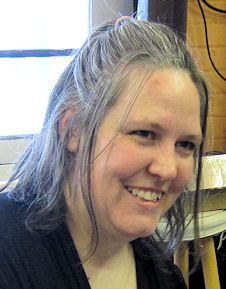
Rhonda Parrish’s “Bedtime Story” delicately balances darkness and the otherworld.

CA: Fairy tales that go back centuries have heroes, or the little man who triumphs over greater odds. Whether it is a simple hobbit and a powerful ring, Jack and the Beanstalk or Harry Potter and Voldemort, it is the will or intelligence that perseveres. Your character is connected to just such a tale, yet she does not directly face those greater odds. Why did you choose to approach it from this angle?
I feel bad because I’d love to have a deep philosophical or some sort of incredibly clever reason for choosing to approach this story from the angle I did, but the truth is, I felt that if I took a more direct route to tell the story, if I picked a different point of view, for example, then it would end up as a novel. At that point in time I didn’t want to write a novel, I wanted to write a short story, so I decided to tell it from Clara’s point of view.
CA: What themes are you exploring right now and will we see Clara again?
I’m working on a large variety of projects these days, with diverse themes. One idea which seems to come up again and again however is that things are not always what they seem. And, when I think about it, I suppose that might be one of the things I was touching on with “Bedtime Story.” Maybe.

As for Clara… I’m not sure. I would love for you to see her again, I’m pretty fond of her, and the world she inhabits so I wouldn’t mind revisiting it. I guess we’ll just have to wait and see if the sandman decides to bring me any more nocturnal inspiration.
Rhonda Parrish is a master procrastinator and nap connoisseur but despite that she somehow manages a full professional life. She has been the publisher and editor-in-chief of Niteblade Magazine for over five years now (which is like 25 years in internet time) and is the editor of the forthcoming benefit anthology, Metastasis. In addition, Rhonda is a writer whose work has been included or is forthcoming in dozens of publications including Tesseracts 17: Speculating Canada from Coast to Coast and Imaginarium: The Best Canadian Speculative Writing. Her website, updated weekly, is at http://www.rhondaparrish.com
Twitter: https://twitter.com/RhondaParrish
Facebook: https://www.facebook.com/rhonda.parrish.31
Filed under: entertainment, fairy tales, fantasy, horror, myth, people, Publishing, Writing Tagged: Albertan authors, Bedtime Story, fairy tale, fantasy, myths, other worlds, Peter Pan, Rhonda Parrish, Tesseracts 17