
Andrew Scott's Blog, page 29
October 7, 2014
On the Term "Graphic Novel"
Here’s an interesting—albeit imperfect—piece by Brenna Clarke Gray about a term that has essentially run its course: graphic novel. Coined by Will Eisner during his early efforts to legitimize the medium in which he supremely excelled, graphic novel is problematic for a number of reasons. Like Gray, I die a little inside when someone refers to a work of nonfiction as a novel, graphic or otherwise. I especially bristle when a personal narrative or work of literary journalism is called a “nonfiction novel,” and yes, that means I hate that Truman Capote used the term for In Cold Blood.
In principle, I agree with Gray’s thesis; I also prefer the term comics. I have for twenty years, since picking up a signed copy of Scott McCloud’s Understanding Comics on the day of its release. Her call to action is one I can support. Graphic novels should not be the all-purpose term we use to discuss a rich and diverse medium.
Personally, I’ve never heard anyone refer to the collected editions of single-issue comics as “trade papers,” though. Trade paperbacks, yes. Even trades, as in, “I’m waiting for the trade,” which is the practice of not buying a comic until its first four, five, or six issues are collected into one edition.
She argues that such language devalues “the episodic nature of [comics],” which is an important distinction. “When you call something like The Walking Dead a graphic novel,” she continues, “you’re eliding the episodic nature—and by extension, the changes in artists, writers, and other personnel that come with it.”
Very true. But I wish she had chosen a better example. Artist Tony Moore left after six issues, and Rus Wooton began lettering the book about five issues later. But since then—for well over 100 issues, which is forever in the life of a comic book series—there have not been many changes regarding “the artists, writers, and other personnel” working on The Walking Dead.
Gray’s point that “we privilege the literary, and we like [comics] that are more like the literary forms” we already know is incredibly smart. I could read another essay solely about this point, to be honest, as it explains the rather swift canonization—in the academy, if not in the world of comics readers and creators—of books like Maus, Persepolis, and Fun Home. The latter two, in particular, seem to have benefitted from the memoir boom of the early- to mid-2000s.
But the guy in the comments who says that graphic novel is the “snotty equivalent of ‘literary fiction’ in the prose world” is just dumb. Literary fiction is a genre, not a gussied-up attempt to make “regular” fiction seem fancy.
I love reading comics scholarship and anything remotely like it—the history of the medium or certain companies, biographies of creators, and the like. In some parallel universe, there’s a version of me who never became a writer because of comics, but who instead found a way to study them in an academic context.


September 14, 2014
Adam Wainwright and Matt Holliday prepare for the upcoming...
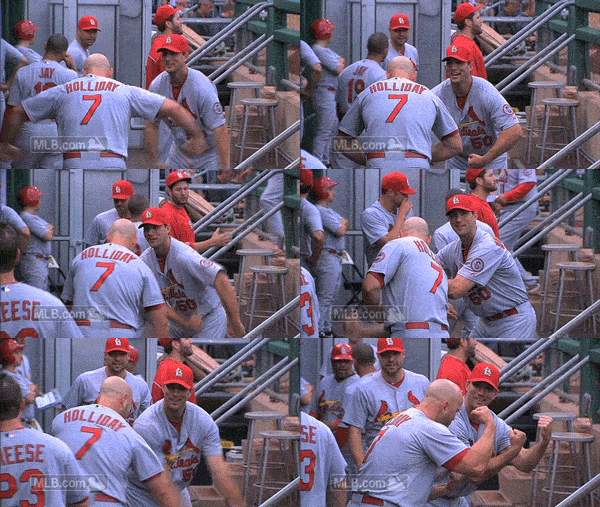
Adam Wainwright and Matt Holliday prepare for the upcoming academic job season. Or the World Series. One or the other.
"Readers kept saying, ‘Is Rainey going to get her own book?’ But I was busy trying to..."
- Dylan Landis, interviewed by Jessica Anya Blau for The Rumpus
September 5, 2014
"With me, everything begins with writing. No pictures at all—you just shut the Polaroid off; you..."
- Maurice Sendak
August 26, 2014
"When difficult things can’t get done, it’s too bad. When easy things can’t get..."
- Richard Russo, Straight Man
August 24, 2014
"Writing is not measured in page counts, I now believe, any more than a writer is defined by..."
- Bill Hayes, “On Not Writing”
August 16, 2014
Interview-in-excerpts
I did an interview using excerpts from Naked Summer for my answers—something the website was doing at the time, but they decided not to share my responses, or lost the damn thing, or whatever. After unearthing the interview in a folder today, I decided to share it here.
1. What is writing like?
The pole flexed and bent, but he got nowhere. He waded into deeper water, still winding the line, but the fish didn’t budge.
2. What isn’t writing like?
Then all three of us left for the bar.
3. When you do it, why?
Above all, he’d keep quiet and to himself and try to forget this, and work to be different than the adults he knew. Nothing had been decided, he reminded himself. He couldn’t give up just yet.
4. When you don’t, why?
I could have made better decisions, like quitting my job and finding another kind of living. I felt as pinned as the downed phone lines along the road, caught under a sequence of bad choices.
August 10, 2014
Amazon wants readers to write to Michael Pietsch! GLADLY.
Dear Mr Pietsch
I write to you as a reader, at the behest of Amazon. Also as a writer, a sometime tech journalist, a former antiquarian bookseller, and as a student of publishing and copyright history.
I beg you to refuse to negotiate with Amazon, now or ever. Don’t do it!
…
August 7, 2014
Andrew Scott's Blog

- Andrew Scott's profile
- 9 followers

