
Andrew Scott's Blog, page 31
June 17, 2014
"Meeting a writer is always a letdown. They’re never as interesting as their work. If they..."
- Robert Boswell, Tumbledown


June 5, 2014
Comic Book Scripts
I once desperately wanted to know how to write a comics script. What did they look like? How were they formatted? When I finally got the chance—one of Neil Gaiman’s scripts in the back of a collected edition of Sandman—it was actually a *bad* thing for me as a budding writer, though I wouldn’t know it for many years. There aren’t a lot of required formatting and other conventions in comics scripts (unlike screenplays), but Gaiman’s are very atypical, and are thus not good models. He learned from Alan Moore, of course, who is famous for writing 4-5 pages of narrative description for each comic book page. (Dave Gibbons, the artist on Watchmen, just highlighted the one line or detail he needed to illustrate in each panel and ignored the rest.)
Now, seeing a Warren Ellis script in the back of The Planetary Omnibus, I really wish I didn’t have access to writers’ scripts. Ellis uses a semicolon instead of a colon—and not in sentences, but to indicate a character’s dialogue.
He’s one of the best comics writers. There’s a documentary about him. How can he make such a mistake? Or is it some weird stylized choice? If so, who cares about style in a script that is mostly not seen by readers?
Maybe it doesn’t matter. Maybe all that matters is the finished comics page, after an editor (and the letterer) have had their hands on the words.
It’s like finding out there are pig lips in your sausage. It’s disgusting, but sausage still tastes good. Just focus on the product you consume, not the process of how it’s made.
June 2, 2014
I made this. Killer broth.
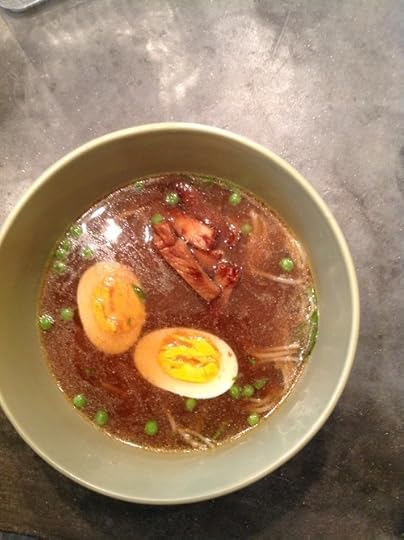
I made this. Killer broth.
The Other Things We Do: Cooking
I can’t remember if I ever shared this post I wrote when Sherrie Flick invited writers to explore “the other things we do” besides writing. I’m part of an AWP panel that Sherrie proposed—I hope it gets accepted. I like writing and talking about food.
Editing/Publishing is a Tough Business
Here’s a nice post from Bryan Furuness, who apparently ended his Facebook fast in order to share this with all of you. Isn’t he generous?
Lots of quote-worthy lines in Bryan’s post, but I’ll excerpt the middle of it below to entice you to read it. Pressgang’s first single-author title (after an anthology) is out now, for a total of two books in the three years since Bryan first asked Victoria Barrett for advice about starting a press. She’d been doing Engine Books for about six months at that point, plus a year of planning before the official launch of EB.
I started Lacewing Books, the YA imprint at Engine Books, in the summer of 2012, and I can relate to a lot of what Bryan says. The first two Lacewing titles will be released in the next four months, with a third coming out in March. (Lacewing will only publish two titles a year for the time being.)
Here’s part of what Bryan had to say after receiving 378 contest entries for the Pressgang prize:
I’m going to be turning down a lot of worthy work, saying no to a long line of deserving writers.
This is hard. It doesn’t stop being hard.
Harder than I expected it to be when I started Pressgang a couple of years ago. By that point I’d been an editor of lit mags for several years. I wasn’t exactly callous about rejecting stories, but I accepted it as part of the business.
It’s different with books.
With a story, you’re talking about something that has taken the writer weeks or months. Not a small amount of time, but not her life’s work, either. Plus, the writer probably has more stories lying around. The writer has diversified. With a book, you’re talking about years. Decades, sometimes. One basket, so many eggs.
I don’t send rejections lightly, is what I’m saying. I feel every one.
The older I get, the tougher my skin and the softer my heart. Taking rejection for my own work doesn’t sting like it used to, but every year it’s harder to send them out.
If I ever quit this business, it will be because I can’t send out one more rejection. Empathy is degenerative.
Very true. And yet, I feel better after reading Bryan’s words, in part because my editorial experiences are somewhat similar.
As an editor at Freight Stories, an online fiction journal, I’ve had to reject plenty of story submissions by some of the best writers in the country—authors who maybe didn’t send their best work, or who sent a novel excerpt that just didn’t make a whole lot of sense on its own, or who, in a few cases, expected us to say “yes” solely because of the writer’s reputation. I could list just 20 of the known and respected authors we’ve rejected in alphabetical order and tell you that it’s the list of authors included in the next Best American Short Stories and you wouldn’t be blamed for believing me.
And Freight Stories—which will see its ninth issue published online later this year, and a tenth and final issue in print after that—is an online journal that doesn’t pay. Why, then, have we received so many submissions from excellent authors, including the many we’ve accepted?
My guess is that these writers want editors. Writers need editors. Sure, writers also want their books (and stories) to be published, but a publishing a book without a good editor involved doesn’t feel right. That’s a lesson I’ve learned as a writer, but also something I’ve observed from the editor’s desk, and from speaking with dozens of authors I respect.
I haven’t had to say “no” nearly as often in my work at Lacewing and Engine Books, because it’s still Victoria’s company, first and always, though I’ve had to decline a number of story collections for various reasons, including manuscripts I knew would easily find a home elsewhere. Lacewing hasn’t started accepting submissions—though we will soon—but even still, a few writers I know have asked me to consider their YA manuscripts, or their friend’s manuscript. I’ve mostly had to reject these queries or submissions.
As editors, we say “no” a lot. Some of that has to do with the shifting economies of literary publishing in America. Story collections, we’re told, don’t make a lot of money for the big publishers, so they publish fewer of them, which means excellent collections by some of the best writers may end up at small presses and university presses.
Bryan says previous winners and finalists for most of the major story collection contests are among the large list of Pressgang contest entries. I’m not surprised, as we’ve seen a lot of them at Engine Books, too. Pressgang is a new press. Bryan is a fine editor, but Pressgang has only brought one single-author book into the world, so I don’t know how many of those entrants are thinking about the chance to work with Bryan, though they’d be lucky to do so. For 378 authors to pay a fee for their manuscripts to be considered by a promising-but-still-brand-new press means that, more than ever, the burden of supporting new and not-yet-forgotten voices has fallen to smaller presses that are always in need of more resources: more money, more readers, more time.
A small press supported by a university, like Pressgang, might have an easier time finding resources and money. Or maybe not, depending on the university. Either way, though, many of the best and most promising small presses today are operated by a small team of dedicated and hard-working individuals—maybe just one person, even, and usually no more than five. Most of them will not draw even a partial salary. A lot of writers and readers assume small presses are non-profit organizations, but most are not. Not making a profit—even by design, say, in the case of throwing back any profits into the expansion of the small business, or back into the promotion of existing or forthcoming titles—is not the same as being a non-profit, after all.
These necessary endeavors need our support. It starts with buying the books published by good and promising small presses. I happily bought the first Pressgang release at AWP two years ago, and I’m going to order the current release this week. I own three of the four releases from . I became an early supporter of A/SO, getting a t-shirt right after I sent my money and their first two titles later, upon publication. I’ve bought several titles from Queen’s Ferry Press, including a few hardcovers. And I’ve backed interesting endeavors in every Kickstarter category, including book (and comics) publishing.
For the record, and despite what you might see in articles about publishing, publishers like Graywolf should not be considered a small press. Buy their books, too. They’re usually excellent. But don’t think that you’re supporting small presses by doing so.
I’m sure there are other examples and worthy presses I could name, but you get my point: If you’re one of the 378 authors who paid a fee to enter Pressgang’s contest (or if you’ve entered any of the other contests—the O’Connor, the AWP prizes, the Iowa one, or whatever), then I hope you’re also buying at least a few books from those publishers.
I support them by submitting my manuscript and paying the contest fee, you might say. Fair enough. But what happens when you actually win one of these contests? Another lesson I’ve learned from the editor’s desk is that getting your book accepted is really just the beginning.
Writers want editors, yes. But they also want readers.
May 19, 2014
Detail from a page in a book-length project I’ve...
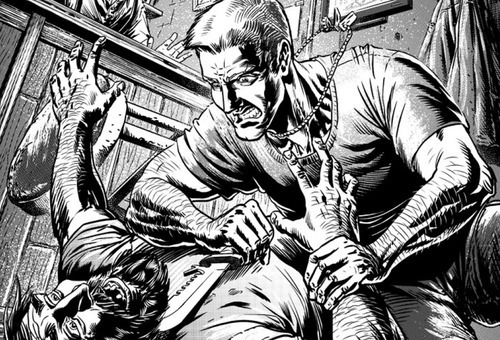
Detail from a page in a book-length project I’ve co-written with Bryan Furuness. Art by Shamus Beyale.
May 18, 2014
"There is this feeling that artists have—photographers, more than other people, and writers—that they..."
There is this feeling that artists have—photographers, more than other people, and writers—that they are acting like a succubus … this process of taking from something that’s alive and using it for one’s own purposes. You can do it with trees, butterflies, or human beings. Making a little life for oneself by scavenging other people’s lives is a big question, and it does have moral and ethical implications.
In fiction, I feel the most intelligent, and the most free, and the most excited, when my characters are fully invented people. That’s part of the excitement. If they’re based on somebody else, in a funny way it’s an infringement of a copyright. That person owns his life, has a patent on it. It shouldn’t be available for fiction.
”- Toni Morrison
May 16, 2014
"A comic script is basically a love letter from you to your artist."
- Brian K. Vaughan
April 13, 2014
"I disavow any essential connection between my life and whatever I write. I think it’s a morbid..."
- John Updike
April 12, 2014
Andrew Scott's Blog
- Andrew Scott's profile
- 9 followers

