
Andrew Scott's Blog, page 33
December 2, 2013
"Music in writing isn’t like salt in cooking. It’s not just there for flavor. It has to be..."
- Dylan Landis, author of Normal People Don’t Live Like This


November 29, 2013
Panel 7: “Criminals are a superstitious, cowardly...
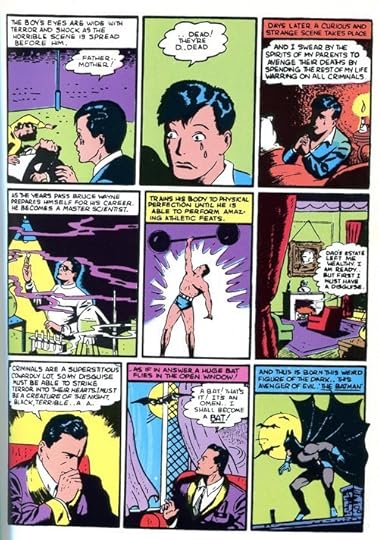
Panel 7: “Criminals are a superstitious, cowardly lot…”
Panel 8: “A bat! That’s it! It’s an omen…”
November 25, 2013
"Pizza is My Business," by Matt Fraction and David Aja, et al.,...

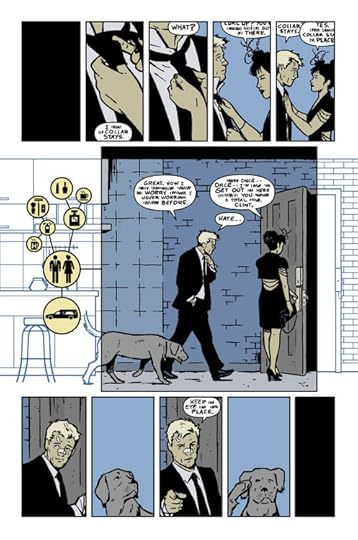
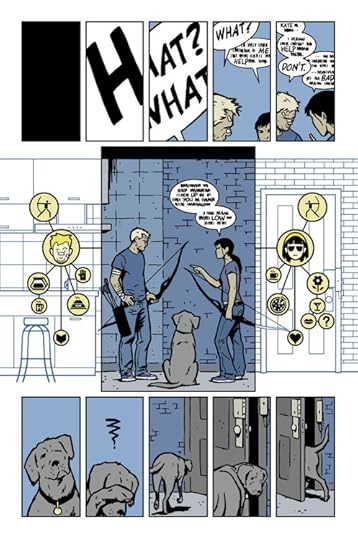
"Pizza is My Business," by Matt Fraction and David Aja, et al., in Hawkeye #11 (Marvel Comics, 2013), possibly the greatest single issue in the history of superhero comics (maybe non-superhero comics, too)—it’s like Chris Ware with heart.
November 18, 2013
"Anything too stupid to be said is sung."
- Voltaire
If I could draw like Adrian Tomine, I would never write again.
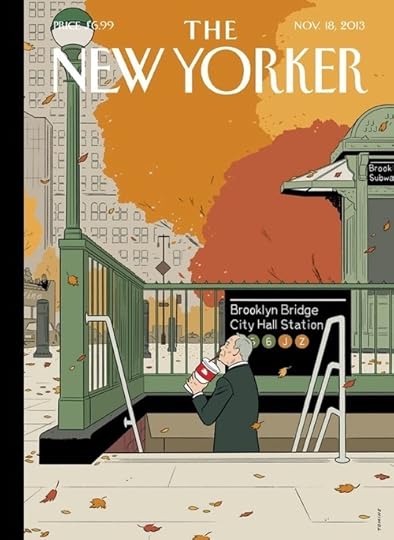
If I could draw like Adrian Tomine, I would never write again.
Recent comics (often more than one issue per title) purchased at my favorite comic book store, Alter...
Recent comics (often more than one issue per title) purchased at my favorite comic book store, Alter Ego Comics in Muncie, IN:
Letter 44
God is Dead
The Massive
Pretty Deadly
The Fox
Saga
Jupiter’s Legacy
Coffin Hill
Hawkeye
Hinterkind
FBP: Federal Bureau of Physics (formerly Collider)
The Star Wars (based on George Lucas’s original rough draft)
The Witching Hour
The Wake
Wraith: Welcome to Christmasland
Daredevil
Recent Comixology purchases:
Fishtown
Torpedo, vol. 1
Winterworld
From Hell (which I already owned for the Kindle, apparently)
Womanthology: Space
The Bunker
Batman
The Walking Dead
Insufferable
Recent comics (often more than one issue per title) purchased at my favorite comic book store, Alter...
Recent comics (often more than one issue per title) purchased at my favorite comic book store, Alter Ego Comics in Muncie, IN:
Letter 44
God is Dead
The Massive
Pretty Deadly
The Fox
Saga
Jupiter’s Legacy
Coffin Hill
Hawkeye
Hinterkind
FBP: Federal Bureau of Physics (formerly Collider)
The Star Wars (based on George Lucas’s original rough draft)
The Witching Hour
The Wake
Wraith: Welcome to Christmaland
Daredevil
Recent Comixology purchases:
Fishtown
Torpedo, vol. 1
Winterworld
From Hell (which I already owned for the Kindle, apparently)
Womanthology: Space
The Bunker
Batman
The Walking Dead
Insufferable
November 13, 2013
Books I Taught in a First-Year Course from 2008-2011 (Three Semesters)
Adrian Tomine, Shortcomings
August Wilson, Fences
Barb Johnson, More of This World or Maybe Another
Barbara Shoup, Everything You Want
Bonnie Jo Campbell, American Salvage
Brady Udall, The Miracle Life of Edgar Mint
Brian K. Vaughan, et al., Pride of Baghdad
Cathy Day, The Circus in Winter
Christopher Coake, We’re in Trouble
Colum McCann, This Side of Brightness
Daniel Woodrell, Winter’s Bone
Donald Ray Pollock, Knockemstiff
Dylan Landis, Normal People Don’t Live Like This
Eugene O’Neill, Long Day’s Journey into Night
Junot Diaz, Drown
Junot Diaz, The Brief Wondrous Life of Oscar Wao
Lorraine Hansberry, A Raisin in the Sun
Louise Erdrich, Tracks
Marie Howe, The Kingdom of Ordinary Time
Patricia Henley, Hummingbird House
Paul Harding, Tinkers
Paul Yoon, Once the Shore
Per Petterson, Out Stealing Horses
Tim O’Brien, The Things They Carried
Tracy Winn, Mrs. Somebody Somebody
November 9, 2013
A Cautionary Tale
I know a comic book penciler who recruited an art school friend to ink his book. He promised to pay the friend if the book made money. After the book came out, the penciler was able to quit his day job. The book was optioned by a film production company — not for crazy money, but for something, at least. The penciler got more work drawing comics. He now works on a TV show.
The inker inked 108 pages and two covers, designed the book’s logo, and painted two covers (it was a 4-issue series), including the cover now used for the trade paperback. Did the penciler ever pay the inker, his supposed friend? Come on, now. You know nobody likes happy stories.
The writer is now a rising commodity at Marvel, but the writer wasn’t the inker’s friend. The writer didn’t make a promise with his art school buddy that he never intended to keep. I don’t imagine the writer knows much about this friendly arrangement, especially because the inker does not want to talk about it. Can you believe that? He’s like a Samurai inker with an honor code.
But let’s pretend we live in a world where the penciler, realizing that the career and life he now has was launched, in part, by taking advantage of a friend, has a change of heart and decides to do the right thing — the decent, bare-minimum thing — and honor his promise by sending his friend a long overdue check. How much should he send the inker, given the 108 pages of inks, two inked covers, two painted covers, and a logo design?
Here’s my proposal:
$10/page for inks (very low, but let’s be realistic) for 108 pages and two covers
$50 each for painted covers
$50 for logo design
Again, these are appallingly low rates. But let’s say the penciler gets the “friends rate” and move on.
That’s $1,250. Do you have a better number?
November 1, 2013
Ashley Nickell, a student at Columbia College Chicago—a terrific school in one of my favorite...
Ashley Nickell, a student at Columbia College Chicago—a terrific school in one of my favorite cities—interviewed me last spring for a class project.
1. What drew you to work as an editor for Engine Books and Freight Stories?
My first experience with literary editing came while I was at Purdue University. I helped run the undergraduate literary magazine, and then became the first undergraduate intern for Sycamore Review, a national literary journal put together by the MFA students there. In graduate school at New Mexico State, I volunteered to read fiction manuscripts for Puerto del Sol, which morphed into sharing the managing editor position with Victoria Barrett for two years.
Victoria and I wanted to start our own fiction journal in 2004-05 because we missed working closely with writers and helping them make their stories better, but it just didn’t seem possible, financially, to start a print journal. In 2008, after we’d married and bought a house, we launched Freight Stories, an online fiction journal. Victoria started Engine Books in 2011, and I joined Engine Books about eighteen months later as Senior Editor. I like editing for a number of reasons. It’s an intense kind of reading, and I like reading more than just about anything. Editing gives me a chance to be useful, too, whereas most of my time as a writer is frustrating. I’ve always been a better reviser than composer.
2. How does being a writer help you with your work in publishing?
They’re closely related. Whether you’re a writer or not, as an editor, you have to be able to convince writers that you know what you’re talking about. A lot of agents and editors studied in MFA programs and stopped writing. At the very least, you have to understand what writers go through, and how to talk with them.
3. What is some advice you can give to emerging writers?
Read at least one book a week—literary fiction, genre fiction, poetry, essays, literary journalism, graphic novels, plays. I do wish I had written every day for the last 10 years. That’s advice I wish I had taken. People say you need to write every day, but it’s not true for all writers. One of my mentors writes every day; his wife writes in bursts. They both have more than 10 books each, so you just have to find what works for you.
Also, find two or three friends with whom you like to discuss books, whether they’re writers or not. And maybe this goes without saying, but emerging writers should buy books, too. Support other writers, however you can. Track down their work in literary journals. Write a fan letter now and then. Attend literary readings. Read your own words in public. Don’t focus on your “career” right away—just keep writing. Find Ted Solotaroff’s essay, “Writing in the Cold: The First Ten Years,” and read it once a year to steel yourself, and for comfort. Read craft books by writers whose work you admire; don’t worry too much about writing-related books that are focused on how to publish, how to write a bestseller, and so on. Charles Baxter’s Burning Down the House, Debra Spark’s Curious Attractions, and Robert Boswell’s The Half-Known World are all excellent books for the emerging fiction writer.
4. What is some advice you can give to someone wanting to work in publishing?
Take literature courses, as well as professional writing courses.
Learn something about typesetting and designing covers—even if you won’t do that work later, you’ll have a greater appreciation for it and know how to talk to people you’ll work with. Find an internship with a mid-major publisher, such as Graywolf or Algonquin, because you’ll likely get the best of both worlds: lots of exposure to every facet of the industry, but in an environment that is more conducive to experiential learning. If that doesn’t work, volunteer or intern wherever you can. With submissions management software and Google Chat /Skype, readers for a literary journal can live anywhere.
5. How do you balance editing, teaching, and working on your own writing?
I’m better when I’m busy. It’s a reason to get out of bed in the morning, or to get off the couch. Things in motion tend to stay in motion.
6. Do you have a routine or schedule for writing time?
I don’t, but I plan to start one soon. Next week. Or maybe the week after that. I swear.
7. What are some goals you have set for yourself as you continue on in writing and/or publishing?
As a writer, I have plans for more books than I’ll likely ever write. That’s just how my mind works. As an editor, I have high hopes for Lacewing Books, our new literary YA imprint, which will begin releasing titles in 2014. Taking the long view, I’d also love to edit a book that wins a major prize. But mostly I look forward to working with serious writers and finding ways to help them more fully realize their books, especially gems that may have been overlooked by the biggest publishers.
Andrew Scott's Blog

- Andrew Scott's profile
- 9 followers

