
David W. Tollen's Blog, page 7
January 14, 2018
Persian Rule Might Have Been Good for Greece (So “300” Got it Wrong)
During the early 400’s BC, an alliance of plucky little Greek city-states beat back an invading superpower. Athens, Sparta, and their allies defeated the Persian Empire twice, in fact. Westerners often see the Persians’ defeat as a victory for freedom. The Movie “300,” for instance, casts the Greeks as freedom-fighters who saved Europe from an Asiatic slave empire. But “300” is about as accurate as “The Wizard of Oz” (or worse, “Braveheart”). What would Persian rule actually have looked like?
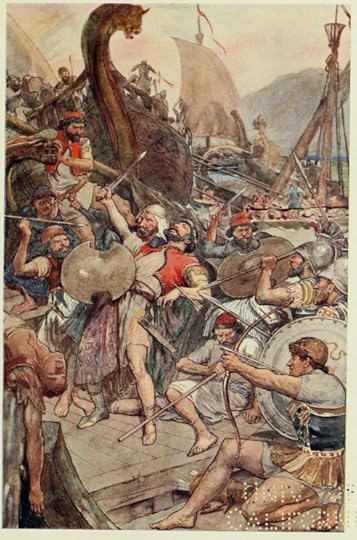
The Persian admiral dies at Salamis
The Persian Empire generally let its subjects govern themselves, and it encouraged local religion and art. So the Persians probably would not have crushed Greek culture or disrupted city government. In fact, Persian rule might have been good for ancient Greece, in at least four ways:
The Persians might have spread democracy in Greece. The Persian Empire didn’t conquer mainland Greece, but it did rule the Greek city-states in what’s now western Turkey. There, the Persians recognized the Greeks’ dislike of tyrants (dictators) and replaced them with democracies. So they probably would have encouraged democracy in mainland Greece too. With more Greek city-states as models, like Athens, democracy might have taken root faster in Western Civilization.
Any harm done to Sparta would have been a victory for freedom. Sparta was a slave society, and during the centuries after the Persian Wars, the Spartan citizens became some of history’s most brutal masters. Ancient sources say the Spartan citizens regularly humiliated, attacked, and killed their serf/slaves, the helots. Every year, Sparta declared war on its own helots, which meant young citizens could kill them. (FYI, some historians think the ancient sources exaggerate Spartan brutality.) Sparta had more helots than the citizens, so fear of slave revolt probably led to the city’s military culture. Defeat by the Persian Empire might have weakened Sparta’s system of state-sponsored terrorism.
The Persian Empire would have given Greek ideas an information super-highway. The Persian Empire connected three continents with a network of roads, travelers’ inns, couriers, and shared languages and writing systems. It spread ideas across more than 2.5 million square miles. Greek culture took advantage of that network of information after Alexander the Great conquered the empire in 330 B.C.E. Persian conquest of Greece during the early 400’s would have started the process earlier.
Persian rule would have prevented the Peloponnesian War. Between 431 and 404 B.C.E, Athens and Sparta fought a devastating war, each leading an alliance of Greek city-states. Athens lost the Peloponnesian War, and both sides suffered staggering losses. But membership in the Persian Empire would have made the war impossible. Freed from that awful conflict, Greek culture could have reached heights we can’t imagine. And Athens might have retained its position of leadership and the chance to develop and spread democracy.
—————–
—————–
Painting: The Death of the Persian Admiral at Salamis, by William Rainey — provided through Wikimedia Commons
© 2018 by David W. Tollen.
The post Persian Rule Might Have Been Good for Greece (So “300” Got it Wrong) appeared first on DavidTollen.com.


January 13, 2018
Teaching Center: News from the Turbo-Charged World of Education
This is how the world should work …
The post Teaching Center: News from the Turbo-Charged World of Education appeared first on DavidTollen.com.
January 11, 2018
New Blog at DavidTollen.com!
I have created a new bog at DavidTollen.com! It will offer articles on history, just like Pints of History, but they’ll be more focused on student readers, particularly in high school, middle school, and college. The DavidTollen.com blog will also feature articles for teachers, school librarians, and home-schoolers — all about teaching history.
You may see some familiar posts at the new blog, because occasionally, I’ll recycle a post from Pints of History — though always updated for the most recent historical thinking and edited for young readers.
I hope you’ll come visit and subscribe!
The post New Blog at DavidTollen.com! appeared first on Pints of History.
Who Thought Up Dog Domestication, People or Dogs?
Some scientists think prehistoric people created the dog by adopting wolf pups and breeding the friendliest of them. But a more recent theory says humans were basically bystanders in dog domestication.
 WARNING: Do Not Pet the Wolf
The Trouble with Adopting a Wolf
Scientists generally agree that Stone Age people domesticated the dog 10,000 years ago or more — possibly much more. But how? The traditional wolf-breeding theory has a problem. Why would anyone ever keep an adult wolf: a animal old enough to breed? It doesn’t matter how carefully you choose the friendliest puppy or how much you love it and train it: your pet will grow into a large, frequently sullen, relatively unpredictable, and always dangerous predator. Have you ever seen a two-year-old grab a dog’s ears and pull? Did you cringe and hope Fluffy wouldn’t bite? What if Fluffy were a full-grown wolf? Would the toddler even survive? Plus, how would Stone Age people tell a full-grown wolf where to go or whom to breed with? And keep in mind, these alleged dog domesticators had no tranquilizer guns, shock collars, chains, or even metal tools or weapons.
Did Wolves/Dogs Adopt Us?
The newer idea is that, at some point, wolves began following human hunter-gatherers to scavenge leftover meat. Among these “camp wolves,” the animals least afraid of humans would usually get the meat first. So these less fearful wolves ate more, survived longer, and had more pups. That’s it: that’s the whole evolutionary story behind dog domestication, just about. Selection for that one feature, low fear of humans, led to a cascade of other changes. Those include shorter noses, curled tales, floppy ears, patches of white fur, puppy-like playfulness, and a tendency to bark when excited — not to mention a submissive, tail-wagging love for Homo sapiens — all without a trace of wolfish dignity. Those doggy traits appeared because they’re governed by the same hormones that reduce avoidance and fear.
I imagine a few outcast wolves: without packs. They cope by following humans around, scavenging garbage and rushing in for scraps as soon as human hunters finish butchering a kill. The humans tolerate them because, well, there are always scavengers, and these camp wolves sometimes scare away more dangerous animals. Over many generations, the two populations grow closer and even cooperate in the hunt. All along, the camp wolves that fear humans least eat most and have the most pups. By the time adult animals literally move into the camp, natural selection has already turned them into dogs.
What Russian Foxes Have to Say about Dog Domestication

You’re dying to pet this domestic fox, right?
Whichever theory is best, we’ve seen how the genetic/evolutionary change probably worked. In 1959, Russian scientists in Siberia began a multi-decade experiment with foxes. From a group of animals kept for fur, researchers bred the foxes least afraid of people. After ten generations, the experiment had transformed a fifth of the foxes. They had shorter noses, curled tails, floppier ears, white patches, and puppy-like playfulness — and they’d become submissive tail-waggers who love, love, love human beings.
In other words, selection for low fear of humans created a new dog-like creature. In fact, you can adopt one of these Russian foxes, and they make great pets — unlike all other foxes all over the world.
—————–
—————–
Wolf photo: Grey wolf in Bavarian Forest National Park, courtesy of MrT HK through Wikimedia Commons.
Fox photo: A Russian domesticated Red Fox with “Georgian White” fur color, by Kayfedewa through Wikipedia.org.
© 2018 by David W. Tollen.
The post Who Thought Up Dog Domestication, People or Dogs? appeared first on DavidTollen.com.
January 8, 2018
Welcome to the Blog at DavidTollen.com!
Welcome to the blog at DavidTollen.com!
This blog offers:
Ideas for teaching history at the high school and middle school levels, and sometimes in college; and
Articles on history: tales from the past that I think will particularly appeal to students.
All posts will be categorized by time period and by whether they’re meant for teachers or students or both.
FYI, teachers can find more resources at our Resources for Teachers page. You can also find older versions of some of the articles at my other blog, Pints of History, though the versions here will likely appeal to students more.
Please enjoy, and please tell a friend — particularly teachers, students, home-schoolers, and school librarians!
/David
The post Welcome to the Blog at DavidTollen.com! appeared first on DavidTollen.com.
December 5, 2017
Ancient History Encyclopedia
There’s a great website out there, and if you don’t already know about it, you should. It’s Ancient History Encyclopedia: https://www.ancient.eu/. It’s a curated resource on history, with short, user-friendly articles on a vast array of topics. And it’s more reliable than most online encyclopedias, since the articles follow academic standards and are reviewed by a dedicated team of editors.
In 2016, AHE won the eu Web award for education. Check this out:
AHE has arguably outgrown its name, since its content has moved out of ancient times into the middle ages (Byzantium, etc.). So the site may have what you need, even if it’s not strictly ancient history.
I’m very proud to serve on Ancient History Encyclopedia’s Board of Advisors.


September 6, 2017


June 29, 2017
George Washington and the Dignity of the Presidency
[image error]George Washington infused the American presidency with his personal dignity and restraint. That may seem a hazy contribution, but it has shaped our nation. “President” was a new title for a head of state in 1789, and no well-known republic had ever created such a strong one-man executive. America’s presidency could easily have become a sleazy office known for naked power, with none of the royal charisma the Eighteenth Century expected. Such a graceless office might have degenerated into a banana republic strongman’s post. Or America might have suffered the sort of “citizen leadership” that destroyed the French Revolution, with executives relentlessly accusing and slandering each other. But no. Our first president was another sort of man.
“A deportment so firm, so dignified, but yet so modest and composed, I have never seen in any other person,” said James Monroe of George Washington. Other contemporaries agreed, including Abigail Adams, who said: “He is polite with dignity, affable without formality, distant without haughtiness, grave without austerity, modest, wise, and good. These are traits in his character which peculiarly fit him for the exalted station he holds ….” But Washington’s dignity did more than comfort his followers. As David Brooks wrote in 2009: “Washington … came to personify what you might call the dignity code. The code was based on the same premise as the nation’s Constitution – that human beings are flawed creatures who live in constant peril of falling into disasters caused by their own passions. … The dignity code … commanded its followers to be reticent — to never degrade intimate emotions by parading them in public. It also commanded its followers to be dispassionate — to distrust rashness, zealotry, fury ….”
Washington’s example imposed the dignity code on his successors. That’s a key reason America’s presidency succeeded — so much so that republics around the world have copied it, establishing presidencies of their own. And American has enjoyed a limited executive, constrained by respect for justice and law.
Some presidents have followed Washington’s example better than others, but all have embraced the dignity code — until now. Today, President Donald Trump called a journalist “low I.Q.” and “Crazy” in public and said he refused an interview because she, “was bleeding badly from a face-lift. I said no!” The bizarre attack isn’t even true, since Trump gave the interview and the journalist wasn’t bleeding. This is just the latest in a stream of mean-spirited, crass attacks and obvious lies from President Trump. His utter lack of dignity threatens George Washington’s legacy.
—————–
—————–
Sources:
Gilbert Stuart, George Washington (The Constable-Hamilton Portrait), 1797
Monroe: McCullough, 1776, p. 247.
Adams: Cot, Man of Honor, p. 102.
Brooks, “In Search of Dignity,” The New York Times, July 6, 2009
© 2017 by David W. Tollen. All rights reserved.


June 26, 2017


June 11, 2017
A New Timeline — and an Old Brain — for Homo Sapiens
Anthropologists recently made a fascinating discovery: Homo sapiens fossils found in Morocco date back 300,000 years. Until about a week ago, we thought our species reaches back only 200,000 years. The extra hundred grand opens up all kinds of possibilities for how and where we evolved — possibilities anthropologists have hardly begun to digest.
[image error]
Lead researcher, Jean-Jacques Hublin, at the site, Jebel Irhoud, Morocco
Even more interesting, the discovery reveals human beings few of us have ever imagined. These newly-discovered Homo sapiens had faces like ours. Unlike Neanderthals, they’d pass for John and Jane Doe if they walked down the street — assuming they wore hats. They’d need the hats because their skulls and brains were not quite like ours. They were longer and less rounded. In other words, these were full members of our species, sharing our faces, yet with non-trivial differences in their brains. No one knows yet how those differences impacted their minds.
The New York Times has a good article on the discovery, here.
—————–
—————–
Images:
Photo: Jean-Jacques Hublin at Jebel Irhoud (Morocco), pointing to the crushed human skull (Irhoud 10) whose orbits are visible just beyond his finger tip. By Shannon McPherron, MPI EVA Leipzig; licensed through Wikimedia Commons.
© 2017 by David W. Tollen. All rights reserved.





.jpg)

![[image error]](https://pintsofhistory.files.wordpress.com/2017/06/stuart-george-washington-constable-1797.jpg)
![[image error]](https://pintsofhistory.files.wordpress.com/2017/06/hublin_at_jebel_irhoud.jpg)
