David W. Tollen's Blog, page 6
July 6, 2018
The Real Destruction of Atlantis
The ancient Greeks believed an island empire ruled the sea in the distant past. The lords of Atlantis built a mighty civilization, but their pride eventually angered the gods, who destroyed their island with earthquakes and fire, sending it beneath the sea.
Atlantis in Comic Books, Fantasy … and History?
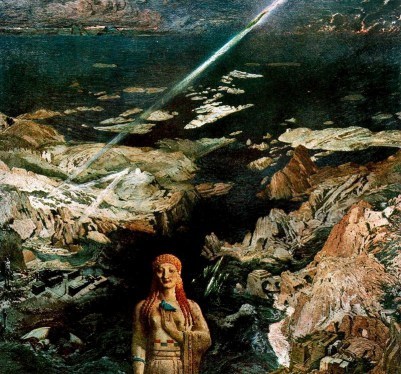
Terror Antiquus by L. Bakst (1908)
The Atlantis myth has fascinated Westerners for centuries, and it often reappears in modern fiction. The superhero Aquaman comes from Atlantis, for instance, which in the DC Comics universe survives as an underwater civilization. And in J.R.R. Tolkien’s writings, Atlantis appears as the island empire of Numenor, which is destroyed for excessive pride but leaves behind the ancestors of heroes and kings from The Lord of the Rings, including Aragorn.
Some scholars think Atlantis is pure fiction, but others think the Greeks got the story from distant history. The leading contender for the real Atlantis is the Minoan settlement on the island of Thera (a.k.a. Santorini).
The Minoans of Atlantis
The Minoans were Bronze Age people who lived on the large island of Crete and built great palaces there. We don’t know what they called themselves, but we use the name “Minoans” because of the Greek myth of Crete’s King Minos. Crete’s palace of Knossos was a giant maze to the more primitive Greeks across the Aegean Sea, and the palace elites enjoyed watching acrobats jump over charging bulls. So real history probably gave rise to the Greek myth of Minos, king at Knossos, and the Minotaur (bull-headed monster) in a maze under his palace.
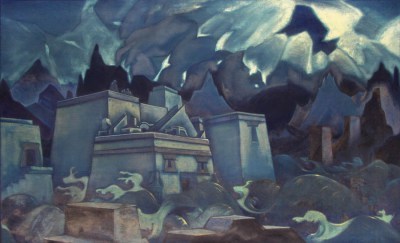
Gibel Atlantidy (The Fall of Atlantis), by N. Roerich (1928/9)
The Minoans built towns on Aegean islands other than Crete, including Thera (modern Santorini), which lies between Crete and Greece. The Minoans of Thera and elsewhere likely dominated the Greeks through sea power, so stories of empires and excessive pride make sense, from a Greek point of view.
Unfortunately for the Minoans, Thera was a volcano. And sometime around 1600 B.C., it erupted spectacularly, sending most of the island beneath the sea and wiping out the Minoan towns there.
So it’s possible that centuries later, the ancient Greeks dimly remembered the disaster of Thera, giving us the Atlantis myth.
This is one of the stories told in my book, The Jericho River! In fact, we just posted an excerpt from the book, involving the Minoan palace at Knossos, in Crete.
© 2018 by David W. Tollen. All rights reserved.
The post The Real Destruction of Atlantis appeared first on DavidTollen.com.


July 5, 2018
New Excerpt from The Jericho River!
We’ve posted a new excerpt from The Jericho River! It’s an exciting scene where Jason and his companions stumble into Minoan Crete — that odd, ancient land hovering between the Middle East and Greece/Europe. And it’s one of many great examples of the book’s use as a supplemental text for social studies classes — at the middle and high school levels — and also as a fantasy adventure, for pure fun.
Please click the chariot below to read the excerpt!
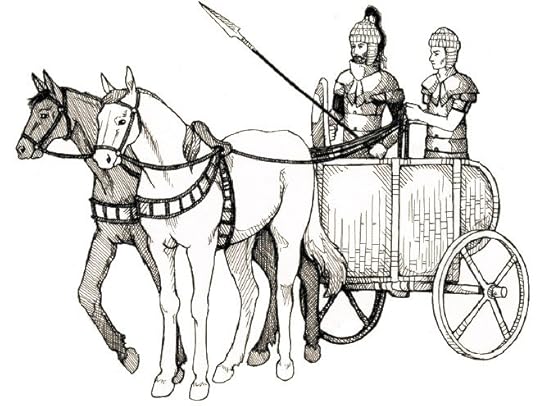
Chariot by Maia Kobabe
The post New Excerpt from The Jericho River! appeared first on DavidTollen.com.
May 8, 2018
Test your history knowledge with this fun, educational, interactive quiz!
I wanted to offer something fun for teachers and students — and for anyone who loves history as much as I do. That’s why I created The Jericho River History Quiz.
It’s an interactive educational experience. Test your knowledge, learn revealing truths, and enjoy the colorful graphics, giving you a window into the past.
If you’re a teacher, use the quiz to add magic to history lessons — to amuse your students and to launch them on an adventure through the past. Offer the quiz as a competitive game — including if you’re about to assign my book, The Jericho River. And please check out the lesson plans and other free tools at my teacher resources page.
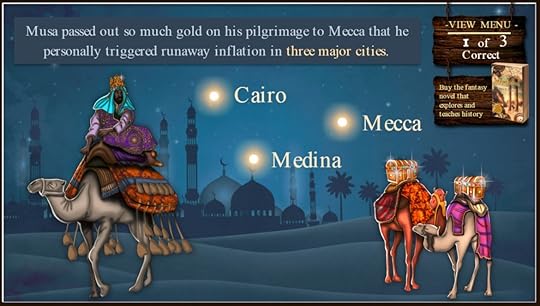
Find out whether you’re an unlettered peasant or a learned philosopher. And learn something new!
Just click here or on the image above. And please share the quiz with your friends!
The post Test your history knowledge with this fun, educational, interactive quiz! appeared first on DavidTollen.com.
May 2, 2018
Turn Your History Class into an Adventure!
My educational edition of The Jericho River has been published, and it’s ready for you to use as a supplemental teaching resource.
In this new edition, you’ll find teaching resources to ignite a love of history in high school, middle school, and college students. You’ll also find a favorite book for your school library. I’ve included:
a curriculum alignment and Lexile score;
chapter questions to foster class discussions;
historic maps, hieroglyphs and other ancient writings, as well as a timeline — all to inspire knowledge and retention;
creative lesson plans to complement required instruction;
beautiful artwork to liven your classroom walls and halls; and
a fun, picture-based quiz to test students’ history knowledge and assumptions.
Why did I write a fantasy novel that teaches the entire history of Western Civilization?
The inspiration came from my childhood reading experience I was an avid fantasy reader who grew to love history. The more I read, the more I saw that real history can look and feel like fantasy — like stories of knights, kings, priestesses, and adventure. Why not weave them together in an engaging story experienced through the eyes of a modern teen — a hero much like any student in your class today?
Build a bridge from the fantasies students love to actual history.
The Jericho River reveals the fun of history: the magic, pageantry, myth, and adventure. It also provides real knowledge of the past. As a social studies teacher, you can use the book to implant or reinforce knowledge you already teach from a textbook. The story follows the chronology of Western Civilization’s history, teaching students who preceded each society and who followed it. It also offers up the colors of each past society: the mighty monuments, glamorous rulers, and common people found in each — along with the mythical creatures. And it’s full of fun facts about the past.
The book is well suited to high school world history and Western Civilization classes and the middle school core curriculum. Use it as a classroom supplement, a summer reading project, or a small group discussion reading assignment. You can also read about Mrs. Rudy Edwards, an innovative Ohio teacher, who used my book in her class. See, Teaching History by Sailing the Jericho River.
I want to help you bring history to life in your classroom. I hope you enjoy teaching with The Jericho River, and I welcome your feedback!
 / David W. Tollen
Thanks for sharing news of my book on Twitter!
Order school curriculum bundles at a discount through Winifred Press or buy it from Amazon, Ingram, and other retailers.
The post Turn Your History Class into an Adventure! appeared first on DavidTollen.com.
March 28, 2018
The Black General in 18th Century Europe
Revolutionary France had a black general.
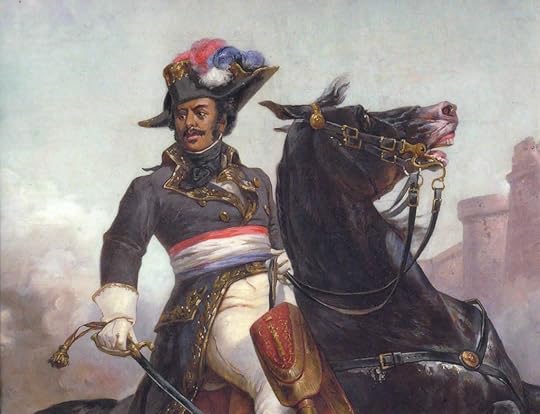
His name was Thomas-Alexandre Dumas, and he was born a slave in Haiti, the son of a French nobleman and his African slave. Dumas’ father had little money and actually sold the boy in 1776, when he was fourteen — but then bought him back. Father and son moved to France, where Dumas gained his freedom and a gentleman’s education. He enlisted as a private in the army at twenty-four. By thirty-one, he had soared to the rank of general — thanks in part to the French Revolution, which created unheard-of opportunities for humble-born men. Dumas led his men to one astounding victory after another. That’s why the Austrians called him the Schwarzer Teufel: the black devil.
Napoleon didn’t like the black general — possibly because Dumas was tall and handsome. So when Napoleon seized power in 1799, Dumas had an enemy at the top. He’d been captured by the Italians and languished in a drafty dungeon, and Napoleon’s government was slow to work for his release. When Dumas finally gained his freedom in 1801, his health was broken. And Napoleon never restored his military career. In fact, the emperor soon reversed the Revolutionary government’s laws on racial equality. That ended the freedom that had made Dumas’ career possible.
Dumas died of stomach cancer in 1806, at age forty-three. He left behind a wife and two children, living in poverty. But Dumas’ legacy lives on. If the name sounds familiar, it’s because the general’s son was Alexandre Dumas, author of The Three Musketeers and The Count of Monte Cristo. General Dumas’ life inspired much of his son’s writing.
—————–
—————–
Painting: Général Alexandre Dumas, by Olivier Pichat (1825-1912)
© 2018 by David W. Tollen. All rights reserved.
The post The Black General in 18th Century Europe appeared first on DavidTollen.com.
February 2, 2018
Teaching History: This is How to Grab Your Students
A little while ago, I wrote an op-ed for History News Network — on how to make history interesting. It’s particularly valuable for anyone teaching history.
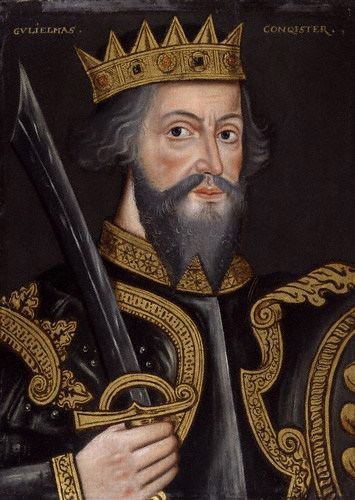
To read the article, please click here or on William the Conqueror below …
The post Teaching History: This is How to Grab Your Students appeared first on DavidTollen.com.
Teaching History: This is How to Interest Your Students
A little while ago, I wrote an op-ed for History News Network — on how to make history interesting. It’s particularly valuable for anyone teaching history.
To read the article, please click here or on William the Conqueror below …
The post Teaching History: This is How to Interest Your Students appeared first on DavidTollen.com.
January 26, 2018
Speaks Yoda Olde English?
Says Yoda things like: “Powerful have you become; the dark side I sense in you.” Sounds it like speaks he English from the olden days — Shakespeare’s English, maybe. Yet uses not Yoda “thou hast” or “erstwhile” or “thee” — or any other term found no longer in English. Old English does not speak Yoda, nor even Middle English. Speaks Yoda Modern English, except that one rule breaks he. That same rule this post breaks too.
 A firm rule has modern English: comes first the subject noun, then the verb, then the object noun. (“SVO” linguists call this pattern, for “subject-verb-object.”) So say we: “Edgar walked to town.” If said we, “Walked Edgar to town” or, “To town walked Edgar,” grammatically wrong would we be. But understand us would most English speakers.
Require many languages a particular noun-verb order, though not necessarily the same as English. More flexible are some languages, however, like German and Dutch — as well as their long-dead aunt, Old English. In Old English could speakers choose their noun-verb order. Lost we that choice, in most cases, in the 11th Century starting. Why that is sounds Yoda so old fashioned. Sounds he like a speaker of Old English, though never uses he old vocabulary.
Actually, a little of our old flexibility keep we English-speakers, even today. Choose can we still between, “Get up!, Mom yelled,” and, “Get up!, yelled Mom.” Also, say we still, “What do you think?” though could we instead say, “You think what?” Not far then from Yoda are we.
—————–
—————–
© 2018 David W. Tollen by
The post Speaks Yoda Olde English? appeared first on DavidTollen.com.
January 16, 2018
The Magic of History – See the Video
A little while ago, I spoke at a TEDx conference — to an audience of smart, motivated high school students. My topic was the magic of history. I told the students many of my favorite short stories from past times. I wanted to reveal history’s endless well of fun, excitement, and humor, and to explain how reading history might enrich the kids’ lives. I think the message here is valuable for both teachers and students. Here’s the video:
(Don’t be confused by the name “David Carthage” on the screen. It’s a former pen name.)
You’ve gotta love the still photo YouTube chose as the “cover” image, in its electronic wisdom. Looks like I’m about to sneeze.
The post The Magic of History – See the Video appeared first on DavidTollen.com.
January 15, 2018
Teaching History by Sailing The Jericho River
A high school teacher in Ohio has done some smart, creative instruction with my novel, The Jericho River. This post describes her lesson-building and offers ideas on teaching with the book — along with links to sample lesson plans — in high school and middle school and at the college level.
The Jericho River Itself
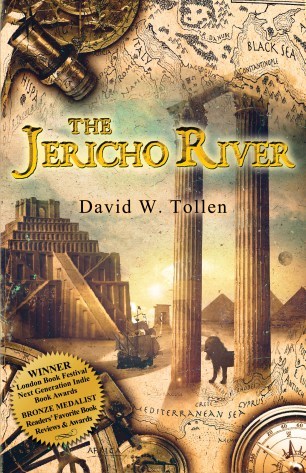 The book is The Jericho River, by David W. Tollen (Winifred Press 2014). It’s a fantasy novel, but it’s also a history. The plot turns a timeline of Western Civilization into a river in another world. The story’s teenage hero travels the river by boat, on a quest that takes him through Sumer, Babylonia, ancient Greece, Medieval Europe, and the other key societies of our past, in chronological order. The text includes short notes about the history behind the story. They tell, for instance, how a humble French lawyer’s son became king of Sweden, as well as the origins of coffee, the cat, chivalry, and the Atlantis myth.
The story also shows young readers the magic of history: the myth, the pageantry, the castles and temples, the glamorous royals, the downtrodden slaves. And it links history with the type of fantasy adventure many teens enjoy. The Jericho River has won several awards, as well as endorsements from historians and educators. And fortunately, it’s attracted the attention of a particularly creative teacher.
Rudy Edwards and Her Goals
Rudy Edwards teaches at Goshen High School in Ohio, which happens to be her alma mater. She also has a master’s in social studies education from Miami University. She’s used The Jericho River for three years in a class on the history of Western Civilization. It’s for juniors and seniors, as well as some sophomores. “I was actually looking to lighten up the subject,” Rudy explains. She also wanted to distract students from an unhelpful focus on dates. “I wanted my kids to follow the story, the progression. Dates are very hard for me … and for the students.” And after all, she points out, history isn’t dates. “History is a story,” or “a soap opera.”
You might think Rudy’s goals would lead to historical novels, but that’s not what she wanted. “Teachers tend to back away from historical novels because they usually hit only one or two objectives, since they only cover one period.” Hoping for something broader, Rudy googled “fiction” and “Western Civilization” and, “[t]o my surprise, I got exactly what I was looking for. The Jericho River hits multiple objectives.”
Using the Book in Class
During their first two quarters, Rudy’s students study Western Civilization up to 1492. They read The Jericho River in the second quarter. “It’s a good culminating event,” Rudy says, and it “helps cement what they’ve learned in their minds.” Rudy also gives her class lessons related to the book. Two years ago, she assigned boat dioramas. Each student built a model boat and scene based on the culture, technology, and style of a historic society visited by the story. And each wrote a summary of the society’s history and its role in The Jericho River. Another year, Rudy assigned a suite of “choose-your-own” activities, particularly written work. The options included an editorial on a controversial issue in The Jericho River, an essay on the student’s favorite passage, a top-ten-list of facts learned, and a pretend front-page news article on a scene from the story. “I like thinking exercises,” Rudy says, and these exercises call on the students to think about history.
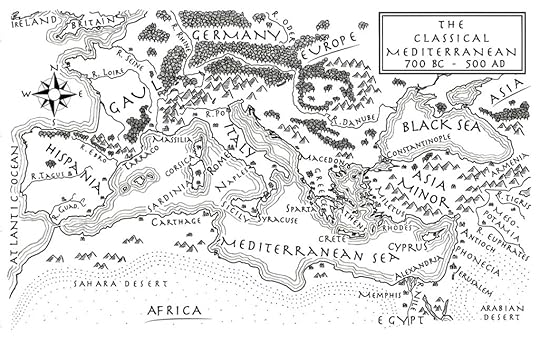
One of the maps from The Jericho River
Rudy suggested another lesson to me, based on an idea from her students. “Lumins” are the mythical creatures of The Jericho River: Greek centaurs and satyrs, Egyptian sphinxes and mummies, Medieval European fairies, etc. Rudy suggested a lumin-creation lesson. For instance: Design a lumin for ancient Roman society, based on images in Roman art and literature. Draw it and describe it in an essay. What values does it stand for? What sort of conduct does it encourage? Is this a lumin for all Romans, or only for certain classes or groups?
Lesson Plans and The Jericho River’s Educational Strategy
I’ve created lesson plans based on all Rudy’s ideas, and they’re posted (free of charge) at my site’s Resources for Teachers page. They incorporate multiple learning objectives: research, writing, technology, visual arts. And teachers can target them to fit their state standards for social studies and language, as well as their unique classrooms. The lessons also offer options for partner, peer, and small group work. And they support multiple learning styles.
Rudy’s used The Jericho River in several ways, and I’m hoping other teachers will too. The book has a five-point educational strategy:
It teaches students that history is fun.
By serving up history as fantasy, it triggers the part of a young reader’s mind that records the details of Harry Potter’s world and of fantasy video games, aiding retention.
The story itself serves as a high-level timeline for Western Civilization, giving young readers the entire 5,000-year arc in order, which makes it easy to retain.
The book connects well-known concepts from the past with the societies that generated them. That gives historical context to familiar images, like pyramids, knights, centaurs, and battleships — again aiding retention.
The Jericho River offers memorable tidbits from the past, increasing interest and the connection between familiar images and the societies that generated them. For example, the notes explain that those winged babies in Renaissance paintings aren’t actually cherubs. They’re called putti, and people confused them with cherubs during the last couple centuries. Biblical cherubs were actually gigantic, fearsome beings.
The Jericho River is particularly useful for high school world history, as well as for sixth and seventh grade core teachers, since it supports their dual responsibilities for history and English. And obviously it works in Western Civilization courses like Rudy’s, as well at the college level. It’s particularly powerful in the hands of creative teachers, like Rudy Edwards.
—————–
—————–
© 2018 by David W. Tollen.
The post Teaching History by Sailing The Jericho River appeared first on DavidTollen.com.