Michelle Ule's Blog, page 49
September 15, 2017
Kathleen Chambers, Memories and Me
Interviewed in 1991 by Oswald Chambers biographer David McCasland, Kathleen told wide-ranging stories of her parents and her life.
She was nearly 78 years-old when she talked with McCasland. Her father had been dead for 73 years; her mother for a quarter century.
Kathleen had no siblings and no first cousins , aunts or uncles still alive.
McCasland used her information when he wrote his book, as did I. She provided stories that charmed me and gave great insight into her mother.
Most of her memories were true.
But not all.
The need to verify
As a one-time reporter, I knew to check Kathleen’s facts when possible.
Before I began my in depth research, I did a genealogical work up of the Chambers and Hobbs families.
I sought answers to specific questions about Biddy’s past–particularly where her stenography skill came from and why.
In hunting down that information–it took me a month to reach my conclusions–I learned about Kathleen’s ancestors.
When I read the transcript, I realized Kathleen had the outline of the story fairly correct, but muddled the generations and didn’t know basic facts.
That surprised me until I recalled how few relatives she had to tell her family stories and none were alive by 1991.
Her uncertainty was not her fault; all my information is backed up with endnotes in the biography for those who are curious.
How true are memories?
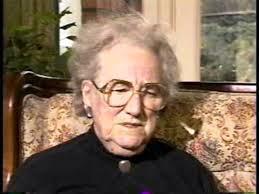
Kathleen at 78
Nearly fifty years ago, my family spent an entire summer camping around Europe.
As a young teenager, I had the task of recording the travel journal.
Twelve years ago, I transcribed those notes into a story for my siblings.
Last spring, I reworked the story and was surprised by facts I did not remember correctly.
Unlike Kathleen, I could ask three other people still alive who took the trip with me.
My uncle and I discussed one of the stories last night–about his birthplace in Sicily.
I was sure we visited Normandy’s veteran’s cemetery.
The journal, a map and someone else’s memory said we stood aghast at Verdun.
I’m a lot younger now than Kathleen Chambers was when she sat for her interview.
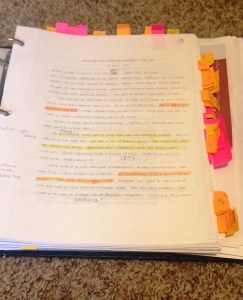
My tabbed version of Kathleen’s transcript!
I’ve got written notes and other eyewitnesses.
Yet I still got the story–events I eye witnessed and wrote down– wrong!
What’s a biographer to do?
Make your best guess, cite what references you have, verify everything that can be checked and use endnotes to explain puzzles.
Logic, reasonable doubt, discussions with others and books can help.
Ultimately, I had to ask myself if I trusted Kathleen Chambers or not?
Who else knew Biddy Chambers as well?
Tweetables
Kathleen Chambers and a need to verify the source. Click to Tweet
Handling an unintentional unreliable narrator: Kathleen Chambers. Click to Tweet
How to verify the unverifiable? Click to Tweet
The post Kathleen Chambers, Memories and Me appeared first on Michelle Ule, Author.


September 12, 2017
Joy in Serving the King
Kristin’s eyes met mine in the high school bathroom mirror.
I was a new believer. I hadn’t heard that before. Her mother, however, taught my high school girl’s Bible study. Kristin would know.
 She spoke those words 44 years ago, and they have stayed with me and echoed throughout my life.
Oft times, I’ve wondered. “Where’s the joy?”
If I don’t feel any aspects of joy (happiness, contentment, delight, peace), I ask myself why not?
If I can’t answer that question, I reconsider whether what I’m doing is the right thing for me to do.
(Which is not to say it isn’t the right service for someone else).
Here are my thoughts about joy in serving.
Many Christians argue there is a difference between joy and happiness.
Pastor/writer Randy Alcorn does a fine job explaining that’s not quite true here.
In regards to serving, I take it to mean as a result of serving God in a way He led you to, you will feel contented.
(Contentment turns up in definitions of both joy and happiness in the Merriam-Webster dictionary.)
That does not mean an easy task, a positive outcome, or no suffering on my part.
It simply means, I’ve accomplished something God sent me to do and I can rest contented in what happened.
I usually feel joyful or even energized by the experience.
Two examples
I spent four days in Nicaragua working at an eyeglass clinic in 2011.
Hot, humid weather affects me negatively.
I dreaded the trip–fear of illness and concern about insects upped the ante.
Yet, I knew God wanted my husband and me to take the trip. So we went.
We realized my worst fears on the first day. Not only did we experience miserable weather and challenging insects (though, they told me, far less than usual, thanks be to God), but I couldn’t fit the glasses well.
Eventually, we discovered I could translate–sort-of–and interview folks.
“Izquierda or derecha?” Right or left?
I managed the eye chart just fine.
Joy, however, consumed me once I found my niche.
I laughed, the patients laughed, I felt invigorated despite the conditions and I accomplished value work.
I’m delighted I went and probably would return.
When we returned, I wrote seventeen blog posts about the experience–my true source of joy.
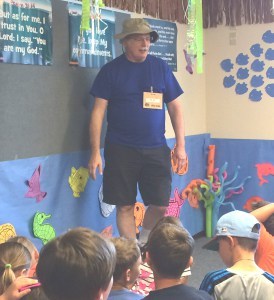
I helped my husband one summer.
Vacation Bible School and Sunday School
While I’m the mother of four and a veteran cub scout leader, I don’t teach Vacation Bible School or children’s Sunday School
Sure, I like kids. I know the importance of both VBS and Sunday school.
But I don’t do well with that age group.
I don’t feel confident–even when I know the stories well.
Adults? No problem, I love teaching adults.
So, do I belong in the teacher role?
I don’t think so.
However, I can support teachers. For the last ten years I’ve watched teacher children before VBS or led recreation.
The trick was finding the right role for me.
From the right role flowed joy and contentment, as well as energy.
What brings you joy?
We have opportunities to help in all walks of life.
It doesn’t hurt to try experiences we may not feel equipped to do. (And sometimes we aren’t).
Photo by Jean Gerber on Unsplash
But pay close attention to what your heart says.
It can be hard and necessary-but if upon completion you are depleted rather than triumphant, reconsider the same task next time.
What doesn’t work for you may very well work for someone else–and bring them joy.
Ministry should not exhaust or dull your soul.
Pay attention to Kristin’s comment from all those years before: “There’s joy in serving God.”
Tweetables
What does it mean, “there’s joy in serving the King?” Click to Tweet
Happiness, contentment and triumph, even in hard things = joy. Click to Tweet
Ministry should not exhaust nor dull your soul. Click to Tweet
Every month in 2017, I’ll be telling the stories about God’s leading and my blessed–and astonished–reactions while writing Mrs. Oswald Chambers
The next newsletter comes out September 13: Emotional upheaval, an Aussie walkabout, and a Hong Kong surprise
Sign up for my newsletter here.
The post Joy in Serving the King appeared first on Michelle Ule, Author.
September 8, 2017
Take a Child to a War Zone?
Biddy Chambers did.
So did I.
We, however, reached different conclusions about the wisdom of visiting a war zone with a child.
My story–the Caribbean

My Navy guy served on a fast attack submarine that spent the 1983 fall on a Unitas Run.
His submarine “showed the colors” up and down South America and transited the Panama Canal.
On their way back to Connecticut, the submarine command scheduled a 10-day visit to Barbados.
They’d show the colors in the British colony, but mostly the stop served as an R and R stop (rest and relaxation stop) for the sailors three months gone from home.
As it happened, we made plans for me to join him. We had no relatives on the east coast, so I would bring the children with me to play on the warm sands and enjoy their father’s presence during his off hours.
I had a vague idea of when the boat would dock and awaited news before purchasing our airfare and making other arrangements.
When I got the go-ahead in October, I grabbed our passports and shepherded the children to the car.
A travel agent would help me purchase our tickets (which is how it was done pre-Internet!).
Just before going out the door, I paused to turn off the Today Show on the television.
Except, NBC news broke in to announce the United States had invaded Grenada, a small island in the Caribbean Sea.
What do you mean a war zone?
I set down everything and hunted up the atlas. Grenada, it turns out, is the next island over from Barbados.
No need to make any reservations until I had more facts. Much though I missed my husband and looked forward to this trip, even I knew a war zone was no place for an 8 month-old and his nearly three year-old brother.
In those long ago days, news came in cycles. I kept the television on all day, but everything looked muddled and uncertain. Bullets rang, paratroopers landed, students huddled in fear.
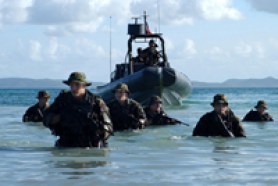
It wasn’t quite this bad, but how could I know? (US Navy photo)
Barbados found itself in the middle of an unexpected war.
But I needed to buy tickets. What to do?
I contacted a friend with insight into the situation. After I explained my dilemma, he told me he’d check around and get back to me.
Two days later, with the situation apparently resolving but still in flux, he called back. “It’s probably okay, but I wouldn’t let my wife go, much less the children. Too much could happen.”
Since he often played the US president in military war games, I figured I could trust his judgement.
I wrote my husband a letter explaining, and we stayed home.
Biddy takes a child to a war zone
Oswald Chambers accepted a YMCA secretary position during World War I, and they assigned him to Egypt.
He asked if he could bring his wife and child–at a time when no other secretaries in Egypt had wives or children with them.
William Jessop, the YMCA head, paused but agreed. The British military (The British controlled Egypt at the time) had not yet closed the borders to civilians.
Oswald arrived in Egypt in October 1915 and scratched his head over conditions. It looked impossible, but he believed God would work out arrangements to His glory.
Biddy remained in London waiting for the situation to become clear–just like I did in 1983 Connecticut.
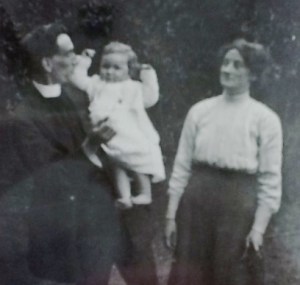
The family shortly before Oswald left for Egypt. Remember, no antibiotics and poor water. (Wheaton College photo)
He wrote often describing deteriorating conditions.
Ask yourself what you would do.
What woman in her right mind takes a two year-old through U-boat infested waters during a world war in a period before antibiotics to Egypt?
A woman who followed her God.
(Okay, I followed God, too, but the stakes weren’t so dire 70 years later!)
Then what happened?
The Chambers family didn’t have relatives they could leave their daughter with either.
Certainly they knew the risks, but God beckoned.
Biddy, Kathleen and friend Mary Riley sailed in December– a terrible month on the ocean–and arrived just after Christmas.
British authorities closed the port to all but military personnel that week.
(Indeed, the only people who got off the SS Herefordshire were our three and two Americans with a special permit to enter).
The rest?
Biddy took notes and God’s glory shown in amazing ways that influence modern Christianity.
Kathleen Chambers’ presence in a war zone made all the difference to many ANZAC troops.
My children and I stayed home and received letters from Barbados marked “war zone,” thus not requiring a stamp.
My husband had a lovely time in Barbados and ever since has said, “I don’t know why you didn’t come. We had a great time.”
Right.
The answer to me is, God obviously didn’t need me in a 1983 war zone.
What choice would you have made–if you were either Biddy or me?
Tweetables
Take a child to a war zone? Why? Click to Tweet
The biographer and Biddy Chambers consider taking a child into a war zone. Click to Tweet
Invasion of Grenada? Not my child in that war zone! Click to Tweet
Every month in 2017, I’ll be telling the stories about God’s leading and my blessed–and astonished–reactions while writing Mrs. Oswald Chambers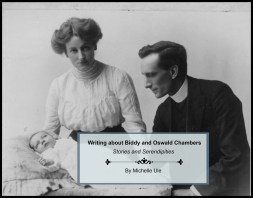
The next newsletter comes out September 13: Emotional upheaval, an Aussie walkabout, and a Hong Kong surprise
Sign up for my newsletter here.
The post Take a Child to a War Zone? appeared first on Michelle Ule, Author.
September 5, 2017
A Conspiracy of Breath–the Writing of Hebrews?
It provides an interesting answer to the question, “Who wrote the New Testament‘s Book of Hebrews?”
Scott believes it may have been a woman named Priscilla–the wife of a man named Aquila.
She makes a compelling argument in a beautifully written work of literary fiction .
.
Whether you accept her reasoning or not, is your own decision.
Here’s an interview I recently conducted with Dr. Latayne Scott (PhD in Biblical Studies).
When did you first encounter the theory Priscilla might have written the book of Hebrews?
“When I was a baby Christian . . . I bought a set of William Barclay’s commentaries on the New Testament. In the section on Hebrews, he said that some people thought a woman may have written that epistle, and I never forgot that idea.”
How did you react to the idea?
“I thought, “Well, cool.”
“And it stayed in my mind for years until someone alerted me to a research book, Priscilla’s Letter, by Ruth Hoppin. She laid out the whole case for the authorship of Hebrews by Priscilla, wife of Aquila, both of whom we read about in the book of Acts and elsewhere.
“In the six times the couple is mentioned in the Bible, four times Priscilla’s name is listed before her husband’s—a very unusual thing in the ancient world.”
Scott went right to work in 2008, researching Priscilla and Aquila and how Christians functioned under persecution. She mentioned The Bone Gatherers by Nicola Denzey, as an “unforgettable book. That, and Hoppin’s book, were most important to me.”
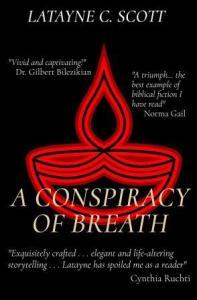 In A Conspiracy of Breath, Prisca, (Priscilla is a nickname), grew up in a wealthy Roman household. She encounters the Apostle Paul and learns about Jesus, killed several years before in Jerusalem.
An articulate woman with a keen mind, Prisca wants to learn more and through the course of the story meets and marries Aquila. But once she commits her life to following the Messiah and applies her education to the task, something happens.
“The Breath,” seems to speak through her and soon people are writing down what “The Breath,” says.
It’s the Holy Spirit providing the words found in the Book of Hebrews.
Where did the concept of “the Breath” originate?
“One of the best gifts I gave myself was to learn Koine, or biblical, Greek. In that language, it’s the same word for spirit and for breath. So speaking of the Holy Breath is very biblical.”
From that beginning in 2008, Scott saw A Conspiracy of Breath as “the opus of my life. Truly, I don’t think I will ever be able to write anything of its caliber again.”
Her language use fascinates–Latinate words, vocabulary sufficed with Greek. Her word choices enthralled.
I loved Scott’s depictions of Rome, Corinth and Jerusalem. The difficulties Priscilla and believers found in the early years of the Christian Church crackled with life and immediacy.
What I appreciated most about this story was the descriptions of early Christian life—the throbbing sense of danger, persecution and the insight into how people turned against each other, particularly the reaction of the Jews. How/where did you do that research?
“The book of Acts is full of such stories. The Jews were always dividing up to try to railroad Paul for something; the pagans rioted over him; Paul and Mark squabbled. They were humans just like us.”
Scott hopes readers will understand the paradox Priscilla felt at the time.
“She lived among the most favored generation of all time – who had seen and known the Savior of the world–and yet most of His close followers lived their lives on the run and died violent deaths.
“Another paradox: There were extravagant, miraculous healings; yet Paul, Timothy, and the sweet Cordelia of my novel suffered illnesses for which there was no healing. And yet for all of them, the point wasn’t survival. The point was the maintenance of faith in a resurrected Man.”
I saw her point as I read, and asked myself, “How did people know what writings to trust? What people told the truth? What a complicated time the first century must have been for members of that new group, The Way.
I came away with a greater appreciation for the Saints who have gone before and the challenges they faced in following Jesus Christ.
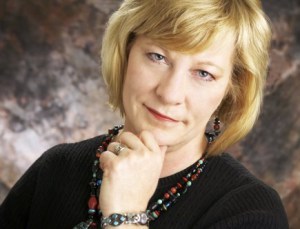
Latayne Scott
Scott is a fabulous writer, an award winning author of two dozen books published by many major Christian publishers, along with hundreds of magazine articles.
A Conspiracy of Breath provides an opportunity to glimpse what life might have been like at the beginning of Christianity.
I finished it encouraged, curious and so very grateful I live in the 21st century.
It’s a lot easier to live on this side of the cross and history.
Tweetables
Who wrote the Book of Hebrews? A Woman? Click to Tweet
A Conspiracy of Breath, the Holy Spirit & the Bible. Click to Tweet
The beginnings of Christian faith in A Conspiracy of Breath. Click to Tweet
The post A Conspiracy of Breath–the Writing of Hebrews? appeared first on Michelle Ule, Author.
September 1, 2017
Whatever Happened to Kathleen Chambers?
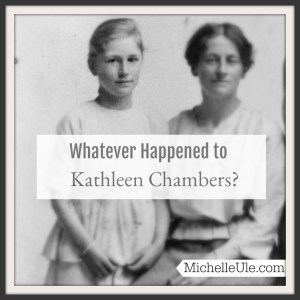 Of course I know what happened to her.
It’s all in my book, Mrs. Oswald Chambers, which will be published in October 2017.
The little girl who spent crucial years in a WWI camp served as a major source I turned to frequently while writing the biography.
But I know you’re curious.
Here are some hints.
Childhood
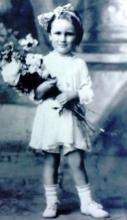 Kathleen spent her first two years doted on at the Bible Training College her parents ran in London.
She sailed U-boat infested seas to Egypt when she was two and a half years-old, with her mother and family friend Mary Riley.
Kathleen Chambers served as a source of constant entertainment, love and encouragement to ANZAC soldiers at the YMCA‘s Zeitoun camp.
Oswald Chambers died when she was four years old. Kathleen already knew about death and loss from soldiers friends who died in the Sinai and the trenches of France.
The little girl, taught by her parents that heaven is a wonderful place, believed them.
In her own way, she ministered to her mother, family friends and the soldiers by her faith in God.
Youth
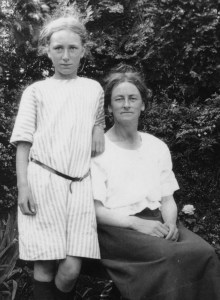
Circa 1925
Kathleen returned to England at the age of six.
Instrumental in some of the significant events of her mother’s post-war life, the little girl lived like most others in post-war England.
She had a keen mind and a strong will.
Biddy sheltered her from the ministry of “the books.”
Kathleen had nothing to do with her father’s words, ideas, teaching or material as she grew up.
Family friends made sure she had access to a good education.
Maturity
Born in 1913, Kathleen came of age before World War II.
Her health and the war changed her life. It also added drama to Biddy’s existence!
As a mother, I was awed by Biddy’s courage and patience with Kathleen. Modern parents can learn much from how Biddy handled her daughter’s spiritual growth.
While she had many friends, Kathleen never married. I don’t know what she looked like as a young woman.
(If you have a photo of Kathleen Chambers between the ages of 13 and 60, please send it to me!)
Post War years
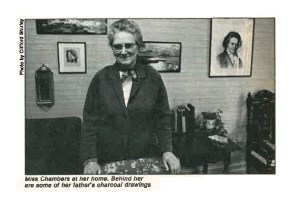
From a 1974 article in Decision Magazine
Kathleen owned a car and worked with handicapped children.
When her mother’s health failed, Kathleen stepped in to care for Biddy.
After Biddy’s death, the quirky opinionated, though polite, woman continued in the ministry begun years before with the Oswald Chambers Publication Association, Ltd.
She looked like her father.
In 1991, Kathleen Chambers sat for a lengthy series of interviews with Oswald Chambers’ biographer, David McCasland.
(He dedicated his book, Oswald Chambers: Abandoned to God to her)
She died in 1997 at the age of 84.
My thoughts?
I feel like I knew her after watching a series of videos taken from McCasland’s interview.
The transcript of the interviews made me laugh, shake my head, irritated me and sent me time and again to Google for research.
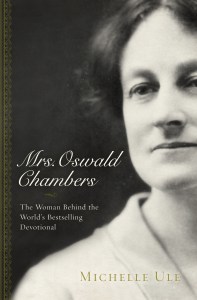
You can order Mrs. Oswald Chambers here and learn all about Kathleen.
I could not have written my book without Kathleen’s pithy remarks, memories and matter-of-fact character.
You’ll like her.
In October. 
August 29, 2017
How to Choose a Fall Bible Study
My co-teacher stopped in the aisle of the Christian book store. “Shouldn’t we pray?”
“I assume you have been praying,” I said.
She nodded.
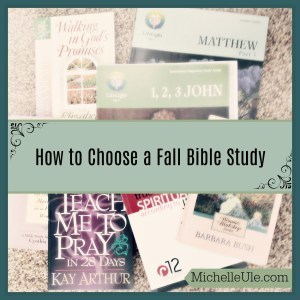
You choose!
“Is there a study in particular you want to do?”
“I didn’t really get an answer,” she said. “Maybe we should pray again?”
I shrugged. “I don’t think it matters. We should choose one you want to do if you don’t have an inclination one way or the other.”
“Don’t you think God cares?”
“He cares,” I said, “but if we don’t have a clear leaning either way, I think we can choose.”
She laughed.
I waved at the shelf. “Choose one.”
Here are four ways, besides answer to prayer, that I use to decide which Bible study to teach in the fall.
All of this assumes you do not have a clear leading or requirement to meet, of course. God’s direction should always be sovereign.
What topic are my friends concerned about?
When we moved to Hawai’i years ago, I had a toddler.
I made new friends in my Navy housing community and mentioned my interest in Bible study.
I’d planned to return to Bible Study Fellowship now my child was old enough, and I asked about it.
To my surprise, several women mentioned their concerns about raising a toddler.
“You should study that book Mastering Motherhood,” I said.
Three times women I scarcely knew said, “great idea. Will you lead it?”
How could I do anything but lead a neighborhood study?
What need do you see among your students?
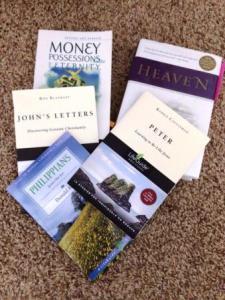
A sampling of what we’ve studied
After I taught a group of women one year, I wasn’t sure if they understood the fundamentals of Christianity.
I like to teach books of the Bible, because “the word of God does not return void, (Isaiah 55:11)” and
“All Scripture is given by inspiration of God, and is profitable for doctrine, for reproof, for correction, for instruction in righteousness, 17 that the man of God may be complete, thoroughly equipped for every good work.” (2 Timothy 3:16-17 )
If the Bible explains the truth, I just have to facilitate.
That fall we studied the Book of John, basic Christianity.
I relied on the Holy Spirit to convict and was always prepared with an answer when a question rose.
Is there a timely subject?
One Christmas we studied Advent. Last year, we spent 10 weeks examining the verses on which Handel based his Messiah.
Many women in my study are older and several have health issues. Two years ago we spent time examining Heaven, and I think we all came away more confident about death.
(Randy Alcorn’s Heaven is an excellent resource).
What question is burning in your heart?
Several years ago, one of my ladies approached and asked if we could study angels. “Some of my friends have odd ideas about angels and I don’t know what to tell them.”
Great idea! I read Billy Graham’s Angels in preparation and we dove right in.
I’ve spent a lot of time reading the Old Testament this last year and kept tripping over some of King David’s behavior.
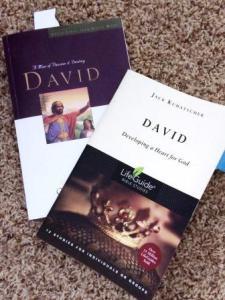
Coming this fall on Tuesday mornings!
As a result, I hunted down a friendly examination of his life from a Biblical point of view, Chuck Swindoll’s David: A Man of Passion and Destiny.
I learned a lot from Swindoll and so when we finished our study in the fall, I suggest we examine him.
The ladies were all for it.
(As a bonus for me, my summer Sunday school class is going through the same book, so I’m getting prep done early!)
Other things to consider
I’ve been leading Bible study for more than 30 years, across the country in a variety of church settings.
I’ve enjoyed Precepts, the LCMS Lifelight, and a host of studies written by different people.
Because of the nature of my current group of ladies, I’ve been using InterVarsity Press‘ Lifeguide Bible studies for five years.
They conveniently have a list of their studies on the back of their books.
We choose several we find appealing, and it always seems to work out time-wise.
I can prepare anywhere!
What happened with my co-teacher all those years ago?
She chose a Lifeguide Bible study that interested her and we enjoyed it.
It’s the Word of God–why wouldn’t it be interesting, fulfilling and apt?
How do you decide which Bible study to use?
Tweetables
Four tips to choosing a fall Bible study. Click to Tweet
Does God care what Bible study you do? Click to Tweet
How to decide what book of the Bible to study. Click to Tweet
The post How to Choose a Fall Bible Study appeared first on Michelle Ule, Author.
August 25, 2017
The Importance of My Utmost for His Highest
It’s one of the best selling devotionals of all time–publishers don’t even know the total number of copies sold.
(The most educated guess puts the number at more than 14 million copies.)
Many people around the world read My Utmost for His Highest regularly.
It tops the list of “Popular Christian Devotionals,” at Goodreads.
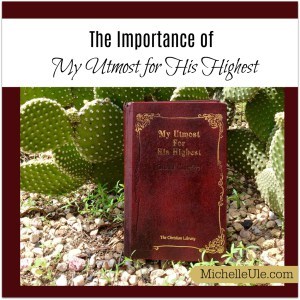 Here are five reasons why people consider it important.
Longevity
Mrs. Oswald Chambers first published My Utmost for His Highest in England in October, 1927.
The product of three years of concentrated thought and prayer, the 366-day devotional struck a chord with British citizens immediately.
The first American edition appeared in 1935.
It’s never been out of print.
Universal Appeal
Dr. Ken Boa noted the devotional has a universal appeal because Oswald Chambers did not use timely stories as his examples.
Of course we all know who compiled My Utmost for His Highest!
By not illustrating his observations with current affairs, Oswald knew his students/readers would focus on the Biblical truth.
As a result, we can easily read the devotional more than 100 years after he taught the concepts.
According to Kevin Halloran at Anchored in Christ:
“Turn to the pages of My Utmost for His Highest to deepen your love and understanding of God. Oswald Chambers was gifted with extracting the essence of biblical principles and condensing them into potent, thought-provoking, and life-changing devotions. They don’t take a lot of time to read, but they can infuse you with the timeless truths of the Bible.”
As I write this, it sits #20 on Christian Books list of bestselling Christian devotionals.
Encouragement
An article on Beliefnet.com summed it up well:
“Utmost” has been updated several times, but it has retained its power to draw people closer to God. Each day the book offers Chambers’ thoughts on complex themes such as redemption, waiting on God, and preaching the Gospel.”
It’s #3 on Devotional Diva’s list of favorites, one she often reads.
During World War II, people smuggled copies of My Utmost for His Highest into prisoner of war camps in Germany.
Brother Andrew regularly carried copies behind the Iron Curtain during the Cold War.
Language Translations
Biddy Chambers and The Oswald Chambers Publications Association, Ltd. authorized the translation of the devotional into over 40 languages.
Many of their meetings dealt with who to translate the devotional and when. Among translated languages are Finnish, Arabic, Chinese and 10 different dialects for readers in India.
You can see the list and where to find them here.
Vietnamese translation
Wisdom
Relevant Magazine‘s list of “6 Devotionals You Should Read next” put it at the top.
“One of Christianity‘s most beloved devotionals. Originally written for students and young followers of Christ, the book offers . . . short yet profound lessons on the fundamentals of Christian life, the Bible, prayer and serving others.”
Memoirist Macy Halford wrote about the wisdom and importance of Chambers’ book in Christianity Today.
From her research in writing My Utmost: A Devotional Memoir, Halford concluded Chambers believed:
To maintain an independent mind, a mind separated unto God, was to look fiercely for the God-given individuality of all his creatures, affording them the dignity they deserved.
“This, in Chambers’s view, was the ultimate goal of maintaining our independence: that we might fully love others as we ourselves have been loved by God, who “hath raised us up together, and made us sit together in heavenly places in Christ Jesus.”
“This was the thread Chambers saw running through the gospel: “We are not raised up alone, but together.” It is the thread that runs through Utmost, too, the thread that has drawn and will continue to draw generations of single, solitary individuals into a community of Christian readers.”
My Utmost for His Highest changed many lives over its 90 year run. Happy birthday in October!
Tweetables
Why is My Utmost for His Highest important? Click to Tweet
5 reasons why My Utmost for His Highest still draws readers. Click to Tweet
Wisdom, relevance, longevity: My Utmost for His Highest. Click to Tweet
The post The Importance of My Utmost for His Highest appeared first on Michelle Ule, Author.
August 22, 2017
Missionaries in Nicaragua–Providing Sight!
My husband and I participated in the same eyeglass ministry in the Rio San Juan region six years ago.
(You can read the seventeen posts I wrote about the 2011 experience starting here).
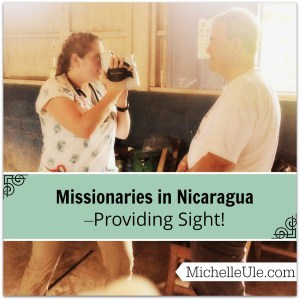 The latest mission marked the eleventh year of providing a rudimentary eye examinations, glasses, sunglasses, Bibles and toys for the local children who visit.
Our church community loves this ministry.
How it works
The journey begins with a sometimes harrowing trip to Sabalos.
(This year the group experienced a wind shear incident while landing at Managua International Airport.)
They catch a plane to Nicaragua, a plane to San Carlos at the mouth (boca) of the San Juan River (Rio San Juan)–where it meets Lake Managua in the southeast.
After a stop off in “civilization” (i.e. bank) in San Carlos, the crew travels two hours down the river to Sabalos.
The trip includes a stay in Sabalos Lodge‘s individual thatched roof huts on stilts.
(With comfortable beds, electric lights and bathrooms–including cold showers).
Off to work
In the morning, the 2017 crew caught the same boat up river for about an hour, whence they boarded an ancient school bus to the town of Los Chiles.
Upon arrival, they met more than 100 people standing in line waiting for them.
There is no eyecare in that part of Nicaragua except what our church and our local Rotary club, bring.
Our crews have seen 21,000 people in the last eleven years.
This time, over three days, they saw nearly 1300, and gave away more than 1500 pair of glasses.
They also handed out 750 Spanish New Testaments, blow-up balls, small soft bears made by a woman at our church, and children’s story books.
The weather often is appalling; this year it featured monsoon rains and thick mud.
It’s hot, humid and everyone sweats–a lot.
But, the task at hand is so fulfilling–seeing the joy when others can actually see–no one really cares.
Here’s what it was like on one of the days:
Research
A young researcher traveled with the missionaries to learn about the prevalence of ptergiums among the patients.
(Ptergiums are a benign growth that can cover the iris thus blinding folks. It caused by an irritant– such as dust or smoke– and prolonged exposure to UV rays.)
She worked the autorefractor (“It’s a lot like playing a video game!”) which, along with the expertise of the team leaders, enabled them to assess a patient’s visual need for glasses.
The patient then visited the volunteer missionaries who tried out a variety of basic prescription glasses to best meet their needs.
(They purchase a wide variety of standard prescriptions glasses in Nicaragua, and give them away for free.)
An experienced Managua opthamologist accompanies the missionaries and sees patients with complicated vision issues.
She puts the names of the difficult cases on a list and when a volunteer group of ophthalmologists visits the area to perform cataract and ptergium surgery.
Such a group usually travels once a year to Nicaragua.
Rewards
For the people of the Rio San Juan, a chance to have their eyes examined for free and glasses.
For a child found nearsighted–the ability to do well in school.
The researcher learned what she needed for a paper.
The missionaries, who paid their own way, savored the joy of serving others.
And God? His Word gets shared for people thirsty for it–few people own Bibles.
Our church members love attending and supporting the eyeglass clinic missionaries to Nicaragua.
Tweetables
Videos of an eyeglass mission to Nicaragua Click to Tweet
What’s it like to to volunteer in Nicaragua? Click to Tweet
The post Missionaries in Nicaragua–Providing Sight! appeared first on Michelle Ule, Author.
August 18, 2017
My Faith and My Utmost for His Highest
I’d been a Christian many years by that point, but I never used a devotional before.
I’ve not used any other devotional since.
Oswald Chambers‘ masterpiece–compiled by his wife Biddy–is enough for me.
 Here are five ways My Utmost for His Highest affected my faith.
Pinned me to the wall
Of course my blue paperback copy didn’t pin me to the wall, but the words I read there certainly did.
How?
With a clear, pointed message that did not allow me to squirm out of my understanding.
What’s the point of prayer, Oswald asked one day.
My question exactly, I hated what had happened as a result of my prayers.
(For the full story see my essay in this fall’s Utmost Ongoing: Reflections on the Legacy of Oswald Chambers).
His answer: “It is not so true that “prayer changes things” as that prayer changes me.” (August 28)
Even if I didn’t want to be changed.
Reminded of prayer’s importance
Prayer is one of Oswald’s key concepts–the importance of prayer.
Martin Luther once said if he had a busy day, he spent the first three hours in prayer.
I often get into such a hurry to get things done, I do a perfunctory pass through the pressing prayer requests and move on.
Oswald called me on it:
“Prayer does not equip us for greater works— prayer is the greater work. . . . we think of prayer as some commonsense exercise of our higher powers that simply prepares us for God’s work. . . . Prayer is the battle.” (October 17)
Pointed out God’s will is the purpose
All through My Utmost for His Highest, we see an appeal to bow our knee to the will of God.
It doesn’t matter if we understand or if what He indicates makes sense (see above on obedience).
My life is in God’s hands, whatever He determines to do with it (See November 15, What is that to you?)
Oswald explains the concept clearly on August 4:
“As Christians we are not here for our own purpose at all—we are here for the purpose of God, and the two are not the same.”
That’s helpful to remember.
Called me–over and over again–to obedience
A Scripture I think of often comes from 1 Samuel 15:22: “Behold, to obey is better than sacrifice.”
God has laid out his precepts and how we need to obey them. Sometimes they don’t make sense.
 Oswald provides an answer to that confusion:
“If things are dark to me, then I may be sure there is something I will not do. Intellectual darkness comes through ignorance; spiritual darkness comes because of something I do not intend to obey.” (July 27)
Ouch.
Well, that gives me a starting point when I’m uncertain: what do I not want to do?
Told me how to think about the past–and the future
One of my favorite quotes is from December 31–I end both my Chambers-related books with it:
“Our yesterdays present irreparable things to us; it is true that we have lost opportunities which will never return, but God can transform this destructive anxiety into a constructive thoughtfulness for the future. Let the past sleep, but let it sleep on the bosom of Christ.
“Leave the Irreparable Past in His hands, and step out into the Irresistible Future with Him.”
This passage helps me set aside the “what ifs?” of the past, along with the guilt that often can dog my regrets.
It reminds me the past, as well as the future, rests securely in the hands of the God who loves me, you and all his saints.
As a genealogist, a recovering–thanks to Oswald and Biddy–worrier, and a mother, these words always feel like a benediction.
They encourage my faith.
Tweetables
Five ways My Utmost for His Highest strengthens faith. Click to Tweet
Conviction, obedience, prayer and God’s will: My Utmost for His Highest in my life. Click to Tweet
How reading My Utmost for His Highest affected my faith. Click to Tweet
Every month in 2017, I’ll be telling the stories about God’s leading and my blessed–and astonished–reactions while writing Mrs. Oswald Chambers
The next newsletter comes out September 13: Emotional upheaval, an Aussie walkabout, and a Hong Kong surprise
Sign up for my newsletter here.
The post My Faith and My Utmost for His Highest appeared first on Michelle Ule, Author.
August 15, 2017
Mrs. Douglas MacArthur’s Tablecloth (idea) and Me
What is that tablecloth?
It’s a white tablecloth she used whenever she served dinner to foreign dignitaries.
Whenever everyone finished eating, she handed them a pen and asked them to sign the tablecloth.
She then had it embroidered.
Can you imagine the names that must still be embroidered on two (or possibly more) tablecloths she owned?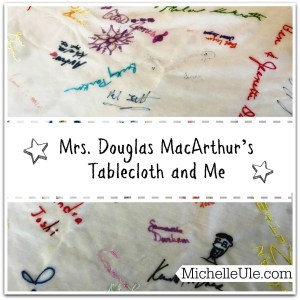
Especially those signed during the years General Douglas MacArthur served as supreme commander of American forces?
I can’t either.
But I have one of my own.
The original idea
I bought a white cotton-polyester blend tablecloth fairly early in our marriage.
Somewhere, I’d heard of Jean Macarthur’s ingenious idea and thought I’d try it, too.
I had no idea if my Navy guy would become a famous military officer (he did not), but I realized we’d meet a lot of people over the years.
Wouldn’t it be fun to have their signatures–especially if I never met them again?
How it worked
Back in the dark ages when I didn’t have any children, I handed out pencils to my guests after dinner and asked them to sign.
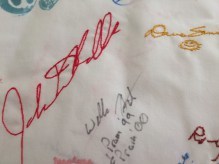 The next day, I embroidered all the names.
Only then could I wash the tablecloth!
(Hey, even wine stains came out–that cotton blend did the trick, along with hanging it on the line in sunlight).
Once the kids came, however, I simply couldn’t keep up.
So, I bought a box of Sharpies and handed out markers after dinner.
People were also given leeway to add the date, draw a picture, whatever.
We simply wanted to remember them.
Dinner Guests today
My husband retired from the military a long time ago, but the tablecloth continues to adorn our table when we have guests.
It amazed prom-goers in one small town–few of whom had ever seen a table set with silver, china and crystal glasses.
They signed with the date and the notation “prom!”
We’ve lived in our present town long enough that folks have returned to dine on many occasions.
Last week several sat around the table looking for their names and exclaiming over people they knew.
Several signatures stand out and always provoke comments.
People periodically request I embroider their names for posterity.
I smile politely and volunteer to hunt up floss and a needle for them.
No one has taken me up on it–yet.
What it means to us
I examine the names and faces spring to mind.
I don’t even remember who some of the people were–and I don’t know where they are now.
What became of the Pakistani naval officer we knew at post-graduate school?
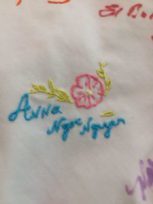 Where is the lovely Thai girl who included a rose?
I don’t know, but I remember them.
My daughter loved the idea so much, she requested a tablecloth of her own when she graduated.
She put it out at her party and invited her guests to sign.
It will be interesting, someday, to learn what happened to those young people just on the cusp of adulthood.
Mrs. Jean MacArthur, an exemplary military wife and hostess, I’m sure, would be proud.
Do you have a souvenir of dinner guests?
Tweetables
Emulating Mrs. Douglas MacArthur with a tablecloth. Click to Tweet
A tablecloth full of memories and signatures. Click to Tweet
Commemorate dinner–why not sign the tablecloth? Click to Tweet
Every month in 2017, I’ll be telling the stories about God’s leading and my blessed–and astonished–reactions while writing Mrs. Oswald Chambers
The next newsletter comes out August 20: In which the Holy Spirit surprises me while I write
Sign up for my newsletter here.
The post Mrs. Douglas MacArthur’s Tablecloth (idea) and Me appeared first on Michelle Ule, Author.