
Heather Solos's Blog, page 48
May 22, 2014
Do you remember when we talked about freezing jeans?
 Heather says:
Do you remember when we talked about whether or not freezing jeans was a practical solution?
I’ve actually come across this twice now in the last month. The first was a speaker at a conference, he mentioned this as an aside, talking about how he expects the jeans -when he washes them in a year- to show the wear on the knees from playing with his child and then, just now in an interview of Levi’s CEO. (You don’t have to watch the whole thing it’s definitely on the dry side, but the point starting around 9:15 about sustainability is relevant)
I get what they are trying to say, but I wish, for everyone’s sake that they clarified what they mean. I don’t think Levi’s CEO is talking about your mowing the lawn, chasing toddler, bathing the dog jeans. I think, he is referring to that nice pair of super dark jeans that one saves to wear somewhere nice.
I think he may also mean the jeans you may wear to a casual office, where there is air conditioning and not a whole lot of heavy lifting.
I wish people like, Mr. Bergh, would remember that use case matters.
I don’t think he means the jeans worn by construction workers or field laborers.
Spot cleaning won’t work for line cooks.
Spot cleaning won’t work for anyone who lifts and bends and stretches their way through the work day.
And to act as though we -those who wash their jeans because we must- are wasteful is really rather clueless.
Wash your jeans when they need it. The less you do, the longer they will last. It’s that simple. We don’t need to offend people on the bus just because some guy thinks not washing our pants is the way to save the earth.

Copyright Home-Ec101.com 2007-2014


 Related ArticlesAnother Case of Musty OdorsHow to Clean a Bath Mat After a Toilet OverflowHow to Remove Flammable Liquids from Clothing


April 14, 2014
Shrimp Quesadillas
Heather says:
I promise you, that if you can make grilled cheese, you’ve got these shrimp quesadillas in the bag. In our house as the weather gets warmer we find ourselves reaching for lighter and lighter fare. Shrimp quesadillas are a perfect main dish item for spring and summer. Don’t go too heavy on the cheese, allow the shrimp to take center stage. If you want to go even lighter, skip the butter on the tortilla, it’s delicious with or without. Serve these as a main dish or appetizer with salsa and guacamole. A handful of raw bell peppers are a perfect side. If you’re only cooking for two, just reduce the shrimp to one pound and use half the tortillas.
If you want these shrimp quesadillas to have a kick, go ahead and leave the jalapeño seeds and ribs intact. Just don’t come crying to me later. Be careful not to boil the shrimp too long, they’ll get rubbery.
I will note that if you use carb balance tortillas, you just might find yourself eating just the filling. Not that anyone around here is guilty of that.

Recipe: Shrimp Quesadillas
Summary: Quick and easy shrimp quesadillas, perfect for a beginner cook.
Ingredients
2 lbs peeled and deveined shrimp
1/2 cup lime juice – about 2 medium limes
2 TBSP ground cumin
3 green onions, chopped
1 handful cilantro, chopped
1 jalapeño, seeded and chopped
8 tortillas (burrito size)
Shredded cheese
Butter
Instructions

Bring a stockpot of water to a full boil. Add the shrimp to the pot and cook for one to two minutes.
Drain the shrimp and run under cold water to stop the cooking process.
While the water is coming to a boil, mix together the lime juice, cumin, jalapeno, green onions, and cilantro in a large bowl. Once the shrimp are cold, add them to the bowl and toss to evenly coat. Allow to marinate for 10 – 30 minutes.

Heat a large skillet or griddle to medium. Place a buttered tortilla in the skillet and add 1/4 lb of the shrimp mixture to one half of the tortilla. Sprinkle with cheese and fold the tortilla. Cook for a couple minutes on each side until the desired level of browning has been achieved. (If you skip the butter your tortilla won’t brown)
Cooking time (duration): 30
Diet type: Pescatarian
Number of servings (yield): 4
Meal type: dinner
Culinary tradition: USA (Southwestern)
I’m trying out some new recipe software, tell me what you think. Do you like the format?
 Shared on Mouthwatering Monday and Tasty Tuesday.

Copyright Home-Ec101.com 2007-2014

CommentsThis is almost my exact same recipe for Shrimp Quesadillas, I ... by JennyLooks great! Love quesedillas and I've never made ones with ... by TraciThis looks good, but we don't eat much shrimp since it's ... by StacyOooh this looks yummy! I was just sitting here wondering what ... by Mrs. Jen BI just found your blog through Simple Mom too, and I love it! ... by Michele in SalemPlus 4 more...Related StoriesGarlic and Soy Chicken ThighsIs Extra Virgin Olive Oil a Substitute for Vegetable OilHow to Store Greens in a Small Living Space
April 9, 2014
How Hot Should My Hot Water Be?
Dear Home Ec 101,
Yesterday you posted about running the hot water before running the dishwasher. I see a lot of save money and be green by turning down the temperature of your water heater. What temperature is the right temperature? Will having my water heater set at 110°F make finding that sweet spot in the shower less of a hassle?
Signed,
Spring Showers Bring May Flowers
Heather says:
Do not set your shower to 110°F. Your water heater should be set between 120°F and 140°F.
Anything below 120°F and runs the risk of setting up a bacterial resort spa. The risk is small, but Legionnaire’s Disease can be fatal.
Legionella, the bacteria responsible for Legionnaire’s disease causes pneumonia and is most easily contracted by the elderly or those with compromised immune systems. This disease isn’t acquired by drinking water, but by aspirating it or inhaling it in the fine mist associated with shower spray.
Anything above 120°F has a scald risk. Water right at 120°F doesn’t carry a scald risk, but 125°F can scald in less than two minutes. If you have small children or elderly family members in a household, err on the side of closer to 120°F.
If your home is on a crawl space or has exposed pipes, be aware that insulating your pipes does more than simply save energy. Water loses heat as it travels through your plumbing. If there are pools of water sitting around at temperatures below 120°F bacteria can grow. Insulating your pipes helps water stay hot enough to flush any potential bacteria from your pipes with normal use.
TL;DR Set your water heater between 120°F and 140°F, this balances the need to keep water at a safe temperature to prevent scalds and not roll out the bacterial welcome mat.
Insulating your water heater helps prevent heat loss and conserves energy.

Copyright Home-Ec101.com 2007-2014
 Related ArticlesDust Your Computer? Spring Cleaning I forgotBrand New Printable Chore Chart for 2014How to Clean a Bath Mat After a Toilet Overflow

April 8, 2014
Why Should I Run the Hot Water Before Starting the Dishwasher
Dear Home Ec 101,
I have always followed my Mom’s advice about running hot water in the kitchen sink before (and while) turning my dishwasher on. She also says that if you run the cold water at any point while your dishwasher is running, the water in your dishwasher will be cold. My husband recently replaced our sink and garbage disposal and noticed that our dishwasher is only hooked up to hot water.
So, do I really need to abide by my Mom’s rules?
Wondering About Water Temps
Heather says
Your mom is partially right. Running the hot water before starting the dishwasher ensures the water that fills the machine is hot instead of lukewarm. You don’t jump in the shower the second you turn on the hot tap, right? It takes a moment for the water that has been cooling in the hot water pipe from the water heater to the tap to be flushed out. Typically your dishwasher is hooked into the hot water line
Remember cleaning is accomplished through several forms of energy:
Thermal – the higher the temperature, the more dirt can go into solution. It should be noted that the heating element / timer combo in your dishwasher was designed to boost hot water near 140°F. If you check your appliance manual or the website of your manufacturer, you’ll see most recommend water at least 120°F but not more than 150°F. (140°F is the recommended setting for most home water heaters.)
Physical – in your dishwasher this is the accomplished with spray
Chemical – this would be your detergent (Oh and as an unasked for aside and plug, I’ve been trying out the Smarty Dish by Method, which was phosphate free before there was the voluntary ban on phosphates and it’s friggin’ awesome. I bought it myself, Method didn’t supply it).
Running the cold water while the machine is running shouldn’t be an issue, but running the hot water before the basin of the dishwasher fills ensures your dishwasher starts with every advantage. Having to rewash dishes is far less efficient than running the hot water before starting your machine. You can always catch the water in a bucket and use it (when cool, naturally) for other tasks like plant watering, if water conservation is a big concern.
Send your reader questions to helpme@home-ec101.com.

Copyright Home-Ec101.com 2007-2014

CommentsThat is 100% absurd and ridiculous. In every cooking or ... by Mr andersonAccording to the Cascade Dishwasher Detergent Website, their ... by Sey@HeatherSolos @KimClemmer I just tried the Smarty Dish last ... by bookchickI have had a dishwasher for years, and moved from the UK to ... by FionaOkay so I have a couple of interesting things to share ... by deneicer1Plus 11 more...Related ArticlesThe Hard Water HeadacheMore on Mildew – The Basement Is DampNest Generation 2 Thermostat Review – Not Sponsored

April 4, 2014
Dust Your Computer? Spring Cleaning I forgot
Heather says:
The next time you are at the store and snicker when you see the canned air -remember The Lorax ?- grab a can anyway.
Why?
Because it’s time to clean out your computer.
I never remember to do this until my computer decides to throw a tantrum, which it did yesterday, twice, in a meeting. /facepalm
I’m just glad it was with my team and not when I was trying to act all super professional and impress a client. I think that may have caused me a minor meltdown of my own.
How do you dust a computer?
If you have a desktop with a tower unit you can use the soft brush attachment on your vacuum to suck the dust off of the cover. In fact, you should do this every time you vacuum. This will help prevent SOME but definitely not all dust from entering the unit.
If you have pets this is especially important as pet hair and dander are drawn to your computer like moths to a flame.
Why?
Static electricity is the devil .
.
You’ve probably noticed anywhere you have a tangle of cords you also have more dust than anywhere else right? The electrons providing all that wonderful electricity love to build a negative charge. This negative charge attracts positively charged dust particles. These dust particles are very social and work together, inside of your computer to create a colony of dust bunnies whose main hobby is knitting your heat sink a cozy little sweater.
 Insulated heat sinks are a bad, bad thing. They can’t allow your computer to cool and this can lead to serious and potentially expensive damage
Static electricity is also why you use compressed air and not your vacuum to clean out the inside of your computer. You don’t want to create a spark near your exposed circuitry.
If it has been a while since you’ve cleaned your computer, take it outside and don’t forget that can of air. Just trust me on this, please? Carefully take the cover off of your tower unit or laptop.
Now take a peek inside, sigh heavily, and use your compressed air and serve up the dust bunny eviction. Pay special attention to the area around the fans and try not to jostle any cords or touch any of the circuitry.
Once you’ve blown out all the dust, replace the cover carefully, take it back inside, and reconnect the cords.
Try to get in the habit of doing this every six months, unless you have multiple pets which means you get to do it MORE.
Now, be honest, when was the last time you’ve dusted the inside of your computer?

Copyright Home-Ec101.com 2007-2014
 Related ArticlesBrand New Printable Chore Chart for 2014How to Clean a Bath Mat After a Toilet OverflowDry Wall Dust and Other Fun Construction Clean Up
March 22, 2014
Chicken Wings in the Oven
Dear Home Ec 101,
I am having a dinner party and I want to have chicken wings as part of the meal. How long should I bake them for to make them taste perfectly tender?
Signed,
Winging it in Wyndham
Heather says:
Actually I have a couple of answers for you depending on how you picture your chicken wings.
Do you want tender fall off the bone chicken wings, or are you thinking more like the wings you find at restaurants with the slightly crispy outer texture?
For moist, falling apart chicken wings cook them low and slow in the marinade of your choice, you’ll want them swimming in the sauce.
You have two options, you can do the slow-cooker 8 hour option OR in the oven at 375°F for at least an hour (depending on the size of your dish and number of wings). If you time and oven space, you can also cook the wings low and slow 250°F for at least two hours (the wings should be in a single layer and start fairly close to room temperature, do not attempt low and slow wings from frozen and always use a meat thermometer to be sure your chicken has reached a safe temperature.)
For chicken wings that more closely resemble what you’ll find in restaurants, broiling or grilling are your go-tos.
See How to Grill Buffalo Wings for classic grilled buffalo wings or broil your wings for about 25 minutes, brushing and turning often to prevent burning. It’s going to be touchy if your sauce contains a lot of sugar.

Be sure to cook your wings on a broiler pan so the fat can drip away from the wings.
Don’t forget to leave your oven door ajar while broiling.
Good luck!

Copyright Home-Ec101.com 2007-2014

CommentsOh my goodness this sounds delicious! Thank you for sharing. Im ... by AmberIf I do the wings in the slow cooker can I start from frozen or ... by casey1977Back when Buffalo wings first became popular, I'd make them in ... by guestMarinate chicken wings in a bag in a mix of soy sauce, oyster ... by HewittWell only use it for the broiling method. Some people just use ... by HeatherSolosOoooooh thanks for the tip on using the broiler pan. Silly me ... by DanielleBRelated StoriesI’m Looking for Tex-Mex Side Dish IdeasKnife Skills RefresherGarlic and Soy Chicken Thighs


February 28, 2014
I’m Looking for Tex-Mex Side Dish Ideas
Heather says:
With things normalizing, I’ve decided to involve the minions in Home-Ec. The site earns a little through advertising and in order to keep the kids from being resentful of this never ending side project that does take time, I have decided let them in on the business side of things. This is what it costs to run, this is the traffic etc. They are going to start helping with setting up the photography equipment (and keeping the table clean so we can). So, we’ll see what happens.
On another note:
I am cooking again.
For real.
Many meals.
With vegetables and nutrition in mind.
I’ve got an Ask the Audience for you. I try to give the growing minions two vegetables a meal -one can be incorporated into the main dish, but the other needs to be a stand alone. Starches don’t count. Why? Because that’s simply how things roll around here.
Most of the time it’s easy, but some cuisines just make vegetable accompaniments difficult, Tex-Mex I’m looking at you. And ever since we saw The Lego Movie, my kid are completely enamored with Taco Tuesday and are insisting we do this. Often.
Most of the time I saute zucchini and yellow squash and I’ll sprinkle in a little cumin and add some fresh garlic. Yes there are tomatoes in salsa, but condiments don’t count. This week we found a pile of vegetables under the youngest minion’s chair (she’s six, can you believe that? I started this site while pregnant with her). Obviously we need alternatives.
I will do fish tacos this Tuesday and cabbage slaw is an option, but what else? (I asked on Twitter and got some ideas, but I’d love to hear your opinion).
If you’re reading this via the Home-Ec 101 newsletter, please click through so everyone can see your comment.
And please keep sending in your questions, they are always appreciated.

Copyright Home-Ec101.com 2007-2014

CommentsWe love Tex Mex food.. Steamed Vegetables – Broccoli, ... by marthaPico…. Pico we love pico here. Many eat it as a condiment, we ... by TeresaIs corn considered a starch? The other night I heated up some ... by JenMexican corn salad is a great side! Corn, red onion, bell ... by JenaI like to make Mexican Rice (I use the Pioneer Woman's recipe) ... by WindyPlus 3 more...Related ArticlesKnife Skills RefresherGarlic and Soy Chicken ThighsJanuary’s Seasonal Recipes Make Eating Local More Practical (for some)

February 26, 2014
More on Mildew – The Basement Is Damp
Dear Home Ec 101,
When I am in the basement, my allergies kick in, immediately, with all the typical allergy symptoms! It may be associated with dampness in an 1880′s basement. We keep it very clean, and no moisture seems to be present, except on a wall or two in which the paint is affected.
Signed,
Sneezing in Snelling
Heather says:
Allergies are no fun. As an aside for your overall health, I highly recommend getting tested to know exactly what is triggering the attacks. Is it dust mites or mold / mildew? (Granted some of the things I am about to go over will help no matter the cause, it’s just good information to have)
To make this information more helpful for the Home-Ec 101 audience, I’m going to answer it as though you hadn’t begun looking for water damage.
Humidity enters your home through four pathways:
rain water or plumbing leaks
capillary action – your building materials absorbing water from the ground. You’ve seen capillary action every time you’ve used a paper towel to mop up a spill
diffusion – water vapor molecules moving through your building from the outside (high concentration) to the inside (lower)
air transport – pretty obvious – windows, doors, vents etc
In a basement you’re most likely to see the first three, unless the basement is a walkout and in that instance, air transport can play a role.
Not seeing moisture damage doesn’t mean it isn’t occurring. Invest ten bucks or so in a hygrometer. 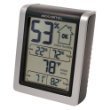 If your basement’s humidity level is more than sixty percent, it’s time to take steps to mitigate the problem.
Why sixty percent? This is the point at which our little microscopic friends begin thriving. What happens when organisms thrive? They multiply. Fun.
What can you do to reduce humidity in your basement?
First ensure that all gutters direct water at least a few feet away from your foundation.
Next, look for moisture damage and ensure there aren’t any plumbing leaks, if so have those fixed and ensure that none of the dry wall or insulation has turned into a mold factory
If your basement is unfinished, with dirt floors, install a vapor barrier -plastic sheeting- to do just that.
If it’s a minor, seasonal problem a product like DampRid can be useful, just make sure that the canister you buy is adequate for the square footage.

 If the humidity problem is more than just during the spring, consider investing in a dehumidifier. Pictured to the right is one I have. As most of you know by now, I live in the South. I also have an older home and rather than crank the AC, I turn on the dehumidifier as lower humidity makes higher temperatures more comfortable (When you sweat it actually evaporates instead of just making you feel gross.) If you have a utility sink you can drain directly into that rather than fussing with the reservoir.
Once the humidity can be maintained below sixty percent, it’s time to thoroughly clean the basement. Don’t forget, if your washer is in the basement, to check it for mildew, too.
Good luck and feel better.
Submit your questions to helpme@home-ec101.com.

Copyright Home-Ec101.com 2007-2014
 Related ArticlesDon’t Just Cover Up Musty OdorsAnother Case of Musty OdorsNest Generation 2 Thermostat Review – Not Sponsored
February 24, 2014
Another Case of Musty Odors
Dear Home Ec 101,
The problem in our family is confined to specific cotton undershirts and one specific dresser drawer. It does not matter how we wash the shirts. We’ve soaked, used vinegar, borax, triple rinsed, air dried for a week, used the gas drier and everything is fine until the shirts are put in a closet or that one drawer. Note, nothing bad has ever been in this closet or drawer. We’ve had them since brand new. After the clothes are confined there for a few weeks, they develop a strong odor that spreads to other clothes which would otherwise not get smelly. We’ve had to resort to banning that one drawer and going through the closets looking for cotton undershirts to re-wash (no other kind of cotton shirt is affected, even though they are usually worn against the skin without undershirts, so it’s not from body odor.) This only happens to some undershirts. Not even all, just some, even though they can all be in the same laundry load together. It seems to me that we will have to gradually separate the smelly from the non-smelly shirts then throw away the bad ones. I will never put anything in that one drawer again though. Nobody has ever had a clue about what could cause such specific smelliness. I look forward to your opinion.
Signed,
Mystified by Must
Heather says:
I had an email exchange with this reader a few months ago. And admittedly, I dropped the ball in getting her a satisfactory answer.
We went back and forth for quite a while on this topic.
I think this is a case of false pattern recognition.
Why? Human beings are designed to recognize patterns, it’s part of the way we are wired, a bazillion -technical term- years ago it helped us find food, remember which cave or clearing was our home, and to learn, over time, cause and effect things like, I didn’t feel well after eating that, perhaps I shouldn’t eat it any more.
What is probably going on here?
I think at some point there was a particularly funky shirt that caused a faint odor in the drawer. This caused an association: stinky shirt came from this drawer. Have there been other stinky items from other drawers, probably, but this one was noteworthy. And the next time a stinky item came from that drawer the conclusion was – AH HA the clothing put in THIS drawer becomes funky.
Eh well, probably the damp items put in this drawer have the potential to become funky and it happens sometimes.
Almost every one of us is guilty of putting away slightly damp clothing at least once in a while. This isn’t a huge problem with clothing hung in closets as there is more air flow within a closet than a drawer. Damp clothes, in a pile, in a drawer are pretty much the perfect storm of mildew growth.
So even if the problem isn’t the drawer itself, how do we prevent funky shirt smells in the future?
Empty the drawer, dry it thoroughly. Maybe let it dry fully in the sun for an afternoon. Sunlight is great at killing mildew spores. I’d probably play it extra safe and do the same for the drawer above and below, just to get any lurking time bombs.
Treat the shirts like you would musty, mildewed towels. If they smell super funky, you aren’t going to wear them anyhow -we hope- so try not to stress about the possibility of fading.
If there is any deodorant or anti-antiperspirant build up on the clothing, be sure to remove it.
Finally, ensure clothing is completely dry before placing it in drawers and consider adding a bar of your favorite soap or a sachet in the drawer. It can’t hurt.
Submit your questions to helpme@home-ec101.com.

Copyright Home-Ec101.com 2007-2014
 Related ArticlesHow to Deal With Stubborn Body Odor in LaundryDon’t Just Cover Up Musty OdorsHow to remove mildew and musty odor from towels


February 19, 2014
Knife Skills Refresher
Heather says:
This post could alternately be called, Saved By a Fingernail, Because I Wasn’t Paying Attention. (only need a bit of super glue until the nail grows out a bit, no actual blood was shed). I’ve been back in the kitchen over the last month or so. I take this as a good sign, as I’m actually looking forward to feeding people again and in my world, food is love. I’m not saying I dish up ice cream to kill the feels, I simply mean that the act of preparing food is an expression of love. (No, hitting the drive through doesn’t mean you hate your family, stop putting words in my mouth, it means your schedule is kicking your butt or life has you overwhelmed. We all have these days, no weeks, no months, fine years.)
Even experienced cooks occasionally need to brush up on their knife skills. To that end, I would like to point you to a number of articles here on Home-Ec 101 that relate.
Before you even get started, please sharpen your knives. Why? Sharp blades are much safer than dull blades. This is one bit of trivia I’d rather you accept than learn through personal experience. Okay?
Okay.
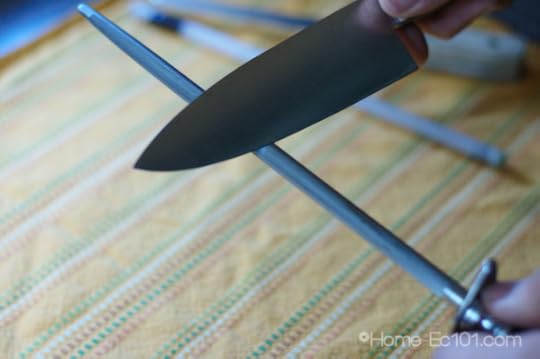
Once your knife is sharp, don’t forget to keep your steel close at hand. Why? Check out honing v sharpening.
Now on to the tutorials -which I will hopefully, maybe, be adding to soon. (I need a spare pair of hands to take these kinds of pictures.) And remember when it comes to vegetable prep, the reason we dice, rather than chop willy-nilly crazy-like is to make the cooking step easier. Vegetables of equivalent size cook more evenly preventing that odd woah, that was crunchy and gee, that’s a bit limp combo you can get.
How to dice an onion and it’s partner how to slice an onion.
How to dice a tomato -and not have the seeds get into everything. Skip the seed scooping part if you want the seeds.
How to chiffonade. (You do this with herbs like basil and occasionally some leafy greens like butter lettuce)
How to cut up a whole chicken. (People, do not underestimate this skill, it’s come in handy so many times for me)
How to spatchcock or butterfly a chicken. Want to cut the cook time of a whole chicken? This is the way to go.
How to debone chicken thighs – if you like to make chicken stock, thigh bones aren’t food waste.
How to dice a butternut squash – this vegetable is a pain in the rear, but the technique applies to other odd shaped squashes.
Embarrassingly bad photo tutorial of how to seed and dice a cucumber – I need to fix this one NOW. Hey, all bloggers started somewhere and here you get to see the humble roots of Home-Ec 101.
How to batonnet – this is getting fancy.
And why do we bother? For that fun, you can visit this piece on why I cook from scratch, even when it can be an utter pain in the butt.
What knife skills tutorials would you like to see here?

Copyright Home-Ec101.com 2007-2014
 Related StoriesGarlic and Soy Chicken ThighsJanuary’s Seasonal Recipes Make Eating Local More Practical (for some)How to Store Greens in a Small Living Space

Heather Solos's Blog

- Heather Solos's profile
- 12 followers


