
Susan Jeffers's Blog, page 4
March 31, 2023
Expand Your Horizons by Doing It Anyway
“We generate fears while we sit. We overcome them by action.” Dr. Henry Link
There is nothing like being comfy and cozy in our comfort zones. Right? The problem with that is, of course, that we can’t change or grow if we hold on to our comfort zones. As Susan wrote in Feel the Fear and Do It Anyway, “Most of us operate within a zone that feels right, and outside of it we are uncomfortable. For each one of us that zone of comfort is different, but whether we are aware of it or not, all of us—rich or poor, famous or unknown, gay or straight, male or female or whatever our gender identity— make decisions based on the confines of that comfortable space.”
While we may feel secure in our comfort zone, we likely are living with the pain of neediness and the fear of change. While comfort zones can make us feel secure, they also keep us from feeling powerful. If we want to grow, to experience, to learn, we have to start moving out of complacency in that comfortable space. We have to start expanding our boundaries. To do so, we have to take action, we have to put in the work—even if it means being uncomfortable. That is the only way we can know our own power.
Trailblazing writer Octavia Butler, who pushed the boundaries in the genre of science fiction and fantasy as a black woman in the 1970s, famously pushed herself out of her comfort zone. She was known for making lists of her goals and then working to make them happen, despite the odds against her. She often wrote affirmations for herself, taping them up next to her workspace. On one index card she wrote, “So be it, so do it.” This simple phrase calls into being what she wants, but also tells her that she has to put in the work to make it happen. A message Susan would definitely get behind.
The simplicity of Butler’s affirmation is something that many of us complicate. We see what we want and we get frustrated because change seems so daunting, so much work, with so little payoff. It scares us to think we might put all that work into what we want and not have anything to show for it at the end. We let the fear of failing keep us from even trying.
We let self-doubt feed our fear and our comfort zone keep us safe, so that we put up a wall between us and our dreams. We become stuck rather than taking the steps to move us towards our goals. Susan said, “Remember that much of the trick of moving from pain to power is taking action.” In other words, we need to focus less on the “Feel the Fear” part of the phrase and spend more time on the “Do It Anyway” part.
Doing is a major part of overcoming our fears, but the doing is also the scariest part. Yet we can’t experience all of life’s goodies if we don’t put ourselves out there and DO IT. We all have the power within ourselves to push past the boundaries of our comfort zones. We need to recognize that.
“Whether it feels like it or not, you already have more power than you could ever have imagined,” Susan wrote. “We all have. When I speak of going from pain to power, I am not talking about pulling the power in from any outside source. Inside of you, just waiting to emerge, is an incredible source of energy that is more than sufficient for you to create a joyful and satisfying life. It isn’t magic. It is only a process of tapping the energy already within you, though you may not be aware of it.”
We can’t always jump right into taking action. Sometimes it requires us to take baby steps. Maybe some of us would rather go from being scared of heights to bungee jumping in one step, but most of us want to expand our comfort zone more carefully, taking one thoughtful step at a time.
“Take a risk a day—one small or bold stroke that will make you feel great once you’ve done it.
Even if it doesn’t work out the way you wanted it to, at least you’ve tried.
You didn’t sit back . . . powerless.”
There is nothing wrong with taking tiny steps to push your boundaries. After all, each tiny rain drop counts in a flood. Make a plan, breaking down your goals into the smallest of steps. Put up affirmations and motivational quotes where you can see them, just like Octavia Butler and Susan did. However you push yourself out of your comfort zone, the important thing is the doing.


March 21, 2023
There is No Such Thing as Making a Mistake
Do you feel like you’ve made a big mistake? Do you feel like you have taken the wrong path in life? Turns out, that is not a possibility. You only think you are wrong. If you change the way you think about an experience, you can see that while the thing you wanted to happen did not, you probably learned a lot that will help you grow as a person. Here’s an example.
Mariam wanted to work in health care and after taking the basic courses, she decided to be a respiratory therapist. After intensive schooling and a lot of money in tuition, she got a job working in a hospital’s emergency room. She only lasted a week. She found that she wasn’t able to deal with a patient dying on her. In fact, she tried so hard to save every patient, once orderlies had to remove her from a room because she wouldn’t stop trying to save her patient.
What that experience taught her was that she really wanted to help people, but taking care of dying patients was not where she needed to be. Instead, she turned to counselling and with a little more education was able to open a successful practice. Did she see her training as a respiratory therapist as a mistake? No, it was a learning experience. A very expensive one, she would often quip. But afterward, she better understood where she could do the most good.
March 9, 2023
There Are No Mistakes When You Course Correct
In Feel the Fear and Do It Anyway, Susan taught us about how to make a No-Lose Decision. Part of that decision-making process is knowing that if you find you are not on the right path, you can change your mind and adjust your path to the place you need to be. This is the example she used in the book.
In his book Actualizations, Stewart Emery presents an excellent model for changing your direction in life. He learned it while seated on the flight deck of an airplane on the way to Honolulu. He noticed a console, which was identified by the pilot as the inertial guidance system. The purpose of the system was to get the plane within one thousand yards of the runway in Hawaii within five minutes of the estimated arrival time. Each time the plane strayed off course, the system corrected it. The pilot explained that they would arrive in Hawaii on time in spite of “having been in error 90 percent of the time.” Emery takes it from there, stating: “So the path from here to where we want to be starts with an error, which we correct, which becomes the next error, which we correct and that becomes the next error, which we correct. So the only time we are truly on course is that moment in the zigzag when we actually cross the true path.” From the analogy, we see that the trick in life is not to worry about making a wrong decision; it’s learning when to correct! My concept of the model looks like this:
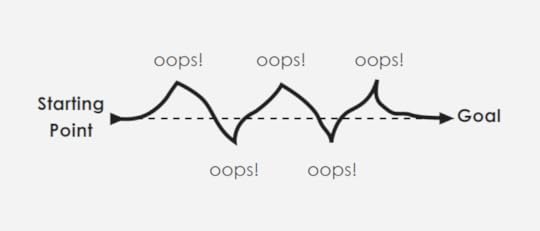 Off Course/Correct Model
There are many inner clues that help you know when it is time to correct. The two most obvious are confusion and dissatisfaction. Ironically, these are considered negatives, instead of positives. I know it is hard to accept, but an upset in your life is beneficial, in that it tells you that you are off course in some way and you need to find your way back to your particular path of clarity once again. Your confusion and dissatisfaction are telling you that you’re off track, and, as the Chinese proverb says, “If you don’t change your direction, you’re likely to end up where you’re heading.”
February 27, 2023
Learning and Growing Through Making Mistakes
Are you making any mistakes lately? I hope so! Susan Jeffers, Ph.D.
Mistakes are a way of life. Everybody makes little mistakes all the time. Things like missing a turn while driving, leaving a typo in an important document, or forgetting to add an attachment to an email. While these are still mistakes, we don’t worry about them too much. We correct them and move on.
Then there are the mistakes that we fear. Mistakes that we label the “wrong” decision, such as taking a job we dislike, or dating a person who isn’t right for us, or buying a car that is a lemon, or, or, or… You know what we mean. Mistakes make us feel less than perfect, so we try to avoid them as much as we can.
Yet, mistakes can be an important part of learning and growing. As Susan wrote in Feel the Fear and Do It Anyway, “When you consider that mistakes are an integral part of living, it is amazing how we are taught to think we must be perfect. This mistake in our thinking, that we must try to be perfect, has created many fears about being adventurous and trying out new territories.”
We are all taught to feel that making a mistake means we are not living up to our potential. Remember in math class when you got a big, red minus sign next to a problem you got wrong? We are taught that making a mistake means we have done something bad. That we are less than perfect. That’s absurd thinking! When we feel like we need to be perfect, it means we are trying to control the outcome. When we try to control how things will turn out, we become petrified about making changes or trying something new. “No one has ever said that ‘being perfect’ made them happier or feel more fulfilled. In fact, the ideal of being perfect is one of the biggest fabrications that we tell ourselves,” said Susan.
Making a mistake is just as important as not making a mistake, maybe even more important. Just as it’s important to find out what you don’t want as opposed to what you do want. This is how we grow as a person. The only way to stretch and expand our lived experiences is to get out of our comfort zone and take a risk.
“You are not going to succeed in everything you attempt in life,” Susan wrote. “That’s guaranteed. In fact, the more you do in life, the more chance there is not to succeed in some things. Look at how rich your life can be, however, from your many adventures.”
Susan uses the example of batting in baseball. Most players in the major leagues have an average of .300—which means that the player hits the ball only three times out of every ten times at bat. Very few players achieve a .400 average. As Susan said, “That’s a champion’s performance—and yet it falls short of perfect—and most of us are just beginners!”
If we look at our own “performance” in our lives, we can likely see that we are not batting an average of .400. Not even close. How many resumes do you have to send out before you get that new job? How many dates do you have to go on before you find the right person? How much work do you have to put in trying before you get that recipe just right or practice knitting a scarf before you can knit a sweater? Everything we do requires taking a chance that the end result won’t be perfect, or even passable. It is the trying that makes our lives richer. It is taking the chance that is the important thing. It is the journey, not the end result, that helps us to expand and grow and learn.
“After much consideration,” wrote Susan, “I have come to the conclusion that if you haven’t made any mistakes lately, you must be doing something wrong. You are taking no risks—nor are you enjoying the goodies life has to offer. What a waste!”
Take a moment now to think about ways that you are avoiding something new out of a fear of making a mistake. Whether that something is small or large, easy or hard, you must find a way through your fear of failing and do it. Because, as Susan taught us, there is nothing to fear in life if we know that we can handle it. And that includes mistakes.
February 20, 2023
Anger Used for Good
This month we’re talking about flowing with the changes in our relationship with our spouse or partner and making sure our old-expectations are not creating friction. In The Feel the Fear Guide to Lasting Love, Susan offered this advice:
PUT YOUR ANGER TO GOOD USE. Anger is a good clue that our expectations are in control and they are getting in the way of love. If we use our inappropriate anger to hurt our mate, our relationship is in danger. On the other hand, if we use our inappropriate anger as a vehicle for growth, then it is a valuable emotion. How do we do that? It’s easy. We pick up the mirror and once again ask ourselves the important questions, ‘What am I not doing for myself that I am expecting him/her to do for me?’ ‘How can I change what isn’t working?’ And other such telling questions.
When we begin taking responsibility for
our experience of life, our anger disappears.
Anger feels powerful, but unless it is used to teach us what we need to work on within ourselves, it is actually powerless. It fools us into thinking we are correct in all our unloving thoughts. It is also an important clue that we are not in control of our reactions. It causes us to blame our mates. It says we are victims. And unless we pick up the mirror, our anger can become vicious and ugly – witness many divorce proceedings.
You can understand why the mirror is so important when we are feeling angry. When we take responsibility for our own lives, our anger disappears and we stop blaming our mate. Powerful indeed!
February 13, 2023
A New Feel the Fear!
March 14th is fast approaching—the day the new edition of Feel the Fear and Do It Anyway comes out in the U.S.! To whet your appetite for this new edition, here is an excerpt.
To preorder your copy—either in print or digital—click here.
TRUTH 4
Not only am I going to experience
fear whenever I’m on unfamiliar
territory, but so is everyone else.
I said to myself: “You mean all those people out there that I’ve been envying because they’re not afraid to move ahead with their lives have really been afraid? Why didn’t somebody tell me!?” I guess I never asked. I was sure I was the only person out there feeling so inadequate. It was such a relief to realize I was not alone in this. I had the rest of the world to keep me company.
A great example of this is the prolific TV producer, creator, and writer Shonda Rhimes. She’s known internationally for her shows Grey’s Anatomy, Scandal, and How to Get Away with Murder. Despite being hugely successful, she hated being in the spotlight. She’s an introvert and found that the glamorous Hollywood life—large events, parties, and award shows—caused her severe anxiety. So she never said yes to invitations. When her older sister pointed this out to her, Shonda decided to turn her life around. She vowed to say yes for a year, no matter what. Her decision became the basis of her bestselling book, Year of Yes, which chronicles how she overcame her intense fear of putting herself in the spotlight.
If you are aware of the Fear Truths, Shonda’s fear will not come as a surprise. Writing is a behind-the- scenes occupation—no wonder Hollywood parties made her nervous. Being the center of attention is something that she’s not comfortable with, so of course she would be scared. After her Year of Yes, Shonda found that stretching past her boundaries increased both her self-worth and her self-confidence. Simply put, that is the way it works—for all of us. By virtue of our being human, we share the same feelings. Fear is no exception.
There are many stories similar to Shonda Rhimes’s experience. Until you are in touch with the Fear Truths, you will hear about and read and see these stories and not notice the underlying principles operating in them. You may never relate the experiences of others, especially celebrities, to your own life. You may think they are lucky because they aren’t afraid to put themselves out there. Not so! They had to push through a tremendous amount of fear to get where they are today . . . and they are still pushing.
Those who have successfully dealt with fear all their lives seem to have known, consciously or unconsciously, the message in this book: you must feel the fear . . . and do it anyway. A very successful friend of mine, a self-made man who allowed nothing to stop him along the way, pondered the title of my course one day, nodded, and said, “Yes, I guess that is the way I’ve always lived my life, without consciously realizing that’s what I’ve been doing. I can’t remember not being afraid, but it never occurred to me that fear would prevent me from taking the risks necessary to get what I wanted. I just went ahead and did what I had to do to make my ideas work—despite the fear.”
There are so many inspiring examples of people becoming hugely successful even after experiencing daunting setbacks. Bill Gates’s first company failed; later he founded Microsoft. Oprah Winfrey was fired from her first broadcast news job. The basketball legend Michael Jordan was cut from his high school basketball team. The first book by Stephen King, the author of more than 100 books, was rejected more than 30 times.
Pushing through the fear is not just for the wildly successful. I know a woman who divorced in her late 30s, when she set out to find a job, wanting to pursue a career in law enforcement. She became a police officer at the age of 39, at a time when there were few women police officers. If you think she didn’t have any fear, you would be very wrong.
These are just a few examples of how people have consciously or unconsciously felt their fear and moved past it. Feeling fear is very lonely, but it helps to know that we all experience it.
February 9, 2023
A Love Lesson for a Strong Relationship
In her book, The Feel the Fear Guide to Lasting Love, Susan wrote about how out-of-date expectations can put cracks in our relationship with our spouse or partner. To make sure we are putting our relationship first—and not our expectations—Susan offered this “Love Lesson.”
Analyze Your Expectations
She wrote, “In no other area do we need to pick up the mirror more than we do relative to our old expectations and new freedoms.” Here are some questions you can use to help evaluate how your expectations are affecting your relationship.
What do I really expect from my mate?
Where am I stuck in old ways of thinking about how a relationship should be?’
How do I remain whole without losing myself to my mate?
How do I maintain my lovingness while fulfilling my own dreams?
Where are my expectations inconsistent with my stated desires?
Take the time to really consider these questions and write down your answers. Perhaps give these questions to your partner as well, so you can both do a “check-up” to make sure your relationship is healthy.
Susan said, “Really analyzing our inconsistencies and expectations requires consciousness. We have to be awake as to where old habits of thinking are getting in the way of a loving relationship. Without consciousness we just keep doing the same relationship-defeating actions over and over again. And a break-up is often inevitable. It is important to look inside to see what we can do to become more loving people, which, as you have already learned, is the most important purpose of our relationship.”
Where does your relationship stand when you answer these questions?
January 31, 2023
People Change and So Must Relationships
“Every couple is on their own to discover how to build a healthy relationship and to forge their own vision of how and why to be together.”
Susan Jeffers
Life changes us, everyday we learn something new, get involved in new hobbies, meet new people, try new foods. Every new thing changes us on a fundamental level. If you look back over the years, you can probably see how you’ve grown and changed as a person. The dreams you had and the choices you made at twenty are probably very different later in your life. Life, and people, constantly change.
This applies to relationships as well. Just as we change, our partners will change too, which means our relationship with each other must also grow and develop. The person we first got involved with and made a commitment to might not be the same person we know today.
Traditionally, roles in a marriage or partnership had the woman as homemaker and the caretaker of the children, while the man went out in the world to make money. How narrow! And even after the children were raised and left the house, those roles were cemented in. How boring to stay stuck in a relationship role that was stifling! Things are different now, but many people still hold on to their first expectations in a relationship while their partner may not. As Susan wrote in The Feel the Fear Guide to Lasting Love, “Even if we have enjoyed compatibility of roles for a number of years, one of us may change our mind as to how we want to live our life.”
These days we have far more flexibility in choosing the type of role we want to play in our relationship. Now it is not necessarily that just the moms quit work to take care of the kids, as many men are finding satisfaction in being the primary caretaker for their children. And now, with the advent of work-from-home positions, many couples are having to rethink their relationship roles both inside and outside the home.
But what happens when one partner wants change and the other doesn’t? What if you or your partner becomes unhappy with the changes in the other? Susan said, “It is important to remember that, once again, it is usually our fear that keeps us locked in many of our beliefs, actions, and expectations.”
If this situation is becoming a struggle for you and your partner, then it’s time to reevaluate your roles and your expectations. If you are feeling anger or disappointment or any other negative emotion about your relationship, you need to look inside to discover what is really causing those feelings. Our relationship should help us to be a more loving person, and if it is not then we must examine why.
In reevaluating our relationship, each partner needs to ask whether or not their role is serving their Higher Self. If it is not, then action needs to be taken to change.
“In an ideal relationship,” Susan wrote, “we don’t get hung up on roles. We are both strong enough to roll with the changes. The key is not to become too rigid in our positions and to learn the meaning of flow. A big challenge indeed! Even those who are adept at flowing with the changes in life often have an initial reaction of fear as changes occur.”
There is no right or wrong way to be in a relationship. Each couple needs to create their own rules as their relationship matures. A relationship is a process, not a contract written in stone. We need to see our relationship as a way to become a more loving person. Making demands based on our insecurities will not help us to be more loving.
Susan wrote in Opening Our Hearts to Men that there is only one expectation we should have. It is this:
My only expectation of this relationship – whether it lasts one week, 25 years, or till death do us part – is that I will learn more about opening my heart and becoming a more loving person. I accept this as one of my highest purposes in life.
Relationships will grow and change as we ourselves grow and change. It doesn’t matter what part you played in your relationship five years ago or yesterday. For Susan:
“There is no question that as our relationship moves forward, we are frequently caught in the middle of discovery and confusion. As I see it, no matter what happens in a relationship, it is all an opportunity to learn more about who we are, what we still have to learn and what we have to be grateful for.”
January 23, 2023
Change Your Life By Acting-As-If
Have you ever tried Susan’s “Acting-As-If” exercise? It is a wonderful tool for improving even the most mundane aspects of your life. It can also help your relationships. Here’s an example.
Katrina had been married for seventeen years to her husband, Marcus. They had two teenage children and both worked full time. Katrina loved her job as designer in a marketing firm. She loved her family too and even though it could be exhausting to help her kids with their homework at the end of the day, she didn’t want to lose that special time with them. While she and Marcus had a loving, supporting relationship they didn’t have time for each other. Marcus would try to carve out some alone time for the both of them, but Katrina always found something else she felt was more important to do.
Marcus, understandably, was frustrated with their relationship and was considering leaving unless things changed. Katrina hadn’t noticed that Marcus was upset. They didn’t fight and he was as committed a father as he had always been. But his resentment was the wake-up call she needed. She had gotten so used to just having a relationship with Marcus that she didn’t put any effort into it.
She asked herself what she would be doing if she was as fully committed to her relationship as she was to her career and her children. How would that be different than what she was presently doing?
She would be sure to acknowledge that she appreciated his being there and being a good dad. She would show him some kind of affection each day. She would make sure to schedule in alone time with her husband. She even decided to throw in some spontaneity to their relationship by taking him out for a surprise lunch on a weekday or sending the kids off to their grandparents for the weekend. Once Katrina started, she came up with lots of ideas to be fully committed to her relationship with her husband.
As she started to implement those changes, she realized that she had been taking other aspects of her life for granted as well. She renewed her commitment to friends she had let go by the wayside and started spending more time with her extended family, creating a more full and well-rounded life.
January 12, 2023
Knowing That You Count By Acting-As-If
This first month of the New Year, we are talking about setting intentions, making resolutions, and doing the work to make them happen. Susan’s Magic Duo—committing 100% and knowing that I Count—is a great tool to help you make your 2023 goals come true. We wanted to give you some more guidance in how to Act-As-If. This is an excerpt from Embracing Uncertainty:
You may still not have the understanding at the deepest level of your being that your life actually does make a difference in this world. You may act lovingly and do wonderful things, but you still don’t feel you are important. You can begin to change this erroneous self-perception by playing the game of “act-as-if.” That is, with each step of the Journey you ask yourself…
“If I truly made a difference in this world, what would I be doing?”
“If I truly made a difference in this world, how would I be more loving?”
“If I truly made a difference in this world, how would I create more harmony around me?”
You then make a list of all the actions you would take in all situations in your life. And then you would act accordingly. For example:
If I truly made a difference in this world, what would I be doing relative to my job? How could I be more loving and create more harmony around me?
1. I would arrive on time.
2. I would be a self-starter, advancing the goals of my company.
3. I would be friendly to my co-workers.
4. I would give them credit when they do something meaningful.
And so on. And then you would follow through on these “I would’s.” The above answers are rather ordinary and obvious, but I am putting my trust in you to be much more creative in your own personal situation. The challenge is to create a wonderful environment for yourself and everyone around you. It doesn’t matter at what level of the company you function–from the lowest on the totem pole to the highest. Your sense of caring is important no matter where you find yourself.
You need to play this game of act-as-if in all areas of your life…with your family, friends, career, and community. And don’t forget to include giving love and caring to yourself. Without yourself, you can’t do much of anything!
As you can see, the process is very simple, but it requires a lifetime commitment of asking yourself these important questions, listening for the answers that come from the highest part of who you are, and then taking the actions that create a healing energy within and around you. The challenge is to ask yourself these questions in all the circumstances in your life.


