
Susan Jeffers's Blog, page 3
July 15, 2023
The Protective Filter Exercise
This month we’re talking about turning our backs on all the messages of ‘danger’ that we are bombarded with. This exercise, from Embracing Uncertainty, can help us set boundaries so that the negativity can’t affect us.
For a while in my own personal growth, I drastically lowered the amount of negative news that I watched on television or read in newspapers and magazines. And that was perfect for my own progression into becoming a more positive person.
Then at some point I was able to create simple protective “tricks” that allowed me to keep my eyes wide open to the bad news in the world without it destroying my peace of mind. This was important to me, as I love to feel as though I am a part of the world…and it’s hard to feel a part of the world when you don’t have a clue as to what is going on! One of the tricks I created was the “Protective Filter” exercise which combines the miracle of glass plus the miracle of imagination. This simple exercise allows me to be a part of it all without being upset by it all. Let me explain.
Glass is an amazing product. Think about windows. Whether in our home or car, they protect us from noise, cold, wind, sleet, snow, rain, and all the negative elements. The amazing things about windows is that, not only do they enrich our lives by protecting us from the “bad news” outside, they enrich our lives by inviting in the “good news”—the light, the sun, and the view. I told you this was a miracle product!
Another miracle “product” is our imagination. If used properly, it allows us to conjure up all sorts of ways of shielding ourselves from the bad news and letting in the good. Of course, if used improperly, it does the reverse. But we are truly in control of our imagination and we need to learn how to use it in a way that supports rather than sabotages us.
In this exercise, I combined the miracles of glass and imagination in a way that allows me to watch the news in a “protective” fashion. I first imagine a glass shield between myself and the television set. Then, as the bad news drones on and on, I imagine this glass shield stopping the negativity but at the same time allowing the salient information to come through. It also allows the few items of good news to come through as well. Think about it: with a little help from an imaginary piece of glass conjured up by my mind, I can be open to, yet protected from, all the bad news that is around me.
I suspect you are thinking, “Susan, you’ve been working too hard!” I suggest you try it out. In fact, use the imaginary piece of glass to protect you not only from the negativity of the television news, but from the negativity in all situations in your life…during a family spat, driving in your car, talking on the phone, reading the newspapers, walking down the street, and so on.


June 30, 2023
Creating Good News Out of Bad News
“I recently received an advertisement for a how-to book about health. On the cover of the brochure was emblazoned the words, ‘READ THIS OR DIE.’ I didn’t read it and I didn’t die!” Susan wrote in Embracing Uncertainty.
How often do we come across headlines, advertisements, videos, social media posts, and more that are meant to scare us. In the attention economy, fear mongering grabs eyes and makes money. The more frightened we are, the more likely we will want to buy their product, support their cause or their popularity. This bombardment of scare tactics makes us feel like there is always impending doom and danger. Susan said, “No wonder we have trouble embracing uncertainty…there only seems to be danger ahead!”
Yet most of us do not live with any real danger around us. How many days go by without the world ending? Or even something closer to home, like a car accident or a break-in? Most of us will spend 95% of our lives just living our day-to-day life without anything truly terrible happening.
Even without watching or listening to the news or doom scrolling through social media, we sabotage ourselves when we let our thinking, our Chatterbox, feed us constant bad news about how our lives aren’t working and how disastrous everything feels. “When we carry a DANGER AHEAD sign in our heads it is really a form of self-sabotage,” said Susan. “The reality is that most of what we worry about never even happens.”
Not only do we need to turn off our electronics, put the newspaper in the recycle bin, and control our negative thoughts, in order to really make the best of what we have, we need to actively see the good. “I refuse to give up my power to find the good news that is always there in unbelievably large measure. While we are wise to take certain protective measures relative to what is happening in our world, we are also wise to understand that it is all a guessing game. And why not ‘guess’ good news instead of bad news?” Susan wrote.
The fact is…there is so much good news around us
that it would stagger the imagination, that is,
IF WE PAID ATTENTION!
Instead of imagining dangerous situations surrounding us, we need to see that we are surrounded by blessings. Susan said, “There is no question that the world gives you the message, DANGER AHEAD. I’ll bet you’ve never seen the message JOY AHEAD. So it’s up to us to create that scenario for ourselves. We should put a sign everywhere we can see it…JOY AHEAD!”
To counter all the “danger” signals we receive, Susan suggested substituting the word “Joy” for “Danger” whenever we can. This idea is an expansion on Susan’s Pain-to-Power Vocabulary lesson. Words have power and the way we use them can impact the quality of our lives. While Joy-to-Danger isn’t a one-to-one exchange, it can help us to see the value of finding good even in the bad. Susan wrote, “Of course, there are times when it is essential to heed the DANGER AHEAD sign that tells us there is a problem on the road ahead, but we should be filled with JOY that someone put the sign there to warn us! See, you can make good news out of anything.”
We can also take it upon ourselves to spread good news. There is the Universal Law of “like attracts like,” so when we become the bearers of good, we are more likely to get back more good. Susan suggested two ways of doing this: affirmations and giving thanks.
We all know the power of repeating affirmations. Affirmations can help replace negative thoughts, improve self-confidence, to remind you to be a good news spreader, and create positive energy that will touch everyone you meet. To help spread good in the world, Susan suggested these affirmations:
I radiate light and love wherever I go.
I see the good in all things.
My actions put healing energy into the world.
Another way to help promote the spread of good news is to thank those who help spread good news. Here, we aren’t necessarily talking about news, we’re talking about anyone who is a positive force. This could be a server in a restaurant who was really understanding or a mailperson delivering an important package. It could be your doctor helping you through a tough illness, a friend who finds the positive even on the most frustrating day, or anyone who is an example of a loving and caring person. Reach out to these people and thank them. As Susan said, “People are so used to getting complaints; a compliment is a blessing.” Reaching out to spread your thanks is a wonderful way to spread good news.
This is just a small taste of all the positivity you can bring to the constant bombardment of danger, danger, danger messages we receive. It’s up to each of us to find the joy. Even when bad things do actually happen, which is a certainty in life, they can be handled in a life-affirming way. Susan wrote, “I’m sure you can think of many people who have experienced great difficulty, even tragedy, and with their uplifting attitude, they were able to turn the bad news into good news. They have learned that no matter what happens, we can create a JOY AHEAD world for ourselves…and that’s REALLY good news!”
June 19, 2023
A Children’s ‘What If’ Game
A fun party game is asking crazy ‘what if’ questions and creating playful, entertaining answers. Questions like, “What if unicorns are real,” or “What if you could surf on sand?” However, ‘what if’ questions can become a problem internally when your inner Chatterbox starts asking them from a place of fear.
Yet, asking ‘what if’ can be a good thing if you try to come up with a practical answer and not let the question fill you up with fear. Another version of the ‘what if’ game is played with children and their carers, helping kids to work through their worries. The game works like this: a parent asks a real-life question, such as “what if the house catches on fire during the night?” Then the parent helps the child come up with a good solution, such as “I would pop-out the window screen and climb out the window and meet you by the mailbox.” Another example, “What if we are in a big store and we can’t find each other?” The answer is “I find the help counter or the cashier to help me find you.”
This is a great tool to help younger kids understand that in any situation, there is a practical way that they can handle it. It can be a good tool for adults too. “What if I lose my job?” The answer might be “I take a deep breath then work on my resume and start looking for a new job. If I don’t find one right away, I could take a temporary job and cut back on expenses.” Another example could be, “What if it rains on the day of my outdoor party?” The answer could be, “We’ll bring part of it inside and set up large umbrellas for the overflow outside.”
Even if you are ‘what if-ing’ a really dire scenario—”What if my child gets cancer?” The answer could be, “I will do everything I can to get them the best health care I can and will support them and cherish them through the ordeal.”
In any of these “what if” scenarios, it always comes down to Susan’s favorite tool—understanding that no matter what happens, “I’ll handle it!”
June 7, 2023
I Will Worry Tomorrow
In Embracing Uncertainty, Susan offers this exercise to help us get past the ‘what if’ fears and stop worrying.
THE I’LL WORRY TOMORROW EXERCISE
The attempt to control the future and the demand to be in charge of everything in our lives sentences us to a daily existence obsessed with life-numbing worry. Many of us have attained the dubious title of “professional worrier”. It seems as though it is our job to worry! Does the following example bear any resemblance to the way you think?
You are going on a long-awaited vacation. Your joy is marred by the multitude of things you are choosing to worry about…your computer being stolen, getting sick in unfamiliar territory, the plane being late, the hotel room being horrible, and whatever else you can think of that would destroy the experience of your trip. Sometimes it feels better just to stay home! Oh, if we could only think of it as a wonderful adventure…no matter what happens!
Even if things are going terrifically well, the mind of a professional worrier can always find something to worry about.…This is because thoughts of potential future disaster immediately step in to take away the good feelings. It is a given that, when they have nothing to worry about, professional worriers invariably create something to worry about. To end this madness, we need to find a way to turn the worry off. The “I’ll Worry Tomorrow” Exercise can be the very thing we need to turn the worry off.
I have used this exercise very effectively for many situations in my life. It came to me as I was sitting at my desk worrying about the sale of our house. We wanted something smaller and the real estate market was good. My mind was driving me crazy with thoughts such as, “Where will we go when the house actually sells?” “Will we find another house that is just as satisfying as this one?” “Will we be able to sell our house at the price we want to get for it?” “Maybe no one will want it?” I laughed as I realized that I was worried that the house would sell…and I was also worried that the house wouldn’t sell! Talk about creating a lose-lose situation in your mind!
I finally said to myself…
“I won’t worry about anything today. I’ll worry about it tomorrow.”
And it worked! I felt my heart lighten. I felt worry-free for the entire day. And it has continued to work. Little by little, I am learning to repeat this simple thought about everything that tends to cause me worry…health, money, the happiness of my children, and so on.
We are often told not to put anything off until tomorrow if it can be done today. We now have at least one big exception to that rule…WORRY. I give you permission, just in case you feel you need it, to put off all your worry until tomorrow. It goes like this…
Monday…repeat over and over again. “I won’t worry about anything today. I’ll worry about it tomorrow.”
Tuesday…repeat over and over again. “I won’t worry about anything today. I’ll worry about it tomorrow.”
Wednesday…repeat over and over again. “I won’t worry about anything today. I’ll worry about it tomorrow.”
Thursday…repeat over and over again. “I won’t worry about anything today. I’ll worry about it tomorrow.”
Friday…repeat over and over again. “I won’t worry about anything today. I’ll worry about it tomorrow.”
Saturday…repeat over and over again. “I won’t worry about anything today. I’ll worry about it tomorrow.”
Sunday…repeat over and over again. “I won’t worry about anything today. I’ll worry about it tomorrow.”
Amazing! Seven worry-free days! And the last time I looked, there are only seven days of the week! If you do this for every week of your life, you have created a worry-free life. I know that this sounds very simplistic, but once you get the hang of it, you will find your life being dramatically uplifted since nothing will be able to pull you down…until tomorrow, which, of course, never comes.
May 31, 2023
Asking “What If?” and Answering “I’ll Handle It”
Even the most enlightened of us can’t always stop ourselves from worrying about the future and asking ourselves “what if?” Underneath our connection to our Higher Self that we work so hard for, lurks the fear of future problems just waiting for an opening to ask us “what if?”
You know how it is…trouble is brewing at your job, layoffs could be coming. What if you lost your job? There have been a rash of pedestrian traffic accidents lately. What if your child is hit by a car? Your mother’s routine check-up turns into several follow-up appointments. What if she is sick? And on and on.
Before we know it, our Chatterboxes have taken over. We are filled with fears about the future and the “what if” questions drag us down to our Lower Self. Many of us “what if” ourselves into a perpetual state of worry.
“What if” questions come from our Lower Self, our inner chatterbox that wants us to live in perpetual fear. Susan wrote in Feel the Fear and Do It Anyway, “When the ‘what ifs’ are out in full force, the internal Chatterbox is at it again. You look at the unknown and try to predict the future; you try to take control of outside forces. Both are impossible. At this point you might notice you are driving yourself crazy.”
When we “what if” ourselves into anxiety and dread, we undermine our self-confidence, which then makes us feel insecure and out of control. Any of us familiar with Susan’s work knows that, “Underlying all our fears is a lack of trust in ourselves.”
We want to feel secure, but living life isn’t about being secure. As one of Susan’s favorite inspirational quotes says: “Ships in harbor are safe, but that’s not what ships are built for.”
In other words, if we want to live a safe and secure life, we won’t be living towards our purpose. There is nothing to be gained by being secure in life because, as you know, confidence doesn’t come from security, confidence comes from knowing that whatever we fear, and that whatever bad thing may come our way, we know we can handle it.
So how do we take on those “what if” fears? First, we need to recognize that the fear is there. Maybe say hello to it like an old acquaintance we have grown away from. We can answer that “what if” question with help from our Higher Self. “What if I lose my job?” Instead of breaking out into a sweat and eating a pint of ice cream, we can think it through. The answer might be, “I will cut back my expenses, start sending out my resume, and sign up for free classes offered by the job center.” “What if my child is hit by a car?” A good answer could be, “I will be frightened for their well-being, but I will make sure they get the best health care available and I will be there for them every minute.”
“What if” questions are only scary when you allow yourself to sit with the fear instead of honestly trying to answer it. When you set the fear aside and examine the question with real intention you build confidence and trust in yourself.
One of Susan’s best lessons is “I’ll handle it.” When we know that we can handle whatever comes our way, we can approach any problem, any fear, with self-confidence that will support us when bad things happen. Unlike “what if-ing” ourselves, which comes from our lower way of thinking “I can handle it” puts us directly in touch with our Higher Self.
Susan wrote, “You, like everyone else, have incredible sources of power within that you haven’t used before. It would serve you to say to yourself, ‘I know I’ll handle it. I have nothing to worry about.’ Instead of ‘I’ve lost my job! What will I do?’ try ‘I’ve lost my job. I know I’ll handle it.’”
Security, she said, is not having things, it is handling things. “Thus, when you can answer all your ‘what ifs’ with ‘I can handle it,’ you can approach all things with a no-lose guarantee, and the fear disappears.”
“What if” questions don’t have to be a source of fear. When approached with the right mind-set and attitude, “what if” questions can help us become more prepared and more confident. When we can answer those fear-mongering questions with practical answers, we are building confidence and trust in ourselves.
So when your Lower Self tries to slip in some “what if’s” into your thinking, try to recognize the question for what it is and then find a practical answer. When you can do this regularly, as Susan said, “You will find yourself coming closer and closer to such a high level of self-confidence that you will ultimately begin to realize that you can handle anything that comes your way.”
Never let these three little words out of your mind—
possibly the most important three little words you’ll ever hear—
I’ll handle it!
May 19, 2023
Transcending Meditation
This month we’re talking about getting to know to your inner self through silence and solitude. Susan believed that meditation could be an important tool for connecting this way. Here is an excerpt from End the Struggle and Dance With Life about meditation:
Let me explore with you a very powerful way of reaching and ultimately embracing the silence of your mind, thus transforming your experience of life from one of confusion and clutter into one of peaceful awareness, MEDITATION.
Many of us don’t like the concept of meditation. It conjures up pictures of people sitting in a monastery in the crossed-legged lotus position being quiet for days on end. Yes, there are those who meditate that way. But for most of us in Western civilization, this is neither practical nor appealing. Luckily, there are other options.
One of the most popular of these options is called TRANSCENDENTAL MEDITATION (TM for short). It was brought to the United States in 1959 by a monk from India, Maharishi Mahesh Yogi. Yet, it is important to keep in mind that…
TM has nothing to do with religion. It’s not even a philosophy or a suggested lifestyle. TM is purely a mechanical technique for achieving a deep state of restful awareness.
So don’t let any religious considerations stop you from deriving all the potential benefits from TM. It is the most studied form of meditation and the documented value it gives to our lives is enormous.
Because TM can be used by everyone, it has been adopted by many people in the mainstream. It is practiced by bankers, college students, athletes, grocery clerks, teachers, and so on. TM has achieved its popularity for a number of reasons.
TM is very easy to do. TM offers us a deeper state of rest than sleep.TM is great for our health.TM improves our mental abilities.TM improves our emotional state, hence, our relationships with everyone in our lives.The TM explanation for this is that at a very deep level, we are connected as one energy. (Quantum physics is certainly agreeing with this notion!) If that energy is negative, the negativity spreads throughout the community. If that energy is positive, the positive energy spreads throughout the community. …
The reported benefits of TM go on and on. It makes one wonder, “How does meditation work?” Leon Weiner, my TM instructor, used the analogy of water. When water is in high activity, it boils…it’s volatile. If you reduce the activity, a sense of calm comes over the water. So too when we reduce the activity in our mind, a sense of calm comes over our being.
May 10, 2023
Being a First-Hand Person
In this month’s article, we talked about how silence and solitude can help you learn to be in touch with your inner self, but it can also be a great way to understand what you really believe. The article uses a quote from essayist William Deresiewicz in a speech he gave to college students about how avoiding silence is a way to avoid confronting our own thoughts.
Later in that same speech, he said, “Here’s the other problem with Facebook and Twitter and even The New York Times. When you expose yourself to those things, especially in the constant way that people do now—older people as well as younger people—you are continuously bombarding yourself with a stream of other people’s thoughts. You are marinating yourself in the conventional wisdom. In other people’s reality: for others, not for yourself. You are creating a cacophony in which it is impossible to hear your own voice, whether it’s yourself you’re thinking about or anything else.”
Susan agreed and, while a devoted student of self-improvement, understood the value of using lessons from others as a stepping stone. She wrote in End the Struggle and Dance With Life, “Although it is wonderful to learn about life from books, tapes, and all manner of external teachers, if that is the only source of our learning, we are what [philosopher] Krishnamurti calls ‘second-hand people.’ When we go to the source that lies deep within our being to guide us in our Journey through life, we become first-hand people once again.”
If we only rely on the thoughts, teachings, and opinions of others, we aren’t really participating in our own life. This is why giving ourselves downtime to experience our own thoughts without the constant bombardment of content is so important, not only to our spiritual growth, but also to our growth as a participant in the world around us.
Switching off is really hard for nearly all of us, for different reasons, but it is an important step to take. “In the beginning, sitting in the silence may be uncomfortable. But after a while, we come to look forward to this wondrous time where we have NOTHING to do but be there. In this time of increased struggle and responsibility, what could be better? Isn’t it wonderful to do something where whatever you do is perfectly OK?” said Susan.
Take the time to find yourself in silence and solitude and become a first-hand person again.
April 30, 2023
The Wonder of Silence and Solitude
Living in the age that we do, it is hard to find quiet time, let alone time to be by ourselves. With social media, internet on our phones, radios and TVs, information at our fingertips, constant contact with our work colleagues, friends and family, we are always occupied—so even when we are alone we aren’t really.
Silence is not something we see as a necessity. For most of us, silence is something to be filled. As Susan wrote in End the Struggle and Dance With Life, “Because it’s a rarity, most of us are uncomfortable with silence. The moment we enter our homes, the television goes on or we pick up the phone…or both! Silence is, indeed, a scary prospect for many people who need noise or ‘busyness’ around them all the time.”
In a speech to college students, called “Solitude and Leadership,” essayist William Deresiewicz pointed out, “It seems to me that Facebook and Twitter and YouTube—and just so you don’t think this is a generational thing, TV and radio and magazines and even newspapers, too—are all ultimately just an elaborate excuse to run away from yourself. To avoid the difficult and troubling questions that being human throws in your way.”
So many of us just don’t know how to be without anything to distract us. We don’t know how to be alone with our own thoughts. Susan said, “Can you remember the last time you allowed yourself such moments of silent wonder? If you are anything like the rest of us, the answer is ‘no.’” For many of us growing up, we are taught that being idle is wrong. We are taught to always be doing.
Why is silence and solitude important? Because when we are alone with our thoughts we can get in touch with our true selves and make a Higher Self connection with the Universe. It gives us the opportunity to think and to be just as we are.
“Despite our discomfort with silence, I believe that we all have a yearning to get to this peaceful place within our being,” Susan wrote. “Silence is a no-no in our society; so, there are very few of us who have embraced the riches of a quiet mind. A child lying on the bed doing nothing is often greeted by a nagging parent’s insistence that he or she get up and do something. What we don’t realize is that he or she is doing something…something very important…connecting with the solitude.”
Anxiety has become a daily experience for many of us, especially for children, and the constant bombardment of information exacerbates the issue. A new therapy method for helping kids deal with their anxiety is called “Radical Downtime.” This calls for kids to have a period of unscheduled time each day in order to let their brain process all the input it has taken. It allows for daydreaming, idle play, doodling, and self-reflection—and reportedly helps kids process their anxiety.
Maybe it is time for a little “Radical Downtime” for all of us. Susan would have appreciated this kind of therapy. She wrote, “In order to embrace fully the riches in our life, we need to go deep within our being to our Higher Self—and beyond—and listen to the important messages we hold inside. In order to do this, we must learn how to embrace the silence…how to quiet the endless chatter in the mind…the chatter of the Lower Self…so that we can hear.”
How do we learn to listen to the silence, enjoy the solitude, and be in touch with our own thoughts? Turning off all our electronics is a start, or putting them aside where they can’t be distracting. This includes smart watches and ear buds, as well as smart phones. Then give yourself the time and space to just think. Staring off into space is a great way start getting comfortable with your solitude and silence.
For those who need more structure, Susan recommended meditation. Meditation helps us learn that thoughts are just thoughts, and we don’t have to get attached to the drama they can bring. “In meditation, we watch our thoughts passing by as if they were floats in a parade…or clouds passing by on a sunny day. We become the witness instead of the central figure in the drama. In so doing we are totally changing our relationship with the thoughts that usually drive us crazy!”
For those of us who prefer movement to sitting still, we can also reach that quiet space in our head through exercise, taking long walks, tai chi, or even dancing. Yoga was invented to help monks better practice meditation, but it can be meditative in itself.
However you approach your own “radical downtime,” it is important that you learn to enjoy the silence and embrace your solitude. Susan wrote, “As we turn off the sound and move into silence, the dancing can begin. We finally hear the music of our Soul and it is this that gives us peace. And as we listen to the music of our Soul, we mysteriously and wondrously hear the music of everyone else’s as well…and we are one with the world.”
April 19, 2023
How Can We Go From Pain to Power?
Going hand-in-hand with talking about our comfort zone, is Susan’s Pain-to-Power chart. We can’t go from a place of pain to a feeling of power without going from stagnation to growth, from comfort zone to possibility.
Susan explains that feeling fear is not really the point when it comes to feeling the fear and doing it anyway. Everyone feels fear. What makes the difference is how we hold the fear. Some people experience fear and just walk right past it, while others—most of us really—experience fear as an insurmountable boundary. Maybe it should be “holding the fear and do it anyway.”
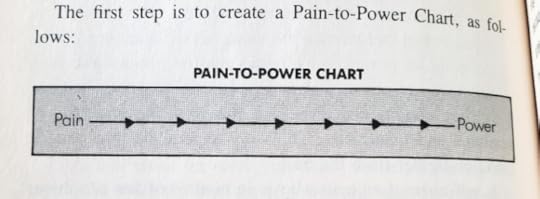
Susan’s Pain-to-Power chart shows us that, “the secret in handling fear is to move yourself from a position of pain to a position of power. The fact that you have the fear then becomes irrelevant.”
The power that Susan refers to here is not the power of control over other people and things, it is the power that each of us holds within the self. Susan said, “This means power over your perceptions of the world, power over how you react to situations in your life, power to do what is necessary for your own self-growth, power to create joy and satisfaction in your life, power to act, and power to love.”
This kind of power leaves neediness and distrust behind. For when we feel internally powerful, we don’t need the kind “power” that draws from other people. We can love and trust with ease because we love and trust ourselves.
When we look at the Pain-to-Power chart, most of us will see ourselves somewhere in the middle. We aren’t totally being held back by our fears, but we are also not fully in touch with our own power. Using the chart as a guide, our job is to expand our comfort zone, little by little, to move ourselves closer to the Power end of the chart. There are probably very few people who live constantly at the Power end of the chart. Most of us will have more powerful days and some painful days. But the chart can help us see where we are right now and help us to see how to move forward in a more powerful way.
April 12, 2023
More About Comfort Zones
What exactly is your comfort zone? Here is Susan’s explanation from Feel the Fear and Do It Anyway:
Most of us operate within a zone that feels right, and outside of it we are uncomfortable. For example, we might spend $50 for a pair of shoes, but $100 would make us nervous. We might be willing to initiate friendships with people at the office who are at our level in the company, but would be uncomfortable doing so with one of the higher-ups. We might be comfortable hanging out with a few friends we know well, but are reluctant to go to a large New Year’s party with more strangers than friends or to a professional convention with colleagues we don’t know well. We might go to the local deli when eating alone but would feel really uncomfortable in a luxurious restaurant all by ourself. We might ask for a $5,000 raise, but asking for a $7,000 raise would make us cringe. We may charge $30 an hour for our services, but we don’t feel we are worth $35. And so on.
For each one of us that zone of comfort is different, but whether we are aware of it or not, all of us—rich or poor, famous or unknown, gay or straight, male or female or whatever our gender identity—make decisions based on the confines of that comfortable space.
With the current state of technology, it has become easier than ever to stay within our narrowly defined comfort zone. We don’t have to visit stores to shop—we can just order online anything our hearts desire, and thereby avoid interacting with salespeople. When a phone call could clear up a question in seconds, how many of us dodge a conversation by sending an email or text? We don’t have to meet with people in person when we can talk to them online. For many of us, forgoing personal interactions defines our lifestyle in the 21st century. All these new ways of communicating allow us to get really cozy in our comfort zones, but real power comes from seeking to step out of them.
I suggest that each day you do something that widens that space for you. Call someone who seems intimidating, buy something that you need that costs more than you would ever have paid in the past, ask for something you want that you have been too frightened to ask for before. Take a risk a day—one
Small or bold stroke that will make you feel great once you’ve done it. Even if it doesn’t work out the way you wanted it to, at least you’ve tried. You didn’t sit back . . . powerless.


