Rachel Maddow's Blog, page 3361
July 31, 2013
Wednesday's campaign round-up
Today's installment of campaign-related news items that won't necessarily generate a post of their own, but may be of interest to political observers:
* In Kentucky, Alison Lundergan Grimes (D) officially kicked off her U.S. Senate bid yesterday, dismissing Senate Minority Leader Mitch McConnell (R) for having "gone Washington." As part of the rollout, the Grimes campaign launched this endorsement video from former President Bill Clinton.
Watch on YouTube* In Montana, Democrats are struggling to recruit a top-tier U.S. Senate candidate in the wake of former Montana Gov. Brian Schweitzer's surprise decision not to run. This week, state Auditor Monica Lindeen and EMILY's List President Stephanie Schriock both withdrew from consideration.
* In North Carolina, there was some recent chatter about Rep. Renee Ellmers (R-N.C.) running against Sen. Kay Hagan (D-N.C.) next year, but the congresswoman announced yesterday she'll seek another House term instead.
* The latest polling in New York City shows former Rep. Anthony Weiner's (D) mayoral candidacy struggling badly following last week's sexting revelations.
* In Alaska, the latest survey from Public Policy Polling shows former half-term Gov. Sarah Palin as the favorite U.S. Senate candidate among Republican voters, but in a hypothetical match-up against incumbent Sen. Mark Begich (D), Palin trails by 12 points.
* Former Arkansas Lt. Gov. Bill Halter (D) ended his gubernatorial bid this week, but party leaders still hope to persuade him to challenge Rep. Tim Griffin (R) next year.


The 'Supreme Court of labor law' can finally function again
Associated Press
I imagine a lot of folks who voted for President Obama last fall are feeling a little frustrated right now. It's not that the president is pursuing a misguided agenda or breaking campaign promises, but the frustration likely comes with the realization that the "fever" among congressional Republicans did not break on Election Day 2012 and radicalized GOP lawmakers will make legislating all but impossible for the foreseeable future.
And so long as Republicans won't compromise, there's not a whole lot Obama can do about it.
But the news for the president's allies isn't all bad -- Congress may be a laughingstock for the ages, but Obama can still make progress on progressive goals. Take the NLRB, for example.
After a contentious fight over some of President Obama's nominees, the Senate confirmed five members to the National Labor Relations Board (NLRB).
On Tuesday, the Senate voted to clear all five nominees -- Harry Johnson III, Philip Miscimarra, Nancy Schiffer, Kent Hirozawa and Mark Pearce.
The Senate was acting against a deadline -- over the August recess, the NRLB chair's term will end, without confirmation of new members, the board would not have the quorum needed to function. As of yesterday, that's no longer an issue.
Following the confirmation votes, the NRLB will have no vacancies for the first time in over a decade.
And why should you care? On the surface, of course, there's the fact that the nuclear-option deal is holding (for now) and the president is finally having some success when it comes to nomination fights. Senate Democrats had to play hardball to overcome obstructionism on this issue, and they can claim some satisfaction from the fact that their efforts worked.
But there's also the fact that the NLRB actually matters. MSNBC's Chris Hayes recently called it the "Supreme Court of labor law in this country," which is a great description.
From an "All In" segment aired a few weeks ago:
"If you don't have a remedy, you don't have meaningful rights. The Supreme Court of labor law, the NLRB has been inoperable for a year and a half. It's really astounding. I mean, think about just turning off the Supreme Court for a year and a half. All those big decisions that came down the last few weeks, all the consequences for people seeking redress, gone, shuttered.
"And there are real consequences for the NLRB. It oversees all kinds of cases. If your boss illegally withholds wages or benefits, if your boss fires you for a Facebook post about safety or salary in the workplace, if your boss fires for you trying to organize fellow workers, all those disputes would work their way through to the NLRB.
"There are a wide range of actions both by you and your boss which come under the umbrella of its protection. If the NLRB isn't there to tell your boss that he can't do that, well, then, your boss can pretty much do as he pleases."
As of yesterday, the NRLB is back on track, able to intervene in these cases once more.
And as this relates to the frustrated Democrats referenced above, it's fair to say if this were the first year of a Romney/Ryan administration -- or the second term of a McCain/Palin administration -- the NRLB would either effectively disappear, or would be stacked with board members who aren't especially interested in the rights of workers. Instead, Obama named progressive members chosen in consultation with his labor union allies.
Yesterday, in other words, was a quiet win for progressive governance, and that matters.
Christie, Paul, and a GOP fissure coming to the fore
Associated Press
More so than at any point in recent memory, the Republican Party is divided. GOP officials are fighting amongst themselves on everything from immigration to agriculture, the budget to filibusters, shutdowns to the culture war.
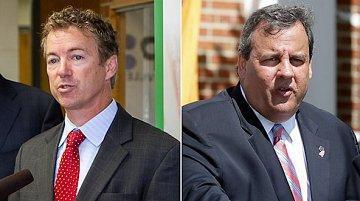
But nowhere is the fight as ugly as the growing feud between New Jersey Gov. Chris Christie (R) and Kentucky Sen. Rand Paul (R). Given their competing ideologies, we'd expect some serious divisions between these two, but the contempt these two have for one another has taken this fight to unexpected depths, and it speaks to a larger area of concern.
The dispute seems to have started about a week ago, with a speech the governor delivered in Aspen.
"As a former prosecutor who was appointed by President George W. Bush on Sept. 10, 2001, I just want us to be really cautious, because this strain of libertarianism that's going through both parties right now and making big headlines, I think, is a very dangerous thought," Christie said.
Asked whether he includes Paul -- a fellow potential 2016 presidential candidate -- in his criticism, Christie didn't back down.
"You can name any one of them that's engaged in this," he said. "I want them to come to New Jersey and sit across from the widows and the orphans and have that conversation.... I'm very nervous about the direction this is moving in."
Christie described the debate over privacy as "esoteric," adding, "I think what we as a country have to decide is: Do we have amnesia? Because I don't. And I remember what we felt like on Sept. 12, 2001."
Paul offered a brief response on twitter, saying, "Christie worries about the dangers of freedom. I worry about the danger of losing that freedom." And I thought that'd probably be the end of it, at least for a while.
It wasn't. Not only did the back and forth continue between these two, it seemed to get personal.
Round Two came Sunday, when Paul appeared at a Republican fundraiser in Tennessee.
"The people who want to criticize me and call me names, they are precisely the same people who are unwilling to cut the spending," Paul said at a "Boots and Jeans, BBQ and Beans" event in Franklin, according to CNN affiliate WKRN-TV.
"They are 'Gimme, gimme, gimme all my Sandy money now.' Those are the people who are bankrupting the government and not allowing enough money be left over for national defense," Paul continued.
As a substantive matter, Paul, as is too often the case, doesn't really know what he's talking about. Federal disaster aid after devastating storms is not, by any sane measure, "bankrupting the government."
Nevertheless, on Monday night, Paul stayed on the offense during a Fox News appearance, saying it's "cheap and sad" for Christie to use "the cloak of 9/11 victims."
Yesterday morning, Christie started Round Three.
At a news conference earlier in the day, Christie said Kentucky takes more federal funding than New Jersey and argued that Paul should examine his pursuit of "pork barrel spending" when finding ways to cut spending.
"If Senator Paul wants to start looking at where he's going to cut spending to afford defense, maybe he should start looking, cutting the pork barrel spending that he brings home to Kentucky," Christie said. "Maybe Senator Paul could, you know, deal with that when he's trying to deal with the reduction of spending on the federal side, but I doubt he would, because most Washington politicians only care about bringing home the bacon so they can get re-elected.
On this, Christie has a point -- Kentucky, unlike New Jersey, receives far more money from Washington than it sends. Paul said that's because of the military bases in Kentucky, but that doesn't make any sense -- New Jersey has more bases than Kentucky, but receives less per capita federal spending. In fact, for every dollar Kentucky sends to D.C., it receives $1.51 back; for every dollar New Jersey sends to D.C., it receives 61 cents back.
And that's when Paul responded with a memorable retort.
Sen. Rand Paul slammed Chris Christie's on Tuesday, calling the GOP governor the "king of bacon," adding another jab in a string of attacks the two Republicans have thrown at each other in recent days.
"This is the king of bacon talking about bacon," the Republican from Kentucky said on CNN's "The Situation Room."
In context, it's possible Paul was talking about Sandy emergency aid, but since New Jersey receives so little pork-barrel funding, especially as compared to Kentucky, it's also possible the "king of bacon" line was the senator's way of making this argument personal.
On the surface, the dispute almost certainly relates to the fact that Christie and Paul will probably both run for president in 2016, and they're starting a fight now that will continue through town-hall meetings in Iowa and New Hampshire in a couple of years. These two, in other words, aren't just from different wings of a divided party; they're rivals.
But let's also remember that the Christie-Paul argument, at its root, is a fight about their party's vision on national security, foreign policy, expansive powers of the executive, and the use of force. It's a fissure that extends throughout the GOP right now, and as fascinating as it is to see these two Republican celebrities go at it, the party is going to have to address the underlying question eventually.
For every question, there is a Reagan
Associated Press
When Ronald Reagan left office in early 1989, several conservative activists feared history may not be especially kind to the two-term Republican, who spent most of his second term under a cloud of scandal, corruption, and mismanagement. The "Reagan Legacy Project" intended to give the former president a public-relations boost, urging state and local governments to start naming things -- schools, bridges, courthouses, highways, etc. -- after Reagan.
And for the most part, the p.r. scheme has been a great success. Reagan's name is everywhere, and the Republican icon is far more popular with Americans now than when he was actually president. Missteps like selling weapons to Iran to finance an illegal war in central America have been largely swept under the rug.
But those preoccupied with the Reagan "legacy" never seem satisfied. Congressional Republicans, for example, have already built a Reagan building downtown and forced National Airport to change its name, but it's now time to start renaming bodies of water, too.
The House Natural Resources Committee will likely approve legislation Wednesday that would name 3.4 million square nautical miles of ocean and thousands of miles of coastline after the late President Ronald Reagan.
Rep. Darrell Issa's (R-Calif.) legislation would rename the country's Exclusive Economic Zone (EEZ), which generally extends from three miles to 200 miles offshore, as the Ronald Wilson Reagan Exclusive Economic Zone.... The late Reagan, a Californian like Issa, established the EEZ with a 1983 presidential proclamation that declared the nation's sovereign rights for exploring, exploiting and conserving offshore resources, including energy.
Yes, the man the RNC once literally referred to as "Ronaldus Magnus" apparently doesn't have quite enough stuff named after him -- a problem Issa is eager to address by changing the name of nearly all of the water surrounding the United States. Our coastal waters would necessarily be known, forevermore, as Reagan waters.
Why? Because congressional Republicans say so.
It comes a year after Mitt Romney proposed the creation of a Reagan Zone Of Economic Freedom -- no, seriously -- that would include all of the countries around China, which would be bolstered by their new powers bestowed upon them by magical Reaganism.
What I find especially curious about all of this is that today's Republican Party, radicalized to an extent unseen in the United States in recent history, has absolutely no use for the Reagan legacy. None.
Bob Dole, Lindsey Graham, Mike Huckabee, and others have all said in recent years that Reagan couldn't even win a GOP primary by today's standards, at least with his policy record, and I'm fairly certain they're correct.
As we talked about last year, Reagan raised the debt ceiling 18 times, and he supported the precursor to the Buffett Rule. In his first term, Reagan raised taxes when unemployment was nearing 11% -- imagine trying this today -- and proceeded to raise taxes seven out of the eight years he was in office. It's a fact the right finds terribly inconvenient, but "no peacetime president has raised taxes so much on so many people" as Reagan.
Reagan gave amnesty to undocumented immigrants, expanded the size of the federal government, tripled the debt, backed bailouts of domestic industries, and called for a world without nuclear weapons. Reagan also routinely compromised with Democrats, met with our most hated enemy without preconditions, and was willing to criticize Israel.
And then there's his gubernatorial record: in California, Reagan increased spending, raised taxes, helped create the nation's first state-based emissions standards, signed an abortion-rights bill, and expanded the nation's largest state-based Medicaid program (socialized health insurance).
Maybe today's GOP policymakers should focus less on naming stuff after Reagan and focus more on governing like him?
Economic growth exceeds expectations

Going into this morning, expectations for economic growth in the second quarter -- April, May, and June of this year -- were quite poor, making the actual GDP report a little more encouraging.
The U.S. economy grew at a 1.7% annual rate in the second quarter, buoyed by a solid gain in consumer spending and a sharp increase in business investment, the Commerce Department said Wednesday. Economists polled by MarketWatch had expected growth to total 1.0%.
To be sure, 1.7% GDP growth is not, by any fair measure, good news. It tells us the economy is growing, but the recovery is at best sluggish. But given the news we were expecting, 1.7% is a relatively pleasant surprise, especially since the previous quarter's growth was revised down to 1.1%.
Of course, this morning's report would have shown GDP growth over 2% had it not been for reductions in government spending, mandated by conservative policymakers who believe the recovery will be stronger if they weaken it by taking capital out of the economy. The caveat to this is that conservative austerity measures at the state and local levels appears to have come to an end, which helps mitigate the deliberate damage done by congressional Republicans.
Incidentally, this is also the report that revises previous GDP estimates, and it now appears the economy grew at a 2.8% annual rate in 2012, up from the previous 2.2% estimate.
Overall, the nation has seen 15 consecutive quarters of economic growth, starting in mid-2009, when President Obama's Recovery Act helped put the nation on stronger footing.
As for the image above, the chart shows GDP numbers by quarter since the Great Recession began. The red columns show the economy under the Bush administration; the blue columns show the economy under the Obama administration.
July 30, 2013
Why would the GOP balk at a corporate tax cut?
As promised, President Obama spoke in Tennessee this afternoon, and made congressional Republicans an offer they probably shouldn't refuse: the GOP would get corporate tax reforms, including lower rates, while Democrats would get investments in infrastructure and manufacturing.
"Here's the bottom line: I'm willing to work with Republicans on reforming our corporate tax code, as long as we use the money from transitioning to a simpler tax system for a significant investment in creating middle-class jobs," Obama said in Chattanooga. "That's the deal."
Now, as a substantive matter, you might be wondering how (and whether) the numbers add up. How is it that lower corporate tax rates would pay for new jobs? The answer is a little wonky, but it has to do with a one-time fee on deferred foreign earnings. Wonky or not, it's a policy worth tens of billions of dollars, which Democrats want to use to create jobs.
As was arguably obvious from the outset, most congressional Republicans have already rejected the offer, maintaining their flawless track record of reflexively opposing everything Obama is for, even when Obama agrees with Republicans.
But in this case, GOP opposition is just a little more difficult to understand. Sure, when the White House proposes new tax revenue from the wealthy, it stands to reason that Republicans will scream bloody murder. When the president talks about increasing the size of government in any appreciable way, we know the GOP will go berserk.
But corporate tax breaks and infrastructure jobs? Why announce knee-jerk opposition to these ideas?
I've spent some time this afternoon collecting Republican complaints about the new Obama offer, so let's take them one at a time.
* Republicans learned about the offer through the media: One of the first responses from Speaker Boehner's office this morning was that the White House didn't call them first about the idea. The White House claims they called Boehner last night, but he didn't respond. But really, I have no idea why anyone would give a darn. What does this have to do with the economic merits?
* Republicans want even more tax cuts: Corporate tax breaks are nice, GOP officials have said, but they're not interested unless there are also tax breaks for wealthy individuals. The problem, of course, is that tax breaks for the rich don't create jobs, do make the deficit worse (remember when Republicans occasionally pretended to care about the deficit?), and don't have anything to do with the offer on the table. Obama is willing to trade lower corporate rates for infrastructure jobs -- this is either worthwhile or it's not. Pointing at some unrelated tax policy is a needless distraction.
* Obama likes corporate tax reform, so this doesn't count as a concession: It's true that the president has offered lower corporate rates before, which Republicans now insist means he's doing what he wants, rather than what they want. The irony of the complaint is overwhelming -- the GOP is spending the afternoon arguing that the radical socialist president they hold in contempt is too big a supporter of lower corporate tax rates. This is transparently silly.
* The offer could hurt small businesses: That was the argument from Senate Minority Leader Mitch McConnell this morning, and I have no idea what he's talking about. Why would lower corporate rates hurt small businesses?
* The president's plan isn't bipartisan: This is another gem from McConnell, and unless he's prepared to say cutting taxes on corporations is a Democratic idea, I'm hard pressed to imagine why anyone would take this seriously.
* Corporate tax reform should be revenue neutral: Many Republicans have spent today arguing that if officials agree to lower corporate tax rates, the plan shouldn't generate any revenue that could be used for anything else. But why hold this position? Why deliberately argue that investing in jobs is a bad idea that Republicans cannot support? It's just bizarre to see GOP officials take a firm stand in support of higher unemployment just for the sake of higher unemployment, as if they find job creation offensive for some unknown reason.
As for the Republican counter-offer for Obama to consider, as best as I can tell, it doesn't exist.
I'm sure, however, that another Obamacare repeal vote will be scheduled any day now, along with something to do with abortion.
Shutdown scheme pits GOP against itself
Sen. Mike Lee (R-Utah) was on Fox News the other day, defending his plan to shut down the federal government rather than finance the federal health care system. The far-right senator insisted "this really isn't about Republican versus Democrat. It's not about liberal or conservative."
And in a way, that's true -- it's really about Republican versus Republican, conservative against conservative.
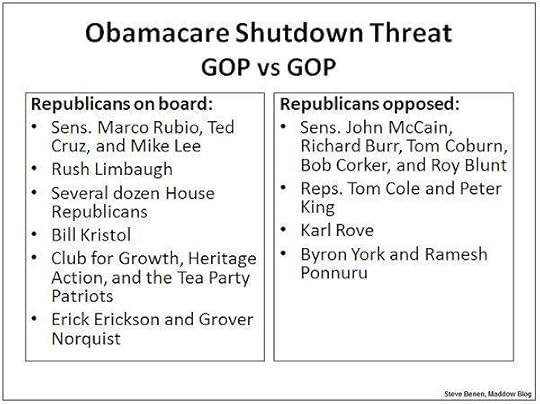
I put together this image to offer a lay of the land, because when it comes to the government-shutdown threat, GOP fissures are coming to the fore in a way we haven't seen in a while. While Republican divisions are not uncommon, it's rare when conservative GOP senators, asked about a prominent idea from other conservative GOP senators, say, it's "the dumbest idea I've ever heard of."
Indeed, even today, the divisions are becoming more pronounced. Sen. Bob Corker (R-Tenn.) -- not exactly a New England moderate from the Rockefeller wing -- told MSNBC the plan from his far-right colleagues is "silly" and not at all "courageous." Around the same time, the Weekly Standard's Bill Kristol, relying on a strained metaphor, argued that conservatives must "stop the train. Stop it dead in its tracks before more damage is done. If this means disrupting the quiet car that so many in the Republican establishment enjoy riding in, so be it."
No, you're not the only one who found it amusing to see Bill Kristol -- Bill Kristol! -- complaining about the "Republican establishment."
You'll also notice, incidentally, that House Speaker John Boehner, Senate Minority Leader Mitch McConnell, and none of the other members of the GOP congressional leadership in either chamber make the above list. There's a good a good reason for that: in this Congress, Republican leaders are generally afraid to lead, and prefer to wait on the sidelines where they won't get hurt.
Regardless, as we look ahead, there are two principal questions to consider: whether the shutdown scheme will come to fruition and what these over-the-top antics will mean in the larger legislative context.
On the former, I think it's safe to say the unhinged wing of the GOP is going to be disappointed. To actually shut down the government because Democrats refused to take health care away from millions of struggling families is, for lack of a better word, hopelessly insane, and to pull this off, Republicans would need a united front. As the above image should help reinforce, these guys are anything but united.
As such, even the ring leaders of the scheme see the writing on the wall.
The conservative plan to use the resolution that funds the government to cripple the president's health-care law has a problem, according to GOP Sen. Ted Cruz: other Republicans.
"The problem right now is we don't have Republicans willing to stand up and do this," Cruz said Monday on The Andrea Tantaros Show, a conservative radio program.
Soon after, Cruz hung out with Glenn Beck -- Glenn Beck! -- to whine about those darned congressional Republicans who are too "scared" to start undermining the nation on purpose.
Of course, this isn't necessarily an awful scenario for Cruz -- he gets to rant and rave with impunity for the next several weeks, knowing that none of his rhetoric will actually effect public policy. The manufactured drama makes Cruz look weak and ineffectual, but that hardly matters to the senator -- the Texas Republican has no real intention of legislating anyway.
This isn't to say the pro-shutdown caucus is giving up - more than 50 right-wing groups co-signed a letter of support yesterday, rallying behind the Rubio/Cruz/Lee threat -- but there's generally an understanding that this is a scheme with a short shelf life.
But is there any larger significance to this? Maybe. It's certainly problematic when a struggling political party is pitted against itself over the merits of a radical scheme, but there may be other practical considerations to keep in mind.
In the House, for example, if a good chunk of the majority caucus is convinced that they have to defund "Obamacare," it means GOP leaders will have to rely on quite a few Democratic votes to approve a continuing resolution to prevent a shutdown. Will Nancy Pelosi and Democratic leaders leverage this opportunity? You better believe it.
It's always been one of the more entertaining aspects of GOP radicalism: more often than not, it's self-defeating.
Bradley Manning convicted on five counts, acquitted of aiding enemy

Associated Press
It's been more than three years since Bradley Manning released sensitive materials, including videos of airstrikes and hundreds of thousands of diplomatic cables, causing an international uproar. This afternoon, the 25-year-old Army private met his legal fate.
Pfc. Bradley Manning, the former Army intelligence officer who was branded as both a whistle-blower and a traitor after he sent 700,000 secret government documents to WikiLeaks, was acquitted Tuesday of aiding the enemy but convicted of other charges.
Manning was convicted of illegally releasing classified documents knowing they would be accessible to the enemy. Aiding the enemy was the most serious charge and carried a potential life sentence.
The verdict was handed down by Col. Denise Lind, the judge at Manning's court-martial at Fort Meade, Md. Manning will be sentenced later.
Note, the six criminal charges come on top of 10 other charges to which Manning had already pleaded guilty.
Ian Johnston noted this morning that the commander of the Military District of Washington, currently Maj. Gen. Jeffery S. Buchanan, will have an opportunity to review and possibly reduce the sentence in Manning's case, though there's no reason to believe he will.
For what it's worth, while the acquittal on "aiding the enemy" won't make an appreciable difference when it comes to the duration of Manning's sentence, it's an important development in the larger context. The charge itself in a leak case is unprecedented, and as the New York Times' Charlie Savage noted, this "could have significant long-term ramifications for investigative journalism in the Internet era."
So a Washington State lawmaker goes to a survivalist rally...
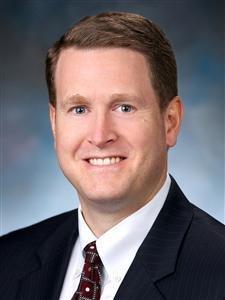
Washington State Representative Matt Shea (R-Spokane Valley)
Washington State Representative Matt Shea (R-Spokane Valley), addressed hundreds of militia patriots and Tea Party faithful over the weekend at a three-day Self Reliance Rally on the shores of Pend Oreille Lake in northern Idaho. By way of the Coeur D'Alene Press:
"We need to prepare for the inevitable collapse that is going to happen. You know it's going to happen. That's right, I am a politician and I am standing up here and saying that."
For a rally dedicated to preparing for America's "inevitable collapse," it was quite the lively affair.
During the morning hours, there were several survival experts giving demonstrations on a variety of things ranging from field midwife training to hand-to-hand combat. Vendors were selling everything from freeze-dried food and ammunition to ham radios and first aid gear. Other experts gave seminars on how to start a barter system, and there was even a history seminar on the real start of the Revolutionary War entitled April 19, 1775.
And then there were speeches by actual elected officials, like Rep. Shea, who offered these hopeful hints for the future:
Shea urged the crowd to stock up on thousands of rounds of ammunition and to stay in shape, practice shooting, learn self defense and special tactics.
For those unfamiliar with Rep. Shea, the Coeur D'Alene Press Self-reminds readers of what the Southern Poverty Law Center had to say:
In a profile of Shea, the SPLC said that he has not recently been involved in the immigration issue, but he is actively perpetuating a conspiracy that the government has plans to disarm Americans and round them up into concentration camps run by the Federal Emergency Management Agency. His talk at the rally didn't mention the concentration camps, but he did urge attendees to get organized and to prepare for when the government steps in after the "inevitable collapse. When it happens, we need to look at this as an opportunity, not a crisis," he said. "Who's job is liberty? That's our job."
Apparently you start that job by buying more ammo. And don't forget your sit-ups.
Virginia's McDonnell vows to return gifts from benefactor
Associated Press
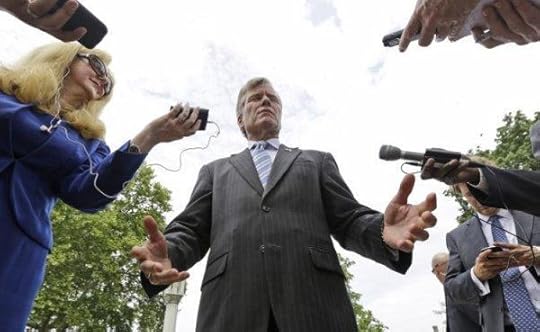
Virginia Gov. Bob McDonnell's (R) defense for his corruption scandal began in earnest last week. The governor announced last Tuesday that he'd repaid the loans he and his wife received from Star Scientific CEO Jonnie R. Williams Sr.
Today, McDonnell went a little further, saying he's working to arrange the return of the other gifts -- including the Rolex.
"My intent is everything I have received from this particular donor ... that those gifts that I have in my possession, I am working with my counsel to be able to return," McDonnell said on WTOP radio.
The governor said that his daughter has already reimbursed Williams for the $15,000 wedding catering tab the Star Scientific CEO had paid for in 2011. That gift was not initially disclosed because family members of public officials aren't required to disclose gifts under Virginia law.
McDonnell said that his decision to repay two loans (with interest) last week was "the first of many things that I intend to do."
It's not yet clear how far McDonnell intends to take this, and the details matter because some of the "gifts" can't be returned. Does he intend to pay the Star Scientific CEO for the use of a Ferrari? For the lake-house vacation?
It's also unclear why it took so long to get to this point, why McDonnell intervened in support of his benefactor, and why the governor needs to return these "gifts" after months of arguing there was nothing untoward about his dealings with Williams.
In other words, McDonnell is clearly in the middle of damage-control mode, but his arguments are shifting and the scandal is hardly over.