Rachel Maddow's Blog, page 3360
August 1, 2013
A debt Cuccinelli will struggle to pay
Associated Press
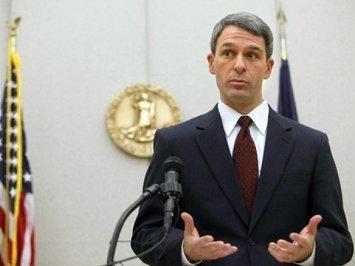
In Virginia, scandal-plagued Gov. Bob McDonnell (R) is scurrying to give back the luxurious gifts he received from Scientific CEO Jonnie Williams, but the governor is not the only Republican caught up in this controversy. State Attorney General Ken Cuccinelli (R), who hopes to replace McDonnell, is involved, too.
So, in light of this week's developments, is there any chance the far-right candidate might follow McDonnell's lead? Apparently not.
Attorney General Ken Cuccinelli says he's glad Gov. Bob McDonnell is returning all the gifts he received from a major political donor. But he has no plans to repay the more than $18,000 in gifts he received from the same benefactor.
Cuccinelli told reporters Wednesday that Star Scientific CEO Jonnie Williams didn't give him the kind of gifts that can be returned. Among the gifts from Williams listed in Cuccinelli's financial disclosure statements are a $1,500 catered Thanksgiving dinner, private jet trips and vacation lodging. Cuccinelli said, "There are some bells you can't unring.''
Perhaps. But ordinarily under circumstances like these, the politician interested in avoiding the appearance of impropriety can do more than nothing. Williams gave Cuccinelli private jet trips? Cuccinelli could determine the value of the trip and pay the benefactor back. Williams gave him vacation lodging? Cuccinelli could write a check for a comparable amount, and perhaps donate it to charity.
This what's-done-is-done response isn't altogether satisfying given the allegations of corruption.
Also note, Cuccinelli's role in the story isn't just the $18,000 in gifts he accepted -- just as important is the Republican's investment strategy involving Star Scientific stock and the fact that Cuccinelli offered legal advice to Williams after Williams sued the commonwealth.
Questions about this scandal won't away fade easily.


Thursday's campaign round-up
Today's installment of campaign-related news items that won't necessarily generate a post of their own, but may be of interest to political observers:
* With NRA-backed recall elections coming up in Colorado, state Senate President John Morse (D) is launching this minute-long ad, as reported by Colorado Pols yesterday.
Watch on YouTube* In Kentucky, Public Policy Polling conducted a stunning new statewide poll for the Progressive Change Campaign Committee and Democracy For America, and found Kentucky Secretary of State Allison Lundergan Grimes (D) narrowly leading Senate Minority Leader Mitch McConnell (R), 45% to 44%.
* Hoping to lower tensions, Sen. Rand Paul (R-Ky.) invited New Jersey Gov. Chris Christie (R) to have a beer with him. The governor declined, saying he's too busy.
* If the 2016 presidential election came down to Paul and former Secretary of State Hillary Clinton, who would Sen. John McCain (R-Ariz.) vote for? It would be "a tough choice," McCain said.
* In West Virginia, Republicans have apparently convinced state Sen. Evan Jenkins to switch parties, abandon Democrats, and run against Rep. Nick Rahall (D) in the state's 3rd congressional district next year.
* Following a series of embarrassing failures in 2012, conservative super PACs have reportedly struggled to raise funds over the first half of 2013. Karl Rove's attack operation, American Crossroads, raised $1.86 million, which isn't much by Crossroads standards, and which would have been far less were it not for a $1 million check from Contran Corp., the holding company of Dallas billionaire Harold Simmons.
Charter school scandal leads to resignation
Associated Press
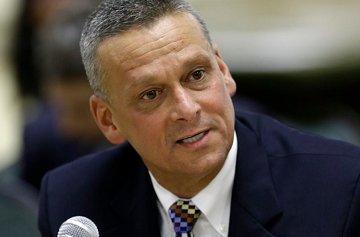
Former Indiana and current Florida schools chief Tony Bennett
We talked on Tuesday about a rather shocking scandal out of Indiana, where the former schools chief Tony Bennett allegedly manipulated state standards to boost a charter school operated by a major Republican donor -- a donor who happened to contribute $130,000 to Bennett directly.
Bennett was rejected by Indiana voters last year -- before anyone was aware of the scandal -- and was recruited to join Gov. Rick Scott's (R) team in Florida. But given the severity of the allegations, and the credibility of the evidence, it appears Bennett has no choice but to quit.
Tony Bennett is expected to resign Thursday as Florida education commissioner following two days of raging controversy over a school grading controversy in his home state of Indiana.
Bennett, who came to Florida from the Hoosier State last January, has faced mounting calls for his resignation in the wake of revelations, first reported by The Associated Press, that he interceded on behalf of an Indiana charter school run by a prominent Republican Party donor.
His resignation would be a major setback for Gov. Rick Scott and state education leaders, who are working to overhaul Florida's system of school accountability and assessment in compliance with the national Common Core standards.
Keep in mind, as the Miami Herald reported yesterday, Bennett was already in trouble in the Sunshine State, where influential superintendents and state Board of Education members "have raised questions about the validity of school grades." This new allegations obviously didn't help.
And when Florida's Republican governor was asked yesterday whether he continues to support his heavily recruited education commissioner, Scott declined to answer, saying he had not yet read the AP article that broke the scandal.
The governor really didn't need another top official in his administration to resign in disgrace a year ahead of his re-election bid, but it appears that's what Scott has on his hands anyway.
Putting the nail in the phony-scandal coffin
The Democratic posture on the so-called "scandals" that erupted in May has clearly shifted as more information has come to light. When the IRS controversy first began in the spring, Democratic officials were quick to condemn any political favoritism or unfair treatment based.
But as the "scandal" evaporated into nothing, Dems apparently realized it was time to stop criticizing IRS misdeeds that apparently didn't happen, and it's time to start mocking Republicans relentlessly for making baseless allegations with no foundation in reality.
Watch on YouTubeDemocrats on the House Oversight Committee released this video yesterday, which is just a brutal takedown of Republican claims. This week, instead of doing real work, House GOP leaders are eager to hold "message" votes related to the IRS story, but as the video makes clear, there is no IRS story. Republicans raised specific questions, which have been answered. They raised specific allegations, which have been discredited.
Capitol Hill Dems aren't the only ones on the offensive. White House senior adviser Dan Pfeiffer dismissed the so-called controversy as a manufactured outrage based on nothing. "The allegation was, by many Republicans, that the White House was directing the IRS to target Tea Party groups," he said. "That was the allegation. And that has turned out to be completely false. There is no evidence to suggest that. And now it has turned out that the IRS was not just targeting conservative groups but also looking at a large number of progressive groups as well."
And in case that weren't quite enough, more information came to light yesterday about Benghazi -- and it disappointed the right, too.
Col. George Bristol, who commanded an Africa-based task force at the time of the attack on the U.S. diplomatic outpost in Benghazi, told the House Armed Services Committee that there was no "stand down" order. His testimony corroborated what Lt. Col. S.E. Gibson, who led the site security team in Tripoli, had already told lawmakers.
In other words, as has been obvious for quite a while, the two stories Republicans have been heavily invested in are both "phony scandals." The right obviously doesn't want to hear that, but one can only deny reality for so long.
Whether there will be any accountability for the pundits and politicians who spent months misleading the public remains to be seen.
Postscript: Apparently, Fox News wants viewers to believe Jay Carney, the White House press secretary, called the attack on the outpost last September "phony." That's clearly not what Carney said, and Fox's report reinforces suspicions that the stories themselves have unraveled, leaving the right to make stuff up.
Wisconsin's Walker targets collective bargaining -- again
Associated Press
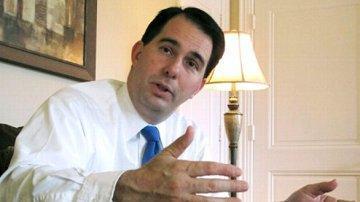
Wisconsin Gov. Scott Walker (R) caused a massive uproar in 2011 when he and his Republican allies eliminated collective-bargaining rights for most state employees, most notably public school teachers. The policy, which Walker neglected to mention to voters before he was elected, positioned the Republican governor as one of the nation's fiercest opponents of organized labor.
Indeed, Walker later admitted his tactics were intended to "divide and conquer" his opponents in Wisconsin unions.
Viewer Dave Wollert emailed us this week to let us know Walker isn't quite done dividing and conquering.
Two-and-a-half years after mostly sparing police officers and firefighters, Gov. Scott Walker said this week he is open to the idea of limiting their ability to collectively bargain.
Such a move would undercut the few unions where he has found support. The unions for Milwaukee officers and firefighters, for example, were among those that endorsed Walker in 2010 and in the 2012 attempt to recall him from office.
After expressing his openness to the idea on Monday, Walker hedged a little on Tuesday, telling reporters he doesn't have "a specific proposal" that he's currently "pushing."
And while that may be mildly comforting to firefighters who want to keep their collective-bargaining rights, it doesn't change the fact that the Republican governor has an opportunity to take those rights away, and he's clearly interested in doing just that. Indeed, in context, it's worth keeping in mind that Walker conceded that the topic came up in legislative discussions -- suggesting some state GOP policymakers may well pursue the policy.
In case anyone needs a reminder, Walker's union-busting policy is, from a labor perspective, simply atrocious.
Under the law, known as Act 10, most public-sector unions can bargain over base wages but nothing else. That makes it impossible for the unions to negotiate over issues such as working conditions, overtime, health care, sick leave and vacation. In negotiations over wages, they can seek raises that are no greater than the rate of inflation.
They also face much tougher standards to achieve recognition from the state. For instance, in annual votes they must win 51% support from all workers eligible to be in the union, not just those voting.... Another aspect of Act 10 required public workers to pay more for their pensions and health care, effectively cutting their take-home pay.
And now the governor is open to applying the law to some of the only public employees in Wisconsin who weren't punished under the 2011 bill.
As Scott Walker gears up for a national campaign in 2016, he appears to have positioned himself as the most anti-union Republican in recent memory.
July 31, 2013
Wednesday's Mini-Report
Today's edition of quick hits:
* It looks like President Obama had some "lively" meetings on Capitol Hill today.
* There were some disagreements: "President Obama clashed with some congressional Democrats Wednesday over the possibility that former treasury secretary Lawrence Summers might be named to succeed Ben Bernanke as Federal Reserve chairman."
* NSA: "The Obama administration on Wednesday released formerly classified documents outlining a once-secret program of the National Security Agency that is collecting records of all domestic phone calls in the United States, as a newly leaked N.S.A. document surfaced showing how the agency spies on Web browsing and other Internet activity abroad."
* Remember when lawmakers said they were in the dark about surveillance programs? "[R]edacted documents released by the Office of the Director of National Intelligence Wednesday morning show that at least as far as bulk collection of Americans' phone data is concerned, the extent of NSA surveillance was in plain sight."
* Egypt: "Egypt's military-led government instructed its security forces on Wednesday to end two large sit-ins in the capital by supporters of the deposed Islamist president, a decree that risked a new round of violent convulsions in the country's political crisis."
* Capitol Hill drama: "The Senate is waiting for Sen. Heidi Heitkamp (D-N.D.) to cast the deciding vote on whether to end debate on President Obama's nominee to head the Bureau of Alcohol, Tobacco, Firearms and Explosives (ATF)."
* Afghanistan: "The number of civilians killed or injured in Afghanistan rose by nearly a quarter in the first six months of 2013, according to a United Nations report on civilian casualties, reversing a decline last year that many hoped would signal an easing in the war's toll on ordinary Afghans."
* Dear Fox, when it comes to Reza Aslan, stop digging.
* I enjoyed Chris Hayes' segment on "white-on-white crime" so much, when I was done watching it, I started over and watched it again. How he kept a straight face throughout, I'll never know.
* As much as I wanted to express my profound disappointment with this disheartening Ron Fournier piece, I just muster the energy to highlight its glaring errors of fact of judgment. Fortunately, Greg Sargent was on the case.
Anything to add? Consider this an open thread.
When radical isn't radical enough
For most of us, the radicalism of today's Republican Party is obvious, quantifiably true, and dangerous. Jon Chait recently summarized the problem this way: "The radicalism of the current Republican Party -- its ideological extremism, disdain for empiricism, the inability to share or modulate power -- is, to me, the central problem in American life. In the long run, the resolution to nearly every policy problem depends on the GOP refashioning itself as a normal, non-pathological party."
And as persuasive as I find this, what's truly amazing is that much of the GOP's own voters are convinced the right-wing party just isn't right-wing enough.
Rush Limbaugh, for example, was on Fox News last night arguing, "I always thought that as Republicans we opposed Democrats. We wanted to beat them. I don't see that. I don't see any pushback against anything Obama wants to do. The pushback's against the Tea Party. The pushback is against conservatives. It's a stunning thing."
Oddly enough, "stunning" is the same word that came to my mind, too.
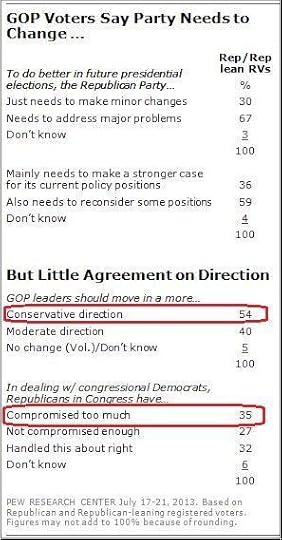
But it's not just party leaders like Limbaugh. My colleague Vanessa Silverton-Peel flagged a fascinating new poll from the Pew Research Center today that found 67% of self-identified Republicans agree that their party has "major problems" that will need to be addressed in order for the party's national candidates to be competitive. But more specifically, what does that mean?
The same poll found that a 54% majority of Republican voters want their party to be more conservative than it already is. A plurality of Republican voters believe their party has compromised too much with Democrats.
On issues like immigration, gun policy, and government spending, this national survey found most Republicans believe their party simply isn't conservative enough.
For those of us familiar with current events, these opinions appear to be stark raving mad. Indeed, they're so hard to believe that I honestly have to wonder if the Republicans who participated in the poll were confused by the questions.
Regardless, the results help explain a few things. It's not uncommon for political observers to wonder aloud why GOP officials can't move towards the mainstream, rebrand into a more sensible and pragmatic political party, and reclaim their lost legacy as a party interested in governing. The answer, apparently, is that their own voters don't want this to happen at all. Most Republican voters apparently see literally the most extreme major political party in the post-Civil War era of the United States and think, "Nah, too moderate."
Boehner picks the wrong fight, wants to talk about polls
House Speaker John Boehner (R-Ohio) was asked at a press briefing this morning about President Obama's series of speeches on the economy and the middle class. My jaw dropped a bit by the response.
"I'm not going to speak to what the president is doing or why he's doing it. If I had poll numbers as low as his, I'd probably be out doing the same thing, if I were him."
Look, if Boehner wants to say his ideas are better than the president's, fine. If the Speaker wants to make the case that the Republican vision of governance is superior to the Democratic vision, that's his right. These are subjective questions.
But the one topic John Boehner should go out of his way not to talk about is his poll numbers. If he had "poll numbers as low" as Obama's? Seriously? If Boehner had poll numbers as high as the president's he wouldn't be such a hapless, accomplishment-free House Speaker.
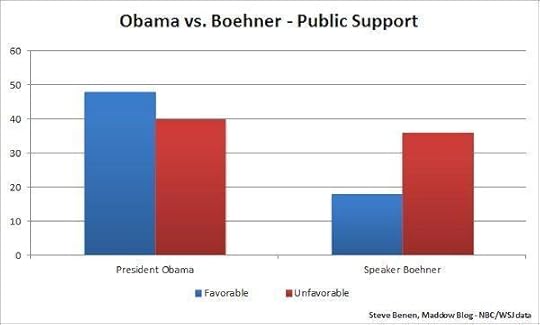
This is not a matter of opinion. The latest NBC/WSJ poll showed Obama with a 48% favorability rating, while the same poll showed Boehner with an 18% favorability rating. The president's approval rating, depending on which poll you like, is somewhere between 45% and 50%, while Boehner's Congress' approval rating is between 11% and 19%.
Obama is a relatively popular president; Congress is a national laughingstock. The House Speaker sometimes struggles with current events, but if he thinks he enjoys a stronger public standing than Obama, he needs to have a long chat with his pollster.
North Colorado, 51st state, now way beyond north Colorado
51stState.org
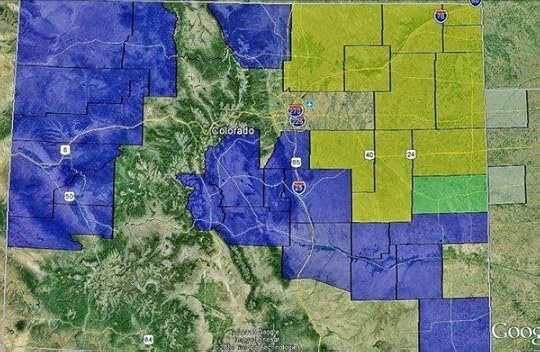
The local officials who support forming a 51st state -- North Colorado -- have been holding meetings (pdf) this month to talk it over with local voters. Press reports show the idea has gotten support at most, but not all, the meetings.
Organizer Jeffery Hare, a member of the Weld County Council, tells us today that the 51st State Initiative has just gotten nonprofit status as a 501(c)(4). They're hoping to get nonbinding referendums about secession on the ballot in Colorado counties for November. On the map above, the green county has already slated the question for the ballot. Yellow counties are gathering signatures. Blue counties has shown "some support." The white counties across the state line have gotten in touch.
Under the U.S. Constitution, breakaway states would first need the support of their legislatures, then the Congress. Despite the seeming impossibility of achieving that, Hare says he has begun to hear from rural groups in other states that are also feeling disenfranchised. Outside interest started with Nebraska, Kansas and (adding) New Mexico, but he says he is getting calls from western Maryland and upstate New York:
There could be multiple states that end up petitioning Congress at the same time. People always say how do we get this through Congress? And the answer is that we may not be the only group.
Hare adds that liberal groups in red states might also be feeling disenfranchised enough to want to secede. Given that he describes his 51st state values as including strong gun rights and opposition to abortion, the blue dots in red states might need a 52nd state.
Watch on YouTubeAbove, Weld County Commissioner Barbara Kirkmeyer testifies last week about the rural-urban divide. She mentions an alternate plan to give rural Coloradans more power in the state legislature; ColoradoPols runs the math on that.
What a governing allergy looks like
Getty Images
Lawmakers on Capitol Hill in Washington are getting ready for a four-week break, followed by a September in which House Republicans have only scheduled nine days of work for the entire month, and they're leaving quite a to-do list behind. Four of the 12 appropriations bills that have to pass before the end of the fiscal year are being ignored; the farm bill is stuck; immigration reform is demanding attention; and a debt-ceiling crisis looms.
There is, in other words, real work that needs to get done, and in theory, members of Congress would be scrambling right now to get as much finished as possible. Indeed, in the not-too-distant past, the days leading up to the August recess were considered some of the most productive of the year -- in part because members wanted something to brag about back in their states and districts.
...House Republicans will spend much of this week voting on a collection of legislative proposals aimed mostly at embarrassing the Obama administration and scoring some political points. [...]
Eager to call renewed attention to the troubled Internal Revenue Service and lingering doubts about the health-care law, Republican leaders have dubbed this "Stop Government Abuse Week," a parting shot at the White House and a conversation-starter for GOP lawmakers as they travel home to their districts in August. [...]
The themed week has been in the works for more than a month, and some GOP aides privately admit that House leaders rushed consideration of the farm bill in early July in order to make space on the calendar for the "scandal bills."
That last point is of particular interest. It's not unusual for lawmakers to play little partisan games, hoping to score cheap points, but as a rule, these antics are supposed to supplement actual governing. But radicalized Republicans prefer a different approach -- they're replacing real work with far-right stunts intended to make them and their base feel better.
There's real work to do? It doesn't matter. The so-called "scandals" have been discredited? That doesn't matter, either.
This is already the least productive Congress in modern American history, and the House GOP majority has already spent an enormous amount of time holding pointless votes to repeal federal health care law and restrict reproductive rights. But in the minds of congressional Republicans, what will really impress voters back home are more symbolic gestures, instead of dealing with actual work.
Here's my question for GOP leaders: when you see Congress' approval rating dropping to its lowest point since the dawn of modern polling, do you think it reflects public demand for more partisan stunts? Do you think these message votes are impressing anyone?