Rachel Maddow's Blog, page 3359
August 2, 2013
Color Coded: 'Freedom Blue' vs. 'Commie Red'
In a recent post on American Thinker, writer Sierra Rayne discusses voting trends, pointing out that Republicans fare far better in rural areas than in the cities and how this bodes ill for conservatives in future elections. The post included this map of the 2012 election results.

So far so good. Then there's the caption:
Of course, Republican victories are more correctly highlighted in freedom blue on this figure, with Democrat wins in commie red (rather than Tim Russert's backwards red state-blue state nonsense)
Wait, "Freedom blue?" "Commie red?" Tim Russert's red state-blue state nonsense? Let's start with the last one. According to a 2004 story in the Washington Post:
The first reference to "red states" and "blue states," according to a database search of newspapers, magazines and TV news transcripts since 1980, occurred on NBC's "Today" show about a week before the 2000 election. Matt Lauer and Tim Russert discussed the projected alignment of the states, using a map and a color scheme that had first shown up a few days earlier on NBC's sister cable network, MSNBC. "So how does [Bush] get those remaining 61 electoral red states, if you will?" Russert asked at one point.....In an interview yesterday, Russert disclaimed credit for coining the red-state, blue-state distinction. "I'm sure I wasn't the first to come up with it," he said. "But I will take credit for the white board," Russert's signature, hands-on electoral vote tracker.
So, in Rayne's world, since it's from Tim Russert, and it's from MSNBC, the dreaded liberal Kracken, the red state-blue state meme is "nonsense" and should be scuppered. Got it. (Although this switcheroo could prove awkward for the folks at Red State.)
As for "commie red," well, sure, red is the color of communism, but it's also the color of the Confederate battle flag, the Nebraska Cornhuskers, the Alabama Crimson Tide, Coca Cola, red velvet cake and plenty of other home grown, non-commie stuff. Whatever.
But what the hell is "freedom blue?" Here's my theory: a conservative chafes at being assigned the color red, but cannot readily switch to placid, dignified blue, because it's been tainted by "commies." What to do? Create a new improved blue, not some fey Massachusetts blue, or a tax and spend Nancy Pelosi blue, or a West Hollywood same sex marriage blue, but a bold, patriotic, American exceptional "freedom blue." So it's blue, only a hundred times freedom-ier.
To any conservatives trying to sell this notion to their colleagues, I wish you not just luck, but freedom luck.


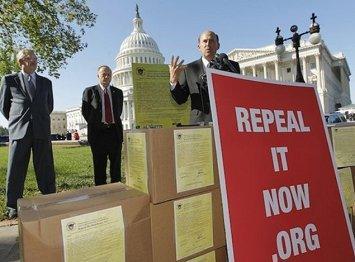
And then there were 40
Associated Press
House Speaker John Boehner (R-Ohio) told reporters yesterday that President Obama and congressional Democrats are "in denial."
Yeah, denial's just awful, isn't it?
Capping a legislative work period more noted for what it failed to pass than for what it completed, the House voted for the 40th time on Friday to repeal President Barack Obama's health care reform law before heading home for a five week recess.
The GOP-controlled House voted to approve a measure to prevent the IRS from enforcing "Obamacare" in a 232-185 vote.
The legislation faces virtually no chance of advancing in the Senate, which is controlled by Democrats.
How many House Republicans voted for repeal? All of them who were on the Hill this morning.
If we include the Senate, the total number of votes held by congressional Republicans to repeal all or part of the federal health care law is 68.
We're talking about a group of folks who are very slow learners.
At this point, what more can be said about such ridiculous congressional antics? Perhaps just this: with each one of these repeal votes, Republicans reinforce the impression that they're not a serious governing party. On the contrary, they're becoming rather pathetic.
Paul Krugman noted in passing last night, "[N]either you nor I should forget that the madness of the GOP is the central issue of our time." This wasn't in response to health care, but it might as well have been.
Whether GOP leaders are reluctant to do unglamorous work or not, Congress has an enormous amount of work it should be doing right now. This is especially true in the House, where lawmakers are supposed to be passing appropriations bills, working on the farm bill, negotiating on a budget, and if we're really lucky, avoiding a debt-ceiling crisis in the fall.
Indeed, in the not-too-distant past, this was one of the more productive weeks of the year on Capitol Hill -- before a four-week break, lawmakers traditionally scrambled to meet deadlines and get some work done so they'd have something to boast about during the August recess.
But that was before Republicans decided governing was for saps. Why get real work done when there are talking points to repeat, partisan stunts to execute, and "message votes" to push?
GOP lawmakers have already wasted months championing culture-war bills they know can't pass and obsessing over discredited "scandals," so there's something oddly fitting about voting 40 times to take away Americans health care benefits, not because they expect their legislation to pass, but because vanity exercises like these make Republicans feel warm and fuzzy.
It's as if Americans elected children to control half of the legislative branch of government.
Indeed, it's been interesting of late to see President Obama give a series of speeches on the economy, and in nearly all of them, he takes time to mock congressional Republicans for these votes. Every time, the audience laughs -- because in a way, this really is funny.
When lawmakers make fools of themselves, I suppose Americans should laugh at them.
It's a shame Republicans aren't in on the joke.
Update: Americans United for Change released a new video this afternoon, driving home exactly what the House GOP voted for (all 40 times).
Watch on YouTubeHow not to talk about a 'war on women'
Associated Press/Getty Images
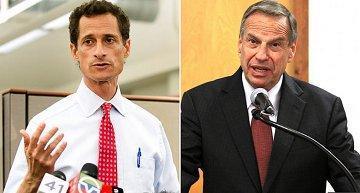
It's been about a week since the RNC began pushing the line that Anthony Weiner and Bob Filner constitute a Democratic "war on women," and though the right hasn't gained any traction on this, the talking points aren't going away.
Today, a joint memo from the Republican National Committee, the National Republican Congressional Committee, the Republican Governors' Association, the National Republican Senatorial Committee, and the Republican State Leadership Committee went out to reporters, hoping to shine a light on the "Democrats' War on Women."
The proof: instances of Filner's alleged sexual harassment, Weiner's online escapades, and remarks a Weiner staffer made this week about a campaign intern.
Republicans were especially indignant towards the House Minority Leader.
Last year, when radio host Rush Limbaugh called liberal activist Sandra Fluke an offensive term, Nancy Pelosi demanded that Republicans speak out. But when an individual currently serving on an actual Democrat campaign used precisely the same term and many more to disparage an intern, Pelosi didn't say a word. [...]
When Nancy Pelosi was asked about her former colleague Mayor Filner, she didn't jump to the defense of the women involved. Instead, she was indignant that she was asked.
There are a couple of angles to this. The first is that the Republican committees aren't just lying, they're doing so in a lazy, easy-to-check sort of way. Pelosi's condemnations of both men were unequivocal:
Watch on YouTubeAs for the larger argument, it didn't make sense a week ago, and it's not improving with age.
I noticed overnight that a conservative website finds the argument confusing, so let's try to be clearer about the differences between the parties.
The actions of Weiner and Filner: tens of women are affected.
The policy agenda of congressional Republicans: tens of millions of women are affected.
This isn't a defense of the San Diego mayor or the former congressman. If the allegations against Filner are accurate, there is no defense for his disgusting misconduct, and he has no business serving in public office. Likewise, Weiner's personal judgment appears bizarre.
But there are qualitative and quantitative differences that the RNC and its allies are choosing to overlook.
As we discussed last week, when we talk about a "war on women," we're talking less about Republican misdeeds towards specific individuals and more about a systemic issue of GOP policymakers pursuing a radical agenda that affects all American women.
Whether the RNC is comfortable with this or not, at issue here are efforts to restrict reproductive rights, scrap Planned Parenthood, close health clinics that provide important services to women, force medical professionals to lie to women, and force women to undergo medically unnecessary exams for political reasons. In recent years, as Republican politics has become more radicalized, the party has also used inexplicable rhetoric on rape, opposed pay equity laws, and pushed antiquated views on gender roles.
That's a war on women. Is it really that hard to appreciate the differences?
When Republican leaders in Congress are prepared to denounce their party's crusade as forcefully as Pelosi denounced Filner and Weiner, the RNC is welcome to send out another press release, but I have a hunch we'll be waiting a while.
'They don't want to be publicly named'
Associated Press
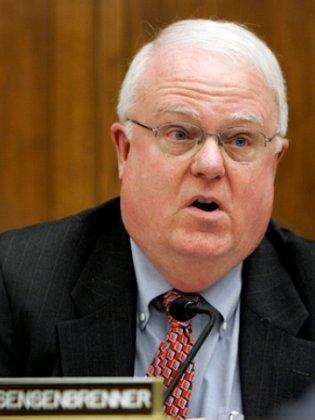
Rep. James Sensenbrenner (R-Wis.)
It's been nearly two months since the Supreme Court gutted the Voting Rights Act, giving Congress the task of creating new standards. Skeptics, including me, argued that the decision effectively dooms the VRA -- there's just no way to expect this Congress to address such a contentious issue, especially when Republicans see voter-suppression as a pathway to victory.
But one notable House Republican remains optimistic, despite the evidence.
Although many congressional Republicans so far have been noncommittal about rewriting an invalidated section of the 1965 Voting Rights Act, Rep. Jim Sensenbrenner said Wednesday that "a lot" of them want to do so.
Sensenbrenner is the most prominent among a small number of GOP lawmakers who have urged a congressional rewrite of the statute after the Supreme Court partially struck it down in June. But that doesn't mean other Republicans are not willing to join him in his effort, he told CQ Roll Call in an interview.
"There are a lot of Republicans who are [on board], but they don't want to be publicly named," said Sensenbrenner, R-Wis., a former Judiciary Committee chairman and architect of the 2006 compromise to reauthorize the voting law.
Look, I'm willing to be persuaded on this. If there's reason to believe lawmakers can work something out and revive the Voting Rights Act, I'd be delighted. I want my predictions from June to be wrong.
But if House Republican proponents of improving the law "don't want to be publicly named," I'm hard pressed to imagine why anyone would be optimistic about the VRA's prospects. In recent years, I can think of plenty of instances in which lawmakers were personally on board with a bill, but were afraid to take a public stand -- and in every instance, they balked when it came time to cast a vote.
What's the difference between an opponent of the Voting Rights Act and a supporter of the Voting Rights Act who's afraid to endorse the law publicly? As a practical matter, there really isn't much of a difference at all.
President Obama's commitment to the VRA is pretty obvious, but this isn't his call. Rather, it's up to Congress -- and in Congress, Rep. Joe Barton (R-Texas) said of the law this week, "Ain't gonna happen." Notice, the right-wing Texan wasn't afraid to "be publicly named."
Voting-rights activists should probably be keeping an eye on Attorney General Eric Holder's efforts, not Congress'.
Don't send Wendy Davis a bill

Associated Press
In late June, state Sen. Wendy Davis' (D) heroics were able to derail sweeping restrictions on reproductive rights in Texas, but her victory was temporary. Soon after, Texas Gov. Rick Perry (R) called the legislature into special session to approve the restrictions again, and this time, there wasn't much Davis or her allies could do.
The issue is headed to the courts, and as the litigation progresses, Texas is headed into another special session, this time to deal with a transportation measure. This was supposed to be the basis for the first special session, before state Republican policymakers decided it should instead focus on curtailing women's access to reproductive services.
Of course, all of these special sessions are pretty expensive, costing Texas taxpayers about $2.4 million. One Republican has an idea as to who should pick up the tab.
State Rep. Giovanni Capriglione told the Fort Worth Star-Telegram he thinks Davis should be on the hook for the cost of the extra lawmaking sessions.
"I am upset at the cost," Capriglione said. "I think we need to remember why we are having this extra special session. One state senator, in an effort to capture national attention, forced this special session. I firmly believe that Sen. Wendy Davis should reimburse the taxpayers for the entire cost of the second special session. I am sure that she has raised enough money at her Washington, D.C., fundraiser to cover the cost."
Now, this is obviously quite silly, and there's simply no way in the world an individual state senator will be handed this kind of bill.
But what strikes me as amusing about this is the underlying assumptions. The state Senate considered a proposal, state senators debated the proposal, and it didn't pass in time. That's how it goes.
Davis didn't want a special session, and she certainly didn't ask for one. Texas could have just moved on, rather than spend more time on a legally dubious anti-abortion bill, but GOP policymakers insisted.
So by Capriglione's reasoning, if the session was so wasteful, shouldn't Rick Perry have to pony up the $2.4 million?
August 1, 2013
Thursday's Mini-Report
Today's edition of quick hits:
* You know what Rep. Steve King's (R-Iowa) office needs? Cantelopes.
* Well, this could be huge: "Secretary of State John Kerry said Thursday that President Obama has a timeline for ending drone strikes in Pakistan, and 'we hope it's going to be very, very soon.'"
* Russia: "Brushing aside pleas and warnings from President Obama and other senior American officials, Russia granted Edward J. Snowden temporary asylum and allowed him to walk free out of a Moscow airport transit zone on Thursday, ending his legal limbo there after more than five weeks."
* Keep a close eye on this one: "The United States is closing embassies and consulates in a number of Middle Eastern and Asian countries Sunday -- including Egypt, Iraq and Afghanistan -- because of a possible al-Qaeda-related threat to diplomatic posts worldwide, American officials told NBC News on Thursday."
* Manufacturing: "U.S. factories revved up production, hired more workers and received a surge of new orders in July, helping them expand at the fastest pace in two years. The gains suggest manufacturing is rebounding and could provide a spark to economic growth."
* If you were happy about the sudden burst of progress in the Senate, I have bad news: the upper chamber's version of the THUD spending had enough votes to pass, but Senate Minority Leader Mitch McConnell (R-Ky.) blocked it with a filibuster. As is too often the case, it was a nice win for McConnell and another loss for the country.
* IRS: "President Obama is nominating John Koskinen, a former official at Freddie Mac and a corporate turnaround specialist, as the next commissioner of the Internal Revenue Service, the White House said Thursday."
* Done deal: The House approved a measure Wednesday to link interest rates on student loans to financial markets, sending the compromise legislation to the president's desk after a lengthy back-and-forth between Congress and the White House. The vote was 392-31."
* Mark Kessler gets suspended: "A Pennsylvania police chief who recorded profanity-ridden YouTube videos in which he fired automatic weapons and railed against Democrats on gun issues was handed a 30-day suspension Wednesday night."
* And in case the right's other recent economic conspiracy theories weren't enough, Limbaugh now believes the Obama administration is cooking the books on the GDP. I hate to break it to the right, but if the White House were fiddling with economic data, we would see growth a lot higher than 1.7%.
Anything to add? Consider this an open thread.
Paul Ryan disappoints reform activists on immigration
There was quite a bit of chatter yesterday about this exchange between House Budget Committee Chairman Paul Ryan (R-Wis.) and a constituent with a question about immigration. At first blush, the congressman's comments seemed to give new hope to reform proponents.
Watch on YouTubeFor those who can't watch clips online, the constituent noted that House GOP leaders won't bring an immigration reform bill to the floor for a vote, even if a majority of House members support it, because of the made-up "Hastert Rule," which says the only bills that deserve a vote are the ones with the support of most Republicans, not most lawmakers.
Ryan, who's been more open than most in his party to immigration reform, responded with an answer that was open to interpretation. He told the voter, "It is not, 'they don't come to the floor unless we have a majority of the majority,' because we don't know if we have a majority until we vote on it."
That didn't make much sense, since House leaders presumably know whether they have a majority long before they vote on it. In fact, it made so little sense that it seemed as if Ryan was suggesting the Hastert Rule should be ignored -- bring the bill to the floor, let members have their say, and then we'll know what the majority thinks.
Jed Lewison argued, persuasively, that the Wisconsin Republican's comments weren't quite as encouraging as reformers hoped, and his instincts were right.
In fact, today, Ryan's spokesperson told Greg Sargent, "The House will consider only those immigration reforms that garner a majority of House Republicans."
So much for that idea.
Obviously, for those suddenly optimistic that Ryan might be an ally for reform efforts, this represents a setback. That said, Greg asks whether Paul Ryan, a national figure in his party and a man with higher ambitions, is prepared to "lead on the issue."
Ryan is in a very good position to do just that. He plainly wants a bill to pass and he is broadly respected as a leadership figure by conservatives in the caucus. If he wants to, he'll presumably be able to influence how the House handles a number of upcoming questions: Will the emerging House gang of seven bill -- which is to the right of the Senate bill but also includes citizenship -- ever get a full vote, even though it's comprehensive and not piecemeal? Will something that emerges out of conference get a vote, even if a majority of Republicans does not publicly support it? What about the Senate bill? If all else fails, will it be allowed to come to the floor without the backing of a majority of the majority?
If I were a betting man, I'd say Ryan won't play a constructive role, as his pointless fealty to the made-up Hastert Rule helps prove. If the far-right Wisconsite continues to have national aspirations, he's no doubt aware of the conservative backlash against Marco Rubio over immigration, and would likely want to avoid the same criticism.
For that matter, it's not clear whether Ryan would make much of a difference anyway. If he were to announce this afternoon that he loves comprehensive reform and thinks the bipartisan Senate compromise should come to the floor immediately, is there any reason to think other House Republicans would care? Ryan might sway a handful of GOP members, but it's not as if Boehner, Cantor, and the leadership team are inclined to take marching orders from him.
I can appreciate why reform proponents would leap at any new opportunity for success, and Ryan is admittedly less rigid on immigration than many others on the far right, but this fight really isn't up to him. It's frustrating, but the fate of immigration reform largely comes down to one person: House Speaker John Boehner. And as of now, he's too weak, cowed, and confused to do much of anything.
Maine's LePage targets clean-air safeguards
Associated Press
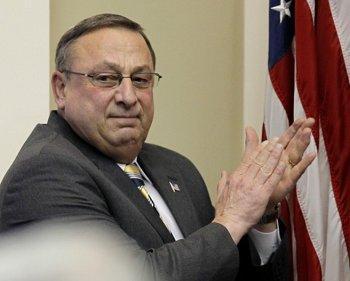
After Maine's beleaguered far-right governor, Paul LePage (R), announced last month that he would seek a second term, I more or less assumed the often-buffoonish Republican would at least pretend to shift towards the mainstream. After all, Maine is a pretty moderate state, and if LePage made a point to be less extreme, he'd probably stand a better chance of winning.
But that doesn't seem to be happening. This week, for example, LePage's Department of Environmental Protection pushed to weaken Maine's anti-smog regulations.
The proposed changes would exempt major new or newly upgraded industrial polluters in Maine from several measures that aim to reduce ground-level ozone in accordance with the federal Clean Air Act.
Critics say the changes would effectively remove Maine from a 13-state regional effort to control cross-border ozone pollution, undermining a project that has reduced smog in Maine.
"This is an attempt by the LePage administration to weaken clean air health standards from the biggest polluters in the state and it just doesn't make sense," said Glen Brand, director of the Sierra Club's Maine chapter. "It's moving Maine in the wrong direction."
Ron Severance, who served as a top official in the Maine Department of Environmental Protection for 15 years, told the Portland Press Herald, "From a practical point of view, it's going to mean a worsening of public health."
Adding insult to injury -- in this case, the phrase applies almost literally -- the LePage administration buried the proposed changes on a website, apparently in the hopes the public wouldn't notice.
But not everyone is disappointed. Lobbyists for the pulp and paper industry said this week that they see this as a great idea.
North Carolina targets key women's health clinic
Associated Press
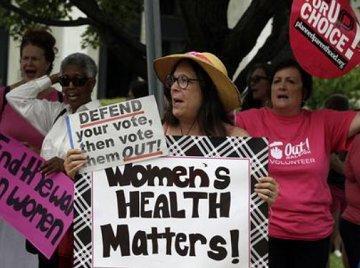
Reproductive-rights proponents protest in North Carolina
We've been keeping a close eye on new abortion restrictions in North Carolina, where Gov. Pat McCrory (R) ignored a campaign promise and approved a new measure that will likely close 15 of the state's 16 women's health clinics. And what about the other one? As of today, it appears to be closing, too.
As controversy brewed over changes to the state's abortion laws, state health officials moved to close a clinic in Asheville after it failed a licensure inspection.
The Department of Health and Human Services announced Wednesday it has temporarily closed the doors of FemCare, an abortion provider in Asheville.
The release cited "egregious violations of existing rules that revealed an imminent threat to the health and safety of patients."
At this point, it's difficult to judge the state's arguments on the merits without more information. FemCare, a licensed ambulatory surgical center, was reportedly cited with 23 violations, which came as a surprise to the facility's operators -- it cleared an August 2006 inspection and nothing has changed since.
That said, speaking on behalf of the clinic, Dr. Lorraine Cummings said standards have changed since the last inspection and FemCare has been in the process of meeting the updated state guidelines. FemCare has vowed to re-open soon.
Of course, in this case, the significance goes beyond just one medical facility -- if FemCare was positioned to be the only clinic in the state that could meet the TRAP law standards, and the state is closing it down, North Carolina women are about to find themselves in an untenable position.
In the meantime, MaddowBlog commenter JulSun76 alerted us to the fact that Dr. Laura Gerald has served as North Carolina's State Health Director and Director of the Division of Public Health for the last year and a half -- that is, until this week. She resigned on Tuesday citing "significant differences and disagreements with many of the policy and administrative directions that I see unfolding in North Carolina and in the Department of Health and Human Services." She added, "These differences are making it increasingly impossible to continue to be effective in my current role."
We'll have more on this on tonight's show.
Boehner's plan to hurt the country on purpose
Associated Press
Sequestration cuts, we learned yesterday, continue to undermine the U.S. economy severely, and are quickly losing support of the congressional Republicans who pushed for the policy in the first place. As the GOP budget strategy unravels, House Appropriations Committee Chairman Hal Rogers (R-Ky.) said yesterday the sequester is "unrealistic," "ill-conceived," and a policy that "must be brought to an end."
For now, House Speaker John Boehner (R-Ohio) doesn't give a darn.
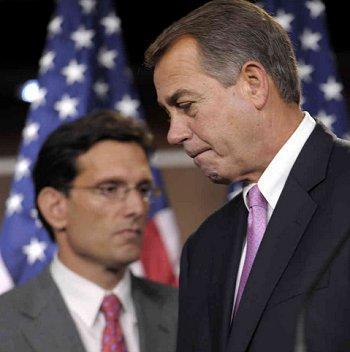
Speaker John A. Boehner came before the mics on Thursday, and he made one thing clear: The sequester is here to stay until the White House gets serious about spending cuts.
"Sequestration is going to remain in effect until the president agrees to cuts and reforms that will allow us to remove it," the Ohio Republican said to reporters in his weekly news conference. "The president insisted on the sequester none of us wanted, none of us like it, there are smarter ways to cut spending."
It's frightening how little Boehner understands about this policy. He's the Speaker of the House, for goodness sake.
First, the president didn't "insist on the sequester." That's just crazy.
Second, if "none of us" want this stupid policy, it's within Boehner's power to stop the cuts that are hurting the country on purpose. For reasons that only make sense to him, the Speaker refuses.
Third, Boehner's argument is that he'll stop deliberately undermining the country when Obama "agrees to cuts and reforms." But Obama has already approved $1.5 trillion in spending cuts, and offered Republicans even more. So far, GOP officials have offered no comparable concessions.
And finally, there's the problem Boehner doesn't like to talk about: he has no alternative.
In effect, he's saying, "When Obama agrees to make me happy, I'll agree to end the pain." And what would make Boehner happy? He won't say -- Obama is supposed to just offer Republican goodies, in the hopes that the House Speaker will eventually say he's satisfied and turn off the policy that's hurting the country on purpose.
Maybe Boehner should take a moment to consider how he defines the nature of "public service." Does he seriously believe he's acting in the nation's best interests by pushing a policy both parties hate and is clearly undermining economic growth and job creation?