
Yanis Varoufakis's Blog, page 19
July 6, 2023
Απάντηση του Γραμματέα του ΜέΡΑ25 στις Προγραμματικές Δηλώσεις του Κ. Μητσοτάκη
The post Απάντηση του Γραμματέα του ΜέΡΑ25 στις Προγραμματικές Δηλώσεις του Κ. Μητσοτάκη appeared first on Yanis Varoufakis.


Το βράδυ της 5ης Ιουλίου 2015 όπως το έζησα
The post Το βράδυ της 5ης Ιουλίου 2015 όπως το έζησα appeared first on Yanis Varoufakis.
July 4, 2023
Ήταν αυταπάτη το ΟΧΙ; Η στρατηγική, οι προοπτικές και το κόστος της Ελληνικής Άνοιξης υπό τη σκιά του Grexit
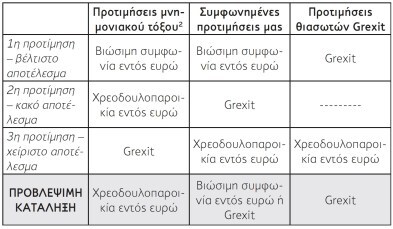 ΠΙΝΑΚΑΣ 1 – Τρεις ιεραρχήσεις προτιμήσεων, τρία διαφορετικά αποτελέσματαΙδού λοιπόν το κλειδί της ερώτησης: «Ήταν μάταιη η διαπραγμάτευση;» Εφόσον προτιμούσαμε το Grexit από το 3ο μνημόνιο, όχι, δεν ήταν μάταιη. (Βλ. την 3η στήλη.) Αυτός άλλωστε ήταν ο λόγος για τον οποίο το σύνθημα με το οποίο κερδίσαμε τις εκλογές του Γενάρη 2015 ήταν: «Συμφωνία βιώσιμη μέσα στο ευρώ, αλλά όχι όλα για το ευρώ!» Κατεβήκαμε στις εκλογές (τουλάχιστον έτσι νόμισα) αποφασισμένοι να καταδείξουμε στους δανειστές την ειλικρινή μας διάθεση για την επίτευξη έντιμης επίλυσης του ελληνικού ζητήματος διαμηνύοντάς τους, παράλληλα, ότι –ενώ σε καμία περίπτωση δεν απειλούμε με Grexit– ήμασταν έτοιμοι να απαντήσουμε σε επιθετικές τους κινήσεις (π.χ. κλεισίματος των ελληνικών τραπεζών) με ανάλογα και εύλογα αντίποινα (κούρεμα ομολόγων SMP της ΕΚΤ, ενεργοποίηση παράλληλου συστήματος πληρωμών κτλ.).Δυστυχώς, μετά την ήττα και τη συνθηκολόγηση, ακούμε και διαβάζουμε καλοπροαίρετους σχολιαστές, ακόμα και πολλούς που διάκεινται επικριτικά απέναντι στην επιλογή Τσίπρα να ενδώσει στην τρόικα και να αποκαλέσει την Ελληνική Άνοιξη «αυταπάτη», να αναρωτιούνται: «Και τι να έκανε όταν κατάλαβε ότι ο εχθρός [σημ.: εννοούν τον κ. Σόιμπλε] επιζητούσε την εφαρμογή της απειλής μας, του Grexit; Να αποδεχόταν την καταστροφή που θα έφερνε το Grexit; Να συνέχιζε να μπλοφάρει με τους δανειστές, όπως ο Βαρουφάκης;» Δυστυχώς, η ήττα φαίνεται πως έφερε αμνησία ως προς το διακύβευμα της Άνοιξης, τους στόχους και τα μέσα μας.Πολύ πριν κερδίσουμε τις εκλογές, προειδοποιούσα τον Αλέξη Τσίπρα να μη διανοηθεί καν να μπλοφάρει απειλώντας μ’ ένα Grexit το οποίο δεν είχε σκοπό να εφαρμόσει. Είχα μάλιστα γίνει και δυσάρεστος, καθώς, από το 2012, επέμενα ότι, αν κέρδιζε εκείνες τις εκλογές, θα ερχόταν αντιμέτωπος με μια τρόικα που θα τον έσπρωχνε τεχνηέντως στο χείλος του Grexit, ώστε να διαπιστώσουν οι δανειστές αν εννοούσε εκείνα που έλεγε. Πρόσθετα μάλιστα ότι η βιωσιμότητα της Ελλάδας εντός του ευρώ απαιτούσε από εκείνον, εκείνη τη στιγμή, να προτιμήσει το επαπειλούμενο Grexit από τη συνθηκολόγηση. Μόνον τότε μπορεί να υποχωρούσαν, δίνοντας στη χώρα τις ανάσες που χρειαζόταν, και άξιζε, εντός της ευρωζώνης.Είχα δίκιο όμως, το 2012, ή το 2015, ότι η βίαιη έξωσή μας από το ευρώ ήταν, παρά το τεράστιο κόστος της, προτιμότερη από τη συνέχιση των μνημονίων και του καθεστώτος χρεοδουλοπαροικίας που αυτά μας επιβάλλουν;Ήταν το Grexit το χειρότερο δυνατό αποτέλεσμα για τον ελληνικό λαό και τις προοπτικές της ελληνικής οικονομίας;Τι θα ήταν καλύτερο τον Ιούλιο του 2015; Ένα Grexit, το οποίο δε θέλαμε; Ή το 3ο μνημόνιο, εναντίον του οποίου εξεγερθήκαμε; Η απάντηση απλή: Το Grexit! Ναι, το κόστος θα ήταν μεγάλο. Το 2012 είχα μάλιστα χρησιμοποιήσει ακραίες εκφράσεις, λέγοντας ότι ένα Grexit θα μας πήγαινε πίσω στη νεολιθική εποχή. Όμως ακόμα και τότε επέμενα: Αν δεν ήμασταν διατεθειμένοι να πούμε «όχι» στις αρπακτικές ιδιωτικοποιήσεις, την σκληρή λιτότητα και τα νέα μνημονιακά δάνεια, η τρόικα θα συνέτριβε τη χώρα. Όπερ και εγένετο! (Βλ. τον ΠΙΝΑΚΑ 1.)Στις αρχές Ιουλίου του 2015, κατά την ηρωική στιγμή του δημοψηφίσματος, ο πρωθυπουργός Τσίπρας πράγματι βρέθηκε αντιμέτωπος με την απειλή του Grexit. Αν τιμούσε το ΟΧΙ, ναι, υπήρχε πιθανότητα να περάσει η γραμμή Σόιμπλε για Grexit – αν και εξακολουθώ να πιστεύω ότι, την τελευταία στιγμή, το δίδυμο Μέρκελ-Ντράγκι θα παρέμβαιναν αντιπροτείνοντας την ριζική αναδιάρθρωση χρέους. Παρόλα αυτά, ο πρωθυπουργός έπρεπε να υπολογίσει τι θα κόστιζε το Grexit αν τιμούσε το ΟΧΙ κι η τρόικα επέλεγε να μην ενδώσει στο κούρεμα του χρέους μας.Τι θα κόστιζε αλήθεια το Grexit το καλοκαίρι του 2015; Ο Πίνακας 2 απαντά παραθέτοντας δύο εκτιμήσεις (βλ. διακεκομμένες καμπύλες). Η πιο αισιόδοξη εκτίμηση βασίζεται σε απλή προβολή της ιστορικής πορείας του εθνικού εισοδήματος χωρών που βίωσαν το απότομο και βίαιο σπάσιμο σταθερών ισοτιμιών (βλ. Βρετανία 1931, 1992, Ιταλία 1992, Μεξικό 1994, Βραζιλία 1999, Αργεντινή 2002). Και η πιο απαισιόδοξη εκτίμηση βασίζεται στην υπόθεση ότι, λόγω της ανυπαρξίας εγχώριων χαρτονομισμάτων, η άμεση μείωση του εθνικού μας εισοδήματος θα ήταν η διπλάσια εκείνων των συγκεκριμένων ιστορικών επεισοδίων.
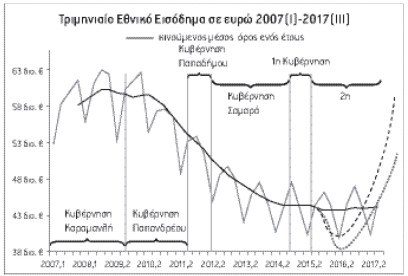 ΠΙΝΑΚΑΣ 2 – Η διακύμανση του τριμηνιαίου ελληνικού εθνικού εισοδήματος σε ευρώ για την περίοδο 2007-2017 – με τη συμπαγή γραμμή να καταδεικνύει τον κινούμενο μέσο όρο (διάρκειας ενός έτους) [στοιχεία ΕΛΣΤΑΤ, επικαιροποιημένα τον Σεπτέμβριο του 2017]. Οι δύο διακεκομμένες χρονοσειρές αποτελούν εκτιμήσεις (μία ουδέτερη και μία απαισιόδοξη) του μέσου όρου του ΑΕΠ μετά από ένα Grexit τον Ιούλιο του 2015. Οι εκτιμήσεις βασίζονται σε προβολές επί των ελληνικών μακροοικονομικών δεδομένων έξι επεισοδίων σπασίματος σταθερών νομισματικών ισοτιμιών (Βρετανία 1931, 1992, Ιταλία 1992, Μεξικό 1994, Βραζιλία 1999, Αργεντινή, 2002), λαμβανομένης υπ’ όψιν της προϋπάρχουσας εσωτερικής υποτίμησης (ιδίως στην περίπτωση της Ελλάδας).Ακόμα και με βάση το απαισιόδοξο σενάριο διαφαίνεται ότι η ανάκαμψη θα ξεκινούσε την άνοιξη του 2016, ότι έναν χρόνο μετά το σοκ του Grexit θα είχε αποσοβηθεί και, σήμερα πλέον, οι ρυθμοί ανάκαμψης θα ήταν εντυπωσιακοί, θέτοντας την ελληνική οικονομία σε τροχιά που καθιστά τη σημερινή μας κατάσταση αποτελμάτωσης και σταδιακής ερημοποίησης ακόμα πιο θλιβερή. Αυτό θα ήταν το αποτέλεσμα του Grexit: Ένα κόστος πρόσκαιρο με μεγάλα οφέλη μετά το 2017 – κάτι που στη γλώσσα της οικονομικής ονομάζεται επένδυση!Αντ’ αυτού, είχαμε τη συνθηκολόγηση Τσίπρα, ώστε να αποφευχθεί το Grexit πάση θυσία, και μια μόνιμη αποτελμάτωση μέχρι και το 2023 που ανάλογή της δεν έχει υπάρξει στην ιστορία του καπιταλισμού – κάτι που φαίνεται στον Πίνακα 3 ο οποίος δείχνει πως ακόμα κι η μεγαλύτερη κρίση στην ιστορία του καπιταλισμού, η Μεγάλη Ύφεση του Μεσοπόλεμου στις ΗΠΑ, ξεπεράστηκε σχετικά γρήγορα ενώ η Ελληνική Κρίση κρατά ως και σήμερα – 13 χρόνια αργότερα!
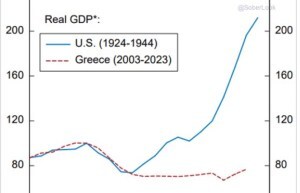 ΠΙΝΑΚΑΣ 3 – Η εξέλιξη του ΑΕΠ των ΗΠΑ (ξεκινώντας το 1924) και της Ελλάδας (ξεκινώντας το 2003)Το κόστος της διαπραγμάτευσης (πρώτο εξάμηνο του 2015)Στην προσπάθεια αμαύρωσης της αντίστασης του ελληνικού λαού εκείνη τη σπουδαία Άνοιξη καταβλήθηκαν φιλότιμες προσπάθειες από την τρόικα εσωτερικού και εξωτερικού να «περάσει» το διπλό ψεύδος ότι: (Α) Ούτε κούρεμα χρέους ούτε 3ο Μνημόνιο χρειαζόταν, και (β) Η Ελληνική Άνοιξη σταμάτησε την ανάπτυξη που είχε αρχίσει το 2014 και κόστισε στην οικονομία έως και 200 δισ. ευρώ.Ως προς το (Α), ότι δηλαδή το 3ο Μνημόνιο ήταν «αχρείαστο», θυμίζω απλώς ότι, μόνο το 2015, και παρά τα απολύτως άδεια ταμεία που βρήκα τον Γενάρη του 2015 από την συγκυβέρνηση ΝΔ-ΠΑΣΟΚ, έπρεπε ως Υπουργός Οικονομικών να αποπληρώσω 22 δις στους δανειστές. Ακόμα και να υπέγραφα ό,τι χαρτί μου έδινε η τρόικα (ακόμα και εκείνα που αρνείτο να υπογράψει ο Α. Σαμαράς), το πολύ να έπαιρνα άλλα 7 δις δανείων – με τα οποία εξαντλείτο όλος ο κουμπαρά δανεικών του 2ου Μνημονίου. Και τα υπόλοιπα 15 δις; Και τα άλλα 18 δις του 2016; Να το πω απλά: Είτε οι αποπληρωμές αυτές θα κουρεύονταν, όπως πρότεινα (στο πλαίσιο της ριζικής αναδιάρθρωσης/κουρέματος χρέους). Είτε 3ο Μνημόνιο (το οποίο εκλεγήκαμε για να μην πάρουμε). Τρίτη εναλλακτική δεν υπήρχε. [Τα περί «πιστοληπτικής γραμμής», αντί για 3ο Μνημόνιο, είναι λογο-τεχνάσματα – απλά, αντί να το λέγανε 3ο Μνημόνιο θα το λέγανε «πιστοληπτική γραμμή».]Πάμε τώρα στο «κόστος της διαπραγμάτευσης» ή και «κόστος Βαρουφάκη». Μια ματιά στον Πίνακα 1 αποκαλύπτει την πραγματικότητα. Η εικόνα του ΑΕΠ μας σε τρέχουσες τιμές (δηλαδή σε ευρώ στις τσέπες των ανθρώπων) είναι ξεκάθαρη. Η μείωσή του αρχίζει με την παγκόσμια χρηματοοικονομική κρίση του 2008 και, από τότε, μέχρι και τις αρχές του 2014, επιταχύνεται ραγδαία, με μια συνολική απώλεια της τάξης του 25% και άνω. Από τα μέσα του 2014 περνάμε από τη ραγδαία πτώση στην αποτελμάτωση: πιο ήπιες μειώσεις του συνολικού εισοδήματος, οι οποίες, όμως, συμπίπτουν με μεγάλες μειώσεις τιμών (αποπληθωρισμός της τάξης του 2% και άνω). Εν συντομία, το 2014 δεν υπήρξε καμία ανάκαμψη, πόσο μάλιστα ανάπτυξη. Αυτό που υπήρξε ήταν παγίωση της κρίσης, αποτελμάτωση και παγίδευση της κοινωνίας στην αυτοτροφοδοτούμενη δίνη ενός μη βιώσιμου χρέους-ύφεσης-λιτότητας.Αντίθετα από το αφήγημα της ολιγαρχίας, σύμφωνα με το οποίο ο «ανόητος» λαός ψήφισε ΣΥΡΙΖΑ τον Γενάρη του 2015 «παρά την ανάκαμψη», η πραγματικότητα καταδεικνύει ότι ο ελληνικός λαός ψήφισε την κυβέρνησή μας επειδή όχι μόνο δεν υπήρξε καμία ανάκαμψη το 2014 αλλά, επιπλέον, δεν μπορούσε άλλο να ανεχτεί τις ανοησίες περί Greekcovery, Greek Success Story κτλ., στις οποίες, προσβλητικά, τον εξέθετε ένα καθεστώς υπό πανικό.Όσο για το «κόστος» της Ελληνικής Άνοιξης, ο Πίνακας 1 είναι εξίσου αποκαλυπτικός: Απλώς δεν προέκυψε ποτέ τέτοιο κόστος! Σε όρους συνολικού εισοδήματος, αν μη τι άλλο, από τις αρχές του 2015 παρατηρούμε μια διαρκή σταθεροποίηση. Μήπως όμως το 2015 αυξήθηκε το χρέος; Όχι, δεν αυξήθηκε ούτε το χρέος – βλ. Πίνακα 4. Όταν παρέλαβα το Υπουργείο Οικονομικών, το δημόσιο χρέος ήταν στα 317 δισ., ενώ το παρέδωσα, έξι μήνες μετά, στα 307 δισ., δηλαδή επί της ουσίας στο ίδιο, κατά τι χαμηλότερο, μη βιώσιμο επίπεδο. Μήπως το νέο χρέος που μου καταλογίζουν προστέθηκε λίγο αργότερα; Ούτε αυτό στέκει: Από το τέλος του 2014 έως την 1η Απριλίου 2016 το δημόσιο χρέος αυξήθηκε, σύμφωνα με τη Eurostat, μόνο κατά 1,5 δισ.Τότε, τα 86,τα 100 δισ. και τα 200 δισ. που μου χρεώνουν οι κκ. Στουρνάρας, Ρέγκλινγκ και Βίζερ αντίστοιχα πώς προέκυψαν; Πολύ απλά: Πήραν το μη βιώσιμο μέρος του δημόσιου χρέους, το οποίο έλεγα ότι αν δεν κουρευτεί (όπως πρότεινα και απαιτούσα) θα το μετακύληαν με νέα μη βιώσιμα δάνεια, και αφού βοήθησαν να εμποδιστεί το κούρεμά του (κάτι που απαιτούσε την απομάκρυνσή μου από το Υπουργείο Οικονομικών και την ακύρωση του ΟΧΙ), εξασφάλισαν όχι μόνο ότι θα μετακυλιστεί με νέα μνημονιακά δάνεια αλλά και θα χρεωθεί σ’ εμένα!Δεν είναι εντυπωσιακό; Το μη βιώσιμο χρέος που εκείνοι συσσώρευσαν πριν από το 2015 αποφάσισαν και διέταξαν να χρεωθεί στην Ελληνική Άνοιξη, στην εξέγερση ενός λαού εναντίον του συγκεκριμένου μη βιώσιμου χρέους! Ο Γιόζεφ Γκέμπελς θα ήταν περήφανος που η τέχνη της θεμελίωσης μιας προπαγάνδας σε γιγαντιαία ψεύδη ζει και βασιλεύει.
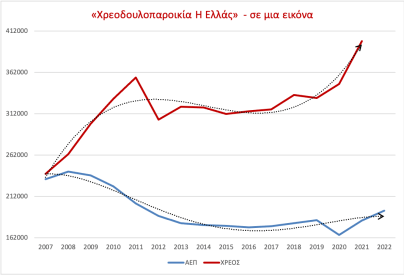 ΠΙΝΑΚΑΣ 4 – Τα σαγόνια του μη βιώσιμου χρέους άνοιξαν μετά το 2008, το 2015 παρέμειναν σταθερά και από το 2018 ανοίγουν κι άλλοΝαι, αλλά σήμερα, εν έτει 2023, η Ελλάδα 2.0 πετάει…Το μόνο που πετάει είναι το χρέος. Το μόνο που μεγεθύνεται είναι οι φούσκες που βασίζονται σε νέα χρέη. Το τσουνάμι «κόκκινων» οφειλών και δανείων του ιδιωτικού τομέα μεγεθύνεται καθημερινά. Η μεταβίβαση των κόκκινων δανείων από τις τράπεζες στα αρπακτικά (πιο ευγευνικά, στους servicers) δεν αλλάζει το γεγονός ότι το σύνολο του ιδιωτικού χρέους που δεν αποπληρώνεται ξεπερνά το 200% του ΑΕΠ. Σε αυτό πρέπει να προστεθεί άλλο ένα βουνό ιδιωτικού χρέους που, κούτσα-κούτσα, αποπληρώνεται αλλά που, κι αυτό λίγο-λίγο «κοκκινίζει» όσο η ακρίβεια θερίζει, τα εισοδήματα αρνούνται να αυξηθούν, κι οι άνθρωποι που μέχρι τώρα αποπλήρωναν τα χρέη τους ξάφνου αδυνατούν να το κάνουν.Συνολικά, σε μια Ελλάδα που το συνολικό μας εισόδημα είναι γύρω στα 200 δις, το ιδιωτικό χρέος ξεπερνά τα 500 δις. Σε αυτό το βουνό ιδιωτικού χρέους προστίθεται το δημόσιο χρέος των 410 δις. Έτσι, φτάσαμε ο λαός μας να χρωστά, συνολικά, πάνω από 900 δις, όταν το εισόδημα δεν ξεπερνά τα 200 δις, από τα οποία τα έσοδα της ολιγαρχίας δεν δηλώνονται και δεν φορολογούνται (μόνο, το πολύ, 90 δις δηλώνονται στην Εφορία – από τους φτωχότερους των ελλήνων και των ελληνίδων).Και να ήταν μόνο αυτό; Κάθε χρόνο ο ιδιωτικός και δημόσιος τομέας μπαίνουν «μέσα», μαζί, κατά 40 δις το χρόνο (ο τεχνικός όρος είναι ότι, το 2022, το έλλειμμα τρεχουσών συναλλαγών στο έφτασε το 10% του ΑΕΠ, δηλαδή περί τα 40 δις). Πως γίνεται αυτό; Παρά τον τουρισμό κάτω από το βάρος του οποίου συνθλίβεται η κοινωνία, οι υποδομές κι η Φύση, ξοδεύουμε σε εισαγωγές υλικών αγαθών και άυλων υπηρεσιών 40 δις περισσότερα από όσα εισπράττουμε εξάγοντας αγαθά και υπηρεσίες. Και που τα βρίσκουμε αυτά τα 40 δις; Είτε τα δανειζόμαστε από ξένες τράπεζες και οργανισμούς είτε καλύπτονται από ξένα κεφάλαια που έρχονται για να εξαγοράσουν ό, τι βρουν.Είναι ξεκάθαρο ότι η «Χρεοδουλοπαροικία η Ελλάς» καλά κρατάει και προμηνύει ένα πράγμα με μαθηματική ακρίβεια: Νέα Σκληρή Λιτότητα, Νέο Κρατικό Δανεισμό, Νέες Περιπέτειες.Εν κατακλείδιΤο 2015 υπήρχε τρόπος να αποδράσει η χώρα από τη φυλακή του χρέους παραμένοντας παράλληλα στο ευρώ: η ηγεσία μας να φοβόταν το 3ο μνημόνιο περισσότερο απ’ ό,τι φοβόταν το Grexit! [Σημ. Αν έστω και μια στιγμή, τότε που μου προτάθηκε να αναλάβω το Υπουργείο Οικονομικών, πίστευα ότι η ηγεσία του ΣΥΡΙΖΑ θα υπέκυπτε στην αυταπάτη ότι η υποταγή στην τρόικα ήταν λιγότερο κακή λύση από το Grexit, δεν υπήρχε πιθανότητα να συμμετάσχω.]Η μόνη αυταπάτη που έκανε κακό στη χώρα ήταν, και παραμένει, η αυταπάτη ότι η ακύρωση του ΟΧΙ έσωσε την Ελλάδα – μαζί με την αυταπάτη πως η καθυπόταξη της κυβέρνησης ΣΥΡΙΖΑ στις βουλές της τρόικας, και το 3ο Μνημόνιο, ήταν μονόδρομος και ευεργετική για τη κοινωνία και τον λαό μας.Αυτός είναι ο λόγος που το ΜέΡΑ25 τιμούμε το ΟΧΙ ως κορυφαία στιγμή λαϊκής ωριμότητας και δημοκρατικής ειρηνικής επανάστασης κόντρα στον ανορθολογισμό και τον ολιγαρχικό αυταρχισμό.
ΣΗΜΕΙΩΣΕΙΣ
Το 2015 το άμεσο κόστος ενός Grexit για ΕΕ, ΔΝΤ, ΕΚΤ ανερχόταν στα περίπου 700 δισ. ευρώ αθετημένων αποπληρωμών: ελληνικό δημόσιο χρέος, TARGET2, υποχρεώσεις των ελληνικών τραπεζών απέναντι στην ΕΚΤ, οφειλές των ελληνικών τραπεζών σε ξένους δανειστές, δάνεια ελληνικών εταιρειών και νοικοκυριών από ξένους δανειστές. Όλα αυτά τα δάνεια σε ευρώ θα ήταν, προφανώς, αδύνατον να αποπληρωθούν σε ευρώ μετά την έξοδο της χώρας από το ευρώ. Επιπλέον, υπολογίζεται ότι, λόγω των λεγόμενων cross defaults (των στάσεων πληρωμών ξένων εταιρειών ή οργανισμών προς άλλες ξένες εταιρείες ή οργανισμούς λόγω της αθέτησης αποπληρωμών από Έλληνες οφειλέτες), τουλάχιστον 300 δισ. επιπλέον πρέπει να προστεθούν στο κόστος της ΕΕ από ένα Grexit. Σύνολο: περί το 1 τρισ. ευρώ!
Ήταν άστοχη εκείνη η υπερβολή μου. Εννοούσα πως ένα Grexit τότε, το 2010, θα συρρίκνωνε το ΑΕΠ μας περισσότερο απ’ ότι συρρικνώθηκε το ΑΕΠ των ΗΠΑ στα πρώτα 3 χρόνια της Μεγάλης Ύφεσης του Μεσοπολέμου. Ναι, αλλά αυτό ακριβώς έγινε: Από 240 δις το ΑΕΠ της χώρας, με 2 καταστροφικά μνημόνια αντί για Grexit, το πήγαν στα 175 δις. Οπότε, το 2015, η μεγάλη πτώση είχε ήδη γίνει και ένα Grexit τότε θα είχε πολύ μικρότερο κόστος – βλ. πιο κάτω.
The post Ήταν αυταπάτη το ΟΧΙ; Η στρατηγική, οι προοπτικές και το κόστος της Ελληνικής Άνοιξης υπό τη σκιά του Grexit appeared first on Yanis Varoufakis.
July 2, 2023
Αντί σχολίου περί παραίτησης Τσίπρα: Δύο σύντροφοι-αινίγματα (απόσπασμα από το ΑΝΙΚΗΤΟΙ ΗΤΤΗΜΕΝΟΙ, 2017)
The post Αντί σχολίου περί παραίτησης Τσίπρα: Δύο σύντροφοι-αινίγματα (απόσπασμα από το ΑΝΙΚΗΤΟΙ ΗΤΤΗΜΕΝΟΙ, 2017) appeared first on Yanis Varoufakis.
Alexis Tsipras resigns: lessons for progressives
The post Alexis Tsipras resigns: lessons for progressives appeared first on Yanis Varoufakis.
June 1, 2023
Who’s Afraid of Central Bank Digital Currencies? Project Syndicate op-ed
The post Who’s Afraid of Central Bank Digital Currencies? Project Syndicate op-ed appeared first on Yanis Varoufakis.
The Strange Death of the Liberal Individual – Project Syndicate op-ed
The post The Strange Death of the Liberal Individual – Project Syndicate op-ed appeared first on Yanis Varoufakis.
May 29, 2023
La Stampa interview (English version) on Greek gvt refugee policy, Greece’s economy, MeRA25′ electoral setback, the euro, Italy’s PD and… Angela Merkel
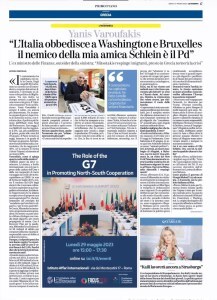 In this post you will find my original answers (in English) to
La Stampa
‘s varied questions (27/5/2023); from the Greek government’s shameful policy on refugees and MeRA25’s electoral setback, to the future of the Eurozone, my friend Elly Schlein’s leadership of Italy’s main opposition party, the PD and, yes, Angela Merkel!Almost all parties, on the campaign trail during the recent Greek election, were in favour of the government’s policy of border controls. A few days before Greece went to vote, a chilling video, published by the New York Times, went around the world: the Greek Coast Guard can be seen abandoning a group of migrant people in the middle of the sea. Are the police turning away migrants, from Evros to the islands,? You, however, were the only leader to have asked a parliamentary question to the Mitsotakis government, accusing him of hiding these inhumane practices.Mr Mitsotakis’ government is actively and consciously violating international law by pushing vessels with vulnerable refugees back into the stormy Aegean Sea. It is a deliberate policy to make our men and women of the Greek Coastguard commit acts which, according to the Law of the Sea and basic human decency, can be described not only as shameful but also illegal. We now have solid evidence that, not only are they pushing flimsy boats back in mid-sea but, even worse, they force refugees that have already landed in Greece back into boats which they then tow back out to sea where they are abandoned.MeRA25, the party that I lead, exposed these crimes in Parliament and, besides, put forward the real reason behind Mitsotakis’ inhumanity: He has chosen to dominate Greek politics through a combination of, on the one hand, cozing up to Big Business and the Greek oligarchs while, on the other hand, pacifying the masses of the impoverished Greeks with large doses of ultranationalism and thinly-covered, but overwhelming, racism.I was in Athens for the elections. I have also been on Evros and interviewed many people. It seems that Greeks are becoming less interested in the migrant issue because there are other problems (economy, wages, inflation) and there have been too many arrivals in recent years. Is your country forgetting human rights?Yes. A population that has been brutalised by thirteen years of crisis, whose median per capita real incomes are 40% lower than in 2007, and whose democracy was crushed in 2015 (when their brave referendum vote was ignored) are now too numb to care about abstract rights. And it is not just the rights of refugees, of ‘others’, that they have become numb towards – it is their own rights too, as witnessed by the apathy toward the exposure of a Prime Minister who has been caught red-handed eavesdropping on political opponents, even on members of his cabinet!Concerning the wall with Turkey. In your opinion, should Greece’s borders close?Of course not. It is one thing to say that a country has the right to control its borders and quite another to say that it will close them down, annulling the internationally recognised right of refugees to apply for asylum.In your opinion, how should the migrant issue be addressed at the European level? Reception, quotas, walls?Walls are a disgrace to humanity. When Donald Trump was screaming “Build the Wall!”, Europeans condemned him – rightly. For us to hide behind our own walls is the apotheosis of hypocrisy. MeRA25’s view, and the view of our paneuropean movement DiEM25, is simple: Europe is an aging continent. We have a real need for many migrants every year. We also have a duty to accept refugees from the wars and the climate catastrophe we are partly to blame for. So, first, we must replace the Dublin framework with one where member-states share migrants and refugees, rather than ‘imprisoning’ them in border countries like Greece and Italy. Secondly, we must open centres in Asia and Africa where people can apply for refugee or migrant status without having to cross deserts and navigate rough seas.Let’s go over last Sunday’s elections. Although the turnout was low (on an absolute level, 58.7 percent), Premier Mitsotakis overwhelmed. The left came out slaughtered, as a whole. How do you explain this collapse?Hard to know where to start. The left, internationally, has never recovered from the collapse of the Soviet Union in 1991 and, later, from its inability to take advantage of the collapse of financialised capitalism in 2008. In the EU, SYRIZA’s capitulation in July 2015, against the verdict of 62% of voters who ordered us not to capitulate in that magnificent referendum, destroyed the very real opportunity Europe’s Left had to put forward a new agenda for the EU – one that moved away from the principle of ‘socialism for the bankers & the oligarchs with harsh austerity for the rest’. Here in Greece, that capitulation led to the rise of the Mitsotakis government who, subsequently, went into an Orban-like, or Erdogan-like, pact with the oligarchic media to create a mass propaganda machine which – in combination with popular anger over SYRIZA’s 2015-era capitulation – handed an unprecedented hegemony to Mitsotakis. Lastly, the pandemic caused the European Central Bank to loosen up the purse strings (along with the Recovery Fund), the result being that Mitsotakis used up another €50 billion of debt to buy influence. Of course, this irresponsible debt binge will come back to haunt the very voters who re-elected Mitsotakis, along with everyone else. Before long, La Stampa will be reporting on the ‘new’ Greek economic crisis – but that does not bother Mr Mitsotakis who only cares about his short-term dominance.Writer Petros Markaris, in an interview with La Stampa, said that the left no longer has a credible and effective recipe, and that is why it loses. This is probably right. Except that Mr Markaris, blinded by his hatred of the left, was saying the same even when we, leftists, had a credible and effective set of policies – which he, and his ilk, opposed tooth and nail.Markaris also said that you are not credible because you are a rich man who wants to defend the poor. If his logic is right, it would mean that only the sick can care for the sick, only the mentally disturbed can care for the mentally disturbed, only blacks can oppose racism and only women can fight against patriarchy. I wonder how credible Mr Markaris can be given such absurd views. [By the way, while perfectly comfortable when compared to the masses out there, I am not rich – but that’s another story.]The poor, Markaris adds, can be defended better by the rich people of the center-right, now in government. What do you answer?Follow the money, is my answer. The median worker is poorer today than when the Mitsotakis government took over. As we speak, in a country of ten million souls two million homes and businesses are about to be confiscated by funds belonging to the ruling class (that adores Mr Mitsotakis’s government) which they have paid no more than 5% of the face value of those people’s loans. Additionally, up to a million young people have left the country while the oligarchs behind the Mitsotakis government collect greater profit rates than almost anywhere else in the world. So much for the protection this government of the oligarchs is offering the poor!For you, it is a shock to be left out of Parliament. How will you organize yourselves now? Are you thinking, by any chance, of leaving politics? You are obviously misinformed. While MeRA25 fell a mere 23 thousand votes short of winning 9 seats in Parliament on 21st May, a new election is scheduled for the 25th of June which we are contesting with all our might and enthusiasm. As for leaving politics, it is impossible. I am the very definition of how Aristotle described a human being: a ‘political animal’!What do you think about the Syriza-Pasok “civil war”? Exactly what you think of the ‘civil war’ between Coca and Pepsi Cola: Not interesting!Wouldn’t a united center-left have favored the whole left?Not since the late 1970s. From 1980 onwards, and especially after the 1990s, the centre left ceased to be even social democratic. They were co-opted by the financial sector and lost their capacity (often their interest) to defend the workers and the poor. Thus, the centre left and the centre right formed an effective cartel working in the interests of the very few, the two blocks being the two different political faces of Big Business. It is in this sense that a united centre left would be terrible for the people – and, thus, for the left.Wasn’t “Demetra” (Nb., MeRA25’ proposed public, free digital payments system) a bit too radical a proposition? Did “Demetra” scare many voters?What scared voters was the very well-planned media campaign to demonise MeRA25 and myself personally, for the simple reason that we exposed the financial crimes against the population committed by the oligarchs who ‘happened’ to own every single TV and radio station. This is how a moderate, technically superb proposal for a publicly owned free digital payments system – that we named ‘Demetra’, was presented as the Satan. When the mere possibility of a dialogue is drowned in the shrieks of the oligarchs’ mouthpieces, democracy dies and fear rules.Many accuse you of still wanting to exit the euro while the Greek economy is growing.The Greek economy is not growing. What is growing is our already gigantic debt and, with it, the debt-fuelled earnings of the top 20% – just as they were before 2008 with the result we all know: the insolvency of our nation. As for the euro, no, I do not want us to exit the euro. At the same time, there are things that need to happen in Greece to make our society viable – to stop the migration of our young whose departure is turning the country into a desert inhabited mostly by old poor Greeks and rich foreigners. The problem is that, whenever MeRA25 proposes these minimum policy changes (e.g., the end of prepayment of small business taxes, or the reduction in VAT from 24% to 15%, the replacement of the secondary market for non-performing loans with a public bad bank), the answer we get is: If you do these things, Frankfurt with will shut your banks and throw you out of the euro. At which point, I respond: Let them do their worst. We will implement all moderate, necessary and logical policies without which Greece will die. You see, I happen to hold the view that the currency should be serving the people, not the other way round.Why do you say that Greece’s “economic miracle” is just an illusion, and instead that Greece is more bankrupt than ever?Yes. When we went bankrupt in 2010, our debt was €300 billion and our income €220 billion. Today, our debt is €420 billion and our income around €200 billion. Add to that the trebling of non-performing private debt and you get the true picture. The only reason there is this illusion of a ‘Greek economic miracle’ is that the ECB is still buying our debt, vulture funds are making huge profits by buying private properties at hugely knockdown prices and, as I mentioned, the government has been borrowing-and-spending as if there is no tomorrow.Are you still convinced that the eurozone is going to “crash against the rocks”?The only thing that stopped the eurozone from dying was the nearly €8 trillion that the ECB printed and passed on to the financial sector since 2009. The result was, first, asset price inflation that benefitted only the rich and, after the pandemic and Ukraine, huge price inflation that again only benefitted the rich, while causing a huge cost-of-living, with added poverty, crisis across the eurozone. Now, the ECB is in a terrible dilemma: Push interest rates further up, and risk crushing Italy, banks and corporations? Or not increase interest rates and watch inflation run away from them? Clearly, they will try to buy time by pushing interest rates up while also printing money for the banks and the corporations. Meanwhile, as a result of these insane and misanthropic policies followed by the eurozone since 2010, Europe is falling behind America and China on every technological front that matters: AI, sophisticated batteries, microchips, renewable energy etc. So, the price we paid for Draghi’s “whatever it takes to save the euro”, in conjunction with universal austerity, is a continent full of poorer Europeans that is falling behind the rest of the world economically, technologically and, yes, geostrategically – with the added misery of growing discontent that feeds into varieties of neofascism.The left is in crisis in many European countries. What is changing in Europe? As in the 1930s, the left’s failure is giving rise to a new form of disguised fascism that is having a revival across a Europe which has lost to the United States any degree of sovereignty it once aspired to; especially after the war in Ukraine.Next year there is a vote in the European elections. What do you think is the proposal to work around, to build a credible alternative?I still believe that the European Green New Deal that our movement, DiEM25, presented to Europeans just before the 2019 European Parliament elections, is the only agenda that can do the trick of putting Europe back on the road toward sustainability, poverty-reduction and technological progress. Unfortunately, there is no paneuropean alliance of political parties to put it to Europe’s voters. DiEM25 will try again, of course, but I doubt that we will have a better chance to be heard in 2024 than we had in 2019.You are a close friend of Elly Schlein. She said “the PD has done so much damage in Italy.” Now, with Schlein, is the center-left becoming left again? I send my love, solidarity and wishes to Elly. I fear that her worst enemies are within the PD. Her success will depend on dealing with them, before she can take on Meloni.How do you judge Giorgia Meloni’s government? In terms of economics (she, for example, agrees with you on the EU’s fiscal compact), and in terms of rights and ideology? Is the legacy of Fratelli d’Italia scary, in your opinion, compared to the historical Italian far right? Are neo-fascist sympathies scary, or are they outdated categories?So far, Meloni has been to the Italian far right what Tsipras was to the Greek radical left: a Prime Minister who followed to the letter the commands of Brussels, Frankfurt and Washington while trying to pay lip service to the ideological principles of her party. That her party’s ideological origins, rooted in midwar fascism, are scary, there is little doubt.Over the years, have you forgiven Angela Merkel anything, or is your judgment always the same?I have always been nuanced, careful and fair in my criticism of Angela Merkel. My greatest criticism, which has been confirmed by events since her retirement, was that she wasted the huge political capital that she so carefully and skilfully built up over the years. She was the only European politician who, between 2009 and 2012, had the political capital to unite Europe, to set the process in motion for the EU’s real political union. Instead of doing that, she frittered her political capital away in one attempt after the other to prevent Europe’s political unification – the result being the sorry state of Germany today within an EU that the rest of the world (the US and China in particular) looks at as a sad irrelevance.
In this post you will find my original answers (in English) to
La Stampa
‘s varied questions (27/5/2023); from the Greek government’s shameful policy on refugees and MeRA25’s electoral setback, to the future of the Eurozone, my friend Elly Schlein’s leadership of Italy’s main opposition party, the PD and, yes, Angela Merkel!Almost all parties, on the campaign trail during the recent Greek election, were in favour of the government’s policy of border controls. A few days before Greece went to vote, a chilling video, published by the New York Times, went around the world: the Greek Coast Guard can be seen abandoning a group of migrant people in the middle of the sea. Are the police turning away migrants, from Evros to the islands,? You, however, were the only leader to have asked a parliamentary question to the Mitsotakis government, accusing him of hiding these inhumane practices.Mr Mitsotakis’ government is actively and consciously violating international law by pushing vessels with vulnerable refugees back into the stormy Aegean Sea. It is a deliberate policy to make our men and women of the Greek Coastguard commit acts which, according to the Law of the Sea and basic human decency, can be described not only as shameful but also illegal. We now have solid evidence that, not only are they pushing flimsy boats back in mid-sea but, even worse, they force refugees that have already landed in Greece back into boats which they then tow back out to sea where they are abandoned.MeRA25, the party that I lead, exposed these crimes in Parliament and, besides, put forward the real reason behind Mitsotakis’ inhumanity: He has chosen to dominate Greek politics through a combination of, on the one hand, cozing up to Big Business and the Greek oligarchs while, on the other hand, pacifying the masses of the impoverished Greeks with large doses of ultranationalism and thinly-covered, but overwhelming, racism.I was in Athens for the elections. I have also been on Evros and interviewed many people. It seems that Greeks are becoming less interested in the migrant issue because there are other problems (economy, wages, inflation) and there have been too many arrivals in recent years. Is your country forgetting human rights?Yes. A population that has been brutalised by thirteen years of crisis, whose median per capita real incomes are 40% lower than in 2007, and whose democracy was crushed in 2015 (when their brave referendum vote was ignored) are now too numb to care about abstract rights. And it is not just the rights of refugees, of ‘others’, that they have become numb towards – it is their own rights too, as witnessed by the apathy toward the exposure of a Prime Minister who has been caught red-handed eavesdropping on political opponents, even on members of his cabinet!Concerning the wall with Turkey. In your opinion, should Greece’s borders close?Of course not. It is one thing to say that a country has the right to control its borders and quite another to say that it will close them down, annulling the internationally recognised right of refugees to apply for asylum.In your opinion, how should the migrant issue be addressed at the European level? Reception, quotas, walls?Walls are a disgrace to humanity. When Donald Trump was screaming “Build the Wall!”, Europeans condemned him – rightly. For us to hide behind our own walls is the apotheosis of hypocrisy. MeRA25’s view, and the view of our paneuropean movement DiEM25, is simple: Europe is an aging continent. We have a real need for many migrants every year. We also have a duty to accept refugees from the wars and the climate catastrophe we are partly to blame for. So, first, we must replace the Dublin framework with one where member-states share migrants and refugees, rather than ‘imprisoning’ them in border countries like Greece and Italy. Secondly, we must open centres in Asia and Africa where people can apply for refugee or migrant status without having to cross deserts and navigate rough seas.Let’s go over last Sunday’s elections. Although the turnout was low (on an absolute level, 58.7 percent), Premier Mitsotakis overwhelmed. The left came out slaughtered, as a whole. How do you explain this collapse?Hard to know where to start. The left, internationally, has never recovered from the collapse of the Soviet Union in 1991 and, later, from its inability to take advantage of the collapse of financialised capitalism in 2008. In the EU, SYRIZA’s capitulation in July 2015, against the verdict of 62% of voters who ordered us not to capitulate in that magnificent referendum, destroyed the very real opportunity Europe’s Left had to put forward a new agenda for the EU – one that moved away from the principle of ‘socialism for the bankers & the oligarchs with harsh austerity for the rest’. Here in Greece, that capitulation led to the rise of the Mitsotakis government who, subsequently, went into an Orban-like, or Erdogan-like, pact with the oligarchic media to create a mass propaganda machine which – in combination with popular anger over SYRIZA’s 2015-era capitulation – handed an unprecedented hegemony to Mitsotakis. Lastly, the pandemic caused the European Central Bank to loosen up the purse strings (along with the Recovery Fund), the result being that Mitsotakis used up another €50 billion of debt to buy influence. Of course, this irresponsible debt binge will come back to haunt the very voters who re-elected Mitsotakis, along with everyone else. Before long, La Stampa will be reporting on the ‘new’ Greek economic crisis – but that does not bother Mr Mitsotakis who only cares about his short-term dominance.Writer Petros Markaris, in an interview with La Stampa, said that the left no longer has a credible and effective recipe, and that is why it loses. This is probably right. Except that Mr Markaris, blinded by his hatred of the left, was saying the same even when we, leftists, had a credible and effective set of policies – which he, and his ilk, opposed tooth and nail.Markaris also said that you are not credible because you are a rich man who wants to defend the poor. If his logic is right, it would mean that only the sick can care for the sick, only the mentally disturbed can care for the mentally disturbed, only blacks can oppose racism and only women can fight against patriarchy. I wonder how credible Mr Markaris can be given such absurd views. [By the way, while perfectly comfortable when compared to the masses out there, I am not rich – but that’s another story.]The poor, Markaris adds, can be defended better by the rich people of the center-right, now in government. What do you answer?Follow the money, is my answer. The median worker is poorer today than when the Mitsotakis government took over. As we speak, in a country of ten million souls two million homes and businesses are about to be confiscated by funds belonging to the ruling class (that adores Mr Mitsotakis’s government) which they have paid no more than 5% of the face value of those people’s loans. Additionally, up to a million young people have left the country while the oligarchs behind the Mitsotakis government collect greater profit rates than almost anywhere else in the world. So much for the protection this government of the oligarchs is offering the poor!For you, it is a shock to be left out of Parliament. How will you organize yourselves now? Are you thinking, by any chance, of leaving politics? You are obviously misinformed. While MeRA25 fell a mere 23 thousand votes short of winning 9 seats in Parliament on 21st May, a new election is scheduled for the 25th of June which we are contesting with all our might and enthusiasm. As for leaving politics, it is impossible. I am the very definition of how Aristotle described a human being: a ‘political animal’!What do you think about the Syriza-Pasok “civil war”? Exactly what you think of the ‘civil war’ between Coca and Pepsi Cola: Not interesting!Wouldn’t a united center-left have favored the whole left?Not since the late 1970s. From 1980 onwards, and especially after the 1990s, the centre left ceased to be even social democratic. They were co-opted by the financial sector and lost their capacity (often their interest) to defend the workers and the poor. Thus, the centre left and the centre right formed an effective cartel working in the interests of the very few, the two blocks being the two different political faces of Big Business. It is in this sense that a united centre left would be terrible for the people – and, thus, for the left.Wasn’t “Demetra” (Nb., MeRA25’ proposed public, free digital payments system) a bit too radical a proposition? Did “Demetra” scare many voters?What scared voters was the very well-planned media campaign to demonise MeRA25 and myself personally, for the simple reason that we exposed the financial crimes against the population committed by the oligarchs who ‘happened’ to own every single TV and radio station. This is how a moderate, technically superb proposal for a publicly owned free digital payments system – that we named ‘Demetra’, was presented as the Satan. When the mere possibility of a dialogue is drowned in the shrieks of the oligarchs’ mouthpieces, democracy dies and fear rules.Many accuse you of still wanting to exit the euro while the Greek economy is growing.The Greek economy is not growing. What is growing is our already gigantic debt and, with it, the debt-fuelled earnings of the top 20% – just as they were before 2008 with the result we all know: the insolvency of our nation. As for the euro, no, I do not want us to exit the euro. At the same time, there are things that need to happen in Greece to make our society viable – to stop the migration of our young whose departure is turning the country into a desert inhabited mostly by old poor Greeks and rich foreigners. The problem is that, whenever MeRA25 proposes these minimum policy changes (e.g., the end of prepayment of small business taxes, or the reduction in VAT from 24% to 15%, the replacement of the secondary market for non-performing loans with a public bad bank), the answer we get is: If you do these things, Frankfurt with will shut your banks and throw you out of the euro. At which point, I respond: Let them do their worst. We will implement all moderate, necessary and logical policies without which Greece will die. You see, I happen to hold the view that the currency should be serving the people, not the other way round.Why do you say that Greece’s “economic miracle” is just an illusion, and instead that Greece is more bankrupt than ever?Yes. When we went bankrupt in 2010, our debt was €300 billion and our income €220 billion. Today, our debt is €420 billion and our income around €200 billion. Add to that the trebling of non-performing private debt and you get the true picture. The only reason there is this illusion of a ‘Greek economic miracle’ is that the ECB is still buying our debt, vulture funds are making huge profits by buying private properties at hugely knockdown prices and, as I mentioned, the government has been borrowing-and-spending as if there is no tomorrow.Are you still convinced that the eurozone is going to “crash against the rocks”?The only thing that stopped the eurozone from dying was the nearly €8 trillion that the ECB printed and passed on to the financial sector since 2009. The result was, first, asset price inflation that benefitted only the rich and, after the pandemic and Ukraine, huge price inflation that again only benefitted the rich, while causing a huge cost-of-living, with added poverty, crisis across the eurozone. Now, the ECB is in a terrible dilemma: Push interest rates further up, and risk crushing Italy, banks and corporations? Or not increase interest rates and watch inflation run away from them? Clearly, they will try to buy time by pushing interest rates up while also printing money for the banks and the corporations. Meanwhile, as a result of these insane and misanthropic policies followed by the eurozone since 2010, Europe is falling behind America and China on every technological front that matters: AI, sophisticated batteries, microchips, renewable energy etc. So, the price we paid for Draghi’s “whatever it takes to save the euro”, in conjunction with universal austerity, is a continent full of poorer Europeans that is falling behind the rest of the world economically, technologically and, yes, geostrategically – with the added misery of growing discontent that feeds into varieties of neofascism.The left is in crisis in many European countries. What is changing in Europe? As in the 1930s, the left’s failure is giving rise to a new form of disguised fascism that is having a revival across a Europe which has lost to the United States any degree of sovereignty it once aspired to; especially after the war in Ukraine.Next year there is a vote in the European elections. What do you think is the proposal to work around, to build a credible alternative?I still believe that the European Green New Deal that our movement, DiEM25, presented to Europeans just before the 2019 European Parliament elections, is the only agenda that can do the trick of putting Europe back on the road toward sustainability, poverty-reduction and technological progress. Unfortunately, there is no paneuropean alliance of political parties to put it to Europe’s voters. DiEM25 will try again, of course, but I doubt that we will have a better chance to be heard in 2024 than we had in 2019.You are a close friend of Elly Schlein. She said “the PD has done so much damage in Italy.” Now, with Schlein, is the center-left becoming left again? I send my love, solidarity and wishes to Elly. I fear that her worst enemies are within the PD. Her success will depend on dealing with them, before she can take on Meloni.How do you judge Giorgia Meloni’s government? In terms of economics (she, for example, agrees with you on the EU’s fiscal compact), and in terms of rights and ideology? Is the legacy of Fratelli d’Italia scary, in your opinion, compared to the historical Italian far right? Are neo-fascist sympathies scary, or are they outdated categories?So far, Meloni has been to the Italian far right what Tsipras was to the Greek radical left: a Prime Minister who followed to the letter the commands of Brussels, Frankfurt and Washington while trying to pay lip service to the ideological principles of her party. That her party’s ideological origins, rooted in midwar fascism, are scary, there is little doubt.Over the years, have you forgiven Angela Merkel anything, or is your judgment always the same?I have always been nuanced, careful and fair in my criticism of Angela Merkel. My greatest criticism, which has been confirmed by events since her retirement, was that she wasted the huge political capital that she so carefully and skilfully built up over the years. She was the only European politician who, between 2009 and 2012, had the political capital to unite Europe, to set the process in motion for the EU’s real political union. Instead of doing that, she frittered her political capital away in one attempt after the other to prevent Europe’s political unification – the result being the sorry state of Germany today within an EU that the rest of the world (the US and China in particular) looks at as a sad irrelevance.The post La Stampa interview (English version) on Greek gvt refugee policy, Greece’s economy, MeRA25′ electoral setback, the euro, Italy’s PD and… Angela Merkel appeared first on Yanis Varoufakis.
May 22, 2023
Our defeat in context: Greece’s Erdogan-isation is almost complete
Watch this space.
The post Our defeat in context: Greece’s Erdogan-isation is almost complete appeared first on Yanis Varoufakis.
May 19, 2023
To βίντεο-μανιφέστο του ΜέΡΑ25 για τις εκλογές της 21ης Μάη 2023
Η συνέχεια επί της οθόνης…
The post To βίντεο-μανιφέστο του ΜέΡΑ25 για τις εκλογές της 21ης Μάη 2023 appeared first on Yanis Varoufakis.
Yanis Varoufakis's Blog

- Yanis Varoufakis's profile
- 2447 followers

