
Huckleberry Hax's Blog, page 46
February 6, 2013
AFK downloaded over 4,000 times
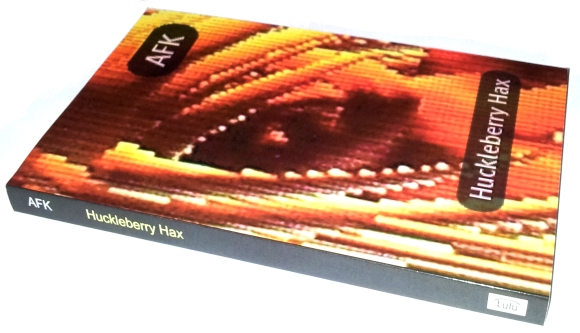
Whilst I continue working on editing its sequel, a short post about AFK's downloads. I discovered today that the downloads recorded at Smashwords in the 'Dashboard' area is only the number of downloads from Smashwords directly and the downloads from other book websites which receive content from Smashwords (via the 'Premium catalogue') is recorded elsewhere. A few clicks later (actually, that's a lie: it took me ages to navigate the system) and I found that the title was downloaded last year from Barnes & Noble an astonishing 1,470 times last year, making the total number of AFK downloads so far at just over 4,000 (the rest being 1,752 from Amazon last year and 821 from Smashwords). Wow. If you're published at Smashwords and haven't taken the time to make the numerous tiny edits required to gain entry into the Premium Catalogue, it would appear to be well worth the effort.


January 30, 2013
AFK sequel still on its way
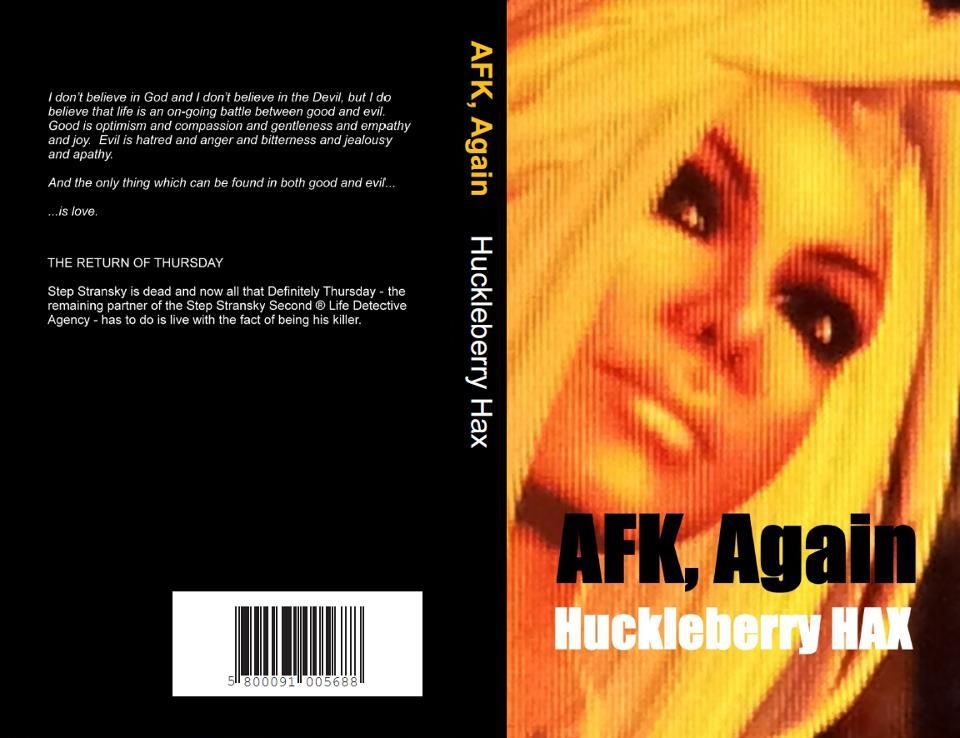
Whenever I write a new book, I always read it straight through on the computer once I've finished it, editing and correcting as I go. Then I get it formatted and a proof copy printed, which I read through again with a pencil to correct any mistakes I find. That's where I'm at right now with 'AFK, Again'. It should be ready for release in another two to three weeks.
In the meantime, here's the cover :)
January 19, 2013
Like it. Your New Year's Resolution.
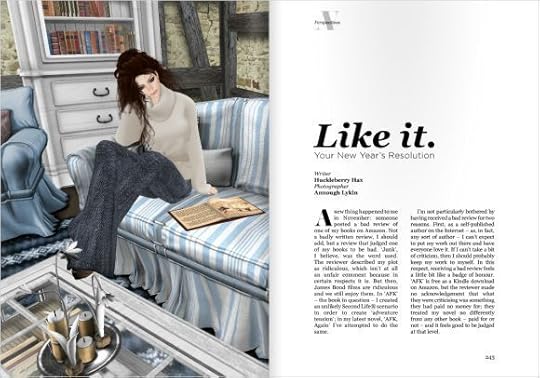
Here's my January column for AVENUE magazine. Photography this month is by Annough Lykin.
A new thing happened to me in November: someone posted a bad review of one of my books on Amazon. Not a badly written review, I should add, but a review that judged one of my books to be bad. ‘Junk’, I believe, was the word used. The reviewer described my plot as ridiculous, which isn’t at all an unfair comment because in certain respects it is. But then, James Bond films are ridiculous and we still enjoy them. In ‘AFK’ – the book in question – I created an unlikely Second Life® scenario in order to create ‘adventure tension’; in my latest novel, ‘AFK, Again’ I’ve attempted to do the same.
I’m not particularly bothered by having received a bad review for two reasons. First, as a self-published author on the Internet – as, in fact, any sort of author – I can’t expect to put my work out there and have everyone love it. If I can’t take a bit of criticism, then I should probably keep my work to myself. In this respect, receiving a bad review feels a little bit like a badge of honour. ‘AFK’ is free as a Kindle download on Amazon, but the reviewer made no acknowledgement that what they were criticising was something they had paid no money for; they treated my novel no differently from any other book – paid for or not – and it feels good to be judged at that level.
Second – perhaps more importantly – this is the first and only (so far) piece of negative feedback I’ve ever had on ‘AFK’ in the five years of its publication. Every single other comment I’ve received has ranged from mildly positive to glowing. Fifteen people have left positive comments on my web site, three have done so on Amazon.com, four on Smashwords and I’ve received five positive reviews/ratings on Goodreads. In addition to this, the novel’s been positively reviewed by four other bloggers in their own blogs, including New World Notes. So that’s one bad review out of 32 published. Less than 5% – or, to express that another way – over a 95% approval rating. In addition to this, I must have received easily at least 20-30 IMs in SL from other readers about the book over the years, all positive.
Enough people appear to like my book, then, that I can continue for now to believe it a worthwhile employment of the written word. There’s just one problem. Although Iknow that over 95% of the people who’ve read ‘AFK’ and left a review of some description have liked it, that fact isn’t going to be apparent to a visitor to Amazon.com, where now only three out of four – 75% – of the reviews are positive. That single bad review has dropped my approval by a whole 25% because, although ‘AFK’ has been downloaded over 1,600 times from Amazon.com over the last year, only four people so far have left a review. That’s just a quarter of 1% of all downloaders. The situation’s not much better on Smashwords, where four reviews have been left after 800 downloads: a half of 1%.
When you’re an independent artist of any description – in other words, someone without a large advertising budget or a big name to guarantee you shop window space or above the fold positioning on popular websites – reviews, ratings and likes are probably the most important thing there is so far as the long-term credibility of your work is concerned. We all hope for the video or picture or excerpt of our work that will go viral and become next week’s Big Thing across the planet – this being the most publicised way that completely unknown people receive world-wide exposure – but the reality is that most such incidents occur with complete randomness; in any case, if your viral attempt doesn’t include a cat in some manner, then you can pretty much forget it (which reminds me, I really must dig out some of those old photos of the tortoiseshell I had when I was growing up and think up a witty, anthropomorphising caption to add as she looks into the camera). For the vast majority of us, then, the route to establishing ourselves in the new world market of digital products is in getting our work reviewed and appreciated.
The political point of anything ‘indie’ is that it represents choice that isn’t available via the mainstream. There’s nothing inherently wrong with mainstream products, but it’s important to remember that these items – purchased in their millions – are selected for you by a very small and – arguably – non-representative group of people. This small group of people effectively get to decide on what you will see and hear and read. Indie offers you an alternative.
Just as there’s nothing inherently bad about mainstream products, however, there’s nothing inherently good about independently produced ones. A self-published book could be brilliant, mediocre or – as my own unsatisfied reviewer declared – junk. The indie scene could be likened to a lucky dip in terms of quality – a vast, enormous, endless lucky dip as more and more people plunge into unregulated self-publishing of one sort or another – if it wasn’t for the fact that the same medium which enables individuals to make their work available also enables other people to give an indication as to whether it’s any good or not. The Internet is the medium which has liberated independent artists in terms of making their work accessible to an international audience; user feedback is the mediating mechanism which actually makes such a thing practical. But we have to use it for that to work.
These days, the line between mainstream and independent products is becoming increasingly blurred. When it comes to writing, self-publishing is still regarded by many with disdain, even though the written word was the very first unit of creation to be liberated by the Internet. Few people experience similar reservations when it comes to downloading Apps for their smartphones, however, many of which are the products of small companies or individuals developing from their bedrooms. We don’t really care about the way in which an app was produced so long as we enjoy the end result and the ratings system is there to guide us in our purchase. But what we mustn’t forget is that the very variety that’s pushed as a selling point of smart phones – as immortalised by the slogan, “There’s an App for that” – exists precisely because this market makes no distinction between products developed by large companies and those by bedroom programmers. Right from the start, the two have been treated exactly the same and as a matter of necessity: just think how slowly the smartphone market would have developed if only large companies were able to bring software to it.
Second Life, of course, is utterly dependent on independently produced products; there is no ‘non-indie’ industry to speak of in the metaverse – everything we wear and use and live in has been designed by a resident. Even the large clothing labels are usually just a single designer and a small collection of staff. One of the reasons that I refuse to fall out of love with SL is its implementation of a modern-day digital cottage industry, one which I see as a model for a much wider industry across the entire Internet. When the web first achieved mass take-up in the late nineties, people used to talk about the liberation it offered artists of all descriptions from the big industries of recording and publishing. Unsigned musicians could get their work out to a larger audience. Artists could get create virtual galleries. And writers could find a following for their work. There was an unspoken understanding that the huge riches awarded to the fortunate few that made it through the funnel under the old system were unlikely to be found by an enlarged group of active creators, but an honest living was never considered out of the question.
If only it were the case that consumers since then had started exploring the work of its lesser-known artists on a scale that changed the relationship society has with its culture; sadly, the main effect so far has just been to threaten the existence of big media through the illegal downloading of the very music and films they were pushing on us in the first place. Our imagination, so far, has failed us. But this isn’t an opportunity that’s about to expire on us and, in fairness, it takes a long time for old habits to be broken. Just like they said that the Internet would kill TV and it hasn’t, we still seek – despite all the technological advances – to encounter our culture through ‘trusted sources’. If we – the consumers – would really like to see this ultimately change, there are steps we can take right now about it.
One of those steps is to buy indie products from time to time. Often, they’re more cheap than their mainstream equivalents. Sometimes – like ‘AFK’ – they’re free. So it’s hardly a great financial risk.
But – and I cannot stress this highly enough – after you’ve read or listened to or viewed it and if you liked the thing that you obtained, leave a rating. On Amazon.com, you only have to leave a 20 word comment in addition to your stars and, if that’s really asking too much, you can just click on the ‘like’ button for that book instead. If you want independent producers to grow, do this to support them.
If you’re a person who’s bought or downloaded things and not left feedback and are feeling now that my whining is nothing more than a guilt trip, I’ll come clean on something: I am just like you. I don’t think I’ve ever left feedback on anything I’ve ever bought from the SL Marketplace. The truth is, it took a negative comment on my book to make me realise my own lack of support for others. I will be doing something about this in 2013: my new year’s resolution is to leave feedback on things I enjoy as often as I can, even if it’s just a twenty word statement; even if it’s just to click a ‘like’ button.
I encourage you to join me.
A new thing happened to me in November: someone posted a bad review of one of my books on Amazon. Not a badly written review, I should add, but a review that judged one of my books to be bad. ‘Junk’, I believe, was the word used. The reviewer described my plot as ridiculous, which isn’t at all an unfair comment because in certain respects it is. But then, James Bond films are ridiculous and we still enjoy them. In ‘AFK’ – the book in question – I created an unlikely Second Life® scenario in order to create ‘adventure tension’; in my latest novel, ‘AFK, Again’ I’ve attempted to do the same.
I’m not particularly bothered by having received a bad review for two reasons. First, as a self-published author on the Internet – as, in fact, any sort of author – I can’t expect to put my work out there and have everyone love it. If I can’t take a bit of criticism, then I should probably keep my work to myself. In this respect, receiving a bad review feels a little bit like a badge of honour. ‘AFK’ is free as a Kindle download on Amazon, but the reviewer made no acknowledgement that what they were criticising was something they had paid no money for; they treated my novel no differently from any other book – paid for or not – and it feels good to be judged at that level.
Second – perhaps more importantly – this is the first and only (so far) piece of negative feedback I’ve ever had on ‘AFK’ in the five years of its publication. Every single other comment I’ve received has ranged from mildly positive to glowing. Fifteen people have left positive comments on my web site, three have done so on Amazon.com, four on Smashwords and I’ve received five positive reviews/ratings on Goodreads. In addition to this, the novel’s been positively reviewed by four other bloggers in their own blogs, including New World Notes. So that’s one bad review out of 32 published. Less than 5% – or, to express that another way – over a 95% approval rating. In addition to this, I must have received easily at least 20-30 IMs in SL from other readers about the book over the years, all positive.
Enough people appear to like my book, then, that I can continue for now to believe it a worthwhile employment of the written word. There’s just one problem. Although Iknow that over 95% of the people who’ve read ‘AFK’ and left a review of some description have liked it, that fact isn’t going to be apparent to a visitor to Amazon.com, where now only three out of four – 75% – of the reviews are positive. That single bad review has dropped my approval by a whole 25% because, although ‘AFK’ has been downloaded over 1,600 times from Amazon.com over the last year, only four people so far have left a review. That’s just a quarter of 1% of all downloaders. The situation’s not much better on Smashwords, where four reviews have been left after 800 downloads: a half of 1%.
When you’re an independent artist of any description – in other words, someone without a large advertising budget or a big name to guarantee you shop window space or above the fold positioning on popular websites – reviews, ratings and likes are probably the most important thing there is so far as the long-term credibility of your work is concerned. We all hope for the video or picture or excerpt of our work that will go viral and become next week’s Big Thing across the planet – this being the most publicised way that completely unknown people receive world-wide exposure – but the reality is that most such incidents occur with complete randomness; in any case, if your viral attempt doesn’t include a cat in some manner, then you can pretty much forget it (which reminds me, I really must dig out some of those old photos of the tortoiseshell I had when I was growing up and think up a witty, anthropomorphising caption to add as she looks into the camera). For the vast majority of us, then, the route to establishing ourselves in the new world market of digital products is in getting our work reviewed and appreciated.
The political point of anything ‘indie’ is that it represents choice that isn’t available via the mainstream. There’s nothing inherently wrong with mainstream products, but it’s important to remember that these items – purchased in their millions – are selected for you by a very small and – arguably – non-representative group of people. This small group of people effectively get to decide on what you will see and hear and read. Indie offers you an alternative.
Just as there’s nothing inherently bad about mainstream products, however, there’s nothing inherently good about independently produced ones. A self-published book could be brilliant, mediocre or – as my own unsatisfied reviewer declared – junk. The indie scene could be likened to a lucky dip in terms of quality – a vast, enormous, endless lucky dip as more and more people plunge into unregulated self-publishing of one sort or another – if it wasn’t for the fact that the same medium which enables individuals to make their work available also enables other people to give an indication as to whether it’s any good or not. The Internet is the medium which has liberated independent artists in terms of making their work accessible to an international audience; user feedback is the mediating mechanism which actually makes such a thing practical. But we have to use it for that to work.
These days, the line between mainstream and independent products is becoming increasingly blurred. When it comes to writing, self-publishing is still regarded by many with disdain, even though the written word was the very first unit of creation to be liberated by the Internet. Few people experience similar reservations when it comes to downloading Apps for their smartphones, however, many of which are the products of small companies or individuals developing from their bedrooms. We don’t really care about the way in which an app was produced so long as we enjoy the end result and the ratings system is there to guide us in our purchase. But what we mustn’t forget is that the very variety that’s pushed as a selling point of smart phones – as immortalised by the slogan, “There’s an App for that” – exists precisely because this market makes no distinction between products developed by large companies and those by bedroom programmers. Right from the start, the two have been treated exactly the same and as a matter of necessity: just think how slowly the smartphone market would have developed if only large companies were able to bring software to it.
Second Life, of course, is utterly dependent on independently produced products; there is no ‘non-indie’ industry to speak of in the metaverse – everything we wear and use and live in has been designed by a resident. Even the large clothing labels are usually just a single designer and a small collection of staff. One of the reasons that I refuse to fall out of love with SL is its implementation of a modern-day digital cottage industry, one which I see as a model for a much wider industry across the entire Internet. When the web first achieved mass take-up in the late nineties, people used to talk about the liberation it offered artists of all descriptions from the big industries of recording and publishing. Unsigned musicians could get their work out to a larger audience. Artists could get create virtual galleries. And writers could find a following for their work. There was an unspoken understanding that the huge riches awarded to the fortunate few that made it through the funnel under the old system were unlikely to be found by an enlarged group of active creators, but an honest living was never considered out of the question.
If only it were the case that consumers since then had started exploring the work of its lesser-known artists on a scale that changed the relationship society has with its culture; sadly, the main effect so far has just been to threaten the existence of big media through the illegal downloading of the very music and films they were pushing on us in the first place. Our imagination, so far, has failed us. But this isn’t an opportunity that’s about to expire on us and, in fairness, it takes a long time for old habits to be broken. Just like they said that the Internet would kill TV and it hasn’t, we still seek – despite all the technological advances – to encounter our culture through ‘trusted sources’. If we – the consumers – would really like to see this ultimately change, there are steps we can take right now about it.
One of those steps is to buy indie products from time to time. Often, they’re more cheap than their mainstream equivalents. Sometimes – like ‘AFK’ – they’re free. So it’s hardly a great financial risk.
But – and I cannot stress this highly enough – after you’ve read or listened to or viewed it and if you liked the thing that you obtained, leave a rating. On Amazon.com, you only have to leave a 20 word comment in addition to your stars and, if that’s really asking too much, you can just click on the ‘like’ button for that book instead. If you want independent producers to grow, do this to support them.
If you’re a person who’s bought or downloaded things and not left feedback and are feeling now that my whining is nothing more than a guilt trip, I’ll come clean on something: I am just like you. I don’t think I’ve ever left feedback on anything I’ve ever bought from the SL Marketplace. The truth is, it took a negative comment on my book to make me realise my own lack of support for others. I will be doing something about this in 2013: my new year’s resolution is to leave feedback on things I enjoy as often as I can, even if it’s just a twenty word statement; even if it’s just to click a ‘like’ button.
I encourage you to join me.
December 10, 2012
The End Is Nigh
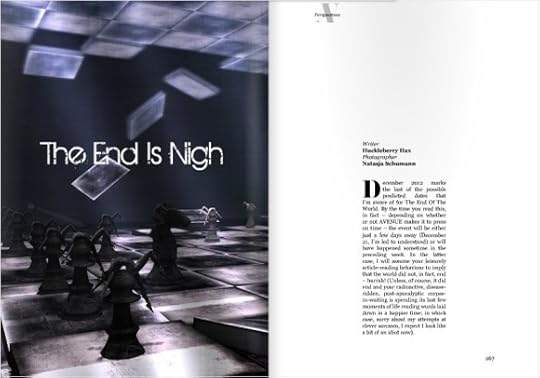
Here's my December column for AVENUE magazine. Photography this month is by Natasja Schumann.
December 2012 marks the last of the possible predicted dates that I’m aware of for The End Of The World. By the time you read this, in fact – depending on whether or not AVENUE makes it to press on time – the event will be either just a few days away (December 21, I’m led to understand) or happened sometime last week. In the latter case, I will assume your leisurely article reading behaviour to imply that the world did not, in fact, end – hurrah! (Unless, of course, it did end and your radioactive, disease-ridden, post-apocalyptic corpse-in-waiting is spending its last few moments of life reading words laid down in a happier time; in which case, sorry about my attempts at clever sarcasm, I expect I look like a bit of an idiot now).
I can’t recall if this date is meant to be the planetary alignment thing or the sudden appearance of Planet X or CERN creating a home-made black hole. Whichever of these it is, I’m hoping that – should the worst turn out to be true – we Brits will have enough moments remaining with which to crack a few dry jokes about the irony of it all. Something linking Armageddon to our Olympic success and/or lifted spirits in 2012. That’ll teach us to be at peace with our post-colonial identity! Better still would be if the Definite End came with at least a week’s notice – enough time for the topic to make its way into the current affairs comedy panels and satire broadcasts on the telly. Of course, just as landing is a more positively experienced event to those of us with a fear of flying, the upside of a belief that the world is about to end must be the nice surprise you get if it doesn’t. Whilst I do understand that one might look a bit of a Charlie under such circumstances – particularly if you spent your time nagging friends and relatives about their post-apocalyptic preparations (anyone who, accordingly, labelled themselves a ‘PAP Buddy’ may hang their head in shame that little bit longer) – it strikes me that this is the kind of thing it’s generally pretty nice to be wrong about, not to mention it’s unlikely anyone will hold it against you. Or will they? What if you persuaded your friend to sell his house to raise funds for your enlightened leafleting campaign or to just to have that final, month-long orgy of sex, drugs and alcohol. (Personally, if I knew with a certainly that the world was about to end, there’s a £250,000 working replica of the 1960s Batmobile with my name on it that I’d be asking my mother to remortage her house for; might as well have a bit of fun whilst there’s still time left to have it in.) What then, when the dust settles – or rather, doesn’t – and the inconsiderately still existing bank requires its debt to be paid? What about the people you convinced to sever their life-long emotional attachment to, well, life, who threw themselves off a picturesque cliff rather than wait to be witness to the planet being crunched down into something smaller than a pea by the black hole those smug scientists so laughingly assured us “would never happen”? In fairness, with The End Of The World just a handful of weeks away at the time of writing, I’m not currently aware of any mass preparatory suicides or partying like-it’s-1999 going on, so it seems reasonable to assume that the majority of people have decided their investment in life to be sufficiently big that they’ll hang around come the end of December to see what happens rather than do anything rash right now. Which is good. And no, by the way: the metaphor I’m constructing here is not about global warming being a myth we’ll all look back on in years to come with egg well and truly dripping from our faces; if that should all turn out to be a red herring, we’ll still be better off for all the improvements in renewable energies because coal and oil are finite and will run out one day. The metaphor I’m constructing is, of course, about Second Life®. A lot has been said over the last twelve months about its imminent demise; we’ve all been told to pack what we can from our inventories and make like refugees to the new worlds of InWorldz and OpenSim. Private land is disappearing from SL faster than Mitt Romney can pack his binders full of women, we hear. Linden itself is raiding its own wine cellar and putting its assets into every last idea it can conceive of, blithely ignoring that long-established commercial principle that companies who refuse to diversify as their product ages are certain to achieve success and longevity. “The (virtual) End Is Nigh!” the blogosphere is crying, “Save yourselves!” And yet, on those occasions when I dip back into SL, it’s still there. It’s still working. My friends list shows many of my friends still online (sorry for not saying hi, by the way). And, meanwhile, it looks more stunning than I ever remember it looking when I was a regular user. Mesh, it seems, has really started to make an impact: not only do individual items look amazing, but their lower prim count (sorry to use such ancient terminology, but expecting an old-timer like me to adopt new units of measurement at this stage is a bit like me expecting my mother to start using metric) means they are plentiful and the virtual world looks more pleasantly packed with detail than it’s ever looked before. Meanwhile, I’ve been to InWorldz a few times too. It would be true to say that there are aspects of InWorldz that I find impressive; beyond the vague nostalgia it evokes for my early years in SL, however, its visual appeal is not one of them. As for OSGrid, I have to confess that I aborted my plans on creating an account there when the home page of its website informed me that in this, the future of the metaverse, there were currently less than a hundred users online. I do believe – as I wrote two months ago in this column – that the future of the metaverse is bigger than SL; OpenSim might well be part of this (I can’t deny that the idea of being able to create my own sim on my own computer is appealing). This isn’t at all my attempt to produce my own counter-argument. It’s just that I can’t quite avoid the feeling that there’s an awful lot of cutting off of noses to spite faces going on right now. SL is more gorgeous than it’s ever been – a place we would have drooled over just a couple of years ago – and yet our anger appears to be driving us away. We are denying ourselves enjoyment of a beautiful place and the experience of beautiful moments. All because we feel hard done by. And my End Of The World metaphor breaks down in a crucial place with respect to SL: enough people jumping over cliffs won’t actually bring about the end of the world in RL. But it will in SL. Apart from The End Of The World, December also plays host to that annual occasion of Christmas, a season which – as I wrote last year – I enjoy very much in its pixel implementation. I’ve not been a regular in SL for quite a while now, but, as the season approaches, I find myself looking forward to exploring it inworld once again. Christmas was the first season I experienced in SL and I recall very vividly its pre-mesh, pre-sculpty realisation. I can only imagine what the creative minds and talents of the SL community will do with it six years later in 2012. Just writing this paragraph is building my anticipation. The UK illusionist and hypnotist Derren Brown recently hosted a two-part TV programme in which he convinced a volunteer that the world had ended in order to get him to appreciate the life he already had. In the publicity for his show, Brown talked about the secret of happiness as desiring the things that you already have, a reference to the current studies in psychology that link emotional wellbeing to gratitude. I am grateful to SL, and I’m grateful that it’s still around and looking better than it’s ever looked before. I know it probably won’t last. I know there are issues with the way in which it’s been managed. But, ultimately, I’m more grateful that it exists than angry that it’s not better. If I had never before experienced it and got introduced to it for the first time on Christmas day, I would find it an overwhelmingly wonderful Christmas present. So I’m going to continue to enjoy Second Life whilst I can. To those of you who secretly wish that it would die so that your declarations of its demise can be retrospectively ratified: be careful what you wish for; you might just get it. Have a good End Of The World if it happens. And have a peaceful Christmas if it doesn’t.
December 2012 marks the last of the possible predicted dates that I’m aware of for The End Of The World. By the time you read this, in fact – depending on whether or not AVENUE makes it to press on time – the event will be either just a few days away (December 21, I’m led to understand) or happened sometime last week. In the latter case, I will assume your leisurely article reading behaviour to imply that the world did not, in fact, end – hurrah! (Unless, of course, it did end and your radioactive, disease-ridden, post-apocalyptic corpse-in-waiting is spending its last few moments of life reading words laid down in a happier time; in which case, sorry about my attempts at clever sarcasm, I expect I look like a bit of an idiot now).
I can’t recall if this date is meant to be the planetary alignment thing or the sudden appearance of Planet X or CERN creating a home-made black hole. Whichever of these it is, I’m hoping that – should the worst turn out to be true – we Brits will have enough moments remaining with which to crack a few dry jokes about the irony of it all. Something linking Armageddon to our Olympic success and/or lifted spirits in 2012. That’ll teach us to be at peace with our post-colonial identity! Better still would be if the Definite End came with at least a week’s notice – enough time for the topic to make its way into the current affairs comedy panels and satire broadcasts on the telly. Of course, just as landing is a more positively experienced event to those of us with a fear of flying, the upside of a belief that the world is about to end must be the nice surprise you get if it doesn’t. Whilst I do understand that one might look a bit of a Charlie under such circumstances – particularly if you spent your time nagging friends and relatives about their post-apocalyptic preparations (anyone who, accordingly, labelled themselves a ‘PAP Buddy’ may hang their head in shame that little bit longer) – it strikes me that this is the kind of thing it’s generally pretty nice to be wrong about, not to mention it’s unlikely anyone will hold it against you. Or will they? What if you persuaded your friend to sell his house to raise funds for your enlightened leafleting campaign or to just to have that final, month-long orgy of sex, drugs and alcohol. (Personally, if I knew with a certainly that the world was about to end, there’s a £250,000 working replica of the 1960s Batmobile with my name on it that I’d be asking my mother to remortage her house for; might as well have a bit of fun whilst there’s still time left to have it in.) What then, when the dust settles – or rather, doesn’t – and the inconsiderately still existing bank requires its debt to be paid? What about the people you convinced to sever their life-long emotional attachment to, well, life, who threw themselves off a picturesque cliff rather than wait to be witness to the planet being crunched down into something smaller than a pea by the black hole those smug scientists so laughingly assured us “would never happen”? In fairness, with The End Of The World just a handful of weeks away at the time of writing, I’m not currently aware of any mass preparatory suicides or partying like-it’s-1999 going on, so it seems reasonable to assume that the majority of people have decided their investment in life to be sufficiently big that they’ll hang around come the end of December to see what happens rather than do anything rash right now. Which is good. And no, by the way: the metaphor I’m constructing here is not about global warming being a myth we’ll all look back on in years to come with egg well and truly dripping from our faces; if that should all turn out to be a red herring, we’ll still be better off for all the improvements in renewable energies because coal and oil are finite and will run out one day. The metaphor I’m constructing is, of course, about Second Life®. A lot has been said over the last twelve months about its imminent demise; we’ve all been told to pack what we can from our inventories and make like refugees to the new worlds of InWorldz and OpenSim. Private land is disappearing from SL faster than Mitt Romney can pack his binders full of women, we hear. Linden itself is raiding its own wine cellar and putting its assets into every last idea it can conceive of, blithely ignoring that long-established commercial principle that companies who refuse to diversify as their product ages are certain to achieve success and longevity. “The (virtual) End Is Nigh!” the blogosphere is crying, “Save yourselves!” And yet, on those occasions when I dip back into SL, it’s still there. It’s still working. My friends list shows many of my friends still online (sorry for not saying hi, by the way). And, meanwhile, it looks more stunning than I ever remember it looking when I was a regular user. Mesh, it seems, has really started to make an impact: not only do individual items look amazing, but their lower prim count (sorry to use such ancient terminology, but expecting an old-timer like me to adopt new units of measurement at this stage is a bit like me expecting my mother to start using metric) means they are plentiful and the virtual world looks more pleasantly packed with detail than it’s ever looked before. Meanwhile, I’ve been to InWorldz a few times too. It would be true to say that there are aspects of InWorldz that I find impressive; beyond the vague nostalgia it evokes for my early years in SL, however, its visual appeal is not one of them. As for OSGrid, I have to confess that I aborted my plans on creating an account there when the home page of its website informed me that in this, the future of the metaverse, there were currently less than a hundred users online. I do believe – as I wrote two months ago in this column – that the future of the metaverse is bigger than SL; OpenSim might well be part of this (I can’t deny that the idea of being able to create my own sim on my own computer is appealing). This isn’t at all my attempt to produce my own counter-argument. It’s just that I can’t quite avoid the feeling that there’s an awful lot of cutting off of noses to spite faces going on right now. SL is more gorgeous than it’s ever been – a place we would have drooled over just a couple of years ago – and yet our anger appears to be driving us away. We are denying ourselves enjoyment of a beautiful place and the experience of beautiful moments. All because we feel hard done by. And my End Of The World metaphor breaks down in a crucial place with respect to SL: enough people jumping over cliffs won’t actually bring about the end of the world in RL. But it will in SL. Apart from The End Of The World, December also plays host to that annual occasion of Christmas, a season which – as I wrote last year – I enjoy very much in its pixel implementation. I’ve not been a regular in SL for quite a while now, but, as the season approaches, I find myself looking forward to exploring it inworld once again. Christmas was the first season I experienced in SL and I recall very vividly its pre-mesh, pre-sculpty realisation. I can only imagine what the creative minds and talents of the SL community will do with it six years later in 2012. Just writing this paragraph is building my anticipation. The UK illusionist and hypnotist Derren Brown recently hosted a two-part TV programme in which he convinced a volunteer that the world had ended in order to get him to appreciate the life he already had. In the publicity for his show, Brown talked about the secret of happiness as desiring the things that you already have, a reference to the current studies in psychology that link emotional wellbeing to gratitude. I am grateful to SL, and I’m grateful that it’s still around and looking better than it’s ever looked before. I know it probably won’t last. I know there are issues with the way in which it’s been managed. But, ultimately, I’m more grateful that it exists than angry that it’s not better. If I had never before experienced it and got introduced to it for the first time on Christmas day, I would find it an overwhelmingly wonderful Christmas present. So I’m going to continue to enjoy Second Life whilst I can. To those of you who secretly wish that it would die so that your declarations of its demise can be retrospectively ratified: be careful what you wish for; you might just get it. Have a good End Of The World if it happens. And have a peaceful Christmas if it doesn’t.
December 2, 2012
Advent calendar
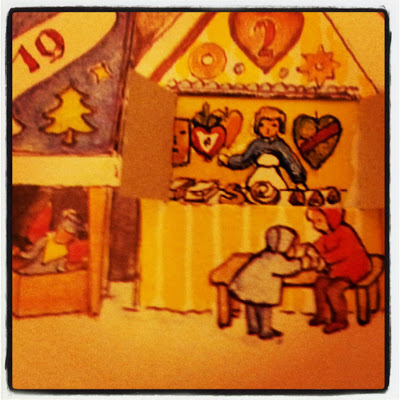
Just wanted to share a detail from the advent calendar my mother bought me this year. It's German and shows a winter village scene. The calendar doors are the doors and windows to the houses and market stalls; when you open one, you get to see what's going on behind them. I had one very similar as a boy and it's the only advent calendar from my youth that I remember. It's so much more imaginative than the open-a-door-in-Santa's-beard-and-get-a-picture-of-a-spring-of-holly type we have in the UK (and don't get me started on the dullness of chocolate advent calendars).
And yes, my mother still buys me advent calendars. Your point is...?

November 30, 2012
NaNoWriMo 2012 update
The bad news: 'AFK, Again' will not be completed by midnight tonight unless I miraculously complete 10,000 words in just under 45 minutes.
The good news: I've written 40,000 words so far and intend to continue writing until the project is finished. The thing is with NaNo, you have to suspend disbelief in your novel otherwise the doubts will start creeping in. So it's full steam ahead and I'm hoping that by this time next week the firsr draft of my AFK sequel will be done.
The good news: I've written 40,000 words so far and intend to continue writing until the project is finished. The thing is with NaNo, you have to suspend disbelief in your novel otherwise the doubts will start creeping in. So it's full steam ahead and I'm hoping that by this time next week the firsr draft of my AFK sequel will be done.
November 16, 2012
Some novel ideas
Whilst I wrestle with my 2012 NaNo (currently at 19,000 words; only 6,000 behind...), here's my November AVENUE column. This month's incredible photographs are again by the wonderful Eve Kazan.
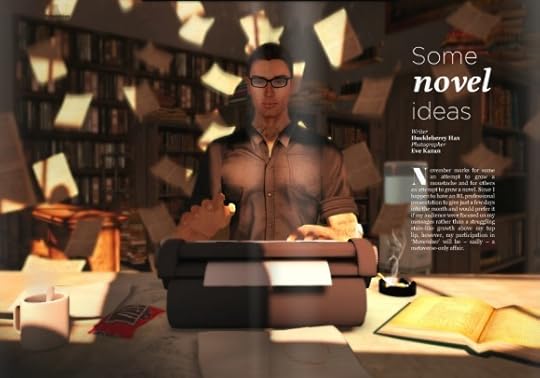
November marks for some an attempt to grow a moustache and for others an attempt to grow a novel. Since I happen to have an RL professional presentation to give just a few days into the month and would prefer it if my audience were focused on my messages rather than a struggling stain-like growth above my top lip, however, my participation in ‘Movember’ will be – sadly – a metaverse only affair.
I will though, once more, be taking part in National Novel Writing Month, creating my fifth novel set in Second Life®. The thing with NaNoWriMo novels is they tend to take on a life of their own, so any plot I have right now (at the time of writing) will probably have long ago been abandoned by the time you read this. That said, I do nonetheless have a storyline of sorts laid out. No spoilers here, I’m afraid, but if I complete it (which I’ve managed to do four out of five times so far), you’ll be able – as always – to download the end result for free from my website (see the plug at the end of this article).
Of course, far more ideas get shelved than completed in the finishing of any novel. In an AVENUE exclusive, therefore, I present to you some of the SL storylines that didn’t end up making it into fully fledged works of metaverse fiction. Naturally, my lawyers will be onto you should any attempt be made to develop any of these without the appropriate licensing agreements. In fact, inspired by Apple, I’ve recently taken out a patent on ‘the story’: “an arrangement of words depicting a happening, said arrangement consisting of a beginning part, a middle part and an end part”. This should cover most works of fiction, but probably the works of Paul Auster will elude me.

Fifty Prims of Grey.Wealthy mesh hair designer Clive meets young student Amy at a shoe fair and seduces her into an SL BDSM lifestyle. A trilogy, with cliffhangers for the first two novels provided by (1) a fatal crosspost during lovemaking (Clive accidentally responds to an alpha layer query from a pubic hair customer in Amy’s window) and (2) the discovery by Amy of Clive’s female alt, a journalist well known for her outspoken views on words like ‘throbbing’ during cybersex (here’s the thing: Clive says ‘throbbing’ all the time). In the very last chapter, we learn that Amy is in fact an eighty year old Muscovite.
The Stuff. Timid Thomason Targwen is in love with the curvaceous Caroline, but his non-Dom ways just aren’t a hook for this submissive doctor of neurobiology. Determined to win her over, Thomason creates a muscular alter-ego called ‘The Stuff’ (he likes the idea that people will announce his arrival with phrases such as, “Here comes The Stuff” and “The Stuff is coming,” and hopes he can introduce “Thank God for The Stuff’ into the English language as an urban catchphrase he can retrospectively claim credit for). A combination of bold – some would say crude – attachments and a personal polar shift in the use of four letter words wins this mask a dedicated following amongst the bored pseudo-intellectuals of the Post-Modern Prim Manipulation (PMPM) community. Alas, Caroline is not one of them. When she outs herself as Switch during his last-ditch attempt at propositioning her, Thomason comes suddenly to the realisation that there is such a thing as a sub(Dom), a person who claims themselves to be submissive, but who secretly desires control over a dominant. In a tense final chapter, the avatar and his alt confront each other at the fourth annual PMPM awards ceremony (just after the first prize in the Two Prim Category has been announced as ‘Pine Cube Next To A Pine Cube’). A tremendous battle takes place, with Thomason emerging as the surprise victor (even he didn’t see it coming). Caroline falls instantly in love and the two take off together as fugitives from the PMPM community. In the epilogue, however, a brief glimpse of a shady observer of the two (whilst they consummate their passion in the novel’s only sex scene) leaves everything unresolved: is Thomason who we think he is and his account has just been hacked, or has something far more sinister been going on? For the observer is revealed in the last three lines as none other than The Stuff. Readers will be kept guessing through the sequel – More of The Stuff – and a disappointing resolution will be reached in book three – Knowing The Stuff – paving the way for a reboot of the franchise five years later, in which Thomason is redrawn as a much younger man with a talent for Italian cooking.

The Affairs of Barnaby Bedsheet. Embittered by his RL love life, Barnaby embarks on a mission to bed as many SL residents as possible, only to discover that all twenty of them are in fact the alts of the same RL person. In an ironic twist, Barnaby then finds out his SL account has been hacked and that nineteen other people are intermittently logging on as his avatar. Alternate title: Being Barnaby Bedsheet.
Mission Unprimable. A crack team of five Second Life residents are hired by a mysterious organisation to penetrate an OpenSim (aka ‘The Other Side’) region and steal a top secret script codenamed ‘The Cat’s Claw’ (the function of ‘The Cat’s Claw’ is never revealed). On entering the enemy grid, the team must fool target avatars into thinking they’re in their familiar daily haunt (a lap dance bar with a perfectly textured sculptie water fountain, a detail that the expert builder on the team is unable to perfectly duplicate – he has a big tantrum at one point where he complains about having to go back to working with sculpties, likening this to building “by throwing lumps of wet mud at each other” – leading to a moment of tension when the chief bad guy goes for a walk around the fountain whilst he soliloquises about what the metaverse will look like under his new order). Just when it looks like the mission has gone without a hitch, the team are betrayed by none other than the guy who hired them in the first place (it turns out he’s one of those bloggers who’s been predicting the doom of SL for years and got fed up with all the waiting). All seems lost until the last few pages, when a confusing exchange establishes that the chief good guy suspected the double cross from the start and in fact defeated him three chapters ago.
For Your Prims Only. Similar plot to Mission Unprimable, but with more girls. And tuxedos. And Vodka Dry Martini.
Carry On Emoting.An eccentric scientist invents an SL/RL sex interface in this comedy romp. No sooner is the prototype constructed, however, than it’s stolen by a pair of bungling burglars, hired (at arm’s length) by corporate sex company boss, Oursyerf Ather. Ather figures this device will make him millions, but hasn’t counted on the incompetence of George and Sid, who attempt to duplicate the invention themselves using cardboard and gaffa tape (inspired by the movie Apollo 13) and a USB memory stick. Testing their copy on the objects of their SL desire – in the hope that this technology will distract these beauties from their constant demands for better emoting (George: She told me I had to grow my ‘vocabulary’, Sid. Sid: Wimin! They’re never satisfied! George: What’s a ‘vocabularly’, Sid? Sid: It’s words, innit! George: Do you think she wants me to use a larger font?) – the two buffons are dismayed to find their attempt at the tech does nothing to improve their chances. A discussion with local adolescent ‘Tommy the Techie’, however, provides the suggestion that their device requires a driver. George and Sid resolve, therefore, to kidnap a chauffeur… Further tenuously related comedy capers added to pad this thing out to full novel length include the boys’ attempt to test the device for themselves by logging in as their girlfriends (naturally, it hasn’t occurred to them to create their own female alts and this requires a convoluted sequence of subterfuge in order to obtain the passwords) and the original inventor’s mission in the final chapter to reclaim his device/avenge its theft through the remote activation of ‘Super Climax Mode’. Hilarious.
Second Second Life.A resident creates a fully functional computer in SL which becomes a Marketplace hit. Computers around the grid are linked up and a metaverse is created on them. A scene featuring a truck falling backwards in slow motion off a bridge will be the central theme of the latter half of this overlength novel.

November marks for some an attempt to grow a moustache and for others an attempt to grow a novel. Since I happen to have an RL professional presentation to give just a few days into the month and would prefer it if my audience were focused on my messages rather than a struggling stain-like growth above my top lip, however, my participation in ‘Movember’ will be – sadly – a metaverse only affair.
I will though, once more, be taking part in National Novel Writing Month, creating my fifth novel set in Second Life®. The thing with NaNoWriMo novels is they tend to take on a life of their own, so any plot I have right now (at the time of writing) will probably have long ago been abandoned by the time you read this. That said, I do nonetheless have a storyline of sorts laid out. No spoilers here, I’m afraid, but if I complete it (which I’ve managed to do four out of five times so far), you’ll be able – as always – to download the end result for free from my website (see the plug at the end of this article).
Of course, far more ideas get shelved than completed in the finishing of any novel. In an AVENUE exclusive, therefore, I present to you some of the SL storylines that didn’t end up making it into fully fledged works of metaverse fiction. Naturally, my lawyers will be onto you should any attempt be made to develop any of these without the appropriate licensing agreements. In fact, inspired by Apple, I’ve recently taken out a patent on ‘the story’: “an arrangement of words depicting a happening, said arrangement consisting of a beginning part, a middle part and an end part”. This should cover most works of fiction, but probably the works of Paul Auster will elude me.
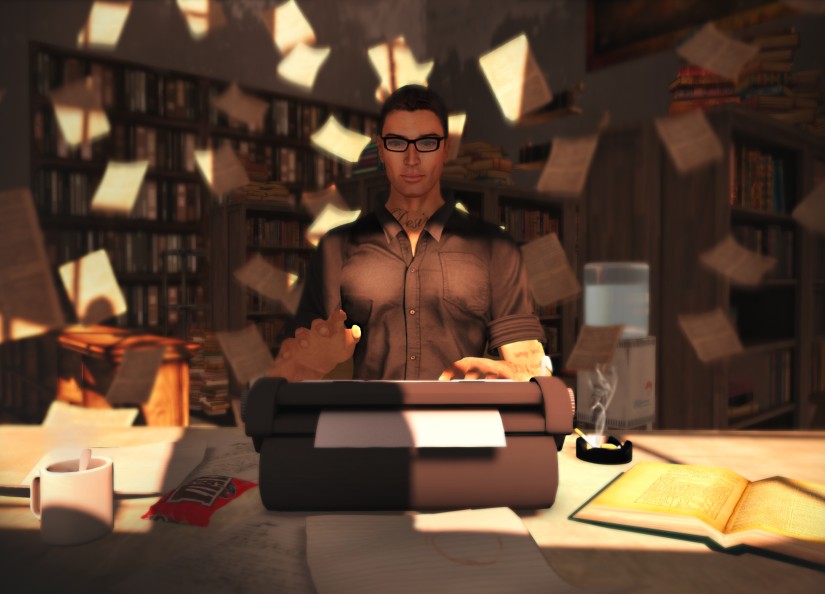
Fifty Prims of Grey.Wealthy mesh hair designer Clive meets young student Amy at a shoe fair and seduces her into an SL BDSM lifestyle. A trilogy, with cliffhangers for the first two novels provided by (1) a fatal crosspost during lovemaking (Clive accidentally responds to an alpha layer query from a pubic hair customer in Amy’s window) and (2) the discovery by Amy of Clive’s female alt, a journalist well known for her outspoken views on words like ‘throbbing’ during cybersex (here’s the thing: Clive says ‘throbbing’ all the time). In the very last chapter, we learn that Amy is in fact an eighty year old Muscovite.
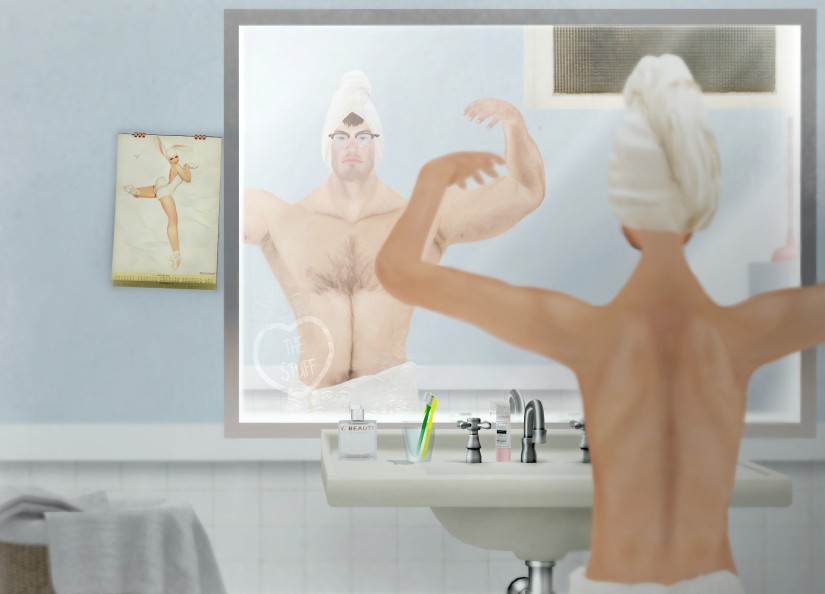
The Stuff. Timid Thomason Targwen is in love with the curvaceous Caroline, but his non-Dom ways just aren’t a hook for this submissive doctor of neurobiology. Determined to win her over, Thomason creates a muscular alter-ego called ‘The Stuff’ (he likes the idea that people will announce his arrival with phrases such as, “Here comes The Stuff” and “The Stuff is coming,” and hopes he can introduce “Thank God for The Stuff’ into the English language as an urban catchphrase he can retrospectively claim credit for). A combination of bold – some would say crude – attachments and a personal polar shift in the use of four letter words wins this mask a dedicated following amongst the bored pseudo-intellectuals of the Post-Modern Prim Manipulation (PMPM) community. Alas, Caroline is not one of them. When she outs herself as Switch during his last-ditch attempt at propositioning her, Thomason comes suddenly to the realisation that there is such a thing as a sub(Dom), a person who claims themselves to be submissive, but who secretly desires control over a dominant. In a tense final chapter, the avatar and his alt confront each other at the fourth annual PMPM awards ceremony (just after the first prize in the Two Prim Category has been announced as ‘Pine Cube Next To A Pine Cube’). A tremendous battle takes place, with Thomason emerging as the surprise victor (even he didn’t see it coming). Caroline falls instantly in love and the two take off together as fugitives from the PMPM community. In the epilogue, however, a brief glimpse of a shady observer of the two (whilst they consummate their passion in the novel’s only sex scene) leaves everything unresolved: is Thomason who we think he is and his account has just been hacked, or has something far more sinister been going on? For the observer is revealed in the last three lines as none other than The Stuff. Readers will be kept guessing through the sequel – More of The Stuff – and a disappointing resolution will be reached in book three – Knowing The Stuff – paving the way for a reboot of the franchise five years later, in which Thomason is redrawn as a much younger man with a talent for Italian cooking.
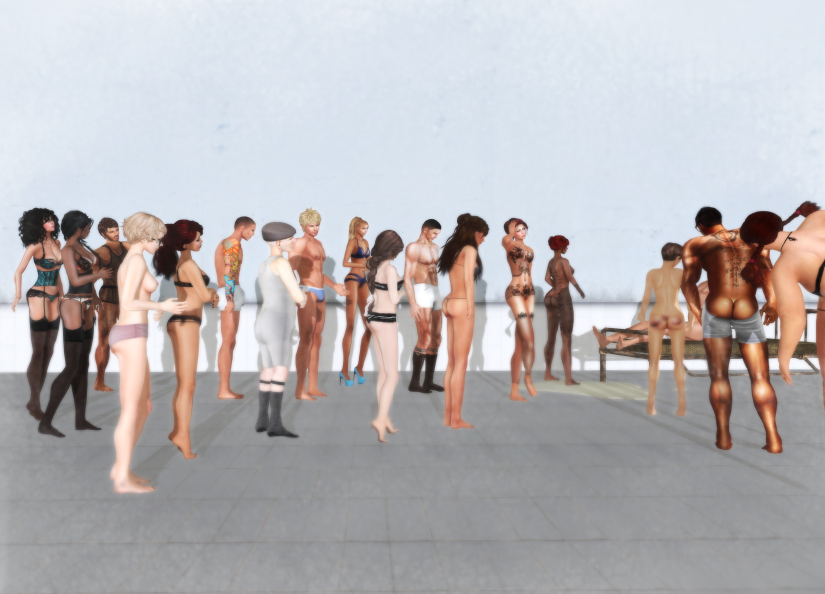
The Affairs of Barnaby Bedsheet. Embittered by his RL love life, Barnaby embarks on a mission to bed as many SL residents as possible, only to discover that all twenty of them are in fact the alts of the same RL person. In an ironic twist, Barnaby then finds out his SL account has been hacked and that nineteen other people are intermittently logging on as his avatar. Alternate title: Being Barnaby Bedsheet.
Mission Unprimable. A crack team of five Second Life residents are hired by a mysterious organisation to penetrate an OpenSim (aka ‘The Other Side’) region and steal a top secret script codenamed ‘The Cat’s Claw’ (the function of ‘The Cat’s Claw’ is never revealed). On entering the enemy grid, the team must fool target avatars into thinking they’re in their familiar daily haunt (a lap dance bar with a perfectly textured sculptie water fountain, a detail that the expert builder on the team is unable to perfectly duplicate – he has a big tantrum at one point where he complains about having to go back to working with sculpties, likening this to building “by throwing lumps of wet mud at each other” – leading to a moment of tension when the chief bad guy goes for a walk around the fountain whilst he soliloquises about what the metaverse will look like under his new order). Just when it looks like the mission has gone without a hitch, the team are betrayed by none other than the guy who hired them in the first place (it turns out he’s one of those bloggers who’s been predicting the doom of SL for years and got fed up with all the waiting). All seems lost until the last few pages, when a confusing exchange establishes that the chief good guy suspected the double cross from the start and in fact defeated him three chapters ago.
For Your Prims Only. Similar plot to Mission Unprimable, but with more girls. And tuxedos. And Vodka Dry Martini.
Carry On Emoting.An eccentric scientist invents an SL/RL sex interface in this comedy romp. No sooner is the prototype constructed, however, than it’s stolen by a pair of bungling burglars, hired (at arm’s length) by corporate sex company boss, Oursyerf Ather. Ather figures this device will make him millions, but hasn’t counted on the incompetence of George and Sid, who attempt to duplicate the invention themselves using cardboard and gaffa tape (inspired by the movie Apollo 13) and a USB memory stick. Testing their copy on the objects of their SL desire – in the hope that this technology will distract these beauties from their constant demands for better emoting (George: She told me I had to grow my ‘vocabulary’, Sid. Sid: Wimin! They’re never satisfied! George: What’s a ‘vocabularly’, Sid? Sid: It’s words, innit! George: Do you think she wants me to use a larger font?) – the two buffons are dismayed to find their attempt at the tech does nothing to improve their chances. A discussion with local adolescent ‘Tommy the Techie’, however, provides the suggestion that their device requires a driver. George and Sid resolve, therefore, to kidnap a chauffeur… Further tenuously related comedy capers added to pad this thing out to full novel length include the boys’ attempt to test the device for themselves by logging in as their girlfriends (naturally, it hasn’t occurred to them to create their own female alts and this requires a convoluted sequence of subterfuge in order to obtain the passwords) and the original inventor’s mission in the final chapter to reclaim his device/avenge its theft through the remote activation of ‘Super Climax Mode’. Hilarious.
Second Second Life.A resident creates a fully functional computer in SL which becomes a Marketplace hit. Computers around the grid are linked up and a metaverse is created on them. A scene featuring a truck falling backwards in slow motion off a bridge will be the central theme of the latter half of this overlength novel.

November 11, 2012
What profile type are you? (NaNo 25%)
Due to a busy week in RL, I'm a little behind in my NaNoWriMo 2012 progress. Today, however, I hit the 25% mark and the week ahead is clear for some solid writing. Here's the exerpt that crossed 'AFK, Again' its quarter-way mark, an examination of some of the different categories of profile that can be found in SL. Which type are you?
There are different categories of Second Life profile. The Empty Profile (EP) is, as its name suggests, a largely unpopulated document, sometimes a single avatar snapshot in the main tab and a single group in the group list – but often not even that. It’s completely understandable for a newbie – who perhaps doesn’t even realise that such a thing as a profile exists – but, after a month or so, starts to look suspicious. An Empty Profile is often thought to be that of an alt that hasn’t been invested in.Empty Profiles complaints are often one of a number of rants to be found on the Aggressive Profile (AP): a collection of gripes and assertions usually also including the aforementioned ‘By saying so here I have a right to copy and paste your IMs wherever I fucking chose to’ declaration. Usually it gets worded along the lines of, ‘Don’t bother IMing me if there’s nothing in your profile; if you can’t be bothered to complete this then I can’t be bothered to find you interesting’ (but, in most cases, without the semi-colon and correct apostrophe usage). Other issues often raised in the Aggressive Profile include a refusal to interact with anyone who looks like a newb, the promise of unimaginable consequences if you – the reader – should dare to think of ‘messing’ with a particular friend (usually someone given the honorary title of ‘sister’ – or, more commonly, ‘sis’) – it’s comforting to know that, in the twenty-first century, the way people feel most secure about expressing platonic love for someone is to threaten violence against anyone who might upset them – and a dramatic statement of disinterest in ‘drama’.In direct response to this is the Anti-Aggressive Profile Profile (or the AAPP), a profile category which takes issue with the statements to be found in most APs. AAPP picks can include, for example, a defence of newb-looking avatars (‘Are you a person who believes that beauty is only skin deep? Then stop fucking hitting on noob avies and start looking below the surface’), a strongly worded retort to the ‘By saying so here I have a right to copy and paste your IMs wherever I fucking chose to’ declaration, and a challenge to the dislike of EPs which asserts that (a) belief in the possibility of reducing the complexity of a human being to a few lines in a profile tab only demonstrates the utter superficiality of the person complaining (sometimes, a cross-reference is made to the noob avatar defence here), and (b) at least empty profiles spare you from having to read through endless collections of inane quotations.Which brings me to the Somebody else’s Quotations Profile (SEQP), a profile type bookended with quotes read someplace (or copied from someone else’s profile), from which one is supposed to infer something meaningful about the avatar driver. A variant on this is the Ironic Quotations Profile (IQP), a profile which contains either a quote about the meaninglessness of quotes or a fictional quote which cannot possibly be true to demonstrate comically the unreliability of quotations (my personal favourite being the Abraham Lincoln quote: “The thing about quotes on the internet is that you cannot confirm their validity”).Then there’s the Promotional Profile (PP), the content of which is dedicated to the promotion of the resident’s interests: their shops, products, clubs, venues, events and any online fiction they’ve written.The Shopper Profile (SP) is essentially a collection of favourite shops – or, at least – those which offer some sort of incentive for listing them in your profile.The Poetry Profile (PoP) attempts to map out the personality of the resident in picks via a selection of poems; subsets of this category are the Rhyming Poetry Profile (RPoP) and the Own Poetry Profile (OPoP).The In love Profile (ILP) also consists of a number of subsets, each representing a different way of declaring love for one’s partner. These include ILMP, profiles saturated with virtual wedding stuff (wedding pictures, key dates, transcripts of proposals and marriage vows, copious use of the word ‘hubby’) and ILSP, where the partner is described in length as the ultimate soulmate (usually involving poetry or song lyrics; there’s significant overlap between ILSP and PoP). Over time, ILPs are often transformed into either DPPs (Damaged Person Profiles) or NMoRPs (No Mention of Romance Profiles).How profiles change over time is an important factor. Static profiles hardly ever change, month to month, year to year. Dynamic profiles change according to virtual life changes – new friends, partners, things to be angry about, etc). Feed profiles are changed constantly, as though the very thought of entries remaining the same from one week to the next is appalling. They are like twitter feeds, constantly being updated with new content like a Twitter feed or a Facebook page. So an EP-s is a static Empty Profile – one that never changes, a PP-d is a Promotional Profile that gets updated when there are new things to promote and a ILP-f is an In Love Profile that gets changed the very instant a partner says something adorable.And so on. I employ most profile types across my portfolio of alts. The Second Life tab text for my primary avatar reads, “Private Investigator, manager of the Step Stransky Second Life Detective Agency. Discrete enquiries undertaken. See picks for office address.”Which means that one thing I had learned about Hewson so far was that he didn’t read profiles.

There are different categories of Second Life profile. The Empty Profile (EP) is, as its name suggests, a largely unpopulated document, sometimes a single avatar snapshot in the main tab and a single group in the group list – but often not even that. It’s completely understandable for a newbie – who perhaps doesn’t even realise that such a thing as a profile exists – but, after a month or so, starts to look suspicious. An Empty Profile is often thought to be that of an alt that hasn’t been invested in.Empty Profiles complaints are often one of a number of rants to be found on the Aggressive Profile (AP): a collection of gripes and assertions usually also including the aforementioned ‘By saying so here I have a right to copy and paste your IMs wherever I fucking chose to’ declaration. Usually it gets worded along the lines of, ‘Don’t bother IMing me if there’s nothing in your profile; if you can’t be bothered to complete this then I can’t be bothered to find you interesting’ (but, in most cases, without the semi-colon and correct apostrophe usage). Other issues often raised in the Aggressive Profile include a refusal to interact with anyone who looks like a newb, the promise of unimaginable consequences if you – the reader – should dare to think of ‘messing’ with a particular friend (usually someone given the honorary title of ‘sister’ – or, more commonly, ‘sis’) – it’s comforting to know that, in the twenty-first century, the way people feel most secure about expressing platonic love for someone is to threaten violence against anyone who might upset them – and a dramatic statement of disinterest in ‘drama’.In direct response to this is the Anti-Aggressive Profile Profile (or the AAPP), a profile category which takes issue with the statements to be found in most APs. AAPP picks can include, for example, a defence of newb-looking avatars (‘Are you a person who believes that beauty is only skin deep? Then stop fucking hitting on noob avies and start looking below the surface’), a strongly worded retort to the ‘By saying so here I have a right to copy and paste your IMs wherever I fucking chose to’ declaration, and a challenge to the dislike of EPs which asserts that (a) belief in the possibility of reducing the complexity of a human being to a few lines in a profile tab only demonstrates the utter superficiality of the person complaining (sometimes, a cross-reference is made to the noob avatar defence here), and (b) at least empty profiles spare you from having to read through endless collections of inane quotations.Which brings me to the Somebody else’s Quotations Profile (SEQP), a profile type bookended with quotes read someplace (or copied from someone else’s profile), from which one is supposed to infer something meaningful about the avatar driver. A variant on this is the Ironic Quotations Profile (IQP), a profile which contains either a quote about the meaninglessness of quotes or a fictional quote which cannot possibly be true to demonstrate comically the unreliability of quotations (my personal favourite being the Abraham Lincoln quote: “The thing about quotes on the internet is that you cannot confirm their validity”).Then there’s the Promotional Profile (PP), the content of which is dedicated to the promotion of the resident’s interests: their shops, products, clubs, venues, events and any online fiction they’ve written.The Shopper Profile (SP) is essentially a collection of favourite shops – or, at least – those which offer some sort of incentive for listing them in your profile.The Poetry Profile (PoP) attempts to map out the personality of the resident in picks via a selection of poems; subsets of this category are the Rhyming Poetry Profile (RPoP) and the Own Poetry Profile (OPoP).The In love Profile (ILP) also consists of a number of subsets, each representing a different way of declaring love for one’s partner. These include ILMP, profiles saturated with virtual wedding stuff (wedding pictures, key dates, transcripts of proposals and marriage vows, copious use of the word ‘hubby’) and ILSP, where the partner is described in length as the ultimate soulmate (usually involving poetry or song lyrics; there’s significant overlap between ILSP and PoP). Over time, ILPs are often transformed into either DPPs (Damaged Person Profiles) or NMoRPs (No Mention of Romance Profiles).How profiles change over time is an important factor. Static profiles hardly ever change, month to month, year to year. Dynamic profiles change according to virtual life changes – new friends, partners, things to be angry about, etc). Feed profiles are changed constantly, as though the very thought of entries remaining the same from one week to the next is appalling. They are like twitter feeds, constantly being updated with new content like a Twitter feed or a Facebook page. So an EP-s is a static Empty Profile – one that never changes, a PP-d is a Promotional Profile that gets updated when there are new things to promote and a ILP-f is an In Love Profile that gets changed the very instant a partner says something adorable.And so on. I employ most profile types across my portfolio of alts. The Second Life tab text for my primary avatar reads, “Private Investigator, manager of the Step Stransky Second Life Detective Agency. Discrete enquiries undertaken. See picks for office address.”Which means that one thing I had learned about Hewson so far was that he didn’t read profiles.
November 2, 2012
NaNoWriMo 2012 starts
Yesterday saw the start of National Novel Writing Month 2012 and the first few pages, therefore, of 'AFK, Again', my sequel to 'AFK'. I'm currently at about the 4.5k mark and feeling pretty good about the start made.
Here's your first excerpt - the first two paragraphs of the new book.
Provided you can manage the whole guilt element, killing a man can be quite the liberating experience. One minute, they’re there and they’re all they ever were to you; the next they’re winked out, switched off, gone. You find it hard to believe just how easy it was to delete them. You picture all of their thoughts and words and actions crammed into a pencil that you held in your hands and snapped.I remember very clearly the way Step Stransky’s hands clutched at my forearms whilst I pushed the pillow into his face. His nails dug furrows in my skin, it was wonderful. I watched his body tense and jerk, as confusion transitioned to fear and fear transitioned to panic. The bedsprings squeaked urgently as they had a few seconds earlier, but for completely different reasons. You forget that emotion can be displayed across all parts of a person’s body when you’re so used to looking for it in faces; it’s a shocking, intensely beautiful thing to witness the physical bleed of it in this way. I watched his conscious, purposeful mind drain out of his movement, never to return. And with amusement – and no small degree of exhilaration – I watched his erection, still wet and shiny from my own insides, droop and fade and whither. Sometimes, you know, I find myself wishing I’d let him cum after all. I could have picked up and pushed that pillow into him whilst I was still on top and fucking him; it would have been the most incredible, the most intimate climax of his life and I would have received it gratefully and cradled the warmth from within my belly as his flesh grew cold to the touch.
That all for now. Look out for another update when I hit the 12,500 (25%) barrier. And wish me luck.

Here's your first excerpt - the first two paragraphs of the new book.
Provided you can manage the whole guilt element, killing a man can be quite the liberating experience. One minute, they’re there and they’re all they ever were to you; the next they’re winked out, switched off, gone. You find it hard to believe just how easy it was to delete them. You picture all of their thoughts and words and actions crammed into a pencil that you held in your hands and snapped.I remember very clearly the way Step Stransky’s hands clutched at my forearms whilst I pushed the pillow into his face. His nails dug furrows in my skin, it was wonderful. I watched his body tense and jerk, as confusion transitioned to fear and fear transitioned to panic. The bedsprings squeaked urgently as they had a few seconds earlier, but for completely different reasons. You forget that emotion can be displayed across all parts of a person’s body when you’re so used to looking for it in faces; it’s a shocking, intensely beautiful thing to witness the physical bleed of it in this way. I watched his conscious, purposeful mind drain out of his movement, never to return. And with amusement – and no small degree of exhilaration – I watched his erection, still wet and shiny from my own insides, droop and fade and whither. Sometimes, you know, I find myself wishing I’d let him cum after all. I could have picked up and pushed that pillow into him whilst I was still on top and fucking him; it would have been the most incredible, the most intimate climax of his life and I would have received it gratefully and cradled the warmth from within my belly as his flesh grew cold to the touch.
That all for now. Look out for another update when I hit the 12,500 (25%) barrier. And wish me luck.
October 16, 2012
Are you a metaverse citizen?
Here's my October column for AVENUE magazine, which relaunches this month with a brand new look to celebrate its fifth birthday. Photography is by Ziki Questi.
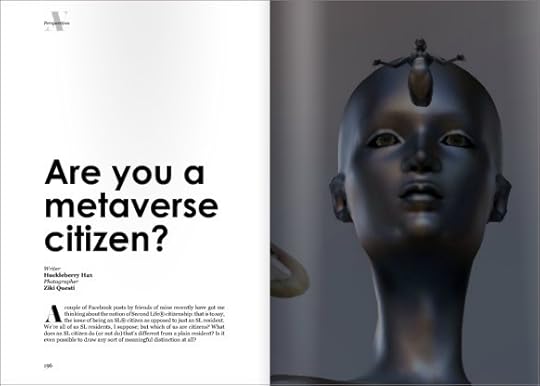
A couple of Facebook posts by friends of mine recently have got me thinking about the notion of Second Life® citizenship; that is to say, the issue of being an SL citizen as opposed to just an SL resident. We’re all of us SL residents, I suppose; but which of us are citizens? What does an SL citizen do (or not do) that’s different from a plain resident? Is it even possible to draw any sort of meaningful distinction at all?
Before political philosophers set about brutalising me with rolled up copies of The Leviathan, I should add the disclaimer that the complex technicalities of whether or not it’s actually possible to be a citizen within an essentially non-government locality (let alone a virtual one) such as SL aren’t really of particular interest to me right now. I’m just assuming that it is. I’m sure there are arguments that could be mounted both for and against the notion that Linden’s authority over SL is comparable to some sort of real life governmental structure. If it is, of course, it’s a decidedly non-democratic structure. In SL, we don’t reside in a world where we have any sort of say over decision-making at the top: so long as it doesn’t actually break the law, Linden can pretty much do whatever it wants to with its world and there’s no five-yearly ballot box for us to clobber them with if they get things massively wrong. For the purposes of this discussion, then, we reside in a virtual community, albeit one which few of us might seek out politically in real life. That said, in exchange for being able to fly, teleport instantly from place to place and create objects out of thin air, I might well be tempted to surrender my voting rights. Tempted.
So what would differentiate someone who was an SL resident and citizen from someone who was just an SL resident? In real world legal terms, the distinction is relatively straightforward: a resident simply lives in a place, whereas a citizen has numerous additional rights. These include the right to continue living in the place for as long as one wishes and the right to vote in elections. But neither of these elements have any relevance to SL: none of us have any right to reside there and – as I’ve mentioned already – we have no political system in which to participate.
At an emotional level, however, it could be argued that citizenship is about more than just the possession of rights. Being able to stay in a place for as long as you want and having a say in its administration could be said to be fundamental elements to a sense of belonging. Perhaps, then, a citizen – fundamentally – is a person who both resides in a place and has a greater – a more valid – sense of belonging in it than someone who is just a resident. For sure, sense of belonging is a concept we can apply to SL.
There’s something else we could apply also. Citizenship is often spoken of in terms of responsibilities as well as rights. Some of those responsibilities we are required by law to take on – Jury duty, for example – whilst some are roles we voluntarily assume – charity work, perhaps, or school governance. When we hear the term ‘a good citizen’, we infer someone who has acted in some way selflessly and with the greater good of the community in mind. In and of itself, of course, the phrase bestows no particular virtue on the mere state of being a citizen – a ‘bad citizen’ would still, presumably, be a citizen – but the implication of this phrase is that a good citizen is fulfilling their citizenly duty, somehow; behaving in a manner that citizenship expects. A good citizen ‘gives back’.
There are, of course, many ways in which we can give back in SL. Countless people I know give and have given to so many, from building the beautiful sims we love experiencing to organising and hosting free events to greeting new residents and helping them get their second lives established. I want to take this opportunity to name a few of them: Persephone Phoenix, for running SL’s longest ever open mic poetry event (and, on a more personal level, for teaching me how to write poetry); Jilly Kidd – who has to be perhaps one of the most consistent people I’ve known in SL – for dedicating friendliness and time every week to the Sounds of Poems poetry event and the Wednesday night Writers’ Circle; Philippe Pascal and Karli Daviau, for their work promoting art and the amazing job they did running the weekly ‘Predicate’ improv workshop; Flora Nordenskiold, for pouring endless time and resources into Nordan Art and the Nordan om Jorden blog, her mission to bring a wider audience to metaverse art. And Dizi Bergbahn, my oldest SL friend, for teaching me how to build.
This is just a small list of people I know. If I worked my way through my friends list, I’m certain I could find many, many more examples. I did worry a few sentences ago, actually, that some of those people might feel left out by not being mentioned; getting tied up in knots like that about who we might inadvertently upset, however, is one of the reasons why we so rarely make a fuss about Good Things in life. Recognising good SL citizens, in fact, is a good deal harder than we like to think it is, a realisation that Linden came to when they abandoned their profile rating system in 2007. Alongside all the genuine positive ratings, came the manipulated ratings: ratings parties, I’m given to understand, is just one example of the way in which the Linden system was abused before it got pulled. It’s hardly an SL-only phenomena: soliciting popularity is something we see all the time on Facebook with those intensely annoying images that extoll some virtue of parents/siblings/offspring/teachers/the military and then ask you to share if you feel the same way (usually with an added sentence or two to imply you’ll be some sort of heartless bastard if you don’t). Take a moment to consider how much energy, bandwidth and storage capacity is being squandered on these empty statements (a single 50k image viewed by 1% of Facebook’s 800 million users would use up 400GB of bandwidth; that’s 40 times a family 10GB monthly limit): all because people want to feel popular.
There’s also to consider the old philosophical issue of whether people can actually be genuinely selfless. I give my SL novels away for free on my website, for example; to say I get nothing out of this personally, however, would be patently untrue. Getting messages from people who’ve read and enjoyed my books is one of my very favourite things in life. The strategy has also helped build me a small fan base and a reputation inworld – which, in turn, has helped land me such wonderful opportunities as writing for AVENUE. Is just doing stuff for free in and of itself an act of citizenship, or do we need to take into account the wider personal benefits of such actions? Does a cigarette company sponsoring a major sporting event ‘make up’ for the human and economic cost of smoking?
When I say ‘consider’, the implication is that such considering would be part of a decision. We’re each of us entitled to our own decisions on whether the actions of a resident constitute good SL citizenship, of course. Beyond that, though, do we actually need any sort of system which decides on or measures positive acts? Or is the issue of SL citizenship not a debate about how appropriate recognition should be delivered, but one instead of highlighting our own responsibility to give something back if we are committed to the metaverse future?
The recent story of Linden pulling the plug on its JIRA bug reporting system has caused quite a number of bloggers to speculate that the end is now finally approaching for SL. They might be right. It annoys me, however, when authors use issues such as this as a personal platform from which to seek attention and glorify themselves, such as the blogger who declared now was the time for everyone to cash in all their Lindens and leave. Angry mob tactics never did all that much for me. A far more intellectual exploration of this issue, however, came from Fleep Tuque (www.fleeptuque.com/blog/2012/08/why-anyone-who-cares-about-the-metaverse-needs-to-move-beyond-second-life-now-not-later/). Tuque argues in this post that our personal responsibility lies not to SL, but to the metaverse as a whole; that SL is ultimately only the first step in an online evolution. There, after all, are lots of online worlds out there now. I’ve spent a little time looking around in InWorldz myself and was impressed at how far it had come since its early days. In fact, InWorldz is run by a company just like Linden runs SL. Of potentially far greater significance is the OpenSim project, a metaverse effectively run by the people who use it. Perhaps, then, the metaverse government we don’t have in SL is closer than we think elsewhere.
The issue of SL citizenship, then, becomes one of metaverse citizenship. Whilst the decay of SL is something we will all feel sadness over, this could ultimately become the issue which forces us to look elsewhere and to broaden our consideration of what it is to be a citizen of online worlds. If you want to be regarded as a metaverse citizen, then, perhaps the best place to start is by asking yourself what you can do to help shape it. HH

A couple of Facebook posts by friends of mine recently have got me thinking about the notion of Second Life® citizenship; that is to say, the issue of being an SL citizen as opposed to just an SL resident. We’re all of us SL residents, I suppose; but which of us are citizens? What does an SL citizen do (or not do) that’s different from a plain resident? Is it even possible to draw any sort of meaningful distinction at all?
Before political philosophers set about brutalising me with rolled up copies of The Leviathan, I should add the disclaimer that the complex technicalities of whether or not it’s actually possible to be a citizen within an essentially non-government locality (let alone a virtual one) such as SL aren’t really of particular interest to me right now. I’m just assuming that it is. I’m sure there are arguments that could be mounted both for and against the notion that Linden’s authority over SL is comparable to some sort of real life governmental structure. If it is, of course, it’s a decidedly non-democratic structure. In SL, we don’t reside in a world where we have any sort of say over decision-making at the top: so long as it doesn’t actually break the law, Linden can pretty much do whatever it wants to with its world and there’s no five-yearly ballot box for us to clobber them with if they get things massively wrong. For the purposes of this discussion, then, we reside in a virtual community, albeit one which few of us might seek out politically in real life. That said, in exchange for being able to fly, teleport instantly from place to place and create objects out of thin air, I might well be tempted to surrender my voting rights. Tempted.
So what would differentiate someone who was an SL resident and citizen from someone who was just an SL resident? In real world legal terms, the distinction is relatively straightforward: a resident simply lives in a place, whereas a citizen has numerous additional rights. These include the right to continue living in the place for as long as one wishes and the right to vote in elections. But neither of these elements have any relevance to SL: none of us have any right to reside there and – as I’ve mentioned already – we have no political system in which to participate.
At an emotional level, however, it could be argued that citizenship is about more than just the possession of rights. Being able to stay in a place for as long as you want and having a say in its administration could be said to be fundamental elements to a sense of belonging. Perhaps, then, a citizen – fundamentally – is a person who both resides in a place and has a greater – a more valid – sense of belonging in it than someone who is just a resident. For sure, sense of belonging is a concept we can apply to SL.
There’s something else we could apply also. Citizenship is often spoken of in terms of responsibilities as well as rights. Some of those responsibilities we are required by law to take on – Jury duty, for example – whilst some are roles we voluntarily assume – charity work, perhaps, or school governance. When we hear the term ‘a good citizen’, we infer someone who has acted in some way selflessly and with the greater good of the community in mind. In and of itself, of course, the phrase bestows no particular virtue on the mere state of being a citizen – a ‘bad citizen’ would still, presumably, be a citizen – but the implication of this phrase is that a good citizen is fulfilling their citizenly duty, somehow; behaving in a manner that citizenship expects. A good citizen ‘gives back’.
There are, of course, many ways in which we can give back in SL. Countless people I know give and have given to so many, from building the beautiful sims we love experiencing to organising and hosting free events to greeting new residents and helping them get their second lives established. I want to take this opportunity to name a few of them: Persephone Phoenix, for running SL’s longest ever open mic poetry event (and, on a more personal level, for teaching me how to write poetry); Jilly Kidd – who has to be perhaps one of the most consistent people I’ve known in SL – for dedicating friendliness and time every week to the Sounds of Poems poetry event and the Wednesday night Writers’ Circle; Philippe Pascal and Karli Daviau, for their work promoting art and the amazing job they did running the weekly ‘Predicate’ improv workshop; Flora Nordenskiold, for pouring endless time and resources into Nordan Art and the Nordan om Jorden blog, her mission to bring a wider audience to metaverse art. And Dizi Bergbahn, my oldest SL friend, for teaching me how to build.
This is just a small list of people I know. If I worked my way through my friends list, I’m certain I could find many, many more examples. I did worry a few sentences ago, actually, that some of those people might feel left out by not being mentioned; getting tied up in knots like that about who we might inadvertently upset, however, is one of the reasons why we so rarely make a fuss about Good Things in life. Recognising good SL citizens, in fact, is a good deal harder than we like to think it is, a realisation that Linden came to when they abandoned their profile rating system in 2007. Alongside all the genuine positive ratings, came the manipulated ratings: ratings parties, I’m given to understand, is just one example of the way in which the Linden system was abused before it got pulled. It’s hardly an SL-only phenomena: soliciting popularity is something we see all the time on Facebook with those intensely annoying images that extoll some virtue of parents/siblings/offspring/teachers/the military and then ask you to share if you feel the same way (usually with an added sentence or two to imply you’ll be some sort of heartless bastard if you don’t). Take a moment to consider how much energy, bandwidth and storage capacity is being squandered on these empty statements (a single 50k image viewed by 1% of Facebook’s 800 million users would use up 400GB of bandwidth; that’s 40 times a family 10GB monthly limit): all because people want to feel popular.
There’s also to consider the old philosophical issue of whether people can actually be genuinely selfless. I give my SL novels away for free on my website, for example; to say I get nothing out of this personally, however, would be patently untrue. Getting messages from people who’ve read and enjoyed my books is one of my very favourite things in life. The strategy has also helped build me a small fan base and a reputation inworld – which, in turn, has helped land me such wonderful opportunities as writing for AVENUE. Is just doing stuff for free in and of itself an act of citizenship, or do we need to take into account the wider personal benefits of such actions? Does a cigarette company sponsoring a major sporting event ‘make up’ for the human and economic cost of smoking?
When I say ‘consider’, the implication is that such considering would be part of a decision. We’re each of us entitled to our own decisions on whether the actions of a resident constitute good SL citizenship, of course. Beyond that, though, do we actually need any sort of system which decides on or measures positive acts? Or is the issue of SL citizenship not a debate about how appropriate recognition should be delivered, but one instead of highlighting our own responsibility to give something back if we are committed to the metaverse future?
The recent story of Linden pulling the plug on its JIRA bug reporting system has caused quite a number of bloggers to speculate that the end is now finally approaching for SL. They might be right. It annoys me, however, when authors use issues such as this as a personal platform from which to seek attention and glorify themselves, such as the blogger who declared now was the time for everyone to cash in all their Lindens and leave. Angry mob tactics never did all that much for me. A far more intellectual exploration of this issue, however, came from Fleep Tuque (www.fleeptuque.com/blog/2012/08/why-anyone-who-cares-about-the-metaverse-needs-to-move-beyond-second-life-now-not-later/). Tuque argues in this post that our personal responsibility lies not to SL, but to the metaverse as a whole; that SL is ultimately only the first step in an online evolution. There, after all, are lots of online worlds out there now. I’ve spent a little time looking around in InWorldz myself and was impressed at how far it had come since its early days. In fact, InWorldz is run by a company just like Linden runs SL. Of potentially far greater significance is the OpenSim project, a metaverse effectively run by the people who use it. Perhaps, then, the metaverse government we don’t have in SL is closer than we think elsewhere.
The issue of SL citizenship, then, becomes one of metaverse citizenship. Whilst the decay of SL is something we will all feel sadness over, this could ultimately become the issue which forces us to look elsewhere and to broaden our consideration of what it is to be a citizen of online worlds. If you want to be regarded as a metaverse citizen, then, perhaps the best place to start is by asking yourself what you can do to help shape it. HH


