
Huckleberry Hax's Blog, page 45
June 5, 2013
Absent activities
In part two of my 'Absent' series, I turn my attention to some of the things I used to do in SL.
Camping
I don’t really miss camping. I miss the excitement of camping, although camping, of course, was never in any way exciting. To this day, I still can’t quite believe I actually did it; I still can’t believe I voluntarily stood around doing absolutely nothing for hours at a time in return for three measly Lindens an hour, thrown at my shoeless feet with contempt by whatever management it was that was hoping my mere presence in the vicinity of his or her establishment would bring people with actual money and a desire to spend it. If camping wasn’t bad enough, there was also queuing for camping: a wait of additional nothingness for a camping spot to become vacant, only this time you got paid nothing. And then there was the wait to get into a sim with good camping spots, because the sim itself was full to capacity from people a) camping and b) waiting to be camping. Nobody ever even spoke to each other whilst they were camping because they were so full of self-loathing at having sunk this low any exposure of personality just made the loss of dignity worse. You came, you sat, you kept your mouth shut and you avoided looking anyone in the eye.
What was exciting about camping was the thing you wanted to buy with the money you got from it. This was your First Big Second Life purchase. You’d done the rounds on the freebie shops, flirted with trying to create a more interesting body shape by manually tweaking the slider bars and experimented with different colours on the lump of plasticine on your head which Linden so optimistically referred to as ‘hair’. Slowly, but surely, the realisation had dawned on you that your avatar looked shit. Slowly, but surely, you started to covet the costing-money things which would make it look better. I estimate that the average newbie back then spent no more than a fortnight doing camping, because by then the desire for costing-money things had overwhelmed the ability to delay gratification any longer (as delays go, earning money though camping was a pretty fucking long one). Out went the policy on not spending any real money on SL and in came the Lindens, freshly minted from the LindeX. Camping was exciting because it was one of the things that represented our transition from ‘I find SL interesting’ to ‘I find SL absorbing’. Camping was when we got hooked.
Exploring
In the early days of my SL, exploring meant walking along a road and seeing where it took me. An inventory devoid of landmarks and a friends list empty of, well, people, it was pretty much the only strategy I had available to me. Through this approach I discovered my first SL art gallery and had there my first SL conversation with another avatar. There was a sense, back then, of SL unfolding around me and that I was in control of the pace at which it unfolded. I could explore one sim of an evening; I could explore two or three or four: it was up to me.
It wasn’t that I was unaware of other distant places, nor that I was totally ignorant on how to get to them. Back then, before both adult venues and their advertisements were moved to their own continent, the newbie avatar had virtual billboards declaring pleasure beyond their hedonistic dreams practically crammed down their throats the moment they took a step outside of whatever info hub it was they’d been sent to. I was indeed curious about ‘cybersex’ as a newbie (chiefly because I thought it sounded ridiculous), but I wanted to discover such places by myself. The idea of hopping about the grid, from one random point to another, made SL seem less like a world – less like one big place – and more like a collection of 3D websites. I wanted it to be a world.
All of which begs the question, why do I no longer explore SL in this way? In part, I suppose it’s because most of the really interesting stuff for me tends to be on private sims disconnected from the mainland; now that my concept of SL as a world is established, it doesn’t really need protecting any more. But I suspect the main reason is pure laziness. I’ve established my places and my people. I’ve grown my avatar identity. Whilst I do from time to time still do new stuff, I’m generally ‘settled’ in my SL ways. Is this a good thing? Probably, it’s not.
Performing
I made a ‘stand’ of sorts about 18 months ago. A newcomer to the poetry events I was attending had various racial hate statements in her profile. She was a perfectly nice person to talk to in chat before you realised what she had listed in her profile; she certainly never in my company brought any of these views into conversation. A friend of mine then discovered these profile picks and stopped attending any events this avatar was present at. She dismissed event hosts’ views that banning avatars with hate speech in their picks was a restriction of their freedom of speech.
By coincidence, I attended in RL a couple of days later a talk given by a black UK celebrity about her life in the 60s in Britain. Her family was one that had moved to the UK in response to the drive back then to recruit migrant workers, and they arrived only to be discriminated against in virtually every aspect of their lives. She would go into a shop, for example, and the shopkeeper would refuse to acknowledge her, far less serve her. I felt ashamed at my willingness to find a reason to ignore this person’s hate speech.
I decided that my friend was right, that if we’re agreed that hate speech should not be tolerated – and it’s not like there’s much legal doubt over that – then profile text should be treated alongside public chat. If I perform in front of an audience knowing that one or more people there are displaying hate speech in their profiles like little placards they've sneaked in with them (and, let’s be clear here, I’m not talking about statements such as ‘Immigration to the UK is a problem’, I’m talking about statements such as ‘UK SHOULD BE WHITES ONLY’) then I’m passively endorsing such comments. A very easy way to not do this is simply to withdraw my performance. Which is what I did.
And I've hardly performed since. And I miss it.
Camping
I don’t really miss camping. I miss the excitement of camping, although camping, of course, was never in any way exciting. To this day, I still can’t quite believe I actually did it; I still can’t believe I voluntarily stood around doing absolutely nothing for hours at a time in return for three measly Lindens an hour, thrown at my shoeless feet with contempt by whatever management it was that was hoping my mere presence in the vicinity of his or her establishment would bring people with actual money and a desire to spend it. If camping wasn’t bad enough, there was also queuing for camping: a wait of additional nothingness for a camping spot to become vacant, only this time you got paid nothing. And then there was the wait to get into a sim with good camping spots, because the sim itself was full to capacity from people a) camping and b) waiting to be camping. Nobody ever even spoke to each other whilst they were camping because they were so full of self-loathing at having sunk this low any exposure of personality just made the loss of dignity worse. You came, you sat, you kept your mouth shut and you avoided looking anyone in the eye.
What was exciting about camping was the thing you wanted to buy with the money you got from it. This was your First Big Second Life purchase. You’d done the rounds on the freebie shops, flirted with trying to create a more interesting body shape by manually tweaking the slider bars and experimented with different colours on the lump of plasticine on your head which Linden so optimistically referred to as ‘hair’. Slowly, but surely, the realisation had dawned on you that your avatar looked shit. Slowly, but surely, you started to covet the costing-money things which would make it look better. I estimate that the average newbie back then spent no more than a fortnight doing camping, because by then the desire for costing-money things had overwhelmed the ability to delay gratification any longer (as delays go, earning money though camping was a pretty fucking long one). Out went the policy on not spending any real money on SL and in came the Lindens, freshly minted from the LindeX. Camping was exciting because it was one of the things that represented our transition from ‘I find SL interesting’ to ‘I find SL absorbing’. Camping was when we got hooked.
Exploring
In the early days of my SL, exploring meant walking along a road and seeing where it took me. An inventory devoid of landmarks and a friends list empty of, well, people, it was pretty much the only strategy I had available to me. Through this approach I discovered my first SL art gallery and had there my first SL conversation with another avatar. There was a sense, back then, of SL unfolding around me and that I was in control of the pace at which it unfolded. I could explore one sim of an evening; I could explore two or three or four: it was up to me.
It wasn’t that I was unaware of other distant places, nor that I was totally ignorant on how to get to them. Back then, before both adult venues and their advertisements were moved to their own continent, the newbie avatar had virtual billboards declaring pleasure beyond their hedonistic dreams practically crammed down their throats the moment they took a step outside of whatever info hub it was they’d been sent to. I was indeed curious about ‘cybersex’ as a newbie (chiefly because I thought it sounded ridiculous), but I wanted to discover such places by myself. The idea of hopping about the grid, from one random point to another, made SL seem less like a world – less like one big place – and more like a collection of 3D websites. I wanted it to be a world.
All of which begs the question, why do I no longer explore SL in this way? In part, I suppose it’s because most of the really interesting stuff for me tends to be on private sims disconnected from the mainland; now that my concept of SL as a world is established, it doesn’t really need protecting any more. But I suspect the main reason is pure laziness. I’ve established my places and my people. I’ve grown my avatar identity. Whilst I do from time to time still do new stuff, I’m generally ‘settled’ in my SL ways. Is this a good thing? Probably, it’s not.
Performing
I made a ‘stand’ of sorts about 18 months ago. A newcomer to the poetry events I was attending had various racial hate statements in her profile. She was a perfectly nice person to talk to in chat before you realised what she had listed in her profile; she certainly never in my company brought any of these views into conversation. A friend of mine then discovered these profile picks and stopped attending any events this avatar was present at. She dismissed event hosts’ views that banning avatars with hate speech in their picks was a restriction of their freedom of speech.
By coincidence, I attended in RL a couple of days later a talk given by a black UK celebrity about her life in the 60s in Britain. Her family was one that had moved to the UK in response to the drive back then to recruit migrant workers, and they arrived only to be discriminated against in virtually every aspect of their lives. She would go into a shop, for example, and the shopkeeper would refuse to acknowledge her, far less serve her. I felt ashamed at my willingness to find a reason to ignore this person’s hate speech.
I decided that my friend was right, that if we’re agreed that hate speech should not be tolerated – and it’s not like there’s much legal doubt over that – then profile text should be treated alongside public chat. If I perform in front of an audience knowing that one or more people there are displaying hate speech in their profiles like little placards they've sneaked in with them (and, let’s be clear here, I’m not talking about statements such as ‘Immigration to the UK is a problem’, I’m talking about statements such as ‘UK SHOULD BE WHITES ONLY’) then I’m passively endorsing such comments. A very easy way to not do this is simply to withdraw my performance. Which is what I did.
And I've hardly performed since. And I miss it.


June 4, 2013
Absent friends
To coincide with Second Life’s tenth birthday, I thought I’d put down a few reflections on my own SL, focusing on some of the things that are no longer present. I’m going to start with friends.
Dizi
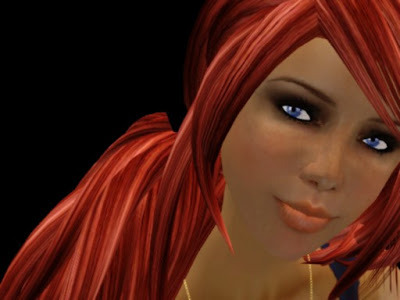
‘You never forget your first friend in Second Life’ is a phrase I’ve heard used exactly zero times in SL, but I’m willing to bet that if I dropped it in to an appropriately philosophical conversation I’d receive nods of earnest agreement from all my fellow participants. Dizi was my first SL friend and I couldn’t have asked, paid or emotionally blackmailed for anyone better. With a fine knack for intelligent, irreverent banter, a quick grasp for the technicalities of the metaverse and a wonderfully clear way of explaining things, Dizi was exactly the right catalyst for turning my vague meanderings in the virtual world into something with some sort of purpose. She taught me how to build, she taught me how to emote and – perhaps most importantly of all – she taught me the pleasure of a tango at Bogart’s. She also bought me my first pair of decent shoes, which might be an odd thing to list in any context, but I mention it here because it illustrates so perfectly her nurturing manner, not to mention her eye for the aesthetically pleasing (especially when it came to shoes).
Dizi eventually moved on from SL and I miss her enormously, but we still keep in touch from time to time via email. I’m lucky to have known her during her time inworld and I count hers amongst the most important friendships I have ever formed.
medi
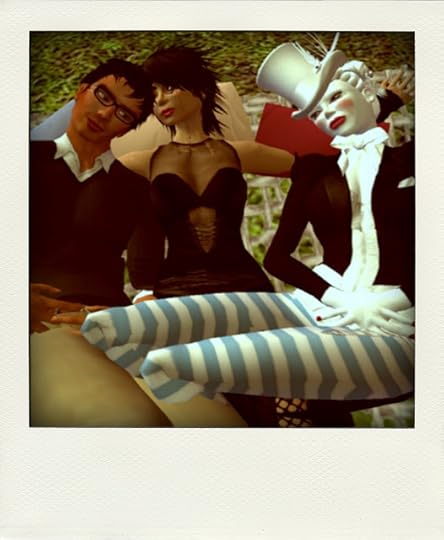
medi was introduced to me by Dizi and I can honestly say that I’ve never met a more actually laugh-out-loud person in SL. This incredibly intelligent and literate woman adopted a porcelain doll as her avatar and dressed it up in all manner of outrageous outfits – blue and white gingham being a particular favourite design. Her condemnations were hilarious. Her insights were profound. I will never forget a conversation we once had where she told me she can’t avoid in RL looking at how light falls on objects; I can’t forget it chiefly for the reason that I have never looked at light in quite the same way since.
medi was ardently against sharing any sort of RL details, taking the view that this tarnished the illusion created by SL. Voice communication in particular was absolutely out of the question. It wasn’t that we used this in our trio anyway, but when I did one of my first ever readings in SL she turned up (to show support) but refused to turn her speakers on, saying that hearing my RL voice would ruin the voice she had allocated to me in her head.
medi announced one day that she was leaving SL and that was the last that either I or Dizi saw or heard of her. She didn’t leave in anger or sadness, and I rather suspect that she left her announcement until the last minute in order to avoid any drawn-out goodbyes. Much as I miss her, I can’t help but grudgingly admire the way she managed this exit. But then, medi was magnificent in every way.
Nancy
Nancy was my first reader. We met in rather embarrassing circumstances. At a dance club, I was browsing her profile and saw an entry in her picks for an SL comedy club. Fascinated by this idea, I immediately clicked on the teleport button only to discover that the club didn’t yet actually exist and she’d created the pick in her own house. In and of itself, turning up unannounced in someone’s house isn’t a total toe-curler on the embarrassment scale, however what I’d failed to notice whilst reading her profile was that Nancy had left the club before me and was partway through an outfit change in the moment that I materialised in her bedroom.
Nancy, however, was a wonderfully friendly and laid back person, and a moment’s worth of awkwardness soon dissolved completely once we got chatting – the subject of which quickly became the Second Life novel I was halfway through writing at the time. Perhaps because of my memorable entrance, she read AFK the moment it was finished and became the first person to give me positive feedback.
I wish now I’d spent more time with this kind, gentle, lovely person. Nancy and I would occasionally IM each other and chat, and after a while she started coming to the Blue Angel Poets’ Dive on Sunday evenings for the open mic poetry sessions I regularly attended back then. It was on one of these Sundays that she told me she was going to be away from SL for a while for health reasons. It never occurred to me that these would be the last words we would exchange, and Nancy died just a couple of months later.
Dizi
‘You never forget your first friend in Second Life’ is a phrase I’ve heard used exactly zero times in SL, but I’m willing to bet that if I dropped it in to an appropriately philosophical conversation I’d receive nods of earnest agreement from all my fellow participants. Dizi was my first SL friend and I couldn’t have asked, paid or emotionally blackmailed for anyone better. With a fine knack for intelligent, irreverent banter, a quick grasp for the technicalities of the metaverse and a wonderfully clear way of explaining things, Dizi was exactly the right catalyst for turning my vague meanderings in the virtual world into something with some sort of purpose. She taught me how to build, she taught me how to emote and – perhaps most importantly of all – she taught me the pleasure of a tango at Bogart’s. She also bought me my first pair of decent shoes, which might be an odd thing to list in any context, but I mention it here because it illustrates so perfectly her nurturing manner, not to mention her eye for the aesthetically pleasing (especially when it came to shoes).
Dizi eventually moved on from SL and I miss her enormously, but we still keep in touch from time to time via email. I’m lucky to have known her during her time inworld and I count hers amongst the most important friendships I have ever formed.
medi
medi was introduced to me by Dizi and I can honestly say that I’ve never met a more actually laugh-out-loud person in SL. This incredibly intelligent and literate woman adopted a porcelain doll as her avatar and dressed it up in all manner of outrageous outfits – blue and white gingham being a particular favourite design. Her condemnations were hilarious. Her insights were profound. I will never forget a conversation we once had where she told me she can’t avoid in RL looking at how light falls on objects; I can’t forget it chiefly for the reason that I have never looked at light in quite the same way since.
medi was ardently against sharing any sort of RL details, taking the view that this tarnished the illusion created by SL. Voice communication in particular was absolutely out of the question. It wasn’t that we used this in our trio anyway, but when I did one of my first ever readings in SL she turned up (to show support) but refused to turn her speakers on, saying that hearing my RL voice would ruin the voice she had allocated to me in her head.
medi announced one day that she was leaving SL and that was the last that either I or Dizi saw or heard of her. She didn’t leave in anger or sadness, and I rather suspect that she left her announcement until the last minute in order to avoid any drawn-out goodbyes. Much as I miss her, I can’t help but grudgingly admire the way she managed this exit. But then, medi was magnificent in every way.

Nancy
Nancy was my first reader. We met in rather embarrassing circumstances. At a dance club, I was browsing her profile and saw an entry in her picks for an SL comedy club. Fascinated by this idea, I immediately clicked on the teleport button only to discover that the club didn’t yet actually exist and she’d created the pick in her own house. In and of itself, turning up unannounced in someone’s house isn’t a total toe-curler on the embarrassment scale, however what I’d failed to notice whilst reading her profile was that Nancy had left the club before me and was partway through an outfit change in the moment that I materialised in her bedroom.
Nancy, however, was a wonderfully friendly and laid back person, and a moment’s worth of awkwardness soon dissolved completely once we got chatting – the subject of which quickly became the Second Life novel I was halfway through writing at the time. Perhaps because of my memorable entrance, she read AFK the moment it was finished and became the first person to give me positive feedback.
I wish now I’d spent more time with this kind, gentle, lovely person. Nancy and I would occasionally IM each other and chat, and after a while she started coming to the Blue Angel Poets’ Dive on Sunday evenings for the open mic poetry sessions I regularly attended back then. It was on one of these Sundays that she told me she was going to be away from SL for a while for health reasons. It never occurred to me that these would be the last words we would exchange, and Nancy died just a couple of months later.

May 16, 2013
Second Life® is Ten
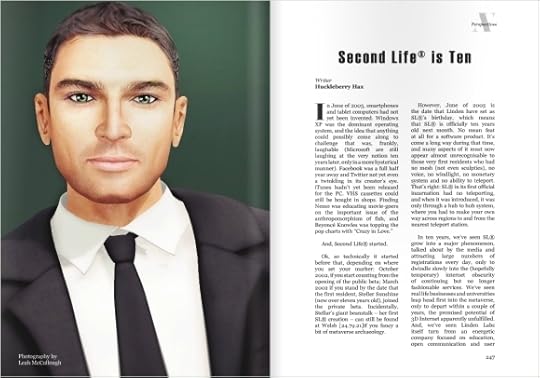
Here's my May column for AVENUE magazine. Photography this month is by Leah McCullough.
In June 2003, smartphones and tablet computers had not yet been invented. Windows XP was the dominant operating system and the idea that anything could possibly come along to challenge that was, frankly, laughable (Microsoft are still laughing at the very notion ten years later, only in a more hysterical manner). Facebook was a full half year away and Twitter not yet even a twinkling in its creator’s eye. iTunes hadn’t yet been released for the PC. VHS cassettes could still be bought in shops. Finding Nemo was educating movie-goers on the important issue of the anthropomorphism of fish and Beyoncé Knowles was topping the pop charts with ‘Crazy in Love’.
And Second Life® started.
Ok, so technically it started before that, depending on where you set your marker: October 2002, if you start counting from the opening of the public beta; March 2002 if you stand by the date that the first resident, Steller Sunshine (now over eleven years old), joined the private beta. Incidentally, Stellar’s giant beanstalk – her first SL creation – can still be found at http://slurl.com/secondlife/Welsh/24/79/21if you fancy a bit of metaverse archaeology.
But June 2003 is the date that Linden have set as SL’s birthday, which means that SL is officially ten years old next month. No mean feat at all for a software product. It’s come a long way during that time and many aspects of it must now appear almost unrecognisable to those very first residents, who had no mesh (not even sculpties), no voice, no windlight, no monetary system and no ability to teleport. That’s right: SL in its first official incarnation had no teleporting, and when it was introduced it was only through a hub to hub system, where you had to make your own way across regions to and from the nearest teleport station.
In ten years, we’ve seen SL grow into a major phenomenon, talked about by the media and attracting large numbers of registrations every day, only to dwindle slowly into the (hopefully temporary) internet obscurity of continuing but no longer fashionable services. We’ve seen RL businesses and universities leap head first into the metaverse, only to depart within a couple of years, the promised potential of 3D Internet apparently unfulfilled. And we’ve seen Linden itself turn from an energetic company focused on education, open communication and user creativity into a much more opaque organisation seemingly concerned mainly with the commercial markets available to it and a more heavy-handed regulation of the metaverse (though not always without good reason).
But, despite all this change and turbulence, is the essence of SL now really so different from how it was back then? I say that it’s not. Whilst there have been many technical improvements over the years, most of us still communicate primarily in text and the graphics upgrades have probably only served to enhance rather than create the sense of immersion we feel in the metaverse. RL businesses opening up in SL – for example, car manufacturers offering prim versions of their latest RL hatchbacks (let’s be honest here, the proper word for this was ‘advertising’) – always was a red herring of no real consequence to the vast majority of residents; probably few of us even realised that they’d left until we read about it in a doomsayer blog post somewhere. And, whilst the ‘feel from above’ has undeniably cooled from the jollier days during such years as 2006 and 2007, I just can’t believe that the average resident’s level of affection for Linden is so significant to their day-to-day enjoyment of the metaverse that they consider the whole thing qualitatively ruined now. For sure, we all grumble about lag and sim crashes, but I’ve yet to hear anyone tell me they’re leaving SL because they just can’t handle the failed teleports any more. If anything, the day-to-day technical issues of SL have just taught us to be tolerant. No-one ever seems to mind when we disappear halfway through a conversation because we’ve all had exactly the same experience at some point or another. And, at the end of the day, SL crashing is pretty far down on the list of the worst things that can happen to you in life – second or otherwise.
When I first entered SL (in 2006), it was mainly as a work-avoidance strategy. I will admit also to having been curious about how any sort of online world could be quite so engrossing that people would spend anything like the hours in them I’d heard reported, but it was hardly a curiosity that required urgent and immediate sating – until the task of writing my first novel in ten years came along, that is. It was with a fairly sceptical mind-set, then, that I first came to the metaverse, not expecting it in any way to exceed my somewhat limited expectations. And, to begin with, it didn’t even meet them. I had imagined that, at the very least, SL would be as smooth and as visually stunning as some of the first person computer games I’d seen advertised, and that this was presumably how it had achieved its following. I didn’t think for one moment that my avatar would look quite so primitive as it did and that everything would be quite so, well, jerky.
In those days, initial orientation took place at Orientation Island (a copy of which exists at http://maps.secondlife.com/secondlife/Orientation Island Public/128/128/2) and further help was then available at Help Island (a copy of which exists at http://maps.secondlife.com/secondlife/Help Island Public/128/128/2). As visually unimpressive as those places were, things did at least work there as they’d been designed to (it helped that numbers per island were restricted and that no-one in either of those places had yet had opportunity to learn about or acquire wearable scripted things). But then I discovered the mainland and got my very first introduction to lag. The region I got sent to was massively overcrowded and my avatar seemed to be unable to do anything other than walk on the spot. Also, the screen seemed to be spewing text endlessly from local chat and I had no idea how one was supposed to keep up with it (in those innocent first few SL days I imagined myself to be a great deal more noticeable than I actually was, and believed that somewhere in that soup of text was at least a line or two addressed to me). Within about five minutes, I experienced my first viewer crash. The whole thing was hopelessly confusing and I persisted only because I still thought there had to be something to this that I was missing.
It’s hard now to remember the exact ‘moment of immersion’. Making my first SL friend was certainly a big part of that. Learning the basics of building was another. The deeper and deeper I got, the more and more it felt like I’d discovered a whole new dimension to life that had previously been hiding in the shadows. SL started to change the way I thought about RL, but the way in which this was true was itself something that changed over time. Imagine a Venn diagram with two circles, one labelled ‘RL’ and the other ‘SL’. When sceptics like I was first enter the metaverse, the two circles are completely separate: what could there possibly be in a ‘computer game’ that is of relevance to the real world? Then the two circles touch. Then they start to overlap. Finally ‘SL’ is just a smaller circle inside an enlarged ‘RL’, and the ‘S’ and ‘R’ prefixes are increasingly meaningless. There is only ‘Life’; there is only that which is experienced, be it physical or virtual or otherwise.
Because all experience is ultimately mental experience. The first things we learn from SL might be how to use the interface and then how to make things happen in the shared creative space (as Linden now view it), but what we go on to learn can end up touching upon some of the most fundamental issues concerning human experience. How do we think about and identify with ourselves? How do we connect with others? What constitutes a place? What constitutes engagement in meaningful activity? The personal growth that SL offers us in these areas is applicable to our whole lives, not just our virtual ones. To give just a small and (literally) concrete example, creating buildings in SL has motivated me to study post-war architecture, which has enhanced enormously my enjoyment of building design in the physical world. Appreciation of that which we already have surrounding us is much touted these days as a key to long-lasting happiness: how ironic that one route to improving this should be through a virtual world where it’s possible to create and explore the things you don’t already have.
Happy birthday, Second Life. You started something amazing. Here’s to the next ten years of metaversing.
In June 2003, smartphones and tablet computers had not yet been invented. Windows XP was the dominant operating system and the idea that anything could possibly come along to challenge that was, frankly, laughable (Microsoft are still laughing at the very notion ten years later, only in a more hysterical manner). Facebook was a full half year away and Twitter not yet even a twinkling in its creator’s eye. iTunes hadn’t yet been released for the PC. VHS cassettes could still be bought in shops. Finding Nemo was educating movie-goers on the important issue of the anthropomorphism of fish and Beyoncé Knowles was topping the pop charts with ‘Crazy in Love’.
And Second Life® started.
Ok, so technically it started before that, depending on where you set your marker: October 2002, if you start counting from the opening of the public beta; March 2002 if you stand by the date that the first resident, Steller Sunshine (now over eleven years old), joined the private beta. Incidentally, Stellar’s giant beanstalk – her first SL creation – can still be found at http://slurl.com/secondlife/Welsh/24/79/21if you fancy a bit of metaverse archaeology.
But June 2003 is the date that Linden have set as SL’s birthday, which means that SL is officially ten years old next month. No mean feat at all for a software product. It’s come a long way during that time and many aspects of it must now appear almost unrecognisable to those very first residents, who had no mesh (not even sculpties), no voice, no windlight, no monetary system and no ability to teleport. That’s right: SL in its first official incarnation had no teleporting, and when it was introduced it was only through a hub to hub system, where you had to make your own way across regions to and from the nearest teleport station.
In ten years, we’ve seen SL grow into a major phenomenon, talked about by the media and attracting large numbers of registrations every day, only to dwindle slowly into the (hopefully temporary) internet obscurity of continuing but no longer fashionable services. We’ve seen RL businesses and universities leap head first into the metaverse, only to depart within a couple of years, the promised potential of 3D Internet apparently unfulfilled. And we’ve seen Linden itself turn from an energetic company focused on education, open communication and user creativity into a much more opaque organisation seemingly concerned mainly with the commercial markets available to it and a more heavy-handed regulation of the metaverse (though not always without good reason).
But, despite all this change and turbulence, is the essence of SL now really so different from how it was back then? I say that it’s not. Whilst there have been many technical improvements over the years, most of us still communicate primarily in text and the graphics upgrades have probably only served to enhance rather than create the sense of immersion we feel in the metaverse. RL businesses opening up in SL – for example, car manufacturers offering prim versions of their latest RL hatchbacks (let’s be honest here, the proper word for this was ‘advertising’) – always was a red herring of no real consequence to the vast majority of residents; probably few of us even realised that they’d left until we read about it in a doomsayer blog post somewhere. And, whilst the ‘feel from above’ has undeniably cooled from the jollier days during such years as 2006 and 2007, I just can’t believe that the average resident’s level of affection for Linden is so significant to their day-to-day enjoyment of the metaverse that they consider the whole thing qualitatively ruined now. For sure, we all grumble about lag and sim crashes, but I’ve yet to hear anyone tell me they’re leaving SL because they just can’t handle the failed teleports any more. If anything, the day-to-day technical issues of SL have just taught us to be tolerant. No-one ever seems to mind when we disappear halfway through a conversation because we’ve all had exactly the same experience at some point or another. And, at the end of the day, SL crashing is pretty far down on the list of the worst things that can happen to you in life – second or otherwise.
When I first entered SL (in 2006), it was mainly as a work-avoidance strategy. I will admit also to having been curious about how any sort of online world could be quite so engrossing that people would spend anything like the hours in them I’d heard reported, but it was hardly a curiosity that required urgent and immediate sating – until the task of writing my first novel in ten years came along, that is. It was with a fairly sceptical mind-set, then, that I first came to the metaverse, not expecting it in any way to exceed my somewhat limited expectations. And, to begin with, it didn’t even meet them. I had imagined that, at the very least, SL would be as smooth and as visually stunning as some of the first person computer games I’d seen advertised, and that this was presumably how it had achieved its following. I didn’t think for one moment that my avatar would look quite so primitive as it did and that everything would be quite so, well, jerky.
In those days, initial orientation took place at Orientation Island (a copy of which exists at http://maps.secondlife.com/secondlife/Orientation Island Public/128/128/2) and further help was then available at Help Island (a copy of which exists at http://maps.secondlife.com/secondlife/Help Island Public/128/128/2). As visually unimpressive as those places were, things did at least work there as they’d been designed to (it helped that numbers per island were restricted and that no-one in either of those places had yet had opportunity to learn about or acquire wearable scripted things). But then I discovered the mainland and got my very first introduction to lag. The region I got sent to was massively overcrowded and my avatar seemed to be unable to do anything other than walk on the spot. Also, the screen seemed to be spewing text endlessly from local chat and I had no idea how one was supposed to keep up with it (in those innocent first few SL days I imagined myself to be a great deal more noticeable than I actually was, and believed that somewhere in that soup of text was at least a line or two addressed to me). Within about five minutes, I experienced my first viewer crash. The whole thing was hopelessly confusing and I persisted only because I still thought there had to be something to this that I was missing.
It’s hard now to remember the exact ‘moment of immersion’. Making my first SL friend was certainly a big part of that. Learning the basics of building was another. The deeper and deeper I got, the more and more it felt like I’d discovered a whole new dimension to life that had previously been hiding in the shadows. SL started to change the way I thought about RL, but the way in which this was true was itself something that changed over time. Imagine a Venn diagram with two circles, one labelled ‘RL’ and the other ‘SL’. When sceptics like I was first enter the metaverse, the two circles are completely separate: what could there possibly be in a ‘computer game’ that is of relevance to the real world? Then the two circles touch. Then they start to overlap. Finally ‘SL’ is just a smaller circle inside an enlarged ‘RL’, and the ‘S’ and ‘R’ prefixes are increasingly meaningless. There is only ‘Life’; there is only that which is experienced, be it physical or virtual or otherwise.
Because all experience is ultimately mental experience. The first things we learn from SL might be how to use the interface and then how to make things happen in the shared creative space (as Linden now view it), but what we go on to learn can end up touching upon some of the most fundamental issues concerning human experience. How do we think about and identify with ourselves? How do we connect with others? What constitutes a place? What constitutes engagement in meaningful activity? The personal growth that SL offers us in these areas is applicable to our whole lives, not just our virtual ones. To give just a small and (literally) concrete example, creating buildings in SL has motivated me to study post-war architecture, which has enhanced enormously my enjoyment of building design in the physical world. Appreciation of that which we already have surrounding us is much touted these days as a key to long-lasting happiness: how ironic that one route to improving this should be through a virtual world where it’s possible to create and explore the things you don’t already have.
Happy birthday, Second Life. You started something amazing. Here’s to the next ten years of metaversing.
April 28, 2013
Romeo and Juliet
Juliet enters the chapel.
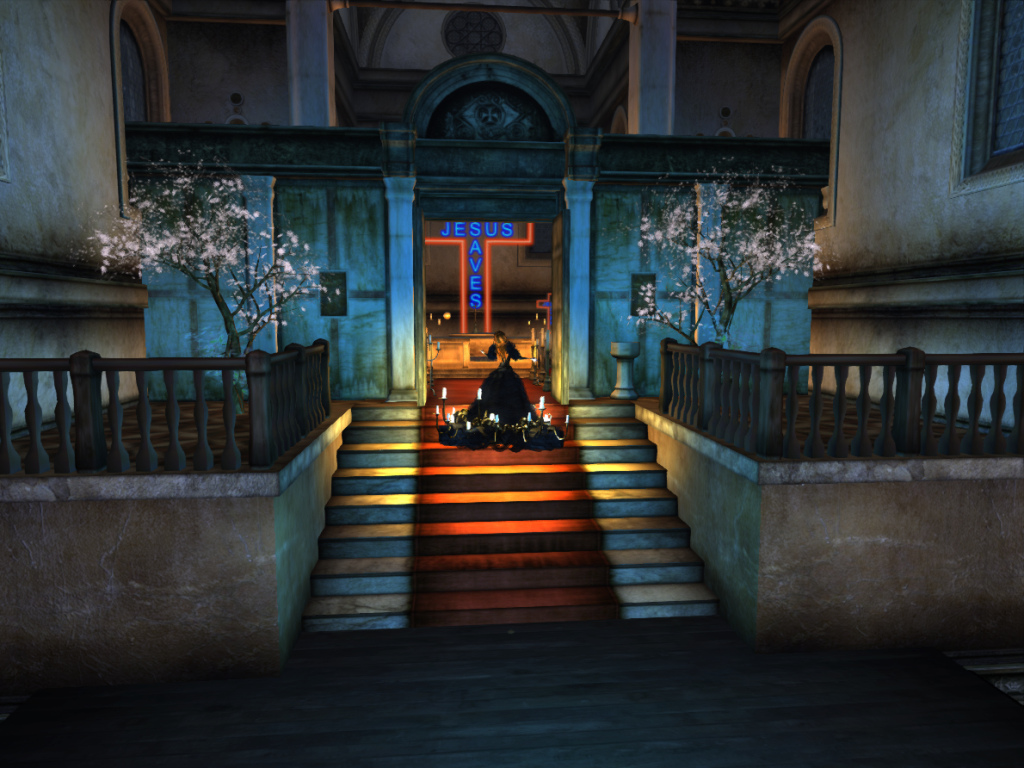
Last night, I attended the opening night of Romeo and Juliet, an SL production stage managed by Harvey Crabsticks, and performed by Canary Beck, Amethyst Dovgal, Cloe Nyn and Belice Benoir. This wasn’t the first production of Shakespeare I’ve seen in SL, the first being a performance of The Tempest I attended many years ago. That was a traditional (if such a word can be applied in the metaverse) rendition of the play, albeit performed on a huge set by a large cast. Romeo and Juliet was a much more scaled down affair put on in a theatre build, and an interpretation performed through music and dance.
What really impressed me about this show was the thought that had gone into using cohesively the many elements we are all familiar with in SL: animations, objects, text, music and voice. Individual scenes were introduced by a narrator in voice over stream, then performed to music through well-chosen pose-ball animations on a stage decorated with just the right amount of furniture. Whilst the dance took place, excerpts from the original text were scrolled by a line reader through local chat (it’s always a great pleasure for me to see the good old line reader – one of the oldest SL performance tools (it even pre-dates voice) – still in action).
The whole thing was a marvel of precision and synchronicity, with more or less every element flawlessly happening at just the right moment. I can’t begin to imagine the complexity of all the scenery, lighting and costume changes – not to mention the cuing up of all the individual dances and audio files – under pressure of the time available to the team. This was a performance by people who clearly love using SL as a form of expression and who wanted to bring Shakespeare to this medium.
These are polarised times, with people arranging themselves seemingly more and more at the opposite ends of the many debates held by society; I was struck once again by the unending relevance of this story and by sadness that its message is still largely unheeded. My absorption in these thoughts is a testament to the success of the team behind Romeo and Juliet in immersing its audience in this tale.
Additional performances commence in a couple of weeks, the details of which will, not doubt, be revealed on the Basilique Blog. My wish list for tweaks would include silencing the various scripts that chatter (lighting being altered, furniture being rezzed, tip jars expressing their gratitude) if at all possible, since this interfered a little with the play text. I’d also get rid of the bunch of TVs placed in front of the stage during scene changes: my habit of focusing on these meant that each time the curtains reopened and these were dropped below the floor I had to walk my crosshairs back into the theatre again. But these are small issues and didn’t detract from the overall effect. A very enjoyable, immersive evening was had by all – the theatre was at capacity for this opening performance – and you would be well advised to set aside 90 minutes for this if you are able to.

April 19, 2013
And you're done
Here's my April column for AVENUE magazine. Photography this month is by Leah McCullough.
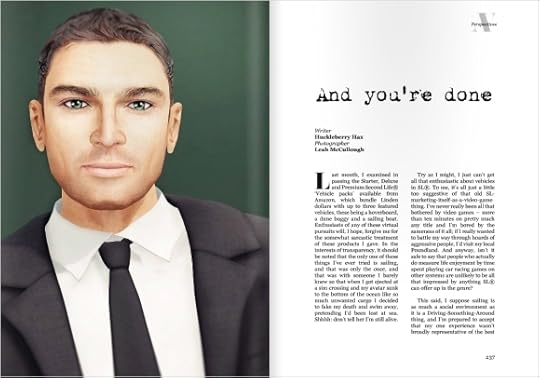
Last month, I examined in passing the Starter, Deluxe and Premium Second Life® ‘Vehicle packs’ available from Amazon, which bundle Linden dollars with up to three featured vehicles, these being a hoverboard, a dune buggy and a sailing boat. Enthusiasts of any of these virtual pursuits will, I hope, forgive me for the somewhat sarcastic treatment of these products I gave. In the interests of transparency, it should be noted that the only one of these things I’ve ever tried is sailing, and that was only the once, and that was with someone I barely knew so that when I got ejected at a sim crossing and my avatar sunk to the bottom of the ocean like so much unwanted cargo I decided to fake my death and swim away, pretending I’d been lost at sea. Shhhh: don’t tell her I’m still alive.
Try as I might, I just can’t get all that enthusiastic about vehicles in SL. To me, it’s all just a little too suggestive of that old SL-marketing-itself-as-a-video-game thing. I’ve never really been all that bothered by video games – more than ten minutes on pretty much any title and I’m bored by the sameness of it all; if I really wanted to battle my way through hoards of aggressive people, I’d visit my local Poundland. And isn’t it safe to say anyway that people who actually do measure life enjoyment by time spent playing car racing games on other systems are unlikely to be all that impressed by anything SL can offer up in the genre?
This said, I suppose sailing is as much a social environment as it is a Driving Something Around thing, and I’m prepared to accept that my one experience wasn’t broadly representative of the best that the occupation has to offer. Nonetheless, I still think SL can do better when it comes to marketing itself with the world’s number one retailer. Here, then, are a few of my suggestions for alternate ‘packs’ to attract newbies and veterans alike.
Starter, Deluxe and Premium Cybersex Packs. Be honest, it’s probably the first thing you thought of too, so let’s get it out of the way. And, whatever your views on sex in the metaverse are, anything that contributes to the extinction of the ‘freenis’ (as a physical item, as a concept and as a word) has got to be a good thing. The Starter Pack, then – available in male and female variants, naturally – would come with medium quality genitalia plus a notecard with example emotes. Yes, this is going to encourage cutting and pasting, but let’s be honest here: for anyone who needs to do this it will probably still represent a step up in quality. The Deluxe Pack would feature high quality genitalia plus a sex bed. The Premium Pack would feature the same plus a skybox fitted additionally with a sex-enabled fridge and hat stand. All genitals, incidentally, would contain a non-removable script that drops a large, horseshoe magnet on the head of the user if ever they should use the letter ‘U’ in place of the word ‘you’.
Starter, Deluxe and Premium BDSM Packs. As above, but including various mechanical apparatus and collars, plus a copy of ‘Fifty Shades of Grey’ (a nice crossover with the more traditional Amazon product line), just to annoy the purists. The skybox would come with a dungeon. Alternatively, the fridge could be fitted with handcuffs.
Film and TV Tie-in Vehicle Pack Range. I’m not abandoning the vehicle pack concept entirely. All Linden has to do is substitute their vehicles with exciting vehicles. The original series Batmobile would be an immediate buy for me. KITT from Knight Rider. Airwolf. The James Bond Lotus Esprit that converts into a submarine. Thunderbirds. But there’s more. The beauty of SL is not only that you can have the machines we know and love (the ‘we’ in most cases admittedly being men) but also the places they’re associated with. Linden could commission licensed sim builds and then rent them out by the hour, and the packs would then come with vouchers for time bundled with the vehicles. Batmobile owners, then, could play in the Batcave; Airwolf pilots could rise from that hollowed out mountain; Thunderbirds fans could take off from Tracy Island; KITT motorists could drive their Knight Two Thousand into the back of a big black truck that drives endlessly round and round a bit of desert somewhere. And so on.
Personal Shopper voucher pack. If, like me, your ideal shopping trip to buy – say – a suit consists of a no-more-than-five-minutes visit to the MarketPlace that involves a quick search on ‘Mesh suit’ and the purchase of anything that looks half good within the first two pages of results then you’re probably missing out on many of the more sophisticated designs that SL has to offer. It never ceases to amaze me the near encyclopaedic knowledge of the latest SL fashions that many of the people I meet seem to be in possession of (and here – yes – ‘people’ can be read to mean in most cases women); that anyone can tolerate more than thirty seconds of a hair fair is a fact I hold in equal awe to such phenomena as quantum physics and the evolution of the human eye. So why not monetise this expertise by creating an elite team of personal shoppers who can take the newbie/uncaring avatar and guide/force/ruthlessly bully them through a shopping experience that meets their needs? I’m aware, of course, that there are people out there who do already offer this sort of service (my own avatar looked like something out of a black and white gangster movie – unintentionally, I might add; the look I was actually aiming for was ‘intellectual’ – until a very kind friend in 2008 diplomatically answered my enquiry as to what parts of my appearance she thought could be improved on with “all of them”); the difficulty is finding one when you actually need one and then knowing if they’re actually any good. At least one of the so called experts whose profiles I’ve nosed within the last year was still wearing flexi hair: even I know that anything which disappears into your breasts is no longer considered the cutting edge. I propose, therefore, that the AVENUE editorial staff set the questions on the entrance exam for people wanting to become personal shoppers.
Novelty Weapons Packs. A fond memory of my time attending the weekly Writers’ Circle event on Wednesday evenings at Cookie, then jointly hosted by Jilly Kid and Hastings Bournemouth, is of firing copies of the bible at Hastings with a bible gun that someone had passed to me and him returning fire with copies of Richard Dawkins’ ‘The God Delusion’. Possibly, you had to be there. Rarely do us peace-loving SL residents have a need for metaverse weaponry, but from time to time there comes along a moment when appropriately ironic armament can add just the right amount of situational comedy. Categories of weapon could include ‘Amusing Projectiles That Aren’t Penises’, ‘Griefer Seekers’, ‘Flower Power’ (including the depleted uranium tipped 45 millimetre daisy shooter) and ‘NRA support’, the latter being there to ease the transition from real to virtual fire-arms when finally the US gets real about its batshit insane gun laws.
And finally, also on the subject of withdrawl support:
Virtual Smoking Pack. In the UK, a debate is starting up over whether or not the smoking of electronic cigarettes should be banned in public places. Should the anti-smoking campaigners find success with their side of this argument, SL will become one of the last remaining places for Britishers to do anything that looks vaguely like smoking in front of other people. Linden should capitalise on this whilst it lasts (for, surely, it will not) with a product line of own-brand smokes (I have dibs on the ‘Hax’ brand, mainly because I like the idea of someone ordering “Two packs of Hax” at the cigarette counter), promoted through a campaign of banner and side bar advertisements: “You’re never alone with a Lucky Linden”; that sort of thing. Smoking packs could also come with collectible cards featuring notable residents from the world of SL, such as artists, builders, photographers, griefers and poets (I’m available for pictures for this last category). They could also include smoke ring HUD attachments which give the customer control over a variety of novelty smoke sculptures to create with their virtual breath and lips. As an additional bonus, cigarette buyers who also own the Premium Cybersex Pack could be given the option to buy a limited edition phallic imagery smoke ring pack that sends a smoke train through a smoke tunnel: perfect, both for suggestive flirtation at parties and for the post-coital shared virtual cigarette.
Last month, I examined in passing the Starter, Deluxe and Premium Second Life® ‘Vehicle packs’ available from Amazon, which bundle Linden dollars with up to three featured vehicles, these being a hoverboard, a dune buggy and a sailing boat. Enthusiasts of any of these virtual pursuits will, I hope, forgive me for the somewhat sarcastic treatment of these products I gave. In the interests of transparency, it should be noted that the only one of these things I’ve ever tried is sailing, and that was only the once, and that was with someone I barely knew so that when I got ejected at a sim crossing and my avatar sunk to the bottom of the ocean like so much unwanted cargo I decided to fake my death and swim away, pretending I’d been lost at sea. Shhhh: don’t tell her I’m still alive.
Try as I might, I just can’t get all that enthusiastic about vehicles in SL. To me, it’s all just a little too suggestive of that old SL-marketing-itself-as-a-video-game thing. I’ve never really been all that bothered by video games – more than ten minutes on pretty much any title and I’m bored by the sameness of it all; if I really wanted to battle my way through hoards of aggressive people, I’d visit my local Poundland. And isn’t it safe to say anyway that people who actually do measure life enjoyment by time spent playing car racing games on other systems are unlikely to be all that impressed by anything SL can offer up in the genre?
This said, I suppose sailing is as much a social environment as it is a Driving Something Around thing, and I’m prepared to accept that my one experience wasn’t broadly representative of the best that the occupation has to offer. Nonetheless, I still think SL can do better when it comes to marketing itself with the world’s number one retailer. Here, then, are a few of my suggestions for alternate ‘packs’ to attract newbies and veterans alike.
Starter, Deluxe and Premium Cybersex Packs. Be honest, it’s probably the first thing you thought of too, so let’s get it out of the way. And, whatever your views on sex in the metaverse are, anything that contributes to the extinction of the ‘freenis’ (as a physical item, as a concept and as a word) has got to be a good thing. The Starter Pack, then – available in male and female variants, naturally – would come with medium quality genitalia plus a notecard with example emotes. Yes, this is going to encourage cutting and pasting, but let’s be honest here: for anyone who needs to do this it will probably still represent a step up in quality. The Deluxe Pack would feature high quality genitalia plus a sex bed. The Premium Pack would feature the same plus a skybox fitted additionally with a sex-enabled fridge and hat stand. All genitals, incidentally, would contain a non-removable script that drops a large, horseshoe magnet on the head of the user if ever they should use the letter ‘U’ in place of the word ‘you’.
Starter, Deluxe and Premium BDSM Packs. As above, but including various mechanical apparatus and collars, plus a copy of ‘Fifty Shades of Grey’ (a nice crossover with the more traditional Amazon product line), just to annoy the purists. The skybox would come with a dungeon. Alternatively, the fridge could be fitted with handcuffs.
Film and TV Tie-in Vehicle Pack Range. I’m not abandoning the vehicle pack concept entirely. All Linden has to do is substitute their vehicles with exciting vehicles. The original series Batmobile would be an immediate buy for me. KITT from Knight Rider. Airwolf. The James Bond Lotus Esprit that converts into a submarine. Thunderbirds. But there’s more. The beauty of SL is not only that you can have the machines we know and love (the ‘we’ in most cases admittedly being men) but also the places they’re associated with. Linden could commission licensed sim builds and then rent them out by the hour, and the packs would then come with vouchers for time bundled with the vehicles. Batmobile owners, then, could play in the Batcave; Airwolf pilots could rise from that hollowed out mountain; Thunderbirds fans could take off from Tracy Island; KITT motorists could drive their Knight Two Thousand into the back of a big black truck that drives endlessly round and round a bit of desert somewhere. And so on.
Personal Shopper voucher pack. If, like me, your ideal shopping trip to buy – say – a suit consists of a no-more-than-five-minutes visit to the MarketPlace that involves a quick search on ‘Mesh suit’ and the purchase of anything that looks half good within the first two pages of results then you’re probably missing out on many of the more sophisticated designs that SL has to offer. It never ceases to amaze me the near encyclopaedic knowledge of the latest SL fashions that many of the people I meet seem to be in possession of (and here – yes – ‘people’ can be read to mean in most cases women); that anyone can tolerate more than thirty seconds of a hair fair is a fact I hold in equal awe to such phenomena as quantum physics and the evolution of the human eye. So why not monetise this expertise by creating an elite team of personal shoppers who can take the newbie/uncaring avatar and guide/force/ruthlessly bully them through a shopping experience that meets their needs? I’m aware, of course, that there are people out there who do already offer this sort of service (my own avatar looked like something out of a black and white gangster movie – unintentionally, I might add; the look I was actually aiming for was ‘intellectual’ – until a very kind friend in 2008 diplomatically answered my enquiry as to what parts of my appearance she thought could be improved on with “all of them”); the difficulty is finding one when you actually need one and then knowing if they’re actually any good. At least one of the so called experts whose profiles I’ve nosed within the last year was still wearing flexi hair: even I know that anything which disappears into your breasts is no longer considered the cutting edge. I propose, therefore, that the AVENUE editorial staff set the questions on the entrance exam for people wanting to become personal shoppers.
Novelty Weapons Packs. A fond memory of my time attending the weekly Writers’ Circle event on Wednesday evenings at Cookie, then jointly hosted by Jilly Kid and Hastings Bournemouth, is of firing copies of the bible at Hastings with a bible gun that someone had passed to me and him returning fire with copies of Richard Dawkins’ ‘The God Delusion’. Possibly, you had to be there. Rarely do us peace-loving SL residents have a need for metaverse weaponry, but from time to time there comes along a moment when appropriately ironic armament can add just the right amount of situational comedy. Categories of weapon could include ‘Amusing Projectiles That Aren’t Penises’, ‘Griefer Seekers’, ‘Flower Power’ (including the depleted uranium tipped 45 millimetre daisy shooter) and ‘NRA support’, the latter being there to ease the transition from real to virtual fire-arms when finally the US gets real about its batshit insane gun laws.
And finally, also on the subject of withdrawl support:
Virtual Smoking Pack. In the UK, a debate is starting up over whether or not the smoking of electronic cigarettes should be banned in public places. Should the anti-smoking campaigners find success with their side of this argument, SL will become one of the last remaining places for Britishers to do anything that looks vaguely like smoking in front of other people. Linden should capitalise on this whilst it lasts (for, surely, it will not) with a product line of own-brand smokes (I have dibs on the ‘Hax’ brand, mainly because I like the idea of someone ordering “Two packs of Hax” at the cigarette counter), promoted through a campaign of banner and side bar advertisements: “You’re never alone with a Lucky Linden”; that sort of thing. Smoking packs could also come with collectible cards featuring notable residents from the world of SL, such as artists, builders, photographers, griefers and poets (I’m available for pictures for this last category). They could also include smoke ring HUD attachments which give the customer control over a variety of novelty smoke sculptures to create with their virtual breath and lips. As an additional bonus, cigarette buyers who also own the Premium Cybersex Pack could be given the option to buy a limited edition phallic imagery smoke ring pack that sends a smoke train through a smoke tunnel: perfect, both for suggestive flirtation at parties and for the post-coital shared virtual cigarette.
April 14, 2013
Introducing HHax Furniture and Accessories
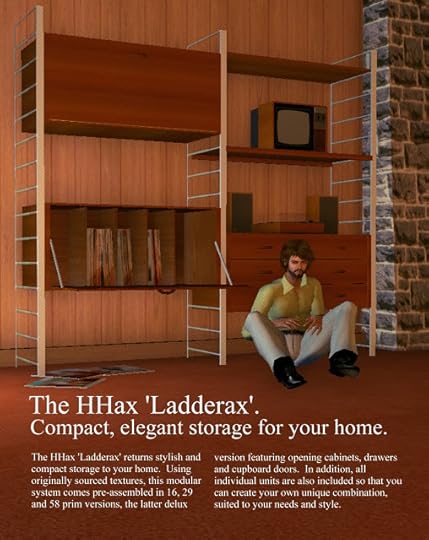
I've been fiddling with my collection of home-made 60s/70s furniture for so long now, the notion of eventually selling them has become something of an in-joke amongst the few people who know this fondness of mine. Happily, I'm now able to announce that I finally have a store on the marketplace for these creations. Such is the length of time I've been tweaking these, they're either prim only or sculpty/prim combinations; the pricing of these items reflects this rather low-tech approach in this day and age of mesh and its associated low prim count. I can honestly say, however, that an awful lot of love and attention to detail has gone into re-creating in SL these Danish teak icons of my childhood. Several of them are based on real life items I have access to and have measured, photographed and even - yes - recorded so that the dimensions, textures and sounds are just right.
The ladderax you see above, for example, has its interior and exterior textures provided from photographs of its real life counterpart, plus the sound the cabinet doors make as they open and shut are the actual sounds those cabinet doors make, painstakingly recorded and uploaded to SL. Oh yes, the doors open and shut. Plus the drawers open and shut. But if functionality isn't your thing in SL, there are also prim-reduced, decorative only builds plus all of the individual units in decorative and functional formats so that you can create your own ladderax combinations.
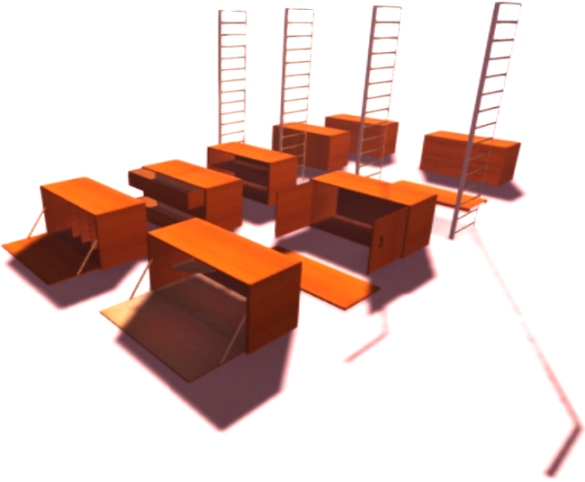
It currently is my ambition to create mesh versions of these items also, so the prim count will hopefully come down eventually. Given that it's taken me the best part of six years to bring these items to the marketplace, however, I wouldn't hold your breath for these. That said, I've really enjoyed getting back into building these last few weeks and the mood is still with me, so expect at least a few more items to be added to my shop. In fact, I'm currently working on a bed and discovering the tedium of pose adjustment. Stay tuned...
March 31, 2013
AFK, Again (2013) by Huckleberry Hax
 I don't believe in God and I don't believe in the Devil, but I do believe that life is an ongoing battle between good and evil. Good is optimism and compassion and gentleness and empathy and joy. Evil is hatred and anger and bitterness and jealousy and apathy. And the only thing which can be found in both good and evil... is love.
THE RETURN OF THURSDAY
Step Stransky is dead and now all that Definitely Thursday - the remaining partner of the Step Stransky Second Life (R) Detective Agency - has to do is live with the fact of being his killer.
'AFK, Again' is the new sequel by Huckleberry Hax to his popular 2007 novel, 'AFK'.
Available formats
Paperback: £8.99 £6.74 Kindle: $0.99 Online (Flash): Free
Support independent authors by leaving a rating/review
Independent authors don't have large advertising budgets; feedback and ratings, therefore, are the most effective way to show that their work is being purchased and enjoyed. If you have enjoyed this novel, please consider leaving a rating or review at Amazon or whichever other service you obtained it from. It will take you five minutes and cost you nothing, but will help me enormously. Thank you :)
March 17, 2013
Second Life Updates
Here's my March column for AVENUE magazine. Photography this month is by Ziki Questi.
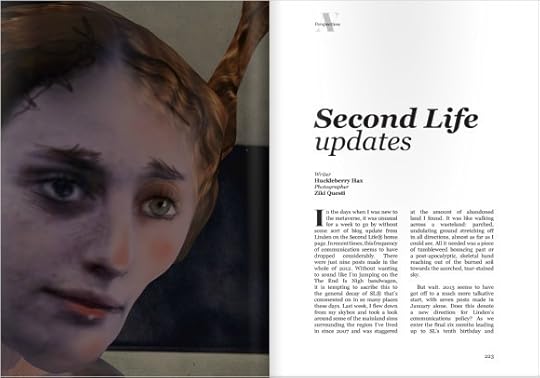
In the days when I was new to the metaverse, it was unusual for a week to go by without some sort of blog update from Linden on the Second Life® home page. In recent times, this frequency of communication seems to have dropped considerably. There were just nine posts made in the whole of 2012. Without wanting to sound like I’m jumping on the The End Is Nigh bandwagon, it is tempting to ascribe this to the general decay of SL commented on in so many places these days. It is, after all, a decay that can be seen in many places. Last week, I flew down from my skybox and took a look around some of the mainland sims surrounding the region I’ve lived in since 2007 and was staggered at the amount of abandoned land I found. It was like walking across a wasteland: parched, undulating ground stretching off in all directions, almost as far as I could see. All it needed was a piece of tumbleweed bouncing past or a post-apocalyptic, skeletal hand reaching out of the burned soil towards the scorched, tear-stained sky.
But wait. 2013 seems to have got off to a much more talkative start, with seven posts made in January alone. Does this denote a new direction for Linden’s communications policy? As we enter the final six months leading up to SL’s tenth birthday and the potential associated media attention, is Linden stepping up its Be Friendly Towards Residents campaign? My curiosity piqued, I decided to take a look at what topics our governors have deemed fit for discussion with us.
The first was the announcement that SL is now available to purchase as a product from amazon.com. Yes. It’s listed under the ‘Video Games’ section of the website, in fact (and let’s not get into the ‘it’s not a game’ debate right now; no matter how right you are, the people you’re making the point to will always regard anything that moves on a computer screen and isn’t a video of an amusing cat on YouTube as a game; in any case, there isn’t a section at Amazon for ‘Metaverses and Virtual Worlds’ so where do you suggest they put it? ‘Patio, Lawn & Garden’?). As well as the basic free download, you can also acquire various inventory ‘packs’ for sums of actual money. The ‘Premium Vehicle Pack’ bundles a sailing boat, a dune buggy and a hoverboard with L$4,000 for the real world price of $24.95, whilst the ‘Deluxe Vehicle Pack’, retailing at $14.95, contains only the hoverboard, sailing boat and L$2,000. I suppose the best way to think about these things is as SL gift vouchers, only ones which cost more than the value of the cash they come with and which have thrown in a couple of novelty items you might use if you’re a newbie for as long as it takes you to discover the experience of crossing a sim border.
Speaking as someone who’s neither seen nor stepped upon a hoverboard in SL, I’m struggling to accept this as the hitherto undiscovered hook that’s going to reel in metaverse newcomers by the million, yet the ‘Starter Vehicle Pack’ ($9.95) contains just this item and a mere L$1,000. Yes: out of all three vehicles created for this stunning new marketing tool, the one that Linden thinks people are most likely to buy by itself is the one that doesn’t actually exist in the real world, which can’t take any passengers, which is difficult to see and aesthetically appreciate when it’s being used and – let’s be honest – which is most likely to annoy other people. What’s more, the ‘Hoverboard Bonus Pack’ contains only hoverboard extras – no lindens whatsoever – and costs $12.95! I rarely use exclamation marks in non-fiction, but this surely merits a minimum of three (you should be respecting me for my restraint). But if you think I’m against the idea of Amazon SL packs then you’re wrong. In fact, I intend to dedicate next month’s column to an analysis of the virtual bundles we might actually find enticing.
Returning to the list of Linden January blog posts, two of these concern the all-new ‘Quicktips’ video tutorials prepared by Linden for newbies. The first is a one minute introduction to avatar appearance, the second a guide to buying and unpacking items. Naturally, the latter cannot possibly fit into a minute and spends instead a second under three trying to make the various caveats to SL shopping (items bought should appear in your received items folder… except they might come in a box… and boxes need to be rezzed on land to be unpacked… oh, but not all land can be rezzed on… you need a sandbox (no explanation is given as to what a sandbox is)… click on the box to unpack it… oh wait, some boxes don’t unpack automatically…) sound easy. All credit to the narrator – who sounds suspiciously like Torley Linden – for resisting the urge to scream hysterically, Why are sellers STILL packing items into boxes and not even providing land to unpack them on? Then again, it does rather sound like he’s reading from a pre-prepared script, possibly with a gun to his head.
Another of the blog posts concerns interesting developments in the SL use of the Leap Motion controller, an as yet to be released controller device that reads real life movement in a manner presumably not all that different from Microsoft’s Xbox Kinect. A video clip embedded in the post demonstrates the use of the device to control with hand movements the movement of an avatar, the positioning and sizing of objects (because we’re all still building stuff out of prims), and the activation of gestures. Regular readers of my column will know I see a healthy future for real life movement metaverse interface; at the same time, anything which makes it any easier for people to unleash those twenty-something lines of ASCII spam across my screen or pre-recorded, not-even-funny-in-the-context-of-the-original-movie sound clips must carry with it the threat of the death penalty. So be warned, developers. Be warned.
Last of all, Linden’s started posting on its blog highlights from its Destination Guide – a handful of destinations per blog post with a picture and a paragraph each to whet your exploration appetite. The most recent of these was themed around new art installations. It’s been a while since I looked at some SL art and I was in the mood for something to cheer me up from the wastelands below my skybox, so I picked a couple of these – Citysphere and Bryn Oh’s sim-sized ‘Imogen and the Pigeons’ and jumped into the teleport.
Citysphere is a large sphere covered in skyscrapers that you can walk around as though it’s a small planet; sort of an SL ecumenopolis that – apparently – gets three times the land space of a sim onto its surface area, although the buildings have no actual function. Sticking to the ground as you walk around the miniature Trantor is achieved by means of a special sit script that enables you to walk normally whilst everything slowly turns upside down. It’s more than a little disorientating to see your avatar dangling from the ceiling – by which I mean ground – and I couldn’t decide whether a reorientation script hadn’t been included a) because the artist didn’t know how to write one or b) because however irritating, dizzying and nauseating it might have been, the effect is a powerful reminder that we’re all of us upside-down to somebody. I’m guessing now probably (b). It is art, after all.
And then there’s ‘Imogen and the Pigeons’, which deposits the arriving visitor in a wasteland not entirely dissimilar to my local SL neighbourhood, except with added cooling towers. Wound around one of them, a thin spiral staircase (watch your step, there’s no railing) is one route up to the hundred metre high entrance to the main exhibit; a set of fallen blocks that arrange themselves into a staircase as you step on them (but turn the wrong way and they all fall back to the ground) is a second; a whirly chair for the can’t-be-arsed-with-precision-movement avatars like yours truly is a third and if you’re really lazy there’s a teleport ball in the middle cooling tower that’ll take you straight there. Thus, you arrive at the reception to the Therapist’s office, one of many narrative signs informing you: An unfortunate space / that the printers missed, / changed the psychologist’s plaque / to read “The rapist” / Sadly the mistake / was not far from true, / as the therapist had / destroyed a mind or two. That sort of therapist, then. In the office, we discover him examining his dead butterfly collection, each insect labelled with the name of one of his patients, except the butterfly for Imogen is missing. He was the type of man / who felt he saw much clearer / from the darkened side / of a one-way mirror. A few locations later, we find Imogen in bed in her room in the hospital and gazing out of the window at her free friends, the pigeons, gathered together on the telephone wire. On the sill, Imogen’s still alive butterfly flaps its wings in a glass jar and clicking this takes you to an online video clip of Bryn releasing a newly metamorphosed butterfly into the sky. ‘Imogen and the Pigeons’ is absolutely packed with puzzles and detail that I couldn’t even begin to describe here. What began as an intended five minute excursion ended up as a full hour exploring the various nooks and crannies of this enormous exhibit, and even then I left feeling I’d only scratched the surface. You could very easily spend a whole day exploring it. It is immense.
I’m glad that Linden appear to have decided we’re worth talking to again. ‘Imogen and the Pigeons’ was also the perfect antidote to all that nothingness now surrounding my home and the vague worry that SL has lost its ability to move and inspire me. Of course, the plus side of being surrounded by wasteland where I live is I could have a lot of fun racing around down there in some sort of buggy. Aha. Suddenly, the Amazon Premium Vehicle pack makes sense…
In the days when I was new to the metaverse, it was unusual for a week to go by without some sort of blog update from Linden on the Second Life® home page. In recent times, this frequency of communication seems to have dropped considerably. There were just nine posts made in the whole of 2012. Without wanting to sound like I’m jumping on the The End Is Nigh bandwagon, it is tempting to ascribe this to the general decay of SL commented on in so many places these days. It is, after all, a decay that can be seen in many places. Last week, I flew down from my skybox and took a look around some of the mainland sims surrounding the region I’ve lived in since 2007 and was staggered at the amount of abandoned land I found. It was like walking across a wasteland: parched, undulating ground stretching off in all directions, almost as far as I could see. All it needed was a piece of tumbleweed bouncing past or a post-apocalyptic, skeletal hand reaching out of the burned soil towards the scorched, tear-stained sky.
But wait. 2013 seems to have got off to a much more talkative start, with seven posts made in January alone. Does this denote a new direction for Linden’s communications policy? As we enter the final six months leading up to SL’s tenth birthday and the potential associated media attention, is Linden stepping up its Be Friendly Towards Residents campaign? My curiosity piqued, I decided to take a look at what topics our governors have deemed fit for discussion with us.
The first was the announcement that SL is now available to purchase as a product from amazon.com. Yes. It’s listed under the ‘Video Games’ section of the website, in fact (and let’s not get into the ‘it’s not a game’ debate right now; no matter how right you are, the people you’re making the point to will always regard anything that moves on a computer screen and isn’t a video of an amusing cat on YouTube as a game; in any case, there isn’t a section at Amazon for ‘Metaverses and Virtual Worlds’ so where do you suggest they put it? ‘Patio, Lawn & Garden’?). As well as the basic free download, you can also acquire various inventory ‘packs’ for sums of actual money. The ‘Premium Vehicle Pack’ bundles a sailing boat, a dune buggy and a hoverboard with L$4,000 for the real world price of $24.95, whilst the ‘Deluxe Vehicle Pack’, retailing at $14.95, contains only the hoverboard, sailing boat and L$2,000. I suppose the best way to think about these things is as SL gift vouchers, only ones which cost more than the value of the cash they come with and which have thrown in a couple of novelty items you might use if you’re a newbie for as long as it takes you to discover the experience of crossing a sim border.
Speaking as someone who’s neither seen nor stepped upon a hoverboard in SL, I’m struggling to accept this as the hitherto undiscovered hook that’s going to reel in metaverse newcomers by the million, yet the ‘Starter Vehicle Pack’ ($9.95) contains just this item and a mere L$1,000. Yes: out of all three vehicles created for this stunning new marketing tool, the one that Linden thinks people are most likely to buy by itself is the one that doesn’t actually exist in the real world, which can’t take any passengers, which is difficult to see and aesthetically appreciate when it’s being used and – let’s be honest – which is most likely to annoy other people. What’s more, the ‘Hoverboard Bonus Pack’ contains only hoverboard extras – no lindens whatsoever – and costs $12.95! I rarely use exclamation marks in non-fiction, but this surely merits a minimum of three (you should be respecting me for my restraint). But if you think I’m against the idea of Amazon SL packs then you’re wrong. In fact, I intend to dedicate next month’s column to an analysis of the virtual bundles we might actually find enticing.
Returning to the list of Linden January blog posts, two of these concern the all-new ‘Quicktips’ video tutorials prepared by Linden for newbies. The first is a one minute introduction to avatar appearance, the second a guide to buying and unpacking items. Naturally, the latter cannot possibly fit into a minute and spends instead a second under three trying to make the various caveats to SL shopping (items bought should appear in your received items folder… except they might come in a box… and boxes need to be rezzed on land to be unpacked… oh, but not all land can be rezzed on… you need a sandbox (no explanation is given as to what a sandbox is)… click on the box to unpack it… oh wait, some boxes don’t unpack automatically…) sound easy. All credit to the narrator – who sounds suspiciously like Torley Linden – for resisting the urge to scream hysterically, Why are sellers STILL packing items into boxes and not even providing land to unpack them on? Then again, it does rather sound like he’s reading from a pre-prepared script, possibly with a gun to his head.
Another of the blog posts concerns interesting developments in the SL use of the Leap Motion controller, an as yet to be released controller device that reads real life movement in a manner presumably not all that different from Microsoft’s Xbox Kinect. A video clip embedded in the post demonstrates the use of the device to control with hand movements the movement of an avatar, the positioning and sizing of objects (because we’re all still building stuff out of prims), and the activation of gestures. Regular readers of my column will know I see a healthy future for real life movement metaverse interface; at the same time, anything which makes it any easier for people to unleash those twenty-something lines of ASCII spam across my screen or pre-recorded, not-even-funny-in-the-context-of-the-original-movie sound clips must carry with it the threat of the death penalty. So be warned, developers. Be warned.
Last of all, Linden’s started posting on its blog highlights from its Destination Guide – a handful of destinations per blog post with a picture and a paragraph each to whet your exploration appetite. The most recent of these was themed around new art installations. It’s been a while since I looked at some SL art and I was in the mood for something to cheer me up from the wastelands below my skybox, so I picked a couple of these – Citysphere and Bryn Oh’s sim-sized ‘Imogen and the Pigeons’ and jumped into the teleport.
Citysphere is a large sphere covered in skyscrapers that you can walk around as though it’s a small planet; sort of an SL ecumenopolis that – apparently – gets three times the land space of a sim onto its surface area, although the buildings have no actual function. Sticking to the ground as you walk around the miniature Trantor is achieved by means of a special sit script that enables you to walk normally whilst everything slowly turns upside down. It’s more than a little disorientating to see your avatar dangling from the ceiling – by which I mean ground – and I couldn’t decide whether a reorientation script hadn’t been included a) because the artist didn’t know how to write one or b) because however irritating, dizzying and nauseating it might have been, the effect is a powerful reminder that we’re all of us upside-down to somebody. I’m guessing now probably (b). It is art, after all.
And then there’s ‘Imogen and the Pigeons’, which deposits the arriving visitor in a wasteland not entirely dissimilar to my local SL neighbourhood, except with added cooling towers. Wound around one of them, a thin spiral staircase (watch your step, there’s no railing) is one route up to the hundred metre high entrance to the main exhibit; a set of fallen blocks that arrange themselves into a staircase as you step on them (but turn the wrong way and they all fall back to the ground) is a second; a whirly chair for the can’t-be-arsed-with-precision-movement avatars like yours truly is a third and if you’re really lazy there’s a teleport ball in the middle cooling tower that’ll take you straight there. Thus, you arrive at the reception to the Therapist’s office, one of many narrative signs informing you: An unfortunate space / that the printers missed, / changed the psychologist’s plaque / to read “The rapist” / Sadly the mistake / was not far from true, / as the therapist had / destroyed a mind or two. That sort of therapist, then. In the office, we discover him examining his dead butterfly collection, each insect labelled with the name of one of his patients, except the butterfly for Imogen is missing. He was the type of man / who felt he saw much clearer / from the darkened side / of a one-way mirror. A few locations later, we find Imogen in bed in her room in the hospital and gazing out of the window at her free friends, the pigeons, gathered together on the telephone wire. On the sill, Imogen’s still alive butterfly flaps its wings in a glass jar and clicking this takes you to an online video clip of Bryn releasing a newly metamorphosed butterfly into the sky. ‘Imogen and the Pigeons’ is absolutely packed with puzzles and detail that I couldn’t even begin to describe here. What began as an intended five minute excursion ended up as a full hour exploring the various nooks and crannies of this enormous exhibit, and even then I left feeling I’d only scratched the surface. You could very easily spend a whole day exploring it. It is immense.
I’m glad that Linden appear to have decided we’re worth talking to again. ‘Imogen and the Pigeons’ was also the perfect antidote to all that nothingness now surrounding my home and the vague worry that SL has lost its ability to move and inspire me. Of course, the plus side of being surrounded by wasteland where I live is I could have a lot of fun racing around down there in some sort of buggy. Aha. Suddenly, the Amazon Premium Vehicle pack makes sense…
March 9, 2013
'AFK, Again' release date: 31 March 2013
Want to know what happens to SL detective Definitely Thursday following the shocking climax to 'AFK'? 'AFK, Again' will be released in paperback and ebook format on 31 March 2013. That's my sixth rezday, by the way ;)
February 14, 2013
The Evolution of Identity
Here's my February column for AVENUE magazine. Photography this month is by Annough Lykin.
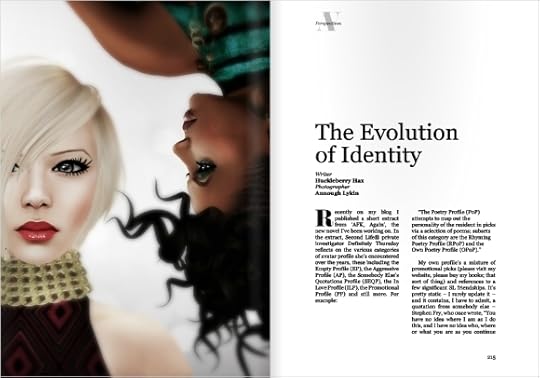
Recently on my blog I published a short extract from the new novel I’ve been working on, ‘AFK, Again’. In the extract, Second Life® private investigator Definitely Thursday reflects on the various categories of avatar profile she’s encountered over the years, these including the Empty Profile (EP), the Aggressive Profile (AP), the Somebody Else’s Quotations Profile (SEQP), the In Love Profile (ILP), the Promotional Profile (PP) and still more. For example:
“The Poetry Profile (PoP) attempts to map out the personality of the resident in picks via a selection of poems; subsets of this category are the Rhyming Poetry Profile (RPoP) and the Own Poetry Profile (OPoP).”
My own profile’s a mixture of promotional picks (please visit my website, please buy my books; that sort of thing) and references to a few significant SL friendships. It’s pretty static – I rarely update it – and it contains, I have to admit, a quotation from somebody else – Stephen Fry, who once wrote, "You have no idea where I am as I do this, and I have no idea who, where or what you are as you continue to read. We are connected by a filament of language that stretches from somewhere inside my brain to somewhere inside yours." He was referring to the relationship he had as a writer to his readers, which is why I personally have selected it, but I also think it’s a beautiful summary for the way we conduct our textual interactions in the metaverse.
Perhaps it seems like stating the bleeding obvious to say that our lives are becoming increasingly digital, but I don’t think society as a whole has yet grasped the larger ramifications of this. As the media gets itself all tied up in debates over privacy and the real life social cost of excessive amounts of time spent online, the issue of digital identity seems to have gone largely unexamined. The elderly throw their arms up in despair at the sheer ridiculousness of it all; the middle aged embrace it, but at the ‘bolt-on’ level where online interaction is an occasional additional social layer; the young, meanwhile, are living it: to them, the online world is increasingly interwoven with the offline world and where the one meets the other is becoming more and more blurred. I’m generalising, of course. And I’m certainly not suggesting that the young have got it right. I belong to the middle category and, whilst I’m undeniably just a little bit in love with some of the possibilities that online interaction offers, I’m also mindful that human beings have evolved to be with other human beings physically: it’s in our nature; it’s primal; it’s how we’re meant to be. The thing is, social trends are entities in their own right and pay little attention to such socio-biological truths. And, barring some big, unforeseen event that sends everyone fleeing from their computers in terror, we are now a long way past the point of no return to a non-digital way of existence. One could, of course, argue that our mission must be to escape the limitations imposed on us by evolution and biology, and that digital identity is one such escape route.
Evolution is fickle beast, full of apparent contradiction. It’s left us with predispositions and mechanisms that are both helpful and unhelpful in our modern age. On the one hand, we’ve evolved to live in groups and therefore survival of the fittest group has perhaps been a more important shaping factor to our genes than survival of the fittest individual over recent millennia. We know, for example, that hostility is a trait that leads to an increased risk of heart attack and it’s been suggested by means of an explanation for this that hostile people would have had a corrosive effect on hunter-gatherer tribe strength such that their death would ultimately be beneficial. We know that women tend to live longer than men, perhaps because their ability to care for the young in a tribe – ie, to continue to contribute – outlasted a man’s ability to hunt. There is also an emerging school of thought that a having different types of thinkers in your tribe would have been advantageous. The people we today diagnose as having ADHD could back then have been thought of as the fast hunter learners who acquired new skills simply through doing them. The people we today diagnose as having Asperger Syndrome could back then have been thought of as the thinkers who found new solutions to problems. As Temple Grandin once said, “Who do you think made the first stone spear? That wasn't the yakkity yaks sitting around the campfire. It was some Asperger sitting in the back of a cave figuring out how to chip rocks into spearheads.” Strength through diversity isn’t just a political correctness banner, it’s evolutionary fact.
On the other hand, tribal life meant competition and aggression from other tribes. This has left us with a strong fear of the unfamiliar, a desire to protect our status quo and a desperate need to strengthen our position within a group for fear it will reject us and leave us at the mercy of others. It’s possible that virtually all forms of prejudice and discrimination arise from this biological predisposition programmed into us by evolution. We make racist jokes because we have no connection with the targeted ethnicity – their ‘not-us-ness’ scare us – and because we hope we’ll get a laugh from the people we tell them too, making them better friends and less likely to exclude us.
It could be argued that the greatest contradiction of the evolved brain, however, is that it’s infinitely more complicated than perhaps it really needs to be, at least so far as survival within a tribe is concerned. Perhaps the original advantage brought about by its key distinguishing property – consciousness; awareness of self – is that it enabled us to step outside of our bodies mentally and, through this, gain a better understanding of the wider world around us: crucial for solving problems that require more than just instinctive knowledge. Out of this ability, however, came a whole set of other skills and properties, such as that of empathy, aesthetic appreciation and sense of identity. The more we’ve become conscious of social variation around us, the more we’ve sought to determine our own place within it.
In SL, the two places where we can give a first glance, ‘snapshot’ sense of our identity to others is through our avatar appearance and our profile. As I indicated earlier, the degree to which we use our profile as an identity tool varies from person to person and our individual usage also varies over time. The same could pretty much be said of avatar appearance. Huck has worn the same black shirt and jeans for the best part of a year, I’m afraid, but you shouldn’t infer from this that my avatar appearance is unimportant to me. In fact, I do have a range of outfits and when I’m inworld for more than a few days in a row I do attempt to rotate them. But all of my outfits still say pretty much the same thing about me: that I’m a quiet, unassuming guy. My shape says the same thing. Way back when the default male shape in SL seemed to be a cross between a Greek God of War and an American Football player, I basically wanted a skinnier, frankly weedier looking avatar. Years spent in real life not able or wanting to fit in with any sort of stereotypical alpha male behaviour has left me enthusiastic to express a more gentle, more intellectual maleness. I’ve had a few AOs over the years too, but I’ve always eschewed anything with any sort of threatening stand. My current AO is something of a fidget, always stretching and moving from foot to foot. It makes me look a little uneasy when I’m amongst a crowd of solid or graceful standers, which is fine by me because that’s exactly how I do feel amongst gatherings of people.
This said, however, it would be untrue to claim that these aspects of my identity are my soleidentity. As I wrote in my very first column for AVENUE, the whole beauty of SL and its anonymity is that it allows us to explore aspects of ourselves which we might not have had the courage to explore in real life. There is nothing preventing us from exploring more than one of these. We can do these in our existing avatars to a certain extent, however the same anonymity which facilitates the first online identity can also facilitate the second and the third and the fourth. I might decide to adopt a whole new writing style and persona, for example, spend time exaggerating my more eccentric qualities or live life as a female. For a while in 2011, I contemplated living as a pine cube with a gender-neutral name, just to see how people responded to someone where they had no cues whatsoever as to RL gender or lifestyle. One of the first things you discover in a new identity, after all, is that people respond to you completely differently. Identity is a socially constructed phenomenon. It’s a two-way thing.
There are plenty of dark sides to this fragmentation of identity, such as exploring the freedom to express hate views, deliberate deception or anonymous bullying – all topics I have written about in various ways over the years. This is by no means by default a peaceful human voyage that lies ahead of us. Like it or not, however, digital identity is going to be the big issue of the decades to come and it’s going to be a lot more complicated than sorting profiles into arbitrary categories. We need to start getting our heads around this issue and soon.
Recently on my blog I published a short extract from the new novel I’ve been working on, ‘AFK, Again’. In the extract, Second Life® private investigator Definitely Thursday reflects on the various categories of avatar profile she’s encountered over the years, these including the Empty Profile (EP), the Aggressive Profile (AP), the Somebody Else’s Quotations Profile (SEQP), the In Love Profile (ILP), the Promotional Profile (PP) and still more. For example:
“The Poetry Profile (PoP) attempts to map out the personality of the resident in picks via a selection of poems; subsets of this category are the Rhyming Poetry Profile (RPoP) and the Own Poetry Profile (OPoP).”
My own profile’s a mixture of promotional picks (please visit my website, please buy my books; that sort of thing) and references to a few significant SL friendships. It’s pretty static – I rarely update it – and it contains, I have to admit, a quotation from somebody else – Stephen Fry, who once wrote, "You have no idea where I am as I do this, and I have no idea who, where or what you are as you continue to read. We are connected by a filament of language that stretches from somewhere inside my brain to somewhere inside yours." He was referring to the relationship he had as a writer to his readers, which is why I personally have selected it, but I also think it’s a beautiful summary for the way we conduct our textual interactions in the metaverse.
Perhaps it seems like stating the bleeding obvious to say that our lives are becoming increasingly digital, but I don’t think society as a whole has yet grasped the larger ramifications of this. As the media gets itself all tied up in debates over privacy and the real life social cost of excessive amounts of time spent online, the issue of digital identity seems to have gone largely unexamined. The elderly throw their arms up in despair at the sheer ridiculousness of it all; the middle aged embrace it, but at the ‘bolt-on’ level where online interaction is an occasional additional social layer; the young, meanwhile, are living it: to them, the online world is increasingly interwoven with the offline world and where the one meets the other is becoming more and more blurred. I’m generalising, of course. And I’m certainly not suggesting that the young have got it right. I belong to the middle category and, whilst I’m undeniably just a little bit in love with some of the possibilities that online interaction offers, I’m also mindful that human beings have evolved to be with other human beings physically: it’s in our nature; it’s primal; it’s how we’re meant to be. The thing is, social trends are entities in their own right and pay little attention to such socio-biological truths. And, barring some big, unforeseen event that sends everyone fleeing from their computers in terror, we are now a long way past the point of no return to a non-digital way of existence. One could, of course, argue that our mission must be to escape the limitations imposed on us by evolution and biology, and that digital identity is one such escape route.
Evolution is fickle beast, full of apparent contradiction. It’s left us with predispositions and mechanisms that are both helpful and unhelpful in our modern age. On the one hand, we’ve evolved to live in groups and therefore survival of the fittest group has perhaps been a more important shaping factor to our genes than survival of the fittest individual over recent millennia. We know, for example, that hostility is a trait that leads to an increased risk of heart attack and it’s been suggested by means of an explanation for this that hostile people would have had a corrosive effect on hunter-gatherer tribe strength such that their death would ultimately be beneficial. We know that women tend to live longer than men, perhaps because their ability to care for the young in a tribe – ie, to continue to contribute – outlasted a man’s ability to hunt. There is also an emerging school of thought that a having different types of thinkers in your tribe would have been advantageous. The people we today diagnose as having ADHD could back then have been thought of as the fast hunter learners who acquired new skills simply through doing them. The people we today diagnose as having Asperger Syndrome could back then have been thought of as the thinkers who found new solutions to problems. As Temple Grandin once said, “Who do you think made the first stone spear? That wasn't the yakkity yaks sitting around the campfire. It was some Asperger sitting in the back of a cave figuring out how to chip rocks into spearheads.” Strength through diversity isn’t just a political correctness banner, it’s evolutionary fact.
On the other hand, tribal life meant competition and aggression from other tribes. This has left us with a strong fear of the unfamiliar, a desire to protect our status quo and a desperate need to strengthen our position within a group for fear it will reject us and leave us at the mercy of others. It’s possible that virtually all forms of prejudice and discrimination arise from this biological predisposition programmed into us by evolution. We make racist jokes because we have no connection with the targeted ethnicity – their ‘not-us-ness’ scare us – and because we hope we’ll get a laugh from the people we tell them too, making them better friends and less likely to exclude us.
It could be argued that the greatest contradiction of the evolved brain, however, is that it’s infinitely more complicated than perhaps it really needs to be, at least so far as survival within a tribe is concerned. Perhaps the original advantage brought about by its key distinguishing property – consciousness; awareness of self – is that it enabled us to step outside of our bodies mentally and, through this, gain a better understanding of the wider world around us: crucial for solving problems that require more than just instinctive knowledge. Out of this ability, however, came a whole set of other skills and properties, such as that of empathy, aesthetic appreciation and sense of identity. The more we’ve become conscious of social variation around us, the more we’ve sought to determine our own place within it.
In SL, the two places where we can give a first glance, ‘snapshot’ sense of our identity to others is through our avatar appearance and our profile. As I indicated earlier, the degree to which we use our profile as an identity tool varies from person to person and our individual usage also varies over time. The same could pretty much be said of avatar appearance. Huck has worn the same black shirt and jeans for the best part of a year, I’m afraid, but you shouldn’t infer from this that my avatar appearance is unimportant to me. In fact, I do have a range of outfits and when I’m inworld for more than a few days in a row I do attempt to rotate them. But all of my outfits still say pretty much the same thing about me: that I’m a quiet, unassuming guy. My shape says the same thing. Way back when the default male shape in SL seemed to be a cross between a Greek God of War and an American Football player, I basically wanted a skinnier, frankly weedier looking avatar. Years spent in real life not able or wanting to fit in with any sort of stereotypical alpha male behaviour has left me enthusiastic to express a more gentle, more intellectual maleness. I’ve had a few AOs over the years too, but I’ve always eschewed anything with any sort of threatening stand. My current AO is something of a fidget, always stretching and moving from foot to foot. It makes me look a little uneasy when I’m amongst a crowd of solid or graceful standers, which is fine by me because that’s exactly how I do feel amongst gatherings of people.
This said, however, it would be untrue to claim that these aspects of my identity are my soleidentity. As I wrote in my very first column for AVENUE, the whole beauty of SL and its anonymity is that it allows us to explore aspects of ourselves which we might not have had the courage to explore in real life. There is nothing preventing us from exploring more than one of these. We can do these in our existing avatars to a certain extent, however the same anonymity which facilitates the first online identity can also facilitate the second and the third and the fourth. I might decide to adopt a whole new writing style and persona, for example, spend time exaggerating my more eccentric qualities or live life as a female. For a while in 2011, I contemplated living as a pine cube with a gender-neutral name, just to see how people responded to someone where they had no cues whatsoever as to RL gender or lifestyle. One of the first things you discover in a new identity, after all, is that people respond to you completely differently. Identity is a socially constructed phenomenon. It’s a two-way thing.
There are plenty of dark sides to this fragmentation of identity, such as exploring the freedom to express hate views, deliberate deception or anonymous bullying – all topics I have written about in various ways over the years. This is by no means by default a peaceful human voyage that lies ahead of us. Like it or not, however, digital identity is going to be the big issue of the decades to come and it’s going to be a lot more complicated than sorting profiles into arbitrary categories. We need to start getting our heads around this issue and soon.


