
Huckleberry Hax's Blog, page 47
October 14, 2012
The Return of Thursday
NaNoWriMo 2012 is just over two weeks away; I'm delighted to announce I'll be entering the annual novel writing contest once more. My intention this year is to attempt to satisfy the many calls for a sequel to AFK. It's been five years since I wrote this - my first and most popular (by a very considerable margin) SL novel - and I'm looking forward to putting down what becomes of Definitely Thursday and Inch Sideways... and hopefully avoiding the law of diminishing returns and disappointing everyone. Just remember - you asked for it!
Written during my very first year in SL, AFK is as much a reflection on the wonder of discovering SL as it is an SL detective story. A lot has happened since then - both in SL and to my own relationship with it - and it's taken a period of time out of the metaverse for me to reflect on this amazing place some more and come up with some new ideas for exploration. As with all NaNo novels, of course, a lot of it will also be made up as I go along :p
Stay tuned for exerpts whilst I write and, of course, the completed book (assuming, of course, I'm successful again) will be availble for you to download for free in the new year (or as a Christmas present if I'm extra efficient this year.
I the meantime, if you haven't yet read the original, you can download it (for free) via this page.
Written during my very first year in SL, AFK is as much a reflection on the wonder of discovering SL as it is an SL detective story. A lot has happened since then - both in SL and to my own relationship with it - and it's taken a period of time out of the metaverse for me to reflect on this amazing place some more and come up with some new ideas for exploration. As with all NaNo novels, of course, a lot of it will also be made up as I go along :p
Stay tuned for exerpts whilst I write and, of course, the completed book (assuming, of course, I'm successful again) will be availble for you to download for free in the new year (or as a Christmas present if I'm extra efficient this year.
I the meantime, if you haven't yet read the original, you can download it (for free) via this page.


September 14, 2012
Proposing the Second Life® Games
Here's my September column for AVENUE magazine. I had a lot of fun thinking up and writing this article; the cherry on the cake, however, was Eve Kazan's quite amazing photography to accompany it.
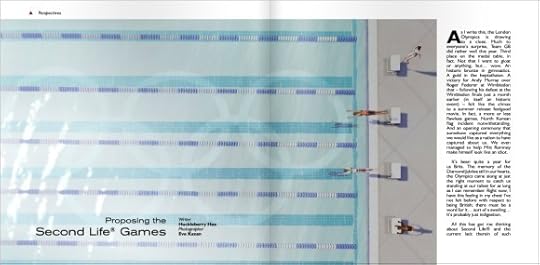 As I write this, the London Olympics is drawing to a close. Much to everyone’s surprise, we did rather well this year. Third place on the medal table, in fact. Not that I want to gloat or anything, but… wow. An historic bronze in gymnastics. A gold in the heptathalon. A victory for Andy Murray over Roger Federer at Wimbledon that – following his defeat at the Wimbledon finals just a month earlier (in itself an historic event) – felt like the climax to a summer release feelgood movie. In fact, a more or less flawless games, North Korean flag incident notwithstanding. And an opening ceremony that somehow captured everything we would like as a nation to have captured about us. We even managed to help Mitt Romney make himself look like an idiot.
It’s been quite a year for us Brits. The memory of the Diamond Jubilee still in our hearts, the Olympics came along at just the right moment to catch us standing at our tallest for as long as I can remember. Right now, I have this feeling in my chest I’ve not felt before with respect to being British; there must be a word for it… sort of a swelling… It’s probably just indigestion.
All this has got me thinking about Second Life® and the current lack therein of such positive feelings. We need our own Olympics, I’ve decided; something that brings us together, celebrates our skills and similarly swells our chests at being part of the amazing metaverse revolution. And, after much reflection, I propose the following events:
100m Lag Hurdles. The more spectators the better in this exciting and dramatic event. Flying is of course prohibited and competitors receive penalties for sailing through hurdles in a lag bubble. Although it’s tempting to propose that the hurdles themselves be made physical so that they fall on impact, a scripted response to contact will probably be preferable in order to avoid hurdles flying around the stadium according to Linden’s somewhat bizarre laws of motion. Alternatively, hurdles could be made physical and unlinked, the resulting prim explosions serving the additional function of a celebratory firework display. Expect the event to take about five hours and several sim-restarts to complete.
Championship Outfit Changing.Starting with plain white gym shorts and t-shirts, competitors race to be the first to strip down (underwear is obligatory in this popular family event) and put on – item-by-item, and in a pre-determined order – an outfit supplied by one of the games sponsors. Extra points can be earned for added flair through improvised emotes, as judged by a panel of literary experts.
Mainland Sim Marathon.Starting at Bear InfoHub (being the originator of the SL Games, I get to decide such things) and following the main road, a minimum of 50 competitors race a track through 26 sims (or multiple thereof). This unticketed event will allow spectators from all over the grid to enjoy watching these prime avatar athletes battle it out, not to mention provide expanded advertising space. Security for this event will include air-to-ground missiles in case any car-owning residents should contemplate imposing their own ‘Tenpin Avatar Bowling’ contest upon it.
Synchronised Avatar Swimming. Teams of eight avatars present performances consisting of sequenced animations from stores of their choice, however a minimum of ten per cent of these must be from dollarbie vendors and include – in a contextually appropriate manner – at least one sitting-with-legs-crossed pose. Athletes are required to select each pose during the sequence from their inventory, a policy which is enforced trough random HUD testing.
Teleportation Triathlon. This trio of events aims to find the best overall TP Olympian. In Full Sim Sprint, avatars compete in groups of ten to be the first to spot a vacant space in a full mainland sim and teleport into it. In Accidental Random TP Acceptance, competitors must accept a TP request whilst running a four sim circuit and are then timed to see how quickly they can get back to the exact spot on the track they were at when they clicked on ‘Ok’. In Suspected Infidelity Speedway, avatars attempt to set the lowest time for teleporting into a named sim, locating the target avatar with their cam and teleporting back out again.
Championship Chat Spam Archery. In this individual event, competitors take it in turns to stand in the middle of a nightclub mock-up surrounded by twenty dancing avatars. At random intervals, one of the dancers spouts chat spam that fills up the screen (the werewolf howling thing, probably; a committee will make the final decision). The competitor is then timed to see how quickly s/he can locate the spammer and shoot them with a prim bow and arrow. Extra points will be earned for a shot between the eyes.
Team Gymnastics event: the TP Tower. Teams from each of the mainland continents compete under a time pressure to create the highest tower of avatars formed by teleporting in someone on top of their heads. Points are deducted for any avies that appear in ‘walking on the spot mode’ but added for upside down materialisations. On the issue of team entry, private islands will be divided into north, south, east and west so that they may form their own co-operatives. Team Zindra will carefully monitored.
Underground Exit Swimming. Less well-known than the TP of Death is the TP of Depth which, rather than sending you outworld following a teleport attempt, transports you to the waters beneath whatever building it had been your intention to leave. Swimmers compete individually in this event, which teleports them initially to the waters beneath a popular casualwear shopping destination, to be the fastest to find a point at which they can surface. As an extra complication, this voice event requires entrants to hold their breath in RL.
Championship IM Juggling. Starting at three, competitors must manage an increasing number of parallel instant message conversations, the time between a correspondent’s and their own Return key being hit (measured to the nearest hundredth of a second) being added to the correspondents’ ratings for the quality of conversation experienced. Topics are drawn from the last seven days of world affairs and use of the ‘lol’ term or any associated acronym (asses off or affixed) is strictly prohibited. Emoticons are permitted, but only as part of a sentence. This event employs the full-nosed smiley of a colon, a dash and a closed bracket; use of the abbreviated smiley of a colon and closed bracket only incurs a five point penalty.
Newbie Hoopla. No further explanation required. An adult only event.
Yes, I can see it now: the joy; the glory; the copybotted merchandise; the last minute hunt to find a sim to host the stadium; the arguments over how the medals table is calculated; the boycotting of the games by Gorean roleplayers in response to the controversial ‘no leashes’ rule. This is what SL needs to bring everyone together; a grid-wide event in which everyone can play a role.
And maybe – just possibly – we might – kind of like us Brits this year – come to realise along the way that actually we’re a pretty grand collection of people with more in common than we realise.
You never know. HH

As I write this, the London Olympics is drawing to a close. Much to everyone’s surprise, we did rather well this year. Third place on the medal table, in fact. Not that I want to gloat or anything, but… wow. An historic bronze in gymnastics. A gold in the heptathalon. A victory for Andy Murray over Roger Federer at Wimbledon that – following his defeat at the Wimbledon finals just a month earlier (in itself an historic event) – felt like the climax to a summer release feelgood movie. In fact, a more or less flawless games, North Korean flag incident notwithstanding. And an opening ceremony that somehow captured everything we would like as a nation to have captured about us. We even managed to help Mitt Romney make himself look like an idiot.It’s been quite a year for us Brits. The memory of the Diamond Jubilee still in our hearts, the Olympics came along at just the right moment to catch us standing at our tallest for as long as I can remember. Right now, I have this feeling in my chest I’ve not felt before with respect to being British; there must be a word for it… sort of a swelling… It’s probably just indigestion.
All this has got me thinking about Second Life® and the current lack therein of such positive feelings. We need our own Olympics, I’ve decided; something that brings us together, celebrates our skills and similarly swells our chests at being part of the amazing metaverse revolution. And, after much reflection, I propose the following events:
100m Lag Hurdles. The more spectators the better in this exciting and dramatic event. Flying is of course prohibited and competitors receive penalties for sailing through hurdles in a lag bubble. Although it’s tempting to propose that the hurdles themselves be made physical so that they fall on impact, a scripted response to contact will probably be preferable in order to avoid hurdles flying around the stadium according to Linden’s somewhat bizarre laws of motion. Alternatively, hurdles could be made physical and unlinked, the resulting prim explosions serving the additional function of a celebratory firework display. Expect the event to take about five hours and several sim-restarts to complete.
Championship Outfit Changing.Starting with plain white gym shorts and t-shirts, competitors race to be the first to strip down (underwear is obligatory in this popular family event) and put on – item-by-item, and in a pre-determined order – an outfit supplied by one of the games sponsors. Extra points can be earned for added flair through improvised emotes, as judged by a panel of literary experts.
Mainland Sim Marathon.Starting at Bear InfoHub (being the originator of the SL Games, I get to decide such things) and following the main road, a minimum of 50 competitors race a track through 26 sims (or multiple thereof). This unticketed event will allow spectators from all over the grid to enjoy watching these prime avatar athletes battle it out, not to mention provide expanded advertising space. Security for this event will include air-to-ground missiles in case any car-owning residents should contemplate imposing their own ‘Tenpin Avatar Bowling’ contest upon it.
Synchronised Avatar Swimming. Teams of eight avatars present performances consisting of sequenced animations from stores of their choice, however a minimum of ten per cent of these must be from dollarbie vendors and include – in a contextually appropriate manner – at least one sitting-with-legs-crossed pose. Athletes are required to select each pose during the sequence from their inventory, a policy which is enforced trough random HUD testing.
Teleportation Triathlon. This trio of events aims to find the best overall TP Olympian. In Full Sim Sprint, avatars compete in groups of ten to be the first to spot a vacant space in a full mainland sim and teleport into it. In Accidental Random TP Acceptance, competitors must accept a TP request whilst running a four sim circuit and are then timed to see how quickly they can get back to the exact spot on the track they were at when they clicked on ‘Ok’. In Suspected Infidelity Speedway, avatars attempt to set the lowest time for teleporting into a named sim, locating the target avatar with their cam and teleporting back out again.
Championship Chat Spam Archery. In this individual event, competitors take it in turns to stand in the middle of a nightclub mock-up surrounded by twenty dancing avatars. At random intervals, one of the dancers spouts chat spam that fills up the screen (the werewolf howling thing, probably; a committee will make the final decision). The competitor is then timed to see how quickly s/he can locate the spammer and shoot them with a prim bow and arrow. Extra points will be earned for a shot between the eyes.
Team Gymnastics event: the TP Tower. Teams from each of the mainland continents compete under a time pressure to create the highest tower of avatars formed by teleporting in someone on top of their heads. Points are deducted for any avies that appear in ‘walking on the spot mode’ but added for upside down materialisations. On the issue of team entry, private islands will be divided into north, south, east and west so that they may form their own co-operatives. Team Zindra will carefully monitored.
Underground Exit Swimming. Less well-known than the TP of Death is the TP of Depth which, rather than sending you outworld following a teleport attempt, transports you to the waters beneath whatever building it had been your intention to leave. Swimmers compete individually in this event, which teleports them initially to the waters beneath a popular casualwear shopping destination, to be the fastest to find a point at which they can surface. As an extra complication, this voice event requires entrants to hold their breath in RL.
Championship IM Juggling. Starting at three, competitors must manage an increasing number of parallel instant message conversations, the time between a correspondent’s and their own Return key being hit (measured to the nearest hundredth of a second) being added to the correspondents’ ratings for the quality of conversation experienced. Topics are drawn from the last seven days of world affairs and use of the ‘lol’ term or any associated acronym (asses off or affixed) is strictly prohibited. Emoticons are permitted, but only as part of a sentence. This event employs the full-nosed smiley of a colon, a dash and a closed bracket; use of the abbreviated smiley of a colon and closed bracket only incurs a five point penalty.
Newbie Hoopla. No further explanation required. An adult only event.
Yes, I can see it now: the joy; the glory; the copybotted merchandise; the last minute hunt to find a sim to host the stadium; the arguments over how the medals table is calculated; the boycotting of the games by Gorean roleplayers in response to the controversial ‘no leashes’ rule. This is what SL needs to bring everyone together; a grid-wide event in which everyone can play a role.
And maybe – just possibly – we might – kind of like us Brits this year – come to realise along the way that actually we’re a pretty grand collection of people with more in common than we realise.
You never know. HH
August 11, 2012
Pixel flesh matters
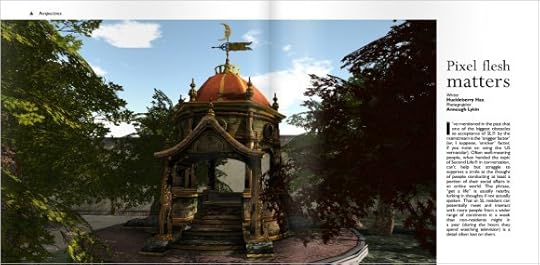
Here's my June column for AVENUE magazine. Photography this month is by Annough Lykin and features Canary Beck's KamaSutra Exotic Dance and Strip club.
I’ve mentioned in the past that one of the biggest obstacles to acceptance of SL by the mainstream is the ‘snigger factor’ (or, I suppose, ‘snicker’ factor, if you insist on using the US vernacular). Often well-meaning people, when handed the topic of Second Life® in conversation, can’t help but struggle to suppress a smile at the thought of people conducting at least a portion of their social affairs in an online world. The phrase, “get a life” is usually nearby, lurking in thoughts if not actually spoken. That an SL® resident can potentially meet and interact with more people from a wider range of continents in a week than non-residents might in a year (during the hours they spend watching television) is a detail often lost on them.
In fairness, friendships and collaborative creativity probably aren’t what most of those people are thinking about whilst they’re busy suppressing (or not) those smiles: what they’re actually thinking about is all the online cybersex they’ve heard about and how utterly bizarre an idea this sounds. Any admission heard about spending time in SL gets somehow translated as, “I masturbate in front of my computer to scenes of cartoon sex.” Watching porn, by comparison, seems an almost mainstream activity.
Where the subject arises, quite a high proportion – but not all – of the people I’ve met inworld tell me they avoid telling their RL friends and family that they do SL for pretty much precisely this reason. A few mention early attempts – long ago abandoned – at convincing people that sex isn’t the only reason people go inworld, but it’s a bit hard to sound convincing when you know full well that sex is massive in SL. In the early days – on which SL’s folklore reputation remains built – you only had to take a few steps outside of your infohub to be bombarded with advertisements for sex halls, many of which were scattered very liberally about the mainland; it’s not hard to see, therefore, how this impression has been formed. Today, such establishments have been pushed by Linden into Adult rated sims and the mainland is free from most references, but one only has to log in to the Marketplace to see the enduring popularity of sex in SL, and that it sells.
Ultimately, though, what’s really remarkable is that the existence of sexual expression in the virtual world is in any way surprising, given its increasing visibility in the physical one. Life without sex, after all, would be like life without laughter or seeing the colour green; it pervades everything. Trying to deny or suppress its existence would be nothing short of Victorian in terms of wisdom. What non-residents should really be asking themselves, is not, “How is cybersex possible?” but, “What is it that makes SL sexuality good enough that people want it?” Is it just a poor substitute for a good RL sex life or does it offer something completely different worth checking out?
The answer to that last question depends entirely on your reality. Everyone has their own unique reality constructed from all the various social rules and mechanisms thrown at them in the years since their birth – although that’s not to say, of course, that realities can’t shift. Take nudity. Whether or not you experience a naked avatar as erotic depends a great deal on how common it is for you to experience both RL and SL nudity. Rezzing into an infohub and seeing the inevitable one or two naked newbies strolling up and down, for example, simply isn’t an arousing experience for the vast majority of people, although it might be if you’re a virgin in RL and this is your very first day in the metaverse. I remember thinking similar things in the sex halls I visited as a newbie myself and watching hoards of naked noobs hobbling from one set of pose balls to the next: there simply wasn’t anything special about it and the whole thing just looked silly. Clearly, however, mine was a minority view in that context.
But if your SL experience consists in the main of hanging around clothed avatars who guard their nudity in public to the same extent as one would in RL, the intimacy of naked exposure associated with real life nudity becomes mapped onto your concept of SL nudity. ‘Pixel flesh’ (a phrase I loathe with an intensity usually reserved for politicians and tabloid newspapers) suddenly becomes exciting because you’re being shown something that’s ordinarily kept hidden away. That you’re being shown it communicates closeness and trust, even if it is just a jpeg image stretched around the vague, hollow approximation of a human shape.
Some of today’s SL sex-themed venues are becoming more sophisticated and savvy than those early sex halls were. In a recent SL conversation I had with Canary Beck – proprietor of the KamaSutra Dance and Strip Club, a place of middle-eastern silks and mango colouring, and absolutely no sex balls – she explained to me that it’s the restriction of nudity and sexual activity that actually makes money in SL. To become a dancer at KamaSutra, you’re required to undertake a training programme in which the rules of the establishment and the principles of good emoting (right down to avoiding errors in spelling and grammar, I was immensely pleased to see; nothing spoils an erotic IM moment for some of us more than failing to type out the word ‘you’ in full). “We don't have, and will likely never have, open sex in the club,” she told me, this meaning both avatar animations and text chat. Although dancers can get naked if they want to, there is no expectation that clothing should be removed in return for tips. A keen monitor of the club’s statistics, Becky has noted that it’s in fact the dancers who remove less that earn the most. Simply put: “The value of one's nudity on the stage increases with the scarcity of which it is available.”
The moment people start talking about the cash value of anything to do with sexual exposure (or, indeed, non-exposure) people start wrinkling their noses in distaste. One of the key values of the adult industry, however, is that – if nothing else – it has no qualms about exploring whatever it is that people want and are prepared to pay for. In an age where the X-rated film industry is starting to fall apart due to the saturation of the internet with free video content, I actually find it heartening that people are starting to learn (and with their wallets) that less is often more and that intimacy – to use an unashamedly tautological argument – only has value when it has value.
Experiencing new forms of intimacy is the key attraction to metaverse sex. For the RL virgin, simply being with someone SL naked and telling them that they’re masturbating in RL might be an almost overwhelmingly liberating experience. Within the fifty shades of grey (a phrase I in no way use to improve search rankings) that the rest of us reside, there is the opportunity to learn the many ways that intimacy is so much more than just physical sensation. Yes, we should have worked that out already; many of us, however – in a society that both bombards us with sexual imagery and hides the discussion of intimacy from mainstream conversation – simply haven’t. Imagine being given permission to express a sexual fantasy to someone for the very first time where real life has previously only conditioned shame to such thoughts. Imagine being able to take those first few steps in the exploration of sexual identity that were never before safe without the anonymity and physical distance of the metaverse. Imagine the intensity of listening in voice to every breath your SL lover draws whilst they orgasm because no other information is available to you, because previously the sound of sex got drowned out by everything else. It might be worth pointing out here that the increasingly visible study of ‘mindfulness’ – psychology’s attempt to understand principles of mental wellbeing which date back to Buddhist teachings – encourages exactly this focus on single sensation.
As with real life, everything in SL is dependent upon the people you find and mix with. As with real life, SL needs its limits – I support completely the banning of child avatars from adult venues – and requires discussion around the murky areas: no matter how many times I read that ‘rape fantasy’ is harmless between consenting adults, I cannot abandon my belief that it ultimately only reinforces ugly, violent, abusive desire – exactly the opposite, in fact, to what I’ve been arguing in favour of here. And can all this new experience in intimacy lead to long-lasting, metaverse-only relationships? However romantic an idea this might sound, nothing I’ve seen so far suggests that it can. Discovering new forms of intimacy is not the same as understanding intimacy; in the long run, we’re most of us still too strongly conditioned to touch and sight and smell to feel sustained satisfaction from the restrictions imposed by the metaverse. But a new generation of young people are growing up for whom internet relationships are far more the norm than they ever were for us: our evolution as beings of thought and mental connection is only in its very first days.
But is SL sex an odd, a ridiculous, a shameful thing? It is not. The sooner we can get that notion out of the way, the sooner we can get to the serious business of exploring its implications properly.

I’ve mentioned in the past that one of the biggest obstacles to acceptance of SL by the mainstream is the ‘snigger factor’ (or, I suppose, ‘snicker’ factor, if you insist on using the US vernacular). Often well-meaning people, when handed the topic of Second Life® in conversation, can’t help but struggle to suppress a smile at the thought of people conducting at least a portion of their social affairs in an online world. The phrase, “get a life” is usually nearby, lurking in thoughts if not actually spoken. That an SL® resident can potentially meet and interact with more people from a wider range of continents in a week than non-residents might in a year (during the hours they spend watching television) is a detail often lost on them.
In fairness, friendships and collaborative creativity probably aren’t what most of those people are thinking about whilst they’re busy suppressing (or not) those smiles: what they’re actually thinking about is all the online cybersex they’ve heard about and how utterly bizarre an idea this sounds. Any admission heard about spending time in SL gets somehow translated as, “I masturbate in front of my computer to scenes of cartoon sex.” Watching porn, by comparison, seems an almost mainstream activity.
Where the subject arises, quite a high proportion – but not all – of the people I’ve met inworld tell me they avoid telling their RL friends and family that they do SL for pretty much precisely this reason. A few mention early attempts – long ago abandoned – at convincing people that sex isn’t the only reason people go inworld, but it’s a bit hard to sound convincing when you know full well that sex is massive in SL. In the early days – on which SL’s folklore reputation remains built – you only had to take a few steps outside of your infohub to be bombarded with advertisements for sex halls, many of which were scattered very liberally about the mainland; it’s not hard to see, therefore, how this impression has been formed. Today, such establishments have been pushed by Linden into Adult rated sims and the mainland is free from most references, but one only has to log in to the Marketplace to see the enduring popularity of sex in SL, and that it sells.
Ultimately, though, what’s really remarkable is that the existence of sexual expression in the virtual world is in any way surprising, given its increasing visibility in the physical one. Life without sex, after all, would be like life without laughter or seeing the colour green; it pervades everything. Trying to deny or suppress its existence would be nothing short of Victorian in terms of wisdom. What non-residents should really be asking themselves, is not, “How is cybersex possible?” but, “What is it that makes SL sexuality good enough that people want it?” Is it just a poor substitute for a good RL sex life or does it offer something completely different worth checking out?
The answer to that last question depends entirely on your reality. Everyone has their own unique reality constructed from all the various social rules and mechanisms thrown at them in the years since their birth – although that’s not to say, of course, that realities can’t shift. Take nudity. Whether or not you experience a naked avatar as erotic depends a great deal on how common it is for you to experience both RL and SL nudity. Rezzing into an infohub and seeing the inevitable one or two naked newbies strolling up and down, for example, simply isn’t an arousing experience for the vast majority of people, although it might be if you’re a virgin in RL and this is your very first day in the metaverse. I remember thinking similar things in the sex halls I visited as a newbie myself and watching hoards of naked noobs hobbling from one set of pose balls to the next: there simply wasn’t anything special about it and the whole thing just looked silly. Clearly, however, mine was a minority view in that context.
But if your SL experience consists in the main of hanging around clothed avatars who guard their nudity in public to the same extent as one would in RL, the intimacy of naked exposure associated with real life nudity becomes mapped onto your concept of SL nudity. ‘Pixel flesh’ (a phrase I loathe with an intensity usually reserved for politicians and tabloid newspapers) suddenly becomes exciting because you’re being shown something that’s ordinarily kept hidden away. That you’re being shown it communicates closeness and trust, even if it is just a jpeg image stretched around the vague, hollow approximation of a human shape.
Some of today’s SL sex-themed venues are becoming more sophisticated and savvy than those early sex halls were. In a recent SL conversation I had with Canary Beck – proprietor of the KamaSutra Dance and Strip Club, a place of middle-eastern silks and mango colouring, and absolutely no sex balls – she explained to me that it’s the restriction of nudity and sexual activity that actually makes money in SL. To become a dancer at KamaSutra, you’re required to undertake a training programme in which the rules of the establishment and the principles of good emoting (right down to avoiding errors in spelling and grammar, I was immensely pleased to see; nothing spoils an erotic IM moment for some of us more than failing to type out the word ‘you’ in full). “We don't have, and will likely never have, open sex in the club,” she told me, this meaning both avatar animations and text chat. Although dancers can get naked if they want to, there is no expectation that clothing should be removed in return for tips. A keen monitor of the club’s statistics, Becky has noted that it’s in fact the dancers who remove less that earn the most. Simply put: “The value of one's nudity on the stage increases with the scarcity of which it is available.”
The moment people start talking about the cash value of anything to do with sexual exposure (or, indeed, non-exposure) people start wrinkling their noses in distaste. One of the key values of the adult industry, however, is that – if nothing else – it has no qualms about exploring whatever it is that people want and are prepared to pay for. In an age where the X-rated film industry is starting to fall apart due to the saturation of the internet with free video content, I actually find it heartening that people are starting to learn (and with their wallets) that less is often more and that intimacy – to use an unashamedly tautological argument – only has value when it has value.
Experiencing new forms of intimacy is the key attraction to metaverse sex. For the RL virgin, simply being with someone SL naked and telling them that they’re masturbating in RL might be an almost overwhelmingly liberating experience. Within the fifty shades of grey (a phrase I in no way use to improve search rankings) that the rest of us reside, there is the opportunity to learn the many ways that intimacy is so much more than just physical sensation. Yes, we should have worked that out already; many of us, however – in a society that both bombards us with sexual imagery and hides the discussion of intimacy from mainstream conversation – simply haven’t. Imagine being given permission to express a sexual fantasy to someone for the very first time where real life has previously only conditioned shame to such thoughts. Imagine being able to take those first few steps in the exploration of sexual identity that were never before safe without the anonymity and physical distance of the metaverse. Imagine the intensity of listening in voice to every breath your SL lover draws whilst they orgasm because no other information is available to you, because previously the sound of sex got drowned out by everything else. It might be worth pointing out here that the increasingly visible study of ‘mindfulness’ – psychology’s attempt to understand principles of mental wellbeing which date back to Buddhist teachings – encourages exactly this focus on single sensation.
As with real life, everything in SL is dependent upon the people you find and mix with. As with real life, SL needs its limits – I support completely the banning of child avatars from adult venues – and requires discussion around the murky areas: no matter how many times I read that ‘rape fantasy’ is harmless between consenting adults, I cannot abandon my belief that it ultimately only reinforces ugly, violent, abusive desire – exactly the opposite, in fact, to what I’ve been arguing in favour of here. And can all this new experience in intimacy lead to long-lasting, metaverse-only relationships? However romantic an idea this might sound, nothing I’ve seen so far suggests that it can. Discovering new forms of intimacy is not the same as understanding intimacy; in the long run, we’re most of us still too strongly conditioned to touch and sight and smell to feel sustained satisfaction from the restrictions imposed by the metaverse. But a new generation of young people are growing up for whom internet relationships are far more the norm than they ever were for us: our evolution as beings of thought and mental connection is only in its very first days.
But is SL sex an odd, a ridiculous, a shameful thing? It is not. The sooner we can get that notion out of the way, the sooner we can get to the serious business of exploring its implications properly.
August 3, 2012
Building matters
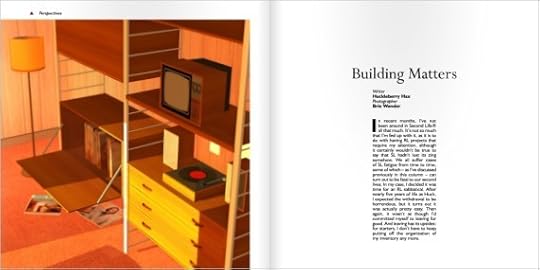
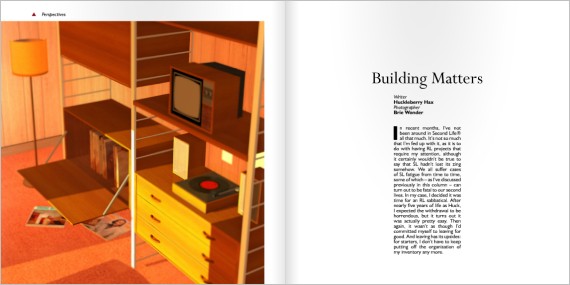
Due to some technical difficulties, the July issue of AVENUE magazine was a little late. Here's my column, and this month photography is by Brie Wonder, who is one of my very favourite SL photographers. Brie's pictures are of my very own - never released - furniture range that I talk about in the column.
Incidentally, this month's issue runs a feature - STAND4LOVE - with photography from one of my other all-time SL favourites - Paola Tauber. Well worth checking out.
In recent months, I’ve not been around in Second Life® all that much. It’s not so much that I’m fed up with it, as it is to do with having RL projects that require my attention, although it certainly wouldn’t be true to say that SL hadn’t lost its zing somehow. We all suffer cases of SL fatigue from time to time, some of which – as I’ve discussed previously in this column – can turn out to be fatal to our second lives. In my case, I decided it was time for an RL sabbatical. After nearly five years of life as Huck, I expected the withdrawal to be horrendous, but it turns out it was actually pretty easy. Then again, it wasn’t as though I’d committed myself to leaving for good. And leaving has its upsides: for starters, I don’t have to keep putting off the organisation of my inventory any more.
Of course I miss the people; of course I miss all those regular events: these, after all, were the things by which my SL was defined; it was the fabric of my virtual universe. Life’s old tapestries fold all too easily into boxes if new occupations tumble upon their space, however. Be they physical or digital, past times are past times – it’s not important to the brain the medium in which social connections took place – and we’re used to moving on. I made a book of pictures at the end of my five year run as Huck (you can see it for yourself at http://issuu.com/huckleberryhax/docs/five) and largely this has served when the mild urge to reconnect to those times has asserted itself.
What’s surprised me, however, is just how significantly I miss building. Never really, a mainstay of my SL – more of a side-line; something I dabbled in from time to time – I didn’t for one moment assume that this would feature at all prominently in any tug back towards the virtual world. Don’t get me wrong: when I was in the mood to build, I could do it for hours and barely notice that the time was passing. I built things from that post-war period when the future we now worry in was gazed upon as a luxury time of atomic rockets and robot servants and flying cars: 60s and 70s artefacts such as Danish Modern furniture, teak-veneered electronics and concrete buildings with angles that seemed determined to defy nature in every manner possible. But this celebration of the childhood memories and fantasies of Generation X was more about nostalgic play than it was about any determined effort to make and sell retro-futurism merchandise. The grand opening of my Second Life shop was always just around the corner because the small business of actually building my Second Life shop was something I was just too lazy to do. I never bothered learning how to make my own sculpties, buying off-the-shelf blanks when I needed one for furniture I was building, because getting into third party software was just too much like hard work. And there was about as much chance of me learning how to design mesh, once I’d seen the user interface for Blender, as there was me spending the several weeks it would take me to sort my aforementioned inventory into neatly categorised folders. Basically, I built stuff for occasional, therapeutic fun. And nothing more than that.
Yet, bizarrely, building is one of the things I miss most of all about SL right now. Building, after all, wasn’t a set of people or a place belonging to a time now over; building was something I did – albeit only occasionally – and did throughout my entire SL. Many of the other things I did whilst I was inworld, like writing poems and stories, I actually did alongside it and can continue to do now; building, however, is an SL-only activity. Yes, I know I could learn 3D modelling in an external application, but given the amount of commitment to such paraphernalia I indicated earlier, do you honestly think this likely?
One of the things I loved about building was the keen eye it gave me for potential textures in the real world. The sheer joy at finding a texture that both offered a good angle and looked like it could be made seamless without too much effort was a difficult phenomenon to relate to those unacquainted with its quality. Some 1970s sky blue tiles between two shop fronts which had just been revealed by a large patch of plaster falling off. A 40 year old wallpaper in a beach shop in Normandy. An avocado-on-white lattice design on a ledge in the gents’ toilets of a conference centre that used to be a secondary school. Yes. The mobile phone camera is a wonderful thing when such treasures reveal themselves to you in your passing (the women in the beach shop to this day must wonder what the hell I was doing taking photographs of her wall). My most used texture of all was the teak veneer I used for my DM furniture: part of the reason I love this style is that my parents had loads of it when I was growing up and my mother still owns quite a bit. But the years haven’t been kind to these surfaces (I confess, I played my part in their current grubbiness) and none of it looked good enough to sample for the creation in SL of something I wanted to look brand new. Imagine, then, my excitement when I remembered the rarely used expansion leaf hanging under the centre of my mother’s dining room table and rotated it out to reveal near-virgin quality teak veneer. I felt like a five-year-old at Christmas.
I’ve written here before about how immersion in SL can sometimes bring about a heightened sense of awareness of RL detail; to be able to look at a blandly refurbished 60s building a thousand times previously ignored and spot suddenly a glimpse of its original design and aspiration – a miniscule breakthrough of the recent past, blinking through a crack into the future – is a new pleasure I relish and one I would not have if it wasn’t for my building in SL. I enjoy my surroundings more, even if I don’t now rush every time to take pictures of what to everyone else looks like a badly maintained bit of wall. Simply looking and relishing the look is enough.
There’s a lot made of building in SL from the perspective of creating saleable content. I, for one, will always maintain support for the notion of a virtual world in which the content is user created: this is one of SL’s defining and most magnificent features. But building is also just fun and everyone should at least dabble in it from time to time. And if the cost of uploading textures puts you off, I feel duty-bound to point out that InWorldz® has an identical building system to SL, except that texture uploads are free. Don’t worry about making something that’s going to earn you millions: just find a sandbox and build something you’d like to build. It’ll make you happier.

Incidentally, this month's issue runs a feature - STAND4LOVE - with photography from one of my other all-time SL favourites - Paola Tauber. Well worth checking out.
In recent months, I’ve not been around in Second Life® all that much. It’s not so much that I’m fed up with it, as it is to do with having RL projects that require my attention, although it certainly wouldn’t be true to say that SL hadn’t lost its zing somehow. We all suffer cases of SL fatigue from time to time, some of which – as I’ve discussed previously in this column – can turn out to be fatal to our second lives. In my case, I decided it was time for an RL sabbatical. After nearly five years of life as Huck, I expected the withdrawal to be horrendous, but it turns out it was actually pretty easy. Then again, it wasn’t as though I’d committed myself to leaving for good. And leaving has its upsides: for starters, I don’t have to keep putting off the organisation of my inventory any more.
Of course I miss the people; of course I miss all those regular events: these, after all, were the things by which my SL was defined; it was the fabric of my virtual universe. Life’s old tapestries fold all too easily into boxes if new occupations tumble upon their space, however. Be they physical or digital, past times are past times – it’s not important to the brain the medium in which social connections took place – and we’re used to moving on. I made a book of pictures at the end of my five year run as Huck (you can see it for yourself at http://issuu.com/huckleberryhax/docs/five) and largely this has served when the mild urge to reconnect to those times has asserted itself.
What’s surprised me, however, is just how significantly I miss building. Never really, a mainstay of my SL – more of a side-line; something I dabbled in from time to time – I didn’t for one moment assume that this would feature at all prominently in any tug back towards the virtual world. Don’t get me wrong: when I was in the mood to build, I could do it for hours and barely notice that the time was passing. I built things from that post-war period when the future we now worry in was gazed upon as a luxury time of atomic rockets and robot servants and flying cars: 60s and 70s artefacts such as Danish Modern furniture, teak-veneered electronics and concrete buildings with angles that seemed determined to defy nature in every manner possible. But this celebration of the childhood memories and fantasies of Generation X was more about nostalgic play than it was about any determined effort to make and sell retro-futurism merchandise. The grand opening of my Second Life shop was always just around the corner because the small business of actually building my Second Life shop was something I was just too lazy to do. I never bothered learning how to make my own sculpties, buying off-the-shelf blanks when I needed one for furniture I was building, because getting into third party software was just too much like hard work. And there was about as much chance of me learning how to design mesh, once I’d seen the user interface for Blender, as there was me spending the several weeks it would take me to sort my aforementioned inventory into neatly categorised folders. Basically, I built stuff for occasional, therapeutic fun. And nothing more than that.
Yet, bizarrely, building is one of the things I miss most of all about SL right now. Building, after all, wasn’t a set of people or a place belonging to a time now over; building was something I did – albeit only occasionally – and did throughout my entire SL. Many of the other things I did whilst I was inworld, like writing poems and stories, I actually did alongside it and can continue to do now; building, however, is an SL-only activity. Yes, I know I could learn 3D modelling in an external application, but given the amount of commitment to such paraphernalia I indicated earlier, do you honestly think this likely?
One of the things I loved about building was the keen eye it gave me for potential textures in the real world. The sheer joy at finding a texture that both offered a good angle and looked like it could be made seamless without too much effort was a difficult phenomenon to relate to those unacquainted with its quality. Some 1970s sky blue tiles between two shop fronts which had just been revealed by a large patch of plaster falling off. A 40 year old wallpaper in a beach shop in Normandy. An avocado-on-white lattice design on a ledge in the gents’ toilets of a conference centre that used to be a secondary school. Yes. The mobile phone camera is a wonderful thing when such treasures reveal themselves to you in your passing (the women in the beach shop to this day must wonder what the hell I was doing taking photographs of her wall). My most used texture of all was the teak veneer I used for my DM furniture: part of the reason I love this style is that my parents had loads of it when I was growing up and my mother still owns quite a bit. But the years haven’t been kind to these surfaces (I confess, I played my part in their current grubbiness) and none of it looked good enough to sample for the creation in SL of something I wanted to look brand new. Imagine, then, my excitement when I remembered the rarely used expansion leaf hanging under the centre of my mother’s dining room table and rotated it out to reveal near-virgin quality teak veneer. I felt like a five-year-old at Christmas.
I’ve written here before about how immersion in SL can sometimes bring about a heightened sense of awareness of RL detail; to be able to look at a blandly refurbished 60s building a thousand times previously ignored and spot suddenly a glimpse of its original design and aspiration – a miniscule breakthrough of the recent past, blinking through a crack into the future – is a new pleasure I relish and one I would not have if it wasn’t for my building in SL. I enjoy my surroundings more, even if I don’t now rush every time to take pictures of what to everyone else looks like a badly maintained bit of wall. Simply looking and relishing the look is enough.
There’s a lot made of building in SL from the perspective of creating saleable content. I, for one, will always maintain support for the notion of a virtual world in which the content is user created: this is one of SL’s defining and most magnificent features. But building is also just fun and everyone should at least dabble in it from time to time. And if the cost of uploading textures puts you off, I feel duty-bound to point out that InWorldz® has an identical building system to SL, except that texture uploads are free. Don’t worry about making something that’s going to earn you millions: just find a sandbox and build something you’d like to build. It’ll make you happier.
June 20, 2012
Visualising the metaverse of the future
Here's my June column for AVENUE magazine. Photography this month is by Eve Kazan.
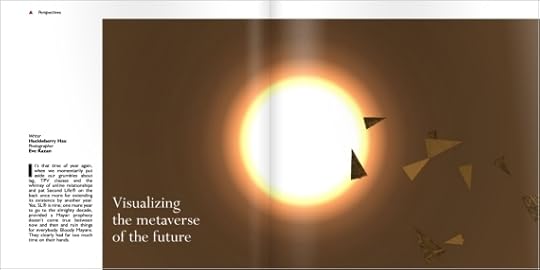
It’s that time of year again where we put aside momentarily our grumbles about lag, TPV clauses and the whimsy of online relationships and pat Second Life® on the back once more for incrementing its existence by another year. Yes, SL is nine; one more year to go to the almighty decade, provided a Mayan prophesy doesn’t come along between now and then and ruin things for everybody. Bloody Mayans. They clearly had far too much time on their hands.
Assuming, then, that we do indeed make it to this momentous occasion, the likelihood is that the blogosphere will use the moment to make a few prophecies of its own. What will SL be like on its twentieth birthday? Will there be a twentieth birthday? I’ve decided to jump the gun on everyone and begin that speculation now. After all, if the blogosphere is right, there might not even be a tenth birthday, and that would be an opportunity for carefree, utterly-without-evidence speculation lost.
In fact, I’m going to ignore SL completely in my 2023 visualisation. Let’s just say, “What might the metaverse look like on SL’s twentieth anniversary?” Whether or not SL is going to still be around to fill that role by then, I confess I have absolutely no idea. But I dobelieve (Mayan prophecies and other non-branded end-of-world predictions aside) there will be a metaverse of some description around at that time. I can’t actually imagine how it could be otherwise. Online 3D gaming is enormous. Social networking is enormous. The desire to exist beyond that which physically surrounds us is as great as it’s ever been. It really is only a matter of time before these things converge on a large scale, and if SL hasn’t captured so far – and doesn’t ultimately end up capturing – a mass market on the concept, I suspect this will only be viewed in retrospect as an attempt at an idea that failed because it was just too ahead of its time and didn’t quite get the finer details right. A bit like the Sinclair C5.
So the 2023 metaverse I’m imagining is immensely popular. Gone are the days of snickering at the guy who let it slip he had an avatar in ‘Second Life’ and residents no longer have to fight the desire to respond to such poorly concealed mirth by smashing people’s faces in. It’s now pretty much accepted, in fact, that metaverse activity and trade is the new direction for online time – much as Facebook is accepted today – and the only poorly concealed smirks to be found are those of the smug, old-timer metaversians privately giving each other gleeful high-fives each time a real life work colleague asks discreetly for tips on managing inventory or cybersex technique.
How has this been achieved? Improvements in technology have, of course, helped. That all-important ‘first hour’ is now smooth and slick and satisfactory. Super-fast broadband speeds of 100Mb or more have reduced lag to hardly noticeable in all but the most crowded of regions. Large screen displays offering life-size avatars; photo-realistic environments, simulated down to the smallest blade of grass; cameras that watch your real life body for movements that can be mapped onto your avatar: all these things make immersion more complete and more immediate than it’s ever been before. 3D immersion glasses also have a following, but the tabloids have had a field day with research linking them to headaches and occasional epileptic seizures.
It’s not at all the technology that’s had the biggest impact on mass take-up, however: the metaverse’s redesign is acknowledged as being largely responsible for that. In the end, all it took was for someone to look at successful social media and actually apply what had been learned there to what had been learned in virtual worlds like SL. For example, there were certain things that most new Facebook users ‘got’, even before they’d logged on to the network for the very first time; the most powerful of these was the understanding that everyone on Facebook had their own space where you could find out things about them. In the 2D world of the web this space was understood to be a web page. In the 3D world of the metaverse, therefore, it was realised that the intuitive expectation had to be that this space would be a room or a building or a garden or some sort of three dimensional placethat represented in some customisable way the person it belonged to. In the new, successful, metaverse, then, signup takes you straight to your very own place. For free. The notion that having any sort of a home is a luxury residents should pay for has been identified as an unworkable business model; instead, everyone gets a free place of a certain size and money is required to make it bigger. You start off with a default house and small garden that you can customise to your heart’s content and if you want a bigger area, then you pay. Simple. And if you want your own space to be something promotional whilst you rent to actually live in someone else’s space (or have residences in a number of different spaces) then that is just fine too.
It’s no longer a single cyber-world, then, as SL was. But SL was never really a single world in any case. Few people actually walked or flew from region to region in the days of SL; teleportation was, of course, the norm – and, in the case of private sims, essential. Naturally, you can still teleport from place to place in metaverse 2023 – let’s call it ‘Huckverse’ for future retrospective patenting purposes – it’s just that the old pretence of a single world has been dropped. If you have the money, you can extend your own space into an entire planet if you want to, or you can link your space to the spaces of your friends and make one up between you. Linking spaces, in 2023, has become the modern day equivalent of friending.
Did I mention that all these spaces are accessed via a web page? Of course they are; why would anyone in their right mind ignore the number one infrastructure in use for accessing the internet (why indeed; why indeed)?
The knowledgeable amongst you might just be thinking right now that the metaverse described thus far isn’t an entirely new concept. Google, in fact, tried something not completely dissimilar back in 2008 with its Livelyexperiment. Announcing the product in July 2008, Google manager, Niniane Wang said of it:
“If you enter a Lively room embedded on your favorite blog or website, you can immediately get a sense of the room creator's interests, just by looking at the furniture and environment they chose. You can also express your own personality by customizing your avatar's look, showing people who you are without having to say a word. Of course, you can chat with each other, and you can also interact through animated actions.”
But Google Lively lasted for just six months. Because what it was was an attempt to apply that which made social networking successful to a 3D environment which completely ignored that which made virtual worlds successful. What seems to be ignored by the ever-searching eye of IT hunger is that Second Life is a successful venture. Where it hasn’t succeeded so far is in achieving mass-appeal, but where it has succeeded – and spectacularly – is in the retention and creativity of residents who do become immersed in it. Once you get past those first few awkward hours that are such a turn-off to so many, the time and talent invested by residents in SL becomes very considerable. Any serious strategic consideration of a mass-appeal metaverse, therefore, has to consider not just what makes people sign up in the first place, but the things that make them want to stay once they’re in. Google Lively was just a 3D chat-room with a few frills – not massively different from Microsoft’s ‘Comic Chat’ in 1996 (also discontinued). Customisation of your room and avatar was extremely limited and making new content was nothing like as easy or as comprehensive as it is in SL. There was very little sense of immersion. The graphical look was very cartoonish. Navigation controls were fiddly and non-intuitive. Basically, it sucked.
Huckverse, then, will combine social networking expectations with all those features we know and love in SL – and just know that others would love if they ever gave SL a proper chance. User content creation will form the basis of a thriving online economy (an economy which, incidentally, is not limited to the metaverse alone – you’ll be able to spend your Lindens earned on Amazon or iTunes, for example) and more tightly interlinked with real life products (clothing manufacture, for example, will adopt the principles of current print-on-demand technology, enabling people to design clothes for avatars which can also be bought in the real world). Inworld events and experiences will be regarded as real and tangible and worthwhile pursuits. Online relationships will be attended to by some as the biggest threat there’s ever been to conventional life and by others as the beginning of a new understanding of human interaction and love (although psychologists probably won’t get around to studying it seriously until about 2053). And so on.
My dearest hope is that Metaverse 2023 will in fact be SL. On that issue, we shall just have to wait and see if Linden’s imagination and courage is up to the task. For the moment, however, such fancies can be put aside. Nine years is quite an achievement, regardless. Happy Birthday, Second Life.

It’s that time of year again where we put aside momentarily our grumbles about lag, TPV clauses and the whimsy of online relationships and pat Second Life® on the back once more for incrementing its existence by another year. Yes, SL is nine; one more year to go to the almighty decade, provided a Mayan prophesy doesn’t come along between now and then and ruin things for everybody. Bloody Mayans. They clearly had far too much time on their hands.
Assuming, then, that we do indeed make it to this momentous occasion, the likelihood is that the blogosphere will use the moment to make a few prophecies of its own. What will SL be like on its twentieth birthday? Will there be a twentieth birthday? I’ve decided to jump the gun on everyone and begin that speculation now. After all, if the blogosphere is right, there might not even be a tenth birthday, and that would be an opportunity for carefree, utterly-without-evidence speculation lost.
In fact, I’m going to ignore SL completely in my 2023 visualisation. Let’s just say, “What might the metaverse look like on SL’s twentieth anniversary?” Whether or not SL is going to still be around to fill that role by then, I confess I have absolutely no idea. But I dobelieve (Mayan prophecies and other non-branded end-of-world predictions aside) there will be a metaverse of some description around at that time. I can’t actually imagine how it could be otherwise. Online 3D gaming is enormous. Social networking is enormous. The desire to exist beyond that which physically surrounds us is as great as it’s ever been. It really is only a matter of time before these things converge on a large scale, and if SL hasn’t captured so far – and doesn’t ultimately end up capturing – a mass market on the concept, I suspect this will only be viewed in retrospect as an attempt at an idea that failed because it was just too ahead of its time and didn’t quite get the finer details right. A bit like the Sinclair C5.
So the 2023 metaverse I’m imagining is immensely popular. Gone are the days of snickering at the guy who let it slip he had an avatar in ‘Second Life’ and residents no longer have to fight the desire to respond to such poorly concealed mirth by smashing people’s faces in. It’s now pretty much accepted, in fact, that metaverse activity and trade is the new direction for online time – much as Facebook is accepted today – and the only poorly concealed smirks to be found are those of the smug, old-timer metaversians privately giving each other gleeful high-fives each time a real life work colleague asks discreetly for tips on managing inventory or cybersex technique.
How has this been achieved? Improvements in technology have, of course, helped. That all-important ‘first hour’ is now smooth and slick and satisfactory. Super-fast broadband speeds of 100Mb or more have reduced lag to hardly noticeable in all but the most crowded of regions. Large screen displays offering life-size avatars; photo-realistic environments, simulated down to the smallest blade of grass; cameras that watch your real life body for movements that can be mapped onto your avatar: all these things make immersion more complete and more immediate than it’s ever been before. 3D immersion glasses also have a following, but the tabloids have had a field day with research linking them to headaches and occasional epileptic seizures.
It’s not at all the technology that’s had the biggest impact on mass take-up, however: the metaverse’s redesign is acknowledged as being largely responsible for that. In the end, all it took was for someone to look at successful social media and actually apply what had been learned there to what had been learned in virtual worlds like SL. For example, there were certain things that most new Facebook users ‘got’, even before they’d logged on to the network for the very first time; the most powerful of these was the understanding that everyone on Facebook had their own space where you could find out things about them. In the 2D world of the web this space was understood to be a web page. In the 3D world of the metaverse, therefore, it was realised that the intuitive expectation had to be that this space would be a room or a building or a garden or some sort of three dimensional placethat represented in some customisable way the person it belonged to. In the new, successful, metaverse, then, signup takes you straight to your very own place. For free. The notion that having any sort of a home is a luxury residents should pay for has been identified as an unworkable business model; instead, everyone gets a free place of a certain size and money is required to make it bigger. You start off with a default house and small garden that you can customise to your heart’s content and if you want a bigger area, then you pay. Simple. And if you want your own space to be something promotional whilst you rent to actually live in someone else’s space (or have residences in a number of different spaces) then that is just fine too.
It’s no longer a single cyber-world, then, as SL was. But SL was never really a single world in any case. Few people actually walked or flew from region to region in the days of SL; teleportation was, of course, the norm – and, in the case of private sims, essential. Naturally, you can still teleport from place to place in metaverse 2023 – let’s call it ‘Huckverse’ for future retrospective patenting purposes – it’s just that the old pretence of a single world has been dropped. If you have the money, you can extend your own space into an entire planet if you want to, or you can link your space to the spaces of your friends and make one up between you. Linking spaces, in 2023, has become the modern day equivalent of friending.
Did I mention that all these spaces are accessed via a web page? Of course they are; why would anyone in their right mind ignore the number one infrastructure in use for accessing the internet (why indeed; why indeed)?
The knowledgeable amongst you might just be thinking right now that the metaverse described thus far isn’t an entirely new concept. Google, in fact, tried something not completely dissimilar back in 2008 with its Livelyexperiment. Announcing the product in July 2008, Google manager, Niniane Wang said of it:
“If you enter a Lively room embedded on your favorite blog or website, you can immediately get a sense of the room creator's interests, just by looking at the furniture and environment they chose. You can also express your own personality by customizing your avatar's look, showing people who you are without having to say a word. Of course, you can chat with each other, and you can also interact through animated actions.”
But Google Lively lasted for just six months. Because what it was was an attempt to apply that which made social networking successful to a 3D environment which completely ignored that which made virtual worlds successful. What seems to be ignored by the ever-searching eye of IT hunger is that Second Life is a successful venture. Where it hasn’t succeeded so far is in achieving mass-appeal, but where it has succeeded – and spectacularly – is in the retention and creativity of residents who do become immersed in it. Once you get past those first few awkward hours that are such a turn-off to so many, the time and talent invested by residents in SL becomes very considerable. Any serious strategic consideration of a mass-appeal metaverse, therefore, has to consider not just what makes people sign up in the first place, but the things that make them want to stay once they’re in. Google Lively was just a 3D chat-room with a few frills – not massively different from Microsoft’s ‘Comic Chat’ in 1996 (also discontinued). Customisation of your room and avatar was extremely limited and making new content was nothing like as easy or as comprehensive as it is in SL. There was very little sense of immersion. The graphical look was very cartoonish. Navigation controls were fiddly and non-intuitive. Basically, it sucked.
Huckverse, then, will combine social networking expectations with all those features we know and love in SL – and just know that others would love if they ever gave SL a proper chance. User content creation will form the basis of a thriving online economy (an economy which, incidentally, is not limited to the metaverse alone – you’ll be able to spend your Lindens earned on Amazon or iTunes, for example) and more tightly interlinked with real life products (clothing manufacture, for example, will adopt the principles of current print-on-demand technology, enabling people to design clothes for avatars which can also be bought in the real world). Inworld events and experiences will be regarded as real and tangible and worthwhile pursuits. Online relationships will be attended to by some as the biggest threat there’s ever been to conventional life and by others as the beginning of a new understanding of human interaction and love (although psychologists probably won’t get around to studying it seriously until about 2053). And so on.
My dearest hope is that Metaverse 2023 will in fact be SL. On that issue, we shall just have to wait and see if Linden’s imagination and courage is up to the task. For the moment, however, such fancies can be put aside. Nine years is quite an achievement, regardless. Happy Birthday, Second Life.
June 8, 2012
Thank you Hater!
Love love love this anti-griefer video!

May 24, 2012
Are you a cyberbully?
Here's my May column for AVENUE magazine. Photography this month is by Val Kendal.

Cyberbullying is a topic of increasing urgency, chiefly because it’s killing people. The suicide of Tyler Clementi in September 2010, itself only one of a sequence of gay teens who had taken their lives in reaction to bullying, resulted in new legislation in the states: The Tyler Clementi Higher Education Anti-Harassment Act, which requires all schools that want federal funding to have in place anti-bullying policies and procedures. This is something we need to take seriously. Cyberbullying is coming out as more serious in its consequences than conventional bullying.
Why might this be? Research – as might be expected for such a new social phenomena – is still relatively thin, but the emerging picture really isn’t rocket science. Something posted online reaches a potentially much larger audience plus electronic media is more pervasive and less easily escapable. If you’re bullied in the ‘conventional’ manner at work or at school, there’s always home to escape to for some peace, but if home pleasures include such pursuits as Facebook, Twitter or – as we’ll come to later – Second Life®, there can be little peace found if the bullying takes place there also. I think there’s an additional element of importance also – that of attack on identity – but we’ll come to that later.
What makes cyberbullying so difficult to get a grasp of is that it’s not an easy thing at all to identify whilst it’s taking place. In retrospect – after someone takes their life, for example – it can appear obvious that this has been going on to people inspecting the situation from the outside, but to the people involved at the time – including the cyberbully/bullies themselves – bullying behaviours often get seen as something else entirely. Five minutes after Tyler Clementi had posted to Facebook that he was going to jump off the George Washington Bridge, Dharun Ravi, Tyler’s roommate who had exposed online his homosexuality through video and tweets, sent Tyler messages apologising for his behaviour and expressing guilt for what had happened. Ravi subsequently claimed he had done so without seeing Tyler’s Facebook post, but whether he did or he didn’t is unimportant in one respect: Ravi realised he had gone too far and that his behaviour had had an effect far worse than he himself had realised it would. Perhaps this was the moment he realised he had been bullying. Few people, after all, actually want to think of themselves as a bully.
Because, in the vast majority of cases, cyberbullying – all bullying, in fact – is not primarily about making the victim feel bad at all; bullying is about achieving status within a community. ‘Status’ here can mean anything from simple acceptance to friendship to a dominant position, all depending on the particular needs and desires of the bully. So one of the key components of bullying – not all bullying, but most bullying – is that it takes place in front of an audience. Sometimes that audience is one person – a remark about someone snickered into the ear of a friend – sometimes it’s a group of people; sometimes – as was the case with Dharun Ravi’s tweets – it’s over a hundred. With cyberbullying, the numbers can, of course, go a great deal higher than that.
But wait. A snickered remark in a friend’s ear is hardly what most people would regard as bullying, right? Where’s the harm in a private joke that the victim is never actually intended to hear? I certainly wouldn’t hold myself up as an example of a person who has never made a private remark to someone about someone we both know (or have head of), and it seems ridiculous to assert than no-one should ever be allowed to say anything about anybody. Humour, after all, is one of the things that makes life great. The important thing to understand here, therefore, is that bullying is not a qualitatively different thing from these sorts of remarks; rather, it is a greatly exaggerated version of them. We make our jokes privately rather than openly precisely because we don’t want to hurt the subject’s feelings; but we still, nonetheless, make them because they earn us some social credit. Occasionally, our remarks get repeated and there comes that sickening feeling when we realise they’ve made it back to the subject (in SL, there is also that terrible moment when we realise we’ve accidentally crossposted a remark about someone into public chat or – worse still – the subject’s own IM window – a phenomenon I refer to as ‘fatal crosspost’). That sickening feeling – feeling dreadful that you’ve upset someone with a glibly made remark they weren’t supposed to hear – is our guide. The moment we lose sight of the importance of another person’s wellbeing and consider that of secondary value to the credit gained by targeting them is when we start taking our first steps into bullying.
It’s also important to note that bullying is different from one-time harassment, which isn’t to say that harassment isn’t a bad thing. One-time harassment – which can range from single remarks to physical violence – tends to be based on prejudice rather than personal knowledge of a victim. A supporter of football team X out with his friends might shout at or attack a supporter of football team Y (a very honest football fan I know once told me he attacked fans supporting different teams because it made his friends like him more). A white male out with his friends might shout at or attack a black male. And so on. Horrific and traumatising though these events can potentially be, they’re a different thing from being targeted over time for things that are personal to you. This is where cyberbullying I think, becomes really damaging. For many of us, our online identities – be it through social networking sites like Facebook or online worlds like Second Life - represent our ideal selves. I was bullied at school for wearing glasses; it bothered me a lot, but it never made me depressed because being a person who wears glasses has never been for me a particularly important aspect of who I am. My online identity, however, is all about myself as a writer, which is a reallyimportant personal aspect of who I am; were a person or group of people to mount a sustained attack over time on my abilities as a writer, I can imagine that being a tremendously difficult thing to deal with. I might decide to abandon writing, which would feel like killing off a huge part of what I consider myself to be. It’s not that I’m saying attacks over less important personal attributes aren’t terrible things, but – as I said earlier – cyberbullying appears to be felt as more damaging than ‘conventional’ bullying, and there has to be a reason for that.
Bullying in SL, therefore, is all about exposing and ridiculing people publically, often for the things that are personally important to them. This can be done in chat at events, but can also spread out onto the wider web, for example by pasting chats or private IMs into blog posts. The latter is against SL terms of service and the former isn’t; regardless, if the function is to post conversations with the intention of ridiculing the people involved, this is an act of bullying.
But what of legitimate protest? What of demonstrations against oppressive regimes or organisations? I, after all, enjoy jokes about the current UK government and its policies as much as the next left-leaning citizen with an appreciation of finely-crafted sarcasm. Would legitimate revolutions and uprisings ever occur if people weren’t able to share their thoughts on their oppressors? What you have to ask yourself in such matters is how damaging actuallyare the actions of your target and how helpful actually a sustained attack on them to your cause is. In my experience of this in SL, these attacks take place over nothing more than a difference of opinion, and all they end up doing is polarising debate – encouraging people to take sides – rather than actually opening up discussion in a meaningful way. The means end up defeating the purpose. And pay careful attention to the methods of the key perpetrators: if their actions are more about getting attention for themselves than they are about meaningfully advancing a debate, then their campaign is more about bullying than it is about any cause.
What research has shown is that it’s the bystanders who give bullies their ultimate power: the people who stand by and say nothing and the people who support the bully (whether or not they actually participate in bullying behaviour themselves). People who are not victims of a bully don’t want to become victims and the safest place to be, therefore, is on the list of people approved of in some way by them. We justify this to ourselves, of course, by convincing ourselves that the bully isn’t a bully at all, but a protester, a lone voice of reason, or just a funny person that other people don’t get. Rationalisation (in psychological terms, the reduction of ‘dissonance’) is an extremely powerful thing and the key reason why people don’t realise that bullying has been taking place until it’s too late.
Are you a cyberbully in SL? Are you a supportive bystander? Think about this carefully the next time you get involved in something that targets an individual. It will be an uncomfortable process, for sure (though less so than if you ever have to go through it after terrible consequences have come to pass), but if more people just stopped and asked themselves that question then bullying, perhaps, might just simply go away.
BulletHuckleberry Hax
So.
Let me see.
What would be a good thing to say?
Which weak spot shall I aim for?
How many times will I hit him?
And how will I dress it up, my dears, so that
only he will know
that my bullet has his name on it?
What metaphor shall I use? What
cultural references shall I throw in?
Something classic? It will
lend me more authority. After all,
I'm not one of these kids, you know;
it's not like I'm posting teenage hate
on Bebo.
If you like,I am the sniper, sitting on a rooftop half a mile away.
When my bullet hits, that boy will drop, and no-one
will know what hit him. Unless I tell them.
And I'm not interested in putting one
through his heart or through his eyes. My target
is his soul.
So.I need a setting.
I need a clever context.
A person in history, perhaps, with
all the right associations (people can look
it up on Wikipedia after and see just how learned
and observant I am).
Maybe an animal? Maybe a sky?
Maybe a colour you add
to fabric?
Dare I play on words? I might just, you know;
I might just.
I can smile at those who see it and grin,
a little cheekily,
and I can show those who frown my middle fucking finger.
I'm from the street, you see. I write haiku with
my knuckles. Of course,
I'm not just one of those kids, you know.
Then there is the issue of audienceand timing, who I want to be there as witness and who
I want as hapless, oblivious bystander. My moment,
if it is right, will win me my longevity. And I
will help the doubters through their dissonance
by reminding them of what an utter fuckwit he was and
by whispering in their ear just how much I love them.
It is all
so kinaesthetic.
It is all
such poetry.
April 2009

Cyberbullying is a topic of increasing urgency, chiefly because it’s killing people. The suicide of Tyler Clementi in September 2010, itself only one of a sequence of gay teens who had taken their lives in reaction to bullying, resulted in new legislation in the states: The Tyler Clementi Higher Education Anti-Harassment Act, which requires all schools that want federal funding to have in place anti-bullying policies and procedures. This is something we need to take seriously. Cyberbullying is coming out as more serious in its consequences than conventional bullying.
Why might this be? Research – as might be expected for such a new social phenomena – is still relatively thin, but the emerging picture really isn’t rocket science. Something posted online reaches a potentially much larger audience plus electronic media is more pervasive and less easily escapable. If you’re bullied in the ‘conventional’ manner at work or at school, there’s always home to escape to for some peace, but if home pleasures include such pursuits as Facebook, Twitter or – as we’ll come to later – Second Life®, there can be little peace found if the bullying takes place there also. I think there’s an additional element of importance also – that of attack on identity – but we’ll come to that later.
What makes cyberbullying so difficult to get a grasp of is that it’s not an easy thing at all to identify whilst it’s taking place. In retrospect – after someone takes their life, for example – it can appear obvious that this has been going on to people inspecting the situation from the outside, but to the people involved at the time – including the cyberbully/bullies themselves – bullying behaviours often get seen as something else entirely. Five minutes after Tyler Clementi had posted to Facebook that he was going to jump off the George Washington Bridge, Dharun Ravi, Tyler’s roommate who had exposed online his homosexuality through video and tweets, sent Tyler messages apologising for his behaviour and expressing guilt for what had happened. Ravi subsequently claimed he had done so without seeing Tyler’s Facebook post, but whether he did or he didn’t is unimportant in one respect: Ravi realised he had gone too far and that his behaviour had had an effect far worse than he himself had realised it would. Perhaps this was the moment he realised he had been bullying. Few people, after all, actually want to think of themselves as a bully.
Because, in the vast majority of cases, cyberbullying – all bullying, in fact – is not primarily about making the victim feel bad at all; bullying is about achieving status within a community. ‘Status’ here can mean anything from simple acceptance to friendship to a dominant position, all depending on the particular needs and desires of the bully. So one of the key components of bullying – not all bullying, but most bullying – is that it takes place in front of an audience. Sometimes that audience is one person – a remark about someone snickered into the ear of a friend – sometimes it’s a group of people; sometimes – as was the case with Dharun Ravi’s tweets – it’s over a hundred. With cyberbullying, the numbers can, of course, go a great deal higher than that.
But wait. A snickered remark in a friend’s ear is hardly what most people would regard as bullying, right? Where’s the harm in a private joke that the victim is never actually intended to hear? I certainly wouldn’t hold myself up as an example of a person who has never made a private remark to someone about someone we both know (or have head of), and it seems ridiculous to assert than no-one should ever be allowed to say anything about anybody. Humour, after all, is one of the things that makes life great. The important thing to understand here, therefore, is that bullying is not a qualitatively different thing from these sorts of remarks; rather, it is a greatly exaggerated version of them. We make our jokes privately rather than openly precisely because we don’t want to hurt the subject’s feelings; but we still, nonetheless, make them because they earn us some social credit. Occasionally, our remarks get repeated and there comes that sickening feeling when we realise they’ve made it back to the subject (in SL, there is also that terrible moment when we realise we’ve accidentally crossposted a remark about someone into public chat or – worse still – the subject’s own IM window – a phenomenon I refer to as ‘fatal crosspost’). That sickening feeling – feeling dreadful that you’ve upset someone with a glibly made remark they weren’t supposed to hear – is our guide. The moment we lose sight of the importance of another person’s wellbeing and consider that of secondary value to the credit gained by targeting them is when we start taking our first steps into bullying.
It’s also important to note that bullying is different from one-time harassment, which isn’t to say that harassment isn’t a bad thing. One-time harassment – which can range from single remarks to physical violence – tends to be based on prejudice rather than personal knowledge of a victim. A supporter of football team X out with his friends might shout at or attack a supporter of football team Y (a very honest football fan I know once told me he attacked fans supporting different teams because it made his friends like him more). A white male out with his friends might shout at or attack a black male. And so on. Horrific and traumatising though these events can potentially be, they’re a different thing from being targeted over time for things that are personal to you. This is where cyberbullying I think, becomes really damaging. For many of us, our online identities – be it through social networking sites like Facebook or online worlds like Second Life - represent our ideal selves. I was bullied at school for wearing glasses; it bothered me a lot, but it never made me depressed because being a person who wears glasses has never been for me a particularly important aspect of who I am. My online identity, however, is all about myself as a writer, which is a reallyimportant personal aspect of who I am; were a person or group of people to mount a sustained attack over time on my abilities as a writer, I can imagine that being a tremendously difficult thing to deal with. I might decide to abandon writing, which would feel like killing off a huge part of what I consider myself to be. It’s not that I’m saying attacks over less important personal attributes aren’t terrible things, but – as I said earlier – cyberbullying appears to be felt as more damaging than ‘conventional’ bullying, and there has to be a reason for that.
Bullying in SL, therefore, is all about exposing and ridiculing people publically, often for the things that are personally important to them. This can be done in chat at events, but can also spread out onto the wider web, for example by pasting chats or private IMs into blog posts. The latter is against SL terms of service and the former isn’t; regardless, if the function is to post conversations with the intention of ridiculing the people involved, this is an act of bullying.
But what of legitimate protest? What of demonstrations against oppressive regimes or organisations? I, after all, enjoy jokes about the current UK government and its policies as much as the next left-leaning citizen with an appreciation of finely-crafted sarcasm. Would legitimate revolutions and uprisings ever occur if people weren’t able to share their thoughts on their oppressors? What you have to ask yourself in such matters is how damaging actuallyare the actions of your target and how helpful actually a sustained attack on them to your cause is. In my experience of this in SL, these attacks take place over nothing more than a difference of opinion, and all they end up doing is polarising debate – encouraging people to take sides – rather than actually opening up discussion in a meaningful way. The means end up defeating the purpose. And pay careful attention to the methods of the key perpetrators: if their actions are more about getting attention for themselves than they are about meaningfully advancing a debate, then their campaign is more about bullying than it is about any cause.
What research has shown is that it’s the bystanders who give bullies their ultimate power: the people who stand by and say nothing and the people who support the bully (whether or not they actually participate in bullying behaviour themselves). People who are not victims of a bully don’t want to become victims and the safest place to be, therefore, is on the list of people approved of in some way by them. We justify this to ourselves, of course, by convincing ourselves that the bully isn’t a bully at all, but a protester, a lone voice of reason, or just a funny person that other people don’t get. Rationalisation (in psychological terms, the reduction of ‘dissonance’) is an extremely powerful thing and the key reason why people don’t realise that bullying has been taking place until it’s too late.
Are you a cyberbully in SL? Are you a supportive bystander? Think about this carefully the next time you get involved in something that targets an individual. It will be an uncomfortable process, for sure (though less so than if you ever have to go through it after terrible consequences have come to pass), but if more people just stopped and asked themselves that question then bullying, perhaps, might just simply go away.
BulletHuckleberry Hax
So.
Let me see.
What would be a good thing to say?
Which weak spot shall I aim for?
How many times will I hit him?
And how will I dress it up, my dears, so that
only he will know
that my bullet has his name on it?
What metaphor shall I use? What
cultural references shall I throw in?
Something classic? It will
lend me more authority. After all,
I'm not one of these kids, you know;
it's not like I'm posting teenage hate
on Bebo.
If you like,I am the sniper, sitting on a rooftop half a mile away.
When my bullet hits, that boy will drop, and no-one
will know what hit him. Unless I tell them.
And I'm not interested in putting one
through his heart or through his eyes. My target
is his soul.
So.I need a setting.
I need a clever context.
A person in history, perhaps, with
all the right associations (people can look
it up on Wikipedia after and see just how learned
and observant I am).
Maybe an animal? Maybe a sky?
Maybe a colour you add
to fabric?
Dare I play on words? I might just, you know;
I might just.
I can smile at those who see it and grin,
a little cheekily,
and I can show those who frown my middle fucking finger.
I'm from the street, you see. I write haiku with
my knuckles. Of course,
I'm not just one of those kids, you know.
Then there is the issue of audienceand timing, who I want to be there as witness and who
I want as hapless, oblivious bystander. My moment,
if it is right, will win me my longevity. And I
will help the doubters through their dissonance
by reminding them of what an utter fuckwit he was and
by whispering in their ear just how much I love them.
It is all
so kinaesthetic.
It is all
such poetry.
April 2009
May 19, 2012
Geek humour, how I love thee
This actually brought a tear to my eye whilst I laughed about it. The world is a better place for geek humour and creativity.

May 10, 2012
An SL rail travelog
[image error]
SL's latest free gift to Premium Members is a "fully interactive railcar that you can ride across more than 80 regions of the Second Life Railroad." Woot. To celebrate - in an entirely non-self-promotional manner - here's an extract from my 2008 novel, Be Right Back, in which Texter Triste follows an SL rail track from Calleta to Bhaga.
I TPed away from Redclaw straight away this evening, worried that each second spent there made it more likely that someone might appear and steal my time away. I went to my original 'home' location, in fact, that hobo infohub in Calleta It was somewhere to stand by myself where I wasn't known, where people wouldn't chat to me. I wondered around for a bit, looking at some of the items I completely missed when I first rezzed into existence because I was in such a hurry to get to Redclaw. Cardboard boxes to sleep in. Breeze block seating around a cable spool table. Oil drums. Bits of steam punk paraphernalia. Old sofas arranged around a blazing fire of abandoned fruit machines. I say I looked at them, but it wasn't like I was actually all that interested. I filled my SL time there, waiting for the IM that would whisk me away from it all. Nothing came. As time wore on I started to grow impatient. I walked to the end of the railroad pier, looked out over the dock at the rusty ship, at the crane, at the locomotive sinking into the trash pile at the side of the shore, all abandoned to entropy. Beyond the heaped garbage I saw there was a railway station. I flew over and walked up and down its platforms for a while, mentally comparing it to Redclaw. There were more trains there, and their exterior textures were beautiful, but there was no interior to the trains that you could sit in. No seating. No tables to sit at with your partner, nowhere to intertwine your fingers and your eyes and your thoughts. And no cafe; just a large booking hall/waiting area. Coloured pink.
That said, they do have one thing there that Redclaw doesn't: a railroad, and one which that stretches well beyond its boundaries. I decided to fly along it, tracked it back to its termination in Cecropia first of all and then followed the line forwards, back into and across Calleta. Into Oculea. Into Neumoegen where it rose up a gradual hill and passed another, smaller station with a ramshackle building of wood and corrugated iron. Into Imperial, where it crossed a small river waterfall that sent a fine particle spray into a clump of Eric Linden's Plumerias. I followed the track across the south-west corner of Didugua and into Achemon, nipped the north-east corner of Vine and then moved into Obscure. I passed a brutalist station there, and a plantation of sunflowers which made me think of a friend of mine who died some years ago. The lag was bad. Each time I crossed a sim boundary, the scene in my viewer froze for several seconds. Then, Texter would be ten, twenty, thirty metres from where he should have been, and I had to backtrack to find the railroad again. But it was always there. I was always able to resume my course. Onwards I pushed, through Horisme, Rivata, Epirrhoe, Jodis. At Epirrhoe, the track followed the floor of a short valley and emerged to pass yet another station, this one looking like it had been made entirely from green plastic, and it had a wind turbine on the top of it as well. I marvelled at the extent and variety of the imagination that I passed. Into Aplasta. Into Ribeta. Into Idia. Finally, the line terminated at a ruined station in Jublata. Feeling slightly cheated, I flew across the next sim, Sinica, following the path that the line would have taken had it still been there. In Torva, I saw not that far away what could only be a railway viaduct and experienced a little burst of pleasure at the re-emergence of what I now thought of as 'my' railroad. I resumed my journey, flying through a delightful little station at the Spini border where a tiled roof actually covers a section of the track. Into Athetis, along another, smaller viaduct and past a station where ivy creeps over the ironwork. Across the corner of Deltote. Across Parva. Across Euclidia and Lota and Lunalis. Across the corner of Fucosa. Into Concinna, where the track passed a derelict motel and thick, wavy wheat had managed nature's reclaim. Through Plebeja and into Lapara, where a set of steps led up to the grand gateway of an enormous walled estate and mist crawled around a selection of coffins and pumpkins on the ground for Halloween. Into Arches. Past another small station in Foxglove. None of these stops were anything approaching the size or scope of the station which had caught my eye in Calleta – or, for that matter, of Redclaw, which I now thought of as something grim and gothic and gloomy compared to these cheerful little halts. But Redclaw wasn't really a station in the same sense that these were. There was no rail-road that you could follow out of it that led to anywhere. It was a pretend station in a way that these pretend stations somehow weren't. I found myself surprised at the annoyance I suddenly felt towards it, my home for all these weeks, viewed suddenly in a new light. I thought, absently, of the theme that ran through Stop's top five movie choices.
As I pushed on through the sims – Sagittata (a rather empty and desolate region at the foothills of steep mountains that shot up through the cloud line), Taeniatum (a rail yard of some description to the left of the track; a pretty little mill house below and to the right), Perizoma (a long, zig-zagged fence came up to meet the track), Immidae – I found myself wishing that an actual train might steam by below me. It seemed wrong that I was able to defy the purpose for which the track had been created in the first place through my flight. That single factor was why all the stations I had passed, of course, were empty. No-one actually needed them. They served no function. Their only purpose was to beautify the scenery for passing explorers like myself. At least that was one thing you could say about Redclaw: there were plenty of people who went there. And yet this did not warm me back to Redclaw; instead it got me thinking that somehow flight itself is wrong. It makes things too easy. It actually reduces the degree to which we could become immersed in this environment. Even with the lag problems I was experiencing, it was still only taking me seconds to fly from one border to the next; mile after mile of virtual land was passing me by below and I was sparing it only the most momentary of inspections. I thought about that and decided that it was probably actually a lag thing in and of itself: a vehicle crossing borders could have been quite a messy affair, especially if the textures were detailed.
Nolidae. Sabre. Clearwing. The terrain got less green and more yellow. A station of four platforms straddled the Clearwing-Paranthrene border; my line ended on the Clearwing side but another began in Paranthrene. In Crenulate, the track was joined by another track that came down from the middle of Paranthrene. I stood for a while outside of Crenulate station, wondering whether to continue my current route or whether to track the new line back. I looked on the map and saw another branch in the northern half of Paranthrene, which also came down into Crenulate: so there were actually three lines entering my current sim and two exiting it – mine into Burnet, the other into Hooktip. They both crossed Leafroller, Lappet and Pini, but then the line that I was following went south to Agirus and the other went east into Pawpaw (where it split again, one line heading north to Maia, Owlet and Tussock, one line heading south-east into Tersa, Anilis, Nerice, Gluphisia and beyond). I decided to stick with my line, walked into Burnet, my head reeling with the complexity and structure and sheer size of the system that I was trying to follow. In Leafroller, I got caught in a lag bubble that sailed me right through the sim completely, almost as though I'd been picked up by strange forces that didn't want me there and deposited on the far boundary (it out-spooked all the Halloween bits and pieces I'd seen on my way by a quite considerable margin). In Lappet, a train for sale – the Flossberg Express – detected my passing and started chirping away in chat about it being the “cutest personal train in SL!” That got me thinking again about the absence of actual trains and it occurred to me that there was nothing stopping me from buying a train vehicle and driving it up and down the lines myself. Lag issues aside, it still didn't appeal to me: for a train to be authentic it needed to be scheduled! And then late. That also got me thinking. I wondered why rail enthusiasts hadn't discovered SL yet and started scheduling services for the hell of it. I wondered if that was why Linden had laid the track in the first place (hoping someone like that might come across it). I wondered if rail enthusiasts had discovered SL but dismissed it on a point of technical detail. I wondered if there was another part of Second Life somewhere where they all congregated, where they had built their own railroad 'properly'. Or something. I tried to think if there were any rail enthusiasts I knew in RL so that I could ask them.
Pini, Agirus, Aglia; I kept checking to see if I'd received a message from Stop that I'd missed somehow, and each time I checked and saw that I hadn't I started to feel a little grumpy again. The journey – now a pilgrimage, of sorts, that I wanted to see through to the end – helped to distract me. I stopped in Aglia to look at a beautiful halt made from triangles of glass and wood. I crossed Nessus, Celerio, Velox. In Tenera, a three-eyed Iron giant stooped as though to lift a little oval shaped station from the ground. In Crumbi, another line joined mine again, and when I checked the map to see where this had come from I felt an odd delight to see that this was actually the line I'd previously tracked as far as Gluphisia. Past another Flossberg Express vehicle, downhill into Mocis and another border lag bubble managed to sink me below the track, where my avatar walked on the spot until I extracted it by TPing to a position a few metres away. Past a small halt in Zale in front of an amphitheatre and across the south-east corner of Fishii (I rather fancied something smelled funny there). Finally, in Bhaga, the line came to an end, and there was no suggestion of any resumption further on, where the land met the sea in a cluster of islands and small land masses. I stood in Bhaga station, an odd sort of construction, coloured brown (but not in a nice way); I thought about the number of sims I'd crossed and then flicked back to map view and zoomed slowly out. The map window started to fill with shrinking squares, each one a sim; by the time the entire area of my journey filled the screen the squares were too small for the sim names to display. I continued to zoom out – slowly, so that the detail got a chance to rez. Then the continent filled the window, then that got smaller and smaller still. Then other continents crowded for room and they shrank. Still I zoomed out. Still there was more to look down upon. Finally I reached the full extent of the zoom and still there was yet more: I clicked the map and held down the left mouse key, grabbed the map, moved everything in view to the right, revealed more, and then more still, and then more still.
And that's how big Second Life is.
SL's latest free gift to Premium Members is a "fully interactive railcar that you can ride across more than 80 regions of the Second Life Railroad." Woot. To celebrate - in an entirely non-self-promotional manner - here's an extract from my 2008 novel, Be Right Back, in which Texter Triste follows an SL rail track from Calleta to Bhaga.
I TPed away from Redclaw straight away this evening, worried that each second spent there made it more likely that someone might appear and steal my time away. I went to my original 'home' location, in fact, that hobo infohub in Calleta It was somewhere to stand by myself where I wasn't known, where people wouldn't chat to me. I wondered around for a bit, looking at some of the items I completely missed when I first rezzed into existence because I was in such a hurry to get to Redclaw. Cardboard boxes to sleep in. Breeze block seating around a cable spool table. Oil drums. Bits of steam punk paraphernalia. Old sofas arranged around a blazing fire of abandoned fruit machines. I say I looked at them, but it wasn't like I was actually all that interested. I filled my SL time there, waiting for the IM that would whisk me away from it all. Nothing came. As time wore on I started to grow impatient. I walked to the end of the railroad pier, looked out over the dock at the rusty ship, at the crane, at the locomotive sinking into the trash pile at the side of the shore, all abandoned to entropy. Beyond the heaped garbage I saw there was a railway station. I flew over and walked up and down its platforms for a while, mentally comparing it to Redclaw. There were more trains there, and their exterior textures were beautiful, but there was no interior to the trains that you could sit in. No seating. No tables to sit at with your partner, nowhere to intertwine your fingers and your eyes and your thoughts. And no cafe; just a large booking hall/waiting area. Coloured pink.
That said, they do have one thing there that Redclaw doesn't: a railroad, and one which that stretches well beyond its boundaries. I decided to fly along it, tracked it back to its termination in Cecropia first of all and then followed the line forwards, back into and across Calleta. Into Oculea. Into Neumoegen where it rose up a gradual hill and passed another, smaller station with a ramshackle building of wood and corrugated iron. Into Imperial, where it crossed a small river waterfall that sent a fine particle spray into a clump of Eric Linden's Plumerias. I followed the track across the south-west corner of Didugua and into Achemon, nipped the north-east corner of Vine and then moved into Obscure. I passed a brutalist station there, and a plantation of sunflowers which made me think of a friend of mine who died some years ago. The lag was bad. Each time I crossed a sim boundary, the scene in my viewer froze for several seconds. Then, Texter would be ten, twenty, thirty metres from where he should have been, and I had to backtrack to find the railroad again. But it was always there. I was always able to resume my course. Onwards I pushed, through Horisme, Rivata, Epirrhoe, Jodis. At Epirrhoe, the track followed the floor of a short valley and emerged to pass yet another station, this one looking like it had been made entirely from green plastic, and it had a wind turbine on the top of it as well. I marvelled at the extent and variety of the imagination that I passed. Into Aplasta. Into Ribeta. Into Idia. Finally, the line terminated at a ruined station in Jublata. Feeling slightly cheated, I flew across the next sim, Sinica, following the path that the line would have taken had it still been there. In Torva, I saw not that far away what could only be a railway viaduct and experienced a little burst of pleasure at the re-emergence of what I now thought of as 'my' railroad. I resumed my journey, flying through a delightful little station at the Spini border where a tiled roof actually covers a section of the track. Into Athetis, along another, smaller viaduct and past a station where ivy creeps over the ironwork. Across the corner of Deltote. Across Parva. Across Euclidia and Lota and Lunalis. Across the corner of Fucosa. Into Concinna, where the track passed a derelict motel and thick, wavy wheat had managed nature's reclaim. Through Plebeja and into Lapara, where a set of steps led up to the grand gateway of an enormous walled estate and mist crawled around a selection of coffins and pumpkins on the ground for Halloween. Into Arches. Past another small station in Foxglove. None of these stops were anything approaching the size or scope of the station which had caught my eye in Calleta – or, for that matter, of Redclaw, which I now thought of as something grim and gothic and gloomy compared to these cheerful little halts. But Redclaw wasn't really a station in the same sense that these were. There was no rail-road that you could follow out of it that led to anywhere. It was a pretend station in a way that these pretend stations somehow weren't. I found myself surprised at the annoyance I suddenly felt towards it, my home for all these weeks, viewed suddenly in a new light. I thought, absently, of the theme that ran through Stop's top five movie choices.
As I pushed on through the sims – Sagittata (a rather empty and desolate region at the foothills of steep mountains that shot up through the cloud line), Taeniatum (a rail yard of some description to the left of the track; a pretty little mill house below and to the right), Perizoma (a long, zig-zagged fence came up to meet the track), Immidae – I found myself wishing that an actual train might steam by below me. It seemed wrong that I was able to defy the purpose for which the track had been created in the first place through my flight. That single factor was why all the stations I had passed, of course, were empty. No-one actually needed them. They served no function. Their only purpose was to beautify the scenery for passing explorers like myself. At least that was one thing you could say about Redclaw: there were plenty of people who went there. And yet this did not warm me back to Redclaw; instead it got me thinking that somehow flight itself is wrong. It makes things too easy. It actually reduces the degree to which we could become immersed in this environment. Even with the lag problems I was experiencing, it was still only taking me seconds to fly from one border to the next; mile after mile of virtual land was passing me by below and I was sparing it only the most momentary of inspections. I thought about that and decided that it was probably actually a lag thing in and of itself: a vehicle crossing borders could have been quite a messy affair, especially if the textures were detailed.
Nolidae. Sabre. Clearwing. The terrain got less green and more yellow. A station of four platforms straddled the Clearwing-Paranthrene border; my line ended on the Clearwing side but another began in Paranthrene. In Crenulate, the track was joined by another track that came down from the middle of Paranthrene. I stood for a while outside of Crenulate station, wondering whether to continue my current route or whether to track the new line back. I looked on the map and saw another branch in the northern half of Paranthrene, which also came down into Crenulate: so there were actually three lines entering my current sim and two exiting it – mine into Burnet, the other into Hooktip. They both crossed Leafroller, Lappet and Pini, but then the line that I was following went south to Agirus and the other went east into Pawpaw (where it split again, one line heading north to Maia, Owlet and Tussock, one line heading south-east into Tersa, Anilis, Nerice, Gluphisia and beyond). I decided to stick with my line, walked into Burnet, my head reeling with the complexity and structure and sheer size of the system that I was trying to follow. In Leafroller, I got caught in a lag bubble that sailed me right through the sim completely, almost as though I'd been picked up by strange forces that didn't want me there and deposited on the far boundary (it out-spooked all the Halloween bits and pieces I'd seen on my way by a quite considerable margin). In Lappet, a train for sale – the Flossberg Express – detected my passing and started chirping away in chat about it being the “cutest personal train in SL!” That got me thinking again about the absence of actual trains and it occurred to me that there was nothing stopping me from buying a train vehicle and driving it up and down the lines myself. Lag issues aside, it still didn't appeal to me: for a train to be authentic it needed to be scheduled! And then late. That also got me thinking. I wondered why rail enthusiasts hadn't discovered SL yet and started scheduling services for the hell of it. I wondered if that was why Linden had laid the track in the first place (hoping someone like that might come across it). I wondered if rail enthusiasts had discovered SL but dismissed it on a point of technical detail. I wondered if there was another part of Second Life somewhere where they all congregated, where they had built their own railroad 'properly'. Or something. I tried to think if there were any rail enthusiasts I knew in RL so that I could ask them.
Pini, Agirus, Aglia; I kept checking to see if I'd received a message from Stop that I'd missed somehow, and each time I checked and saw that I hadn't I started to feel a little grumpy again. The journey – now a pilgrimage, of sorts, that I wanted to see through to the end – helped to distract me. I stopped in Aglia to look at a beautiful halt made from triangles of glass and wood. I crossed Nessus, Celerio, Velox. In Tenera, a three-eyed Iron giant stooped as though to lift a little oval shaped station from the ground. In Crumbi, another line joined mine again, and when I checked the map to see where this had come from I felt an odd delight to see that this was actually the line I'd previously tracked as far as Gluphisia. Past another Flossberg Express vehicle, downhill into Mocis and another border lag bubble managed to sink me below the track, where my avatar walked on the spot until I extracted it by TPing to a position a few metres away. Past a small halt in Zale in front of an amphitheatre and across the south-east corner of Fishii (I rather fancied something smelled funny there). Finally, in Bhaga, the line came to an end, and there was no suggestion of any resumption further on, where the land met the sea in a cluster of islands and small land masses. I stood in Bhaga station, an odd sort of construction, coloured brown (but not in a nice way); I thought about the number of sims I'd crossed and then flicked back to map view and zoomed slowly out. The map window started to fill with shrinking squares, each one a sim; by the time the entire area of my journey filled the screen the squares were too small for the sim names to display. I continued to zoom out – slowly, so that the detail got a chance to rez. Then the continent filled the window, then that got smaller and smaller still. Then other continents crowded for room and they shrank. Still I zoomed out. Still there was more to look down upon. Finally I reached the full extent of the zoom and still there was yet more: I clicked the map and held down the left mouse key, grabbed the map, moved everything in view to the right, revealed more, and then more still, and then more still.
And that's how big Second Life is.
April 21, 2012
Reports of SL's death have been greatly exaggerated
Here's my April column for
AVENUE magazine
. I'm delighted that this month my article has been accompanied by photographs by Simotron Aquila, one of my very favourite SL artists.

Rumours are currently abound (perhaps substantiated by the time you read this) that Linden Labs® have New Stuff up their sleeve. But not Second Life® New Stuff.
It was a post on New World Notes that first alerted me to this. The interpretation there was that potential new products could include some sort of prim building game (inspired by the popularity of Minecraft), a fashion app for social networks and an interactive fiction product following the Lab’s acquisition of Little Text People in February. Little Text People, I’m given to understand, is an experimental game studio (set up by artificial intelligence specialist Richard Evans and interactive fiction writer Emily Short) that is “exploring the emotional possibilities of interactive fiction”. I’m not entirely certain what that means, but on face value it does seem compatible with Linden CEO Rod Humble’s December statement on creating artificial life in SL, about which I mused in these very pages a couple of months ago. I have a history with interactive fiction. The genre has its origins in 1980s ‘adventure games’: text only games you would load into your 8-bit computer and type commands into. You’d start off in a location described to you by the computer (eg, ‘You are in a cave; everything is black’) and your subsequent instructions (eg, ‘Turn on my torch’ would be interpreted to give text responses (eg, ‘You turn on your torch and see a sleeping vampire’). So long as you typed your commands correctly, that is, and used words that were in the computer program’s vocabulary – which, as you can imagine for a machine with less that 50k memory (that’s kilobytes, those tiny little things that came before megabytes), was not particularly large. I wrote three adventure games and they are each of them offspring of my writer’s mind that I am especially fond of. I always liked the idea that a reader should have to actively do something in order to discover the next little bit of a story. I’m excited, therefore, to see what comes out of this new Linden partnership.
But what I’m more interested in right now is the impact all of this New Stuff is going to have on SL. These are, as I said earlier, non-SL projects. The very idea that the Lab is starting to focus on things other than the metaverse has set the blogosphere ablaze with talk that it’s abandoning SL, seeing it as a lost cause that can now only serve as a cow to be milked, whilst it’s still viable, for cash that can be invested in new directions. It hasn’t helped that, alongside this news, Linden has also announced that it will no longer be publishing its quarterly stats, the interpretation being that visible evidence of a decline in SL usage will only speed up the remaining residents’ departure.
It would be foolish to deny the possibility that Linden stumbling across a Next Big Thing in its diversification could result in the relegation of SL to an online nook or cranny that’s allowed to quietly die. After all, the technology on which it’s based is now sufficiently old that the term ‘legacy’ can now be comfortably applied; one of the challenges presenting its development, therefore, is making new features fit within the framework of all the old stuff. Have you ever tried to get a shiny new Blue Ray player to feed a 1980s cathode ray tube television? You can do it, but it’s a whole load of hassle and it’s ultimately a great deal easier to just throw out the old TV and get a modern one. But the old TV in this case is the existing grid with all its users and their bulging inventories and the land they’ve paid tier or rent for over the years; people just don’t want to abandon all of that. Mesh, therefore, would probably have taken a great deal less time to develop if it was for a brand new grid, but expecting users to abandon their acquisitions on the promise of something a little bit better would be a bit like – let’s see now – inventing Google+ and expecting users to abandon Facebook. So developing SL further to meet the expectations raised by other advances in the IT world is going to become increasingly hard. If that’s a little too abstract for you, take a look at the Outerra Engine virtual world in development: within a few seconds of watching the video you’ll realise that this is visually in a whole different league from SL. In the end, then, there’s probably only so much that can be shoe-horned into the existing grid and we just have to live with that.
At the same time, assuming that Linden would just abandon its key product in favour of fiddling with unknown possibilities is equally foolish. Even if success was found outside of SL, this wouldn’t presuppose the casting aside of the grid. Have Google abandoned their search engine with the success of Android? Have Apple abandoned their computers with the success of the iPhone? Of course they haven’t, because these are still massively viable products – products which, incidentally, have benefitted themselves immensely from the success and development of their new siblings. In fact, Linden’s recent rewriting of the requirements for third party viewers – critically, the very ambiguous statement on TPVs not altering the ‘shared experience’ of SL – could be interpreted as evidence of the Lab’s strong commitment to new innovation on the grid. Taken by many scathing bloggers to be an attempt to shut down TPVs and force residents back to the official SL viewer, this new requirement could alternatively be seen as an effort to get everyone up-to-date on new technology so that it is actually used. It’s a well-known problem in the videogame console industry that add-ons – however impressive they might be – do little to stimulate software development. The Wii Fit board, for example, is a mightily impressive piece of hardware, but developers are going to be reluctant to create games that require it when they know that only a percentage of the total Wii owners out there actually have one: it’s always safer to aim for the lowest common denominator, where the biggest market lies. How many SL content developers, therefore, are going to be eager to create mesh products – something which has the potential to transform the look, feel and (crucially) appeal of SL – when they know that there are still masses of residents out there using non-mesh viewers? Knowing that the latest tech is available to everyone because everyone has an up-to-date viewer, makes this market far more attractive to develop in. Yes, we all still hate the new viewer interface, but if we want SL to succeed, we need to be big enough to see the wider picture.
This approach might even mean in the future that some legacy elements of SL get dropped in order to enable the grid’s infrastructure to evolve; I probably won’t like it very much if items in my inventory I once paid money for stop working, but the likelihood is I actually stopped using those things a long time ago and I’ll want the new things more than I’ll want the old. By the same token, I still have on floppy disk old DOS programs for my PC that I can no longer use; this is a shame, but I’m essentially happy for them to be sacrificed if it means this makes new technology easier. Does it bother you that much that your iPod can’t play your old cassette tapes? Of course it doesn’t.
And, right at the start of my writing this article, Linden published details of some new SL ‘tweaks’, one of which I’m quite excited about (disproportionately so, if I’m honest). An upcoming feature to be implemented will allow residents to be teleported directly to any point on the grid. Yes. During my time at Nordan Art, you see, I was unofficially the Chief Teleportation Officer (my teenage fondness for Star Trek will never die). When new exhibits were installed at new locations and heights on the sim, it was my job to work out how to get people there from the landing point. I was astonished to discover how fiddly this process actually was: teleporting residents any distance over 1000m within a sim turned out to be about as exact a science as launching them from a catapult in the approximate direction and hoping for the best. I’m still enormously grateful to whoever it was who first thought up the idea of the prim teleporter – essentially a prim you sit on that warps its way up to the destination, taking you with it like a little virtual taxi. The new teleportation feature, therefore, probably won’t be visible to many as any sort of big step forward, but I appreciate it and I appreciate that Linden thought of it.
So reports of SL’s death, in my opinion, are greatly exaggerated. There is lots of evidence that Linden is continuing to think strategically about its development, and new products don’t need to be thought of automatically as a threat. The blogosphere just loves to complain about the approaching virtual apocalypse, but these articles typically take a single line of interpretation and pursue this to an extreme end. The likelihood is that solar activity over the next twelve months is probably more of a threat to the grid than new products are.

Rumours are currently abound (perhaps substantiated by the time you read this) that Linden Labs® have New Stuff up their sleeve. But not Second Life® New Stuff.
It was a post on New World Notes that first alerted me to this. The interpretation there was that potential new products could include some sort of prim building game (inspired by the popularity of Minecraft), a fashion app for social networks and an interactive fiction product following the Lab’s acquisition of Little Text People in February. Little Text People, I’m given to understand, is an experimental game studio (set up by artificial intelligence specialist Richard Evans and interactive fiction writer Emily Short) that is “exploring the emotional possibilities of interactive fiction”. I’m not entirely certain what that means, but on face value it does seem compatible with Linden CEO Rod Humble’s December statement on creating artificial life in SL, about which I mused in these very pages a couple of months ago. I have a history with interactive fiction. The genre has its origins in 1980s ‘adventure games’: text only games you would load into your 8-bit computer and type commands into. You’d start off in a location described to you by the computer (eg, ‘You are in a cave; everything is black’) and your subsequent instructions (eg, ‘Turn on my torch’ would be interpreted to give text responses (eg, ‘You turn on your torch and see a sleeping vampire’). So long as you typed your commands correctly, that is, and used words that were in the computer program’s vocabulary – which, as you can imagine for a machine with less that 50k memory (that’s kilobytes, those tiny little things that came before megabytes), was not particularly large. I wrote three adventure games and they are each of them offspring of my writer’s mind that I am especially fond of. I always liked the idea that a reader should have to actively do something in order to discover the next little bit of a story. I’m excited, therefore, to see what comes out of this new Linden partnership.
But what I’m more interested in right now is the impact all of this New Stuff is going to have on SL. These are, as I said earlier, non-SL projects. The very idea that the Lab is starting to focus on things other than the metaverse has set the blogosphere ablaze with talk that it’s abandoning SL, seeing it as a lost cause that can now only serve as a cow to be milked, whilst it’s still viable, for cash that can be invested in new directions. It hasn’t helped that, alongside this news, Linden has also announced that it will no longer be publishing its quarterly stats, the interpretation being that visible evidence of a decline in SL usage will only speed up the remaining residents’ departure.
It would be foolish to deny the possibility that Linden stumbling across a Next Big Thing in its diversification could result in the relegation of SL to an online nook or cranny that’s allowed to quietly die. After all, the technology on which it’s based is now sufficiently old that the term ‘legacy’ can now be comfortably applied; one of the challenges presenting its development, therefore, is making new features fit within the framework of all the old stuff. Have you ever tried to get a shiny new Blue Ray player to feed a 1980s cathode ray tube television? You can do it, but it’s a whole load of hassle and it’s ultimately a great deal easier to just throw out the old TV and get a modern one. But the old TV in this case is the existing grid with all its users and their bulging inventories and the land they’ve paid tier or rent for over the years; people just don’t want to abandon all of that. Mesh, therefore, would probably have taken a great deal less time to develop if it was for a brand new grid, but expecting users to abandon their acquisitions on the promise of something a little bit better would be a bit like – let’s see now – inventing Google+ and expecting users to abandon Facebook. So developing SL further to meet the expectations raised by other advances in the IT world is going to become increasingly hard. If that’s a little too abstract for you, take a look at the Outerra Engine virtual world in development: within a few seconds of watching the video you’ll realise that this is visually in a whole different league from SL. In the end, then, there’s probably only so much that can be shoe-horned into the existing grid and we just have to live with that.
At the same time, assuming that Linden would just abandon its key product in favour of fiddling with unknown possibilities is equally foolish. Even if success was found outside of SL, this wouldn’t presuppose the casting aside of the grid. Have Google abandoned their search engine with the success of Android? Have Apple abandoned their computers with the success of the iPhone? Of course they haven’t, because these are still massively viable products – products which, incidentally, have benefitted themselves immensely from the success and development of their new siblings. In fact, Linden’s recent rewriting of the requirements for third party viewers – critically, the very ambiguous statement on TPVs not altering the ‘shared experience’ of SL – could be interpreted as evidence of the Lab’s strong commitment to new innovation on the grid. Taken by many scathing bloggers to be an attempt to shut down TPVs and force residents back to the official SL viewer, this new requirement could alternatively be seen as an effort to get everyone up-to-date on new technology so that it is actually used. It’s a well-known problem in the videogame console industry that add-ons – however impressive they might be – do little to stimulate software development. The Wii Fit board, for example, is a mightily impressive piece of hardware, but developers are going to be reluctant to create games that require it when they know that only a percentage of the total Wii owners out there actually have one: it’s always safer to aim for the lowest common denominator, where the biggest market lies. How many SL content developers, therefore, are going to be eager to create mesh products – something which has the potential to transform the look, feel and (crucially) appeal of SL – when they know that there are still masses of residents out there using non-mesh viewers? Knowing that the latest tech is available to everyone because everyone has an up-to-date viewer, makes this market far more attractive to develop in. Yes, we all still hate the new viewer interface, but if we want SL to succeed, we need to be big enough to see the wider picture.
This approach might even mean in the future that some legacy elements of SL get dropped in order to enable the grid’s infrastructure to evolve; I probably won’t like it very much if items in my inventory I once paid money for stop working, but the likelihood is I actually stopped using those things a long time ago and I’ll want the new things more than I’ll want the old. By the same token, I still have on floppy disk old DOS programs for my PC that I can no longer use; this is a shame, but I’m essentially happy for them to be sacrificed if it means this makes new technology easier. Does it bother you that much that your iPod can’t play your old cassette tapes? Of course it doesn’t.
And, right at the start of my writing this article, Linden published details of some new SL ‘tweaks’, one of which I’m quite excited about (disproportionately so, if I’m honest). An upcoming feature to be implemented will allow residents to be teleported directly to any point on the grid. Yes. During my time at Nordan Art, you see, I was unofficially the Chief Teleportation Officer (my teenage fondness for Star Trek will never die). When new exhibits were installed at new locations and heights on the sim, it was my job to work out how to get people there from the landing point. I was astonished to discover how fiddly this process actually was: teleporting residents any distance over 1000m within a sim turned out to be about as exact a science as launching them from a catapult in the approximate direction and hoping for the best. I’m still enormously grateful to whoever it was who first thought up the idea of the prim teleporter – essentially a prim you sit on that warps its way up to the destination, taking you with it like a little virtual taxi. The new teleportation feature, therefore, probably won’t be visible to many as any sort of big step forward, but I appreciate it and I appreciate that Linden thought of it.
So reports of SL’s death, in my opinion, are greatly exaggerated. There is lots of evidence that Linden is continuing to think strategically about its development, and new products don’t need to be thought of automatically as a threat. The blogosphere just loves to complain about the approaching virtual apocalypse, but these articles typically take a single line of interpretation and pursue this to an extreme end. The likelihood is that solar activity over the next twelve months is probably more of a threat to the grid than new products are.


![[image error]](http://lecs-destinations-secondlife-com.s3.amazonaws.com/img/6601/4fabfaba1b5dd532001772.jpg)