Huckleberry Hax's Blog, page 44
September 18, 2013
The withheld smiley
Here's my September column for AVENUE magazine.
The written word, as we all know, is a wonderful thing. As it has done over the centuries, it constantly shapes and remoulds itself to suit our contemporary needs. What fascinates me most of all about text communication is the ingenious ways in which we bend it so that it includes the very non-verbal information it’s supposed to lack.
Perhaps the most obvious and well-known way of doing this shorthand today is through the use of smileys. Those cute little sideways faces are an easy way of showing happiness, amusement, cheekiness and sarcasm, although technically they’re not as such an employment of the written word (they’ve elbowed their way in). Of course, smileys exist for negative emotions also; but the thing with negative smileys is they’re not quite really, well, negative enough. The very word, ‘smiley’, after all, hardly sits with any attempt to express genuine anger or despair; whether it’s a sad-faced open bracket you’re using or a thin-lipped lower-case l, negative smileys are still just too cute and clever to be taken all that seriously. Using them to communicate genuine states of displeasure is a bit like announcing you’ve been made redundant through an arrangement of alphabet noodles. For all their valiant efforts, they’re ultimately best suited to expressing the milder side of negativity, such as inconvenience or a smattering of frustration. “That book I ordered by Huckleberry Hax still hasn’t arrived
yet :(”. That sort of thing.
When it comes to real annoyance, real anger, real miserableness, we turn to a different, far more subtle set of strategies. Whenever we’re feeling really low, after all, we lack the energy and emotional literacy to simply tell people what we’re feeling – and don’t pretend you don’t know what I mean. Instead of simply saying how we feel, we offer up clues to our dearest and closest so that they might infer our emotional state. In RL, these clues are relatively obvious and include: The Silent Treatment, stomping about, applying significantly more pounds per square inch than required when returning objects to a surface. And so on. In text, it’s a lot harder. Smileys are still a notable part of our strategy, but they’re now notable chiefly through their absence: when we’re really pissed off in text, we withhold them. All of them. Deciphering the meaning of an absent smiley is a complex issue. Here is my brief guide to this art form.
The Greeting Without Smiley (GWS)
Withholding smileys can be a very powerful form of expression, particularly in the initial IM greeting. There are two essential forms of this action. The first – opening an IM exchange without a smiley – is relatively moderate in its severity as a face slap. Starting a conversation, then, with:
Someoneyouknow Resident: hi
is usually a communication that translates along the lines of, “I’m feeling low and I’d appreciate it if you ask me how I am (I’ll probably reply with, ‘I’m fine’, but rest assured any negativity you then subsequently experience from me will be far less than if you hadn’t asked).” Receiving such a message when you weren’t expecting it is often accompanied by a feeling no more serious than “It looks like a significant percentage of my carefree evening in the metaverse can be written off, then; I suppose I’d better ask what’s wrong.”
The Reply Without Smiley (RWS)
The second form of this strategy, however, is far more biting. This is to wait for your close friend or partner to greet you with their own smiley and then to reply without one:
You: hey there :)Someoneyouknow Resident: hey
Depending on the closeness of the relationship you have with your correspondent, this could mean anything from, “I denounce your generally cheerful state as naïve, bourgeois ignorance of the pain I suffer; I doubt very much you could have the merest hint of insight into it” to “You, buddy, are in serious trouble”. The length of the pause between the greeting and the reply is especially significant: too long, and the recipient might assume the sender to have been AFK or in another conversation, their non-smileyness connected to an entirely external issue; too short and the apparent eagerness to deliver the absent smiley might be inferred by the recipient to mean that the sender was strategically waiting for the greeting, their non-smiley reply prepared and awaiting the fall of the enter key – it might just possibly be a bluff, a pretence at anger to distract from a deeper issue:
You: hey there :) [thinks, “If I start cheerful, she might feel less threatened by a conversation about why we’ve not been spending time together recently”].Someoneyouknow Resdient: hey [thinks, “If I fake anger over him being on half an hour later than usual, perhaps he won’t ask me difficult questions”].
The Reply Without Smiley is the wrong-footing technique of the text conversation world; it leaves the smiling initiator suddenly knowing they’ve completely misjudged the direction from which the correspondent is coming and defenceless to make any sort of powerful return. To the Greeting Without Smiley, of course, there is always the option to reply in kind, to answer the sender’s grimace with your own: “I’ll see your pain and match it,” you can nonverbally reply; the opening moves of a game I refer to as ‘Pissed Off Poker” (POP):
Someoneyouknow Resident: hiYou: hey
But to the RWS, any attempt to imply your own annoyance following that initial smile – that gawping, inane, frankly idiotic grin – is certain to be met with failure. A smiley smiley, once offered, cannot be taken back.
Adding extra bite to the withheld smiley
Veterans of POP will know that there are, of course, a number of additional techniques to strengthen a RWS or own opening gambit. Capital letters and full-stops (or ‘periods’, as I understand they’re called in the US) are one such play. Restraint from the use of familiar forms of greeting is another.
You: Hello.
is, therefore, a hard GWS that signifies trouble and only trouble lies ahead for the recipient. On the other hand:
Someoneyouknow Resident: hiYou: Hello.
is the POP equivalent of “I’ll see your pain and raise you my misery”. Finally:
Someoneyouknow Resident: hey there :)You: Hello.
is the ultimate in RWS replies – less of a slap across the face and more of a punch to the nose – and to be used very sparingly. Incidentally, those of you who insist on initial letter capitalisation and full punctuation in every IM you write might like to rethink this approach: your ‘Hello.’ will be greatly diminished in its power as a result.
[Even more incidentally, whilst we’re on the subject of literary pedantry, if you’re one of those people who just can’t lower yourself to the pictorial arrangement of alphanumeric characters, “/me smiles” is not the grammatically correct equivalent of “:)” – the fact you’ve gone to the effort of typing the extra four characters makes it a non-spontaneous smile; thought through; calculated; possibly insincere. Don’t like that? Go to the extra effort of writing “/me smiles warmly” or “/me smiles in delight” then.]
Responding to the withheld smiley
What options remain to the recipient of a RWS? It all depends. There will be those times when your reaction to one of these is a genuine ‘huh?’ and a frantic searching of recent memories for clues of something you should feel guilty about: profiles will be hurriedly examined for their rez dates (if you can enter a “Happy Rez Day!!” within ten seconds of a RWS, you might just pull it off as an unresearched comment; you can be fairly certain, however, that you’ll be in a busy region in such moments and profiles will take no fewer than 90 minutes to rez), IM logs will be rapidly scrutinised for mention of RL issues you should have attended to better. If nothing is discovered, one option is to take the ‘standby gambit’ and just await a further response (depending on the circumstances, this will either reward you with an eventual comment that strengthens your position – since it betrays your partner’s desire to speak with you – or it will result in a silence until logoff for which you will pay dearly at a later date – probably with your life). Another is to overcommit to happy smileys in every subsequent comment as some sort of stubborn, post-hoc rationalisation of cheerfulness, slapping them merrily to the end of every sentence visible. For example:
You: hey there :)Someoneyouknow Resident: Hello.You: how are you? :)
effectively says, “I refuse to succumb to your attempts at reducing my well-earned positivity”. It’s a bit like those Facebook picture-quotes on happiness and love and not changing that you sometimes find yourself wishing you could roll into a cone and use to stab the poster in the eye.
But there will also be those times when you know full well why you haven’t received, won’t go on to receive and – quite possibly – don’t deserve to receive a smiley in reply to your greeting. To this, I can only ask, why the hell did you open with a smiley in the first place? Talk about just asking to be slapped.
The written word, as we all know, is a wonderful thing. As it has done over the centuries, it constantly shapes and remoulds itself to suit our contemporary needs. What fascinates me most of all about text communication is the ingenious ways in which we bend it so that it includes the very non-verbal information it’s supposed to lack.
Perhaps the most obvious and well-known way of doing this shorthand today is through the use of smileys. Those cute little sideways faces are an easy way of showing happiness, amusement, cheekiness and sarcasm, although technically they’re not as such an employment of the written word (they’ve elbowed their way in). Of course, smileys exist for negative emotions also; but the thing with negative smileys is they’re not quite really, well, negative enough. The very word, ‘smiley’, after all, hardly sits with any attempt to express genuine anger or despair; whether it’s a sad-faced open bracket you’re using or a thin-lipped lower-case l, negative smileys are still just too cute and clever to be taken all that seriously. Using them to communicate genuine states of displeasure is a bit like announcing you’ve been made redundant through an arrangement of alphabet noodles. For all their valiant efforts, they’re ultimately best suited to expressing the milder side of negativity, such as inconvenience or a smattering of frustration. “That book I ordered by Huckleberry Hax still hasn’t arrived
yet :(”. That sort of thing.
When it comes to real annoyance, real anger, real miserableness, we turn to a different, far more subtle set of strategies. Whenever we’re feeling really low, after all, we lack the energy and emotional literacy to simply tell people what we’re feeling – and don’t pretend you don’t know what I mean. Instead of simply saying how we feel, we offer up clues to our dearest and closest so that they might infer our emotional state. In RL, these clues are relatively obvious and include: The Silent Treatment, stomping about, applying significantly more pounds per square inch than required when returning objects to a surface. And so on. In text, it’s a lot harder. Smileys are still a notable part of our strategy, but they’re now notable chiefly through their absence: when we’re really pissed off in text, we withhold them. All of them. Deciphering the meaning of an absent smiley is a complex issue. Here is my brief guide to this art form.
The Greeting Without Smiley (GWS)
Withholding smileys can be a very powerful form of expression, particularly in the initial IM greeting. There are two essential forms of this action. The first – opening an IM exchange without a smiley – is relatively moderate in its severity as a face slap. Starting a conversation, then, with:
Someoneyouknow Resident: hi
is usually a communication that translates along the lines of, “I’m feeling low and I’d appreciate it if you ask me how I am (I’ll probably reply with, ‘I’m fine’, but rest assured any negativity you then subsequently experience from me will be far less than if you hadn’t asked).” Receiving such a message when you weren’t expecting it is often accompanied by a feeling no more serious than “It looks like a significant percentage of my carefree evening in the metaverse can be written off, then; I suppose I’d better ask what’s wrong.”
The Reply Without Smiley (RWS)
The second form of this strategy, however, is far more biting. This is to wait for your close friend or partner to greet you with their own smiley and then to reply without one:
You: hey there :)Someoneyouknow Resident: hey
Depending on the closeness of the relationship you have with your correspondent, this could mean anything from, “I denounce your generally cheerful state as naïve, bourgeois ignorance of the pain I suffer; I doubt very much you could have the merest hint of insight into it” to “You, buddy, are in serious trouble”. The length of the pause between the greeting and the reply is especially significant: too long, and the recipient might assume the sender to have been AFK or in another conversation, their non-smileyness connected to an entirely external issue; too short and the apparent eagerness to deliver the absent smiley might be inferred by the recipient to mean that the sender was strategically waiting for the greeting, their non-smiley reply prepared and awaiting the fall of the enter key – it might just possibly be a bluff, a pretence at anger to distract from a deeper issue:
You: hey there :) [thinks, “If I start cheerful, she might feel less threatened by a conversation about why we’ve not been spending time together recently”].Someoneyouknow Resdient: hey [thinks, “If I fake anger over him being on half an hour later than usual, perhaps he won’t ask me difficult questions”].
The Reply Without Smiley is the wrong-footing technique of the text conversation world; it leaves the smiling initiator suddenly knowing they’ve completely misjudged the direction from which the correspondent is coming and defenceless to make any sort of powerful return. To the Greeting Without Smiley, of course, there is always the option to reply in kind, to answer the sender’s grimace with your own: “I’ll see your pain and match it,” you can nonverbally reply; the opening moves of a game I refer to as ‘Pissed Off Poker” (POP):
Someoneyouknow Resident: hiYou: hey
But to the RWS, any attempt to imply your own annoyance following that initial smile – that gawping, inane, frankly idiotic grin – is certain to be met with failure. A smiley smiley, once offered, cannot be taken back.
Adding extra bite to the withheld smiley
Veterans of POP will know that there are, of course, a number of additional techniques to strengthen a RWS or own opening gambit. Capital letters and full-stops (or ‘periods’, as I understand they’re called in the US) are one such play. Restraint from the use of familiar forms of greeting is another.
You: Hello.
is, therefore, a hard GWS that signifies trouble and only trouble lies ahead for the recipient. On the other hand:
Someoneyouknow Resident: hiYou: Hello.
is the POP equivalent of “I’ll see your pain and raise you my misery”. Finally:
Someoneyouknow Resident: hey there :)You: Hello.
is the ultimate in RWS replies – less of a slap across the face and more of a punch to the nose – and to be used very sparingly. Incidentally, those of you who insist on initial letter capitalisation and full punctuation in every IM you write might like to rethink this approach: your ‘Hello.’ will be greatly diminished in its power as a result.
[Even more incidentally, whilst we’re on the subject of literary pedantry, if you’re one of those people who just can’t lower yourself to the pictorial arrangement of alphanumeric characters, “/me smiles” is not the grammatically correct equivalent of “:)” – the fact you’ve gone to the effort of typing the extra four characters makes it a non-spontaneous smile; thought through; calculated; possibly insincere. Don’t like that? Go to the extra effort of writing “/me smiles warmly” or “/me smiles in delight” then.]
Responding to the withheld smiley
What options remain to the recipient of a RWS? It all depends. There will be those times when your reaction to one of these is a genuine ‘huh?’ and a frantic searching of recent memories for clues of something you should feel guilty about: profiles will be hurriedly examined for their rez dates (if you can enter a “Happy Rez Day!!” within ten seconds of a RWS, you might just pull it off as an unresearched comment; you can be fairly certain, however, that you’ll be in a busy region in such moments and profiles will take no fewer than 90 minutes to rez), IM logs will be rapidly scrutinised for mention of RL issues you should have attended to better. If nothing is discovered, one option is to take the ‘standby gambit’ and just await a further response (depending on the circumstances, this will either reward you with an eventual comment that strengthens your position – since it betrays your partner’s desire to speak with you – or it will result in a silence until logoff for which you will pay dearly at a later date – probably with your life). Another is to overcommit to happy smileys in every subsequent comment as some sort of stubborn, post-hoc rationalisation of cheerfulness, slapping them merrily to the end of every sentence visible. For example:
You: hey there :)Someoneyouknow Resident: Hello.You: how are you? :)
effectively says, “I refuse to succumb to your attempts at reducing my well-earned positivity”. It’s a bit like those Facebook picture-quotes on happiness and love and not changing that you sometimes find yourself wishing you could roll into a cone and use to stab the poster in the eye.
But there will also be those times when you know full well why you haven’t received, won’t go on to receive and – quite possibly – don’t deserve to receive a smiley in reply to your greeting. To this, I can only ask, why the hell did you open with a smiley in the first place? Talk about just asking to be slapped.


August 25, 2013
Immersion matters
Here's my August column for AVENUE magazine.
Much ado is currently being made about the Oculus Rift, a virtual reality headset currently under development and being fitted out for Second Life®. Or rather, SL is currently being fitted out for it, with a Rift-enabled version of the viewer scheduled for public release in late summer. There have been significant steps forward in SL visuals in recent months, what with the switchover to server-side avatar rendering promising to assign blurry avatars to history, and the recent introduction of ‘New Materials’ (my ballpark reading of which is ‘advanced bump-mapping’) enabling more realistic surface textures. Factor in the buzz surrounding the Rift and there’s this faint feeling of stars lining up for a possible second age of SL. I’m not entirely sure how SL will work inside the Rift (I don’t know, for example, how typing will be done), though it’s easy to see the attraction of this new layer to SL’s secret ingredient: immersion.
Immersion is already the thing that, for the vast majority of us, makes SL work. Somehow or another, when we see our avatar in a house or on a beach or in a club or in a shop, there’s a part of our mind which treats these digital constructions as though they’re actual three dimensional spaces which we really are occupying. Our awareness of our real life surroundings becomes reduced and our attention becomes focused on the objects and people surrounding our virtual representative.
What’s perhaps most astonishing about metaverse immersion, however, is that it doesn’t appear to require especially sophisticated visuals. Although we might always imagine a more graphically beautiful SL to be a better experience than that which we are currently enjoying, when I look back on my own sense of immersion in SL it’s not at all the case that it has increased only as a result of improvements to the graphical environment. Some of my fondest memories in SL, in fact, are of locations constructed from prims and textures which, by today’s SL standards, really wouldn’t drop any jaws in aesthetic appreciation. The town centre performance area in Cookie, for example, is a build so basic it consists to this day of just a simple stage and a collection of single prim seats, yet it’s still one of the most real places that exists in my SL.
A couple of weeks or so after joining SL, I was exploring the sims surrounding my birthplace region of Bear and came across an art gallery. What surprised me about this visit was the feeling later on that day that I’d actually visited an art gallery rather than just viewed a representation of one (as we might by looking at pictures in a book or seeing a gallery on the television). Thinking back on it now, I realise a number of important things happened during that visit. Firstly, since my camming skills were still pretty basic back then, I examined paintings on display just by walking up to them. In other words, the behaviour of my avatar mimicked actual ‘art gallery behaviour’. Secondly, I had my very first SL conversation there with another visitor, at least a few lines of which were about the exhibits. In other words, I had a conversation with someone that was appropriate to the context of the setting.
It occurs to me now that this occurrence encapsulated some of the vital component parts of immersion in SL. First of all, places with a specific function increase immersion. The graphical complexity of these places isn’t as important as the function itself, though it would be disingenuous to suggest it adds no meaningful embellishment whatsoever. Second, functional places where other people act in a contextually appropriate manner increase immersion. If other people in an SL gallery or an SL café or an SL poetry venue behave in the broadly defined manner that one might expect others to behave in such places, they start to become more real. To put it another way, people ‘buying in’ to the function of a place makes it work.
For example, kitchens. People creating in SL virtual homes that are essentially the RL house of their dreams is one of the things I found perplexing in my first few months in the metaverse. What on Earth, I asked myself, was the point in creating a kitchen or a bathroom in SL? What was the point in having virtual cupboards that could store no objects and virtual shelving that could hold no books? Initially, I ascribed this behaviour to an absence of imagination. Later, it occurred to me that, in building houses, residents were essentially creating a set on which they could enact their social interaction. In building a kitchen, then, they were providing themselves with a space where spontaneous, informal conversation might take place. It had function. Knowing that a certain space was intended to be a kitchen influenced the sort of behaviours that happened there.
In the creation of familiar places, what we seem to be doing is building areas that allow us to import into SL our RL patterns of social interaction. Of course, this is a far from perfect thing – especially if we interact with friends from different cultures, where such things as kitchens might have subtly different associations – but it’s enough of a hook to make talking with someone in a kitchen or a bedroom or a library feel qualitatively different from talking to them in an open field or – for that matter – talking to them in a Facebook chat box. Places in SL provide an unspoken context to our interactions.
The third component part of immersion to be found in my art gallery example concerns the movement of our own avatars, a dimension so subtle it includes all the things we’re not doing as much as it does the things that we are. In real life, for example, I find dancing at parties a vastly undignified act which I avoid at all costs. To see Huck ‘getting down’ at a club or event is to see a stranger that I don’t associate myself with. To see him standing at the periphery, however – the awkward attendee whom everyone suspects is secretly counting the minutes until it’s socially acceptable to leave – is to see myself. It resonates.
Immersion isn’t, of course, only about finding SL comfort zones that echo RL habits; it’s also about exploring new ways of being. I might not like the idea of dancing at clubs, but what better place to become a little more comfortable with the idea than in SL, where I don’t have to worry about my rubbish dancing skills, the possibility of knocking into someone, my perspiration levels and the question of if my jacket has been stolen? Whether or not this can ultimately impact on my ability to dance in RL is another question – perhaps that gap is still too large to bridge with current technology – but perhaps the most important issue is less the transference of SL behaviours into RL and more the way that we think about them. I might previously have rationalised my non-dancing behaviour with a belief such as ‘All people who dance are idiots’; it will be a bit harder for me to hold on to such a view if I become a regular groover at SL parties.
That said, the current research interest into mirror neurons – recently identified cells in the brain which activate on seeing human movements performed as though we have performed them ourselves – might have a great deal to teach us in the near future about how SL and RL movement interrelate. An article this year in New World Notes (http://nwn.blogs.com/nwn/2013/02/second-life-possible-parkinsons-therapy.html) told the story of Fran, a senior citizen suffering from Parkinson’s disease who has experienced an improvement in her movement since she started using SL. “As I watched [my avatar doing Tai Chi],” Fran reported, “I could actually feel the movements within my body as if I were actually doing tai chi in my physical life […] For a year I have sat and slept in a motorized lounge chair that brings me to a standing position when I push a button. […] Now, I can go from a sitting to standing position without even using my arms to push against the arm rests.” Claims like this should always be treated with caution until research has had a chance to explore them systematically – indeed, the researchers looking at Fran’s case are keen to highlight her own remarkable qualities as a person in terms of the role they might have played in this improvement; as an indication of how much there is yet to learn about the potential impact of immersion in virtual worlds, however, the story has enormous merit. The Oculus Rift, incidentally, doesn’t necessarily denote a step forward for people like Fran if it imposes a first person perspective (in the manner of ‘mouselook’ on current viewers): if you can’t see clearly your own body movement, mirror neurons will presumably have less to tune in to.
I still walk up to exhibits in art galleries, even though I could easily cam everything from one spot. That said, if I visited a gallery and there was no-one else there, I might well be tempted to cam. When others are present, I am pushed towards context-appropriate behaviour. A fourth component of immersion, therefore, might be the knowledge that others can see and judge us, activating our responses to being in the company of others (whatever they might be). Human beings are ultimately social creatures: it is to the ways that technology facilitates and frames our interactions that we should look when discussing immersion, not just the visual appeal.
Much ado is currently being made about the Oculus Rift, a virtual reality headset currently under development and being fitted out for Second Life®. Or rather, SL is currently being fitted out for it, with a Rift-enabled version of the viewer scheduled for public release in late summer. There have been significant steps forward in SL visuals in recent months, what with the switchover to server-side avatar rendering promising to assign blurry avatars to history, and the recent introduction of ‘New Materials’ (my ballpark reading of which is ‘advanced bump-mapping’) enabling more realistic surface textures. Factor in the buzz surrounding the Rift and there’s this faint feeling of stars lining up for a possible second age of SL. I’m not entirely sure how SL will work inside the Rift (I don’t know, for example, how typing will be done), though it’s easy to see the attraction of this new layer to SL’s secret ingredient: immersion.
Immersion is already the thing that, for the vast majority of us, makes SL work. Somehow or another, when we see our avatar in a house or on a beach or in a club or in a shop, there’s a part of our mind which treats these digital constructions as though they’re actual three dimensional spaces which we really are occupying. Our awareness of our real life surroundings becomes reduced and our attention becomes focused on the objects and people surrounding our virtual representative.
What’s perhaps most astonishing about metaverse immersion, however, is that it doesn’t appear to require especially sophisticated visuals. Although we might always imagine a more graphically beautiful SL to be a better experience than that which we are currently enjoying, when I look back on my own sense of immersion in SL it’s not at all the case that it has increased only as a result of improvements to the graphical environment. Some of my fondest memories in SL, in fact, are of locations constructed from prims and textures which, by today’s SL standards, really wouldn’t drop any jaws in aesthetic appreciation. The town centre performance area in Cookie, for example, is a build so basic it consists to this day of just a simple stage and a collection of single prim seats, yet it’s still one of the most real places that exists in my SL.
A couple of weeks or so after joining SL, I was exploring the sims surrounding my birthplace region of Bear and came across an art gallery. What surprised me about this visit was the feeling later on that day that I’d actually visited an art gallery rather than just viewed a representation of one (as we might by looking at pictures in a book or seeing a gallery on the television). Thinking back on it now, I realise a number of important things happened during that visit. Firstly, since my camming skills were still pretty basic back then, I examined paintings on display just by walking up to them. In other words, the behaviour of my avatar mimicked actual ‘art gallery behaviour’. Secondly, I had my very first SL conversation there with another visitor, at least a few lines of which were about the exhibits. In other words, I had a conversation with someone that was appropriate to the context of the setting.
It occurs to me now that this occurrence encapsulated some of the vital component parts of immersion in SL. First of all, places with a specific function increase immersion. The graphical complexity of these places isn’t as important as the function itself, though it would be disingenuous to suggest it adds no meaningful embellishment whatsoever. Second, functional places where other people act in a contextually appropriate manner increase immersion. If other people in an SL gallery or an SL café or an SL poetry venue behave in the broadly defined manner that one might expect others to behave in such places, they start to become more real. To put it another way, people ‘buying in’ to the function of a place makes it work.
For example, kitchens. People creating in SL virtual homes that are essentially the RL house of their dreams is one of the things I found perplexing in my first few months in the metaverse. What on Earth, I asked myself, was the point in creating a kitchen or a bathroom in SL? What was the point in having virtual cupboards that could store no objects and virtual shelving that could hold no books? Initially, I ascribed this behaviour to an absence of imagination. Later, it occurred to me that, in building houses, residents were essentially creating a set on which they could enact their social interaction. In building a kitchen, then, they were providing themselves with a space where spontaneous, informal conversation might take place. It had function. Knowing that a certain space was intended to be a kitchen influenced the sort of behaviours that happened there.
In the creation of familiar places, what we seem to be doing is building areas that allow us to import into SL our RL patterns of social interaction. Of course, this is a far from perfect thing – especially if we interact with friends from different cultures, where such things as kitchens might have subtly different associations – but it’s enough of a hook to make talking with someone in a kitchen or a bedroom or a library feel qualitatively different from talking to them in an open field or – for that matter – talking to them in a Facebook chat box. Places in SL provide an unspoken context to our interactions.
The third component part of immersion to be found in my art gallery example concerns the movement of our own avatars, a dimension so subtle it includes all the things we’re not doing as much as it does the things that we are. In real life, for example, I find dancing at parties a vastly undignified act which I avoid at all costs. To see Huck ‘getting down’ at a club or event is to see a stranger that I don’t associate myself with. To see him standing at the periphery, however – the awkward attendee whom everyone suspects is secretly counting the minutes until it’s socially acceptable to leave – is to see myself. It resonates.
Immersion isn’t, of course, only about finding SL comfort zones that echo RL habits; it’s also about exploring new ways of being. I might not like the idea of dancing at clubs, but what better place to become a little more comfortable with the idea than in SL, where I don’t have to worry about my rubbish dancing skills, the possibility of knocking into someone, my perspiration levels and the question of if my jacket has been stolen? Whether or not this can ultimately impact on my ability to dance in RL is another question – perhaps that gap is still too large to bridge with current technology – but perhaps the most important issue is less the transference of SL behaviours into RL and more the way that we think about them. I might previously have rationalised my non-dancing behaviour with a belief such as ‘All people who dance are idiots’; it will be a bit harder for me to hold on to such a view if I become a regular groover at SL parties.
That said, the current research interest into mirror neurons – recently identified cells in the brain which activate on seeing human movements performed as though we have performed them ourselves – might have a great deal to teach us in the near future about how SL and RL movement interrelate. An article this year in New World Notes (http://nwn.blogs.com/nwn/2013/02/second-life-possible-parkinsons-therapy.html) told the story of Fran, a senior citizen suffering from Parkinson’s disease who has experienced an improvement in her movement since she started using SL. “As I watched [my avatar doing Tai Chi],” Fran reported, “I could actually feel the movements within my body as if I were actually doing tai chi in my physical life […] For a year I have sat and slept in a motorized lounge chair that brings me to a standing position when I push a button. […] Now, I can go from a sitting to standing position without even using my arms to push against the arm rests.” Claims like this should always be treated with caution until research has had a chance to explore them systematically – indeed, the researchers looking at Fran’s case are keen to highlight her own remarkable qualities as a person in terms of the role they might have played in this improvement; as an indication of how much there is yet to learn about the potential impact of immersion in virtual worlds, however, the story has enormous merit. The Oculus Rift, incidentally, doesn’t necessarily denote a step forward for people like Fran if it imposes a first person perspective (in the manner of ‘mouselook’ on current viewers): if you can’t see clearly your own body movement, mirror neurons will presumably have less to tune in to.
I still walk up to exhibits in art galleries, even though I could easily cam everything from one spot. That said, if I visited a gallery and there was no-one else there, I might well be tempted to cam. When others are present, I am pushed towards context-appropriate behaviour. A fourth component of immersion, therefore, might be the knowledge that others can see and judge us, activating our responses to being in the company of others (whatever they might be). Human beings are ultimately social creatures: it is to the ways that technology facilitates and frames our interactions that we should look when discussing immersion, not just the visual appeal.
July 22, 2013
Linden’s adventure products: dio and Versu
The second of two articles this month for AVENUE magazine.

Just over a year ago (February 2012), we discovered that Linden Lab had acquired experimental game studio Little Text People, a venture set up by Artificial Intelligence specialist Richard Evans and Interactive Fiction author Emily Short. The day after the purchase, Linden CEO Rod Humble left comments on the New World Notes blog which indicated the company was developing new products that had nothing to do with Second Life®. Rumours had been circulating the previous year that Linden were interested in developing text adventures, although a tweet by Humble in September 2011 had appeared to deny this.
Twelve months later, Linden have launched first ‘dio’ (at the end of January) and then ‘Versu’ (in the middle of February), and we have not one but two new products based around the text adventure genre, the first a web-based platform and the second an iOS app. Neither are in any way related to SL, and if it wasn’t for the banner ads for Versu recently added to the SL website, you could be forgiven for having completely failed to notice these new companions to our beloved digital world in its parent’s product portfolio; nothing about these launches has so far (at the time of writing) been announced on the SL site. This does though add some possible light to the sudden flurry of posts since the start of the year in the ‘Featured News’ section of the SL dashboard: perhaps Linden are hoping new users of these two products might pay SL a visit and want their engagement with the community to appear a little more, well, in existence.
Dating back to 1975, text adventures started out as games where descriptions of locations were given in text and you were able to move around and do things by typing in simple instructions such as ‘Go north’ and ‘Get sword’ and ‘Kill troll’. In the very first text adventure, for example (‘Colossal Cave Adventure’, written by Will Crowther), players were greeted with the following at the start of the game:
You are standing at the end of a road before a small brick building. Around you is a forest. A small stream flows out of the building and down a gully.
Typing, ‘Go in’ then gave this update:
You are inside a building, a well house for a large spring. There are some keys on the ground here. There is a shiny brass lamp nearby.
Games were eventually completed by using objects found such as the keys and the lamp to solve problems encountered. A darkened room, for example, might yield no secrets without that shiny brass lamp lit, but you might have to source oil and matches elsewhere before you could do that.
Text adventures were popular in the very early days of home computing, with titles such as the 1982 adaptation of Tolkien’s The Hobbit achieving over a million sales in the UK. As the graphical capabilities of those machines developed, however, the more immediate appeal of arcade style games swiftly pushed adventures out of the mainstream market. But a small and dedicated community of writers and players remained loyal to the genre and new games have continued to be created ever since. Whilst they might be more difficult to get into initially than a game of Space Invaders, text adventures can be very immersive once you’ve got your head around them and the pleasure at solving a complex problem is immense.
Two key developments in adventures as the memory capacity of computers grew were the addition of pictures to location descriptions in some games (though these were still considered ‘text adventures’ since the medium of interaction remained text) and a greater focus on the quality of writing. The text descriptions in very early games were necessarily short and functional since anything more indulgent would have quickly filled up memory; as this ceased to be a limiting factor, however, more lengthy and literate narratives could be created. Over time, the term ‘interactive fiction’ became adopted to reflect this shift towards more immersive writing. Today, the term ‘text adventure’ is often used to refer to games where the focus is on solving puzzles and moving around an environment, and the term ‘interactive fiction’ used to refer to games where the focus is on narrative. This is a useful distinction for the exploration of Linden’s new products, since dio would appear to be built around the text adventure approach and Versu is very much a platform for interactive fiction.
In fact, one of the first adventures to be found at dio (www.dio.com), which you access via the web and can log into using your Facebook account, is an implementation of none other than Will Crowther‘s Colossal Cave Adventure (https://www.dio.com/places/colossal-cave). The dio approach, however, does not require anything to be typed in: instead, the options available to you in any given location are arranged down the left hand side of the screen like the navigation buttons of a turn-of-the-century web page. The location text, pictures and messages display in a frame in the middle of the screen and there is space to the right of this for visitors to leave their comments. For me, the photographic illustrations instantly cheapened the feel of the Colossal Cave Adventure, but then text adventure enthusiasts always did argue that graphics ruined the visuals. Moreover, the arrangement of text and pictures on some of the dio titles feels a little ‘scrapbook’. Still, it’s early days. The first blogs were hardly works of art either.
But it’s not just adventure games that can be created using dio. A text description of a place could be a real place or an historic place or a remembered place or a hypothetical place. A teacher could create a Victorian street of shops for pupils to explore. Distant relatives could create ‘tourable’ versions of their homes to show off. Holiday photos of places visited could be linked together as an album of pictures and jotted down memories. And so on. In a sense, dio kind of does for text adventures what SL did for first person shooter games: it takes a way of exploring an environment and broadens this beyond merely ‘game’. dio ‘places’ are not just restricted to spatial environments either: suggestions made on the site for content include hobbies and interests, such as dios that show off any collections you might have (think places on a shelf). This, therefore, is Linden’s ‘Pinterest Product’, a new way for linking pictures and text that challenges the dominance of the blog and Facebook format: items linked conceptually rather than chronologically. At a simplistic level, it could just be used as a website creation tool.
Versu (www.versu.com), on the other hand, is only a dedicated interactive fiction platform, the obvious outcome of the purchase of Little Text People. Currently only available as an app for Apple devices, the download comes with three free stories and a fourth available to purchase – all written by award winning interactive fiction writer Emily Short. No doubt, the range of titles for sale will grow over time, especially once users are able to generate their own content. Currently this isn’t an option, although there are plans to introduce it in the future.
The Short stories are a collection of nineteenth century tales, the freebies consisting of ‘An Introduction to Society’, a Versu tutorial that follows schoolgirl Lucy taking instruction from her grandmama on how to behave in polite society, ‘The Unwelcome Proposal’, an adaption of Mr Collins’ proposal to Elizabeth Bennet in Pride and Prejudice, and ‘The House on the Cliff’, a mystery story taking place on an apparently empty estate following a horse and carriage accident. On entering a story, the reader is given a choice of characters to play and narrative is presented from that person’s perspective from that point onwards.
As with dio, there is no text input for the Versu stories and your options are made available via menus. Don’t mistake this for a simple system, however: the options available are numerous. When Lucy takes tea with her grandmama, for example, these include stirring her tea, sipping it, slurping it, checking the level in the teapot, pouring out a cup for Grandmama, spilling a cup on Grandmama and many more besides. The response of other characters to your actions will depend upon a number of factors, including their personality, abilities and mood. And all of this complexity is gift-wrapped in Short’s sumptuous narrative and accompanied by beautiful line art illustrations. Overall, they brilliantly showcase Versu as a reading experience and set a high standard for future authors to live up to. I hope there will be more titles available soon.
Blogoshpere comment on dio and Versu at the time of writing is sparse, since they are both still very recent releases. Some initial disappointment has been expressed that two products which appear at face value to do a similar thing are not compatible with each other. dio and Versu, however, are conceptually different things and targeted at different audiences. They both have immense potential as content platforms and of course both will succeed or fail depending on the content created for them. I used to write text adventures many years ago and I like both of these products. I have two new toys to play with, therefore, which take me back to a way of thinking about stories that I haven’t entertained for a long time. That they both come from Linden – the company responsible for the product that has perhaps most engaged my imagination and creativity over the last ten years – is just the icing on the cake.
Just over a year ago (February 2012), we discovered that Linden Lab had acquired experimental game studio Little Text People, a venture set up by Artificial Intelligence specialist Richard Evans and Interactive Fiction author Emily Short. The day after the purchase, Linden CEO Rod Humble left comments on the New World Notes blog which indicated the company was developing new products that had nothing to do with Second Life®. Rumours had been circulating the previous year that Linden were interested in developing text adventures, although a tweet by Humble in September 2011 had appeared to deny this.
Twelve months later, Linden have launched first ‘dio’ (at the end of January) and then ‘Versu’ (in the middle of February), and we have not one but two new products based around the text adventure genre, the first a web-based platform and the second an iOS app. Neither are in any way related to SL, and if it wasn’t for the banner ads for Versu recently added to the SL website, you could be forgiven for having completely failed to notice these new companions to our beloved digital world in its parent’s product portfolio; nothing about these launches has so far (at the time of writing) been announced on the SL site. This does though add some possible light to the sudden flurry of posts since the start of the year in the ‘Featured News’ section of the SL dashboard: perhaps Linden are hoping new users of these two products might pay SL a visit and want their engagement with the community to appear a little more, well, in existence.
Dating back to 1975, text adventures started out as games where descriptions of locations were given in text and you were able to move around and do things by typing in simple instructions such as ‘Go north’ and ‘Get sword’ and ‘Kill troll’. In the very first text adventure, for example (‘Colossal Cave Adventure’, written by Will Crowther), players were greeted with the following at the start of the game:
You are standing at the end of a road before a small brick building. Around you is a forest. A small stream flows out of the building and down a gully.
Typing, ‘Go in’ then gave this update:
You are inside a building, a well house for a large spring. There are some keys on the ground here. There is a shiny brass lamp nearby.
Games were eventually completed by using objects found such as the keys and the lamp to solve problems encountered. A darkened room, for example, might yield no secrets without that shiny brass lamp lit, but you might have to source oil and matches elsewhere before you could do that.
Text adventures were popular in the very early days of home computing, with titles such as the 1982 adaptation of Tolkien’s The Hobbit achieving over a million sales in the UK. As the graphical capabilities of those machines developed, however, the more immediate appeal of arcade style games swiftly pushed adventures out of the mainstream market. But a small and dedicated community of writers and players remained loyal to the genre and new games have continued to be created ever since. Whilst they might be more difficult to get into initially than a game of Space Invaders, text adventures can be very immersive once you’ve got your head around them and the pleasure at solving a complex problem is immense.
Two key developments in adventures as the memory capacity of computers grew were the addition of pictures to location descriptions in some games (though these were still considered ‘text adventures’ since the medium of interaction remained text) and a greater focus on the quality of writing. The text descriptions in very early games were necessarily short and functional since anything more indulgent would have quickly filled up memory; as this ceased to be a limiting factor, however, more lengthy and literate narratives could be created. Over time, the term ‘interactive fiction’ became adopted to reflect this shift towards more immersive writing. Today, the term ‘text adventure’ is often used to refer to games where the focus is on solving puzzles and moving around an environment, and the term ‘interactive fiction’ used to refer to games where the focus is on narrative. This is a useful distinction for the exploration of Linden’s new products, since dio would appear to be built around the text adventure approach and Versu is very much a platform for interactive fiction.
In fact, one of the first adventures to be found at dio (www.dio.com), which you access via the web and can log into using your Facebook account, is an implementation of none other than Will Crowther‘s Colossal Cave Adventure (https://www.dio.com/places/colossal-cave). The dio approach, however, does not require anything to be typed in: instead, the options available to you in any given location are arranged down the left hand side of the screen like the navigation buttons of a turn-of-the-century web page. The location text, pictures and messages display in a frame in the middle of the screen and there is space to the right of this for visitors to leave their comments. For me, the photographic illustrations instantly cheapened the feel of the Colossal Cave Adventure, but then text adventure enthusiasts always did argue that graphics ruined the visuals. Moreover, the arrangement of text and pictures on some of the dio titles feels a little ‘scrapbook’. Still, it’s early days. The first blogs were hardly works of art either.
But it’s not just adventure games that can be created using dio. A text description of a place could be a real place or an historic place or a remembered place or a hypothetical place. A teacher could create a Victorian street of shops for pupils to explore. Distant relatives could create ‘tourable’ versions of their homes to show off. Holiday photos of places visited could be linked together as an album of pictures and jotted down memories. And so on. In a sense, dio kind of does for text adventures what SL did for first person shooter games: it takes a way of exploring an environment and broadens this beyond merely ‘game’. dio ‘places’ are not just restricted to spatial environments either: suggestions made on the site for content include hobbies and interests, such as dios that show off any collections you might have (think places on a shelf). This, therefore, is Linden’s ‘Pinterest Product’, a new way for linking pictures and text that challenges the dominance of the blog and Facebook format: items linked conceptually rather than chronologically. At a simplistic level, it could just be used as a website creation tool.
Versu (www.versu.com), on the other hand, is only a dedicated interactive fiction platform, the obvious outcome of the purchase of Little Text People. Currently only available as an app for Apple devices, the download comes with three free stories and a fourth available to purchase – all written by award winning interactive fiction writer Emily Short. No doubt, the range of titles for sale will grow over time, especially once users are able to generate their own content. Currently this isn’t an option, although there are plans to introduce it in the future.
The Short stories are a collection of nineteenth century tales, the freebies consisting of ‘An Introduction to Society’, a Versu tutorial that follows schoolgirl Lucy taking instruction from her grandmama on how to behave in polite society, ‘The Unwelcome Proposal’, an adaption of Mr Collins’ proposal to Elizabeth Bennet in Pride and Prejudice, and ‘The House on the Cliff’, a mystery story taking place on an apparently empty estate following a horse and carriage accident. On entering a story, the reader is given a choice of characters to play and narrative is presented from that person’s perspective from that point onwards.
As with dio, there is no text input for the Versu stories and your options are made available via menus. Don’t mistake this for a simple system, however: the options available are numerous. When Lucy takes tea with her grandmama, for example, these include stirring her tea, sipping it, slurping it, checking the level in the teapot, pouring out a cup for Grandmama, spilling a cup on Grandmama and many more besides. The response of other characters to your actions will depend upon a number of factors, including their personality, abilities and mood. And all of this complexity is gift-wrapped in Short’s sumptuous narrative and accompanied by beautiful line art illustrations. Overall, they brilliantly showcase Versu as a reading experience and set a high standard for future authors to live up to. I hope there will be more titles available soon.
Blogoshpere comment on dio and Versu at the time of writing is sparse, since they are both still very recent releases. Some initial disappointment has been expressed that two products which appear at face value to do a similar thing are not compatible with each other. dio and Versu, however, are conceptually different things and targeted at different audiences. They both have immense potential as content platforms and of course both will succeed or fail depending on the content created for them. I used to write text adventures many years ago and I like both of these products. I have two new toys to play with, therefore, which take me back to a way of thinking about stories that I haven’t entertained for a long time. That they both come from Linden – the company responsible for the product that has perhaps most engaged my imagination and creativity over the last ten years – is just the icing on the cake.
July 21, 2013
Fatal Crosspost: Coming soon to a conversation near you
The first of two articles this month for AVENUE magazine.
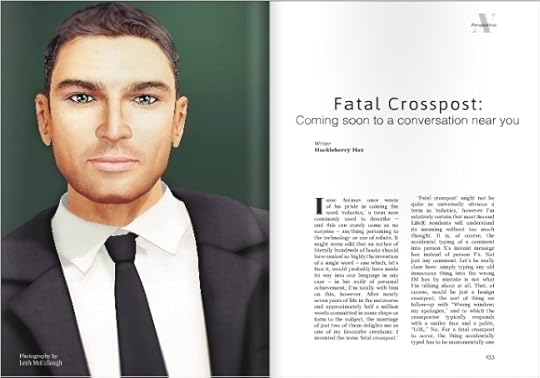
Asimov once wrote of his pride in coining the word ‘robotics’, a term now commonly used to describe – and this can surely come as no surprise – anything pertaining to the technology or use of robots. It might seem odd that an author of literally hundreds of books should have ranked so highly the invention of a single word – one which, let’s face it, would probably have made its way into our language in any case – in his audit of personal achievement; I’m totally with him on this, however. After nearly seven years of life in the metaverse and approximately half a million words committed in some shape or form to the subject, the marriage of just two of them delights me as one of my favourite creations: I invented the term ‘fatal crosspost’.
‘Fatal crosspost’ might not be quite so universally obvious a term as ‘robotics’, however I’m relatively certain that most Second Life® residents will understand its meaning without too much thought. It is, of course, the accidental typing of a comment into person X’s instant message box instead of person Y’s. Not just any comment. Let’s be really clear here: simply typing any old innocuous thing into the wrong IM box by mistake is not what I’m talking about at all. That, of course, would be just a benign crosspost, the sort of thing we follow-up with “Wrong window; my apologies” and to which the crosspostee typically responds with a smiley face and a polite ‘lol’. No. For a fatal crosspost to occur, the thing accidentally typed has to be monumentally one of the worst possible things you could say to that person in that moment. For example, a comment about person X meant for person Y. An uncomplimentary comment. As a general rule, it’s unusual for me to make uncomplimentary comments about other people; one might think, therefore, that the law of averages alone would result in the number of benign crossposts made vastly outnumbering the number of fatal ones. This is not the case. In fact, I’ve found the benign crosspost to be a much less common occurrence than probability would predict based on the mental challenge posed by juggling two, three, even four IM conversations at once. On the other hand, those moments of immense peril involving immature conversations about someone nearby seem to attract the accidental crosspost like gravity attracts matter.
This is not to say that the benign crosspost can do no harm. Accidentally crossposting a comment on, say, the state of the economy into the IM box of someone you’ve intimated has your complete attention would be embarrassing for the crossposter and potentially humiliating for the crosspostee. Such a crosspost could indeed turn out in the long-term to be fatal. But the true fatal crosspost requires no time for its consequences to become apparent; its impact is as subtle as the kiss of a flying brick smashing into your face. And the torchlight embarrassment felt previously at an awkward crosspost will become in the sun-like glare of the sheer shame of an FC as minor as accidentally letting out in conversation one of those high-pitched sneezes you’ve always tried to repress in public. The fatal crosspost is the noisy fart you let out during your annual appraisal with the line manager you’ve always had a secret crush on by comparison.
I’m not quite sure why the creation of this phrase gives me so much pleasure. One theory I have is that the sheer mortification experienced at my own incidences of fatal crosspost is so intense I’ve disproportionately attached immense pride to the making of the phrase in order to convince myself that all the pain I’ve experienced and caused was in some way worth it in the end. The mollified corpses left in my fumbling wake are the unfortunate collateral damage of genius, if you like: I might have seriously upset perfectly decent people with my social ineptitude, but without those subsequent moments of utter self-abhorrence I might never have achieved the greatness of inventing this amazing phrase. Incidentally, I’m not not mentioning here examples of my own personal FCs here out of consideration for the privacy of the crosspostees insulted by them, nor out of any attempt to reduce damage to whatever impression you might currently hold of me: the reason I’m not mentioning them is I have very little actual recollection of their content and circumstances. I believe that the magnitude of my horror on these occasions activated some sort of emergency self-preservation system which declared martial law on my brain and promptly ordered the neurons retaining the memory of the event to commit suicide. All I’m left with today is the recollection of suddenly realising the full magnitude of what my third finger and the Enter key had just done to me and the extreme desire in that moment for my life to end immediately.
There is, of course, no recovery from a fatal crosspost. In the instant of their occurrence, one is usually completely aware that, following the optional grovelling apology, the crosspostee will never be spoken to again. Their name must be added reluctantly to the growing list of people we’re resigned to acknowledge would not only be likely to run us down if they happened to spot us walking alone on a country lane, but would actually be justified in doing so. Any attempt to recover even the smallest fraction of the previously held relationship will only result in the degradation and further humiliation of both poster and postee: any hugs, praise and compliments, any statements of self-flagellation, any intellectual attempts to undermine, counter-argue or in any other way rescind the offending comment made – humorous or otherwise – will ring more hollow and more false than a politician’s pre-election promise; never, under any circumstances, should this be attempted. Accept the new reality and move on.
I’m joking, of course. Recovery is indeed possible. You should be warned, however, that the possible grain of truth in your flippant comment, made for the sake of a moment’s worth of positive affirmation from the person you thought you were talking to, is likely to become the catalyst for a new level of relationship that involves open articulation of the neuroses you might previously have wished person X had some awareness of, but which you’ll conclude were probably better left unexamined after all. By means of compensation, you’ll then feel the need to share some of your own insecurities in return; before you know it, you’ll be listing each other in your profiles as SL siblings, bound together by the pain of existence in an unfair universe and threatening the ten courts of hell on anyone who “messes” with the other. In the long term, then, it might ultimately be far less pain and hassle to just let the crosspostee get on with the business of thinking you a complete and utter turd from this point on in both your lives.
Returning to the issue of ‘fatal crosspost’ the phrase as opposed to fatal crosspost the experience, the invention of any new piece of terminology is only really meaningful if other people go on to use it. The difficulty with this particular phrase is that it contains within it – through use of the word ‘fatal’ – a strong acknowledgement of the magnitude of the deed’s consequences that only a person who’s committed it can really fully appreciate. To anyone who has not thus far committed this crime (enjoy your smug innocence whilst it lasts), ‘fatal’ must seem a bit disproportionate, a bit of an over-exaggeration, a bit – dare I say it – ‘drama’. They might consider the phrase ‘accidental crosspost’ to be entirely sufficient a term, not in need of any embellishment or sub-categorisation. A person who chooses to use ‘fatal crosspost’, then, is sort of admitting through so doing their own guilt. It’s a bit like announcing to all who are present that you’re the sort of person who routinely talks about others behind their back.
The good news is that, by the same logic, this will only be apparent to other offenders, who will likely nod their heads solemnly in RL and welcome you into the brethren of convicted FC felons. Just as some of you reading this will be wondering what on earth all the fuss is about (whilst others will be smiling at the resonance and simultaneously shuddering at the brief re-emergence of heavily repressed memories), the innocent bystanders will scratch their heads in puzzlement, shrug the phrase off and take their next step on the journey towards their own fatal crosspost appointment – because we’re all of us human and we all occasionally gossip. Then, and only then will the true meaning of the phrase reveal itself to them.
If you belong to the group of people who’ve committed fatal crosspost, can I ask you to do this veteran SL resident a favour and start using it in your conversation? The thing to remember is we’re not really bad people for having done this, particularly if the words we use to describe it convey that we know that it was wrong and we do indeed feel shame.
Asimov once wrote of his pride in coining the word ‘robotics’, a term now commonly used to describe – and this can surely come as no surprise – anything pertaining to the technology or use of robots. It might seem odd that an author of literally hundreds of books should have ranked so highly the invention of a single word – one which, let’s face it, would probably have made its way into our language in any case – in his audit of personal achievement; I’m totally with him on this, however. After nearly seven years of life in the metaverse and approximately half a million words committed in some shape or form to the subject, the marriage of just two of them delights me as one of my favourite creations: I invented the term ‘fatal crosspost’.
‘Fatal crosspost’ might not be quite so universally obvious a term as ‘robotics’, however I’m relatively certain that most Second Life® residents will understand its meaning without too much thought. It is, of course, the accidental typing of a comment into person X’s instant message box instead of person Y’s. Not just any comment. Let’s be really clear here: simply typing any old innocuous thing into the wrong IM box by mistake is not what I’m talking about at all. That, of course, would be just a benign crosspost, the sort of thing we follow-up with “Wrong window; my apologies” and to which the crosspostee typically responds with a smiley face and a polite ‘lol’. No. For a fatal crosspost to occur, the thing accidentally typed has to be monumentally one of the worst possible things you could say to that person in that moment. For example, a comment about person X meant for person Y. An uncomplimentary comment. As a general rule, it’s unusual for me to make uncomplimentary comments about other people; one might think, therefore, that the law of averages alone would result in the number of benign crossposts made vastly outnumbering the number of fatal ones. This is not the case. In fact, I’ve found the benign crosspost to be a much less common occurrence than probability would predict based on the mental challenge posed by juggling two, three, even four IM conversations at once. On the other hand, those moments of immense peril involving immature conversations about someone nearby seem to attract the accidental crosspost like gravity attracts matter.
This is not to say that the benign crosspost can do no harm. Accidentally crossposting a comment on, say, the state of the economy into the IM box of someone you’ve intimated has your complete attention would be embarrassing for the crossposter and potentially humiliating for the crosspostee. Such a crosspost could indeed turn out in the long-term to be fatal. But the true fatal crosspost requires no time for its consequences to become apparent; its impact is as subtle as the kiss of a flying brick smashing into your face. And the torchlight embarrassment felt previously at an awkward crosspost will become in the sun-like glare of the sheer shame of an FC as minor as accidentally letting out in conversation one of those high-pitched sneezes you’ve always tried to repress in public. The fatal crosspost is the noisy fart you let out during your annual appraisal with the line manager you’ve always had a secret crush on by comparison.
I’m not quite sure why the creation of this phrase gives me so much pleasure. One theory I have is that the sheer mortification experienced at my own incidences of fatal crosspost is so intense I’ve disproportionately attached immense pride to the making of the phrase in order to convince myself that all the pain I’ve experienced and caused was in some way worth it in the end. The mollified corpses left in my fumbling wake are the unfortunate collateral damage of genius, if you like: I might have seriously upset perfectly decent people with my social ineptitude, but without those subsequent moments of utter self-abhorrence I might never have achieved the greatness of inventing this amazing phrase. Incidentally, I’m not not mentioning here examples of my own personal FCs here out of consideration for the privacy of the crosspostees insulted by them, nor out of any attempt to reduce damage to whatever impression you might currently hold of me: the reason I’m not mentioning them is I have very little actual recollection of their content and circumstances. I believe that the magnitude of my horror on these occasions activated some sort of emergency self-preservation system which declared martial law on my brain and promptly ordered the neurons retaining the memory of the event to commit suicide. All I’m left with today is the recollection of suddenly realising the full magnitude of what my third finger and the Enter key had just done to me and the extreme desire in that moment for my life to end immediately.
There is, of course, no recovery from a fatal crosspost. In the instant of their occurrence, one is usually completely aware that, following the optional grovelling apology, the crosspostee will never be spoken to again. Their name must be added reluctantly to the growing list of people we’re resigned to acknowledge would not only be likely to run us down if they happened to spot us walking alone on a country lane, but would actually be justified in doing so. Any attempt to recover even the smallest fraction of the previously held relationship will only result in the degradation and further humiliation of both poster and postee: any hugs, praise and compliments, any statements of self-flagellation, any intellectual attempts to undermine, counter-argue or in any other way rescind the offending comment made – humorous or otherwise – will ring more hollow and more false than a politician’s pre-election promise; never, under any circumstances, should this be attempted. Accept the new reality and move on.
I’m joking, of course. Recovery is indeed possible. You should be warned, however, that the possible grain of truth in your flippant comment, made for the sake of a moment’s worth of positive affirmation from the person you thought you were talking to, is likely to become the catalyst for a new level of relationship that involves open articulation of the neuroses you might previously have wished person X had some awareness of, but which you’ll conclude were probably better left unexamined after all. By means of compensation, you’ll then feel the need to share some of your own insecurities in return; before you know it, you’ll be listing each other in your profiles as SL siblings, bound together by the pain of existence in an unfair universe and threatening the ten courts of hell on anyone who “messes” with the other. In the long term, then, it might ultimately be far less pain and hassle to just let the crosspostee get on with the business of thinking you a complete and utter turd from this point on in both your lives.
Returning to the issue of ‘fatal crosspost’ the phrase as opposed to fatal crosspost the experience, the invention of any new piece of terminology is only really meaningful if other people go on to use it. The difficulty with this particular phrase is that it contains within it – through use of the word ‘fatal’ – a strong acknowledgement of the magnitude of the deed’s consequences that only a person who’s committed it can really fully appreciate. To anyone who has not thus far committed this crime (enjoy your smug innocence whilst it lasts), ‘fatal’ must seem a bit disproportionate, a bit of an over-exaggeration, a bit – dare I say it – ‘drama’. They might consider the phrase ‘accidental crosspost’ to be entirely sufficient a term, not in need of any embellishment or sub-categorisation. A person who chooses to use ‘fatal crosspost’, then, is sort of admitting through so doing their own guilt. It’s a bit like announcing to all who are present that you’re the sort of person who routinely talks about others behind their back.
The good news is that, by the same logic, this will only be apparent to other offenders, who will likely nod their heads solemnly in RL and welcome you into the brethren of convicted FC felons. Just as some of you reading this will be wondering what on earth all the fuss is about (whilst others will be smiling at the resonance and simultaneously shuddering at the brief re-emergence of heavily repressed memories), the innocent bystanders will scratch their heads in puzzlement, shrug the phrase off and take their next step on the journey towards their own fatal crosspost appointment – because we’re all of us human and we all occasionally gossip. Then, and only then will the true meaning of the phrase reveal itself to them.
If you belong to the group of people who’ve committed fatal crosspost, can I ask you to do this veteran SL resident a favour and start using it in your conversation? The thing to remember is we’re not really bad people for having done this, particularly if the words we use to describe it convey that we know that it was wrong and we do indeed feel shame.
June 29, 2013
Going back
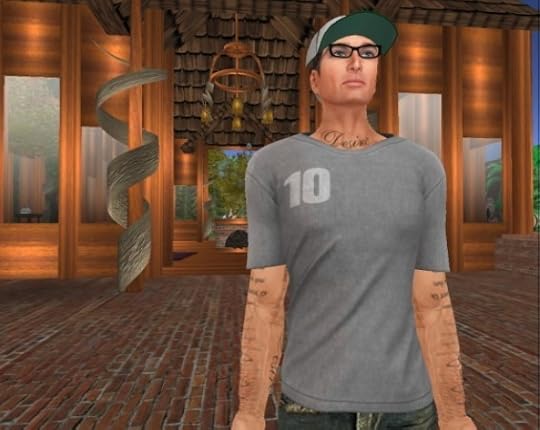
Whilst the celebrations on SL10B draw to a close and in the few remaining days before the switch gets flipped on server-side rendering - changing forever the way in which avatars are served up in Second Life - I decided to revisit my roots in SL and take a few pictures of the places of my first few metaverse days. Of course, I didn't know back then how to take photographs in SL, so the experience itself went unrecorded. Luckily, the places themselves - or rather, copies of them - continue to exist, so I donned my SL10B celebratory t-shirt and cap (I can't quite yet bring myself to wear the special edition bear avatar, at least in public) and made for the very first place ever to rez on my screen - Orientation Island.
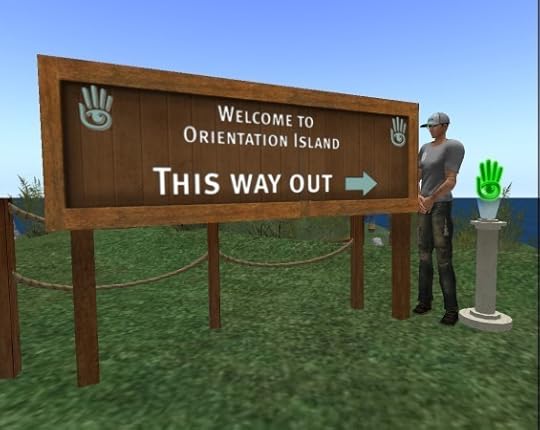
Linden's developed several 'First Hour' experiences since Orientation Island and all that exists of it now is the single 'public' copy. Back in 2006, there were loads of copies of the island, accessible only to brand new residents: once you left it, you could never go back. But they did create a public copy that you could visit if you were feeling wobbly once you'd passed the point of no return.
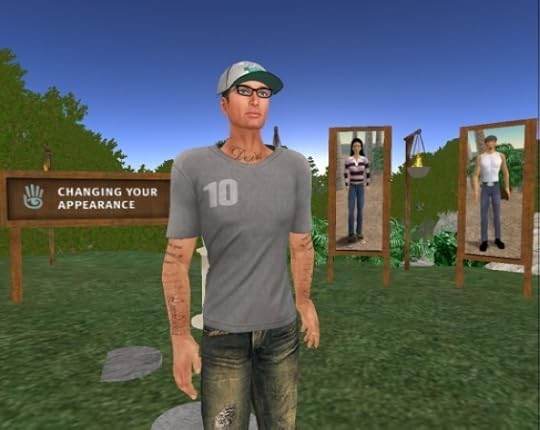
At Orientation Island, you rezzed atop a small hill. The first thing you encountered as you walked down was a new outfit, courtesy of Governor Linden. That avatar shown in the right sign was my first ever change of clothes.
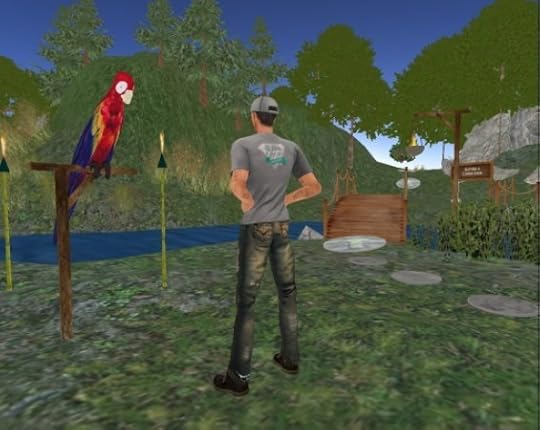
At the bottom of the hill was a parrot who would give you a kiss in return for asking for one in text: the first words spoken by many, perhaps. Although the outfit I wore for these pictures included mesh items, I decided to crank back the graphics to how I have seen SL back in 2006, when there was no mesh, no sculpties, no shadows and no windlight. I even turned off my AO.
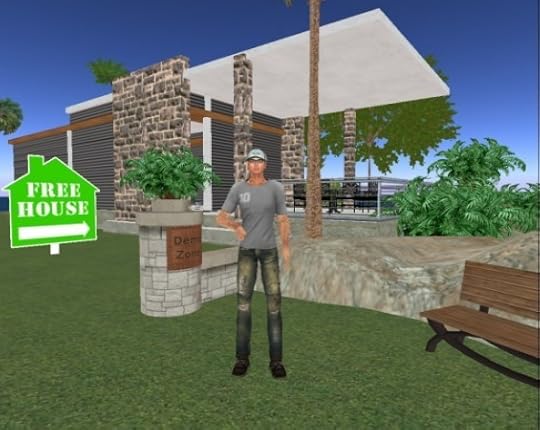
After Orientation Island, you could go straight to the mainland to start Second Life proper, or you could visit Help Island as an intermediate stage. Again, this was cut off from the main grid, and again a public copy was created and still exists. The focal point of Help Island is a large, central, circular structure where helpers would hang out to answer the questions of the newly rezzed. It's still a hang-out today, but - just like Orientation Island - it's more a social thing than a place of any real function.
Around the edges of the island the various freebies and help points remain, such as Bill Stirling's free 'Archer House', a set of building tutorials and a sandbox. Then there's the freebie shop with its collection of economy brand avatars and furniture. These must now surely be the oldest 'products' available anywhere in SL
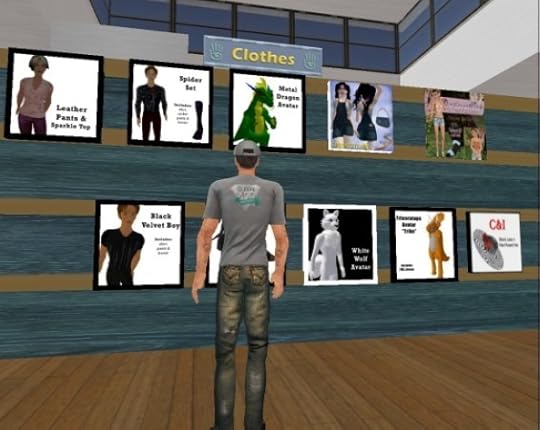
I originally spent several days at Help Island before finally moving on to the main grid. It was a strange, slightly surreal experience to watch so many people arrive and then move on to the 'real world'. There was some sort of a game which hasn't made it to the archived copy, which made sounds I will now forever associate with being new in SL. Also, a lot of people seemed inclined to try out the 'laugh' gesture whilst they were on Help Island.
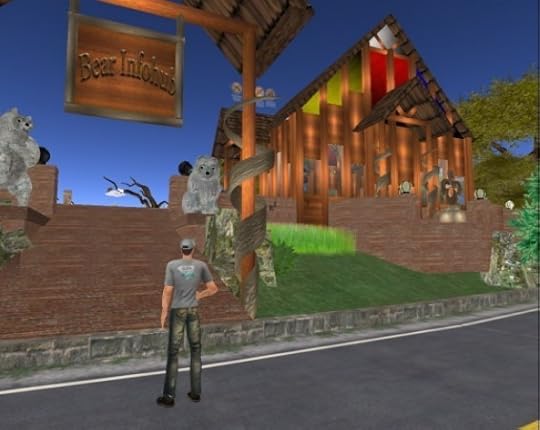
Finally, I left Help Island and got sent to Bear Infohub. In contrast to the two islands, Bear - by virtue of being part of the mainland - has evolved a little over the years; for example, trees and a forest scene have been added all around this red-brick-and-wood construction. I had to remove a number of items for the photos I took there to look like the Bear of my memories.
Bear was my home spot for several weeks - with each day's exploration usually starting there - right up to the day when I became a subscription resident and bought my first 512m plot of land. I still go back from time to time; it's a bit like going home for Christmas.
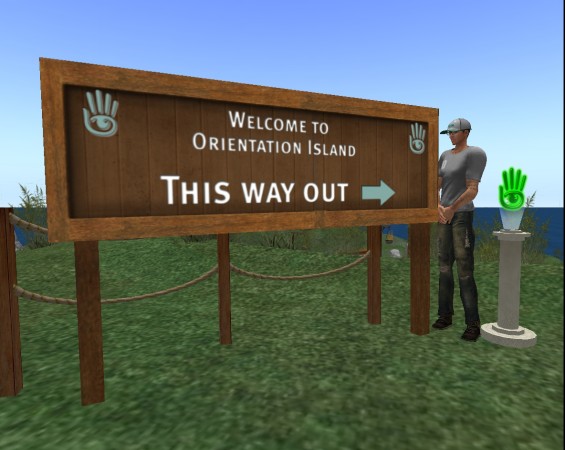
Linden's developed several 'First Hour' experiences since Orientation Island and all that exists of it now is the single 'public' copy. Back in 2006, there were loads of copies of the island, accessible only to brand new residents: once you left it, you could never go back. But they did create a public copy that you could visit if you were feeling wobbly once you'd passed the point of no return.
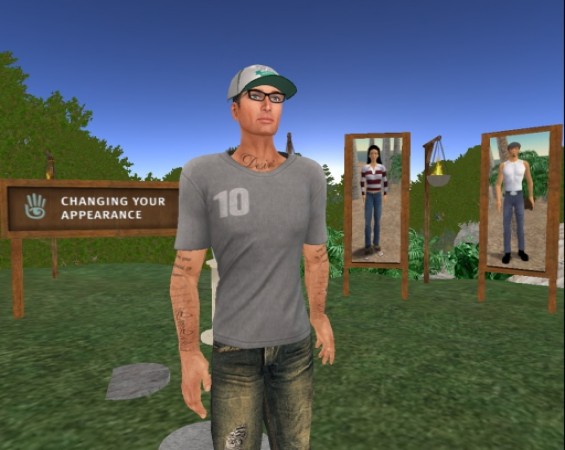
At Orientation Island, you rezzed atop a small hill. The first thing you encountered as you walked down was a new outfit, courtesy of Governor Linden. That avatar shown in the right sign was my first ever change of clothes.
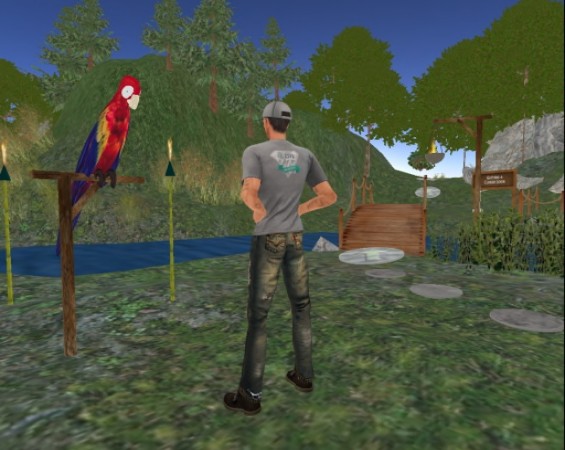
At the bottom of the hill was a parrot who would give you a kiss in return for asking for one in text: the first words spoken by many, perhaps. Although the outfit I wore for these pictures included mesh items, I decided to crank back the graphics to how I have seen SL back in 2006, when there was no mesh, no sculpties, no shadows and no windlight. I even turned off my AO.
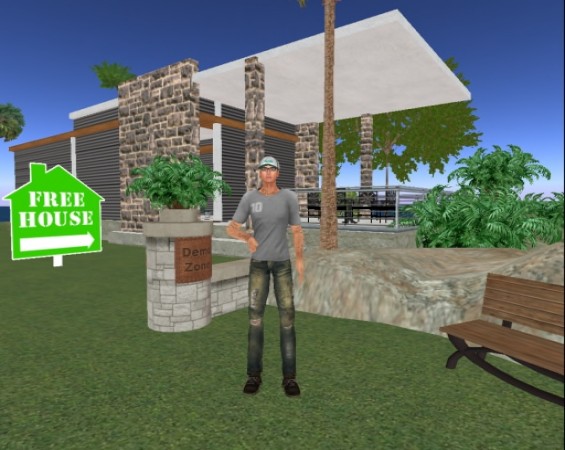
After Orientation Island, you could go straight to the mainland to start Second Life proper, or you could visit Help Island as an intermediate stage. Again, this was cut off from the main grid, and again a public copy was created and still exists. The focal point of Help Island is a large, central, circular structure where helpers would hang out to answer the questions of the newly rezzed. It's still a hang-out today, but - just like Orientation Island - it's more a social thing than a place of any real function.
Around the edges of the island the various freebies and help points remain, such as Bill Stirling's free 'Archer House', a set of building tutorials and a sandbox. Then there's the freebie shop with its collection of economy brand avatars and furniture. These must now surely be the oldest 'products' available anywhere in SL
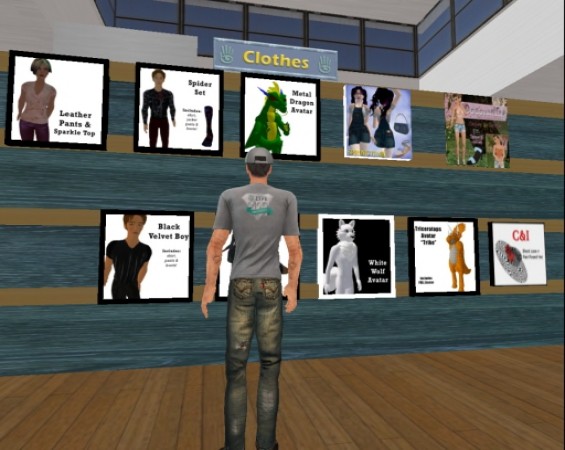
I originally spent several days at Help Island before finally moving on to the main grid. It was a strange, slightly surreal experience to watch so many people arrive and then move on to the 'real world'. There was some sort of a game which hasn't made it to the archived copy, which made sounds I will now forever associate with being new in SL. Also, a lot of people seemed inclined to try out the 'laugh' gesture whilst they were on Help Island.
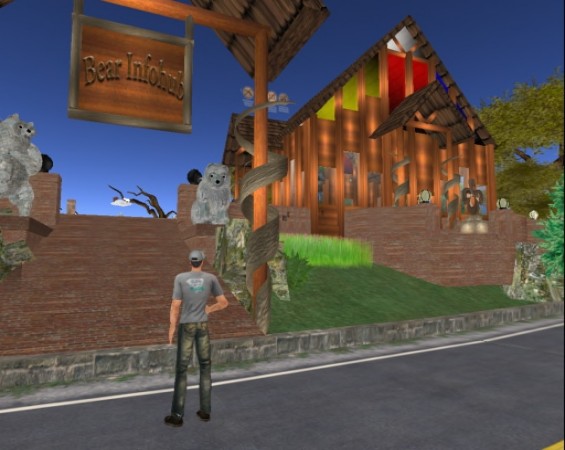
Finally, I left Help Island and got sent to Bear Infohub. In contrast to the two islands, Bear - by virtue of being part of the mainland - has evolved a little over the years; for example, trees and a forest scene have been added all around this red-brick-and-wood construction. I had to remove a number of items for the photos I took there to look like the Bear of my memories.
Bear was my home spot for several weeks - with each day's exploration usually starting there - right up to the day when I became a subscription resident and bought my first 512m plot of land. I still go back from time to time; it's a bit like going home for Christmas.
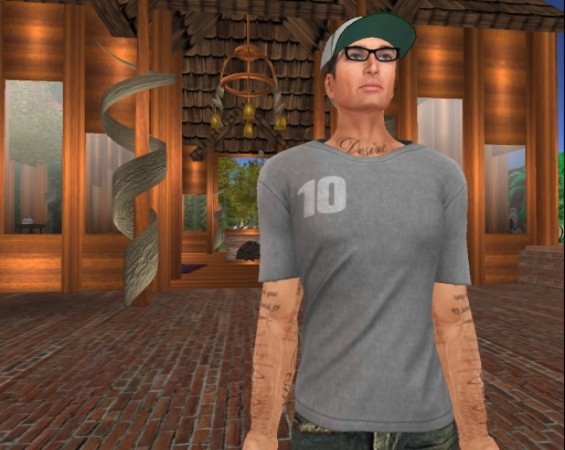
June 23, 2013
Absent addiction
It's SL's tenth birthday today. And here's the final part of my 'Absent' series.
Absent addiction
In AFK I wrote about a character who was – by her own admission – addicted to Second Life. She spent as much time inworld as she possibly could; she even slept logged in so that the dingding of any IMs coming to her during the night would wake her up.
I can’t say that I’ve ever been thataddicted to SL, but for sure there was a long period – of several years – when any day without at least some metaverse time felt hopelessly incomplete. I’d even go so far as to say that I regarded SL time during these years as the period during which I could be most true to myself as I felt myself to be in my non-working hours. SL was where I existed, socially. To a certain extent, I had good reasons for that.
It was more than a little ironic that I should have felt that way about the metaverse, since one of my curiosities about it in the first place was the whole issue of online world addiction. The key reason that I entered when I did was as task avoidance from working on a book I was writing at the time, but that’s not to say I didn’t also have questions I wanted answering. One of those concerned addiction. I’d heard a few months earlier about a young man in Japan who had actually died from sitting in one place for too long whilst he was gaming in an online world. I just didn’t see how that was possible.
Although I personally never fell victim to such a level of addiction as that, I came close enough that I could see clearly how it was possible. I remember a day fairly early on in my residency when the whole grid went down for several hours. This used to happen every now and again back then, but rarely for more than a few minutes. Linden posted a message on the SL website encouraging us to view this downtime as an opportunity to get reacquainted with our first lives again. “Go and walk your dog,” they joked. I wanted to scream.
Interestingly, time spent on the internet has been proposed as a possible factor in the current downward trend in UK crime. The proposal is that young people who might previously have spent time getting up to anti-social shenanigans in the evening are now spending their free time online at home. There’s no evidence for this as yet, far less any idea as to what on the internet might be most responsible, but the reduction in crime – and through a period of economic depression most commonly associated with an increase in crime – is marked and experts are scratching their heads in genuine bewilderment. There has to be something they hadn’t thought of before and the table is open to all ideas.
Few people would complain about crime reducing, but what if the cost of that is internet addiction? As online, graphical environments such as that offered by SL become more and more immersive, will more and more people surrender their entire lives to the virtual world of their choice?
I’m no longer addicted to SL, but neither am I someone who has to leave it completely in order to be free of it. I go inworld sometimes as little as half an hour in a week. Occasionally, I get the desire to do a particular thing and can spend much longer, or visit every day for a while. But, somehow – and I’m not entirely sure how or why – the need to be in whenever I can is now just a distant memory. I’m perfectly content for SL to be just a thing I sometimes enjoy.
The metaverse still fascinates me; I follow news about it avidly and there are often things I read about which I decide I have to witness or try for myself. I still consider myself very much a resident. But SL has lost its hold on me. For the most part, I’m glad about that.
For the most part.
Absent addiction
In AFK I wrote about a character who was – by her own admission – addicted to Second Life. She spent as much time inworld as she possibly could; she even slept logged in so that the dingding of any IMs coming to her during the night would wake her up.
I can’t say that I’ve ever been thataddicted to SL, but for sure there was a long period – of several years – when any day without at least some metaverse time felt hopelessly incomplete. I’d even go so far as to say that I regarded SL time during these years as the period during which I could be most true to myself as I felt myself to be in my non-working hours. SL was where I existed, socially. To a certain extent, I had good reasons for that.
It was more than a little ironic that I should have felt that way about the metaverse, since one of my curiosities about it in the first place was the whole issue of online world addiction. The key reason that I entered when I did was as task avoidance from working on a book I was writing at the time, but that’s not to say I didn’t also have questions I wanted answering. One of those concerned addiction. I’d heard a few months earlier about a young man in Japan who had actually died from sitting in one place for too long whilst he was gaming in an online world. I just didn’t see how that was possible.
Although I personally never fell victim to such a level of addiction as that, I came close enough that I could see clearly how it was possible. I remember a day fairly early on in my residency when the whole grid went down for several hours. This used to happen every now and again back then, but rarely for more than a few minutes. Linden posted a message on the SL website encouraging us to view this downtime as an opportunity to get reacquainted with our first lives again. “Go and walk your dog,” they joked. I wanted to scream.
Interestingly, time spent on the internet has been proposed as a possible factor in the current downward trend in UK crime. The proposal is that young people who might previously have spent time getting up to anti-social shenanigans in the evening are now spending their free time online at home. There’s no evidence for this as yet, far less any idea as to what on the internet might be most responsible, but the reduction in crime – and through a period of economic depression most commonly associated with an increase in crime – is marked and experts are scratching their heads in genuine bewilderment. There has to be something they hadn’t thought of before and the table is open to all ideas.
Few people would complain about crime reducing, but what if the cost of that is internet addiction? As online, graphical environments such as that offered by SL become more and more immersive, will more and more people surrender their entire lives to the virtual world of their choice?
I’m no longer addicted to SL, but neither am I someone who has to leave it completely in order to be free of it. I go inworld sometimes as little as half an hour in a week. Occasionally, I get the desire to do a particular thing and can spend much longer, or visit every day for a while. But, somehow – and I’m not entirely sure how or why – the need to be in whenever I can is now just a distant memory. I’m perfectly content for SL to be just a thing I sometimes enjoy.
The metaverse still fascinates me; I follow news about it avidly and there are often things I read about which I decide I have to witness or try for myself. I still consider myself very much a resident. But SL has lost its hold on me. For the most part, I’m glad about that.
For the most part.
June 17, 2013
Living in your gender, in SL
Here's my June column for AVENUE magazine.
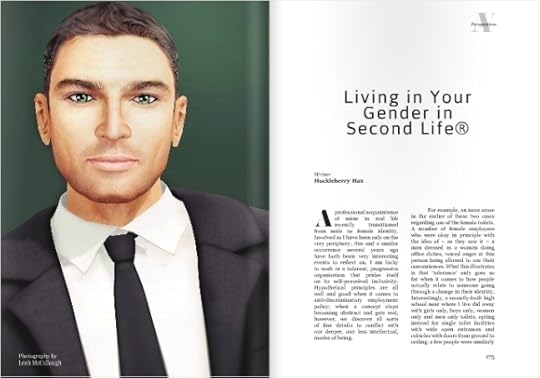
A professional acquaintance of mine in RL recently transitioned from male to female identity. Involved as I have been only on the very periphery, this and a similar occurrence several years ago have both been very interesting events to reflect on. I am lucky to work in a tolerant, progressive organisation that prides itself on its self-perceived inclusivity. Hypothetical principles are all well and good when it comes to anti-discriminatory employment policy; when a concept stops becoming abstract and gets real, however, we discover all sorts of fine detail to conflict with our deeper, our less intellectual modes of being.
For example, an issue arose in the earlier of these two cases regarding use of the female toilets. A number of female employees who were okay in principle with the idea of – as they saw it – a man dressed as a woman doing office duties, voiced anger at this person being allowed to use their conveniences. What this illustrates is that ‘tolerance’ only goes so far when it comes to how people actually relate to someone going through a change in their identity. Interestingly, a recently-built high school near where I live did away with girls only, boys only, women only and men only toilets, opting instead for single toilet facilities with wide open entrances and cubicles with doors from ground to ceiling: a few people were similarly uncomfortable with this idea at first, but the end result of it is that toilet bullying – a long-standing problem in British schools – has been all but eradicated there. This new approach to gender division (or rather, lack of) has been accepted, ultimately, because people empathise with the idea of being bullied in out-of-sight, isolated places. We can adapt to significant changes when we are sufficiently motivated and when we are sufficiently personally connected to their rationale that they make sense.
About twenty years ago, my mother told me about a person in their early twenties who sat next to her on the train to work each morning. Having made the transition from male to female identity, this young woman wanted to talk to her about ‘women stuff’ like clothes and hair and make-up and shoes. A lot of her questions seemed at first to my mother to have a sort of clichéd superficiality about them – they were almost child-like in their complexity; the sort of questions, perhaps, a young girl might ask her mother. Although she ‘played along’ with the conversations, a part of her doubted the sincerity of the context. It felt incongruous. This was not, after all, a young person with learning difficulties. When we discussed this further, however, we realised that a recently transitioned female who’d spent most of her life being socialised as male would have few common points of cultural reference with women. Put simply, she’d had little experience of talking to women as a woman and needed a non-threatening, non-judgemental role model with whom she could learn some of these female socialisation ‘basics’ that life’s conditioning so far had denied her.
Perhaps more importantly, she also just needed to have conversations with someone where she was spoken to as a female – and what better way to do this than through female topics of conversation? In thinking now about the issue of the colleague using the female toilets, I’m struck by how essential to acceptance female ritual must be to someone recently transitioned to female (or how essential male ritual must be to someone recently transitioned to male). The complainants might have defended their proposed restrictions to toilets access (none were ultimately made, thankfully) as some sort of limitation that ensured one person’s ‘preferences’ didn’t impose on others, not realising the fundamental importance of such ritual and not sensing that this issue of identity begins way deeper than the surface layer of clothing and hair style and make-up.
But perhaps most important of all is how this case demonstrates that the supposedly ‘tolerant’ co-workers revealed through this complaint that they weren’t really thinking of this person as a female at all, but as a male, and thereby ultimately denying her her need to be spoken to as a woman for the sake of her own developing identity. To what extent is our identity influenced by that which others project upon us? Quite a bit, if you consider such theories as Henri Tajfel and John Turner’s hugely influential ‘Social Identity Theory’ as valid.
But even if you try harder than these women did to empathise, it’s still not easy to think about a person of one biology as the opposite gender when you’re face-to-face in conversation with them, particularly if you knew him or her before they started their transition. Ultimately, it’s the presence and absence of a hundred tiny little details which create the sense of incongruity we feel, much as we don’t want to feel it, far less acknowledge it. We do our very best to take manual control and override all these automatic associations, but we have a lifetime of conditioning to overcome in those moments. The end result can often be that we come away worrying we haven’t been natural with our friend or colleague and that they might have sensed our subtle disorientation – and we might be right. To a certain extent, there’s not a great deal that can be done about this in the short term other than maintain our very best efforts to think of transitioned or transitioning friends as belonging to their chosen gender: eventually, the societal associations concerning gender will weaken and become rewritten, and perhaps future generations will consider our mental inflexibility absurd.
In the meantime, though, where can transgender people experience being treated and spoken to as – or, perhaps more importantly, thought of as belonging to – their chosen gender? Where can they explore their identity unencumbered by the baggage of others who are at worst overtly prejudiced and discriminatory and at best struggling to overcome their own institutionalised conditioning? The Internet in its widest sense has, to some extent, provided this medium for some time now: there was internet chat before the web and social networking now allows us to build whatever personal profile we desire. The metaverse, however, takes this to a whole new level of interaction. Second Life® allows the anonymity that other forms of internet interaction provide, but it also allows us to adopt the visual appearance of our chosen gender and to exist in three dimensional spaces with others. As an opportunity to experience being treated by others in a chosen gender role on a day-to-day, moment-by-moment basis, it must be without historical precedent. Yes, it’s a reduced sensory environment and communicating in text is not the same as spoken interaction, but it is at least an equal playing field with everyone else.
Concealment of biological gender does, of course, carry with it the uncomfortable issue of deception. If a transgender person exploring a female identity chooses not to make known her male biology inworld in order to experience properly being regarded as female, is she then guilty of deceiving what could potentially become very important friends in her life? Even though SL’s terms and conditions are clear that no person is under any obligation to reveal their RL gender and that telling others the RL details of a resident – including their gender – is a serious breach, the perception continues that knowing such fundamental information about someone is some sort of human right. What we need to understand is that a transgender person is not ‘pretending’ to be the gender they adopt. They have always felt themselves to be this way, but that is not to say that they have had experience in living it. All too often, SL gets spoken of in the same breath as comments on sexual behaviour, with concealment of identity assumed to mean some sort of sexual misdemeanour; one of its most praiseworthy qualities, however, has to be the opportunity it gives people to just be in whatever way it is they want to be: through going shopping together, through irreverent chat, through looking at art together, through whatever.
And if a close SL friend should choose to reveal that they are transgender, we should look upon this as nothing less than a gift. For us, also, this is an opportunity. Those two hundred tiny details won’t be anything like as apparent in metaverse interaction as they are in RL and our own sense of incongruity will be greatly reduced. As it does in so many other ways, SL helps us to experience something abstract as something plain and ordinary; the absence of detail allows us to see through that which might normally distract and to connect at that level where we are all of us just everyday people.
Perhaps it and the virtual worlds which will follow might even speed up in RL the weakening of our socially programmed associations. I, for one, won’t miss them.
A professional acquaintance of mine in RL recently transitioned from male to female identity. Involved as I have been only on the very periphery, this and a similar occurrence several years ago have both been very interesting events to reflect on. I am lucky to work in a tolerant, progressive organisation that prides itself on its self-perceived inclusivity. Hypothetical principles are all well and good when it comes to anti-discriminatory employment policy; when a concept stops becoming abstract and gets real, however, we discover all sorts of fine detail to conflict with our deeper, our less intellectual modes of being.
For example, an issue arose in the earlier of these two cases regarding use of the female toilets. A number of female employees who were okay in principle with the idea of – as they saw it – a man dressed as a woman doing office duties, voiced anger at this person being allowed to use their conveniences. What this illustrates is that ‘tolerance’ only goes so far when it comes to how people actually relate to someone going through a change in their identity. Interestingly, a recently-built high school near where I live did away with girls only, boys only, women only and men only toilets, opting instead for single toilet facilities with wide open entrances and cubicles with doors from ground to ceiling: a few people were similarly uncomfortable with this idea at first, but the end result of it is that toilet bullying – a long-standing problem in British schools – has been all but eradicated there. This new approach to gender division (or rather, lack of) has been accepted, ultimately, because people empathise with the idea of being bullied in out-of-sight, isolated places. We can adapt to significant changes when we are sufficiently motivated and when we are sufficiently personally connected to their rationale that they make sense.
About twenty years ago, my mother told me about a person in their early twenties who sat next to her on the train to work each morning. Having made the transition from male to female identity, this young woman wanted to talk to her about ‘women stuff’ like clothes and hair and make-up and shoes. A lot of her questions seemed at first to my mother to have a sort of clichéd superficiality about them – they were almost child-like in their complexity; the sort of questions, perhaps, a young girl might ask her mother. Although she ‘played along’ with the conversations, a part of her doubted the sincerity of the context. It felt incongruous. This was not, after all, a young person with learning difficulties. When we discussed this further, however, we realised that a recently transitioned female who’d spent most of her life being socialised as male would have few common points of cultural reference with women. Put simply, she’d had little experience of talking to women as a woman and needed a non-threatening, non-judgemental role model with whom she could learn some of these female socialisation ‘basics’ that life’s conditioning so far had denied her.
Perhaps more importantly, she also just needed to have conversations with someone where she was spoken to as a female – and what better way to do this than through female topics of conversation? In thinking now about the issue of the colleague using the female toilets, I’m struck by how essential to acceptance female ritual must be to someone recently transitioned to female (or how essential male ritual must be to someone recently transitioned to male). The complainants might have defended their proposed restrictions to toilets access (none were ultimately made, thankfully) as some sort of limitation that ensured one person’s ‘preferences’ didn’t impose on others, not realising the fundamental importance of such ritual and not sensing that this issue of identity begins way deeper than the surface layer of clothing and hair style and make-up.
But perhaps most important of all is how this case demonstrates that the supposedly ‘tolerant’ co-workers revealed through this complaint that they weren’t really thinking of this person as a female at all, but as a male, and thereby ultimately denying her her need to be spoken to as a woman for the sake of her own developing identity. To what extent is our identity influenced by that which others project upon us? Quite a bit, if you consider such theories as Henri Tajfel and John Turner’s hugely influential ‘Social Identity Theory’ as valid.
But even if you try harder than these women did to empathise, it’s still not easy to think about a person of one biology as the opposite gender when you’re face-to-face in conversation with them, particularly if you knew him or her before they started their transition. Ultimately, it’s the presence and absence of a hundred tiny little details which create the sense of incongruity we feel, much as we don’t want to feel it, far less acknowledge it. We do our very best to take manual control and override all these automatic associations, but we have a lifetime of conditioning to overcome in those moments. The end result can often be that we come away worrying we haven’t been natural with our friend or colleague and that they might have sensed our subtle disorientation – and we might be right. To a certain extent, there’s not a great deal that can be done about this in the short term other than maintain our very best efforts to think of transitioned or transitioning friends as belonging to their chosen gender: eventually, the societal associations concerning gender will weaken and become rewritten, and perhaps future generations will consider our mental inflexibility absurd.
In the meantime, though, where can transgender people experience being treated and spoken to as – or, perhaps more importantly, thought of as belonging to – their chosen gender? Where can they explore their identity unencumbered by the baggage of others who are at worst overtly prejudiced and discriminatory and at best struggling to overcome their own institutionalised conditioning? The Internet in its widest sense has, to some extent, provided this medium for some time now: there was internet chat before the web and social networking now allows us to build whatever personal profile we desire. The metaverse, however, takes this to a whole new level of interaction. Second Life® allows the anonymity that other forms of internet interaction provide, but it also allows us to adopt the visual appearance of our chosen gender and to exist in three dimensional spaces with others. As an opportunity to experience being treated by others in a chosen gender role on a day-to-day, moment-by-moment basis, it must be without historical precedent. Yes, it’s a reduced sensory environment and communicating in text is not the same as spoken interaction, but it is at least an equal playing field with everyone else.
Concealment of biological gender does, of course, carry with it the uncomfortable issue of deception. If a transgender person exploring a female identity chooses not to make known her male biology inworld in order to experience properly being regarded as female, is she then guilty of deceiving what could potentially become very important friends in her life? Even though SL’s terms and conditions are clear that no person is under any obligation to reveal their RL gender and that telling others the RL details of a resident – including their gender – is a serious breach, the perception continues that knowing such fundamental information about someone is some sort of human right. What we need to understand is that a transgender person is not ‘pretending’ to be the gender they adopt. They have always felt themselves to be this way, but that is not to say that they have had experience in living it. All too often, SL gets spoken of in the same breath as comments on sexual behaviour, with concealment of identity assumed to mean some sort of sexual misdemeanour; one of its most praiseworthy qualities, however, has to be the opportunity it gives people to just be in whatever way it is they want to be: through going shopping together, through irreverent chat, through looking at art together, through whatever.
And if a close SL friend should choose to reveal that they are transgender, we should look upon this as nothing less than a gift. For us, also, this is an opportunity. Those two hundred tiny details won’t be anything like as apparent in metaverse interaction as they are in RL and our own sense of incongruity will be greatly reduced. As it does in so many other ways, SL helps us to experience something abstract as something plain and ordinary; the absence of detail allows us to see through that which might normally distract and to connect at that level where we are all of us just everyday people.
Perhaps it and the virtual worlds which will follow might even speed up in RL the weakening of our socially programmed associations. I, for one, won’t miss them.
June 13, 2013
Absent products
In part five of my 'Absent' series, I discard some obsolete products.
Mega prims
Oh how I cheered when the switch got flipped removing the ten metre limit on prim length (I think it was at about the same time that mesh got introduced). I didn’t immediately optimise my skybox, but when I did I managed in the space of about an hour to reduce the prim count for the building shell by almost fifty per cent. More to the point, I was able to ditch every last mega prim I’d used in my previous optimisation. If I could have, I’d have lit a fucking great big fire and burned the lot of them in celebration.
Mega prims were a necessary evil if you wanted to build anything bigger than a garden shed and not have it suck dry the measly 117 prim allowance on your 512m plot. Imagine a shoe box with the lid taped on and one of the long sides cut out and you pretty much have the shape of my skybox. It measures now 32m by 16m and is 10m high. To do this in old, ten metre restricted prims would cost a staggering twenty prims; today, it can be done in two. Of course, to reduce this number, I originally built the skybox as 30m by 15m but that still cost me sixteen prims – and that’s before I got to the windows, let alone the furnishings. With mega prims, I managed to reduce the sixteen to a very respectable five. But not without pain.
I don’t understand how mega prims were made: through some sort of black SL art, I suspect, that involved naked dancing and incantations. Or possibly a viewer bug which talented residents exploited for the brief period that it existed (you decide which is most appealing). The thing with mega prims was that they only came in certain dimensions – dimensions which you couldn’t adjust (because the moment you attempted to do so they snapped instantly back to the ten metre limit) and dimensions which very rarely coincided with the actual size of prim that you wanted. You only realised this, of course, after you’d trawled through the eye-bleedingly long list of mega prims in your inventory – twice, because you just couldn’t bring yourself to accept that your perfectly reasonable dimension needs could not be met. Even the builder’s HUD I later obtained ended up making me want to stab myself: although it conveniently took size requests from the command line and searched for something that matched, it didn’t realise that a 15m x 30m x 0.5m prim was functionally the same as a 30m x 15m x 0.5m prim, making every ultimately unsuccessful search six commands long and a headache in trying to make sure you’d exhausted all the X, Y and Z combinations. I’m an ungrateful bastard, I know; mega prims ultimately saved me a great deal of land impact prior to the ten metre limit removal, but Christ they were a pain.
Of course, mega prims are still around today: the ten metre limit might have been removed, but a sixty-four metre limit was then imposed and mega prims exist at sizes up to sixty-four thousand metres (that’s 256 whole sims lined up next to each other). Thankfully, since it’s unlikely I’ll ever be able to afford a land parcel that exceeds 64m in any direction, using these things again is a horror I will never have to contemplate.
Flexi Jackets
In much the same way that I kind of like the way 1980s programmers became increasingly ingenious at getting more and more from the old eight bit computers, I have a certain affection for the ways in which clothes designers overcame the limitations of the old ‘painted-on’ shirts and jackets prior to the introduction of mesh. As mesh continues its apparel assault, I imagine there must be designers now lamenting that their once clever tricks for adding hoods and collars and cuffs and rolled up sleeves and all manner of other bits in some way embellishing an avatar’s upper body (a single jacket could have 30+ prims in its folder) will soon become about as relevant as Ray Harryhausen’s amazing stop-motion modelling techniques are in the digital effects era. Unless they sell in InWorldz, of course…
Well, their day isn’t over just yet. Lots of this clothing still gets worn today because the best of it still looks pretty good. I have a tuxedo, bought years ago from Blaze, that continues to look perfectly respectable. Amazingly, this doesn’t even use that little prim flap to be found at the bottom of so many men’s jackets of what I propose become known now as the paint-prim hybrid (PPH) era. The only prim garnish to be found on it anywhere is a little sculptie bow tie. Awww.
Any jacket that employs those strips of flexi-prims in order to give them a ‘loose’ feel, however, may now become extinct. Seriously; I really hope I never see another of these again. Similarly, any jacket with one of those wrap-around cone-shaped prims to give it a wide flare at the bottom has my permission to die. It looked great in the static picture you clicked on to buy it; as soon as you tried to move, however, it looked like you were wearing some sort of portable iron lung.
Nobody especially likes deleting inventory, so dump all of this stuff in a special ‘retro’ folder and intend to wear it again for laughs at the 2023 SL reunion. Of course, by then we’ll all be wearing the rigged mesh version of ‘Ruth’ and commenting on how perfect the emulation is. Ah, the irony.
Mega prims
Oh how I cheered when the switch got flipped removing the ten metre limit on prim length (I think it was at about the same time that mesh got introduced). I didn’t immediately optimise my skybox, but when I did I managed in the space of about an hour to reduce the prim count for the building shell by almost fifty per cent. More to the point, I was able to ditch every last mega prim I’d used in my previous optimisation. If I could have, I’d have lit a fucking great big fire and burned the lot of them in celebration.
Mega prims were a necessary evil if you wanted to build anything bigger than a garden shed and not have it suck dry the measly 117 prim allowance on your 512m plot. Imagine a shoe box with the lid taped on and one of the long sides cut out and you pretty much have the shape of my skybox. It measures now 32m by 16m and is 10m high. To do this in old, ten metre restricted prims would cost a staggering twenty prims; today, it can be done in two. Of course, to reduce this number, I originally built the skybox as 30m by 15m but that still cost me sixteen prims – and that’s before I got to the windows, let alone the furnishings. With mega prims, I managed to reduce the sixteen to a very respectable five. But not without pain.
I don’t understand how mega prims were made: through some sort of black SL art, I suspect, that involved naked dancing and incantations. Or possibly a viewer bug which talented residents exploited for the brief period that it existed (you decide which is most appealing). The thing with mega prims was that they only came in certain dimensions – dimensions which you couldn’t adjust (because the moment you attempted to do so they snapped instantly back to the ten metre limit) and dimensions which very rarely coincided with the actual size of prim that you wanted. You only realised this, of course, after you’d trawled through the eye-bleedingly long list of mega prims in your inventory – twice, because you just couldn’t bring yourself to accept that your perfectly reasonable dimension needs could not be met. Even the builder’s HUD I later obtained ended up making me want to stab myself: although it conveniently took size requests from the command line and searched for something that matched, it didn’t realise that a 15m x 30m x 0.5m prim was functionally the same as a 30m x 15m x 0.5m prim, making every ultimately unsuccessful search six commands long and a headache in trying to make sure you’d exhausted all the X, Y and Z combinations. I’m an ungrateful bastard, I know; mega prims ultimately saved me a great deal of land impact prior to the ten metre limit removal, but Christ they were a pain.
Of course, mega prims are still around today: the ten metre limit might have been removed, but a sixty-four metre limit was then imposed and mega prims exist at sizes up to sixty-four thousand metres (that’s 256 whole sims lined up next to each other). Thankfully, since it’s unlikely I’ll ever be able to afford a land parcel that exceeds 64m in any direction, using these things again is a horror I will never have to contemplate.
Flexi Jackets
In much the same way that I kind of like the way 1980s programmers became increasingly ingenious at getting more and more from the old eight bit computers, I have a certain affection for the ways in which clothes designers overcame the limitations of the old ‘painted-on’ shirts and jackets prior to the introduction of mesh. As mesh continues its apparel assault, I imagine there must be designers now lamenting that their once clever tricks for adding hoods and collars and cuffs and rolled up sleeves and all manner of other bits in some way embellishing an avatar’s upper body (a single jacket could have 30+ prims in its folder) will soon become about as relevant as Ray Harryhausen’s amazing stop-motion modelling techniques are in the digital effects era. Unless they sell in InWorldz, of course…
Well, their day isn’t over just yet. Lots of this clothing still gets worn today because the best of it still looks pretty good. I have a tuxedo, bought years ago from Blaze, that continues to look perfectly respectable. Amazingly, this doesn’t even use that little prim flap to be found at the bottom of so many men’s jackets of what I propose become known now as the paint-prim hybrid (PPH) era. The only prim garnish to be found on it anywhere is a little sculptie bow tie. Awww.
Any jacket that employs those strips of flexi-prims in order to give them a ‘loose’ feel, however, may now become extinct. Seriously; I really hope I never see another of these again. Similarly, any jacket with one of those wrap-around cone-shaped prims to give it a wide flare at the bottom has my permission to die. It looked great in the static picture you clicked on to buy it; as soon as you tried to move, however, it looked like you were wearing some sort of portable iron lung.
Nobody especially likes deleting inventory, so dump all of this stuff in a special ‘retro’ folder and intend to wear it again for laughs at the 2023 SL reunion. Of course, by then we’ll all be wearing the rigged mesh version of ‘Ruth’ and commenting on how perfect the emulation is. Ah, the irony.
June 9, 2013
Absent ideas
In part four of my 'Absent' series, I remember some SL ideas.
Business
When I joined SL, there was one big thing that it was renowned for and two that it wanted to be renowned for. The one big thing it was renowned for was sex, which Linden ended up moving onto its own continent and adult sims, causing huge controversy amongst residents at the time. For example, enormous helicopters came to airlift entire adult clubs across the sea – some still with dancers in them – resulting in three venues being lost at the bottom of the ocean in a series of “unrelated” in-flight accidents. Actually, it wasn’t that controversial, but you’d have been forgiven for thinking so at the time.
The first of the two things it wanted to be renowned for was business, by which I mean RL companies establishing an SL presence. I’m still not entirely certain how it was that Linden actually visualised the manifestation of this idea. What exactly was there that a car company, for example, could achieve in the metaverse? Were they expected to bring products to the SL market such as officially licensed versions of their RL creations? Were they expected to promote their RL business through inworld sales reps and SL freebies? I’m fairly certain I must still have an old Mazda hatchback in my inventory from this period; thinking of it now brings back a fuzzy memory of a gleaming showroom in a pristine sim – spoiled only by newbies zooming and bumping around in their free Mazdas. I might be wrong, but I think it possible that a constant stream of simulated fatal road accidents just outside the store wasn’t quite the image the company had been hoping for in the metaverse. It might not have been Mazda, by the way – there were quite a few car companies in SL back then.
Then again, the very same question – what were they expecting? – could probably have been asked of the web back in the days of its early expansion prior to the dotcom boom. Companies practically fell over each other back then to throw themselves onto that bandwagon, with little actual strategy as to what they were going to do on the web once they got there. Much the same could be said today for the continuing stampede of businesses to Facebook and Twitter. Does anyone actually follow these organisations for reasons other than a Like getting you some sort of discount voucher or extra levels in Angry Birds? Is there anything other than simple raw exposure to be gained from establishing your business there?
I’ve more or less come to the conclusion that simple raw exposure was about the only bit of the SL business boom that was actually worked out. In came organisations like Vodafone, Sony, Mazda, Renault, Mercedes, Coca Cola, the BBC and Calvin Klein, lured by Linden’s seductive talk of SL as the ‘3D Internet’. The rhetoric was all about developing new ways of “interacting and developing our relationship with our customers”, but really this was just another stampede of organisations wanting to be part of the Next Big Internet Thing. The details of what they were actually going to do could be worked out once they’d opened their nice shiny building with their logo on the front: basically, a website made 3D.
But Second Life didn’t become the Next Big Internet Thing; once that was obvious, all the businesses left.
Education
The second of the two things SL wanted to be renowned for was education. There was a lot of talk about this back in 2007, with a number of universities signing up and establishing virtual presences, encouraged in part by the reduced tier Linden was offering at the time for educational organisations. I’m not unduly bothered by the departure of business, because I see that only as a consequence of SL’s mainstream popularity: if SL were to become big one day, the businesses would return in the snapping of a finger; no-one’s really the worse off for their absence and it’s not like they attract new people to the metaverse. But the failure to establish SL as a worthwhile platform for learning is an enormous shame.
Unlike business, it’s not hard at all to imagine how education could work in the metaverse. In the real world, training sessions are hampered by two key logistical and financial factors: venue and travel. For sure it’s a swings and roundabouts situation: no-one would deny the benefit of being in the physical presence of a skilled trainer for a teaching session, but if that trainer happened to live on a different continent to you and attending a session run by him or her in Second Life would cost you $50 instead of the $1000 you simply couldn’t afford on travel and accommodation, wouldn’t that be an acceptable compromise?
Obviously, SL isn’t the only way in which online education can be achieved. There’s a staggering number of educational videos to be found on YouTube these days, from filmed speeches to custom made animations: many of these are excellent and I think it would be true to say that the earnest learner has never had it quite so good. But teaching has always held interaction close to its heart and this is the unique selling point that SL has – had – to offer online education. When you’re in a class you get the opportunity to ask questions. The teacher gets to gauge from your questions your understanding and can modify his or her strategy. As an RL trainer myself from time to time, I often find myself branching off – pulling up completely different slides from those I’d originally intended to talk to – because a question from an attendee reveals something I need to explain better.
And learning, let’s not forget, is a social experience. The conversations we have with our fellow learners help us to make sense of the material we’re hearing. No YouTube video gives you the opportunity to whisper in the ear of classmates who are hearing the exact same thing as you are at the exact same moment.
Second Life is now marketed by Linden as a ‘shared, creative space’. In one respect, that’s fine: I’m certainly not going to undermine the value of creativity. But most of the education institutions have gone now: it’s an opportunity missed and a lesson not learned.
Business
When I joined SL, there was one big thing that it was renowned for and two that it wanted to be renowned for. The one big thing it was renowned for was sex, which Linden ended up moving onto its own continent and adult sims, causing huge controversy amongst residents at the time. For example, enormous helicopters came to airlift entire adult clubs across the sea – some still with dancers in them – resulting in three venues being lost at the bottom of the ocean in a series of “unrelated” in-flight accidents. Actually, it wasn’t that controversial, but you’d have been forgiven for thinking so at the time.
The first of the two things it wanted to be renowned for was business, by which I mean RL companies establishing an SL presence. I’m still not entirely certain how it was that Linden actually visualised the manifestation of this idea. What exactly was there that a car company, for example, could achieve in the metaverse? Were they expected to bring products to the SL market such as officially licensed versions of their RL creations? Were they expected to promote their RL business through inworld sales reps and SL freebies? I’m fairly certain I must still have an old Mazda hatchback in my inventory from this period; thinking of it now brings back a fuzzy memory of a gleaming showroom in a pristine sim – spoiled only by newbies zooming and bumping around in their free Mazdas. I might be wrong, but I think it possible that a constant stream of simulated fatal road accidents just outside the store wasn’t quite the image the company had been hoping for in the metaverse. It might not have been Mazda, by the way – there were quite a few car companies in SL back then.
Then again, the very same question – what were they expecting? – could probably have been asked of the web back in the days of its early expansion prior to the dotcom boom. Companies practically fell over each other back then to throw themselves onto that bandwagon, with little actual strategy as to what they were going to do on the web once they got there. Much the same could be said today for the continuing stampede of businesses to Facebook and Twitter. Does anyone actually follow these organisations for reasons other than a Like getting you some sort of discount voucher or extra levels in Angry Birds? Is there anything other than simple raw exposure to be gained from establishing your business there?
I’ve more or less come to the conclusion that simple raw exposure was about the only bit of the SL business boom that was actually worked out. In came organisations like Vodafone, Sony, Mazda, Renault, Mercedes, Coca Cola, the BBC and Calvin Klein, lured by Linden’s seductive talk of SL as the ‘3D Internet’. The rhetoric was all about developing new ways of “interacting and developing our relationship with our customers”, but really this was just another stampede of organisations wanting to be part of the Next Big Internet Thing. The details of what they were actually going to do could be worked out once they’d opened their nice shiny building with their logo on the front: basically, a website made 3D.
But Second Life didn’t become the Next Big Internet Thing; once that was obvious, all the businesses left.
Education
The second of the two things SL wanted to be renowned for was education. There was a lot of talk about this back in 2007, with a number of universities signing up and establishing virtual presences, encouraged in part by the reduced tier Linden was offering at the time for educational organisations. I’m not unduly bothered by the departure of business, because I see that only as a consequence of SL’s mainstream popularity: if SL were to become big one day, the businesses would return in the snapping of a finger; no-one’s really the worse off for their absence and it’s not like they attract new people to the metaverse. But the failure to establish SL as a worthwhile platform for learning is an enormous shame.
Unlike business, it’s not hard at all to imagine how education could work in the metaverse. In the real world, training sessions are hampered by two key logistical and financial factors: venue and travel. For sure it’s a swings and roundabouts situation: no-one would deny the benefit of being in the physical presence of a skilled trainer for a teaching session, but if that trainer happened to live on a different continent to you and attending a session run by him or her in Second Life would cost you $50 instead of the $1000 you simply couldn’t afford on travel and accommodation, wouldn’t that be an acceptable compromise?
Obviously, SL isn’t the only way in which online education can be achieved. There’s a staggering number of educational videos to be found on YouTube these days, from filmed speeches to custom made animations: many of these are excellent and I think it would be true to say that the earnest learner has never had it quite so good. But teaching has always held interaction close to its heart and this is the unique selling point that SL has – had – to offer online education. When you’re in a class you get the opportunity to ask questions. The teacher gets to gauge from your questions your understanding and can modify his or her strategy. As an RL trainer myself from time to time, I often find myself branching off – pulling up completely different slides from those I’d originally intended to talk to – because a question from an attendee reveals something I need to explain better.
And learning, let’s not forget, is a social experience. The conversations we have with our fellow learners help us to make sense of the material we’re hearing. No YouTube video gives you the opportunity to whisper in the ear of classmates who are hearing the exact same thing as you are at the exact same moment.
Second Life is now marketed by Linden as a ‘shared, creative space’. In one respect, that’s fine: I’m certainly not going to undermine the value of creativity. But most of the education institutions have gone now: it’s an opportunity missed and a lesson not learned.
June 8, 2013
Absent places
In part three of my 'Absent' series, I remember some SL places.
The Greenies home
Stepping into the Greenies home six years ago was like stepping into an entirely new metaverse, one where everything basically didn’t look like printed out pictures stuck to the sides of variously shaped cardboard cereal boxes. Next to today’s mesh buildings and objects, I will grudgingly admit that this wonderful sim of a giant 1950s lounge-kitchen overrun by miniature Little Green Men probably wouldn’t look quite so stunning as it did back then, but it would still measure up pretty well. This was pre-mesh, pre-sculpty technology; knowing what I know now about building today, there are still things about that place that I can’t work out. How, for example, did they line up all those prims without the joins being visible? Even in firestorm now, with its extra decimal points for X, Y and Z location, this is still an operation that ends up making me want to punch myself repeatedly in the face. And the texturing – oh, the texturing. How did they do that Coca Cola flowing out of the tipped-over bottle? How?
If you never visited the Greenies sim, you have missed out on a treat. Starting under the floorboards and emerging from a mouse hole (later, the starting point was moved to one of the kitchen cupboards), your mission, as such, was to locate all the little green aliens in their various humorous locations around this scaled up house – which, in its 1950s decoration, was the very embodiment of the science fiction B-movie. You found them dizzy on the turntable, you found them in the kitchen drawer and driving a remote control car and down the back of a picture frame. You found one sitting on a vibrator. Enjoying it. The detail was staggering; the build quality exquisite. The atmosphere (in particular, the repeating black and white sci-fi clip on the TV if you had stream turned on) was extraordinary. The Greenies was a glimpse of the graphical future potential of the metaverse, one which we are now becoming acquainted with through mesh – and already starting to take for granted.
Sawtooth
I’ve lived in a skybox over the same spot of mainland now for nearly six years. For most people living in such circumstances, the flow of neighbours in and out of your region is fairly constant, as it was for me for the first six months or so. And then a lady called Lorene moved in and bought up what she could (nearly half of the sim) and turned it into Sawtooth Mountain Resort.
Sawtooth was a peaceful community of rented log cabins, with space allocated also for communal areas: a camp fire, a paddock with grazing horses, a small river, a greenhouse, a church and a pond. I was happy for my own land at ground level to be a part of this as an open space, since I’m not keen on living on the soil; my concrete brutalist building would have looked quite out of place down there and it was perfectly happy floating at 200 metres on its atomic motors (you do realise that’s how skyboxes float, right?).
I got on with Lorene, but a year or so after she’d established Sawtooth, she decided SL was not for her and moved on. Perhaps she wanted to leave a return open to her, however, because she left Sawtooth in its entirely. For something like three years, the resort remained untouched, the cabins completely unoccupied. I used to drop down from time to time for a peaceful wander in what became over time in my head my secret personal relaxation zone.
Compared to modern mesh builds, there was nothing especially remarkable about the constructions in Sawtooth, but taken as a whole, the resort had a tranquil cohesiveness about it. Lorene eventually realised she wasn’t coming back and, about a year or so ago, she got rid of the land. I’m back to the flow of neighbours in and out, now, but I’ll always remember Sawtooth as something special.

The Greenies home
Stepping into the Greenies home six years ago was like stepping into an entirely new metaverse, one where everything basically didn’t look like printed out pictures stuck to the sides of variously shaped cardboard cereal boxes. Next to today’s mesh buildings and objects, I will grudgingly admit that this wonderful sim of a giant 1950s lounge-kitchen overrun by miniature Little Green Men probably wouldn’t look quite so stunning as it did back then, but it would still measure up pretty well. This was pre-mesh, pre-sculpty technology; knowing what I know now about building today, there are still things about that place that I can’t work out. How, for example, did they line up all those prims without the joins being visible? Even in firestorm now, with its extra decimal points for X, Y and Z location, this is still an operation that ends up making me want to punch myself repeatedly in the face. And the texturing – oh, the texturing. How did they do that Coca Cola flowing out of the tipped-over bottle? How?
If you never visited the Greenies sim, you have missed out on a treat. Starting under the floorboards and emerging from a mouse hole (later, the starting point was moved to one of the kitchen cupboards), your mission, as such, was to locate all the little green aliens in their various humorous locations around this scaled up house – which, in its 1950s decoration, was the very embodiment of the science fiction B-movie. You found them dizzy on the turntable, you found them in the kitchen drawer and driving a remote control car and down the back of a picture frame. You found one sitting on a vibrator. Enjoying it. The detail was staggering; the build quality exquisite. The atmosphere (in particular, the repeating black and white sci-fi clip on the TV if you had stream turned on) was extraordinary. The Greenies was a glimpse of the graphical future potential of the metaverse, one which we are now becoming acquainted with through mesh – and already starting to take for granted.
Sawtooth
I’ve lived in a skybox over the same spot of mainland now for nearly six years. For most people living in such circumstances, the flow of neighbours in and out of your region is fairly constant, as it was for me for the first six months or so. And then a lady called Lorene moved in and bought up what she could (nearly half of the sim) and turned it into Sawtooth Mountain Resort.
Sawtooth was a peaceful community of rented log cabins, with space allocated also for communal areas: a camp fire, a paddock with grazing horses, a small river, a greenhouse, a church and a pond. I was happy for my own land at ground level to be a part of this as an open space, since I’m not keen on living on the soil; my concrete brutalist building would have looked quite out of place down there and it was perfectly happy floating at 200 metres on its atomic motors (you do realise that’s how skyboxes float, right?).
I got on with Lorene, but a year or so after she’d established Sawtooth, she decided SL was not for her and moved on. Perhaps she wanted to leave a return open to her, however, because she left Sawtooth in its entirely. For something like three years, the resort remained untouched, the cabins completely unoccupied. I used to drop down from time to time for a peaceful wander in what became over time in my head my secret personal relaxation zone.
Compared to modern mesh builds, there was nothing especially remarkable about the constructions in Sawtooth, but taken as a whole, the resort had a tranquil cohesiveness about it. Lorene eventually realised she wasn’t coming back and, about a year or so ago, she got rid of the land. I’m back to the flow of neighbours in and out, now, but I’ll always remember Sawtooth as something special.