
Huckleberry Hax's Blog, page 43
January 14, 2014
Second Life 2 going alpha
Sign up to test the new world.
Picked up from New World Notes just now, Philip Rosendale's new virtual world project has started looking for alpha testers. Funny this should happen now, because I was only wondering about it the other day.
The new world is the product of 'High Fidelity', Rosendale's latest startup, and promises an altogether much more hi-tech virtual world experience than the ten year old SL is able to offer, even with all its recent shiny additions. Take a look at the development blog and you'll see posts about such topics as incorporating RL touch and how to integrate Google glass.
At New World Notes, Wagner James Au has been talking about 2014 being a big year for virtual reality. With the consumer launch of the increasingly talked about Oculus Rift hanging tantalisingly towards the end of the next twelve months, the new virtual world might just be able to pull off something SL sadly never really managed: get its timing right.
Picked up from New World Notes just now, Philip Rosendale's new virtual world project has started looking for alpha testers. Funny this should happen now, because I was only wondering about it the other day.
The new world is the product of 'High Fidelity', Rosendale's latest startup, and promises an altogether much more hi-tech virtual world experience than the ten year old SL is able to offer, even with all its recent shiny additions. Take a look at the development blog and you'll see posts about such topics as incorporating RL touch and how to integrate Google glass.
At New World Notes, Wagner James Au has been talking about 2014 being a big year for virtual reality. With the consumer launch of the increasingly talked about Oculus Rift hanging tantalisingly towards the end of the next twelve months, the new virtual world might just be able to pull off something SL sadly never really managed: get its timing right.


January 10, 2014
AFK, Indefinitely: cover art
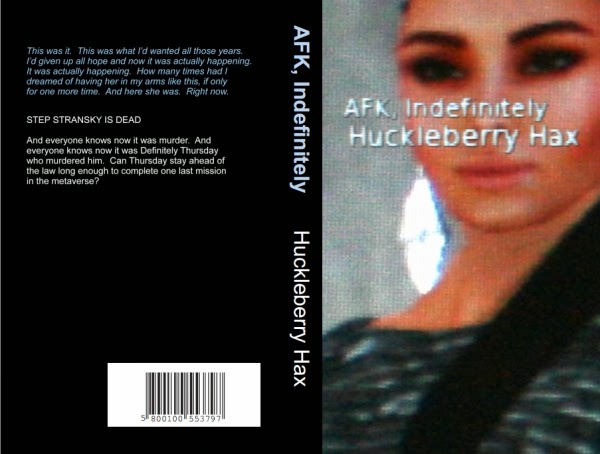
UPDATE: After another fiddle, a 'wraparound' design:
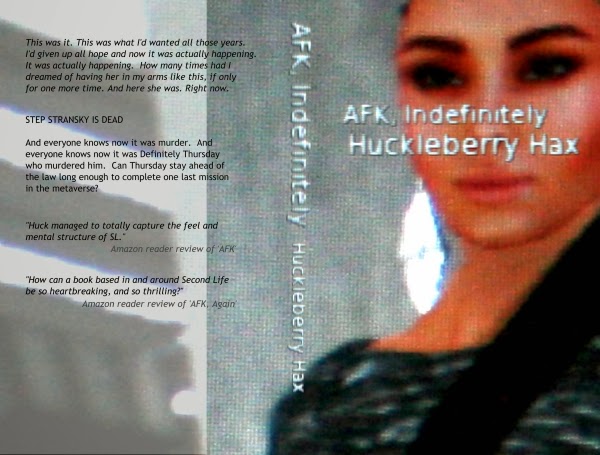
Which do you prefer?
January 2, 2014
2014 and all that
Happy New Year! Last night - 1 January - I finished the first draft of my latest novel, 'AFK, Indefinitely'. The third installment of the AFK series ended up weighing in at an ounce over 60,000 words, making it the longest entry so far. My editing process now will consist of going through the novel once in Word document format and then again in a draft printed version. I also have to design a cover. I'm currently aiming for all this to be done by the end of January, with a paperback, Kindle and Issuu release (the latter will be free) some time in February.
2014 should be a busy year. I'm also hoping to release a new 'Huckleberry H Hax' novella (anything released under my name with the extra middle H means its not a NaNoWriMo project and significantly more time has been put into it) that I've been working on for a couple of years now. 'SIM' is nearly complete and I hope to release it Spring/Summer this year. It's quite unlike anything I've written before, so it will be interesting to see what reaction (if any) it gets.
I've also been working on a collection of my various articles on Second Life over the last few years, most of them AVENUE articles. I'm uncertain when this will be released at this moment, but hopefully something will turn up before the year is out.
I also have plenty of work to do in bringing all my books up to date in ePub and Kindle versions, and producing hardback versions of my latest three novels. I know hardly anyone purchases the hardback versions of my novels, but they do look superb on my own bookshelf!
I've also been putting in a bit of work over Christmas on my 'HHax' Second Life furniture range. Having purchased an inworld HUD recently that enables prim to mesh conversion I've been able to produce versions of my builds that look identical to the original prim-based products, but which take up a fraction of the land impact, making them much more attractive to the modern discerning SL home-owner. I'll be uploading these to the Marketplace over the next few weeks and I might also publish an HHax dedicated website I've been working on over the last few months.
A lot of long-term projects coming together in 2014, then. I'm looking forward to sharing them with you all!
2014 should be a busy year. I'm also hoping to release a new 'Huckleberry H Hax' novella (anything released under my name with the extra middle H means its not a NaNoWriMo project and significantly more time has been put into it) that I've been working on for a couple of years now. 'SIM' is nearly complete and I hope to release it Spring/Summer this year. It's quite unlike anything I've written before, so it will be interesting to see what reaction (if any) it gets.
I've also been working on a collection of my various articles on Second Life over the last few years, most of them AVENUE articles. I'm uncertain when this will be released at this moment, but hopefully something will turn up before the year is out.
I also have plenty of work to do in bringing all my books up to date in ePub and Kindle versions, and producing hardback versions of my latest three novels. I know hardly anyone purchases the hardback versions of my novels, but they do look superb on my own bookshelf!
I've also been putting in a bit of work over Christmas on my 'HHax' Second Life furniture range. Having purchased an inworld HUD recently that enables prim to mesh conversion I've been able to produce versions of my builds that look identical to the original prim-based products, but which take up a fraction of the land impact, making them much more attractive to the modern discerning SL home-owner. I'll be uploading these to the Marketplace over the next few weeks and I might also publish an HHax dedicated website I've been working on over the last few months.
A lot of long-term projects coming together in 2014, then. I'm looking forward to sharing them with you all!
December 30, 2013
On faking your death in SL
Here's my December column for AVENUE magazine, the last for a while whilst AVENUE takes a break to consider a change of format.
There ought to be a word for when a comment left in response to a Facebook friend’s post piques your curiosity enough that you click on the commenter’s name to see what other sorts of thing they’ve written elsewhere (I make no apology for this snooping; I’m endlessly interested in how people express themselves online)… and a resulting chain of profile hopping ensues as you move from comment to profile to comment to profile, a sometimes hour-long exploration of random people you’ve never met connected only by the thread of your happenstance curiosity. ‘Browsing’ doesn’t quite capture it for me, somehow. ‘Browsing’ implies you’re waiting to find something of interest, whereas this little bounce from personality to personality reveals new fascinations with every single step.
One such carefree hop and skip across Second Life® Facebook profiles a few months ago led me to a comment about a man who was described as having died in RL some time ago, only to return in SL about a year later. I’ve heard about this sort of thing before, but never actually met someone who did it. Also, I was under the impression that people who ‘came back’ tended to do so in a new account so that they didn’t get found out (although, of course, they usually did get found out because they just couldn’t resist getting in touch with old friends in their new persona and giving themselves away through their textual mannerisms; it would be nice to think that the number of people who use ‘u’ instead of ‘you’ in SL do so only to distract from signature phrase slippage and that it hurts their soul to do this just as much as it does mine to read it). I did a web search on this returned avatar’s name and found several posts across various forums about his RL death, plus a couple of later – less than complimentary – confirmations that he was, in fact, alive. I looked up his profile inworld and saw that he is indeed currently active. He made no comment there about his earlier ‘death’, but there was a mention of sending those who didn’t “understand” him to a dark and fiery place.
It turns out that faking your own death on the internet is sufficiently significant and old a phenomenon that it’s been researched. As an example of ‘Munchausen by Internet’, a term coined by Dr Marc Feldman (thanks to Mistletoe Ethaniel’s very informative blog post on the topic - http://tinyurl.com/qxvw9hl- for pointing me to this), the prevailing hypothesis on faked internet death appears to be that the main motive for doing this is to inflict emotional pain on people, perhaps some sort of revenge for actions they have previously taken or as a gauge by which to assess how much you were loved. I’ve personally never heard of such a thing actually happening within my own SL, although I’ve certainly seen emotional blackmail used in spades – including someone hinting about considering killing themselves in RL in response to the actions of SL others. Hinting is a long way from actually doing, of course, but then – well – so is pretend doing.
Dare I say it, but could another rationale be to get out of an unwanted relationship? We can criticise such a strategy for being cowardly, but we’ve all been in a situation where the noble, the sensible, the intelligent thing to do feels either completely impossible or – frankly – too much bother. Breaking up with someone because they’re insecure and needy, for example, is an insanely hard thing to do without a) leaving them feeling criticised and worthless, and/or b) becoming a cold, uncaring bastard. How much more easy must it be to simply die, terminating the relationship and leaving the ex-partner grief-stricken, but with their self-esteem and the memories of their love intact? If you’re really into the rationalisation of being a total shit, you could even argue that the bereaved might end up this way with a better sense of perspective: it’s the win-win approach to breaking someone’s heart.
Perhaps the reason for faking one’s death in SL that I have the most empathy with, however – and I should probably add at this point that I’m not considering this as an option; if you should hear that Huck’s driver has completed his mortal doings, you can be relatively certain that this is genuinely the case (although if I was planning to fake my death I suppose I would say that) – is the possibility this offers for witnessing the reaction to your demise. Perhaps ‘empathy’ is the wrong word; what I mean is that I can understand the curiosity people might have about the esteem in which others actually hold them. After all, how often do we actually tell people whilst they’re still alive what they mean to us? However many irritating Facebook memes on floral backgrounds we see telling us to do this, it’s just not a thing we’re comfortable with; we save our best, our most comprehensive praise for people until after they’re gone.
I should point out that I see a clear distinction between this reason and the Munchausen by Internet motive outlined earlier: were I to contemplate such I thing (I’m really not, ok?), it wouldn’t be to measure my worth by the size of others’ pain; it would be out of a genuine curiosity to know what people thought of me. I have no idea what impact I’ve had on others as Huck. I have a few friends who I’m reasonably certain like me more than they dislike me, but beyond that I really don’t have much of a clue. And what about my novels? Would they receive some sort of posthumous recognition denied me denied me during life? I can’t deny that makes me curious.
Of course, one of the reasons why we don’t hand out praise whilst people are still alive is that no person comes in a package of good qualities only. Whilst someone’s still alive, their negative attributes are often just as visible as all the positives. Whilst positive attributes such as notable achievements or generosity continue to be true after death, however, negative issues pretty much cease to be a concern. If I’m considered to be impulsive, temperamental and unpredictable whilst alive, for example, my capacity to shock and upset pretty much stops the instant I pass away. That truth becomes less meaningful posthumously than the truth of my achievements. To put it another way, how we think about people is different after they’ve died than whilst they’re still alive; it’s not necessarily the case that people are withholding what they think of you whilst you’re still around.
So what I hear people say of me at my virtual memorial might not be what they think of me whilst I’m still alive; that doesn’t mean to say, of course, that I’m still not curious as to what it might be. And this is where an RL faked death really comes into its own in SL, for where else on the internet could you find an actual gathering of people collected for the sole purpose of paying tributes to a deceased friend? Comments on a discussion forum is one thing, but an event held in your honour at a place and a time is where SL claims the trophy on online remembrance.
But a note of warning for anyone who mistakes this piece as an instructional article: be careful what you wish for; people don’t always celebrate the deceased. You might put on your very best alt and very best suit and very best black tie and turn up to your virtual memorial to find yourself the only person there. You might even discover that no-one was especially moved to hold one. Don’t be too surprised to discover that you have no friends if they meant so little to you in that first place that you were prepared to let them think you’d died.
Huckleberry Hax was the author of ‘AFK’ and other novels set in Second Life®. He passed away after an aggrieved reader dropped a 1000m x 1000m x 1000m megaprim on his head for daring to suggest that the possibility that her ex-lover’s death was faked as a result of him being unable to tolerate her constantly referring to him as her ‘hubby’. You can still read his novels for free at www.huckleberryhax.blogspot.com
There ought to be a word for when a comment left in response to a Facebook friend’s post piques your curiosity enough that you click on the commenter’s name to see what other sorts of thing they’ve written elsewhere (I make no apology for this snooping; I’m endlessly interested in how people express themselves online)… and a resulting chain of profile hopping ensues as you move from comment to profile to comment to profile, a sometimes hour-long exploration of random people you’ve never met connected only by the thread of your happenstance curiosity. ‘Browsing’ doesn’t quite capture it for me, somehow. ‘Browsing’ implies you’re waiting to find something of interest, whereas this little bounce from personality to personality reveals new fascinations with every single step.
One such carefree hop and skip across Second Life® Facebook profiles a few months ago led me to a comment about a man who was described as having died in RL some time ago, only to return in SL about a year later. I’ve heard about this sort of thing before, but never actually met someone who did it. Also, I was under the impression that people who ‘came back’ tended to do so in a new account so that they didn’t get found out (although, of course, they usually did get found out because they just couldn’t resist getting in touch with old friends in their new persona and giving themselves away through their textual mannerisms; it would be nice to think that the number of people who use ‘u’ instead of ‘you’ in SL do so only to distract from signature phrase slippage and that it hurts their soul to do this just as much as it does mine to read it). I did a web search on this returned avatar’s name and found several posts across various forums about his RL death, plus a couple of later – less than complimentary – confirmations that he was, in fact, alive. I looked up his profile inworld and saw that he is indeed currently active. He made no comment there about his earlier ‘death’, but there was a mention of sending those who didn’t “understand” him to a dark and fiery place.
It turns out that faking your own death on the internet is sufficiently significant and old a phenomenon that it’s been researched. As an example of ‘Munchausen by Internet’, a term coined by Dr Marc Feldman (thanks to Mistletoe Ethaniel’s very informative blog post on the topic - http://tinyurl.com/qxvw9hl- for pointing me to this), the prevailing hypothesis on faked internet death appears to be that the main motive for doing this is to inflict emotional pain on people, perhaps some sort of revenge for actions they have previously taken or as a gauge by which to assess how much you were loved. I’ve personally never heard of such a thing actually happening within my own SL, although I’ve certainly seen emotional blackmail used in spades – including someone hinting about considering killing themselves in RL in response to the actions of SL others. Hinting is a long way from actually doing, of course, but then – well – so is pretend doing.
Dare I say it, but could another rationale be to get out of an unwanted relationship? We can criticise such a strategy for being cowardly, but we’ve all been in a situation where the noble, the sensible, the intelligent thing to do feels either completely impossible or – frankly – too much bother. Breaking up with someone because they’re insecure and needy, for example, is an insanely hard thing to do without a) leaving them feeling criticised and worthless, and/or b) becoming a cold, uncaring bastard. How much more easy must it be to simply die, terminating the relationship and leaving the ex-partner grief-stricken, but with their self-esteem and the memories of their love intact? If you’re really into the rationalisation of being a total shit, you could even argue that the bereaved might end up this way with a better sense of perspective: it’s the win-win approach to breaking someone’s heart.
Perhaps the reason for faking one’s death in SL that I have the most empathy with, however – and I should probably add at this point that I’m not considering this as an option; if you should hear that Huck’s driver has completed his mortal doings, you can be relatively certain that this is genuinely the case (although if I was planning to fake my death I suppose I would say that) – is the possibility this offers for witnessing the reaction to your demise. Perhaps ‘empathy’ is the wrong word; what I mean is that I can understand the curiosity people might have about the esteem in which others actually hold them. After all, how often do we actually tell people whilst they’re still alive what they mean to us? However many irritating Facebook memes on floral backgrounds we see telling us to do this, it’s just not a thing we’re comfortable with; we save our best, our most comprehensive praise for people until after they’re gone.
I should point out that I see a clear distinction between this reason and the Munchausen by Internet motive outlined earlier: were I to contemplate such I thing (I’m really not, ok?), it wouldn’t be to measure my worth by the size of others’ pain; it would be out of a genuine curiosity to know what people thought of me. I have no idea what impact I’ve had on others as Huck. I have a few friends who I’m reasonably certain like me more than they dislike me, but beyond that I really don’t have much of a clue. And what about my novels? Would they receive some sort of posthumous recognition denied me denied me during life? I can’t deny that makes me curious.
Of course, one of the reasons why we don’t hand out praise whilst people are still alive is that no person comes in a package of good qualities only. Whilst someone’s still alive, their negative attributes are often just as visible as all the positives. Whilst positive attributes such as notable achievements or generosity continue to be true after death, however, negative issues pretty much cease to be a concern. If I’m considered to be impulsive, temperamental and unpredictable whilst alive, for example, my capacity to shock and upset pretty much stops the instant I pass away. That truth becomes less meaningful posthumously than the truth of my achievements. To put it another way, how we think about people is different after they’ve died than whilst they’re still alive; it’s not necessarily the case that people are withholding what they think of you whilst you’re still around.
So what I hear people say of me at my virtual memorial might not be what they think of me whilst I’m still alive; that doesn’t mean to say, of course, that I’m still not curious as to what it might be. And this is where an RL faked death really comes into its own in SL, for where else on the internet could you find an actual gathering of people collected for the sole purpose of paying tributes to a deceased friend? Comments on a discussion forum is one thing, but an event held in your honour at a place and a time is where SL claims the trophy on online remembrance.
But a note of warning for anyone who mistakes this piece as an instructional article: be careful what you wish for; people don’t always celebrate the deceased. You might put on your very best alt and very best suit and very best black tie and turn up to your virtual memorial to find yourself the only person there. You might even discover that no-one was especially moved to hold one. Don’t be too surprised to discover that you have no friends if they meant so little to you in that first place that you were prepared to let them think you’d died.
Huckleberry Hax was the author of ‘AFK’ and other novels set in Second Life®. He passed away after an aggrieved reader dropped a 1000m x 1000m x 1000m megaprim on his head for daring to suggest that the possibility that her ex-lover’s death was faked as a result of him being unable to tolerate her constantly referring to him as her ‘hubby’. You can still read his novels for free at www.huckleberryhax.blogspot.com
December 24, 2013
December 1, 2013
NaNoWriMo 2013 update

Yesterday, at about 5:40pm, my latest novel, NaNoWriMo attempt and entry in the AFK series (yes, yes; I'm now the author of a 'series'), 'AFK, Indefinitely', passed the magical 50,000 words mark. It was a brutal month this year; my RL work schedule hit an even busier peak than usual and my word count suffered massively during the week. Some seriously focused weekends and a hell-for-broke dash yesterday of 5,000 words in under six hours, however, saw me cruising across the NaNo finish line with over six hours remaining to the month.
As is often the case come 1 December, the book is not yet actually finished. Last year, 'AFK, Again' ended up consisting of 54,000 words once the polish was done, and I suspect 'AFK, Indefinitely' will end up a comparable length. Expect a release early in 2014 and, for now, here's a copy of my 2013 certificate for you to stroke. OOOooo AAAaaa And so on.
November 3, 2013
Some more novel ideas
Here's my November column for AVENUE magazine.
November is with us again, the month in which hundreds of thousands of people each year turn their backs to orange-coloured October and sink all their free mental capacity into the writing of a fifty thousand word story. I’m talking about National Novel Writing Month, of course: a cocoon-like period of time out of which one emerges bleary-eyed and startled to find that Christmas has somehow arrived. I started in 2006 and I’ve only missed the finish line once since then. Actually, last year I was ten thousand words short by 30 November, but I did at least go on to finish that title and ‘AFK, Again’ – my fifth novel set in Second Life® – hit my virtual bookstore in March of this year. That’s a plug, by the way. You can buy it.
Last year in this column I had a lot of fun dreaming up potential SL storylines for novels. Unashamedly, I intend to do the same again here. I’ve long believed, after all, that the potential for metaverse fiction is vast (my meagre offerings are but a scratch across the surface). Here are just a few humble suggestions.
Occulus Thrift. As the global financial crisis deepens, more and more people turn to the metaverse – now reborn through virtual reality headsets distributed through a government depression reduction initiative – to escape the poverty-stricken decay of their real lives. Bit by bit, society transfers itself into this second world: physical schools are deemed too costly to maintain and teachers face obligatory transfer to virtual equivalents; public transport is closed down in line with new policy that actually seeing in real life your friends and relatives is now a luxury activity. Finally, even, parliament itself is shut down as an unnecessary expenditure, elected officials moving into a dedicated sim custom-built to include a 1000 square metre debating chamber and a 5000 square metre lobbyist parlour. Into all of this enter Aramatter Fisk, a young student of domestic history (specialist subject: Tupperware) who accidentally discovers a whole extra hidden world being developed by the wealthy elite. Thinking at first that he’s stumbled across a 1950s cold war experiment (a hypothesis that fits absolutely none of the available facts, but which appeals to him as a fan of the pre-1958 Tupperware sale to Rexall), Fisk attempts to open peace negotiations with the first residents he encounters. The Overlords – as they call themselves – take him immediately into custody and charge him with treason, but Fisk escapes by taking a plane to a rival faction within the same metaverse. Granted asylum, he then sets about the task of revealing to the world the true nature of its digital government; meanwhile, the Overlords impeach their President on the grounds that he didn’t do a good enough job of making the rival faction scared of him. Following a thrilling chase scene, the novel ends on an anti-climax when The People respond to Fisk’s news with a nonplussed shrug and comment that they’d pretty much figured something like this was going on anyway.
Far from the Madding Prim. A novel set entirely in a single region called Wessex. Although a walk along the country lane that connects up East Wessex with West Wessex would take in real time about a minute, the narrative is padded out into a seven hundred page volume through the protagonist’s description of every prim he observes along the way. Every. Single. Prim.
You’ve Got IMs. This metaverse RomCom (alternative titles: Sleepless in Second Life or Love Virtually) telling of the clichéd boy meets girl, boy loses girl, boy runs into girl by accident a few months later at a hair fair and she can’t slip away because of the lag, girl turns out to be boy, boy turns out to be girl, boy(girl) and girl(boy) get married tale lulls the reader into a false sense of security four fifths of the way into the novel, then plunges him/her back into uncertainty at the shock revelation that both boy(girl) and girl(boy) are in their nineties. Somehow or another, through avoiding too many age-appropriate cultural references and by throwing in the odd mention of iPhones and Miley Cyrus, they have successfully given the impression that both are professionals in their twenties involved in IT startups. They arrange to meet in RL, choosing Brighton Pier as their rendezvous. When Adam(Felicity) realises that the chosen date clashes with his(her) scheduled hip operation, he(she) cancels the medical appointment, only for Mary(Bill) to then get offered a date for her(his) own hip operation because someone else cancelled at the last minute. In RL, Felicity hobbles painfully along the pier and eases herself down onto the empty bench they were supposed to meet at. With just two paragraphs to go, the reader assumes all is lost, but then the agreed pass phrase is whispered from behind her and Felicity closes her eyes and smiles. The book closes on this happy, tear-jerker moment, although the astute reader will note that Felicity is still expecting at this point to open her eyes and see a man seventy years her junior. Possibly, this intellectual cliff-hanger will be debated in internet discussion forums. Possibly, it won’t.
Downton Primley. Another attempt at a period SL novel. This time, the story revolves around Baldwin, a servant in the estate of Mr Robert Primley, Earl of Lindham. In addition to managing the estate staff, Baldwin is also the Head Builder for this metaverse role-play affair. Not only must he see that afternoon tea is served on time, he also has to hunt down period appropriate textures every time Lady Primley decides that the china needs replacing. Whilst our hero struggles with his employers’ ever-increasing appetite for authentic mesh furnishings, he is witness to an illicit affair between the Earl’s visiting brother, Sir Marcus Primley, and nineteen-year-old chambermaid, Agnes. Four months later, Agnes comes down from the servants’ quarters wearing a second trimester pregnancy bump which she’s resolved to display at luncheon. Sir Marcus is visiting again, en route to his Cornish residence in Penzance, but this time he has with him his wife (who’s taking the advice of her physician and leaving London for a short, restorative break of three months). Agnes plans blackmail. Baldwin tries to talk her out of it, knowing what the Earl’s brother is capable of, but the naïve young girl goes ahead with her plan anyway and is found hanging from her bedroom rafter the following morning (her account hacked by the evil Sir Marcus, who is in reality the CEO of a large Android software company). The novel ends on this tragic note, Baldwin musing philosophically, whilst he supervises the morning laundry, that Edwardian period role-play represents the top of a new slippery slope in society’s moral decline.
Murder in Prims. Franklin Berkowitz, a deeply eccentric yet wildly successful designer of state-of-the-art mesh avatars, decides to give away his entire catalogue – including his next generation, full facial animation range, ‘AVXL’ – in protest against Linden’s new terms and conditions. He announces this plan to his real life and metaversian business partner, Mark Warburton, over a Martini in a piano bar in downtown LA. Warburton is aghast, for the AVXL range is set to take the virtual world by storm and earn them a ton of cash. When he realises Berkowitz is serious, he arranges to meet the following night to discuss the giveaway strategy (telling Berkowitz not to speak a word of his intention until they’ve had the chance to plan it properly). The next night, Warburton murders Berkowitz, making it look like a suicide. Enter Lt. Columbus, an Italian-American police detective who smokes cigars and wears a crumpled raincoat (and is legally distinguishable from any similar fictional detectives by a nervous twitch that presents whenever fish are nearby). Feigning incompetence at anything remotely digital, Columbus lulls Warburton into a false sense of security, then irritates the crap out of him by constantly turning up in SL to ask him questions about the metaverse. A typical exchange goes something like this:
Columbus: This is your house, sir?Warburton: Yes Lieutenant.Columbus: And you built it?Warburton: Every last prim.Columbus: This is really something. This is really something.Warburton: There was something you wanted to ask me, Lieutenant?Columbus: Oh, yes, sir. Just a small issue. I have to fill out these reports, you know…Warburton: Of course.Columbus: I was just wondering… something I just can’t figure out about the gunshot… And this couch? You made this couch too?Warburton: Yes, Lieutenant, I made the couch.Columbus: Did I tell you my cousin makes real couches?Warburton: You didn’t. Something about the gunshot, you say?
In the end, it turns out Columbus had Warburton identified as the murderer within three minutes of entering the crime scene from the position of the walnuts on the coffee table. The novel ends with our hero reaching a decision about what sort of gift to buy his wife as an anniversary present, a comedy theme threaded through the plot including one scene where he convinces Warburton to build him in prims a faithful replica of his own mantelpiece so that he can see what various ornaments will look like on it.
November is with us again, the month in which hundreds of thousands of people each year turn their backs to orange-coloured October and sink all their free mental capacity into the writing of a fifty thousand word story. I’m talking about National Novel Writing Month, of course: a cocoon-like period of time out of which one emerges bleary-eyed and startled to find that Christmas has somehow arrived. I started in 2006 and I’ve only missed the finish line once since then. Actually, last year I was ten thousand words short by 30 November, but I did at least go on to finish that title and ‘AFK, Again’ – my fifth novel set in Second Life® – hit my virtual bookstore in March of this year. That’s a plug, by the way. You can buy it.
Last year in this column I had a lot of fun dreaming up potential SL storylines for novels. Unashamedly, I intend to do the same again here. I’ve long believed, after all, that the potential for metaverse fiction is vast (my meagre offerings are but a scratch across the surface). Here are just a few humble suggestions.
Occulus Thrift. As the global financial crisis deepens, more and more people turn to the metaverse – now reborn through virtual reality headsets distributed through a government depression reduction initiative – to escape the poverty-stricken decay of their real lives. Bit by bit, society transfers itself into this second world: physical schools are deemed too costly to maintain and teachers face obligatory transfer to virtual equivalents; public transport is closed down in line with new policy that actually seeing in real life your friends and relatives is now a luxury activity. Finally, even, parliament itself is shut down as an unnecessary expenditure, elected officials moving into a dedicated sim custom-built to include a 1000 square metre debating chamber and a 5000 square metre lobbyist parlour. Into all of this enter Aramatter Fisk, a young student of domestic history (specialist subject: Tupperware) who accidentally discovers a whole extra hidden world being developed by the wealthy elite. Thinking at first that he’s stumbled across a 1950s cold war experiment (a hypothesis that fits absolutely none of the available facts, but which appeals to him as a fan of the pre-1958 Tupperware sale to Rexall), Fisk attempts to open peace negotiations with the first residents he encounters. The Overlords – as they call themselves – take him immediately into custody and charge him with treason, but Fisk escapes by taking a plane to a rival faction within the same metaverse. Granted asylum, he then sets about the task of revealing to the world the true nature of its digital government; meanwhile, the Overlords impeach their President on the grounds that he didn’t do a good enough job of making the rival faction scared of him. Following a thrilling chase scene, the novel ends on an anti-climax when The People respond to Fisk’s news with a nonplussed shrug and comment that they’d pretty much figured something like this was going on anyway.
Far from the Madding Prim. A novel set entirely in a single region called Wessex. Although a walk along the country lane that connects up East Wessex with West Wessex would take in real time about a minute, the narrative is padded out into a seven hundred page volume through the protagonist’s description of every prim he observes along the way. Every. Single. Prim.
You’ve Got IMs. This metaverse RomCom (alternative titles: Sleepless in Second Life or Love Virtually) telling of the clichéd boy meets girl, boy loses girl, boy runs into girl by accident a few months later at a hair fair and she can’t slip away because of the lag, girl turns out to be boy, boy turns out to be girl, boy(girl) and girl(boy) get married tale lulls the reader into a false sense of security four fifths of the way into the novel, then plunges him/her back into uncertainty at the shock revelation that both boy(girl) and girl(boy) are in their nineties. Somehow or another, through avoiding too many age-appropriate cultural references and by throwing in the odd mention of iPhones and Miley Cyrus, they have successfully given the impression that both are professionals in their twenties involved in IT startups. They arrange to meet in RL, choosing Brighton Pier as their rendezvous. When Adam(Felicity) realises that the chosen date clashes with his(her) scheduled hip operation, he(she) cancels the medical appointment, only for Mary(Bill) to then get offered a date for her(his) own hip operation because someone else cancelled at the last minute. In RL, Felicity hobbles painfully along the pier and eases herself down onto the empty bench they were supposed to meet at. With just two paragraphs to go, the reader assumes all is lost, but then the agreed pass phrase is whispered from behind her and Felicity closes her eyes and smiles. The book closes on this happy, tear-jerker moment, although the astute reader will note that Felicity is still expecting at this point to open her eyes and see a man seventy years her junior. Possibly, this intellectual cliff-hanger will be debated in internet discussion forums. Possibly, it won’t.
Downton Primley. Another attempt at a period SL novel. This time, the story revolves around Baldwin, a servant in the estate of Mr Robert Primley, Earl of Lindham. In addition to managing the estate staff, Baldwin is also the Head Builder for this metaverse role-play affair. Not only must he see that afternoon tea is served on time, he also has to hunt down period appropriate textures every time Lady Primley decides that the china needs replacing. Whilst our hero struggles with his employers’ ever-increasing appetite for authentic mesh furnishings, he is witness to an illicit affair between the Earl’s visiting brother, Sir Marcus Primley, and nineteen-year-old chambermaid, Agnes. Four months later, Agnes comes down from the servants’ quarters wearing a second trimester pregnancy bump which she’s resolved to display at luncheon. Sir Marcus is visiting again, en route to his Cornish residence in Penzance, but this time he has with him his wife (who’s taking the advice of her physician and leaving London for a short, restorative break of three months). Agnes plans blackmail. Baldwin tries to talk her out of it, knowing what the Earl’s brother is capable of, but the naïve young girl goes ahead with her plan anyway and is found hanging from her bedroom rafter the following morning (her account hacked by the evil Sir Marcus, who is in reality the CEO of a large Android software company). The novel ends on this tragic note, Baldwin musing philosophically, whilst he supervises the morning laundry, that Edwardian period role-play represents the top of a new slippery slope in society’s moral decline.
Murder in Prims. Franklin Berkowitz, a deeply eccentric yet wildly successful designer of state-of-the-art mesh avatars, decides to give away his entire catalogue – including his next generation, full facial animation range, ‘AVXL’ – in protest against Linden’s new terms and conditions. He announces this plan to his real life and metaversian business partner, Mark Warburton, over a Martini in a piano bar in downtown LA. Warburton is aghast, for the AVXL range is set to take the virtual world by storm and earn them a ton of cash. When he realises Berkowitz is serious, he arranges to meet the following night to discuss the giveaway strategy (telling Berkowitz not to speak a word of his intention until they’ve had the chance to plan it properly). The next night, Warburton murders Berkowitz, making it look like a suicide. Enter Lt. Columbus, an Italian-American police detective who smokes cigars and wears a crumpled raincoat (and is legally distinguishable from any similar fictional detectives by a nervous twitch that presents whenever fish are nearby). Feigning incompetence at anything remotely digital, Columbus lulls Warburton into a false sense of security, then irritates the crap out of him by constantly turning up in SL to ask him questions about the metaverse. A typical exchange goes something like this:
Columbus: This is your house, sir?Warburton: Yes Lieutenant.Columbus: And you built it?Warburton: Every last prim.Columbus: This is really something. This is really something.Warburton: There was something you wanted to ask me, Lieutenant?Columbus: Oh, yes, sir. Just a small issue. I have to fill out these reports, you know…Warburton: Of course.Columbus: I was just wondering… something I just can’t figure out about the gunshot… And this couch? You made this couch too?Warburton: Yes, Lieutenant, I made the couch.Columbus: Did I tell you my cousin makes real couches?Warburton: You didn’t. Something about the gunshot, you say?
In the end, it turns out Columbus had Warburton identified as the murderer within three minutes of entering the crime scene from the position of the walnuts on the coffee table. The novel ends with our hero reaching a decision about what sort of gift to buy his wife as an anniversary present, a comedy theme threaded through the plot including one scene where he convinces Warburton to build him in prims a faithful replica of his own mantelpiece so that he can see what various ornaments will look like on it.
November 2, 2013
NaNoWriMo 2013 kicks off
And we're off...
Having said previously to quite a number of people that I wouldn't write a sequel to AFK, last year I wrote a sequel to AFK. I enjoyed doing this way more than I expected and so this year I'm going to write during NaNoWriMo a third novel in the series. It's pure indulgence on my part, but then what is writing if indulgence doesn't figure anywhere?
Here is the opening section.
“Got you,” said Inch Sideways, as she left.In a way, you could say that it was Inch who turned me into a murderer in the first place. I mean, it’s not like I’d even contemplated killing anyone before I met her, aside from the occasional (and entirely understandable) desire to slaughter in cold blood the odd politician here and there. And it’s hardly the case that, having done the deed once, I would go on to murder again. I like to think that I’m no more likely to kill a second person than anyone I pass on the street is likely to kill their first.So I fell in love with her. I fell in love with her after a single night. Can I be blamed for that? Last time I checked, falling in love wasn’t exactly a cognitive decision-making process. When someone like Inch comes along – someone who upturns the table and everything on it – you either recoil from the emotional shock and run as fast as you can in the opposite direction, or your curiosity gets the better of you and you make the fatal error of pausing to look more closely for a moment; next thing you know, your eyes are doing that swirly, hypnotised thing and it feels like they’re being pulled out of your soul. What I’m saying is it’s an involuntary reaction. Some part of one person snaps into place with some part of the other and, from that point on, it’s not about whether you’re in love with them, it’s entirely about what you’re going to do about the fact that you are.Can I be blamed any more than a bee can be blamed for its attraction to flowers that I saw that night in Inch Sideways everything I wanted and everything I’d always imagined had to exist somewhere in a single human being? There she was, my very own Higgs-Boson, realised in the prims and pixels of Second Life®. Finding that your hypothetical ideal somebody really does exist is more than a moment of happiness, more even than a moment of love: it is, quite simply, themoment of ratification, the sigh of relief that you don’t have to discard the way you have personally constructed happiness all these years, that the wait was worth it, that you were right to think all those well-meaning nudgers towards John from IT or Mary from finance could go fuck themselves.A single night. “Forget me,” she said at the end of it, “and you go straight to hell, ok?” There was no possible way I could ever have forgotten Inch Sideways. It was almost a year before I saw or heard anything from her again, and I pretty much spent all of that time trying somehow or another to cope with what she’d awoken in me. I tried everything I could think of, including breaking the heart of a beautiful person along the way in the futile hope that I might transpose my love for Inch onto her, but Inch had somehow hard-wired herself into me and all I could ultimately do was get used to how it felt to be alive with a little bit missing.Then, out of the blue, she appeared again, tapping me on the virtual shoulder at some Egyptian-themed club and asking me for a dance. It was like the restoration of air to my lungs. I still remember how deliriously happy I felt that evening, even when I turned down that dance to go to work in RL. She was back and she had sought me out, and that tiny little piece of happenstance information danced in my head all night and meant more to me than any other fact I had possession of.I didn’t know at that point why it was she’d spent fifty weeks out of SL. To be honest, I didn’t really care. But that night, whilst I served pizzas with an inanely cheerful grin to customers I’d ordinarily have considered scowling at a wasted facial effort, she talked about her year to my SL business partner, Step Stransky, the decision-making half of the Step Stransky Second Life Detective Agency. She told him about the death of her husband and little boy on the day following my encounter with her, and Step, supposedly because he’d suffered his own personal loss a few years earlier, knew exactly how to listen to her. The next day, I logged on to discover that the two of them had become partnered in the intervening twelve hours, and that was the moment when my world collapsed around me.Did Inch turn me into a murderer? No sane person would ever consider unrequited love a justification for killing someone; of course they wouldn’t. But even now it staggers me that she didn’t think for one moment that partnering Stransky within hours of meeting him might have some sort of emotional impact on me. I’m not saying she should or could have guessed that I was in love with her – if the situation had been reversed, I wouldn’t have supposed that for a second (frankly, I’d have laughed at the very idea); but come on: the last time we’d met, we’d fucked; didn’t that earn me even the littlest of pauses? Was I really so far out of her mind that it never even occurred to her that jumping into the arms of my so-called best friend was lacking just a little in tact?Of course I was. The night Inch Sideways met Step Stransky was her first night back in the metaverse; her recollection of the previous one was likely to be less anything to do with me and more that it was the very last time her man and her baby had been alive and safe and nearby. But I didn’t know that at the time. In fact, it was months before she finally told me what had happened to her during that absence.I have to ask myself – still – what it was about Step’s listening skills that was so unbelievably amazing that she submitted to him so completely by the end of a single night. I have to keep on reminding myself that, at the start of the evening, he was a total stranger to her. And I have to ask myself what it was about my own presentation that – clearly – put me somehow in a whole league below him. I’d be the first to admit that the rather amateur edge to my role playing skills was on full display during my night with Inch, but has anyone ever judged someone’s ability to listen and console based solely on their ability to communicate in fictional paragraphs – and an ability previously experienced nearly a year ago at that? Did I really come across that badly that it was inconceivable she could share her pain with me? And if I did, why did she bother with that tap on the shoulder when she could have just turned around and left? Why speak to me at all if I’d left such a hopeless impression?It never occurred to me until now to be angry at Inch for any of this. Actually, that’s not true – all of these points occurred to me before, but it was abstract information then, like the knowledge that I’m moving all the time at over sixty thousand miles per hour due to the Earth’s orbit around the sun. I knew these things, but they affected me no more than I become dizzy from the Earth’s rotation: I just didn’t feel them. But I feel them now.Anyway, where were we? Oh yes…
“Got you,” said Inch Sideways, as she left.
Having said previously to quite a number of people that I wouldn't write a sequel to AFK, last year I wrote a sequel to AFK. I enjoyed doing this way more than I expected and so this year I'm going to write during NaNoWriMo a third novel in the series. It's pure indulgence on my part, but then what is writing if indulgence doesn't figure anywhere?
Here is the opening section.
“Got you,” said Inch Sideways, as she left.In a way, you could say that it was Inch who turned me into a murderer in the first place. I mean, it’s not like I’d even contemplated killing anyone before I met her, aside from the occasional (and entirely understandable) desire to slaughter in cold blood the odd politician here and there. And it’s hardly the case that, having done the deed once, I would go on to murder again. I like to think that I’m no more likely to kill a second person than anyone I pass on the street is likely to kill their first.So I fell in love with her. I fell in love with her after a single night. Can I be blamed for that? Last time I checked, falling in love wasn’t exactly a cognitive decision-making process. When someone like Inch comes along – someone who upturns the table and everything on it – you either recoil from the emotional shock and run as fast as you can in the opposite direction, or your curiosity gets the better of you and you make the fatal error of pausing to look more closely for a moment; next thing you know, your eyes are doing that swirly, hypnotised thing and it feels like they’re being pulled out of your soul. What I’m saying is it’s an involuntary reaction. Some part of one person snaps into place with some part of the other and, from that point on, it’s not about whether you’re in love with them, it’s entirely about what you’re going to do about the fact that you are.Can I be blamed any more than a bee can be blamed for its attraction to flowers that I saw that night in Inch Sideways everything I wanted and everything I’d always imagined had to exist somewhere in a single human being? There she was, my very own Higgs-Boson, realised in the prims and pixels of Second Life®. Finding that your hypothetical ideal somebody really does exist is more than a moment of happiness, more even than a moment of love: it is, quite simply, themoment of ratification, the sigh of relief that you don’t have to discard the way you have personally constructed happiness all these years, that the wait was worth it, that you were right to think all those well-meaning nudgers towards John from IT or Mary from finance could go fuck themselves.A single night. “Forget me,” she said at the end of it, “and you go straight to hell, ok?” There was no possible way I could ever have forgotten Inch Sideways. It was almost a year before I saw or heard anything from her again, and I pretty much spent all of that time trying somehow or another to cope with what she’d awoken in me. I tried everything I could think of, including breaking the heart of a beautiful person along the way in the futile hope that I might transpose my love for Inch onto her, but Inch had somehow hard-wired herself into me and all I could ultimately do was get used to how it felt to be alive with a little bit missing.Then, out of the blue, she appeared again, tapping me on the virtual shoulder at some Egyptian-themed club and asking me for a dance. It was like the restoration of air to my lungs. I still remember how deliriously happy I felt that evening, even when I turned down that dance to go to work in RL. She was back and she had sought me out, and that tiny little piece of happenstance information danced in my head all night and meant more to me than any other fact I had possession of.I didn’t know at that point why it was she’d spent fifty weeks out of SL. To be honest, I didn’t really care. But that night, whilst I served pizzas with an inanely cheerful grin to customers I’d ordinarily have considered scowling at a wasted facial effort, she talked about her year to my SL business partner, Step Stransky, the decision-making half of the Step Stransky Second Life Detective Agency. She told him about the death of her husband and little boy on the day following my encounter with her, and Step, supposedly because he’d suffered his own personal loss a few years earlier, knew exactly how to listen to her. The next day, I logged on to discover that the two of them had become partnered in the intervening twelve hours, and that was the moment when my world collapsed around me.Did Inch turn me into a murderer? No sane person would ever consider unrequited love a justification for killing someone; of course they wouldn’t. But even now it staggers me that she didn’t think for one moment that partnering Stransky within hours of meeting him might have some sort of emotional impact on me. I’m not saying she should or could have guessed that I was in love with her – if the situation had been reversed, I wouldn’t have supposed that for a second (frankly, I’d have laughed at the very idea); but come on: the last time we’d met, we’d fucked; didn’t that earn me even the littlest of pauses? Was I really so far out of her mind that it never even occurred to her that jumping into the arms of my so-called best friend was lacking just a little in tact?Of course I was. The night Inch Sideways met Step Stransky was her first night back in the metaverse; her recollection of the previous one was likely to be less anything to do with me and more that it was the very last time her man and her baby had been alive and safe and nearby. But I didn’t know that at the time. In fact, it was months before she finally told me what had happened to her during that absence.I have to ask myself – still – what it was about Step’s listening skills that was so unbelievably amazing that she submitted to him so completely by the end of a single night. I have to keep on reminding myself that, at the start of the evening, he was a total stranger to her. And I have to ask myself what it was about my own presentation that – clearly – put me somehow in a whole league below him. I’d be the first to admit that the rather amateur edge to my role playing skills was on full display during my night with Inch, but has anyone ever judged someone’s ability to listen and console based solely on their ability to communicate in fictional paragraphs – and an ability previously experienced nearly a year ago at that? Did I really come across that badly that it was inconceivable she could share her pain with me? And if I did, why did she bother with that tap on the shoulder when she could have just turned around and left? Why speak to me at all if I’d left such a hopeless impression?It never occurred to me until now to be angry at Inch for any of this. Actually, that’s not true – all of these points occurred to me before, but it was abstract information then, like the knowledge that I’m moving all the time at over sixty thousand miles per hour due to the Earth’s orbit around the sun. I knew these things, but they affected me no more than I become dizzy from the Earth’s rotation: I just didn’t feel them. But I feel them now.Anyway, where were we? Oh yes…
“Got you,” said Inch Sideways, as she left.
October 26, 2013
It was a dark and stormy night: some words for NaNoWriMo from Asimov
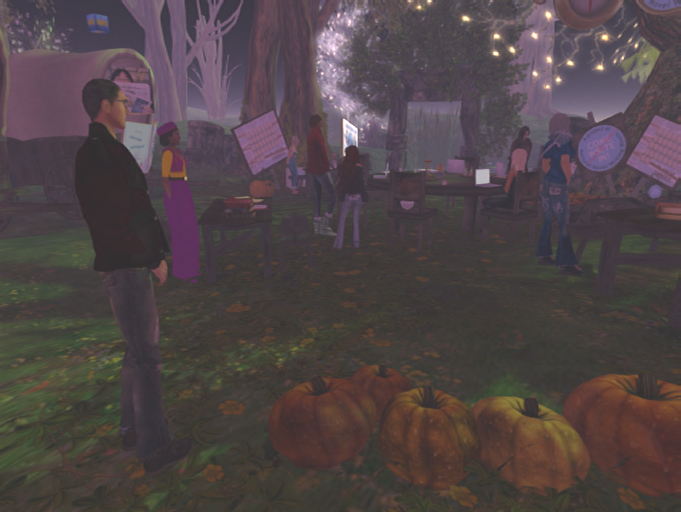
Many thanks to everyone who came to my NaNoWriMo workshop at Milk Wood last night. In case you missed it, here are some words from the great Isaac Asimov speaking in 1974 about how it was he'd managed to write nearly 150 books in just under 25 years:
I’m constantly asked, “How do you manage to write all those books?” And the answer is very simple. First, you tell them the truth – I work very hard – but that’s not glamorous. And so I dig deeper, and I come up with something which is surprisingly true: I cut out the frills like thinking.
You realise how many books don’t get written because of thinking? That is, you write the first sentence, It was a dark and stormy night… and that’s fine if you’ll keep on, but you don’t: you commit the fatal error of thinking and you say, “not sufficiently dramatic.” You cross it out and write, A dark and stormy night: that’s what it was. And then you say, “No – it’s too dramatic. Perhaps we ought to open on an air of uncertainty”. Was the night dark and stormy? And then you think some more and you say, “No no I’m ruining it, it’s anti-climactic.” And you say, “It was a stormy and dark night.”
Well this goes on forever and you never write the book, see? Now I don’t do that. I start with the assumption that the way I say it the first time is right.
Pretty sound advice for NaNoWriMo, huh?
October 20, 2013
Five tips on writing a NaNoWriMo
Here's an article I was asked to write by Virtual Writers Inc about National Novel Writing Month. I'll also be hosting a workshop in SL at 3pm SLT this coming Friday at Milk Wood about writing a NaNo. NaNoWriMo 2013 is fast approaching, and my own preparations are in progress. Stay tuned for more news about that...

There’s plenty that’s already been written about the business of writing a 50,000 word novel in the thirty days of November – an annual act of insanity for the last ten years known as ‘National Novel Writing Month’, or just NaNoWriMo (the pedant in me – and it’s a considerable percentage of my personality, sadly – really wishes that could be changed to ‘International Novel Writing Month’ or even just ‘Novel Writing Month’; do we have to point out to America yet again that there are other countries in the world?). If you’ve previously completed or attempted this feat, or gone no further even than just registering at www.nanowrimo.org, you will no doubt have received plenty of emailed advice and be fully familiar with such constructs as ‘the Inner Editor’, that pesky critic inside you that deplores every last word you’ve written and stops you from getting any more than a few pages into any novel-length writing attempt. The Inner Editor is bad and must be silenced. If, on the other hand, you’re completely new to the process, have a nose around on the website for this advice: it’s definitely worth reading.
What leads me to think I have any sort of right to add to this accumulated wisdom? Only that I’ve produced a novel out of NaNoWriMo six times now. In 2006, 2007, 2008, 2009 and 2011 I completed my 50,000 words with a few extra to spare by 30 November, whilst last year I fell 10,000 words short but had the book finished by January. Without a doubt, NaNoWriMo has become part of my Autumn routine now and notdoing it would feel like not doing Christmas in December. I adore NaNoWriMo.
Over the years, I’ve come to certain conclusions about what things seem to work for me personally during November. They might not work for you. Here, in no particular order, are a few of them.
Write using a pseudonym
Writing anonymously is a liberating experience. A significant part of the inner editor’s sting is that nagging thought, “What will people who know me think about me writing this?” Adopting a pseudonym isn’t cart blanche to go into unnecessary graphic detail on that sex scene you’ve always secretly wanted to write – and it certainly shouldn’t be viewed as absolving you of all social responsibility for your text – but it might just be the thing that enables you to write something punchy and powerful rather than something safe and bland. Be bold. Be outrageous, if necessary. Don’t let worrying about how others see you paralyse your creativity.
Occasionally talk about your novel to someone
Actively talking about your plot to someone will bring it to life in a way that’s much harder to achieve if it remains only in your head. Find a friend and throw the topic into conversation over a beer or a coffee. You’ll be amazed at the new ideas that come to you from simply speaking aloud your ideas. What’s more, your friend doesn’t have to say a single word in reply; even if their eyes glaze over in boredom, even if they slip into a coma right in front of you, you’ll still find the act of talking it through helpful. If you’re writing anonymously, incidentally, the friend doesn’t necessarily need to know that you’re actually writing this story; you could introduce the plot as a hypothetical tale or perhaps the premise of something you read by someone else.
Connect to a NaNoWriMo community (but not too frequently)
Writing a novel is ultimately a solitary experience, even if you’re surrounded by people; if friends and family aren’t constantly having to repeat what they just said to you because your head’s immersed in the issue of what sort of one-liner your protagonist might use after beating up a bad guy then, quite frankly, you’re not doing it right. That said, knowing that others are going through the same sort of authorial highs and lows as you are can be immensely helpful to your mental wellbeing. Connecting to a group – as I do in Second Life® – should prevent you from sliding too far into the solipsistic delusion that your novel is the only reality and you and others around you are actually fictional characters. Talking with other novellers, however, should be done only in small measures. Spend too much time around them and you’ll start getting distracted by such non-important detail as how in God’s name they’ve managed that high a word count in so short a time.
Give yourself permission to write without knowing where your plot is going
The likelihood is you’re one of the millions upon millions of people who, as a child, were taught that stories have to be planned out in advance before you actually start writing them. They do not. Not only do they not, but plenty of bestselling novels have been written by writers who readily admit to pretty much making things up as they go along. There’s nothing wrong in having an idea in your head on how things are going to turn out in advance of day one, but if you find that the text starts taking you in a new direction, just go with it. In all my NaNoWriMos, I very rarely have any sort of a plan in mind before I start writing and only once have I had to delete a whole chunk of text because I decided this wasn’t the book I wanted to write (last year, as it happens; also one of the main reasons I was 10,000 words short by the end of the month). Remember: you can always edit once the month is up.
Track your progress using a spreadsheet
Time might be money during the other eleven months of the year, but for the thirty days of a novelling November, wasted minutes equals not generated word count. An inevitable consequence of this quantitative contest is the maths required each day in order to know whether or not you’re on target for the big 50k. If, like me, word count is something you check up on on a paragraph-by-paragraph basis, that adds up to a lot of time spent doing calculations which could be better spent doing writing or thinking about writing or any number of task-avoidance activities you’ve talked yourself into believing are in some way ‘for the good of the novel’. Save that time by using a NaNoWriMo spreadsheet. I constructed one myself several years ago (a task-avoidance activity that was for the good of my novel) and you can download it from http://huckleberryhax.blogspot.co.uk/2009/10/free-nanowrimo-progess-spreadsheet.html. Enter your word count into the current day’s cell and the spreadsheet will not only tell you how many words you’ve written that day, but also whether you’re in credit or debit for the overall project. It will even draw you a pretty graph. A hunt around the web will find you other, similar tools, but just think what better procrastination purposes you could put that time to.
Happy novelling!
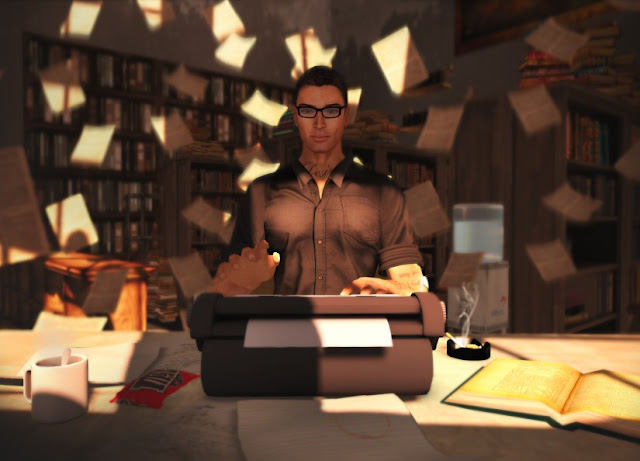
There’s plenty that’s already been written about the business of writing a 50,000 word novel in the thirty days of November – an annual act of insanity for the last ten years known as ‘National Novel Writing Month’, or just NaNoWriMo (the pedant in me – and it’s a considerable percentage of my personality, sadly – really wishes that could be changed to ‘International Novel Writing Month’ or even just ‘Novel Writing Month’; do we have to point out to America yet again that there are other countries in the world?). If you’ve previously completed or attempted this feat, or gone no further even than just registering at www.nanowrimo.org, you will no doubt have received plenty of emailed advice and be fully familiar with such constructs as ‘the Inner Editor’, that pesky critic inside you that deplores every last word you’ve written and stops you from getting any more than a few pages into any novel-length writing attempt. The Inner Editor is bad and must be silenced. If, on the other hand, you’re completely new to the process, have a nose around on the website for this advice: it’s definitely worth reading.
What leads me to think I have any sort of right to add to this accumulated wisdom? Only that I’ve produced a novel out of NaNoWriMo six times now. In 2006, 2007, 2008, 2009 and 2011 I completed my 50,000 words with a few extra to spare by 30 November, whilst last year I fell 10,000 words short but had the book finished by January. Without a doubt, NaNoWriMo has become part of my Autumn routine now and notdoing it would feel like not doing Christmas in December. I adore NaNoWriMo.
Over the years, I’ve come to certain conclusions about what things seem to work for me personally during November. They might not work for you. Here, in no particular order, are a few of them.
Write using a pseudonym
Writing anonymously is a liberating experience. A significant part of the inner editor’s sting is that nagging thought, “What will people who know me think about me writing this?” Adopting a pseudonym isn’t cart blanche to go into unnecessary graphic detail on that sex scene you’ve always secretly wanted to write – and it certainly shouldn’t be viewed as absolving you of all social responsibility for your text – but it might just be the thing that enables you to write something punchy and powerful rather than something safe and bland. Be bold. Be outrageous, if necessary. Don’t let worrying about how others see you paralyse your creativity.
Occasionally talk about your novel to someone
Actively talking about your plot to someone will bring it to life in a way that’s much harder to achieve if it remains only in your head. Find a friend and throw the topic into conversation over a beer or a coffee. You’ll be amazed at the new ideas that come to you from simply speaking aloud your ideas. What’s more, your friend doesn’t have to say a single word in reply; even if their eyes glaze over in boredom, even if they slip into a coma right in front of you, you’ll still find the act of talking it through helpful. If you’re writing anonymously, incidentally, the friend doesn’t necessarily need to know that you’re actually writing this story; you could introduce the plot as a hypothetical tale or perhaps the premise of something you read by someone else.
Connect to a NaNoWriMo community (but not too frequently)
Writing a novel is ultimately a solitary experience, even if you’re surrounded by people; if friends and family aren’t constantly having to repeat what they just said to you because your head’s immersed in the issue of what sort of one-liner your protagonist might use after beating up a bad guy then, quite frankly, you’re not doing it right. That said, knowing that others are going through the same sort of authorial highs and lows as you are can be immensely helpful to your mental wellbeing. Connecting to a group – as I do in Second Life® – should prevent you from sliding too far into the solipsistic delusion that your novel is the only reality and you and others around you are actually fictional characters. Talking with other novellers, however, should be done only in small measures. Spend too much time around them and you’ll start getting distracted by such non-important detail as how in God’s name they’ve managed that high a word count in so short a time.
Give yourself permission to write without knowing where your plot is going
The likelihood is you’re one of the millions upon millions of people who, as a child, were taught that stories have to be planned out in advance before you actually start writing them. They do not. Not only do they not, but plenty of bestselling novels have been written by writers who readily admit to pretty much making things up as they go along. There’s nothing wrong in having an idea in your head on how things are going to turn out in advance of day one, but if you find that the text starts taking you in a new direction, just go with it. In all my NaNoWriMos, I very rarely have any sort of a plan in mind before I start writing and only once have I had to delete a whole chunk of text because I decided this wasn’t the book I wanted to write (last year, as it happens; also one of the main reasons I was 10,000 words short by the end of the month). Remember: you can always edit once the month is up.
Track your progress using a spreadsheet
Time might be money during the other eleven months of the year, but for the thirty days of a novelling November, wasted minutes equals not generated word count. An inevitable consequence of this quantitative contest is the maths required each day in order to know whether or not you’re on target for the big 50k. If, like me, word count is something you check up on on a paragraph-by-paragraph basis, that adds up to a lot of time spent doing calculations which could be better spent doing writing or thinking about writing or any number of task-avoidance activities you’ve talked yourself into believing are in some way ‘for the good of the novel’. Save that time by using a NaNoWriMo spreadsheet. I constructed one myself several years ago (a task-avoidance activity that was for the good of my novel) and you can download it from http://huckleberryhax.blogspot.co.uk/2009/10/free-nanowrimo-progess-spreadsheet.html. Enter your word count into the current day’s cell and the spreadsheet will not only tell you how many words you’ve written that day, but also whether you’re in credit or debit for the overall project. It will even draw you a pretty graph. A hunt around the web will find you other, similar tools, but just think what better procrastination purposes you could put that time to.
Happy novelling!


